R E S E A R C H
Open Access
Load balancing algorithm by vertical handover
for integrated heterogeneous wireless networks
Mohammad Ali Pourmina
*and Navid MirMotahhary
Abstract
In this paper, an adaptive resource management scheme for hybrid WWAN/WLAN is proposed. Based on proposed joint velocity and average received power (ARP) estimation algorithms, a novel vertical handoff (VHO) for efficient load balancing in multitier network is developed. Simulation results show that proposed scheme achieves significant improvements over conventional schemes.
Keywords:mobility aware vertical handover, load balancing heterogeneous networks, power estimation
1. Introduction
Future wireless communication systems can be visualized as the integration of different radio access network (RAN) technologies, to provide always best connected. Heteroge-neous wireless networks (HWN) will give the service pro-vider, a chance to provide sufficient capacity, needed to support the temporally and spatially fluctuating traffic demands generated by mobile users. A practical benefit is that users can be served at lower cost and with the better quality of service (QoS). To support freedom of movement between HWNs and seamless roaming, several VHO man-agement architectures and decision-making algorithms have already been proposed [1]. These will allow full exploitation of flexible HWN infrastructure, resources, and services. Although individual radio resource manage-ment (RRM) schemes can be tuned to optimally perform within their respective RANs, they may not efficiently per-form in an HWN if the different RRM schemes are not properly managed. Hence, a major issue is how to jointly utilize the resources of the different RANs in an efficient manner while simultaneously achieving the desired QoS and minimizing the service cost from both user and ser-vice provider perspectives. In an integrated heterogeneous wireless network (IHWN), a mobile terminal (MT) is equipped with heterogeneous network interface, which is
called themultimodeterminal. When a multimode MT
generates or originates a new call in an IHWN, it can select connections among different types of the IHWN
based on network selection strategies. An active multi-mode MT can also change its connections among different types of IHWN. Such a process is called thevertical hand-off(VHO). Traditional handoff algorithms are based on link quality or estimate of ARP. However, this measure is not sufficient for VHO, and other factors like mobile user velocity, network condition, and user preferences should be considered. Also because of complex structure of next-generation networks, more precise and sophisticated method for link measurements is required. In mul-tipath channel, received signal strength (RSS) is consisted of three different phenomena (path loss, shadow fading, and fast fading). Because of MT mobility, multipath effect, and shadowing, the RSS has fluctuations, which make raw sig-nal strength an unstable criterion for triggering vertical and horizontal handoffs (HHOs). Shadowing, large-scale variation in path loss, is caused by obstacles in the propa-gation path between the MT and the base station (BS). The small-scale variation is due to the Doppler shift along the different signal paths and the time dispersion caused by the multipath propagation delays. As one primary indi-cator of channel quality, the power of the slowly varying shadow component is important for handoff decisions and power control. Most existing handoff algorithms assume that multipath fluctuations can be adequately filtered and base their handoff decisions on local mean power estimates [2,3]. Although these variations bring back uncertainty in the act of VHO decision making, they can be utilized to extract precious information about propagation environ-ment and mobility behavior of mobile user [4]. In order to mitigate these variations in RSS, efficient smoothing
* Correspondence: [email protected]
Department of Electrical Engineering, Science and Research Branch, Islamic Azad University, Tehran, Iran
too short, fluctuations may not be effectively removed, or if the interval is too long, it may cause delay in handoff pro-cedure, or in non-line of site (NLOS) scenarios, it can aver-age out useful information of corner’s positions. To fully exploit the capacity of the wireless channel, and to over-come ping-pong effect, an efficient power estimation method is required [5,6]. The ping-pong effect occurs if factors for VHO decision are changing rapidly and an MT performs the handoff as soon as it detects a more suitable BS. Because of heterogeneity, PHY and MAC layer of dif-ferent IHWN are difdif-ferent, so a unified approach must be taken into consideration for collection of specific measures from different networks. As a result, more sophisticated VHO algorithm is required to extend the throughput of multilayer network and to increase efficiency of resource management for next generation of HWNs. In this paper, utilizing an accurate joint velocity and ARP estimation algorithms, a novel VHO algorithm is proposed which can effectively be used for load balancing and internetwork ping-pong effect reduction in HWNs. Also based on Mar-kov model, an analytical model for performance evaluation of the VHO algorithm is proposed. This paper is organized as follows. Section 2 reviews related work on VHO algo-rithms. In Section 3, propagation model for an IHWN is introduced. In Section 4, proposed load balancing algo-rithm is discussed. VHO algoalgo-rithm analysis framework is described in Section 5. The performance of the proposed VHO algorithm is analyzed through a theoretical model and simulations based on probability of blocking and prob-ability of false network layer assignment in Section 6. Finally, paper is concluded in Section 7.
2. Previous works
Early works on VHO considered multitier homogeneous networks and used the RSS as the main factor of the hand-off decision-making process [7]. However, the VHO needs to be triggered considering a few more factors [8]. In [9], a VHO algorithm is proposed based on a assump-tion that a data call is kept in the higher bandwidth net-work as long as possible and voice calls are vertically handed over as soon as possible to avoid handoff delay. In [10], a network selection strategy that only considers mobile users’power consumption is introduced. To maxi-mize the battery life, the mobile user selects the uplink or downlink that has the lowest power consumption from all of the available networks. In [11], a policy-enabled net-work selection strategy is proposed, which combines sev-eral factors such as bandwidth provision, price, and power consumption. By setting different weights over different factors based on the user’s preference, a mobile user can connect to the most desired network. Reference [12] pre-sents a signaling protocol for the exchange of information between a network management system and intelligent
ment; some preliminary measurement works were done mainly between WLANs, general packet radio service (GPRS), and digital video broadcasting for terrestrials (DVB-T), but the described algorithms were very simple, and it did not present how such redistribution would be performed in detailed steps. Efforts on standardization of the VHO operation can be review on [13-15]. Although the above network selection strategies have their own advantages, they did not put much attention on system performance, such as the blocking probability of originat-ing calls and the forced termination probabilities of hori-zontal and VHO calls. They fail to address any ARP and also velocity estimation method in order to perform an accurate and seamless VHO. Also these have not consid-ered corner effect and effect of low SNR in cell bound-aries. In a homogenous environment, the ping-pong effect is a phenomenon that rapidly repeats HHOs between two BSs and can be mitigated by means ofdwell timer(DT) or hysteresis margin [16]. In a heterogeneous environment, the ping-pong effect occurs if factors for the VHO deci-sion are changing rapidly and an MT performs handoff as soon as the MT detects the better BS [17]. The DT scheme has been used to avoid such ping-pong effects due to the fact that RSS from HWNs is not comparable to each other [5,6]. The ping-pong effect can also occur if the MT’s speed is high or its moving direction is irregular. Therefore, the proposed VHO algorithm balances the traf-fic load in each network based on eftraf-ficient mitigation of inter-network ping-pong effect and also based on MT mobility behavior.
3. Propagation and noise model
The propagation model discussed here takes into account correlated multipath fading, correlated lognor-mal shadowing, and a distance dependant trend [18]. A discrete model (with the sampling rate of 1/2BW) for the received signal (RS),g[n], is given by
γ[n] =s[n].r[n] +η[n] (1)
where r[n] is the complex envelop due to multipath propagation and user mobility, which contains the mobile’s Doppler amplitude information ands[n] is ARP (local mean) at the MT and h[n] is AWG noise with zero mean and variance ofσ2
n which is added to the RS.
r[n], s[n], andh[n] are mutually independent. r[n] is defined by [4]
r[n] = √1 k
K
i=1
aiej(2πfdcos(θi)n+φi) (2)
where fd is the Doppler frequency, θi and ji are
distributed over (-π,π, aiis the gain ofith scatter andK
is the number of independent scatters; usuallyK= 20 is sufficient to provide good approximation). The processs
[n] is a wide-sense stationary lognormal random pro-cess, which contains distance-dependent trend and log-normal shadowing. We denote its mean and variance by
μs and σ2
s, respectively. Shadow fading process is
assumed to have the exponential correlation function proposed by [19] based on the measured autocovariance function of s[n] in urban environments. Path loss, (μs (d)) which is a mean of s[n], decreases monotonically
with distance from the BS. Let dc be the distance
between BS and intersection at which MT makes a turn. Following [4], dimensionless parameter x0, the distance parameters xc, y0, yc and exponentsζ, h, c are intro-duced. Corner effect could cause ΔSdB signal drop, in
y0meters.P0 is a constant that accounts for transmitted power and antenna gain. Path loss for microcellular structure at positiondis modeled by
μs(d) =
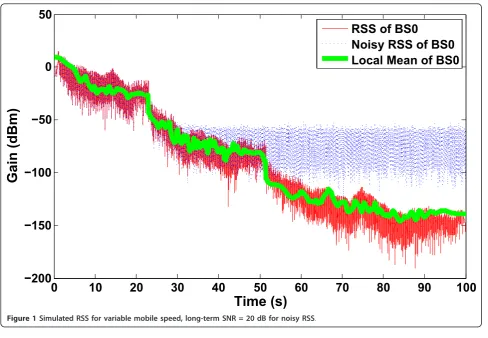
To suppress noise and interference terms, g[n] is passed through a unit-gain, square-root raised cosine lowpass filter with a bandwidthBW>fmax, since we are only interested in the Doppler power spectrum, which is narrowband and variable (0- fmax(Hz)) in microcellular structure.fmax is maximum possible Doppler frequency of channel. An example of RSS in a microcellular envir-onment is plotted in Figure 1, for variable mobile speed when long-term SNR is 20 dB. As it is seen, short-term SNR is high near base stations. Long-term SNR is plotted for 100 s observation.
4. Proposed traffic load balancing algorithm Knowledge of MT’s position and velocity plays an impor-tant role on offering efficient network controlling mechan-isms and variety of offered services in IHWNs. Mainly in IHWNs structure, WLANs have less coverage than WWAN, so a reliable mobility tracking algorithm is desir-able to reduce the number of handoffs and waste of band-width due to unnecessary signaling. Researches about MT speed estimation are divided into two different groups. First one uses statistics of RSS from different BSs
characteristics. In particular, errors in the estimates could propagate due to suboptimal observation windows. A joint velocity and power estimator are proposed in this paper to calculate mobility behavior of ma-noeuvering MT in dense urban area also to mitigate fluctuations of RSS in order to minimize number of VHOs and simultaneously assign dif-ferent service requests and MTs efficiently to difdif-ferent net-works in a IHWN. This in turn can minimize probability of blocking and probability of false network assignment.
4.1. Joint velocity and average received power estimation In HWNs in order to reduce number of VHOs state of velocity plays an important role in classification of MTs, therefore our proposed method in [4] is modified in such a way that state of velocity is determined in real time for act of VHO decision making. Due to time-varying nature of communication channel, the signal properties include (amplitude, frequencies, and phases) will change with time. Thus, we utilized time-dependent Fourier trans-form also referred to as the short-time Fourier transtrans-form to estimate power spectral density (PSD) of RS by using DFT of finite-length segments of the RS, obtained by banks of rectangular filters such that, each filter has dif-ferent duration. The N-DFT of segmented RS,gi[n], is
Vi[k] = N−1
n=0
wi[n]γ[n]e
−j2πn
N k (4)
wherewi[n] is theith window with the lengthLi. An estimate of PSD (called periodogram) would be
PSDi(ωk)≈ 1 LiF{|
Vi[K]|2} (5)
where ωK=
2πK
N for K = 0, 1,..., N - 1. It is well known that fast-moving MTs cause high Doppler spread while slow-moving MTs cause low Doppler spread. Therefore, the shift in local maxima of estimated period-ogram (PSD) is related to maximum Doppler frequency, which is proportional to the mobile speed(νˆ ∝ ˆfd.λ)in whichυˆiis estimated speed underith window andlis wavelength [4].
ˆ
υi∝arg Max
ω {PSDi(ω)} (6)
As it is seen in Figure 2, increase in velocity can be interpreted as a Doppler spread in frequency domain. Thus, the mobile velocity can be obtained from esti-mated Doppler spread. First, the estiesti-mated PSD is
0
10
20
30
40
50
60
70
80
90
100
−
200
−
150
−
100
−
50
0
50
Time (s)
G
ain
(dBm
)
RSS of BS0
Noisy RSS of BS0
Local Mean of BS0
normalized to estimate fˆdthen due PSD symmetry, PSD is folded (folded PSD is plotted in Figure 2). Bandwidth of PSD is detected which is proportional to Doppler spread. In order to find the relative velocity of user, we classify user’s mobility model into two classes, pedes-trian and fast. As a result, only two segments (subsets) of frequency domain of estimated PSD are going to be considered as regions of interest, and fˆdextraction is done only in these two segments. In proposed algo-rithm, maximum is searched only in pedestrian subset of estimated PSD of RS, which limits search space and as a result increases estimation speed. The ARP (RS local mean) is estimated based on a fact that slow fading and path loss have slow variations while MT is manoeu-vering in coverage area; therefore, they are present only in DC component of the estimated PSD of the RS. For manoeuvering MT, the duration of observation window must be constantly adapted, and the rate of adaptation is critical on performance of speed and power estima-tors [18]. DC component of estimated PSD is adaptively extracted from different filters
ˆ
Si≈ 1 LitF|
Vi(ejω)|2|ω=0 ≈ 1 LitF
Li−1
n=0
wi[n]P[n]
2
(7)
whereŝiis the estimated ARP,Liis window length,Δt
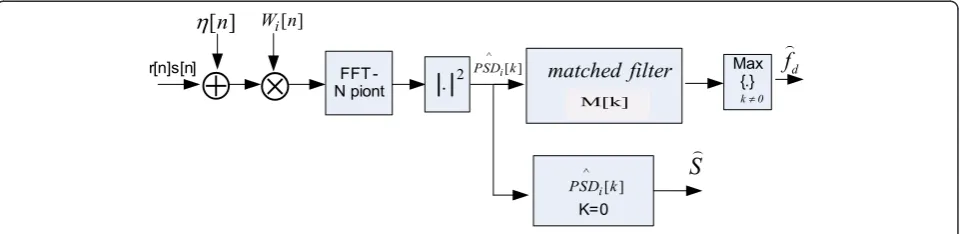
is sampling interval, andF is normalization factor [4]. Active smoothing window is switched to another win-dow in which duration is selected proportional to inverse of estimated velocity for any iteration. The sche-matic of joint ARP and velocity estimator is shown in Figure 3. Bias and variance of proposed local mean esti-mator power are given in Appendix A.
4.2. Load balancing by VHO algorithm
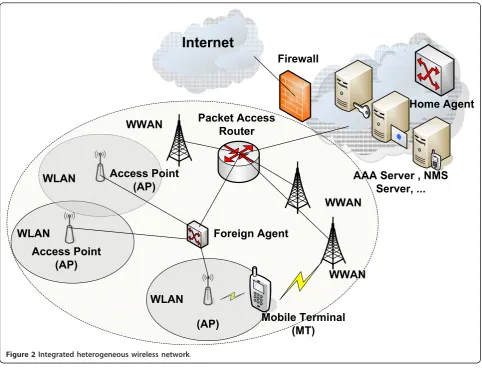
As it is mentioned in previous section, due to heteroge-neity of integrated networks, measurements of each net-work cannot be compared directly to other netnet-works, so hysteresis method [10,11] cannot be utilized in VHO algorithm. Thus, thresholding technique is considered in this paper. In HWN structure shown in Figure 4, each network shall have its own thresholds. Also due to the fact that requirements of load balancing in each network
Internet
Packet Access
Router
WLAN
Access Point
(AP)
Access Point
(AP)
(AP)
WLAN
WLAN
WWAN
WWAN
WWAN
Mobile Terminal
(MT)
Foreign Agent
Firewall
Home Agent
AAA Server , NMS
Server, ...
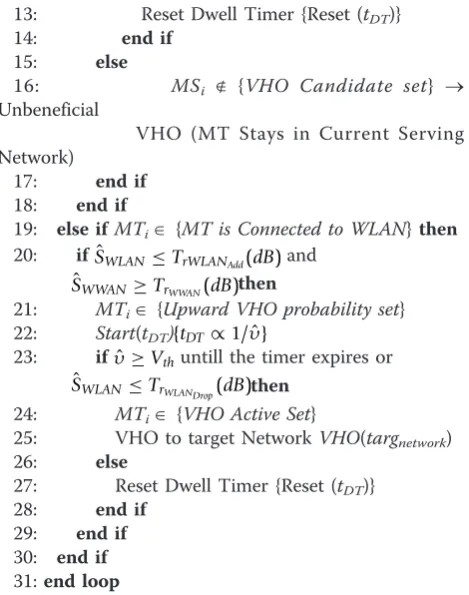
are different, so proposed algorithm is divided into 2 sections, (1) Downward VHO from WWAN to WLAN and (2) Upward VHO from WLAN to WWAN. In defined scenario, HHOs are only between BSs of WWAN network due to limitations of coverage that WLAN access points have. HHO algorithm utilizes joint velocity and ARP estimator in the act of HHO decision making. Proposed HHO is based on using hysteresis margin method [22] in addition to DT which is calcu-lated based on inverse of velocity estimates. Block dia-gram of proposed VHO algorithm is shown in Figure 5. First, velocity and RS local mean are estimated from raw RSS. Values and thresholds used in the VHO decision making are also calculated and updated periodically. The proposed load balancing algorithm selects a net-work based on specifications of each netnet-work. Algo-rithm 1 illustrates VHO algoAlgo-rithm. According to Algorithm 1 in order to reduce the effect of velocity estimation error on accuracy of VHO decision making,
average of the all the velocity estimates during dwell time period is considered as a velocity estimate to clas-sify MT as pedestrian or fast. The idea of utilizing 2 thresholds for adding MT to the list of upward VHO candidates solves the problem of lack of accuracy in sce-narios that slow manoeuvering MT are bouncing inside and outside of cell boundary. Benefits gained from knowledge of user real velocity are to reduce ping-pong effect caused by mobility behavior of MTs, and idea of using adaptive DT ((tDT∝1/υˆ)) velocity lack of ability to use hysteresis methods for HWNs and in addition to novel proposed ARP method mitigates ping-pong effect caused by fluctuations and RSS due to fading.
5. VHO algorithm analysis
Due to the fact that in VHO (HHO) algorithms, deci-sion making on target network (cell) is based on present and previous step states, Markov model can be used for modeling and calculation of probability of transition in
0
100
200
300
400
500
0
0.2
0.4
0.6
0.8
1
Frequancy (Hz)
N
orma
lize
d
P
ower
D
ens
ity
F
unct
ion
Estimated PSD for v= 0 km/h
Estimated PSD for v= 108km/h
Doppler Spread
Figure 3Folded PSD which shows Doppler spread for different velocities.
r[n]s[n] FFT
-N piont
[ ]
n
K
W ni[ ]^
[ ]
i
PSD k
2 .
Max {.}
f
dk 0z
[ ]
matched filter
W k
K=0 ^
[ ] i
PSD k
S
M[k]
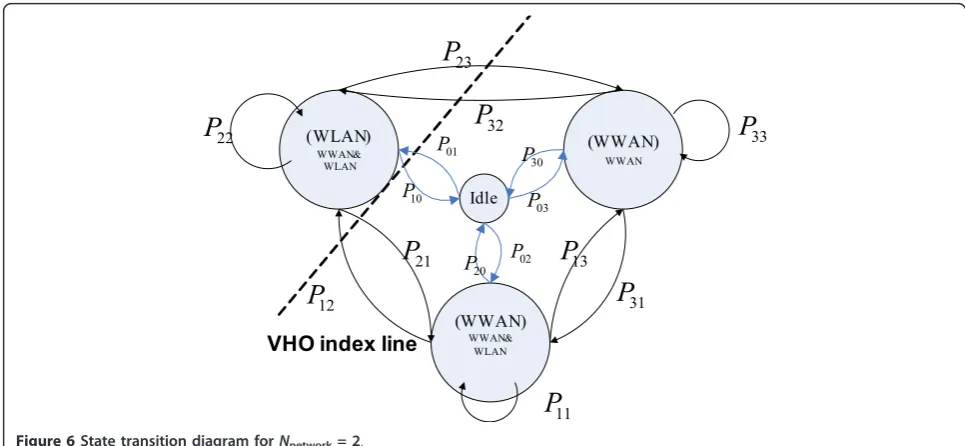
each state. For the given system model of Figure 4, a user in the system can be in one of theNstates defined as follows
Nstate= 1 +
Nnetwork−1
i=0
Nnetwork−i (8)
In case of 2 integrated networks, we have
• State0) The user has no active session in progress and is not occupying any channel (i.e., the user is idle), independent of its location.
• State1) The user in the WLAN coverage area is
occupying the WWAN resource.
• State2) The user in the WLAN coverage area is
occupying the WLAN resource.
• State3) The user in the out of WLAN coverage
area is occupying the WWAN resource.
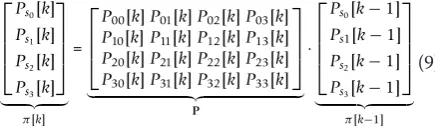
Figure 5 shows the user state transition diagram for the 2 network system models, where Psi[k] shows ith steady-state probability at kth moment and Pij [k] denotes the transition probability from stateito state j,
i, jÎ 0, 1, 2,..., Nstate, and state transition probability matrixPis given by
⎡
Based on Algorithm 1, a user can change state from state0 to any nonzero state when a new connection is made. If a session is completed while a user is currently in a nonzero state, the user changes to state0. The Mar-kov chain depicted in Figure 5 is irreducible and aperio-dic, and all the states are recurrent nonnull, so that the equilibrium state probabilities can be determined by sol-ving the (9), subject to the normalization condition
Nstate
i=0 Psi= 1; however, the expressions for the transition probabilities remain to be determined; these form the topic of discussion in the succeeding sections.
5.1. Service model
The service model relies on four assumptions.
1. Due to wide coverage that WWAN has, we assume that probability of MT being inside the
cov-erage area of WWAN, PWWAN = 1 and as the
cover-age area of WLAN is subset of WWAN; it is clear thatPWLAN< 1.
2. New calls arrive in the macrocell and microcell according to a Poisson process with mean arrival rateslWWandlWL, respectively. A new call is ran-domly determined as the real time (RT) and non-RT (NRT) calls with probabilitiesPrtand Pnrt, respec-tively. Similarly, a call is also independently deter-mined as a low (high)-bandwidth application with probability Pbwl(Pbwh). Clearly, Prt + Pnrt = 1 and Pbwl+Pbwh= 1
Algorithm 1Proposed VHO algorithm
1:loop
2: ifMSiÎ{MSi|Connected to WWAN}then
3: ifSˆW L A N≥TrW L A N(dB)}then
4: MSiÎ{Downward VHO probability set}
5: ifυˆ ≤Vththen
6: MTiÎ{Pedestrain Class}and MTiÎ
{VHO Candidate set} 7: Start(tDT){tDT ∝1/υˆ}
11: VHO to target Network
VHO(targnetwork)
12: else
14: end if
15: else
16: MSi ∉ {VHO Candidate set} ®
Unbeneficial
VHO (MT Stays in Current Serving Network)
17: end if
18: end if
19: else ifMTiÎ {MT is Connected to WLAN}then
20: ifSˆWLAN ≤TrWLANAdd(dB)and ˆ
SWWAN≥TrWWAN(dB)then
21: MTiÎ {Upward VHO probability set} 22: Start(tDT){tDT ∝1/υˆ}
23: ifυˆ ≥Vthuntill the timer expires or ˆ
SWLAN≤TrWLANDrop(dB)then 24: MTiÎ{VHO Active Set}
25: VHO to target NetworkVHO(targnetwork)
26: else
27: Reset Dwell Timer {Reset (tDT)}
28: end if
29: end if
30: end if
31:end loop
3. Call duration Tcallis exponentially distributed with a mean of 1/μ, where μis the average call comple-tion rate. Hence, the call complecomple-tion (terminacomple-tion) probability Pterm =P (Tcall≤Tth), whereTth is the time unit for the user state transition diagram, as shown in Figure 5.
4. From Nstate
i=0 Psi= 1, it is clear that for scenario depicted in Figure 5. PWWAN=Ni=0statePsiandPWLAN =Ps0+Ps1+Ps2= 1 -Ps3.
based on the service model, the transition probabilities areP10=P20=P30=Pterm. For exponentially distributed interarrival timeTarwith a mean of 1/ln(ln=lWW+ lWL), the new call arrival probability within the next time unit isPnew=P(Tar≤Tth). Also, it is clear thatP10=Pnew
arrival. The probability of a new call arrival in the WLAN areaPnew WLand the probability of a new call arrival in the WWAN areaPnew WWcan be written as follows
Pnew WL=Pnew×PWLAN (10)
and
Pnew WW=Pnew×PWWAN (11)
5.2. State transition probabilities for VHO
As it is shown in Figure 5, VHO probability can be deter-mined by state probabilities crossed by VHO index line
VHO s1 − 12 s2 − 21
+Ps2[k−1]P23[k] +Ps3[k−1]P32[k]
(12)
According to list of states, each state consists of set of events (Si)(e.g., each network hasNcelliBSs, so
probabil-ity of being in any state can be determined based on probability of being connected to any of cells inside net-work coverage area). Hence,
Psi[k] = NCelli
l=1
Psil[k] (13)
whereSi={Si1, ...,SiNCelli}{∀i,l|iÎ {1,...Nstate} andlÎ {1,..., Ncelli}}, and Psil[k] is probability of occupying
resources of tth BS from ith network at the kth
moment. State transition probabilities can be defined as follows
pij[k] =P{Si[k]|Sj[k−1]}= Ncell
l=1
P{Sil[k]|Sjl[k−1]}(14)
each P{Sil [k]|Sjl[k- 1]} will be determined based on predefined VHO algorithm. Before further discussion on how to determine conditional probability of transi-tion between events in HWN, it is worth mentransi-tioning that based on scenario, some simplifications are
possi-ble in transition matrix (P) determination. For
instance, state transition from state3 to state2 is not feasible directly, because if a user out of WLAN cover-age area intends to change state to state2 which is occupying resources of WLAN, first it must change state to state1 which is entering into coverage area of WLAN and then it would be feasible to switch to state2 so for anyk, we have
P32[k] =P{S21[k]|S31[k−1]}
=P{S22[k]|S32[k−1]}=P{S23[k]|S33[k−1]}= 0
(15)
because in proposed VHO algorithm, upward and downward VHO are different; thus for each scenario, equations must be calculated separately. VHO criteria (estimated velocity and ARP) are prepared according to Figure 6, and clearly, velocity and ARP estimates are independent. Event of presence of user in state1 and
downward VHO to WLAN at thekth moment is
S2[k]S1[k−1]
=SˆWLAN[k]>TWLAN,V[k]≤Vth|S1[k−1]
=SˆWLAN[k]>TWLAN,|S1[k−1]
×
V[k]≤Vth|S1[k−1]
=SˆWLAN[k]>TWLAN|S1[k−1]
and corresponding state transition probability is as fol-lows
P12[k] =P
S2[k]|Sl[k−1]
=PSˆWLAN[k]>TWLAN|Sl[k−1]
×P{V[k]≤Vth}
=
PSˆWLAN[k]>TWLAN|Sl[k−1]
P{Sl[k−1]} ×P{V[k]≤Vth}
(17)
whereP{Sl[k- 1]} is given by
P{Sl[k−1]}=
PSˆWWAN[k−1]>TrWWAN,SˆWLAN[k−1]≤TrWLAN
×P{V[k−1]>Vth}
(18)
It should be noted that because RSS from different networks cannot be compared to each other, they can be considered as independent variables. Hence,
P12[k] =P{V[k]≤Vth}
×P
ˆ
SWLAN[k]>TWLAN,SˆWLAN[k−1]≤TWLAN
P{ˆSWLAN[k−1]≤TWLAN}
(19)
After a few simplifications, upward VHO to WWAN at thekth moment is given by
P23[k] =P
ˆ
SWWAN[k]≥TWWAN
⎡
⎣P
ˆ
SWLAN[k]≤TAdd,WLAN,SˆWLAN[k−1]≥TWLAN
PSˆWLAN[k−1]≥TWLAN
×P{V[k]>Vth}
+
PSˆWLAN[k]≤TDrop,WLAN,SˆWLAN[k−1]≥TWLAN
P
ˆ
SWLAN[k−1]≥TWLAN
⎤ ⎦
×P{V[k]≤Vth}
(20)
Other transition probabilities can be determined like-wise. To calculate a close form for transition probabil-ities, it is required to calculate joint and conditional PDF of RSS which is given in Appendix B.
6. Performance evaluation
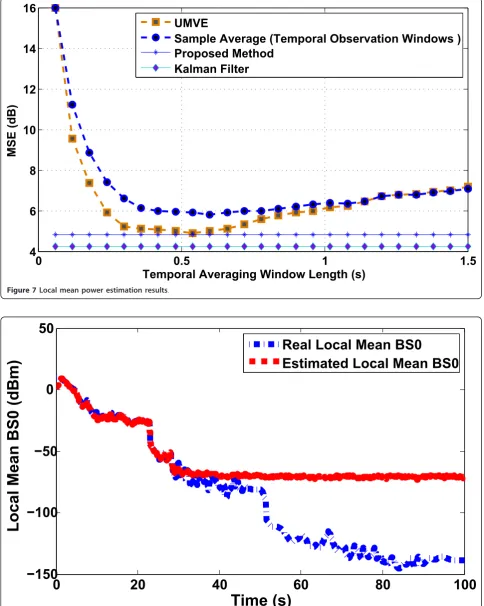
This section presents numerical results that demonstrate the network-level performance of an HWN comprising mobile WIMAX and IEEE 802.11 WLAN RANs. Prob-ability of blockage in WLANs and WWANs and prob-ability of false load balancing based on velocity and ARP estimates are considered as performance criteria. Users are distributed uniformly in simulation area (Manhattan area). Mobility behavior of MTs is considered according to mobility profile proposed in [4]. Performance of pro-posed ARP estimation algorithm is compared to WBEs, like sample average (SA), uniformly minimum variance unbiased (UMVU) estimator, and Kalman-based method discussed in [21]. As it is seen in Figure 7, proposed local mean power estimator shows less MSE than win-dow-based methods, although Kalman-based method shows better performance but requires large number of transmitted messages and heavy calculations so that sig-nal strength variations can be filtered out. In Figure 8, estimated local mean power based on proposed method is plotted. Performance of proposed load balancing algo-rithm has been investigated in the case that total call arrival rate and the ratio of the fast to the slow traffic vary. For example, assume that the total call arrival rate to a WWAN and its embedded WLANs is 1,500 calls/h, and the ratio of the fast traffic to the slow traffic is 2:1. Then, the call arrival rate of fast traffic is 1,000 calls/h and the slow traffic is 500calls/h. The traffic load on the
(WLAN) WWAN&
WLAN
(WWAN) WWAN&
WLAN
(WWAN) WWAN
11
P
33
P
22
P
P
3223
P
12
P
21
P
P
1331
P
VHO index line
Idle 30
P
03
P
02
P
20
P
10
P
01
P
0
0.5
1
1.5
4
6
8
10
12
14
16
Temporal Averaging Window Length (s)
M
S
E
(dB
)
UMVE
Sample Average (Temporal Observation Windows )
Proposed Method
Kalman Filter
Figure 7Local mean power estimation results.
0
20
40
60
80
100
−
150
−
100
−
50
0
50
Time (s)
Local Mean B
S
0
(dBm
)
Real Local Mean BS0
Estimated Local Mean BS0
Figure 8MSE of local mean estimation versus averaging window length,v= 20 km h-1,
Xc= 10 m, shadowing varianceσs2= 6 dB,
WWAN is 140 calls/h, and the load on each WLAN is 136 calls/h, which consists of 86 calls/h for fast and 50 calls/h for slow. From these assumptions, the actual call arrival rates to the WWAN and each WLAN are given by
λWW= 140(1−PeWL+ 860PeWW)
and
λWL= 364PeWL+ 86(1−PeWW)+ 50 (21)
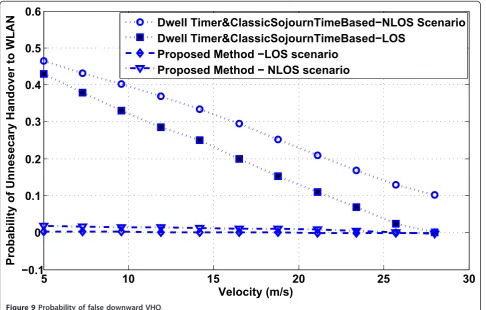
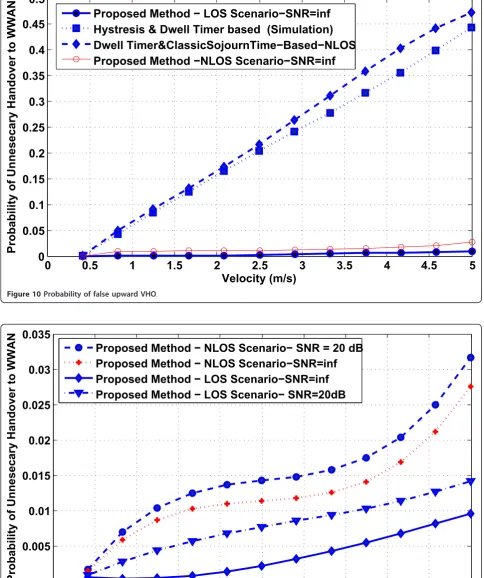
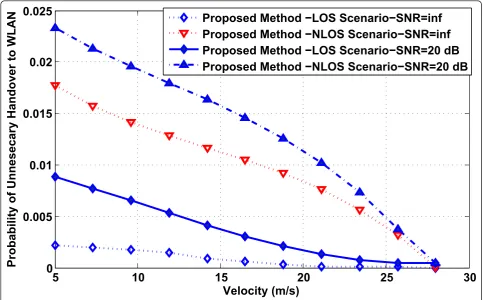
wherePeWWis the probability that slow user is allo-cated to WWAN, which gives arise to shortage in macrocell capacity, andPeWL is probability that the fast user is allocated to WLAN, which causes increase in number of hand-offs. Speed threshold is consideredVth = 5 m/s. As it is demonstrated in Figure 9 and 10, in both LOS and NLOS scenarios, due to efficient load bal-ancing based on mobility behavior of MTs and network conditions, probability of false VHO to WWAN and WLAN (i.e., two consecutive VHOs within a short dura-tion for a roaming call in the hot-spot area or a very short WLAN session before the user moves out of the hot-spot area) is efficiently reduced. Effect of low SNR
on proposed method is plotted in Figure 11 and 12 for upward and downward VHO, respectively. Because of robustness of proposed method even in low SNR sce-narios, load balancing is done effectively. In Figure 13 and 14, blocking probability is plotted versus different call arrival rate (from 500 calls/h to 2,000 calls/h) for each layer with ln = 0.4 and 1/l = 120s. Figure 13 shows that blocking probability is effectively decreased in WWANs due to more efficient load balancing, and as a result, blocking probability is increased in WLAN (Fig-ure 14), which shows more WLAN resource utilization due to more efficient load balancing. For better demon-stration, blocking probability in WLAN and WWAN is plotted in Figure 15 and 16 versus specific arrival traffic with variable ratio of slow traffic, respectively. As it is shown in Figure 15, when number of slow MTs is increased, blocking probability is decreased in WWAN and as a result for WLAN as it is plotted in Figure 16, there is a small increase in blocking probability.
7. Conclusion
This paper proposed a load balancing scheme that mini-mizes the VHO rate while achieving the desired service
5
10
15
20
25
30
−
0.1
0
0.1
0.2
0.3
0.4
0.5
0.6
Velocity (m/s)
Probability o
f Unnesecary Handover to WLAN
Dwell Timer&ClassicSojournTimeBased
−
NLOS Scenario
Dwell Timer&ClassicSojournTimeBased
−
LOS
Proposed Method
−
LOS scenario
Proposed Method
−
NLOS scenario
0
0.5
1
1.5
2
2.5
3
3.5
4
4.5
5
0
0.005
0.01
0.015
0.02
0.025
0.03
0.035
Velocity (m/s)
Probability o
f Unnesecary Handover to WWAN
Proposed Method
−
NLOS Scenario
−
SNR = 20 dB
Proposed Method
−
NLOS Scenario
−
SNR=inf
Proposed Method
−
LOS Scenario
−
SNR=inf
Proposed Method
−
LOS Scenario
−
SNR=20dB
Figure 11Probability of false upward VHO, SNR = 20 dB.
0
0.5
1
1.5
2
2.5
3
3.5
4
4.5
5
0
0.05
0.1
0.15
0.2
0.25
0.3
0.35
0.4
0.45
0.5
Velocity (m/s)
Probability o
f Unnesecary Handover to WWAN
Proposed Method
−
LOS Scenario
−
SNR=inf
Hystresis & Dwell Timer based (Simulation)
Dwell Timer&ClassicSojournTime
−
Based
−
NLOS
Proposed Method
−
NLOS Scenario
−
SNR=inf
500
1000
1500
2000
0
0.05
0.1
0.15
0.2
0.25
0.3
0.35
Total Call Arrival Rate (Calls/h)
Bl
oc
ki
ng
P
ro
b
abili
ty
in
WWAN
Proposed Method
Classic Sojouron Time Based (LOS)
Classic Sojouron Time Based (NLOS)
Figure 13Blockage probability in WWAN, LOS and, NLOS scenarios.
5
10
15
20
25
30
0
0.005
0.01
0.015
0.02
0.025
Velocity (m/s)
Probability o
f Unnesecary Handover to WLAN
Proposed Method
−
LOS Scenario
−
SNR=inf
Proposed Method
−
NLOS Scenario
−
SNR=inf
Proposed Method
−
LOS Scenario
−
SNR=20 dB
Proposed Method
−
NLOS Scenario
−
SNR=20 dB
10
20
30
40
50
60
70
80
90
0
0.05
0.1
0.15
0.2
0.25
0.3
0.35
Traffic Rate of pedestrain users (%)
Bl
oc
ki
ng
P
ro
b
abili
ty
in
WWAN
Proposed Method (LOS and NLOS cenario)
Classic Sojouron Time Based (NLOS)
Classic Sojouron Time Based (LOS)
Figure 15Blockage probability in WWAN for different number of pedestrian users in LOS and NLOS scenarios.
500
1000
1500
2000
−
0.01
0
0.01
0.02
0.03
0.04
0.05
0.06
Total Call Arrival Rate (Calls/h)
Blocking Probability in WLAN
Proposed Method (LOS and NLOS scenario)
Classic Sojouron Time Based (LOS)
Classic Sojouron Time Based (NLOS)
quality (i.e., low call blocking probabilities) for highly dense urban area. The performance of the proposed scheme was analyzed via user level Markov chains. Numerical results show that the proposed scheme achieves low VHO rate and low call blocking probability in comparison with the currently existing service-based and sojourn time-based load balancing schemes. Results show that, under different mobility conditions, the pro-posed scheme exhibits more recourse utilization in
inte-grated networks while achieving low blocking
probability in highly dense urban area. Based on these results, it is concluded that the proposed scheme exhi-bits a good service quality and, hence, serves as a viable alternative for practical IHWN deployment.
Appendix A. Derivation of bias and MSE for proposed ARP estimator
If shadowing is assumed to be constant over the length of temporal windows (LTW) and also if shadowing and mul-tipath fading are considered to be independent, from (4)
E[Sˆi] = lim Li→∞
EVi
ejω·Vi∗ejω LitF
ω=0
(22)
E[Sˆi] = 1 LitF
Li−1
n=0 Li−1
n=0
We−jω(n−m)E{s[n]s∗[m]}
× E
k−1
i=0 k−1
z=0
ej(ωdcosθin+φi)e−j(ωdcosθzm+φz)
ω=0
Considering the fact that shadowing has small varia-tions over the LTW (W=w[n]w*[m] andEs{s[n]s*[m]} = ss), then
E[Sˆi] = σs LitF
lim Li→∞
Li−1
n=0 Li−1
n=0 J0
ωd(n−m)
×We−jω(n−m) ω=0 = lim
Li→∞
Gi(ω)∗wi(ω) 2!
ω=0
(23)
whereGi(0) and Wi(0) are DC component of RSS PSD and rectangular window, respectively, and * refers to convolution. Equation (23) shows that if LTW approaches to infinitum in time domain, in frequency domain it approaches to Kronecker delta functionδ[·], and as a result, the periodogram estimation error approaches to zero. Assume that window magnitude is
10
20
30
40
50
60
70
80
90
4
5
6
7
8
9
10
11
12
x 10
−3
Traffic Rate of pedestrain users (%)
Bl
oc
ki
ng
P
ro
b
abili
ty
in
W
L
AN
Proposed Method (LOS and NLOS)
Classic Sojouron Time Based (NLOS)
Classic Sojouron Time Based (LOS)
we find a closed form for bias and variance of proposed ARP estimator, as followsS
ˆ
where CWW[m] is autocorrelation function (ACF) of rectangular window. Thus, window ACF can be deter-mined as
After substitution in (25), bias can be calculated as fol-lows.
In order to calculate variance of local mean estimates,
4th moment of RSS is calculated. When LTW
approaches infinity, the 4th moment of most of stochas-tic processes will approach to Gaussian process, and for a Gaussian process, it can be calculated based on
with ACF equals to J20(ωdKt)[16]. Thus for RSS which is a Gaussian process, it can be shown that EX2=σx2+X
A lower bound for variance of proposed local mean power estimator can be determined as follows (from (28))
Var(S)ˆ ≤σs2
Appendix B. Derivation of joint and conditional PDF of received signal estimates
Due to the fact that RS estimates Ŝ dB have Gaussian
distribution, joint fSˆk−1,ˆSk Sˆk−1,Sˆk
!
and fSˆk|,Sˆk−1 Sˆk|ˆSk−1
!
PDF of each event will be Gaussian. Let
E{ˆS[k−1]}=μsˆ[k−1], Var{ˆS[k−1]}=σSˆ[k−1], E{ˆS[k]}=μSˆ[k],
P
wherex0is correlation distance of local mean power andxavis smoothing window length. From above, tran-sition probabilities can be determined, for instance p23 [k] is
The authors declare that they have no competing interests.
Received: 23 February 2011 Accepted: 16 January 2012 Published: 16 January 2012
References
1. IF Akyildiz, J Xie, S Mohanty, A survey of mobility management in next-generation all-IP-based wireless systems. IEEE Trans Wirel Commun.11(4), 16–28 (2004). doi:10.1109/MWC.2004.1325888
2. SN Enrique, YX Lin, WSW Vincent, An MDP based vertical handoff decision algorithm for heterogeneous wireless networks. IEEE Trans Veh Technol.
57(2), 1243–1254 (2008)
3. W Shen, QA Zeng, Cost-function-based network selection strategy in integrated wireless and mobile networks. IEEE Trans Veh Technol.57(6), 3778–3788 (2008)
4. N Mirmotahhary, A Kohansal, H Zamiri-Jafarian, M Mirsalehi, Discrete mobile user tracking algorithm via velocity estimation for microcellular urban environment. inIEEE Vehicular Technology Conference, Singapore2631–2635 (May 2008)
5. M Ylianttila, M Pande, J Makela, P Mahonen, Optimization scheme for mobile users performing vertical handoffs between IEEE 802.11 and GPRS/ EDGE networks, inIEEE Global Telecommunication Conference, San Antonio, TX, (December 2001)
6. R Hsieh, ZG Zhou, A Senevirante, S-MIP: A seamless handoff architecture for mobile IP, inIEEE International Conference on Computer CommunicationSan Francisco, CA, (April 2003)
7. GP Pollini, Trends in handover design. IEEE Commun Mag.34(3), 82–90 (1996). doi:10.1109/35.486807
8. N Mirmotahhary, Y Mafinejad, F Atbaei, A Kouzani, An adaptive policy-based vertical handoff algorithm for heterogeneous wireless networks, inIEEE 8th International Conference on Computer and Information Technology, Sidney, pp. 188–193 (July 2008)
9. Q Zhang, C Guo, Z Guo, W Zhu, Efficient mobility management for vertical handoff between WWAN and WLAN. IEEE Commun Mag.41(11), 102–108 (2003). doi:10.1109/MCOM.2003.1244929
10. N Nam, N Choi, Y Seok, Y Choi, WISE: energy-efficient interface selection on vertical handoff between 3G networks and WLANs. IEEE Int Symp Pers Indoor Mobile Radio Commun 692–698 (July 2004)
11. H Wang, R Katz, J Giese, Policy-enabled handoffs across heterogeneous wireless networks. inIEEE Workshop on Mobile Computing Systems and Applications51–60 (1999)
12. Xiaodong Yang, Thomas OwensJ, Intersystem soft handover for Converged DVB-H and UMTS Networks. IEEE Trans Veh Technol.57, 1887–1898 (2008) 13. G Lampropoulos, C Skianis, P Neves, Optimized Fusion of Heterogeneous
Wireless Networks based on Media Independent Handover Operations. IEEE Wirel Commun Mag.17(4), 78–87 (2010)
14. N Dimitriou, L Sarakis, D Loukatos, G Kormentzas, C Skianis, Vertical handover framework for future collaborative wireless networks, Int J Netw Manag, (Wiley)
15. WF El-Sadek, MN Mikhail, Universal mobility with global identity (UMGI) architecture. IEEE International Conference on Wireless Networks and Information Systems, WNIS 09 Los Alamitos389–394
16. N Zhang, J Holtzman, Analysis of handoff algorithms using both absolute and relative measurements. in44th IEEE Vehicular Technology Conference
82–86 (September 1994)
17. Y Chung, DJ Lee, DH Cho, BC Shin, Macrocell/microcell selection schemes based on a new velocity estimation in multi-tier cellular system. IEEE Trans Veh Technol.51(5), 893–903 (2002). doi:10.1109/TVT.2002.801764 18. R Narasimhan, DC Cox, Estimation of mobile speed and average received
power in wireless systems using best basis methods. IEEE Trans Commun.
49(12), 2172–2183 (2001). doi:10.1109/26.974264
19. D Wong, DC Cox, Optimal local mean signal power level estimator for rayleigh fading environments. inIEEE International Conference on Information, Communications Signal Processing1701–1704 (September 1997) 20. KDA Appiah, On generalized covariance-based velocity estimation IEEE
Trans. Veh Technol.48, 1546–1557 (1999). doi:10.1109/25.790529 21. T Jaing, ND Sidiropulos, G Giannakis, Kalman filtering for power estimation
in mobile communications. IEEE Trans Wirel Commun.2(1), 151–161 (2003). doi:10.1109/TWC.2002.806386
22. AE Leu, BL Mark, An efficient timer-based hard handoff algorithm for cellular networks. inIEEE Wireless Communication and Networking Conference
1969–1974 (March 2003)
23. A Papoulis, SU Pillai,Probability, Random Variables and Stochastic Processes, 4th edn. (McGraw-Hill, New York, 2002)
doi:10.1186/1687-1499-2012-14
Cite this article as:Pourmina and MirMotahhary:Load balancing algorithm by vertical handover for integrated heterogeneous wireless networks.EURASIP Journal on Wireless Communications and Networking