Volume 2011, Article ID 837209,19pages doi:10.1155/2011/837209
Research Article
CS-DRM: A Cloud-Based SIM DRM Scheme for Mobile Internet
Chaokun Wang,
1, 2, 3Peng Zou,
1Zhang Liu,
4and Jianmin Wang
1, 2, 31School of Software, Tsinghua University, Beijing 100084, China
2Key Laboratory for Information System Security, Ministry of Education, Beijing 10084, China
3Tsinghua National Laboratory for Information Science and Technology (TNLIST), Beijing 100084, China 4Department of Computer Science and Technology, Tsinghua University, Beijing 100084, China
Correspondence should be addressed to Chaokun Wang,[email protected]
Received 2 June 2010; Revised 8 September 2010; Accepted 26 October 2010
Academic Editor: Damien Sauveron
Copyright © 2011 Chaokun Wang et al. This is an open access article distributed under the Creative Commons Attribution License, which permits unrestricted use, distribution, and reproduction in any medium, provided the original work is properly cited.
With the rapid development and growth of the mobile industry, a considerable amount of mobile applications and services are available, which involve Internet scale data collections. Meanwhile, it has a tremendous impact on digital content providers as well as the mobile industry that a large number of digital content have been pirated and illegally distributed. Digital Rights Management (DRM) aims at protecting digital contents from being abused through regulating their usage. Unfortunately, to the best of our knowledge, fewer of these DRM schemes are concerned with the cost of the servers in a DRM system when the number of users scales up, and consider benefits of content providers who can be seen as tenants of a content server. In this paper, we propose CS-DRM, a cloud-based SIM DRM scheme, for the mobile Internet. The SIM card is introduced into CS-DRM to both reduce the cost and provide higher security. Also, the characteristics of cloud computing enable CS-DRM to bring benefits for content providers, and well satisfy the performance requirements with low cost when the number of users increases significantly. Furthermore, we have implemented a prototype of our DRM scheme, which demonstrates that CS-DRM is efficient, secure, and practicable.
1. Motivation
With the rapid development and growth of the mobile industry, a considerable amount of mobile applications and services are available, which involve extremely large, Internet scale data collections, for example, image, e-books, audio, and video. As a result, users are capable of sharing and distributing digital content easily through mobile Internet. However, a large number of digital content have been pirated and illegally distributed, which has a tremendous impact on digital content providers as well as the mobile industry.
Digital Rights Management(DRM) is a mechanism which protects digital content from being abused through
regulat-ing its usage.A DRM schemeis a model of DRM and consists
of related components, protocols, and algorithms (the formal
definition of a DRM scheme is given in Section 2.2.1). A
DRM system is an implementation of aDRM scheme. In the
context of a DRM system, only an authorized user, who has
obtained a license, can access the digital content according to the rights information defined in the license.
Current DRM schemes can be summarized into the following two categories.
Smart Card-Based DRM. In order to overcome the inflex-ibility of device-based DRM schemes, the smart card-based DRM scheme is proposed. A “smart card” is a chip card with storage, identification, and encryption/decryption capabilities [3] and is the core component of the scheme. The security of this kind of DRM scheme rests on key generation-related algorithms and protocols protected by the smart card. However, there are security issues, such as imposter attacks [4, 5], in some existing smart card-based DRM schemes. Meanwhile, some solutions (e.g., [6]) are proposed to solve these issues, but the complexity and cost of this kind of DRM schemes dramatically increase. Especially, existing smart card-based DRM schemes are uneconomic and inconvenient in the mobile Internet. In detail, besides a smart card, each
mobile device needs a smart card reader [5,6]. When a user
wants to access digital content, a smart card and a smart card reader have to be carried and connected to a mobile device.
Taking note of shortcomings of the smart card-based DRM scheme, for the mobile Internet, we propose SIM DRM
(SIM card-based DRM system) inSection 2.2.2, which uses a
SIM card instead of a smart card. It overcomes the deficiency of existing smart card-based DRM schemes.
According to the investigation report on the China mobile Internet and 3G networks by CNNIC [7], the number of mobile Internet users has reached 155 million in China by late June 2009, 46% of the mobile phone users, and with the proportion of mobile Internet users increased by 6.5% within six months. A large amount of mobile media, such as mobile video and music, are downloaded or enjoyed online. On one hand, large numbers of mobile content providers emerge, such as Arphiola and telecomCONTENT. Specifically for the domain of DRM, these content providers may upload digital
content with different formats using divergent channels to
the content server. However, two pivotal requirements need to be concerned by both content providers and the content server. First, the content server of a DRM system can only deal with and encrypt some certain formats of contents so that these contents can be used under the framework of a DRM scheme. Preliminary works for contents, such as content editing and format conversion, have to be done by content providers themselves. However, it is clearly a burden for content providers. Second, as a tenant of the content server, each content provider uploads digital content to the content server and derives benefits from its contents being consumed by users. Since contents of each content provider are all stored and handled in the same place, the data security, sharing, and isolation among content providers becomes a rather important issue. Fortunately, the cloud environment is one of the best solutions. In a cloud, the content server provides rich and powerful services for handling contents. Each content provider only needs to use these services to do complex preliminary works without any extra cost. Meanwhile, the virtualization technology used above the infrastructure of the cloud guarantees the data security, sharing, and isolation among tenants.
On the other hand, while the stable growth of the mobile Internet active users brings huge economic interests, the performance of the mobile applications and services
becomes more and more important. The low access speed and long response time have been the most important factors limiting the development of the mobile Internet, which is voted by 55% of mobile Internet users [7]. Specifically in a DRM system, with the number of active users scaling up, mass of the data requests and data operations place a heavy burden on the DRM system. The capabilities of computation, storage as well as the performance of data management system are main constraints on the performance of the whole DRM system. The existing DRM schemes are still required to purchase huge amount of equipment and perform maintenance, which is a large investment and takes high daily expenses, when the number of user visits increases. The huge capability of computation and storage of the cloud environment makes the cloud one of the best solutions for satisfying performance requirements of the entire DRM system when the number of user visits grows to infinity.
The above situations call for a new DRM scheme which
is low-cost, flexible, secure, efficient, and practicable. In
addressing this problem, we propose a novel DRM scheme, called CS-DRM, which is a Cloud-based SIM DRM scheme for media protection in the mobile Internet. In summary, our main contributions are as follows.
(i) We propose CS-DRM, a 4-tuple model, in which the usage of a SIM card instead of a smart card not only reduces the unnecessary cost, but also provides higher security. In addition, the cloud computing is
introduced in the scheme to provide more efficient
and higher quality services.
(ii) We propose a practicable use case for our CS-DRM scheme. It is a concrete process which consists of five phases, that is, preparation phase, rights customization phase, license acquisition phase, play phase, and download/upload phase.
(iii) We have implemented a prototype of our proposed scheme, called Phosphor, which demonstrates that
CS-DRM is efficient, secure, and practicable.
The rest of this paper is organized as follows. Some
preliminaries are introduced inSection 2. We detail the
CS-DRM scheme inSection 3. InSection 4, we focus on the
CS-DRM use case. Security issues and system characteristics of
the CS-DRM are analyzed and discussed inSection 5. The
implementation details of Phosphor are stated inSection 6.
Section 7reports the results of our experiments and analyzes
the effectiveness and efficiency of our scheme. The related
works are reviewed in Section 8. Finally, we conclude this
paper inSection 9.
2. Preliminaries
In this section, we state the preliminaries of CS-DRM. First,
we discuss differences between a SIM card and a smart card.
Virtual infrastructure
Physical infrastructure Computation Storage
CS-DRM cloud
Infrastructure
License service
Servers Network
· · · Platform
Application services
Content service Application
Platform services
Figure1: The architecture of a cloud.
2.1. Differences between a SIM Card and a Smart Card. A smart card follows the Standard ISO 7816 [3] which defines the physical and electrical characteristics of smart cards. A SIM card is produced according to the specification GSM 11.11 [8] and GSM 11.14 [9] besides the standard ISO 7816. GSM 11.11 defines the interface between the SIM card and the mobile device as well as the interaction between the SIM card and the mobile operator. GSM 11.14 describes the SIM Application Toolkit which is a set of applications and related procedures used in a GSM session.
A SIM card distinguishes itself by the following three points. Firstly, a SIM card has the proactive SIM mechanism [9] which allows a SIM card to send proactive commands. In this way, a SIM card can do many things that normal smart cards could not do, such as proactive information synchronization between the SIM card and the mobile
operator. Secondly, theA3,A5,A8 andA38 algorithms [8]
embedded in the SIM card can help SIM card authenticate the subscriber, encrypt/decrypt data and generate a secret key. Finally, a SIM card owns a secure file system which
has a complete access control mechanism [3,8]. All these
characteristics make the SIM card more efficient and secure
than the normal smart card.
2.2. Concepts
2.2.1. DRM Scheme. Formally, a DRM scheme is a 3-tuple, shown as follows:
DRM=(C,P,A), (1)
whereCis a set of main components,P is a set of protocols
which are in charge of communication and data transmission
among components, andAis a set of auxiliary algorithms in
the scheme. However, the denotation of each tuple could be
different depending on different schemes. Taking the OMA
DRM scheme as an example,Ccontains five components—
DRM Agent, Content Issuer, Rights Issuer, User and Off
-device Storage; ROAP and other protocols form P; A
consists of kinds of hash algorithms as well as symmetric and asymmetric encryption/decryption algorithms.
2.2.2. SIM DRM. As the name suggests, a SIM DRM scheme, abbreviated as SIM DRM, is a DRM scheme based on the
SIM card. Formally, SIM DRM is also a 3-tuple (C,P,A)
where a SIM card, as a component, is added toC. Meanwhile,
some protocols and algorithms specially designed for SIM
DRM are added toP andA, such as the LSWP protocol and
the License-Generationalgorithm presented in sequel.
2.2.3. Cloud Computing. The cloud computing provides services, computation, and storage from a remote and
centralized facility or contractor [10,11]. In a cloud, data
can be easily and ubiquitously accessed. One of the most
important characteristics of cloud computing is its
pay-as-you-go manner. It means that users only need to rent corresponding services provided by cloud computing and pay for the actual utilization of services, rather than buy software and physical hardware which users may consider too expensive.
comprise the application layer. For example, in the CS-DRM scheme described later, the license service and content service are established within the application layer.
Any client connected to a cloud, via wired or wireless means, is called a cloud client. Correspondingly, the cloud is also called the backend.
2.3. Fundamental Statements. As known to all, SIM cards are issued by mobile operators which have mobile networks and a large number of users. We have some fundamental statements as follows.
2.3.1. Trust in the Mobile Operator. The mobile operator is trustworthy. If the mobile operator fabricates facts or divulges user privacy so that the interests of mobile users are undermined, the mobile operator will lose the reputation, credit and market, which the mobile operator could not
afford.
2.3.2. Cooperation with the Mobile Operator. It is of practical significance to cooperate with the mobile operator. First, a SIM card issued by the mobile operator is of vital importance for a client. It is the foundation of algorithms and protocols for the security of DRM. Since SIM cards used in CS-DRM are provided by the mobile operator, we need to cooperate with the mobile operator naturally. Second, the servers of CS-DRM need corresponding algorithms and data
from the mobile operator, such asA5/A8 algorithms andKi
of the SIM card [8]. Please note thatKimust be safe, which is
a secret key stored in the SIM card and the mobile operator. It only can be acquired from the system of the mobile operator by a special interface. For the privacy and the security of this acquisition process, the hash value of the International Mobile Subscriber Identity (IMSI) is required as a parameter of the interface. Third, the mobile operators have the mobile network and huge number of users which are two crucial factors of a successful business system of CS-DRM.
For the convenience of presentation, some symbols used
in the remainder of the paper are listed inTable 1.
3. The CS-DRM Scheme
In this section, we propose the CS-DRM scheme which is
different from existing DRM schemes. The definition of the
CS-DRM scheme is presented at first. Then, we elaborate on its elements one by one. The original idea of the CS-DRM scheme is presented in [12].
3.1. Definition. A DRM scheme, abbreviated as CS-DRM, is a 4-tuple
CS-DRM=(E,S,P,A), (2)
whereEis the set of entities in the cloud client,Sthe set of
application services based on cloud computing,Pthe set of
protocols amongE∪S(E∪Sdenotes all elements in bothE
andS), andAthe set of auxiliary algorithms used inP.
Users of a system implementing the CS-DRM scheme utilize or enjoy digital content by a frontend, that is, a cloud
Table1: Symbols.
Symbol Definition
Ki
A secret key stored in the chips of SIM card. In our scheme, its copy is also stored in the storage of license service.
A3(·) An authentication algorithm for authenticating the subscriber.
A5(·) An algorithm for enciphering/deciphering data. The inputs areKcand data.
A8(·)
An algorithm for generatingKc. Kcis the cryptographic
key used by theA5 algorithm. The inputs areKiand a
random number.
A38(·) A single algorithm performing the functions ofA3 and A8.
Kcek A key by which the content service encrypts the digitalcontent.
UK A key by which the license server encryptsKcek.
EK The encryptedKcek.
AUK(·) An algorithm used to generateUK.
Ek(·) A symmetric encryption algorithm with keyk.
DEk(·) A symmetric decryption algorithm with keyk.
H(·) A public one-way hash function.
GetKI(·) A function for fetchingKiin the license service. Concatenation operation.
client, after purchasing corresponding licenses. The backend of the system contains kinds of application services based on cloud computing, which are in charge of generating, storing and transmitting encrypted digital content and corresponding licenses.
Because the SIM card and cloud are introduced into CS-DRM, the roles and functions of the client and backend
are more distinguished. In our scheme, we use E and S
instead ofC defined inSection 2.2.1 so that characteristics
of these two parts can be expressed clearly, such as the better security provided by the SIM card, and the elasticity, significant economic advantages [11] as well as multitenant nature brought by the cloud.
3.2. Entities. The cloud client of CS-DRM has four main entities: a SIM card, a DRM agent, a custom player, and a CS-DRM compliant browser.
SIM Card is the Subscriber Identity Module card used in the mobile device [8]. At the client, besides the network operations such as identifying a subscriber of the mobile network, the SIM card is in charge of security issues, for example, authentication between the cloud client and the license service, verification for license integrity and
generating Kcek, as shown later in Algorithm 4. It stores a
secret keyKiand a unique IMSI. TheA3,A5,A8, andA38
algorithms embedded in a SIM card are implemented and protected by hardware.
digital media when it has acquired the corresponding license, the DRM agent will send an APDU (Application Protocol
Data Unit) command to the SIM card forKcek. After that,
the DRM agent decrypts encrypted digital media byKcekand
then sends it to the compliant player for rendering. HereKcek
is generated by decryptingEK usingUK, and more details
will be presented later in Algorithms3and4.
Custom Playeris for rendering digital media. The player could not illegally copy or distribute the decrypted digital media when it is rendering the content.
CS-DRM Compliant Browseris for browsing web sites of the backend. It notifies the DRM agent to do the next action when it receives corresponding responses or events.
3.3. Application Services. As shown inFigure 1, the backend of CS-DRM provides cloud clients with two application services within the application layer. The implementation of the platform layer and infrastructure layer is not considered in this paper because it is out of the scope of this work.
Content Service deals with all content related requests from clients and provides high-quality services to content providers for dealing with contents. It encrypts digital
content with the keyKcek and hosts distribution channels,
such as a web site used to search TV menus. Content
service will transmitKcekto the license service for generating
licenses.
License Serviceis in charge of all license-related requests, such as dealing with SIM card authentication and generat-ing, transmitting licenses to the DRM agent according to
rights, Kcek and other necessary information, as shown in
Algorithm 2. The rights information is the usage rules of the content.
These application services in CS-DRM get new feathers from the cloud such as elasticity, multitenancy, and
dis-tributed storage, which is quite different from common DRM
servers. Taking Content Issuer (CI) for example, our content service guarantees the data security, sharing, and isolation among multiple content providers and provides rich as well as powerful services for handling contents, which is not well considered by CI of OMA DRM.
For convenience of explanation, we assume that each application service is provided by a group of servers in the cloud. Therefore, we let certain servers represent correspond-ing application services. For instance, the content service is provided by a group of servers called content servers, and the license service is provided by those called license servers.
In the rest of the paper, we do not differentiate between
application servicesandcorresponding servers.
3.4. Protocols. The CS-DRM scheme has a collection of protocols. Besides several common protocols such as HTTP, RTP [13], RTSP [14], and SSL, we designed two new protocols—License State Word Protocol (LSWP) and License Acquisition Protocol (LAP)—to guarantee the integrity of license files, as well as the safety of the whole scheme. The
processes of both LSWP and LAP are illustrated inFigure 2.
3.4.1. The License State Word Protocol. We propose a data structure, License State Word (LSW), stored in the SIM card
Table2:LSWCommands.
LSW Command Function Description
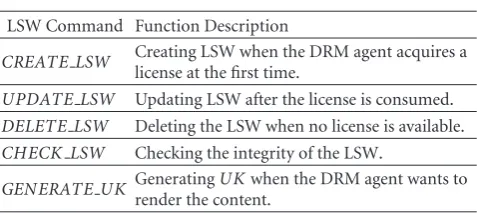
CREATE LSW Creating LSW when the DRM agent acquires a license at the first time.
UPDATE LSW Updating LSW after the license is consumed. DELETE LSW Deleting the LSW when no license is available. CHECK LSW Checking the integrity of the LSW.
GENERATE UK GeneratingUKwhen the DRM agent wants to render the content.
file system. We apply the data hiding technique proposed in [15] on LSW to make sure that LSW is invisible. The structure of LSW is
LSW=License IDRandLicense HashV ersion, (3)
whereLicense IDis the license index andRandis a random
number in the license and is also a parameter of Algorithms 1 and2. License Hashis the hash value of the license for
ensuring the license integrity. V ersion is an identity for
uploading LSW. Only if the LSW version in the license service equals the version of the uploaded LSW, the LSW in the license service will be replaced by the uploaded LSW. When the upload subprotocol of LAP carried out successfully, the version domain of LSW in both the SIM card and license service will be updated.
In order to regulate the operations on LSW between the SIM card and DRM agent, LSWP is designed and adopted in the cloud client. The instructions of the ADPU
command for LSWP are CREATE LSW, UPDATE LSW,
DELETE LSW,CHECK LSW, andGENERATE UK. The
functional descriptions of these instructions are listed in Table 2.
An example of the APDU command CREATE LSW
is shown in Table 3. The parameter CLA is the class of
instruction; “0x88” represents the instruction class for LSWP.
INSis the instruction code; “0x20” meansCREATE LSW
command. Lc is the number of bytes in the data field of
the command; “0x10” means that the Datadomain is the
next 16 bytes behind theLcdomain. In theDatadomain,
the first 4 bytes represent License ID, the second 4 bytes
representRand, and the last 8 bytes representLicense Hash.
Leis the maximum number of bytes expected in the data field
of the response command; “0x01” means that only 1 byte is expected for the data field of the response.
3.4.2. The License Acquisition Protocol. License Acquisition Protocol (LAP) is a protocol based on XML for license
acquisition and is shown in Figure 2. LAP consists of
Rights customization Rights customization webpage
Trigger
Triggerconfirm Triggersub-protocol
Authentication
Confirm authentication Authentication sub-protocol
Licenserequest
Licenseresponse sub
License transmission -protocol
Rendercontent
License upload
Upload confirm
Upload sub-protocol LSWP
LAP DRM agent
SIM card License server
Create LSW/check LSW
Update/delete LSW Generate UK
Figure2: The processes of both LSWP and LAP.
Table3: An example of APDU command CREATE LSW.
CREATE LSW
Parameter CLA INS Lc Data Le
License ID Rand License Hash
Length 1 1 1 4 4 8 1
Value 0x88 0x20 0x10 0x00000001 0x1d3a9f62 0x1d31e4049a672dc8 0x01
generates the rights for a license. The DRM agent starts a 2-pass authentication subprotocol after confirming the trigger message. The authentication subprotocol is a 2-pass protocol for transmitting and authenticating identity information of
the SIM card to the license server as seen fromAlgorithm 3.
The license transmission subprotocol is a 2-pass protocol for transmitting a license to the DRM agent during which
the sensitive data have been encrypted byAlgorithm 2. The
upload subprotocol is a 2-pass protocol for synchronizing the license, and LSW stored in the license server. The upload command is a proactive command [9] initiated by the SIM card.
3.5. Algorithms. There are four main algorithms in the CS-DRM scheme. In this subsection, each algorithm is presented in detail.
Input: Rand: a 4-byte random number from the DRM agent;
Ki: a secret key stored in both the SIM card and
the database of the license server;
Output:CK: a byte array for SIM-Authentication (1)Kc:=A8(Ki,Rand);
(2)CK:=A5(Kc,Rand);
Algorithm1: SIM-Authentication (Rand, Ki).
3.5.1. SIM Card Authentication Algorithm. The SIM card
authentication algorithm, as shown in Algorithm 1, is
exe-cuted within the SIM card and used to generate the SIM card
Input:Rand: a 4 byte random number from the DRM Agent;
IMSI hash: the index forKistored in the
database of the mobile operator; CK: the authentication value;
Rights ID: the index of rights information stored in the database of the license server.
Output:Message: the transmission message to the DRM Agent
(7) Rights:=GetRight(Rights ID);
(8) license:= {License ID,Content ID,Rights,
(9) EK,Rand,H(HKeyRightsEKRand)}; (10) Message:=GenerateMessage(license);
(11)else
(12) error:=ErrorIn f o(“Unauthentic SIM Card);
(13) Message:=GenerateMessage(error);
Algorithm 2: License-Generation (Rand, IMSI hash, CK, Rights ID).
numberRandfrom the DRM agent, the SIM card generates
an intermediate numberKcbyKi,Rand, andA8. Then, the
SIM card generatesCKand sends it to the license server to
distinguish the legal SIM card from impostors.
3.5.2. License Generation Algorithm. The license generation algorithm is executed in a license server to generate licenses.
As shown inAlgorithm 2,Randis a 4-byte random number
from the DRM agent; IMSI hash is used to get Ki;CK
is the SIM card authentication information generated by Algorithm 1;Rights ID is the index of usage rights which is generated through the trigger subprotocol. The Hash
function needs a special key HKey as a parameter. HKey
is generated by hashing the concatenation of the random
number andKiwhich can be acquired through IMSI. Since
attackers could not get theKi, they cannot generateHKey
and tamper the message and hash value without being
aware. The license server first verifiesCK for the SIM card
authentication. After that, the license server generatesUK,
and then encrypts Kcek by EUK, that is, the symmetric
encryption algorithmEkwhere the value ofkisUK.EK is
the encryptedKcek. At the end, the license server generates a
license.
A license is an XML file. An example of the license
is shown in Figure 3. In general, a license contains two
parts. One is the rights related part, which defines the
rights information of the digital content, in theprotectLicense
domain, such as the encryptedKcek in thekeyInfo domain
and the constraint of the rights information in theconstraint
domain. The other is the part which describes the user and
server information, for example, theIMSI hashdomain and
<LicenseResponse id=“0152 0003 BraveHeart” status=“Success”>
<IMSI hash>
C6357835D8FA407894653EAC5749CC94 BC219D155FFB5590C1F46E50E9383196
</IMSI hash>
<LicenseServerID>1</LicenseServerID> <nonce>32efd34de39sdwefqwer</nonce> <protectedLicense>
<Payload id=“0152” stateful=“true” version=“1.0”> <rights id=“C.1”>
<Uid>BraveHeart</Uid> </context>
<cekKeyRand>76BAC0E6</cekKeyRand> <Content ID>0003 BraveHeart</Content ID>
... ...
<paymentFeedback>6</paymentFeedback> <hashValue>
4CD943D00BA424EF8B1F421066A3AE5F76F31AF8
</hashValue> </LicenseResponse>
Figure3: An example of a license.
the LicenseServerID domain. The integrity of a license is ensured by kinds of Hash algorithms.
3.5.3. Key Generation Algorithm. The key generation
algo-rithm is used to generateKcek by decrypting EK, which is
executed within a SIM card. This algorithm, as shown in Algorithm 3, is the pivotal step ofAlgorithm 4. The related
A8 and AUK algorithms are embedded in the hardware of
a SIM card. And the output Kcek cannot be acquired by
attackers because of LSWP.
3.5.4. Content Decryption Algorithm. The content
decryp-tion algorithm, as shown inAlgorithm 4, is used to decrypt
the encrypted content after the DRM agent acquires an available license. The DRM agent first checks whether the rights information is available and then gets the useful
information such as Rand, License ID, Rights, EK, and
Input: Rand: a 4 byte random number; EK: the encryptedKcekin the license; Output:Kcek: the key for decrypting the encrypted
content. (1)Kc:=A8(Ki,Rand);
(2)UK:=AUK(Kc,Rand);
(3)Kcek:=DEUK(EK);
Algorithm3: Key-Generation (Rand, EK).
Input: License: the license for decrypting the content; En Content: the encrypted content;
Output:Content: the decrypted content. (1)Flag:=Check License(License)Agent;
(2)ifFlag==Truethen
(3) License ID:=GetID(License)Agent;
(4) Rand:=GetRand(License)Agent;
(5) Rights:=GetRights(License)Agent;
(6) EK:=GetEK(License)Agent;
(7) Hash:=H(HKeyLicense IDRights)Agent;
(8) if It is the f irst timethen
(9) CreateLSW(License ID, Rand, Hash)SIM;
(10) Kcek:=Key-Generation(Rnad,EK)SIM;
(11) else
(12) ifCheckLSW(License ID, Rand, Hash)SIM; (13) then
(14) Kcek:=Key-Generation(Rnad,EK)SIM;
(15) else (16) error:=
ErrorIn f o(“License is unavailable) Agent;
(17) return:=GenerateMessage(error)Agent;
(18) Content:=DEKcek(En Content)Agent;
(19) U pdateLSW(License ID, Rand, Hash)SIM;
(20)else
(21) error:=ErrorIn f o(“License is unavailable) Agent;
(22) return:=GenerateMessage(error)Agent;
Algorithm4: Content-Decryption (License,En Content).
the SIM card creates a corresponding LSW. After that, the
SIM card generates Kcek by Algorithm 3 and sends it to
the DRM agent. The DRM agent decrypts the content by
Kcek in the secure memory of the device. The subscript of
the operation represents the entity where the operation is executed. For example, the subscript “SIM” of the operation A5(Kc,Rand)SIMmeans the operation is executed in the SIM
card.
4. A Case Study
In this section, we propose a case study for our proposed CS-DRM scheme. This case consists of preparation phase, rights customization phase, license acquisition phase, play phase,
and download/upload phase.Figure 4illustrates the process
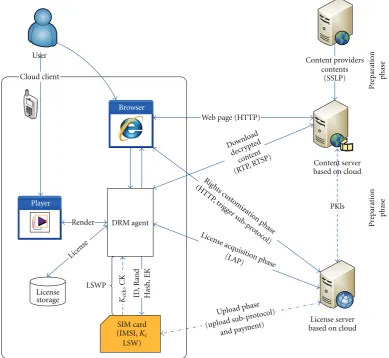
of the CS-DRM use case, where protocols amongE∪Sare
also shown. The play phase, not appearing in the figure, is executed in the cloud client, and more details are presented inSection 4.4.
4.1. Preparation Phase. The preparation phase does pre-liminary works for the entire process. The initialization operation of the CS-DRM backend is carried out in this phase.
(a) Content providers upload content to a content server by SSL protocols.
(b) The content server generates the key Kcek and
encrypts digital content by Kcek using symmetric
encryption. After that, the content server hosts encrypted content for users to download.
(c) The content server transmitsContent ID,IContent ID,
Kcekto the license server in the format of
EPKls(Con-tent IDKcekIContent ID) whereEPKIsis an
asymmet-ric encryption operation using the public keyPKlsof
the license server.Content IDis a content identity. In
order to makeContent IDunique,Content ID
con-sists of local content identifier and the corresponding
content provider identifier. IContent ID is the rights
description information, such as price and play type.
(d) The license server stores Kcek, Content ID, and
IContent ID, and then generates the rights customiza-tion web page which is hosted on the license server for the rights customization phase.
(e) The license server transmitsContent IDand the URL
of corresponding rights customization web page to the content server.
4.2. Rights Customization Phase. The rights customization phase is used to customize the rights of a digital content.
(a) The user browses the content server web site and selects the content (s)he wants.
(b) The DRM agent looks for a license with aContent ID
suffix in the device. If the DRM agent finds a
corre-sponding license, it will check the license against LSW
according to License ID. The rights customization
phase starts if the result is not correct or the rights is unavailable. For example, the rights is available if the rights information allows a user to play the content for 5 times. But the rights is unavailable if the value of play times is 0.
(c) The DRM agent requests the URL of rights cus-tomization web page from the content server. As the URL is received, the browser acquires rights customization web page from the license server with this URL and renders it. Then, the user customizes the rights on the web page and confirms the rights information (s)he selects. After that, the trigger
message TM, that is, (Content ID,License ID,rights,
license url) is generated and sent by the license
server. Herelicense urlis the URL for acquiring the
corresponding license.
(d) After the user affirms TM, the license server stores the
User
Contentproviders contents
Figure4: The typical process of a use case.
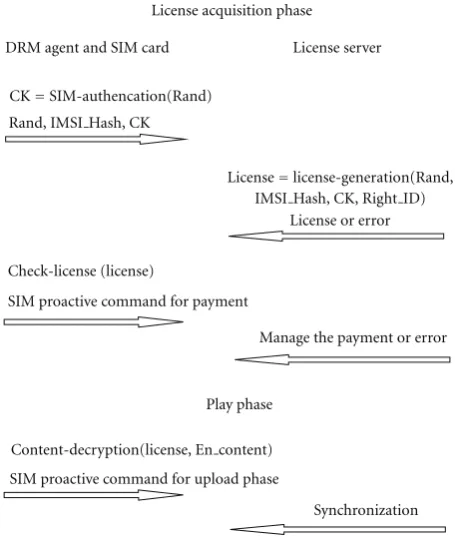
4.3. License Acquisition Phase. The license acquisition phase is used to acquire a license from the license server. The process of both this phase and play phase is shown in Figure 5.
(a) The DRM agent first generates a random number,
Rand, and passes Rand to the SIM card for
calcu-latingKc andCK which are used for the SIM card
authentication byAlgorithm 1. After that, the DRM
agent combines Rand, IMSI hash, Rights ID, and
CK as a request and transmits the request to the
license server.
(b) The license server checks whetherCKis equal to the
CK∗ which is calculated by the same method using
RandandIMSI hash. The SIM card is authentic if
CKandCK∗are identical. The license server creates
a license. More details of the license generation are
shown inAlgorithm 2.
(c) After the DRM agent receives a license for the first time, it creates LSW in the SIM card. The corresponding license and LSW will be updated after the license is consumed. The upload phase is launched in order to synchronize licenses and LSW
with the license server when the user starts up the client of CS-DRM.
(d) The payment for the license is accomplished by the SIM card after the user receives the license [16]. Before the purchase, the license server will check the user account first. As long as the SIM card connects to the network of the mobile operator, it will send proactive comments [9] to the system of the mobile operator for the payment.
4.4. Play Phase. The play phase describes steps of rendering
a digital content. The process of generatingKcekis the key of
this phase, as shown inAlgorithm 4.
(a) The play phase is initiated when the DRM agent gets
a correct license with theContent IDsuffix.
(b) The DRM agent extractsRand andHash from the
license and checksHashwith LSW in the SIM card.
If they are equal, the DRM agent sendsRand, EK,
andLicense IDto the SIM card for generatingKcek,
License server
License orerror
Manage thepayment orerror
License acquisitionphase
Synchronization Playphase
Check-license (license)
Content-decryption(license, En content) DRM agent and SIM card
CK=SIM-authencation(Rand)
SIMproactive command for payment
SIMproactive command foruploadphase
License=license-generation(Rand, IMSI Hash, CK, Right ID) Rand, IMSI Hash, CK
Figure5: The process of License Acquisition Phase and Play Phase.
(c) The DRM agent decrypts the encrypted content
byKcek. The decrypted content is rendered by the
player. TheKcekand the decrypted content are stored
in the secure memory of mobile device when a user is enjoying the content.
(d) Once the user stops playing, the Kcek and the
decrypted content will be deleted. At the same time, the DRM agent updates the rights information in the license as well as the LSW in the SIM card.
(e) If the rights information is unavailable, the DRM agent deletes the license and notifies the SIM card to delete LSW.
4.5. Download/Upload Phase. The download/upload phase is for the flexibility and integrity of CS-DRM, where the download phase allows users to change the device and the integrity is guaranteed by the upload phase.
In the download phase, if a user inserts a SIM card into another device which does not have the content and license, the user selects the “Download License” menu item. The DRM agent downloads the license from the license server according to the LSW. The DRM agent checks the new license against the LSW in the SIM card. If the verification fails, the new license will be deleted. Clearly, a user cannot assist another user, say Bob, to “get” the appropriate keys or contents without giving the SIM card to the user Bob.
The upload phase is launched once the user starts up the client of CS-DRM. The SIM card sends the upload proactive
command to synchronize the license and LSW stored in the license server when the upload phase starts.
5. Characteristics of CS-DRM
In this section, we discuss characteristics of CS-DRM by analyzing security, privacy issues, the cost of CS-DRM, and how the cloud enhances our DRM scheme. As shown in Table 3, in order to elaborate on these characteristics more clearly, we compare CS-DRM with several typical DRM schemes.
5.1. Security Analysis. The security of our proposed CS-DRM scheme is distinguished by the utilization of the SIM card and LSW. The scheme we proposed is one solution to focus on the encryption of data exchanged between the SIM card and the DRM agent. It is noteworthy that the last releases of the SIM card can support SSL over USB for secure communications between the SIM card and the applications outside the SIM card. When this kind of SIM card is widely used in the mobile industry, it may be the more popular solution for this encryption problem. Although the security of cloud is also an important aspect to CS-DRM, it is not the focus of this paper. There are a lot of research works in this area [18]. Meanwhile, most commercial solutions of cloud, for example, GAE, have their own security principles.
A SIM card is safe enough to storeKiand other important
information due to the following points, though it is perhaps
running in a hostile environment. Firstly, it is difficult
to crack a SIM card thanks to well-developed industrial standards, such as ISO 7816, GSM 11.11, and GSM 11.14. Secondly, algorithms used in a SIM card are kept strictly con-fidential by the mobile operator. The encryption/decryption schema of CS-DRM can be established on most of the complex and advanced encryption/decryption algorithms, which only need to customize the encryption/decryption algorithms and adjust corresponding encryption/decryption steps in the SIM card and license service. In this paper, for convenience of explanation, the Advanced Encryption Standard (AES) is adopted as the encryption/decryption schema of CS-DRM. Thirdly, data hiding approaches applied in the file system of the SIM card make LSW secure and invisible to crackers. Finally, the interaction between a SIM card and a DRM agent is protected by LSWP.
Another important security issue is how we can make the DRM agent and the player in the mobile device enough trustworthy. CS-DRM solves this issue from two aspects. On one hand, in industry, there are kinds of certification systems
based on different mobile operating systems. The mobile
Table4: A Comparison of Some DRM Schemes.
DRM Scheme OMA DRM [1] Conrado et al.’s
DRM [4] TMP-based DRM [17] CS-DRM
Characteristic Device based Smart card based Trust mobile platform
based SIM card and cloud based
Encrypted Content Yes No Yes Yes
Privacy Protection No Yes Yes Yes
PKI used in the license
delivery Yes No Yes No
Information Stored Public/Private key PK/SKSK,SK p, and p
Public/Private key and sensitive information for
proving the identity
Ki, LSW, and sensitive
information for proving the identity
the player, are in the decoded format, which guarantees the security of the communication.
Three types of attacks are listed as follows. We analyze these attacks and present the solutions in CS-DRM.
Attack 1: Tamper the License. CS-DRM guarantees the integrity of a license by the LSW and SIM card. A hash value (Hash) will be calculated according to the license. The DRM agent compares the computed Hash with License Hash in the LSW by LSWP, before it uses the license. Once the license
has been tampered, the computed Hash is different from the
License Hash. The modification can be noticed by the DRM agent, and then a mark is made on the license. The tampered license is not available anymore; therefore, the attacker could not use the tampered license.
Attack 2: Tamper or Detect the LSW. First, the LSW is stored in the SIM card file system which owns complete access control mechanism for the file system. Only authorized program can access and modify the SIM card file system. Because of that, a malicious user could not tamper the SIM card file system. Second, a malicious user can scan the SIM card file system using special tools such as SIMbrush [15]. However, the data hiding approach applied on the LSW makes LSW invisible. Therefore, a malicious user will not detect the LSW information even if (s)he can scan the file system. Then, the attacker could not access the content by tampering or detecting the LSW.
Attack 3: SIM Card Replication Attack. An attacker may replicate a SIM card and attempt to illegally access the content many times. However, the LSW will be modified immediately once the attacker stops playing the content. The information in the license server will be updated when the upload phase starts. In the upload phase, only the LSW with the correct version can be updated in the license server. Otherwise, if another SIM card uploads LSW with the wrong version, the license server will send a command to ask the SIM card to delete LSW. So only one user can access the content by the SIM card at a time.
5.2. Privacy Analysis. CS-DRM has the privacy protection for users. In our scheme, IMSI of the SIM card is the only
sensitive information which can be used to know the user identity. However, the hash value of IMSI instead of IMSI itself is used during the process of the license acquisition, so that the license server could not match this hash value with a certain user. Meanwhile, the mobile operator does not divulge user privacy, which makes sure that the license
server can only getKiand is impossible to acquire the user
identity information from the mobile operator. Without the permission of the mobile operator, the license server has no rights to check IMSI. Let alone surveying user privacy. Therefore, no one could acquire the privacy information of a user, such as the license list of contents consumed by a user and the user identity.
However, the certain user would be identified by exhaus-tively searching all possible IMSI instead of reversing the hash value. The number of the legal IMSI is limited. The attack seems to be possible. In order to prevent this kind of exhaus-tively searching attack, we can apply an encoding/decoding function on the IMSI hash. Only the SIM card and the mobile operator know how to encode/decode the message. In this way, the IMSI hash is safe enough for the exhaustively searching. This kind of encoding/decoding function can be
flexible. Here we give the mode we used, as shown inTable 5.
The IMSI hash is expressed in hexadecimal. The original IMSI hash is 20 bytes in the prototype. After the IMSI hash is encoded in the frontend, the new IMSI hash is 37 bytes. The first byte denotes the mode of the encoding. If the first bit is 0, the encoding starts from the left-hand side, otherwise from the right-hand side. If there are more 1’s than 0’s in the rest 7 bits, the distribution of 1’s in the next 4 bytes denotes the positions of the original 20 bytes appearing in the new one. The rest positions are padded with random numbers. Otherwise, the distribution of 0’s denotes the positions. Only the mobile operator can decode this new IMSI hash to the
original one, and then find the correspondingKi.
5.3. Cost Analysis. In this subsection, we elaborate on the cost of CS-DRM. Comparing with existing DRM schemes, the cost of CS-DRM is much lower. First, for smart card-based DRM schemes, a SIM card replaces a smart card in CS-DRM, which reduces the cost for issuing a smart card and a smart card reader. Second, the sensitive
Table5: The encoding/decoding mode of IMSI hash.
1 byte 2–5 bytes 6–37 bytes expressed in hexadecimal
1 bit 2–8 bits 32 bits The original IMSI hash:
C635D8403E49CC949D155FFB90C16E50E9383196
0 1001110 10011010001001110011110110111111 The new IMSI hash in the encoded format:
C6357835D8FA407894653EAC5749CC94BC219D155FFB5590C1F46E50E9383196 Left The distribution of 1’s denotes the positions
encryption/decryption and authentication mechanisms designed in CS-DRM. Comparing with some DRM schemes (such as OMA DRM) which protect the sensitive data depending on the mechanisms of Certificate Authority (CA) and PKI, CS-DRM removes CA from the scheme and then reduces the cost of purchasing certifications for each cloud
client. Third, as we mentioned before inSection 2.2.3,
CS-DRM is a cloud-based CS-DRM scheme whose most important characteristic is its “pay-as-you-go” manner. The owner of CS-DRM does not need to purchase the infrastructure
which may be too expensive to be afforded, such as software
and physical servers. CS-DRM only demands to rent services provided by the cloud computing. The cost of renting services is much lower than that of buying software and hardware. Meanwhile, the high elasticity of the cloud brings capabilities of matching resources to workload much more closely by adding or removing resources at an acceptable time of minutes rather than weeks, which makes CS-DRM satisfy the requirements of cloud clients automatically according to the current demands with a low cost. Also, the disaster recovery and maintenance cost of the entire system is reduced by the cloud.
5.4. Cloud DRM. CS-DRM is a cloud-based DRM scheme. The cloud enhances our DRM scheme at three following aspects. First, the virtualization technology used above the infrastructure of the cloud guarantees the data security, sharing, and isolation among tenants of the content server. Second, because of the cloud, CS-DRM has high elasticity as well as the “pay-as-you-go” manner of the cloud. The cost of our DRM scheme is significantly lower than that of others, especially when the number of active users scales up. Third, cloud computing is a large service platform. We can integrate the most popular services nowadays to our DRM scheme. Based on the cloud, CS-DRM can own powerful service support, which makes CS-DRM a flexible and humanistic system with wonderful user experience. For instance, the content server can provide kinds of content editing and format conversion services for content providers.
6. Implementation
We have implemented a prototype, called “Phosphor”, of our proposed CS-DRM scheme. Phosphor contains both the frontend and the backend. Specifically, Phosphor is designed for protecting mobile streaming multimedia. Obviously, we can easily extend Phosphor to protect other kinds of media. A preliminary description on Phosphor was presented in
[19]. In this section, we discuss the implementation details of Phosphor. Firstly, we present the frontend and backend
of Phosphor in Sections6.1and6.2, respectively. Secondly,
video encoding/decoding methods used in Phosphor are brought forth. Finally, we concern the user experience of the phosphor client.
6.1. Frontend. To verify our DRM scheme, we developed a DRM video client, which is allowed to use the standard video on demand services via RTSP protocol [14], on a mobile device. It is a Symbian C++ application using the Nokia S60 3rd Edition Feature Pack 2 Software Development Kit [20]. We implemented a browser and a player besides the DRM agent and SIM card. A user can browse the portal web site hosted on the content server and the rights customization web site on the license server by the browser. Meanwhile, the player is for rendering video stream. A client receives the encrypted video data from the content server via RTP protocol [13] and applies for the decryption key from the SIM card via APDU commands. If the acquisition of the key is successful, the client decrypts the video data, decodes the decrypted data to video frames, and renders the video frames on the screen of the mobile device periodically.
6.2. Backend. We developed and deployed application ser-vices of the CS-DRM scheme in both a private cloud and
a public cloud. The private cloud is a cluster of local
machines with abundant resources such as large storage
and efficient computation. Meanwhile, the public cloud is
Video
Anti-scrambling
/inverse DCT
Removing paddingbits
Inverse transform Device
Figure6: The implementation process of the improved H.263 video encoding/decoding method in Phosphor.
Video frame
Entropy encoding
Quantization Stream
Scrambling/
quantization Stream
Anti-scrambling/ decryption Inverse
DCT
(b)
Figure 7: The process of the improved H.263 video encod-ing/decoding: (a) is the process of the improved H.263 video encoding; (b) is the process of the improved H.263 video decoding.
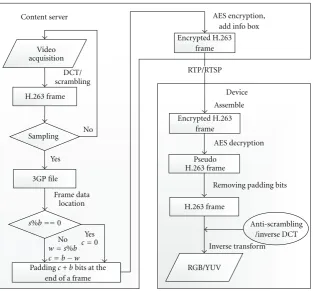
6.3. Encoding/Decoding. We adopt an improved H.263 video encoding/decoding method in Phosphor. The
implementa-tion process is shown inFigure 6. The encoding process is
carried out in the content server. First, we acquire the original frames from the video. Through the DCT transform and scrambling operations, the original video frame becomes a H.263 frame. Then, the frame is encrypted by AES with
counter (CTR) mode [23] using Kcek and encoded by
the entropy encoding operation. After that, these frames constitute a video streaming which is transmitted to the device through RTP and RTSP. More details can be found
inFigure 7(a). The decoding process in the device, as shown inFigure 7(b), is the inverse process of encoding.
Different from traditional encoding/decoding methods,
there are some improved ones, such as [24], in which the scrambling operation is added into the encoding/decoding process. In Phosphor, similarly, the scrambling operation is after the quantization and before the entropy encoding in the content service. Meanwhile, the inverse scrambling operation is between the inverse quantization and the entropy decoding, after the streaming is received by the
device. More details are shown inFigure 7.
We compare the original video data with the encoded video data. The result of the comparison, shown in Figure 8, demonstrates that the video is well protected in Phosphor. Furthermore, the improved H.263 video encryption/decryption method provides higher security and reduces the computational cost of encryption/decryption operations.
6.4. User Experience. We implemented and deployed the client of Phosphor on a real device, Nokia N76. In this subsection, a perceptual understanding of Phosphor through user operations is given. The following pictures shown in Figure 9 are taken by a camera to record some typical scenarios of Phosphor on the real device.
As shown inFigure 9(a), a user is browsing the content
server web site and selecting her/his favorite. The user
(a) (b)
Figure8: The comparison between the original video data and the encoded video data. (a) is the original video data; (b) is the video data after the improved H.263 encoding method.
(a) (b) (c) (d)
Figure9: The implementation diagram of Phosphor: (a) describes the scene searching content on the content server web site; (b) describes the scene customizing the rights on the license server; (c) describes the scene where the DRM agent is acquiring a license after successful registration; (d) describes the process of rendering the media in the compliant player.
no license in the device. In detail, the user can customize the rights in actions or types. For example, (s)he can customize rights to play a video segment 3 times or in a time period. After the user finishes customizing the rights, the trigger message is sent to her/him. At present, the users can acquire
the license (seeFigure 9(c)). Finally, as shown inFigure 9(d),
the user can watch the streaming media content, after (s)he acquires the license and pays for it.
7. Experiments
We conduct extensive experiments on the performance of our proposed CS-DRM scheme and Phosphor. In this section, the experimental setting is described at first. Then, extensive experimental results are reported to show the
effectiveness and the efficiency of the CS-DRM scheme.
For the aspect of the efficiency, we only focus on the
license service, because the results of the experiments on the
license service are representative and the similar conclusion can also be reached to the content service.
It is worth noting that DRM is a special area for security. We do not use any benchmark in our experiments. A DRM system involves too many domains, for example, encryp-tion/decryption, network transmission, the implementation technology of the compliant client and servers; therefore, there is no public benchmark so far.
3
Figure10: Running time.
the license service is also deployed on the GAE. However, since we only have a free account of GAE, there are a lot of limitations. For example, the maximum number of simultaneous dynamic requests (users) is 30. It means that we cannot simulate hundreds of users to connect the license server concurrently. But it is enough for us to study the performance of application services in both the private and public clouds.
7.2. Effectiveness. We run our program in the N76 to
illustrate the effectiveness of CS-DRM according to a general
process. We divided the general process into four main steps
under different scenarios. The first scenario starts when a
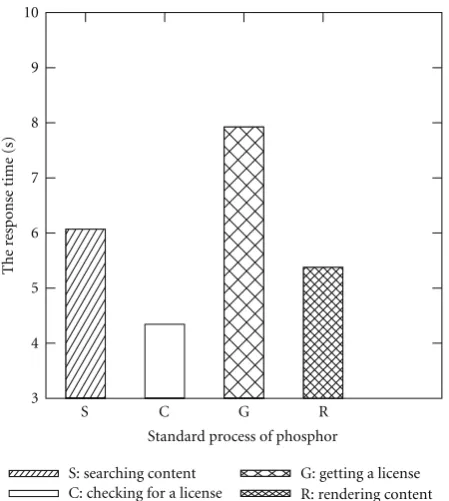
user browses the content portal web site and ends when (s)he selects her/his favorite. The second scenario starts when the user clicks the “play” button to check for a license for watching the content and ends when the rights customization web page appears in the browser. The third scenario starts when the user customizes the rights and ends when (s)he acquires the license. The fourth scenario starts when the user gets the license and ends when the user can
watch the media. As shown in Figure 10, we measure the
approximate running time of the whole general process, which includes the time of artificial operations, such as filling out forms.
Analyzing the running time of each scenario of CS-DRM, we conclude that the third scenario takes more time than other scenarios. It takes about 8 seconds in this scenario to customize the rights, authenticate, and transmit the license. Users need to do some artificial operations during the entire process. Just because of artificial operations, users would not
feel intolerable or boring. Removing the time cost of these
artificial operations, our scheme has excellent effectiveness.
7.3. Efficiency. As mentioned inSection 5.3, the low access speed and long latency are two major factors limiting the development of the mobile Internet. In the CS-DRM scheme, the response time of the communication between cloud clients and cloud services becomes the most important indicator of the performance. Both the license service and content service are deployed in the cloud. We consider that the performance of these two services is the key for CS-DRM to provide a better user experience. Naturally, the response time for user requests is an appropriate indicator for the performance. Here we focus on the life cycle of a license, which is involved in the LAP.
In this experiment, we simulate simultaneous users sending requests to license service for acquiring licenses and
calculate the response time—TotalandAverage. Totalis the
running time from the first user sending a request to the last user receiving a response and represents the longest delay the
user may incur.Averageis the average response time of each
user and is calculated as
Average=
n
k=1Timek
n , (4)
wherenis the number of simultaneous users andTimek is
the response time of thekth user. In this experiment, lots of
mobile phone simulators are utilized to run on computers, because there are not enough physical mobile devices to simulate hundreds of simultaneous users. The number of simultaneous users for the private cloud increases from 50 to 500 with a step 50. Meanwhile, the number for GAE increases from 5 to 30 with a step 5. If the number of simultaneous users in GAE is bigger than 30, the error rate of requests for GAE will raise extremely fast due to the limitation on the maximum number of simultaneous requests for free. For example, when the number of simultaneous users is 100, the error rate is 78.4%.
As shown in Figures11and12, bothTotalandAverage
increase when the number of simultaneous users scales up. Meanwhile, the total running time is a little longer than the response time of the individual user. The results on both GAE and the private cloud are reasonable. As shown in Figure 11, for GAE, when the number of simultaneous users is lower than the quota, the license service can get enough resources to deal with requests without much latency. Also,
there are several interesting features. Firstly,Averageof GAE
increases abruptly when the number of simultaneous users
increases from 5 to 10. ButAverageremains with very little
0
The numberof simultaneous users
Total Average
Figure11: Total response time in the public cloud.
0
The numberof simultaneous users
Total Average
Figure12: Total response time in the private cloud.
which reduces theTotal. The last point ofTotalinFigure 11
fits well with the prediction.
In the private cloud, as shown inFigure 12, bothTotal
and Average increase proportionally to the number of
simultaneous users. It means that our private cloud does not do well in the distributed computing, which can be improved in the future. When there are 500 simultaneous requests, the license server reaches a limitation of the resources of the private cloud. It has to slow down and wait for new resources to deal with rest requests. However, the total running time of license service on GAE is much longer than that on the
0
Figure13: Response time of LAP in the private cloud with 100 simultaneous users.
Figure 14: Response time of LAP in the public cloud with 20 simultaneous users.
private cloud when the number of simultaneous users is the same. The main reason for this situation is the network latency of GAE which is the main factor influencing the performance of license service in the public cloud. The results of the next experiment just explain it well.
In order to investigate factors influencing the perfor-mance, we analyze the response time of subprotocols of
LAP according to Server-Time and Network-Time, where
5 10 15 20 25
100 200 300 400
The
r
es
p
onse
time
(s)
The numberof simultaneous users
Trigger
Authentication
License acquisition Upload
Figure 15: Response time of LAP in the private cloud with increasing simultaneous users.
0 5 10 15 20
5 10 20
The
r
es
p
onse
time
(s)
The numberof simultaneous users
Trigger
Authentication
License acquisition Upload
Figure 16: Response time of LAP in the public cloud with increasing simultaneous users.
requests and generating responses in the license service, and Network-Time is the network latency of the message transmission. Here we fix the number of simultaneous users. The simultaneous number of GAE is 20, and that of the private cloud is 100. The results of two experiments are
shown in Figures13and14. Obviously, the network latency
is the main factor influencing the performance of cloud.
The differences onServer-Timebetween GAE and the private
cloud are not too much, which means that the efficiency can
be satisfied by both the private and public clouds. Comparing with each subprotocol, the trigger subprotocol needs the
longestServer-Time. In this subprotocol, the cloud analyzes
the requests, generates, and stores usage rights with a large number of data operations for the corresponding licenses. The upload subprotocol takes more time on network due to uploading licenses and LSW. The other subprotocols do not involve so much data operations; therefore, they take less
Server-Time.
From the analysis of the experiments on subprotocols of LAP both in the private and the public clouds (see Figures 13and14), we conclude that, for the public cloud,
Server-Timechanges a little, whileNetwork-Timebecomes the main
factor for GAE to provide high quality services. Since that, we argue that there are some optimization opportunities for
reducing Network-Timein the public cloud, such as XML
compression. We can encode the license and transfer the messages, which are both in the XML format, into binary code. These binary encoded streams are used for delivery between a client and a backend. However, the encoding and decoding process may take more computational cost.
We show the relationship between the response time of LAP including its subprotocols and the number of
simultaneous users. The results are shown in Figures15and
16. The response time of each LAP subprotocol increases with the increasing of the number of simultaneous users in the private cloud. Moreover, the response time of the trigger subprotocol and that of the upload subprotocol increase faster than those of the other two subprotocols in public cloud.
8. Related Work
Digital Rights Management is an active area of research with a lot of prior works. Device-based DRM schemes and smart card based DRM schemes are two main categories for the existing DRM schemes. OMA DRM [1] and Microsoft DRM [2] are device-based DRM schemes which have a common problem—inflexibility. In order to solve this problem, smart card-based DRM schemes are proposed [4–6].
system in its last document of DRM specification. In the specification, a SIM card is only used to bind Rights Objects (RO) with user identity. Considering the authority of OMA, both the scientific research and engineering practice on the SIM card-based DRM should pay close attention to the OMA DRM specification in the future. Smart card-based DRM systems are more suitable for the mobile environment. However, there are security issues, such as imposter attacks [4, 5], in some existing smart card-based DRM schemes. Although some solutions (e.g., [6]) are proposed to solve these security issues, the complexity and cost of the system dramatically increase.
Reference [17] is a relevant prior work about the SIM card. It proposes a TMP-based DRM system which combines the trust mobile platform (TMP) and OMA DRM. The TMP-based DRM introduces SIM card to the DRM scheme, but the usage of SIM card is very limited. The SIM card is just for the authentication in [17], such as the confirmation of the user identity for TMP, network as well as Rights Issuer (RI). Moreover, the concrete authentication steps and authentication algorithms are not mentioned anymore. The security issue about the communication between TMP and SIM card is also ignored. Reference [25] is another relevant work on the multimedia content distribution on the mobile phone. It introduces smart card in the DRM scheme. Meanwhile, watermarking is applied to detect piracy in the network. Reference [26] applies a smart card to the condition access system and designs a communication method and the interface between a set-top box and a smart card. Reference [27] designs a fair exchange protocol for trading electronic rights to claim goods and services. Reference [28] proposes a smart card-based digital content protection scheme for the workflow and implements the system.
There are also some related works on the performance
issue of mobile DRM schemes. References [29, 30] are
two schemes on how to improve the performance of OMA DRM scheme. The device identifier is introduced to the OMA DRM in [29]. The RI server encrypts RO by using the symmetric encryption instead of asymmetric encryption. The device identifier is the symmetric key for the symmetric encryption. However, the device identifier has to be transmitted by asymmetric encryption using public key of RI. Since that, this scheme not only lacks flexibility, like device-based DRM system, but also increases the cost and complexity by transmitting the device identifier to RI. Reference [30] improves the performance of the RO generation algorithm by reducing generation and usage times of the random number. However, the performance improvement is very limited.
9. Conclusions
This paper presented a new DRM scheme—CS-DRM which is a cloud-based SIM DRM scheme for the mobile Internet. CS-DRM introduces a SIM card and cloud computing to save the cost and provide higher security. Meanwhile, a pro-totype of CS-DRM called Phosphor has been implemented. Furthermore, our experimental results on the performance
of CS-DRM show that CS-DRM can satisfy performance requirements of users well. All of these demonstrate that
CS-DRM is low cost, high efficient, secure, and practicable.
However, there are still some optimization opportunities for CS-DRM, such as XML compression, which are our future works.
Acknowledgments
The authors would like to thank the editor and the two anonymous reviewers, who have made very valuable and constructive comments that resulted in an improved paper. Their thanks go to Wanpeng Tian and Dalei Bao for their help in the deployment of Phosphor. Their thanks also go to Shen He and Xianbo He for their hard work in authors’ mobile DRM group. This work was partially supported by the National Natural Science Foundation of China (no. 60803016 and no. 90718010), the National Basic Research Program of China (no. 2007CB310802), the National HeGaoJi Key Project (no. 2010ZX01042-002-002-01), and Tsinghua National Laboratory for Information Science and Technology (TNLIST) Cross-discipline Founda-tion.
References
[1] “OMA DRM Specification V 2.1,” 2009, http://www .openmobilealliance.org/.
[2] “Microsoft DRM,” 2009,http://www.microsoft.com/windows /windowsmedia/forpros/drm/default.mspx.
[3] “ISO 7816 Smart Card Standard,” http://www.iso.org/iso/ search.htm?qt=7816&sort=rel&type=simple&published=true. [4] C. Conrado, F. Kamperman, G. J. Schrijen, and W. Jonker, “Privacy in an identity-based DRM system,” in Proceedings of the 14th International Workshop on Database and Expert Systems Applications, pp. 389–395, 2003.
[5] H. M. Sun, C. F. Hung, and C. M. Chen, “An improved digital rights management system based on smart cards,” in Proceedings of the Inaugural IEEE-IES Digital EcoSystems and Technologies Conference (DEST ’07), pp. 308–313, February 2007.
[6] S. Palavalli, U. S. Srinivas, and A. R. Pais, “Identity based DRM system with total anonymity and device flexibility using IBES,” in Proceedings of the 22nd EUROPEAN Conference on Modelling and Simulation, June 2008, http://www.scs-eu-rope.net/conf/ecms2008/ecms2008%20CD/hpcs2008%20pdf/ hpcs08w1-1.pdf.
[7] “Statistical Report on Internet Development in China,” July 2009, http://www.cnnic.cn/uploadfiles/pdf/2010/8/24/93145 .pdf.
[8] “GSM 11.11,”http://www.ttfn.net/techno/smartcards/gsm 11-11.pdf.
[9] “GSM 11.14,”http://www.ttfn.net/techno/smartcards/GSM11 -14V5-2-0.pdf.