Volume 2011, Article ID 780632,11pages doi:10.1155/2011/780632
Research Article
Full Rate Network Coding via Nesting
Modulation Constellations
Suhua Tang,
1Hiroyuki Yomo,
1, 2Tetsuro Ueda,
1Ryu Miura,
1and Sadao Obana
11ATR Adaptive Communications Research Laboratories, 2-2-2 Hikaridai, Seika-cho, Soraku-gun, Kyoto 619-0288, Japan 2Faculty of Engineering Science, Kansai University, 3-3-35 Yamate-cho, Suita, Osaka 564-8680, Japan
Correspondence should be addressed to Suhua Tang,[email protected]
Received 30 September 2010; Revised 15 December 2010; Accepted 14 January 2011
Academic Editor: Steven McLaughlin
Copyright © 2011 Suhua Tang et al. This is an open access article distributed under the Creative Commons Attribution License, which permits unrestricted use, distribution, and reproduction in any medium, provided the original work is properly cited.
Network coding is an effective method to improving relay efficiency, by reducing the number of transmissions required to deliver data from source(s) to destination(s). However, its performance may be greatly degraded by rate mismatch, which is seldom touched in previous works and remains a challenge. In this paper, we reinterpret network coding as a mapping of modulation constellation. On this basis, we extend the mapping to support full rate network coding (FRNC), enabling simultaneous use of different modulations by nesting the low level constellation as a subset of the high level constellation. When relay links have different qualities, the messages of different flows are combined via network coding in such a way that for each relay link, its desired message is transmitted at its own highest rate. The limit in constellation size is also addressed. Compared with the state-of-the-art solutions to rate mismatch, the proposed scheme achieves the full rate of all relay links on the broadcast channel.
1. Introduction
Wireless communications suffer greatly from multipath fading where outages may degrade communication quality. Different schemes, such as adaptive modulation and coding and relay [1], have been exploited to mitigate this problem. The relay efficiency can be improved via network coding (NC) [2] if the traffic pattern and thea prioriinformation are exploited. Typical transmission patterns suitable for applying NC include two-way relay [3–5], multihop forwarding [6], multiple access channel [7], multicast channel, and so forth. In addition, joint network and channel coding can further improve spectral efficiency [7,8].
A two-way relay transmission typically consists of two stages: multiple access stage and broadcast stage. NC is applied in the second stage and has two types. The first type of NC is performed in the bit level [3]. Each node transmits its packet to the relay node successively. The relay node decodes each packet and combines them together via NC and forwards the coded packet later. The second type of NC is performed in the signal level. Typically two nodes transmit simultaneously their packets. The relay node regards the superposed signal as a NC signal and forwards it. Each
node recovers its desired signal from the NC signal with interference cancelation [4]. The NC signal is further refined in [5] by taking modulation constellations into account.
The performance of NC, especially bit level NC, is limited by several factors such as packet length mismatch (the short packets are zero padded), traffic rate mismatch (some packets cannot be network-coded due to lack of pairing packets) and transmit rate mismatch. The last factor is neglected in most previous works. In the two-way relay scenarios, the rate mismatch may be formed due to two factors. One is the relay position (which leads to relatively stable differences in link qualities) and the other is fading. Even though the relay lies exactly in the middle of two nodes, the two relay links may have different instantaneous qualities. Since the network-coded packet is intended to be received by both nodes, the minimal rate is chosen for the NC transmission [3]. In this way, the transmission at a low rate on the link supporting a high rate wastes channel bandwidth.
M1
QPSK
R M2
c1=1/2,m1=2 c2=1/2,m2=4 16 QAM
Figure1: Two-way relay, a special case of the general model.
of them are selected by taking the tradeoff between the number of links and the actual rate [9]. This opportunistic scheduling, however, cannot exploit the full power of NC.
Recently, some initial efforts were made to fully exploit rate adaptations in NC. Multiplicative NC was proposed in [10] to better adapt code and modulation rates to different links. However, it only applies to constant modulus signals. Unconventional 5-ary modulation was introduced to work together with QPSK in [11]. This makes modulation complex and is difficult to extend to other modulations. Compress and forward was studied in [12], with the assumption that the relay is much closer to the sink than nodes and has a much higher rate. Its application is limited to multiple access up-link. XOR-based NC and physical layer superposition coding were combined together to better exploit rate adaptation in [13], however, at the cost of significant power loss. Moreover, its performance is degraded and approaches that of NC when relay links have similar quality. Despite all these efforts, there is still no complete solution to the rate mismatch problem.
In this paper, we focus on the bit level NC and propose to achieve full rate network-coding (FRNC) on the broadcast channel via nesting modulation constellations. With a cross-layer design, we exploit physical cross-layer method as well. The principle of dirty paper coding [14] indicates thata signal known at the receiver is not interferenceat all and with suitable coding the full capacity is achievable. As an analogy for NC, when thea prioriinformation is available, NC should also achieve the highest rate over each link, in other words, achieve the full rate on the broadcast channel. This is our starting point. The basic idea is as follows: (i) at the relay node, in order to combine packets together and transmit them over links supporting different rates (modulations), the low level constellation points are nested in the high level constellation. In other words,a subset of the high level constellation is used as the low level constellation, and this subset depends on the design of NC. (ii) At the receiver side, nodes merely supporting low level modulation first find their constellation according to the a priori information and then perform demodulation and decoding. In this way, the highest rate of each link is used and the sum rate is achieved over the broadcast channel. We further study the effect of the limit in constellation size and suggest combining FRNC with superposition coding (SC). Both the analysis and simulation evaluation show that FRNC with SC is significantly superior to the state-of-the-art solutions to the rate mismatch problem.
The rest of the paper is organized as follows: the relay model is presented in Section 2 and the reinterpretation of NC as constellation mapping is addressed in Section 3.
In Section 4, the detailed procedures for achieving full
rate in network-coded transmissions are described. The
performance of different schemes is analyzed in the two-way relay scenario in Section 5 and the related simulation evaluation is presented inSection 6. Finally, we conclude the paper withSection 7.
2. System Model
We consider a network withnnodesMi,i=1, 2,. . .,n, and 1 relayR. For the simplicity of description, we assume that all nodes andRare synchronized and the transmissions are done in terms of TDMA (it is possible to extend the proposed scheme to other channel access methods such as CSMA.) There arenflows. Theith flow fromMS
i toMDi goes through the two-hop pathMS
i-R-MiDand the actual transfer of pack-ets is via the relayR. The packet transfer is divided into two stages: (a) multiple access stage whereRcollects packets from all nodes. Each nodeMiSsends packetPitoRin theith slot, using its optimal rate (modulation and coding). After the data transmission, each node reports its receiving status of packets toR, in a similar way as the COPE scheme [15]. Based on such a feedback,Rmakes the NC scheduling, selecting a subset ofn1nodes, each of which knows all packets involved in the NC except its own desired packet. Without loss of generality, in the following, we assumen1equalsn. Then after n slots, MD
i knows P1,. . .,Pi−1,Pi+1,. . .,Pn. (b) Broadcast stage whereRforwards packets to all nodes.RtransmitsPΣ= ⊕iPi(⊕represents the bitwise exclusive or (XOR) operation) to all nodes, andMD
i recoversPi by (⊕j=/iPj)⊕PΣ. Hence, npackets are exchanged inn+1 slots. A typical example for the model is the local area wireless networks where nodes exchange packets via their associated access point (Rin the model). A special case isn = 2, corresponding to the two-way relay in Figure 1. In this special case, each node uses its transmitted packet as the a priori information and the feedback of receiving status of packets is unnecessary.
Over each link, the rate can be adjusted by modulation and coding. With coding rate c and modulation level m
(constellation size = 2m), on average c · m bits can be transmitted by each symbol. Generally, the modulation level determines a rate range, within which the coding scheme further fine adjusts the rate. Different modulation levels have constellations with different sizes. But these constellations all have the same normalized energy.
In the above model, NC is used at the second stage. We focus on this stage and exploit joint design of modulation and coding so that the highest rate of each link is realized in the NC transmission. We take the following assumptions: (i)
Rhas collected enough data for each flow so that the zero-padding is unnecessary in the NC transmission, (ii) the a prioriinformation required for network decoding is available at each node by recording the overheard packets, and (iii) the relay node knows the channel state information of all links.The key problem is how to realize full rate on all links simultaneously.
3. Reinterpretation of Network Coding
QPSK constellation atRfor NC transmission
Figure2: Reinterpretation of network-coding by modulation.
then transmitted. The receiver just works in the reverse way to recover its information bits. Due to the linearity of both channel coding and NC, their order can be exchanged [16]. In this paper, the NC operation is done after channel coding. Although the NC is performed in the bit level, it can be reinterpreted as a function of constellation mapping. This is explained by an example shown in Figure 2 using the typical QPSK constellation with gray codes. AssumeR
relaysa1a0(“01”) fromM2toM1, andb1b0(“11”) fromM1 to M2, respectively. When relaying these bits, R combines them together as “10” by XOR and transmits (S2)QPSK.
M1 already knows b1b0 (“11”). Exploiting this as the a
priori information, for all possible bits of a1a0, the NC bits and corresponding signals can be computed locally at
M1. These signals, when interpreted as the points fora1a0, construct a new QPSK constellation (SA0SA1SA2SA3)QPSK. This constellation has the same size as (S0S1S2S3)QPSK but with a different layout due to NC. In this way, the NC function actually provides a mapping between constellations. Instead of a fixed constellation in conventional modulations, such a mapping depends on the a priori information and changes for each symbol. The reinterpretation of NC can be summarized as follows:
(i)R transmits F(P1,c,P2,c,. . .,Pn,c) where Pi,c is the
channel-coded packet of theith flow, andFinvolves NC (XOR in conventional NC) and modulation. (ii) At the receiver side, F−1(api) (api = ⊕j=/iPj,c
in conventional NC) provides the constellation for demodulatingPi,c, whereapiis thea priori informa-tion at theith receiver.
In conventional NC schemes, the constellations for different flows have the same size and min-distance, and the latter is the main factor that decides the rate. This forces the relay node to transmit the XORed packet with the minimal rate of all links so that all nodes can correctly recover the XORed packet.
The above constellation mapping can be extended to sup-port simultaneous use of modulations with different levels
(size and min-distance). Specifically, we use constellation-compatible modulations and nest the low level constellation inside the high level constellation. For example, a subset of four 16 QAM constellation points can be used as the QPSK constellation so that over the broadcast channel QPSK is used for one link while 16 QAM is used for the other link in the two-way relay scenario. In other words, among the links supporting different modulations, the highest modulation level is always used as the container. Other low level modulations use a subset of the high level constellation as their constellations.
4. Full Rate Network Coding Protocol
In this section, we present the full rate network-coding (FRNC) protocol. First the basic idea is explained with a simple example. Then the idea is generalized. How to nest constellations, how to find the actual constellation under the NC operation, how to transmit at the relay, and how to receive at the nodes are successively described in detail.
4.1. An Example Revealing the Basic Idea. With the two-node (n= 2) scenario inFigure 1, we show how to use different rates over different links in the network-coded transmission. Assume that (i) links betweenRandM1/M2 support rates withc1=1/2,m1=2 (QPSK),c2=1/2,m2=4 (16 QAM), respectively. On average,Rcan forwardr1 = c1·m1 = 1 bit/symbol toM1andr2=c2·m2=2 bit/symbol toM2. (ii) The slot length isN=2 symbols. Then 2 bits toM1or 4 bits toM2can be transmitted in a single slot. (iii) The two bits fromRtoM1areP1,u=“10” and 4 bits fromRtoM2areP2,u
=“1101”.
The transmit procedure is shown inFigure 3. AtR,P1,u and P2,u are channel-coded to P1,c = “1101” and P2,c =
“11100010”. The modulations for the two messages are QPSK and 16 QAM, respectively. To transmit the two messages together via NC, the QPSK constellation for P1,c is nested
in the 16 QAM constellation used for P2,c. The nesting is
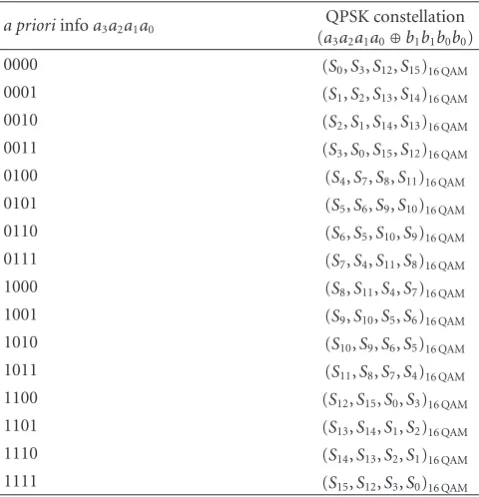
Table 1: Constellation conversion from 16 QAM to QPSK (a3a2a1a0represents thea prioriinfo,b1b0are the info bits to be
received).
a prioriinfoa3a2a1a0 QPSK constellation
(a3a2a1a0⊕b1b1b0b0)
0000 (S0,S3,S12,S15)16 QAM
0001 (S1,S2,S13,S14)16 QAM
0010 (S2,S1,S14,S13)16 QAM
0011 (S3,S0,S15,S12)16 QAM
0100 (S4,S7,S8,S11)16 QAM
0101 (S5,S6,S9,S10)16 QAM
0110 (S6,S5,S10,S9)16 QAM
0111 (S7,S4,S11,S8)16 QAM
1000 (S8,S11,S4,S7)16 QAM
1001 (S9,S10,S5,S6)16 QAM
1010 (S10,S9,S6,S5)16 QAM
1011 (S11,S8,S7,S4)16 QAM
1100 (S12,S15,S0,S3)16 QAM
1101 (S13,S14,S1,S2)16 QAM
1110 (S14,S13,S2,S1)16 QAM
1111 (S15,S12,S3,S0)16 QAM
same length asP2=P2,c=“11100010”. The XORed sum ofP1
andP2isPΣ=“00010001”. ThenPΣ is modulated with the 16 QAM constellation (using gray codes) shown inFigure 4, andRtransmitsxΣ=(S1S1)16 QAM.
The receive procedure is shown inFigure 5. At the ith node, the signal received fromRissi(t). For simplicity, noise and channel fading are ignored. In the same way as the relay performs channel coding and post-coding,P1=“11110011” is calculated from P1,u at M2, and P2 = “11100010” is calculated from P2,u at M1, and are used as the a priori information in the network decoding stage.
Since s2(t) has the same modulation level as the one supported by the quality of linkM2R, decoding atM2is the same as usual. At first,PΣ=“00010001” is demodulated from s2. With P1 =“11110011” as thea priori information,P2,c = P2 =“11100010” is obtained and then P2,u = “1101” is channel decoded.s1(t) has a higher modulation level than the one supported by the quality of link M1R. Therefore, the decoding at M1 is a little more complex. The QPSK constellation to be used at M1 depends on the a priori information and has to be constructed from the 16 QAM constellation. With repetition codes used in the post-coding stage in this example, two bitsb1b0carried in a QPSK symbol are post-coded tob3b2b1b0 =b1b1b0b0, corresponding to a 16-QAM symbol. Witha3a2a1a0as thea prioriinformation, varyingb1b0, the possible NC bitsa3a2a1a0⊕b3b2b1b0and the corresponding signals can be computed. Table 1shows the derived QPSK constellations for demodulatingb1b0, with the foura prioribitsa3a2a1a0as an index.
AtM1, withP2=“11100010” knowna priori, for the first symbol inxΣ,a3a2a1a0=“1110”, (S1)16 QAMis to be demod-ulated with the QPSK constellation (S14,S13,S2,S1)16 QAM
Table 2: A comparison of the broadcast channel among three schemes, for the scenario shown inFigure 1.
scheme rate # transmitted bits DF (r1/2) + (r2/2) 3
NC (min rate) min (r1,r2)·2 4
FRNC (full rate) r1+r2 6
(refer to Table 1); for the second symbol in xΣ, a3a2a1a0 =“0010”, (S1)16 QAM is to be demodulated with the QPSK constellation (S2,S1,S14,S13)16 QAM. Here,xΣ = (S1S1)16 QAM logically corresponds to (S3S1)QPSK. It is demodulated to P1,c = “1101” and converted to P1,u = “10” after channel decoding. In this way network decoding is realized by the constellation conversion.
A simple comparison on the broadcast channel, among decode-and-forward (DF), bit level NC with minimal rate, and FRNC, is summarized inTable 2. With DF,Ruses one symbol for each node and thus transmits 3 bits in total. With NC, Rtransmits (min(ri)·2)·2 =4 bits. With FRNC,R transmits (ri)·2=6 bits using two symbols.
Although superposition coding handles links with dif-ferent qualities as well, the proposed FRNC scheme is quite distinct from it. Constellation nesting fully exploits the power on each link by using the a priori information in times of decoding. As a comparison, superposition coding does not exploit thea prioriinformation for decoding the desired signal. Instead, the total power is divided into two parts, most power for the base layer signal and little power for the secondary layer signal, which results in significant power loss in transmitting the secondary layer signal.
In the following sections, we extend the above idea to more general cases and study the related post-coding scheme and the decoding method.
4.2. Nesting Constellations. We first consider how to nestN1 -QAM (we focus on the constellations in the form of grid, extension to other forms of constellations is also possible.) in N2-QAM (N2 > N1,Nk = (nk)2 = 2mk, k = 1, 2). A simple way is to choose a subset ofN2-QAM constellation points as theN1-QAM constellation. We construct theN1 -QAM constellation by dividingN2-QAM into subsets. Let the min-distance ofN2-QAM bed2. The points ofN1-QAM with a distanced1=n2/n1·d2to their neighbors are grouped into the same subset. In this way, theN2-QAM constellation is divided into (n2/n1)2subsets, each of which having the same sizeN1.
Choosing points for (non-QAM) BPSK requires one more step: after choosing a subset for QPSK from the QAM constellation, select two diagonal points from the QPSK constellation for BPSK.
A single point of the N1-point constellation can only carry m1 information bits. But after nesting it inside the N2-constellation, its bit vector is extended tom2bits. There should be a bit-mapping. The only subset, which contains the all-zero bit-vector, is used for bit mapping fromm1tom2.
Figure 4shows an example of dividing 16 QAM to find
Info bits toM1
P1,u=10
CH-COD CH-COD
P1,c=1101
POST-COD POST-COD
(QPSK)
P1=11110011 ⊕
MOD
Pn=11100010
Pn,c=11100010
Pn,u=1101
· · ·
P∑=P1⊕· · ·⊕Pn=00010001
(16 QAM)
(16 QAM)
x∑=(S1S1)16 QAM
Info bits toMn
GetNr1bits GetNrnbits
Figure3: Coding and modulation at the relay node.
01xx (−0.316)
11xx (0.316)
10xx (0.948)
xx10 (0.948) S2: 0010
S3: 0011
S1: 0001
S0: 0000
S6: 0110
S7: 0111
S5: 0101
S4: 0100
S14: 1110
S15: 1111
S13: 1101
S12: 1100
S9: 1001
S8: 1000 S11: 1011 S10: 1010 (−0.948)
00xx
xx11 (0.316)
xx01 (−0.316)
xx00 (−0.948)
Figure4: Nesting QPSK constellation in 16 QAM constellation.
m1 = 2. The 16 QAM constellation is divided into four subsets:CS1=(S0,S3,S12,S15),CS2=(S1,S2,S13,S14),CS3=
(S4,S7,S8,S11),CS4=(S5,S6,S9,S10).CS=CS1∪CS2∪CS3∪ CS4is the constellation for 16 QAM. QPSK may use anyCSi as its constellation point, although with a different layout under NC.
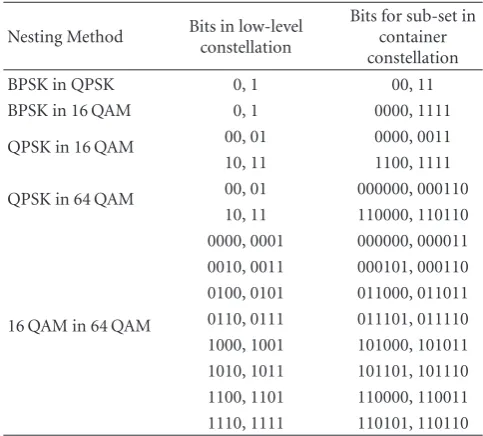
Table 3shows some bit mapping methods, where theN1
m1-bit vectors are one-to-one mapped toN1 m2-bit vectors in the subset containing the all-zero vector. The left column represents the nesting method, the second column is the original bits to be transmitted with low level constellation, and the right column shows the bit vectors in the nested constellation. With the bit mapping, the bits of low-level constellations are modulated to the subsets of high-level
Table3: Some bit mapping methods.
Nesting Method Bits in low-level constellation
Bits for sub-set in container constellation
BPSK in QPSK 0, 1 00, 11
BPSK in 16 QAM 0, 1 0000, 1111
QPSK in 16 QAM 00, 01 0000, 0011 10, 11 1100, 1111
QPSK in 64 QAM 00, 01 000000, 000110 10, 11 110000, 110110
16 QAM in 64 QAM
0000, 0001 000000, 000011 0010, 0011 000101, 000110 0100, 0101 011000, 011011 0110, 0111 011101, 011110 1000, 1001 101000, 101011 1010, 1011 101101, 101110 1100, 1101 110000, 110011 1110, 1111 110101, 110110
modulation, and the function of post-coding inFigure 3is realized.
The constellation nesting may have SNR loss since the min-distance of the nested constellation may be a little less than that of the standard one. For example, with normalized energy, the min-distance of two 16-QAM points equals 0.6325. When nesting QPSK inside 16 QAM, the min-distance equals 0.6325·2 = 1.265, which is 0.97 dB less than 1.414, the min-distance of normal QPSK constellation.
CH-DEC CH-DEC
NC-DEC
NC-DEC QPSK
constellation
s1(t)
sn(t)
P∑=00010001 For
M1
For Mn
Pn,u=1101
a priori info
a priori info
⊕ ⊕
P1⊕· · ·⊕Pn−1 =11110011 P2⊕· · ·⊕Pn
=11100010 P1,c=1101
P1,u=10
Pn,c=11100010
DEMOD DEMOD
x∑=(S1S1)16 QAM
P2,. . .,Pn P1,. . .,Pn−1
Figure5: Recover information bits at the nodes.
Table4: Potential SNR loss in constellation conversion.
BPSK QPSK 16 QAM 64 QAM
QPSK 0
16 QAM −0.97 dB −0.97 dB
64 QAM −1.18 dB −1.18 dB −0.21 dB
256 QAM −1.23 dB −1.23 dB −0.26 dB −0.05 dB
SNR loss of about 0.97 dB, nesting other constellations has little SNR loss (0.05 dB for 64 QAM in 256 QAM) or no SNR loss (0 dB for BPSK in QPSK) at all. The SNR loss is taken into account when choosing rate (modulation and coding) according to SNR.
4.3. Actual Constellation under Network Coding. The next
important issue is to find the actual constellation layout under NC. We explain this withFigure 4as an example. It can be easily verified that the division has the following property:
∀P1∈CS1, ∀ap1∈CS, ifap1∈CSi, thenP1⊕ap1∈CSi.
(1)
Equation (1) shows that, for a pointap1in the high level con-stellation (ap1∈CS), ifap1is in the subsetCSi, it mapsCS1 toCSiby the NC operation. The actual constellation layout of CSifor demodulatingP1is determined byP1⊕ap1, withapi knowna prioriat the receiver. Although a constellation under NC changes with thea prioriinformation, the min-distance forN1-QAM, under all thea prioriinformation, remains the same:d1=n2/n1·d2.
As for the example in Figure 1, using the third row of Table 3, two bits b1b0 are post-coded to b3b2b1b0. With
a3a2a1a0 ⊕b3b2b1b0 being received and api = a3a2a1a0 knowna prioriatM1, the QPSK constellation for demodulat-ingb1b0is looked up inTable 1by usinga3a2a1a0as an index. For example, whena3a2a1a0=“1110”, (S14,S13,S2,S1)16 QAM is equivalent to (S0,S1,S2,S3)QPSK. Since the derived QPSK constellation depends on thea prioriinformation, it changes for each symbol. Recovery of other constellations can be done in a similar way.
Table 5: SNR threshold for rate adaptation (for a message consisting of 4800 symbols).
SNR (dB) Modulation and coding Bit/Sym
BPSK (1/2) 0.50
≥7.0 BPSK (3/4) 0.75
≥7.6 QPSK (1/2) 1.00
≥10.4 QPSK (3/4) 1.50
≥12.8 16 QAM (1/2) 2.00
≥17.0 16 QAM (3/4) 3.00
≥21.0 64 QAM (2/3) 4.00
≥23.4 64 QAM (3/4) 4.50
≥26.8 256 QAM (2/3) 5.33
≥28.0 256 QAM (3/4) 6.00
4.4. Encoding/Modulation at the Relay. Figure 3 shows the transmit procedure at relayR. For each flow fi, according to the SNR of its relay link,Rfinds the transmit rateri from an empirical SNR-rate table shown inTable 5. SNR loss due to constellation nesting is considered in this process: the rate corresponding to SNR is lowered if SNR loss makes this rate improper.
Assume, without loss of generality, that rates, r1,r2,
. . .,rn, over links from R to M1,M2,. . .,Mn, are in the
increasing order, that is,r1 ≤r2· · · ≤rn. Eachri =ci·mi corresponds to a coding rateci and a modulation levelmi.
mi,i=1, 2,. . .,n, are also in the increasing order. Transmission atRis done by the following steps.
(i) Every timeRtransmits a fixed number of symbols,N. For each flow fi, the number of information bits that can be transmitted isN·ri. These information bits form a framePi,u. OnPi,uchannel coding with rateci is performed, which generatesPi,c.Pi,c,i=1, 2,. . .,n,
have different length in bits.
(iii)Pi,i = 1,. . .,n are XORed together as PΣ = ⊕iPi. PΣ, modulated to signal xΣ with constellation mn, is transmitted to all nodes with out-of-band rate informationri,i=1, 2,. . .,n(each node only records the information bits on overhearing packets from nearby nodes to the relay. With the rate information from the relay, the node performs the same channel coding/post coding as the relay and calculates the coded bits as thea priori information for network decoding.)
4.5. Demodulation/Decoding at the Receiver. Figure 5shows the demodulation and decoding procedure at all nodes. At theith node, the signal received fromRis
si(t)=hi·xΣ(t) +ni(t), (2)
wherehiis the channel gain andni(t) is zero mean additive white Gaussian noise (AWGN).
A node Mi, supporting the used constellation (mi =
mn), performs soft demodulation and calculates symbol log-likelihood ratio (LLR) [17] and then converts to bit LLR. The bit LLR corresponds to XORed bits from all flows. With the
a prioriinformation bits (api= ⊕j=/iPj) known in advance, the LLR of desired bits can be recovered and then channel decoding is performed. The whole procedure is shown in the right side ofFigure 5.
For a receiverMirequiring a lower constellation (mi <
mn), at first the low-level constellation is derived by exploit-ing the a priori information, as described in Section 4.3. This derivation of constellation is actually network decoding. Then the received signal is demodulated with the derived constellation and later channel decoded to recover the bits, as shown in the left side ofFigure 5.
4.6. Discussion: Constellation Size Limit. FRNC requires that constellation size should be large enough so that high rate can be used at high SNR. In practical systems, there is a constraint on the constellation size which restricts the maximal rate. The maximum of constellation size, referred to as the constellation size limit hereafter, confines the performance of FRNC. In such cases, FRNC can be used together with superposition coding (SC) to fully exploit the transmit power. NC is already used together with SC in [13], where the fine scheduling is used to combine links with almost the same gain and apply NC to them. For links with quite different gains, SC is applied. But such a scheduling heavily depends on the actual topology. As a comparison, we replace the NC in [13] with FRNC and suggest FRNC + SC, which is analyzed inSection 5.
5. Performance Analysis of Two-Way Relay
In this section, we analyze the performance of different schemes under the two-way relay scenario shown inFigure 1. Six schemes are compared here. (i) DF, the decode-and-forward scheme, (ii) NC, the normal bit level NC scheme with minimal rate constraint, (iii) SC, the superposition
coding scheme, (iv) NC + SC, the iPack scheme in [13], (v) FRNC, and (vi) FRNC + SC. In the analysis, we assume (i) each channel has zero mean AWGN noise with varianceσ2
n; (ii) channel gain of the link Mi-R is hi; (iii) each symbol has normalized energy and the SNR over each link isγi = |hi|2/σ2
n, (iv) the packet length is infinite.
5.1. Capacity without Fading. With FRNC, the capacity of
the broadcast channel reaches the sum rates of the two links (here, we ignore SNR loss in constellation nesting for simplicity. the SNR loss is taken into account in the simulation evaluation),
cFRNC
γ1,γ2=log21 +γ1+ log21 +γ2. (3)
The capacity of DF is half of that of FRNC,
cDF= cFRNC
2 . (4)
The capacity of NC is
cNC
γ1,γ2=2·log21 + minγ1,γ2. (5)
the maximal capacity, the power allocation should be done as
The capacity of the pure SC is as follows:
cSC
This is a decreasing function ofαand reaches its maximum when α approaches 0. With the constellation size limit in practical systems, over the link M2-R, all SNR greater than a certain threshold γmax supports the maximal rate. When γ2is large enough, it is sufficient to chooseαso as to satisfy (1−α)·γ2≥γmax. The rest of the power can be used for the SC transmission over the linkM1-R.
As for FRNC + SC, the FRNC coded message replacesxΣ in (6), and its capacity is as follows:
It is interesting to see that the power allocation has no capacity loss over the link R-M2. The only loss compared with FRNC is the part log2(1+(1−α)·γ1) over theR-M1link, which approaches 0 as α approaches 1. cFRNC+SC(γ1,γ2,α) is an increasing function of α. Without constellation size limit,αshould be set to 1, and FRNC + SC degenerates to FRNC. With the constellation size limit, devoting full power to transmitting the FRNC coded packet is unnecessary. Therefore, the SC coding should be used andγ2is divided into two parts, γ2 and γ2. The optimal power allocation
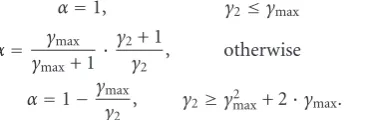
The power allocation can be explained as follows: (i) when γ2is small enough (γ2≤γmax), all power (α=1) should be used for FRNC since its rate is not saturated yet. (ii) Asγ2 gets greater thanγmax,αshould be set to satisfyγ2 = γmax.
Figure6: Throughput achieved by different schemes on the broad-cast channel-effect of relay position for two way relay (theoretical calculation, no constellation size limit).
The maximal rate is used over linkM2-Rfor FRNC, and the extra power is used for the SC transmission over the linkM2
-R. (iii) Ifγ2is very large, both the FRNC and SC transmission reach the maximal rate over the linkM2-R, andαis chosen to satisfy (1−α)·γ2 ≥ γmax for the SC transmission. The rest power is used in improving the FRNC rate over the link
M1-R.
5.2. Capacity with Fading. Next we consider the effect of fading and assume each channel experiences block Rayleigh fading. γi follows the exponential distribution: fγi(γi) =
1/γi · e−γi/γi, and the joint distribution is f(γ1,γ2) = fγ1(γ1)· fγ2(γ2). The average throughput can be calculated by numerical integration.
With a two-way relay scenario similar to the one shown in
Figure 1, we study how the position of the relay node affects the system performance. Adjusting the position ofRbetween
M1 and M2 changes the normalized distance dM1R/dM1M2. Average SNR (γi) of linksM1RandM2Ris calculated from the normalized distancedM1R/dM1M2 according to the two-ray model [18] with the path loss exponent (equaling 3 in the simulation). WhenRlies in the middle of M1andM2, the average SNR of both relay links equals 20 dB.αis set to the optimal value for schemes employing SC.
Figure 6 shows the average throughput of different
0.2 0.4 0.6 0.8 0
20 40 60 80
Normalized dist
Thr
o
ug
hput
(Mbps)
DF NC SC
NC + SC FRNC FRNC + SC
Figure7: Throughput achieved by different schemes on the broad-cast channel-effect of relay position for two way relay (simulation results, largest constellation is 256 QAM).
20 40 60 80 100
0 0.2 0.4 0.6 0.8 1
Throughput achieved on broadcast channel (Mbps)
CDF
DF NC SC
NC + SC FRNC FRNC + SC
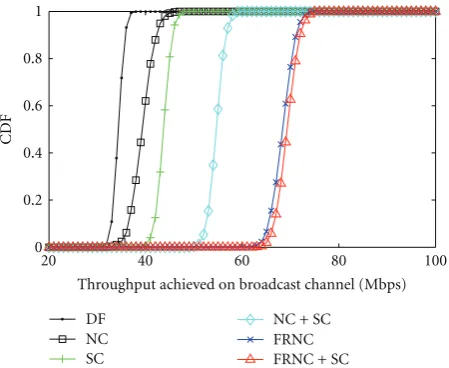
Figure8: Cumulative density function of throughput achieved on the broadcast channel (normalized distance=0.3 inFigure 7).
the same average SNR have different instantaneous SNR. Therefore, FRNC/FRNC + SC outperform NC and NC + SC even when the normalized distance equals 0.5.
6. Numerical Results
In this section, we evaluate the proposed FRNC and FRNC + SC schemes using Monte-Carlo simulations. Each slot consists of 4800 symbols. Messages are coded by a 4-state recursive systematic convolutional (RSC) code with the generator matrix (1, 5/7). Modulation and coding schemes shown inTable 5are used. Altogether, 10 different transmit rates can be supported. The number of information bits in a message varies from 2400 bits to 28800 bits. Messages are transmitted fromRto nodes via different schemes and decoded accordingly. In the evaluation, we focus on the
0.2 0.4 0.6 0.8
0 20 40 60 80
Normalized dist
Thr
oug
hput
(Mbps)
FRNC (64 QAM) FRNC (256 QAM)
FRNC + SC (64 QAM) FRNC + SC (256 QAM)
Figure 9: Throughput achieved by different schemes on the broadcast channel-effect of relay position for two way relay.
broadcast channel, and compare FRNC, FRNC + SC against DF, NC [3], NC with opportunistic scheduling (NCSched) [9], SC, and NC + SC [13]. SNR loss in FRNC is taken into account when choosing rates for transmissions. It is assumed that each link experiences independent block Rayleigh fading. Modulation constellations are adopted from IEEE 802.11a and the related parameters (symbol period, number of subcarrier) are used in calculating throughput [19].
With the two-way relay scenario shown inFigure 1and the same setting as in Section 5.2, we compare the actual throughput achieved by different schemes, with the practical constellation size limit.Figure 7shows the total throughput of different schemes on the broadcast channel with respect to the normalized distance, where the largest constellation is 256 QAM. Generally speaking,Figure 7shows similar trend
as Figure 6. But with the limit in constellation size, some
differences do occur: (i) FRNC + SC outperforms FRNC, (ii) at a small distance, FRNC and NC + SC have similar performances, and (iii) the difference between FRNC + SC and NC + SC gets larger than that in Figure 6. By the optimal allocation of power between FRNC and SC, the best performance is achieved in FRNC + SC under all distances. When the distance equals 0.30, FRNC + SC reaches the largest throughput gain, 25.8%, against NC + SC. At this distance, FRNC + SC achieves a much larger gain, 74.2%, against NC. The cumulative density function of the throughput at this distance is shown inFigure 8. The superiority of FRNC and FRNC + SC over other schemes is very clear.
Figure 9shows the effect of constellation size limit. When the largest constellation is constrained to 64 QAM instead of 256 QAM, the performance of both FRNC + SC and FRNC is degraded. But the performance of FRNC + SC is less affected, where the extra-power is used in SC transmission than being wasted in FRNC.
2 3 4 5 6
Figure 10: Throughput achieved by different schemes on the broadcast channel, effect of the number of nodes. (simulation results, largest constellation is 256 QAM).
scenarios, SC can hardly be used. Therefore, only the schemes without using SC are compared.Figure 10 shows the throughput on the broadcast channel. DF transmits in a TDMA manner. Therefore, it cannot benefit from the increase in nodes and its throughput is almost a constant value. On the other hand, NC, NCSched and FRNC all benefit from the increase in flows more or less. Due to the different capability in handling rate mismatch, the slopes of three curves differ greatly. FRNC always has the highest throughput because the rate mismatch problem is completely solved and full rate is achieved.
7. Conclusions
Recently, network coding is widely studied for improving the relay efficiency in wireless networks. Its performance, however, is greatly limited by factors such as rate mismatch. In this paper, we reinterpreted network coding as a mapping between modulation constellations and extended this map-ping to enable simultaneous use of different modulations in network-coded transmissions. In this way, the highest rate over each link can be used and the sum rate can be achieved over the broadcast channel. As a result, the rate mismatch problem is completely solved. The only shortcoming of the proposed scheme is its SNR loss in nesting constellations. This little SNR loss is acceptable if the throughput gain is taken into account. We will further study the effect of the direct link and the potential errors at relay node.
Acknowledgment
This research was performed under research contract of “Research and Development for Reliability Improvement by The Dynamic Utilization of Heterogeneous Radio Systems”, for the Ministry of Internal Affairs and Communications, Japan.
References
[1] F. H. P. Fitzek and M. D. Katz, Cooperation in Wireless Networks: Principles and Applications, Springer, New York, NY, USA, 1st edition, 2006.
[2] R. Ahlswede, N. Cai, S. Y. R. Li, and R. W. Yeung, “Network information flow,”IEEE Transactions on Information Theory, vol. 46, no. 4, pp. 1204–1216, 2000.
[3] P. Larsson, N. Johansson, and K. E. Sunell, “Coded bi-directional relaying,” inProceedings of the IEEE 63rd Vehicular Technology Conference (VTC ’06), vol. 2, pp. 851–855, July 2006.
[4] P. Popovski and H. Yomo, “Bi-directional amplification of throughput in a wireless multi-hop network,” inProceedings of the IEEE 63rd Vehicular Technology Conference (VTC ’06), vol. 2, pp. 588–593, July 2006.
[5] S. Zhang, S. C. Liew, and P. P. Lam, “Hot topic: physical-layer network coding,” in Proceedings of the 12th Annual International Conference on Mobile Computing and Networking (MOBICOM ’06), pp. 358–365, September 2006.
[6] S. Katti, S. Gollakota, and D. Katabi, “Embracing wireless interference: analog network coding,” in Proceedings of the ACM : Conference on Computer Communications (SIGCOMM ’07), pp. 397–408, August 2007.
[7] C. Hausl and J. Hagenauer, “Iterative network and channel decoding for the two-way relay channel,” inProceedings of the IEEE International Conference on Communications (ICC ’06), vol. 4, pp. 1568–1573, July 2006.
[8] S. Tang, J. Cheng, C. Sun, R. Miura, and S. Obana, “Joint channel and network decoding for XOR-based relay in multi-access channel,”IEICE Transactions on Communications, vol. E92-B, no. 11, pp. 3470–3477, 2009.
[9] H. Yomo and P. Popovski, “Opportunistic scheduling for wireless network coding,”IEEE Transactions on Wireless Com-munications, vol. 8, no. 6, Article ID 5089949, pp. 2766–2770, 2009.
[10] P. Larsson, “A multiplicative and constant modulus signal based network coding method applied to CB-Relaying,” in
Proceedings of the IEEE 67th Vehicular Technology Conference (VTC ’08), pp. 61–65, May 2008.
[11] T. Koike-Akino, P. Popovski, and V. Tarokh, “Denoising maps and constellations for wireless network coding in two-way relaying systems,” in Proceedings of the IEEE Global Telecommunications Conference (GLOBECOM ’08), pp. 3790– 3794, December 2008.
[12] G. Zeitler, R. Koetter, G. Bauch, and J. Widmer, “On quantizer design for soft values in the multiple-access relay channel,” in
Proceedings of the IEEE International Conference on Communi-cations (ICC ’09), June 2009.
[13] R. Alimi, LI. Li, R. Ramje, H. Viswanathan, and Y. R. Yang, “IPack: in-network packet mixing for high throughput wireless mesh networks,” inProceedings of the 27th IEEE Com-munications Society Conference on Computer ComCom-munications (INFOCOM ’08), pp. 66–70, April 2008.
[14] M. H. M. Costa, “Writing on dirty paper,”IEEE Transactions on Information Theory, vol. IT-29, no. 3, pp. 439–441, 1983. [15] S. Katti, H. Rahul, W. Hu, D. Katabi, M. M´edard, and
J. Crowcroft, “XORs in the air: practical wireless network coding,” inProceedings of the Conference on Computer Com-munications (SIGCOMM ’06), pp. 243–254, 2006.
[17] J. Hagenauer, L. Papke, E. Offer, and L. Papke, “Iterative decoding of binary block and convolutional codes,” IEEE Transactions on Information Theory, vol. 42, no. 2, pp. 429– 445, 1996.
[18] A. Goldsmith,Wireless Communications, Cambridge Univer-sity Press, New York, NY, USA, 2005.