MP-01.01
The Impact of a Sensitivity Adapted Antimicrobial Prophylactic Strategy on Prostate Biopsy Sepsis
Rowe, Neal; Breau, Rodney H.; Cagiannos, Ilias; Zvonar, Rosemary; Fergusson, Dean; Lavallée, Luke T.; Mallick, Ranjeeta; Morash, Christopher G. University of Ottawa, Ottawa, ON, Canada
Introduction and Objectives: Infections following prostate biopsy can be associated with significant morbidity and occasional mortality. Studies have suggested an increased incidence in post-biopsy sepsis. The purpose of this study was to determine the effect of a bacteria sensitivity adapted antimi-crobial prophylactic strategy on the incidence of sepsis post prostate biopsy. Methods: In October 2008, based on the prevalence of ciprofloxacin-resis-tant E.coli in the region, our institution modified the prophylactic regimen for prostate biopsy from oral ciprofloxacin alone to a combination of single-dose ciprofloxacin and trimethoprim/sulfamethoxazole. If patients had a his-tory of urosepsis, bacterial prostatitis, organ transplant, or fluoroquinolone use in the preceding 12 months, intramuscular ceftriaxone was administered for prophylaxis. Patients with penicillin allergy received gentamicin. We determined the incidence of ciprofloxacin-resistant bacteremia 15 months before and 15 months after the change in antibiotic protocol.
Results: Between June 2007 and September 2008, 9 of 847 (1.06%) patients were admitted with prostate biopsy induced bacteremia secondary to cip-rofloxacin-resistant E. coli. In the 15 months following introduction of the described prophylactic regimen, 1 of 989 (0.10%) patients suffered ciprofloxacin-resistant sepsis. The absolute reduction in E. coli sepsis was 0.96% (95%CI 0.2% to 1.7%; p=0.007). The number needed to treat is 104. Conclusions: Bacterial susceptibility to antimicrobial agents is in evolution. Using a regional bacteria sensitivity based approach to biopsy prophylaxis, we have significantly decreased ciprofloxacin-resistant E. coli sepsis in our patients. Regional bacteria sensitivity based protocols may decrease the incidence at other centres and warrants further study.
MP-01.02
Serum Adipokine Levels Improve Prostate Cancer Prediction Compared to Clinical Data Only
Margel, David1; Trottier, Greg1; Yap, Stanley1; Connor, Mike2; Elharram,
Malik1; Bhindi, Bimal1; Kulkarni, Girish1; Finelli, Antonio1; Zlotta, Alexandre
R.1; Fleshner, Neil1
1Division of Urology, Department of Surgical Oncology, University Health
Network, University of Toronto, Toronto, ON, Canada; 2University of York,
Toronto, ON, Canada
Introduction and Objectives: Previously we demonstrated the potential of adipokines as biomarkers for prostate cancer. However biomarkers are costly and should be used if they prove superior to existing models using clinical data. In this study we sought to determine whether adipokines offer additional diagnostic benefit in comparison to clinical data.
Methods: The analysis included data from 200 patients undergoing prostate biopsy ( One-hundred PCa cases and 100 controls). Serum samples col-lected prior to prostate biopsy were used to measure adipokines (adipo-nectin, leptin, PAI, Resistin, HGF, IL-1β, IL-6, IL-8, MCP-1, NGF and TNF-alpha) using Milliplex Multi-Analyte Profiling kits. Multivariable models for predicting PCa and high grade PCa were created using predictors from three model selection methods (Forward, Backward, Stepwise) based on 1000 bootstrap samples. We compared a model composed of clinical data to one that includes both clinical data and adipokines. The ability of each model to predict PCa was evaluated by area under the receiver operating
characteristic curve (AUC of ROC).
Results: The multivariable clinical model to predict PCa included: DRE, BMI, previous biopsy and PSA. The adipokine multivariable model included the clinical variables MCP-1, TNF-alpha , IL-6 and HGF. The AUC of the ROC curve for predicting PCa was 0.67 (95%CI 0.59-0.74) for the clinical data only vs. 0.745 (95%CI 0.67-0.81) for the model including adipokines (p=0.018). The clinical model to predict high grade PCa included: DRE, PSA and previous biopsy. The adipokines added to predict high grade cancers were: NGF and MCP-1. The AUC of the ROC curve for predicting high grade prostate cancer was 0.75 (95%CI 0.67-0.83) for the clinical data only vs. 0.79 (95%CI 0.71-0.86) for the model including adipokines (p=0.0532). Conclusions: We have demonstrated that adding serum adipokine levels increases the accuracy of models predicting both prostate cancer and high grade prostate cancer.
MP-01.03
PCA3 Test as an Adjunct in Diagnosis of Prostate Cancer Yutkin, Vladimir1; Al-Zahrani, Ali1; Williams, Andrew1; Hidas, Guy2;
Martinez, Carlos1; Izawa, Jonathan1; Pode, Dov2; Chin, Joseph1
1University of Western Ontario, Uro-Oncology Fellowship Program,
London, ON, Canada; 2Hadassah and Hebrew University Medical Center,
Jerusalem, Israel
Introduction and Objectives: Early diagnosis of prostate cancer is conven-tionally done with serum prostate specific antigen (PSA) test and digital rectal examination, but these tests lack specificity. Many men worldwide undergo repeated, sometimes unnecessary prostate biopsies due to sus-picious or rising PSA levels. In this multinational study we assessed the performance of the PCA3 urine test in patients who were candidates for prostate biopsies due to high or rising PSAs.
Methods: The PCA3 scores were determined in urine samples in these men. A PCA3 scores of 35 or higher were considered higher probability of cancer. Subsequent biopsy was performed as per current best practice and at the discretion of the urologist in concert with the patient. We used multiple logistic regression analysis and ROC curves to evaluate PCA3 as a prognostic factor compared with PSA and evaluated the influence of PCA3 testing on the decision making.
Results: In 256 patients (63.8%) the indication was rising or high PSA after previous negative biopsies, finding of HGPIN or ASAP on previous biopsy – in 101 patients (25.2%). PCA3 scores were significantly lower in patients without malignancy using a cutoff score of 35 (OR 2.99 (95%CI), p=0.004). On ROC analysis PCA3 AUC of 0.722 was significantly greater than PSA (0.4837). Sensitivity and specificity of PCA3 score using the 35 cutoff were 63.6% and 63.0%, respectively. The PCA3 test affected the patient’s man-agement in 73.5% of cases. The follow-up PSA values in patients who did not perform biopsy after PCA3 testing had, without exception, remained stable or dropped with follow-up of at least 6 months.
Conclusions: In this multinational study we demonstrate that urine PCA3 score test out-performs PSA in decision making in men facing possibility of repeat prostate biopsy. We recommend that the PCA3 score should be integrated with other relevant data and rather be used in continuous fashion, and not with certain cutoff value.
MP-01.04
Percentage of Gleason 4 on Repeat Biopsy: How Much Matters? Punnen, Sanoj; Glass, Allison; Cowan, Janet; Carroll, Peter
University of California, San Francisco, CA, United States
Introduction and Objectives: A common trigger for intervention in men on active surveillance (AS) is an upgrade to Gleason 4 disease on repeat biopsy. However, it is unknown what percentage of Gleason 4 portends worse outcomes at the time of surgery. Our objective was to investigate the relationship between percentage of Gleason 4 on repeat biopsy and pathological stage at surgery.
Methods: This was a retrospective review of AS patients who had low grade and volume of disease at diagnosis,underwent at least 1 repeat biopsy, and ultimately went on to radical prostatectomy. We reported the distribution of patients who had no, <30% and ≥30% Gleason 4 on repeat biopsy. Multivariate logistic regression was used to assess the association between percent of high-grade disease (Gleason 4) on repeat biopsy and the likelihood of pathological ≥T3 disease at surgery.
Results: The cohort consisted of 85 patients. The mean age was 60 (6.7) and the median number of biopsies per patient was 2 (2-9). Among these patients, 32 (38%) had no grade progression, 21 (25%) had <30% Gleason 4 and 31 (36%) had ≥30% Gleason 4 on repeat biopsy. Percentage of high-grade biopsy tissue was associated with higher risk of upstaging in univariate and multivariate analysis. Men with ≥30% Gleason 4 on repeat biopsy were more likely to have pathological T3 disease compared to men that did not have grade progression (OR 9.2, 95%CI 1.7-48.9; p<0.01). However, there was no difference in the likelihood of pathological ≥T3 disease between those patients without grade progression and those with upgrade to <30% Gleason 4 (p=0.87).
Conclusions: This analysis showed that the percentage of Gleason 4 on repeat biopsy was associated with the likelihood of extra-prostatic dis-ease at surgery and thus, should be an important factor when making treatment decisions.
MP-01.05
Diagnostic Accuracy of Seminal Vesicle Biopsy in Evaluating Seminal Vesicle Invasion: Comparison with MRI
Suntharasivam, Thiru; Hameed, Ammar; Doble, Andrew
Urology Department, Addenbrookes University Hospital, Cambridge, United Kingdom
Introduction and Objectives: No consensus exists regarding role of semi-nal biopsy for patients in whom staging MRI suggests semisemi-nal vesicle invasion MRI has a high false positive rate for seminal vesicle invasion. Our aim was to retrospectively determine the accuracy of seminal vesicle biopsy in diagnosing seminal vesicle involvement in carcinoma of pros-tate, as compared to magnetic resonance (MR) imaging and to correlate to radical prostatectomy specimen histology.
Methods: Retrospective review of MRI findings along with radical pros-tatectomy specimen of patients who underwent seminal vesicle biopsy as a diagnostic tool. Data were collected on all patients who underwent seminal vesicle biopsy (period: 2002-2010). Forty-one men (age range: 48-79 years). The histology was reviewed individually and correlated with pre-biopsy MRI and post biopsy prostatectomy if surgery performed. Results: MRI: Thirty-one (76%) cases had suspicious to positive MRI find-ings for seminal vesicle involvement and 10 (24%) had –ve results. SV: Of all the 41 patients who underwent SV biopsy, 30(73%) were –ve, 6 (15%) were suboptimal, 5 (12%) were +ve and they did not undergo rad-ical surgery. Out of all negative SV biopsy patients: Nine (22%) underwent radical robotic prostatectomy. All the nine surgical specimens showed no seminal vesicle involvement however All the nine patients had a suspi-cious to +ve on MRI prostate. All those underwent SV biopsy did not have any significant post operative complications.
Conclusions: Seminal vesicle biopsy appears to have higher diagnostic accuracy when compare to MRI in diagnosing seminal vesicle invasion by carcinoma of prostate. Patients with positive to suspicious MRI will benefit from SV biopsy before deciding about surgery.
MP-01.06
Ultra-extended Prostate Biopsy Improves Detection of Pathologic Progression in Patients on Active Surveillance for Prostate Cancer Wong, Lih-Ming1; Trottier, Greg1; Fleshner, Neil1; Lawrentchuk, Nathan1;
Kulkarni, Girish1; Zlotta, Alexandre R.2; Trachtenberg, John1; Toi, Ants3;
Timilshina, Narhari4; Finelli, Antonio1
1Department of Urology, Princess Margaret Hospital, Toronto, ON,
Canada; 2Department of Urology, Mount Sinai Hospital, Toronto,
ON, Canada; 3Department of Radiology, Princess Margaret Hospital,
Toronto, ON, Canada; 4Division of General Internal Medicine & Clinical
Epidemiology, University Health Network, Toronto, ON, Canada Introduction and Objectives: Active surveillance (AS) involves regular prostate re-biopsy to minimize sampling error and detect pathological progression. At our institution, re-biopsy consists of an “ultra-extended” template (UET) of 15-17 cores. We investigated if biopsy templates with fewer cores could be used with similar rates of detecting cancer and pathological progression.
Methods: We identified patients in our single institution prospectively maintained database with an entry PSA <10, Gleason sum (GS) ≤6, stage T1c, ≤3 cores positive for cancer, <50% of single core involved and age
≤75 years (N=272). From this group, 94 patients fulfilled the standard criteria for pathological progression at any follow-up biopsy and were selected for evaluation. By mapping tumor location on the pathologi-cal progression determining biopsy, we were able to apply hypothetipathologi-cal scenarios of sextant or standard extended templates to establish if these biopsy templates were equivalent in detecting pathological progression. Results: For the 94 patients analyzed, the median number of cores taken at baseline was 9.7 (6-22) and 15.1 (6-27), for follow-up biopsies. The median time between baseline and the pathological progression deter-mining biopsy was 15.4 months (8.9-27.8). Patients pathologically pro-gressed with one (56.4%), two (28.7%) and all three criteria (14.9%) respectively. If a sextant template had been used, 84% of the cancers and 47.9% of the progressive events would have been identified. A stan-dard extended template scenario detected 99% of cancers and 81.9% of patients that pathological progressed. When considering GS ≥7 related progression events, standard extended template found 60.6% compared to UET, 72.3%.
Conclusions: When following patients on AS, a 15-17 core UET detects pathologically significant cancer in 20-50% more patients than standard sextant or extended biopsy templates. Better predictors for tailoring biopsy templates are required.
MP-01.07
Is There a Role for Routine Anterior Zone Sampling during Transrectal Ultrasound Guided Saturation Prostate Biopsy Cole, Eric1; Shayegan, Bobby1; Matsumoto, Edward1; Greenspan, Michael1;
Daya, Dean2; Patlas, Michael3; Pinthus, Jehonathan H.1
1McMaster Institute of Urology, Hamilton, ON, Canada; 2McMaster
Department of Pathology, Hamilton, ON, Canada; 3McMaster University
Department of Radiology, Hamilton, ON, Canada
Introduction and Objectives: The anterior zone (AZ) of the prostate has been recognized as a sanctuary site for prostate cancer (PC). We exam-ined the diagnostic yield of AZ biopsies as part of a saturation template in patients with elevated PSA levels but with previous negative extended prostate biopsies (group 1), and in surveillance biopsies of PC patients (group 2).
to age and PSA. There was an equal incidence of ≥ Gleason 7 disease in the AZ in both groups, however, this was often accompanied by disease of equal grade in the PZ. Isolated TZ cancers were not detected. 28.6% and 25.9% of patients with positive biopsies in groups 1 and 2 met the Epstein Criteria for insignificant PC. Overall 15/29 (52%) of patients in the AS group showed some progression in disease on their surveillance biopsy (8 with increased disease volume, 7 with upstaging to Gleason 7). Conclusions: Saturation biopsy is almost always positive in patients under-going surveillance biopsy and commonly positive in patients with clinical suspicion for PC despite previous negative biopsies. However, the routine addition of TZ and AZ sampling rarely adds to the diagnostic yield, and will seldom change a patient’s risk stratification.
MP-01.08
International Multi-centre Study Examining Selection Criteria for Active Surveillance in Men Undergoing Radical Prostatectomy Wong, Lih-Ming1; Neal, David2; Johnston, Richard2; Shah, Nimesh2;
Warren, Anne2; Hovens, Chris3; Goldenberg, Larry4; Gleave, Martin4;
Costello, Anthony3; Corcoran, Niall3
1Princess Margaret Hospital, Toronto, ON, Canada; 2Addenbrookes
Hospital, Cambridge, United Kingdom; 3The Australian Prostate Cancer
Centre at Epworth and Departments of Urology and Surgery, Royal Melbourne Hospital, Melbourne, Australia; 4The Vancouver Prostate
Centre, Department of Urological Sciences, University of British Columbia, Vancouver, BC, Canada
Introduction and Objectives: To examine the proportion of pathological re-classification for men who were initially suitable for active surveillance (AS), that underwent radical prostatectomy.
Methods: From three centres in UK, Canada and Australia, prospective data on men who underwent radical prostatectomy was retrospectively reviewed. Men initially suitable for AS, according to Toronto (1) and PRIAS (2) criteria, had prostatectomy specimens analyzed for pathological upgrading (Gleason score ≥7) and upstaging (≥pT3 disease). Multivariable logistic regression was performed to identify predictors of high-risk dis-ease. A nomogram was generated by logistic regression analysis, and performance characterized by ROC curves.
Results: The number of men meeting the Toronto and PRIAS criteria was 800 and 410 respectively. For Toronto and PRIAS groups, the rates for upgrading were 50.6%, 42.7%, and upstaging 17.6%, 12.4% respec-tively. Significant predictors of high-risk disease were: - Toronto criteria: increasing age, cT2 disease, centre of diagnosis and number of positive cores - PRIAS criteria: increasing PSA and cT2 disease Cambridge had a high pT3a rate (26% vs. 12%). To assist selection of men in the UK for AS, from the Cambridge data, we generated a nomogram predicting high-risk features in patients who meet the Toronto criteria (AUC of 0.72). Conclusions: The rate of pathological re-classification in our cohort was higher than previously reported from Europe and America. Care must be used when applying AS criteria generated from one population to another. With more stringent selection criteria, there is less reclassification but also fewer men who may benefit from AS.
MP-01.09
Gleason Upgrading and Increased Cancer Volume on Repeat Prostate Biopsy in Patients on Active Surveillance (AS)
Preston, Mark A.1; Carrasquillo, Robert2; Paly, Jonathan J.1; Coen, John J.1;
Zietman, Anthony I.1; Smith, Matthew R.1; Wu, Chin-Lee1; McDougal, W.
Scott1; Feldman, Adam S.1
1Massachusetts General Hospital, Boston, MA, United States; 2Harvard
Medical School, Boston, MA, United States
Introduction and Objectives: The choice to terminate AS for localized prostate cancer in favor of initiating definitive treatment is based on factors including pathologic change on re-biopsy, progression in PSA or DRE, or patient preference. The relative extent to which each of these factors plays a role in the termination of AS is not clearly established. Our objective was to determine the prevalence of prostate re-biopsy and subsequent pathologic change in an AS cohort.
Methods: Under IRB approved protocol, a historical cohort study of men diagnosed with prostate cancer was performed at a single centre between 1997 and October 2009. Although AS had been practiced throughout this period, in 2008 our group agreed upon a protocol for repeat biopsy at 12-18 months after diagnosis. Subsequent biopsy was left to the discretion of the treating physician. Only men with AS as the initial management option were included.
Results: The median fu was 4.8yr for the 499 patients included in the study. Median PSA at diagnosis was 5.1. 98.2% (490/499) of patients were Gleason 6, 1.8% (9/499) were Gleason 7 and 94.0% (469/499) were stage T1c. 322/499 (65%) patients underwent rebiopsy. The number of rebiopsies ranged from 1–5 with 113/499 (23%) patients having more than one rebiopsy. Findings on initial rebiopsy revealed prostate cancer in 71% (228/322), benign tissue in 21% (67/322), PIN in 7% (23/322), and atypia in 1% (4/322). The Gleason sum increased in 19% of patients whose rebiopsy revealed cancer. Cancer volume increased (expressed as percent of positive cores in quartiles) in 26% of patients on rebiopsy. Of 123 patients who required active treatment, 46% (56/123) was due to pathologic progression.
Conclusions: We identified a significant proportion of Gleason upgrading and volume progression on repeat biopsy in this cohort. Repeat biopsy often resulted in a significant change in management. These findings support the critical role of repeat biopsy in an AS protocol.
MP-01.10
Multi-institutional Validation of the CAPRA-S Score to Predict Outcomes after Radical Prostatectomy
Punnen, Sanoj1; Freedland, Stephen2; Presti, Joseph3; Aronson, William4;
Terris, Martha5; Kane, Christopher6; Amling, Christopher7; Carroll, Peter1;
Cooperberg, Matthew1
1University of California, San Francisco, CA, United States; 2Duke
University, Durham, NC, United States; 3Stanford University, Palo Alto, CA,
United States; 4University of California, Los Angeles, CA, United States; 5Medical School of Georgia, Augusta, GA, United States; 6University
of California, San Diego, CA, United States; 7Oregon Health Sciences
University, Portland, OR, United States
Introduction: The UCSF Cancer of the Prostate Risk Assessment post-Surgical (CAPRA-S) score uses postoperative pathological data to predict the risk of PSA recurrence post radical prostatectomy. The study objective was to validate this instrument’s performance in a large, multi-institutional, external database.
Methods: Of the 2,892 men in the Shared Equal Access Regional Cancer Hospital (SEARCH) database, 2,670 (92%) had complete data available to calculate a CAPRA-S score. The CAPRA-S is determined by adding up to 3 points each for PSA and pathological Gleason score, 2 points each for positive surgical margins and seminal vesicle invasion and 1 point each for extracapsular extension and lymph node involvement. Performance of the CAPRA-S score was assessed using proportional hazards regression, and compared to a validated postoperative nomogram by the concordance (c) index, calibration plots and decision curves analysis.
Results: Among this cohort, the mean age was 62 (SD 6.3) years and 33.3% of men recurred. Median follow-up was 61 months among men who did not recur. The hazard ratio (HR) for each one-point increase in the CAPRA-S score was 1.39 (95%CI 1.36-1.43). The 5-year progression free probability for those patients with a CAPRA-S score of 0-2, 3-5 and 6-10 (defining low-, intermediate-, and high-risk) were 72%, 39%, and 17%, respectively. The CAPRA-S c-index was 0.75 in this validation set, compared to a c-index of 0.73 for the Stephenson nomogram and 0.77 for CAPRA-S in the original development set. The CAPRA-S score per-formed better than the Stephenson nomogram on both calibration plots and decision curves analysis.
MP-01.11
High Intensity Focused Ultrasound for Localized Prostate Cancer: Impact of Nadir PSA on Cancer Control
Shayegan, Bobby1; Dason, Shawn1; Pinthus, Jehonathan H.1; Farrokhyar,
Forough2; Orovan, William1
1Division of Urology, McMaster University, Hamilton, ON, Canada; 2Department of Surgery, McMaster University, Hamilton, ON, Canada
Introduction and Objectives: High intensity focused ultrasound (HIFU) is a treatment for clinically localized prostate cancer. The aim of this study is to assess the impact of PSA nadir on biochemical failure free rate (BFFR) in a large single centre cohort.
Methods: We analyzed our institutional review board approved pro-spectively collected database of consecutive patients who underwent primary HIFU (Ablatherm, EDAP, Lyon) for prostate cancer. Patients were included in the study if they were stratified by the D’Amico criteria as either low- or intermediate-risk with at least 12 months follow-up. Patients with prior radiotherapy or HIFU were excluded. PSA nadir was defined as the lowest value of post treatment PSA at any time during follow-up. Biochemical failure (BCF) was defined by the Stuttgart method (nadir+1.2 ng/mL). Kaplan-meier survival curves for BFFR over time stratified by PSA nadir ≤0.5 ng/ml and >0.5 ng/ml were compared using the log-rank test. Univariable and multivariable Cox regression analysis was performed. Results: Between May 2005 and December 2010, 402 patients met the inclusion criteria for the study. Median follow-up was 24 months, median nadir PSA was 0.1 ng/mL, median time to nadir PSA was 3 months, and BCF was observed in 81 patients. BFFR at 48 months follow-up was 79% (72-86, 95%CI) for a PSA nadir ≤0.5 ng/mL and 25% (13-38, 95%CI) for PSA nadir >0.5 ng/mL (log-rank p<0.001). PSA nadir >0.5 ng/mL (HR 7.69, 95%CI 4.93 – 12.0), prostate volume and pretreatment PSA were significant predictors of BCF on univariate Cox analysis (p<0.05). PSA nadir >0.5 ng/mL (HR 6.88, 95%CI 4.39-10.77) and pretreatment PSA (HR 1.11, 95%CI 1.05 – 1.18) were found to predict BCF on multivari-able Cox analysis.
Conclusions: Nadir PSA following primary HIFU serves as a highly sig-nificant predictor of BCF. Given that nadir PSA is achieved at a median time of 3 months, this variable can be used as an early trigger for post-treatment biopsy.
MP-01.12
Radical Prostatectomy in Patients with High-Risk Prostate Cancer: Predicting Oncological Outcomes in a Single Series Autran Gomez, Ana Maria; Chin, Joseph; Izawa, Jonathan
London Health Sciences Centre, University of Western Ontario, London, ON, Canada
Introduction and Objectives: The role of radical prostatectomy (RP) in patients (pts) with high risk disease is controversial. Objectives of this study were to report our experience in terms of oncological outcomes and to analyze the risk factors for disease progression in a select group of patients who underwent RP, with or without adjunctive therapies. Methods: We retrospectively reviewed the records of 209 consecutive pts with high risk PCa having one or more of the following risk factors: PSA
≥20,cT3, Gleason 8-10, underwent RP and bilateral pelvic lymphadenec-tomy between 2000 to 2010. Pathologically confined disease (PCD) was defined as negative surgical margins, pT2-pT3a, and negative lymph node involvement. The Kaplan Meier method was used to assess biochemical recurrence (BCR)-free survival and cancer-specific survival (CSS) rates. Potential predictors were explored using univariable and multi-variable Cox regression models.
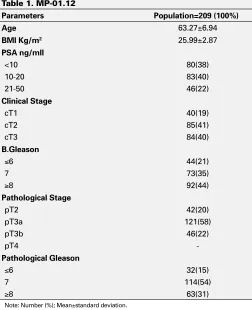
Results: Patient and tumor characteristics are listed in Table 1. Of 209 pts, 126 (60%) had PCD and 83(40%) extraprostatic disease. 160 (77%) pts had one high risk feature, 17% of pts had 2 and 7% had 3 features. Mean pre-PSA was 12.54 (range 2.23-36) ng/ml. Median follow-up was 55 (8-109) months. At multivariable analysis: cT3 (p=0.022), biopsy Gleason score (p=0.004) and pre-PSA (p=0.001) were all predictive factors of progression of disease but the percentage of tumor involvement was not a predictor (p=0.657). At 5 years, overall BCR-free survival was 56% and CSS was 92%. 104 (50%) pts had androgen deprivation therapy
postoperative, 35 (17%) had adjuvant radiotherapy and 70 (33%) received combined therapy.
Conclusions: In our series, 60% of pts presented with organ-confined dis-ease. At intermediate term, the results showed acceptable cancer control and CSS. Radical prostatectomy has a role in a select group of patients with high-risk disease, with adjuvant therapy recommended for those with risk factors for disease progression.
MP-01.13
Prospective, Randomized Use of the VLOC Vesicourethral Anastamosis during Robot-assisted Radical Prostatectomy: Long-term Follow-up
Zorn, Kevin; Trinh, Quoc-Dien; Liberman, Dan; Elhakim, Assaad University of Montreal (CHUM), Montreal, QC, Canada
Introduction and Objectives: Robotic vesicourethral anastomosis (VUA) using the Van Velthoven technique has significantly improved urinary reconstruction during RARP. Recent series suggest off-label use of barbed polyglyconate suture mayfacilitate VUA, however the long-term risk for stricture formation and impact on urinary continence is unknown. We sought to evaluate the effectiveness of VLOC for urinary reconstruction with minimum 1 year follow-up.
Methods: A prospective, randomized study was conducted in 120 con-secutive RARP. Assurance of watertight closure was ensured with 300mL intraoperatively. Suture related complications, validated-questionnaire continence and a cost analysis were analyzed.
Results: Compared to conventional reconstruction, there was a significant reduction in mean reconstruction time (14.1 vs. 22.2min; p<0.01). Need to readjust suture tension or place additional LapraTy clips to establish a watertight closure was observed in 13 (22%) vs. 5 (8%) of cases (p=0.05). Time to foley removal was comparable between groups (4.1 vs. 4.2 days,
p=0.87). Need for catheter replacement was similar between groups (both
Table 1. MP-01.12
Parameters Population=209 (100%)
Age 63.27±6.94
BMI Kg/m2 25.99±2.87
PSA ng/mll
<10 80(38)
10-20 83(40)
21-50 46(22)
Clinical Stage
cT1 40(19)
cT2 85(41)
cT3 84(40)
B.Gleason
≤6 44(21)
7 73(35)
≥8 92(44)
Pathological Stage
pT2 42(20)
pT3a 121(58)
pT3b 46(22)
pT4
-Pathological Gleason
≤6 32(15)
7 114(54)
≥8 63(31)
5%). With a mean follow-up of 18.2 months, no delayed clinical anasto-motic leaks or bladder neck contractures were observed in either group. Padfree continence outcomes at 1 (64% vs. 69%, p=0.60), 3 months (76% vs. 81%, p=0.54), 6 months (88% vs. 92%, p=0.67) and 12 months (90% vs. 92%; p=0.57), were also comparable.
Conclusions: Compared to standard monofilament suture, use of VLOC suture appears to provide a safe, more efficient and cost effective urinary reconstruction during RARP. Use of the interlocked-VLOC suture tech-nique prevents slippage, precluding the need for assistance, knot tying and constant reassessing of anastomosis integrity. More important, to the best of our knowledge, this is the longest follow-up with such soft-tissue suture material for urinary reconstruction. Despite initial concern for increased inflammation from delayed material absorption and suture barbs, no adverse outcomes are observed in long-term assessment.
MP-01.14
Comparison of Open and Robotic-assisted Prostatectomy: The University of British Columbia Experience
Gagnon, Louis-Olivier; Lynch, Kenny; Hurtado -Coll, Antonio; Goldenberg, Larry; Gleave, Martin
Department of Urologic Sciences, University of British Columbia, Vancouver, BC, Canada
Introduction and Objectives: The purpose of this study is to report on outcomes and costs of open prostatectomy (OP) versus robotic-assisted prostatectomy (RAP) at a single tertiary care university hospital. Methods: Retrospective analysis has been done on the last 200 patients operated by one experienced open surgeon (MG) and the last 200 patients operated by one experienced robotic surgeon (LG), as of October 1st 2011.
Results: The 2 groups had similar demographics, including mean age (64.7 vs. 64.2), mean body mass index (27.2 vs. 27.2), and rate of prior abdominal surgery (31% vs. 27%). The OP group had more high risk cancers compared to the RAP group (32.5% vs. 8.5%). Operative room time was less for the open cases, with mean skin-to-skin time of 114.2 mins versus 234.1 mins. The OP group had a higher mean blood loss of (402.8 ml vs. 287.5 ml). The transfusion rate was similar at 1.5% (3/200) in the OP group compared to 3.5% (7/200) in the RAP group. For the last 100 cases, the mean length of stay was 1.78 days for the open cases compared to 1.76 days for the robotic cases. The OP group had more high grade disease in the prostatectomy specimen, with Gleason 8 or more in 23.5% compared to 3.5% in the RAP group. The positive surgical margin rate was comparable at 31% for the OP group overall and 24.6% for the RAP group. The rate was also comparable after stratification between pT2 and pT3. Preliminary results for postoperative outcomes revealed similar stress urinary incontinence rates at 12 months of 3.9% for the open cases and 5.8% for the robotic cases. The biochemical-free status at 12 months was also comparable at 95.7% and 94.3% respectively. The added cost of robotic prostatectomy was calculated as 5629$ per case.
Conclusions: In this study, open prostatectomy had a shorter opera-tive time and a lower cost compared to the robotic-assisted approach. Transfusion rates, length of hospital stay, positive surgical margin rates and preliminary postoperative outcomes were similar.
MP-01.15
How Does Robot-assisted Laparoscopic Radical Prostatectomy Compare to Open Surgery in Men with High Risk Prostate Cancer?
Punnen, Sanoj; Cowan, Janet; Carroll, Peter
University of California, San Francisco, CA, United States
Introduction and Objectives:: Contemporary studies at high volume cen-tres have suggested equivalent oncologic outcomes when comparing open radical prostatectomy to robot assisted laparoscopic radical prostatectomy (RALP). However, the use of RALP in men with high-risk tumors has been debated. The objective of this study was to compare oncologic outcomes in patients who underwent open and robotic surgery at a single institution. Methods: A retrospective analysis of D’Amico high-risk patients treated with open or robotic surgery at UCSF from 2002 to 2011 was conducted. Multivariate logistic regression was used to assess likelihood of positive surgical margins by surgical approach, adjusting for age, common tumor characteristics, and degree of nerve sparing. Time to tumor recurrence by surgical approach was evaluated with Cox proportional hazards regres-sion, controlling for similar tumor characteristics, degree of nerve sparing, and adjuvant treatment.
Results: 177 open radical prostatectomy and 234 RALP patients made up the final cohort for analyses. Mean age was 61.6 years (SD=6.6) and median follow-up was 27 months (range 2-112). RALP patients experi-enced less blood loss (median 200 vs. 400 cc, p<0.01) and underwent complete bilateral nerve sparing more often (54% vs. 34%, p<0.01) then those undergoing open surgery. Those undergoing open surgery were more likely to have a lymph node dissection and nodal involvement. There were no differences by approach in pathological grade, stage, or positive margin rate. Recurrence-free survival was similar at 2 years (84% and 79%) and 4 years (68% and 66%) after open and robotic surgery, respectively (log-rank p=0.53).
Conclusion: This study is novel in that it assesses outcomes of open versus robotic prostatectomy in a cohort of high-risk men at a single institution. Surgical approach was not associated with oncologic outcomes after surgery with short-term follow-up making RALP a feasible option for men with high-risk prostate cancer.
MP-01.16
Positive Surgical Margins at Radical Prostatectomy: Population-based Averages within PSA and Gleason Strata
Izard, Jason1; Salazar, Marco2; Chatterjee, Suman3; Lin, Daniel1; Wright,
Jonathan1
1Department of Urology, University of Washington, Seattle, WA, United
States; 2Sound Urological Associates, Edmonds, WA, United States; 3William Osler Health Centre, Brampton, ON, Canada
Introduction and Objectives: Positive surgical margins (PSM) at the time of radical prostatectomy (RP) are an independent predictor of biochemical recurrence, local recurrence and distant metastasis. Avoidance of PSM is desirable and is the only risk factor for poor outcomes that can be altered by the surgeon. Rates of PSM vary in the literature and are often based on information from single institutions and centres of excellence. We therefore sought to explore the rates of PSMs on a population level and establish the risk factors for its occurrence in this group.
with pT2 tumors, reaching 63% for those with pT3a, Gleason 8-10, PSA >10 disease.
Conclusions: In this population-based study of PSM after RP, the propor-tion of PSM vary significantly within different PSA and Gleason strata for organ confined and extracapsular disease. This data can be used as a reference for urologist self-assessment.
MP-01.17
Prostate Cancer Less than Two Cells from the Surgical Margin Predicts Biochemical Recurrence
Izard, Jason1; True, Lawrence2; May, Philip1; Ellis, William1; Lange, Paul1;
Lin, Daniel1; Wright, Jonathan1
1Department of Urology, University of Washington, Seattle, WA, United
States; 2Department of Pathology, University of Washington, Seattle, WA,
United States
Introduction and Objectives: A positive surgical margin at the time of radical prostatectomy (RP) is an independent predictor of biochemical recurrence (BCR). Previous studies examining the distance between the cancer and a negative surgical margin did not find an increase in BCR. However, these studies were limited by either a small sample size or a relatively large cancer to surgical margin distance analyzed as a continu-ous variable. We hypothesized that the distance PCa cells are from a negative surgical margin predicts for BCR.
Methods: Since 1998, all RP specimens and clinical outcomes at our centre have been entered into a prospective database. Margin status is categorized as “negative,” “close” (between 2-6 cells from margin), “abuts” (≤2 cells from the margin) or “positive” (ink touching margin). We examined all men undergoing RP without neoadjuvant treatment who had an undetectable postoperative PSA. We used multivariate cox regression analysis to determine if margin status was predictive of PSA recurrence adjusting for pathologic T stage, Gleason score, age, race, adjuvant radiotherapy, and diagnostic serum PSA.
Results: The study was based on 1588 patients. 193 (12%) patients had BCR. Median follow-up was 25 months. On multivariate analysis, the risk of BCR for patients with “close” margins was similar to those with negative margins (HR 1.12, 95%CI 0.67-1.92). Those patients with margins that “abut” (HR 2.13, 95%CI 1.23-3.69) had a risk of BCR that was similar to those with positive margins (HR 2.25, 95%CI 1.62-3.12). There was no difference in risk of BCR between patients with margins that “abut” the cancer and margins that were positive.
Conclusions: At RP, those patients with PCa that abuts the surgical margin (≤2 cells from margin) have a risk of BCR that is similar to those with a
positive surgical margin. These findings have implications for pathologic reporting of margin status, counseling of postoperative patients, and con-sideration for adjuvant therapy.
MP-01.18
Striated Muscle in Radical Prostatectomy Specimens: Is It Predictive of Post-prostatectomy Urinary Incontinence? Skeldon, Sean; Gani, Johan; Evans, Andrew; van der Kwast, Theodorus H.; Radomski, Sidney
University of Toronto, Toronto, ON, Canada
Introduction and Objectives: Urinary incontinence (UI) following radical prostatectomy (RP) for prostate cancer has become an increasing concern due to the rising number of RPs being performed and the burden it places on quality of life. We hypothesized that the amount of striated muscle removed with the apical aspect of the prostate at RP can be predictive of post-RP UI.
Methods: The records of 61 consecutive patients seen in follow-up after RP were reviewed and complete clinical data was collected. Two uropatholo-gists reviewed the H&E sections of the apical margin to semiquantitatively assess the amount of striated muscle (SM) according to the following scheme: 0 - no SM, 1 - 1-10% SM (of total tissue), 2 - 11-30% SM and 3 - >30% SM. At our institution, the apical margin is defined as the distal 3 mm around the urethra. This section is divided into left and right halves, sectioned perpendicularly and submitted in two paraffin blocks. The SM scores for the two halves were averaged to give a final SM score for each case. Continence status was determined based on the last clinical visit, with UI considered any reported leakage.
Results: Patients had a median age of 62 years at surgery (SD +/- 6.34, range 43-73) and a median follow-up after surgery of 23 months (SD +/- 18.43, range 1-77). A SM score of ≥2 had a specificity of 97.5% and sensitivity of 19.0% for incontinence (LR 7.619, p=0.0437). Age at surgery (mean 64.10 vs. 60.63 years, p=0.0413), prostate volume on TRUS (mean 42.06 vs. 33.85 cc, p=0.0257) and prostate weight (mean 52.51 vs. 43.99 g, p=0.0489) were associated with an increased risk for UI.
Conclusions: The amount of SM seen in the pathology specimen following RP can have a significant effect on post-RP UI. This could be utilized in the future to predict and counsel patients following surgery.
Table 1. MP-01.16. Positive surgical margins stratified by pathological stage, PSA and Gleason score
Organ Confined (pT2)
PSA Level
Gleason 2–6 Gleason 3 + 4 Gleason 4 + 3 Gleason 8–10
p-value N % Positive
Margin N
% Positive
Margin N
% Positive
Margin N
% Positive Margin
<4.0 2903 7.9 1529 14.1 278 15.1 169 16.6 <0.001
4–9.9 7305 12.6 6681 19.4 1416 19.4 942 20.2 <0.001
10+ 1207 12.1 1283 24.7 379 26.7 387 28.4 <0.001
p-value <0.001 <0.001 0.002 <0.001
Extra-Capsular Extension (pT3a)
PSA Level
Gleason 2–6 Gleason 3 + 4 Gleason 4 + 3 Gleason 8–10
p-value N % Positive Margin N % Positive Margin N % Positive Margin N % Positive Margin
<4.0 78 28.2 211 28.9 87 34.5 97 36.1 0.50
4–9.9 334 37.7 1132 38.7 507 38.7 517 44.7 0.09
10+ 64 34.4 361 44.9 277 53.1 315 62.5 <0.001
p-value 0.28 0.001 <0.001 <0.001
MP-01.19
Radiotherapy after Radical Prostatectomy: Treatment Recommendations Differ between Urologists and Radiation Oncologists
Lavallée, Luke T.1; Fergusson, Dean2; Grenon, Renee3; Morgan, Scott4; Momoli,
Franco2; Morash, Christopher G.1; Cagiannos, Ilias1; Breau, Rodney H.1 1Division of Urology, The Ottawa Hospital, University of Ottawa, Ottawa,
ON, Canada; 2Ottawa Hospital Research Institute, University of Ottawa,
Ottawa, ON, Canada; 3Children’s Hospital of Eastern Ontario, Ottawa,
ON, Canada; 4Division of Radiation Oncology, The Ottawa Hospital,
University of Ottawa, Ottawa, ON, Canada
Introduction and Objectives: To describe the practice patterns and atti-tudes of urologists and radiation oncologists for adjuvant and salvage radiotherapy after radical prostatectomy.
Methods: In October 2011, Canadian urologists and genitourinary radiation oncologists were solicited to participate in an on-line survey. Respondent characteristics collected included; age, specialty, practice setting, patient volume/experience, and access to surgery/radiotherapy. Likert scales were used to assess participant practice patterns and atti-tudes towards the use of adjuvant and salvage radiation in several clinical scenarios.
Results: Of 586 emailed clinicians, 148 staff physicians participated in the survey (106 urologists and 42 genitourinary radiation oncologists). Among participants, 26 (25%) urologists and 23 (55%) radiation oncol-ogists had subspecialty training in genitourinary oncology. A majority of urologists (49; 58%) and radiation oncologists (36; 90%) report that recent randomized trials have changed the way they view and utilize post-prostatectomy pelvic radiation. We identified significant differences of opinion between urologists and radiation oncologists (Table 1). For example, there is nearly 50% absolute difference in the proportion of clinicians that recommend post-surgery adjuvant radiation for a 60 year-old with Gleason 6 pT2R1 prostate cancer (recommended by 70% of radiation oncologists compared to 21% of urologists). The associations between specialty and other respondent characteristics and the decision to recommend post-prostatectomy adjuvant and salvage radiation will be presented in detail.
Conclusions: The evidence supporting adjuvant and salvage pelvic radia-tion for the post-prostatectomy patient is evolving. Recent randomized tri-als have influenced management. However significant differences exist in the opinions of urologists and radiation oncologists. This study highlights these differences and assists in targeting education and future research.
MP-01.20
Osteoporosis Management Program Decreases the Incidence of Hip Fracture in Prostate Cancer Patients on Androgen Deprivation Therapy
Chien, Gary1; Zhumkhawala, Ali1; Gleason, Joseph1; Cheetham, Craig1;
Niu, Fang1; Dell, Richard2; Jacobsen, Steven3
1Kaiser Permanente, Los Angeles, CA, United States; 2Kaiser Permanente,
Downey, CA, United States; 3Kaiser Permanente, Pasadena, CA, United
States
Introduction and Objectives: Androgen deprivation therapy (ADT) as a treatment for prostate cancer can cause osteoporosis, which can result in hip fractures. Kaiser Permanente Southern California’s (KPSC) osteoporosis disease management program, Healthy Bones Program (HPB), has shown to reduce hip fracture rates in the osteoporotic population. We aim to assess if prostate cancer patients on ADT can also experience a lower rate of hip fracture.
Methods: Since 2002, HBP was implemented across KPSC. HBP patients are given a dual x-ray absorptiometry scan (DEXA), and started on Vit D/calcium and/or bisphosphonates based on their T score. Using KPSC Cancer Registry, we performed a retrospective review of 2176 patients who are diagnosed with prostate cancer between January 2003 and December 2007 who are on ADT up to September 2008. Patients who were in the HBP were identified by presence of DEXA scans. The number of hip fractures was recorded.
Results: There were a total of 1482 patients, with 1071 patients in HBP, and 411 patients in the non-HBP group. The mean age was older in the HBP group, 74 vs. 71 years, respectively (p<0.01). The mean total number of leuprolide dosages given was also higher for the HBP group, 6.3 vs. 4.7, respectively (p<0.01). The racial breakdown was similar between the two groups (p=0.5). The incidence rate of hip fractures per 1000 person years was lower for the HBP group, 5.1 vs. 18.1, respectively. For patients who sustained hip fractures, median time from first leuprolide dose to hip fracture was longer for the HBP group, 801 days to 528 days, respectively. Conclusions: Hip fracture incidence rates are reduced by over 1/3 when ADT patients are enrolled in HBP. Due to the high health care costs and high morbidity/mortality of hip fractures, this finding may have a signifi-cant implication in the management of this large population of patients on ADT for prostate cancer.
MP-01.21
Testosterone Suppression: Impact of Testosterone Level on Disease Progression in Advanced Prostate Cancer
Dason, Shawn; Tong, Justin; Allard, Christopher; Shayegan, Bobby Division of Urology, McMaster University, Hamilton, ON, Canada Introduction and Objectives: In patients with advanced prostate can-cer, medical castration remains a mainstay of treatment. A testosterone level below 50 ng/dL has been previously accepted as the benchmark level for clinical trials. However, there is mounting evidence that lower testosterone levels may be associated with improved clinical outcomes. We evaluated our cohort of patients with advanced prostate cancer to assess the impact of testosterone suppression on progression to castrate resistant prostate cancer (CRPC).
Methods: Patient data was obtained from a prospective database of patients undergoing androgen deprivation therapy (ADT) at a tertiary cen-tre from 2006-2011. Patients were followed-up with a clinical assessment, testosterone level and PSA level every 3 months. Patients were considered to have progressed to CRPC when there were at least 2 consecutive rises in PSA above nadir, clinical progression, or death from disease. Patients were stratified into two risk groups based on 9-month absolute and 1-year mean testosterone levels following initiation of ADT. Baseline character-istics between risk groups were compared using the Student’s t-test and chi-squared test. Probability of disease progression was assessed using the Kaplan-Meier method and compared using the log-rank test.
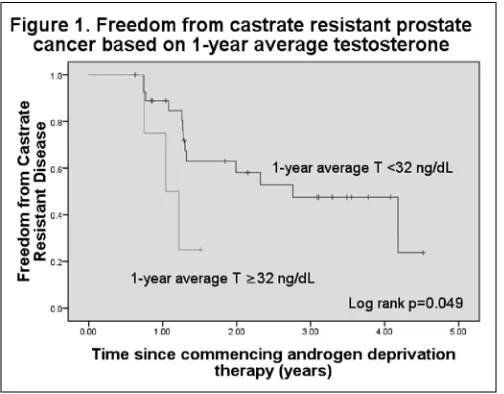
Results: Thirty-two patients were included. Mean patient follow-up was 25.7 months with 50.0% free of CRPC at last follow-up. Patients with 9-month absolute testosterone less than 32 ng/dL had a significantly increased time to CRPC (log-rank p=0.001). Patients with 1-year mean
Table 1. MP-01.19. A fit 60-year-old male is in your office following a radical prostatectomy. His PSA at 3 months postoperatively is undetectable. Do you favour treatment for this man with aXRT within 6 months of surgery with an undetectable PSA
testosterone less than 32 ng/dl also had a significantly increased time to CRPC (log-rank p=0.05). Patients did not differ significantly in their baseline characteristics (p>0.05) (Fig. 1).
Conclusions: Testosterone level in the first year following initiation of ADT may serve as an early predictor of disease progression. Routine testoster-one measurement has a role in management of patients receiving ADT.
MP-01.22
Inadequate Testosterone Suppression in Prostate Cancer Patients Failing on GnRH Agonists: Preliminary Data from the Delay Study Casey, Richard1; Morales, Alvaro2; Siemens, D. Robert3
1The Male Health Centre, Oakville, ON, Canada; 2Queen’s University,
Kingston, ON, Canada; 3Queen’s University, Kingston, ON, Canada
Introduction and Objectives: Inadequate testosterone (T) suppression on gonadotropin-releasing hormone (GnRH) agonist therapy has been linked with reduced time to castration-resistant prostate cancer and decreased overall survival. We report baseline T data from DELAY (Hormone Sensitive Prostate Cancer Patients Switched to Degarelix Therapy after Failing on GnRH Agonists: A Prospective, Observational, Phase IV Study). Methods: Patients with biochemical PSA progression on GnRH agonist therapy defined as ≥50% increase in PSA between 2 measurements (≥1 week apart) are eligible. Prior treatment with chemotherapy, radiopharma-ceuticals, estrogen, ketoconazole or other secondary hormonal treatments such as antiandrogens (except <3 months for induction) is not allowed. As of January 10, 2012 baseline T had been assessed in 44 of 105 planned patients. Here we compare T suppression on GnRH agonist to 3 levels: 1.7 nmol/L (traditional castrate level), 1.1 nmol/L (previously reported in the literature) and 0.7 nmol/L (orchiectomy).
Results: Median age of the 44 patients was 81 (range 63-93). Overall mean baseline T and PSA were 1.0 nmol/L (range 0.1-12.4) and 17.7 ng/mL (range 1.3-141.0), respectively. The percentage of patients with baseline T levels above 1.7, 1.1 and 0.7 nmol/L was 6.5% (3/44), 11.4% (5/44) and 25.0% (11/44), respectively.
Conclusions: A significant number of patients on GnRH agonists and with apparent PSA progression are not adequately castrated. Monitoring T levels is recommended to ensure adequate suppression and allow for cor-rective action if needed. The DELAY study will examine whether switching to Degarelix improves disease progression in patients both adequately and inadequately castrated on GnRH agonists.