AES, EELS and TRIM simulation method study of InP(100)
subjected to Ar
+, He
+and H
+ions bombardment.
M. Ghaffour1,a, A. Abdellaoui1, M. Bouslama1, A. Ouerdane1 and B. Abidri2
1Laboratoire “LABMAT”, ENSET d’Oran, BP1523, Oran M’naouar 31000, Oran, Algeria. 2
Faculté des Sciences, Département de Physique, Université Djillali Liabès, Sidi Bel-Abbes 22000, Algéria.
Abstract. Auger Electron Spectroscopy (AES) and Electron Energy Loss Spectroscopy (EELS) have been performed in order to investigate the InP(100) surface subjected to ions bombardment. The InP(100) surface is always contaminated by carbon and oxygen revealed by C-KLL and O-KLL AES spectra recorded just after introduction of the sample in the UHV spectrometer chamber. The usually cleaning process of the surface is the bombardment by argon ions. However, even at low energy of ions beam (300 eV) indium clusters and phosphorus vacancies are usually formed on the surface. The aim of our study is to compare the behaviour of the surface when submitted to He+ or H+ ions bombardment. The helium ions accelerated at 500V voltage and for 45 mn allow removing contaminants but induces damaged and no stoichiometric surface. The proton ions were accelerated at low energy of 500 eV to bombard the InP surface at room temperature. The proton ions broke the In-P chemical bonds to induce the formation of In metal islands. Such a chemical reactivity between hydrogen and phosphorus led to form chemical species such as PH and PH3, which desorbed from the surface. The chemical susceptibly and the small size of H+ advantaged their diffusion into bulk. Since the experimental methods alone were not able to give us with accuracy the disturbed depth of the target by these ions. We associate to the AES and EELS spectroscopies, the TRIM (Transport and Range of Ions in Matter) simulation method in order to show the mechanism of interaction between Ar+, He+ or H+ ions and InP and determine the disturbed depth of the target by argon, helium or proton ions.
Keywords: AES, EELS, interaction ions-matter, simulation method TRIM, InP.
1 Introduction
InP is expected to be a promising material for both high-speed electrical and optoelectronic device application, in large part due to its high mobility. The most of these applications, metal-InP Schottky structures of good quality is required [1-4]. The nature and quality of surface preparation in semiconductor technology is of the utmost importance during device fabrication and has a pronounced influence on the performance of these devices [5-8].
a
e-mail : [email protected]
DOI: 10.1051/ C
Many woks have been done concerning the study of InP compound in order to understand the origin of the instabilities of components so elaborated from this compound. The most important results so found are the instability of InP against all physical treatment such as the sputter etching by Ar+ ion bombardment or heating in UHV [9-12].
The aim of our study is to compare the behaviour of the surface when subjected to He+ or H+ ions comparatively to the Ar+ ions bombardment, which is usually used to clean surfaces. In this interest, we use the spectroscopy methods such as the Auger Electron Spectroscopy (AES) and the Electron Energy Loss Spectroscopy (EELS). So, we present some results about the effect of H+ and He+ ions bombardment on the InP(100) surface. However, because it is difficult to determine the affected depth of the surface by ions, we combine these analysis techniques with the simulation method TRIM (Transport and Range of Ions in Matter) to determine the affected depth of the InP surface as a function of the ions energy.
2 Experimental
The Auger electron spectra (AES) and electron energy loss (EELS) were performed by using an hemispherical spectrometer. For the best compromise between the transmission and the resolution of the apparatus [13], we use constant pass energy of 80 eV between the deflectors of the analyzer operating in direct mode N (E). The InP(100) surface was characterized by AES (electron beam of 3 KeV, with a low current density Jp=10-3 A.cm-2). The incident electron beam was focussed onto an area of 1 mm of diameter. These routine parameters were choose in order to reduce the effect of the electron beam on the material surface and may be changed when needed. An ion pump associated with a cooled titanium sublimator assured a bass pressure of 10-9 torr.
Before loading in the UHV chamber, the InP(100) samples were chemically cleaned with successively pure H2SO4 acid, 3% Br2 solution in CH3OH and finally rinsed in deionised water and methanol bath [14].
3 Results and discussion
The remaining contamination layer on the sample was mainly composed of carbon and oxygen as revealed by the first recorded AES spectra (C-KLL and O-KLL) [15-17]. The sample was sputter-cleaned, as usual, by a normal incidence Ar+ ion beam at low energy of 500 eV with a current density of about 2.10-6 A.cm-2 to remove these contaminants. The argon pressure was in the range of 10-5 torr. Consequently, a system labelled (In; InP) results from such cleaning, where In is the metallic indium as clusters distributed on the InP surface. Furthermore, the argon ion bombardment of InP surface induces a superficial roughness which affects the EELS spectra as reported by other authors [18-20].
3.1 Action of He+ ions bombardment on InP(100)
Fig. 1. a) Contaminated surface of InP(100) just after its introduction in UHV spectrometer chamber. b) Decontamination of the surface by the He+ ions.
The contaminants are mainly carbon and oxygen. In order to remove these contaminants, we have submitted the InP surface to He+ ions bombardment for 15 mn at 500V accelerated voltage. Figure 1(b) shows the cleaned surface of InP(100).
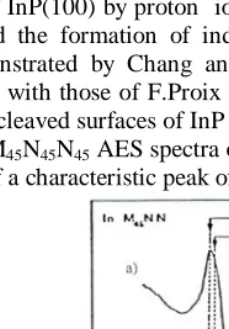
But this cleaning effect is also accompanied by the formation of indium metal as shown in fine structure of AES spectra of indium In-M45N45N45 recorded in Figure 2.
Fig. 2. Evolution of In-MNN Auger spectra of indium during the He+ ions bombardment. a)just after introduction of the sample in the UHV chamber, b), c) and d)
after 5, 10 and 15 mn time ions bombardment.
The Auger spectra shape varies as a function of bombardment time of the surface. Indeed, there develops a peak related to the chemical bond of metallic In. This metallic indium is resulted from the broken of chemical bonds (In-P) and distributed on the surface as clusters.
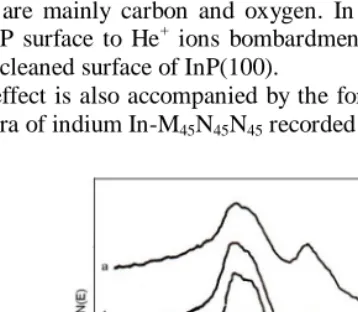
primary energy comparatively to the a) one. The low primary energy concerns the first layers of the surface.
Fig. 3. Structure offinal state of EELS spectra of InP bombarded by He+ ions for different primary energy Ep: a) Ep=750 eV and b) Ep=500 eV.
3.2 Action of H+ bombardment on InP(100):
We bombard the surface of InP(100) by proton ions accelerated by a voltage of 500V. Preferential etching of phosphorus and the formation of indium metal is observed. There is desorption of chemical species as demonstrated by Chang and al.[21-22 ] with a mass spectrometer. These observations also coincides with those of F.Proix and al.[23] who studied the interaction of atomic and ionized hydrogen with cleaved surfaces of InP (110).
Figure 4 shows the In-M45N45N45 AES spectra of InP when bombarded by H+ ions. The spectrum b) involves the formation of a characteristic peak of metallic indium.
Fig. 4. Evolution of In-MNN Auger spectra of InP:a) After introduction of the sample in the UHV chamber, b) After H+ ions bombardment and c) pure metallic In
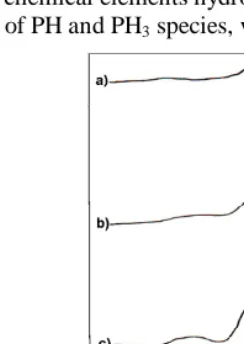
The recorded EELS spectra at the same experimental conditions of the Figure 5 confirm this result. Indeed, the formation of the peaks located at 8.6 eV and 11.6 eV related respectively to surface and bulk plasmons of metallic indium appears clearly on the spectrum b) of the Figure 5. The high reactivity between the chemical elements hydrogen and phosphorus led to a rupture of chemical bonds (In-P) and formation of PH and PH3 species, which desorbed from the surface.
Fig. 5. EELS spectra recorded at 1000 eV of InP: a) After introduction of the sample in the UHV chamber, b) After H+ ions bombardment and c) pure
metallic In sample. 3.2 Simulation method TRIM:
The TRIM simulation method is based on the interaction process between the Ar+, He+ and H+ ions and the matter. The ions bombardment is achieved according to the normal incidence with the surface. The effect of ions induces a displacement of atoms of the target with the possibility to form vacancies on irradiated area. Such a process is susceptible to lead to a new arrangement of atoms occurring in the material matrix. We interest to study the interaction mechanism between ions and the InP target. However, our aim is to know also the depth affected by ions. The recorded TRIM spectra are constituted of two main peaks (see Figure 6).
Fig. 6. TRIM spectra recorded for different ions (Ar+, HE+ and H+) irradiating the target InP at ions energy of 500 eV.
Disturbed depths, as indicated by the position of the second peak vary as a function of ions energy. The interaction process between the ions and the target depends on the chemical nature of target, its physical structure and even on the nature and energy of ions. The importance of damage due to ions on the target is related to the location of the TRIM second peaks. However, the interaction phenomenon ions-matter is complex. It depends on the cross-section as was reported by other authors [25, 26] and on other physical parameters.
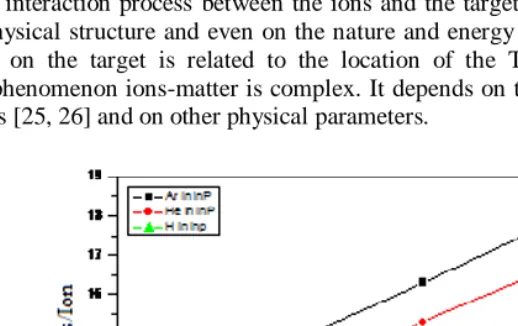
Fig. 7. The produced vacancies according to the TRIM simulation method of InP bombarded by Ar+, He+ and H+ ions as a function of their energy.
In Figure7, we show that the produced vacancies caused on the target InP by the Ar+ ions is more important than He+ and H+ ones.
action of ions depends on the physical properties related to atomic displacement and relaxation phenomenon of the target.
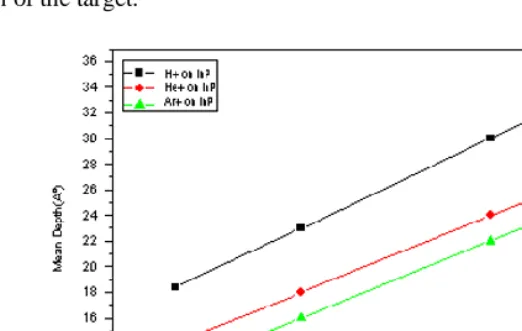
Fig. 8. Variation of the mean depth calculated by TRIM simulation method as a function of H+; He+ and Ar+ ions energy.
Conclusion
Owing to the analysis techniques such as AES and EELS, we show that the substitute of Ar+ ions by a small tall ions like He+ or H+ to clean the InP(100) surface is not advantageous. Indeed, The use of He+ and H+ ions allow to remove carbon and oxygen contaminants but induces damaged and no stoichiometric surface. There appears an excess of metallic indium distributed on the top of the surface with desorption of phosphorus.
The association of the simulation method TRIM to EELS and AES reveals the different interactions in bulk between the ions and the InP target. The H+ ions interaction process affects a higher mean depth than He+ and Ar+ ones. However, the produced vacancies caused on the target InP by the Ar+ ions is more important than H+ and He+ ones. The combination of AES, EELS and TRIM constitutes a good tool to study the compositional aspect of disturbed depths by the Ar+, He+ and H+ ions irradiating the InP compound.
References
1. M. Yamada, A. K. Wahi, T. Kendelewicz and W. E. Spicer, Applied Surf. Sc. 56, 325 (1992) 2. B. Sautreuil, P. Viktorovich and R. Blanchet, J. Appl. Physics. 57, 2322 (1985)
3. C. Jardin, D. Robert, B. Achard, B. Gruzza and C. Pariset, J. of Surf. and Interface Analysis, 10, issue 6, 301 (1987)
4. A. Ouerdane, M. Bouslama, M. Ghaffour, A. Abdellaoui, K. Hamaida, Z. Lounis, Y. Monteil, N. Berrouachedi and A. Ouhaibi, J. of Appl. Surf. Sc. 254, 7394 (2008)
5. S. Tizi, Z. Benamara, M. Chellali, A. Taibi, B. Gruzza, S. Merle and C. Robert, J. Vacuum. 62, 315 (2001)
6. N. I. Plusnin J. of Electron Spectroscopy and Related Phenomena. 137, 161 (2004)
7. M. Ghaffour, M. Bouslama, Z. Lounis, A. Nouri, C. Jardin, Y. Monteil and H. Dumont, J. Of electron Spectroscopy and Related Phenomena, 134, 81 (2004)
9. Z. Lounis, M. Bouslama, N. Berrouachedi, C. Jardin, L. Auvray, A. Abdellaoui, A. Ouerdane and M. Ghaffour, J. Vacuum. 82, 529 (2008)
10.A. Nouri, Z. Lounis, A. Ouerdane, M. Ghaffour, M. Bouadi, H. Dumont, L. Auvray and M. Bouslama, J. Vacuum. 81, 979 (2007)
11.M. Bouslama, Y. Monteil, G. Younes, C. Jardin and M. Ghamnia, J. Vacuum. 47, 27 (1996) 12.C. Jardin, D. Robert, B. Achard, B. Gruzza and C. Pariset, J. of Analy. Elect. Spectroscopy, 19, 5
(1992)
13.Bui Minh Duc, C. Jardin, J. P. Gauthier and P. Michel, J. of Physics and Instruments. 12, 43 (1979)
14.D. Gautard, J. L. Laporte, M. Cadoret and C. Pariset, J. of Crystal Growth. 71, 125 (1985) 15.C. Jardin and M. Bouslama, J. of Microscopy and Electron Spectroscopy. 13, 305 (1988)
16.L. Bideux, Y. Ould Metidji, B. Gruzza and V. Matolin, Surf. and Interface Analysis. 34, issue 1, 712 (2002)
17.S. Abdellaoui, B. Gruzza, C. Pariset, M. Bouslama, C. Jardin and D. Robert, J. of Surf. Science Letters. L 21, 208 (1989)
18.M. Bouslama, Z. Lounis, M. Ghaffour, M. Ghamnia and C. Jardin, J. Vacuum. 65, 185 (2002) 19.M. Bouslama, M. Ghamnia, B. Gruzza, F. Miloua and C. Jardin, J. of Electron Spectroscopy and
Related Phenomena. 68, 377 (1994)
20.M. Bouslama, PhD dissertation, University of Claude Bernard, LyonI, France, (1989)
21.A. Porte, B. Gruzza, C. A. Bondot, L. Bideux, C. Jardin and G. Gergely, J. of electr. spectroscopy and related phenomena. 68, 391 (1994)
22.J. A. Schaefer, J. of Surf. Sci. 178, 90 (1986)
23.F. Proix, O. M’hamedi, M. Cherchour and C. A. Sebenne, J. Le vide, Les couches minces. 41, 189 (1986)
24.N. Berrouachedi, M. Bouslama, A. Abdellaoui, M. Ghaffour, C. Jardin, K. Hamaida, Y. Monteil, Z. Lounis and A. Ouerdane, Applied Surface Science. 256, 21–26 (2009)
25.L. Nasdala, M. Wenzel, M. Andrut, R. Wirth, P. Blaun, Mineralogical society of America 86, N°4, 498 (2001)