An Oblivious Parallel RAM with
O(log
2
N
)
Parallel
Runtime Blowup
Kartik Nayak
∗Jonathan Katz
∗Abstract
Oblivious RAM (ORAM) is a cryptographic primitive that allows a client to access memory locations from a server without revealing its access patterns. Oblivious Parallel RAM (OPRAM) is a PRAM counterpart of Oblivious RAM, i.e., it allowsmclients that trust each other to simultaneously access data from a server without revealing their access patterns. The best known OPRAM scheme [2, 3] achieves amortized client-server bandwidth of O(log2N) per lookup, but they do not achieve perfectly linear access time speedup with clients. In fact, for each access, the blowup for the slowest client (also known as parallel runtime blowup) isO(f(m) logmlog2N), f(m) =ω(1). This implies that, for most accesses, some clients remain idle while others are accessing data. In this work, we show an OPRAM scheme that has parallel runtime blowup ofO(log2N) while maintainingO(log2N) client-server bandwidth blowup for each client.
1
Introduction
Oblivious RAM is a cryptographic primitive that allows a client to store and retrieve blocks of data on an untrusted server in such a way that no information about the access pattern of the client’s accesses is revealed to the server beyond the total number of accesses. This primitive was introduced by Goldreich and Ostrovsky [9, 10, 18] in a model where a trusted processor is accessing data from main memory during execution of some protected software. Since this initial work, there has been a lot of work on designing ORAM schemes in the secure data-outsourcing scenario [1, 4, 11–14, 17, 19, 21–23, 26], secure processor scenario [5, 6, 16, 20, 23], and for applications to secure computation [8, 14, 15, 24, 25, 27].
ORAM schemes inherently make multiple physical accesses to portions of server memory for each log-ical memory access. ORAM schemes mainly try to optimize the bandwidth, i.e., the (amortized) client-server communication for each logical memory access, as a function of N, the total number of memory locations. Assuming no computation on the server, the best known ORAM scheme achieves a bandwidth of O(log2N/log logN) when the block size of memory is Ω(logN) [13] and O(logN) if the block size is Ω(log2N) [23, 24].
A fundamental limitation of ORAM is that it allows only one client to access memory. Sometimes—for example, in a multicore processor—it may be necessary to allow multiple independent clients to access the same memory at the same time. ObliviousParallel RAM (OPRAM) [2] addresses this, and allowsmclients to access data obliviously. A key challenge in realizing OPRAM is to ensure that when multiple clients access the same data block, no additional information is revealed. Also, the communication between clients may also be visible to the server, and hence this communication pattern needs to be oblivious as well. Boyle, Chung and Pass introduced an OPRAM scheme with client-server bandwidth blowup ofO(log3N) [2], which was later improved by Chen, Lin, and Tessaro [3] to an amortized blowup ofO(log2N) per client.
A key metric for any parallel system is the parallel runtime of the computation, i.e., the number of rounds of communication with the server until all clients have obtained the result. The OPRAM scheme by Chen
et al. has parallel runtime blowup ofO(f(m) logmlog2N), f(m) = ω(1), compared to an insecure PRAM
Table 1: Complexity of OPRAM protocols. Here, f(m) = ω(1) andκ is the computational security parameter for an additive homomorphic encryption scheme.
Client-server Client-server Parallel bandwidth blowup bandwidth blowup runtime (amortized) (worst case) blowup
Trivial O(log2N) O(log2N) O(mlog2N) Boyleet al.[2] O(log3N) O(log3N) O(log3N) Chenet al.[3] O(log2N) ω(logNlogλ) +O(log2N) O(f(m) logmlog2N) Our scheme (with AHE) O(logN(logN+κ)) O(logN(logN+κ)) O(logN(logN+κ))
Our scheme (w/o AHE) O(log2N) O(log2N) O(log2N)
that does not hide access patterns. In this work we improve upon this and show an OPRAM construction that achieves parallel runtime blowup ofO(log2N), while maintaining bandwidth blowup of O(log2N). We first show this by allowing the server to perform additive homomorphic encryption (Section 3.2). We then improve upon this construction to avoid any computation on the server (Section 3.5).
1.1
Overview of our Construction
In Path ORAM [23], memory is stored as a tree and each block is mapped to a random leaf in this tree. Given a (block b, leafl) mapping, the following invariant holds: the block b would be stored in some tree node from root to the leaf l. In OPRAM, there are m clients and for each access, each of the m clients request one logical block from memory. The OPRAM scheme by Chen et al. accesses data from memory using Path ORAM. The physical memory is partitioned into m parts, forming m Path ORAM subtrees. Each client is allowed to read and write only to its assigned part. With this, they ensure that no two clients read or write to the same physical location at the same time. Given blocks in Path ORAM are mapped to a leaf uniformly at random, for each access, it can be shown by a simple balls and bins analysis that
k=O(f(m) logm), f(m) =ω(1) leaves may be mapped to one subtree. Thus, for each access, some client performs k Path ORAM accesses. Hence, the span of computation (or the parallel runtime) is a factor
1: functionAccess(addr,op, v0)
2: l←PosMap [addr]
3: stash←stash∪ReadPath(l)
4: l0 ←UniformRandom(0, N−1)
5: PosMap [addr]←l0
6: v←ReadBlockFromStash(addr, stash)
7: if op=Readthen 8: returnv to client 9: else
10: v←v0 11: evict(l, stash)
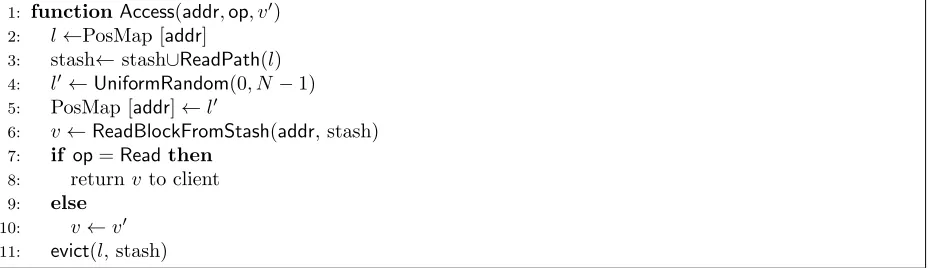
Figure 1: Path ORAM data access algorithm. Here, PosMap is a map from an address addrto a leaf
l of the tree. ReadPath(l,addr) retrieves a path from the root until leafl. ReadBlockFromStash(addr, stash) retrieves a valid block with addressaddrfrom the stash.
2
Preliminaries
2.1
Oblivious RAM
The basic oblivious RAM setting consists of two parties, a client and a server. The client wants to outsource storage of N data blocks, each of size B bits, on the server, and can also store a small amount of data locally. The client outsources (encrypted) data blocks to the server and can arbitrarily access the blocks usingAccess(op,addr, v0) commands. Here,op∈ {Read,Write}, addris the logical address of the block, and
v0 is the data to be written to the block when op=Write. An ORAM scheme hides a sequence oflogical
accesses Access(op,addr, v0) made by the client from the untrusted server who observes the corresponding
physical accesses output by the ORAM. The input to the ORAM algorithm can be viewed as a sequence of logical accesses Access(opi,addri, vi0). To “hide” the logical accesses, they are converted into multiple
physical accesses per request (opi,1,addri,1, v0i,1), . . . ,(opi,q,addri,q, vi,q0 ). For the i-th logical access, at the
end of theqth request, the client learns contents of block with addressaddri. Typical ORAM constructions
haveq=polylog(N) physical accesses for every logical access.
2.1.1 Path ORAM
We provide a high-level overview of Path ORAM [23].
Server Storage. In Path ORAM, the data blocks are stored in a binary tree. Each node of the binary tree is called a bucket and contains Z =O(1) blocks. Each block may contain B bits of information. Some of these blocks may be dummy, i.e., contain no information. All the buckets are encrypted using a symmetric key randomized encryption scheme and hence the server does not learn whether a block is dummy.
Metadata. For each block on the tree, along with the blocks, some metadata is also stored. In particular, metadata consists of an identifier to denote the logical addressaddrand a validity bitvalid. In addition, the client stores a mapPosMap from eachaddrto a path to a leaflof the tree.
Main invariant. A key invariant of Path ORAM is that, each block is mapped to a leaf l ←[N] in the binary tree. This block is stored in some bucket from the root to the leafl.
Stash. The client maintains a small amount of local memory, called the stash. This is used to hold overflowing blocks from the tree.
Accessing a block. A pseudocode for the algorithm to access a block is shown in Figure 1. Each access
1. Retrieve data. The client looks up the position map to determine the leafl corresponding toaddr. It then reads the path from root to leaf l and adds them to the stash. The block with addressaddr
is then read from the stash. The position map for addr is updated to a randomly selected leafl0. If op=Write, it updates the block content tov0.
2. Path write-back and eviction. The eviction operation is used to upload blocks from the stash to the tree. The client iterates over every block b in stash and inserts it along the pathl on the lowest possible bucket that is also along the path assigned tob. If there are no positions available,bremains in the stash.
Obliviousness and size of stash. For every access, a single path is read from the tree. This location of this path is statistically independent of all the previous paths accessed. Hence, intuitively, the access algorithm is oblivious.
In [23], the authors analyze size of stash for polynomial number of accesses. They show that for a bucket sizeZ = 5, tree height ofdlogNeand stash sizeR, the probability of failure forsaccesses is≤s.14.(0.6002)R.
Thus, fors=poly(N), for a stash size ofO(f(N) logN), f(N) =ω(1), the probability of failure is negligible inN.
Recursion. The position map consists of O(NlogN) bits. WhenB >logN, the size of this position map is smaller than the original data. This data can be stored recursively as another ORAM tree with an even smaller position map. As was shown in [23], if this is doneO(logN) times, the client storage reduces toO(1) blocks. We assume such recursion is done in what follows.
Improved eviction procedure. Gentry et al. [8] introduced an alternative eviction procedure for Path ORAM. In this procedure, instead of evicting along the same path chosen for reading the block, after t-th access, a leafl=DigitReverse(t) is chosen for eviction (DigitReverse(t) represents the bits oftin the reverse-bit order). The proof in Ring ORAM [19] shows that using such reverse lexicographic ordering of eviction in Path ORAM bounds the stash size byO(f(N) logN), f(N) =ω(1).
Bandwidth blowup. Path ORAM achieves a bandwidth overhead of O(log2N) whenB = Ω(logN), and
O(logN) whenB= Ω(log2N).
2.2
Oblivious Parallel RAM (OPRAM)
An oblivious parallel RAM (OPRAM) setting consists of (1)m stateful interactive clients and (2) a server
S. Them clients together outsourceN (encrypted) data blocks, each of sizeB, to the serverS. The server storesM(N) data blocks, where M(·) is the storage overhead of the OPRAM scheme. Each of the clients access logical data blocks in parallel. At the beginning of an access, each clientiinputsAccess(opi,addri, vi0)
where, opi∈ {Read,Write},addri is the logical address of the block, and v0i is the data to be written to the
block when opi = Write. Subsequently, the clients perform an interactive protocol where they either (1) read/write data from server S or (2) communicate with other clients. We assume that all the clients hold a shared symmetric secret key. Communication between clients as well as the data stored on the server are encrypted using this secret key.
Write-conflict resolution. We note that in a PRAM, multiple Readoperations to the same address can be executed concurrently. However, when multiple clients perform aWriteto the same address, only one of the operations can be applied. Without loss of generality, we assume that write request of the client with smallest identifier takes effect. Moreover, when multiple clients read and write to the same address during one access, all clients read the contents of the block before the write operation is performed.
Correctness and obliviousness. During each access, the server S observes the physical accesses
by each client on S as well as the communication pattern between the clients. Let OP RAM(y) de-note this sequence of interactions between the clients and the server as well as communication be-tween clients. Let y = (y1, . . . ,yt) denote t OPRAM accesses where each access yj is given by yj =
(Accessj(op1,addr1, v10), . . . ,Access j
We say that an OPRAM algorithm is correct if for each access j ∈[t], OP RAM(yj) returns data that
is consistent with yj except with negligible probability. In other words, for each clienti, for each accesst,
the following holds: clientireceives blockvas output, wherev is the most recently written value to address
addri or⊥ifaddri has not yet been written.
We say that an OPRAM algorithm is secure if for two access patternsyandzwith|y|=|z|, their access patternsOP RAM(y) andOP RAM(y) are computationally or statistically indistinguishable. Respectively, the OPRAM algorithms are called computationally or statistically secure.
Efficiency metrics. The following metrics have been used to determine the efficiency of OPRAM schemes.
• Client-server bandwidth blowup. The client-server bandwidth blowup is the ratio of number of
bits accessed by the slowest client in the oblivious PRAM for each logical access to the number of bits accessed by a non-oblivious PRAM for each logical access.
• Inter-client communication. Different clients may access the same memory block from the server during the same access and hence need to communicate to ensure obliviousness. Inter-client commu-nication is the amount of data communicated by each client (in bits) with other clients for each logical access.
2.3
Oblivious Inter-client Communication
In the following subsections, we discuss oblivious inter-client communication protocols from previous work [2, 3] that we use in our construction.
2.3.1 Oblivious Aggregation Protocol (OblivAgg)
An oblivious aggregation protocol is used to aggregate data held by multiple clients holding the same key. Each client begins holding as input a key and some data. At the end of the protocol, the following holds: for each key, a unique client (say, the client with the smallest id holding that key initially) outputs a function
Agg of all data associated with that key. We assume that the aggregation functionAgg is associative, i.e.,
Agg(Agg(data1,data2),data3) =Agg(data1,Agg(data2,data3)).
OblivAgg
Input: Each client ihas input (keyi,datai).
Output: Each client i receives either (key,data) or (⊥,⊥). For each key, a unique client outputs (key,aggkey) whereaggkey=Agg({dataj|j :keyj =key}).
There exists a protocol for this functionality that can be implemented inO(logm) rounds, where in each round, each client sendsO(1) messages of sizeO(logm+|data|).
2.3.2 Oblivious Election Protocol (OblivElect)
An oblivious election protocol selects a unique representative for each address that appears in m client requests. If there is a client that writes to an address, then the client with the smallest id writing to that address is chosen as the representative. Otherwise, the party with the smallest id reading from that address is chosen as the representative.
OblivElect
Input: Each partyihas input (opi,keyi) whereopi∈ {Read,Write}.
Output: Each party i receives either rep or ⊥. For each unique key = keyi, the party with smallest i
having input (Write,key) will outputrep. If no party issues aWrite request, then the party with lowesti
OblivElect can be implemented using OblivAgg with |data| = logN. Thus, the functionality can be implemented inO(logm) rounds, where in each round, each client sendsO(1) messages of size O(logm+ logN).
2.3.3 Oblivious Routing Protocol (OblivRoute)
This protocol allows each party to send a message to another party in such a way that the recipient of the message is hidden.
OblivRoute
Input: Each client ihas input (idi,datai), where 1≤idi≤m.
Output: Each clientioutputs{(idj,dataj)|idj=i}, i.e., the set of messages for which it is the receiver.
We use OblivRoute only in the scenario where the recipient (idi) is chosen at random by each client.
Boyleet al.[2] implementOblivRouteinO(logm) rounds, where in each round clients send messages of size
O(K(|datai|+ logm)); the protocol aborts with probabilityO(mlogm2−K). This can be made negligible by
settingK=ω(logλ), whereλis a statistical security parameter.
2.3.4 Oblivious Multicast (OblivMCast)
The oblivious multicast protocol allows a subset of clients to multicast a message to other clients such that each client can either act as a sender or receiver. Each client can send and/or receive exactly one message.
OblivMCast
Input: Each senderihas input (send, idi, vi), where 1≤idi≤m. Each receiverihas input (recv, idi,⊥).
For every possibleid, there is at most one sender withidi=id.
Output: Each sender i receives (idi, vi) as its output; each receiver i receives output (idj, vj), where idj=i.
TheOblivMCastprotocol is similar to theOblivElectprotocol and can be implemented inO(logm) rounds, where in each round each client sendsO(1) messages of sizeO(logm+ logN+|v|) wherev is the message sent/received by a client.
3
Our OPRAM Construction
We describe our construction in this section. We first define parallel runtime blowup for an OPRAM access in Section 3.1. Section 3.2 describes our construction for one recursion level assuming a shared local position map between clients and assuming the server performs computation. Section 3.3 explains how this position map can be offloaded to the server and accessed recursively. We discuss the security and asymptotics of our construction in Section 3.4. Finally, we discuss how the construction can be modified to achieve the same parallel runtime blowup without server computation in Section 3.5.
3.1
Parallel Runtime Blowup for an OPRAM Access
We assume a fixed bandwidth D between each client i and server S. In one round of communication, a subset of clients read/write D bits of information from/to the server. The parallel runtime is the total number of rounds of client-server communication for each OPRAM access. Thus, parallel runtime blowup is the ratio of rounds of server communication required for an OPRAM access to the rounds of client-server communication required for a PRAM access.
C1
C2
C3
C4
Data ORAM Recursion Level 1
Recursion Level 2
Parallel time for one access Reading 3 tree paths
Path write-back and eviction
. . . .
(a) Scheme by Chenet al.[3]
C1
C2
C3
C4
Data ORAM Recursion
Level 1 Recursion
Level 2
Parallel time for one access
. . . .
(b) Our scheme
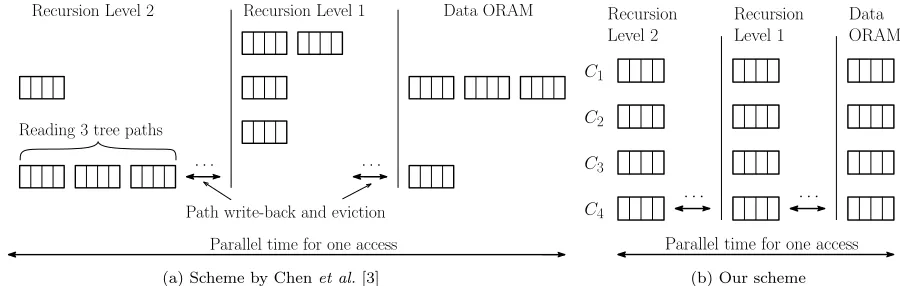
Figure 2: Parallel runtime for a single OPRAM access. The figure shows parallel runtime an OPRAM access performed form= 4 clients and two Path ORAM recursion levels. For ease of exposition, only paths read by each client is shown.
in the scheme by Chen et al. for m = 4 clients and two Path ORAM recursion levels in addition to the data ORAM. For simplicity, only paths read by clients are shown in the figure. Communication for path write-back and eviction are not shown.
For each ORAM tree access, clients access one random path. The scheme by Chen et al. partitions memory into mparts and one client is responsible for each part. As there are m clients, one of the clients may access multiple paths. For example, in Figure 2a, when accessing the main ORAM tree, client C2
accesses three paths whereas C1 and C2 do not access a path. Similarly, in the first recursion level, client
C1accesses two paths whileC4 accesses none. Accessing a path at recursion levelj depends on the position
map value obtained through recursion levelj+ 1. Accesses between two recursion levels are thus dependent. Hence, although clientC4does not access a block at the first recursion level, it cannot proceed to accessing
data ORAM.
For a fixed bandwidth of D bits, accessing one block of B bits requires dB/De rounds of communi-cation. The slowest client accesses up to O(f(m) logm) paths with high probability. For Path ORAM, each path consists of O(logN) blocks and there are O(logN) recursion levels. The parallel runtime is thus O(d(Bf(m) logmlogN)/DelogN) rounds of communication. The parallel runtime blowup is
O(d(Bf(m) logmlogN)/DelogN)
dB/De =O(f(m) logmlog 2
N).
Parallel runtime blowup for our construction. The parallel runtime blowup for our construction is
shown in Figure 2b. In contrast to Chen et al., in our construction, each client accesses exactly one path for each ORAM tree access. By a similar analysis as above, it can be shown that our construction obtains parallel runtime blowup ofO(log2N).
3.2
Non-recursive Construction
At a very high level, our construction follows a structure similar to the OPRAM protocol of Chen et al.
However, compared to their work, we ensure that each client performs an equal amount of work in parallel for every access.
Server storage. For simplicity, we assume that both the number of data itemsN and the number of clients
mare powers of 2. The server storage is organized as a complete tree withN leaves numbered 0 toN−1, but with the top logmlevels of the tree removed. In other words, the data is organized as a forest containing
mtreesT1, . . . ,Tm, each of height logN−logm. Each node in the tree is a bucket of sizeZ=O(1) blocks,
each of size B bits. As in Path ORAM, blocks are encrypted (see more below) and some of them may be dummy blocks.
integer validwith valid= 1 indicating that the block is valid. The data and address are encrypted using a symmetric-key encryption scheme, whereasvalidis encrypted using an additively homomorphic (public-key) encryption scheme.
Managing a tree. Client i is responsible for managing the i-th tree Ti and all leaves therein. That is,
client 1 is responsible for leaves 0, . . . , N/m−1; client 2 is responsible for leavesN/m, . . . ,2N/m−1, and so on. The client responsible for a leafl, denotedResp(l), is in charge of:
1. Maintaining a stash for all blocks assigned to leaf l. As in [3], the required stash size isω(logλ) +
O(logm).
2. Performing an eviction operation for the path to leafl.
Access. Consider a logical access where each client begins holding input (opi, addri, vi0) with opi ∈ {Read,Write},1 ≤ addri ≤ N, and v0i = ⊥ in case of a read operation. We assume the clients have
ac-cess to a shared position map.
1. Select block representatives. Themclients run sub-protocolOblivElect(Section 2.3.2) where each clientihas input (opi,addri). Each client outputsrepor⊥. We call any client who does not output⊥
a representative.
2. Lookup position map. Each client idoes:
• Representative clients. If clienti is a representative for some addressaddri, then it uses the
shared position map PosMap to obtain the leaf li corresponding to addri. It then generates a
fresh leafl0i←[N] and sets PosMap (addri) =l0i.
• Other clients. If clienti is not a representative, then it performs a random access to PosMap. It generates uniform leavesli, l0i←[N].
3. Search for block in stash. Suppose clientj=Resp(li). Each clientidoes:
• Representative clients. Clientisendsaddri to clientj. • Other clients. Clienti sends⊥to clientj.
Clientj looks upaddri in its stash. If the block is found in stash, it is deleted and returned to clienti.
Otherwise, a dummy block is returned to clienti.
4. Read paths. Supposej =Resp(li). Each client ireads a path P(Tj, li) from root ofTj until leafli.
Note that overlapping paths can be read by two different clients.
5. Delete block with address addri. In this step, the block that was read by each client is deleted on
the server.
• Representative clients. Supposek-th block onP(Tj, li) has address addri andvalid= 1. The
client generates a vectorY of length|P(Tj, li)|=Zlog(N/m). Thek-th element of this vector is Enc(1) and all other elements areEnc(0), whereEnc is an additively homomorphic encryption scheme. The client sends Y to the server. For the k-th block in the path, server computes
Enc(validk)×Yk.
– For the block that is to be deleted,Yk=Enc(1). Hence,Enc(validk)×Yk =Enc(1)×Enc(1) = Enc(2). validk = 2 implies an invalid block.
– For all other blocks, Yk = Enc(0). Hence, Enc(validk)×Yk = Enc(validk)×Enc(0) = Enc(validk). Thus, these blocks are not invalidated.
• Other clients. The client generates a vectorY of length|P(Tj, li)|where each element isEnc(0).
The client sendsY to the server. The server performsEnc(validk)×Enc(0) =Enc(validk). Thus,
6. Answer client requests and update. At the end of the previous step, every representative client holdsvi. The clients now run a protocolOblivMCastwhere:
• Representative clients. Representative clients act as senders and multicast the block to all clients that requested it. Representative clients use input (send,addri, vi). If the representative
client requests a write operation, it updates value of the block tovi0 locally.
• Other clients. Non-representative clients do not hold valid blocks and act as receivers in the protocol. Hence, client i uses input (recv,addri,⊥). Client i receives output (addri, vi00) where addri is the block that clientirequested andvi00 is the value of the block.
7. Route blocks to clients responsible for the block. Recall that l0i is the new leaf generated uniformly at random by clientiin step 2. Supposej=Resp(l0i). The clients run anOblivRouteprotocol where each representativeiuses input (j,(li0,addri, bi)) and other clients use (j,(l0i,⊥,⊥)). Each client k receives a set of blocks{(lp0,ap, bp0)}where k=Resp(lp0). The client adds valid (non-dummy) blocks
to local stash.
8. Evict using reverse lexicographical paths. Each client uses a reverse lexicographical path (as suggested by Gentryet al.[7]) to evict as in Path ORAM. The reverse lexicographical ordering ensures that a clienti responsible for managing a treeTi evicts exactly one path from the tree.
3.3
Recursive Construction
Our solution for the recursive construction uses the same idea as Chen et al. [3]. Our non-recursive con-struction storesN blocks of sizeB bits and requires the existence of a shared position map PosMap of size
NlogN bits. AssumingB ≥clogN, c >1, one can recursively store the position map in O(logN) trees to achieve a position map of size O(1) blocks. This can be stored by one of the clients and other clients can access this information usingOblivAggandOblivMCastprotocols.
In our OPRAM construction, asmclients accessmblocks, if they request to write to the same block one of the clients is chosen as a representative and this client performs the write. However, when position map is accessed, position values for different data blocks may be stored in the same position map block. Thus, for correctness, updates to all these distinct position map values in the same position map block should be incorporated. This can be achieved by replacing theOblivElect protocol in step 1 by anOblivAggprotocol during recursion. Here, each client inputs the new leaf values and the representative client aggregates these values by performing a union of the values. More precisely, each clientiuses input (keyi=addri,datai=li),
and the aggregate function is Agg(data1,data2, . . .) = data1||data2||. . .. The representative client outputs
(rep,Agg(data1,data2, . . .)) while other clients output (⊥,⊥).
Given that a position map block stores a maximum of a constant c position map values, the size of the aggregated data is bounded byclogN. Thus, this step of the protocol proceeds inO(logm) rounds, where in each round, every client sendsO(1) messages of sizeO(logN+ logm) bits.
3.4
Obliviousness and Asymptotics of our Construction
Obliviousness. We first note that all the inter-client protocols discussed in Section 2.3 are oblivious. Thus, steps 1, 6 and 7 are oblivious. Step 2 is a recursive access to position map. For each access, steps 3, 4 and 5 reveal a new leaf and hence a new random path that is statistically indpendent of all the paths accessed before. In step 8, each client a path is chosen deterministically. As each of these steps are oblivious, the access algorithm is oblivious.
Asymptotics. Let us first find the client-server bandwidth required. Let |ct| denote size of the AHE ciphertext forvalid. Due to reverse lexicographical ordering of paths for eviction, each path is evicted every
N/m accesses. Thus, the maximum value thatvalid can assume is N/m. Assuming Paillier cryptosystem,
Steps 1, 3, 6 and 7 do not involve client-server communication. Step 2 involves accessing O(logN) position map blocks (one from each recursion tree) of size O(logN) bits. For each position map block, a path ofZlogN =O(logN) blocks is read. The write-back operation involves writing back |ct|logN bits, where This results inO(log2N(logN+|ct|)) bits for position map data.
For data ORAM access, in steps 4 and 8, each client accesses exactly one path which isO(logN) blocks andO(logN) ciphertexts. Step 5 requires uploading O(logN) ciphertexts of an AHE scheme. This results in accessing O((B+|ct|) logN) bits by each client. Thus, the per client client-server communication is
O((B+κlogN+ log2N) logN) bits. For a sufficiently large block withB= Ω(κlogN+ log2N), the blowup isO(logN). For B= Ω(κ+ logN), the blowup isO(log2N).
For each of the steps, when clients communicate with the server, each client accesses a single path on the server independently of each other. Thus, the parallel client-server runtime blowup isO((logN+κ) logN) blowup.
3.5
Avoiding Additive Homomorphic Encryption
Step 5 of our construction in Section 3.2 requires the server to perform additive homomorphic encryption (AHE). In this section, we describe the protocol without using AHE. In this step, all clients write back blocks in the read path except the blockb of interest. b is replaced by a dummy block. This was done by setting the value ofvalid6= 1 using AHE.
In this modified construction, we use valid0, which is a bit to indicate validity of the block. This bit is stored encrypted using symmetric key encryption on the server. As two intersecting paths can be read by two clients and the required blocks can reside in the intersecting portions (buckets) of the paths, it is necessary that only one client deletes and writes back this intersecting portion.
Let pathi,k denote the lengthk bit prefix of pathli. Each client performs the following - for each level lev= logm+ 1, . . . ,logN of the tree
-• The clients run OblivAggprocedure withkeyi =pathi,lev,datai=bi ifbi is in the current level of the
path li, otherwise datai =⊥. The aggregation function is the union function Agg(data1,data2, . . .) = data1||data2||. . .. As the output of the protocol, for each block with bucket prefix pathi,lev held by clients, a representative clientj is chosen for deletion of bucketpathi,lev.
• The representative clientj performs the deletion of bucket pathi,levin the ORAM treeTpathi,lev.
The above step ensures that a unique client is selected for deleting (possibly zero) blocks from every bucket that was read. The other steps from Section 3.2 remain unchanged.
Client-server bandwidth blowup and parallel runtime blowup. The only modification from analysis
in the previous section is that, AHE ciphertexts are not read/written by clients. Hence, the per client client-server communication is O((B+ log2N) logN) bits. For B = Ω(log2N), the per client bandwidth blowup is O(logN) while for B = Ω(logN), the blowup isO(log2N). Similarly, the client-server parallel runtime blowup isO(log2N) for all block sizes.
4
Conclusion
In this work, we show a scheme that obtains O(log2N) client-server bandwidth blowup with O(log2N) parallel runtime.
5
Acknowledgements
References
[1] V. Bindschaedler, M. Naveed, X. Pan, X. Wang, and Y. Huang. Practicing oblivious access on cloud storage: The gap, the fallacy, and the new way forward. In Proceedings of the 22Nd ACM SIGSAC Conference on Computer and Communications Security, CCS ’15, pages 837–849, New York, NY, USA, 2015. ACM.
[2] E. Boyle, K.-M. Chung, and R. Pass. Oblivious parallel ram and applications. InTheory of Cryptography, pages 175–204. Springer, 2016.
[3] B. Chen, H. Lin, and S. Tessaro. Oblivious parallel ram: improved efficiency and generic constructions. InTheory of Cryptography, pages 205–234. Springer, 2016.
[4] S. Devadas, M. van Dijk, C. W. Fletcher, L. Ren, E. Shi, and D. Wichs. Onion oram: A constant bandwidth blowup oblivious ram. In Theory of Cryptography Conference, pages 145–174. Springer, 2016.
[5] C. W. Fletcher, M. v. Dijk, and S. Devadas. A secure processor architecture for encrypted computation on untrusted programs. InProceedings of the seventh ACM workshop on Scalable trusted computing, pages 3–8. ACM, 2012.
[6] C. W. Fletcher, L. Ren, A. Kwon, M. van Dijk, and S. Devadas. Freecursive oram:[nearly] free recursion and integrity verification for position-based oblivious ram. InACM SIGPLAN Notices, volume 50, pages 103–116. ACM, 2015.
[7] C. Gentry, K. A. Goldman, S. Halevi, C. S. Jutla, M. Raykova, and D. Wichs. Optimizing ORAM and using it efficiently for secure computation. InPrivacy Enhancing Technologies Symposium (PETS), 2013.
[8] C. Gentry, S. Halevi, C. Jutla, and M. Raykova. Private database access with he-over-oram architecture. InApplied Cryptography and Network Security, pages 172–191. Springer, 2015.
[9] O. Goldreich. Towards a theory of software protection and simulation by oblivious rams. In ACM symposium on Theory of computing (STOC), 1987.
[10] O. Goldreich and R. Ostrovsky. Software protection and simulation on oblivious rams. J. ACM, 43(3), May 1996.
[11] M. T. Goodrich and M. Mitzenmacher. Privacy-preserving access of outsourced data via oblivious ram simulation. InProceedings of the 38th international conference on Automata, languages and program-ming - Volume Part II, ICALP’11, pages 576–587, Berlin, Heidelberg, 2011. Springer-Verlag.
[12] M. T. Goodrich, M. Mitzenmacher, O. Ohrimenko, and R. Tamassia. Privacy-preserving group data access via stateless oblivious ram simulation. InProceedings of the Twenty-Third Annual ACM-SIAM Symposium on Discrete Algorithms, SODA ’12, pages 157–167. SIAM, 2012.
[13] E. Kushilevitz, S. Lu, and R. Ostrovsky. On the (in)security of hash-based oblivious ram and a new balancing scheme. In Proceedings of the Twenty-Third Annual ACM-SIAM Symposium on Discrete Algorithms, SODA ’12, pages 143–156. SIAM, 2012.
[14] S. Lu and R. Ostrovsky. Distributed oblivious ram for secure two-party computation. In Theory of Cryptography, pages 377–396. Springer, 2013.
[15] S. Lu and R. Ostrovsky. How to garble ram programs. InEUROCRYPT, 2013.
[17] K. Nayak, L. Ren, C. W. Fletcher, I. Abraham, and B. Pinkas. Asymptotically tight bounds for composing oram with pir.
[18] R. Ostrovsky. Efficient computation on oblivious rams. In Proceedings of the twenty-second annual ACM symposium on Theory of computing, STOC ’90, pages 514–523, New York, NY, USA, 1990. ACM. [19] L. Ren, C. W. Fletcher, A. Kwon, E. Stefanov, E. Shi, M. van Dijk, and S. Devadas. Ring oram: Closing the gap between small and large client storage oblivious ram.IACR Cryptology ePrint Archive, 2014:997, 2014.
[20] L. Ren, X. Yu, C. W. Fletcher, M. Van Dijk, and S. Devadas. Design space exploration and optimization of path oblivious ram in secure processors. InACM SIGARCH Computer Architecture News, volume 41, pages 571–582. ACM, 2013.
[21] E. Shi, T.-H. H. Chan, E. Stefanov, and M. Li. Oblivious ram with o((logn)3) worst-case cost. In
ASIACRYPT, pages 197–214, 2011.
[22] E. Stefanov and E. Shi. Oblivistore: High performance oblivious cloud storage. InSecurity and Privacy (SP), 2013 IEEE Symposium on, pages 253–267. IEEE, 2013.
[23] E. Stefanov, M. van Dijk, E. Shi, C. Fletcher, L. Ren, X. Yu, and S. Devadas. Path ORAM – an extremely simple oblivious ram protocol. InCCS, 2013.
[24] X. Wang, H. Chan, and E. Shi. Circuit oram: On tightness of the goldreich-ostrovsky lower bound. In
Proceedings of the 22nd ACM SIGSAC Conference on Computer and Communications Security, pages 850–861. ACM, 2015.
[25] X. S. Wang, Y. Huang, T. H. Chan, A. Shelat, and E. Shi. Scoram: oblivious ram for secure computation. InProceedings of the 2014 ACM SIGSAC Conference on Computer and Communications Security, pages 191–202. ACM, 2014.
[26] X. S. Wang, K. Nayak, C. Liu, T. Chan, E. Shi, E. Stefanov, and Y. Huang. Oblivious data structures. In
Proceedings of the 2014 ACM SIGSAC Conference on Computer and Communications Security, pages 215–226. ACM, 2014.