On the Power of Multiple Anonymous Messages
∗Badih Ghazi Noah Golowich† Ravi Kumar Rasmus Pagh‡ Ameya Velingker Google Research
Mountain View, CA
[email protected], [email protected], [email protected], [email protected], [email protected]
Abstract
An exciting new development in differential privacy is theshuffledmodel, in which an anonymous channel enables non-interactive, differentially private protocols with error much smaller than what is possible in the local model, while relying on weaker trust assumptions than in the central model. In this paper, we study basic counting problems in the shuffled model and establish separations between the error that can be achieved in the single-message shuffled model and in the shuffled model with multiple single-messages per user.
For the problem offrequency estimationfornusers and a domain of sizeB, we obtain:
• A nearly tight lower bound ofΩ˜pminp?4n,?Bqqon the error in the single-message shuffled model. This
implies that the protocols obtained from the amplification via shuffling work of Erlingsson et al. (SODA 2019) and Balle et al. (Crypto 2019) are essentially optimal for single-message protocols. A key ingredient in the proof is a lower bound on the error of locally-private frequency estimation in the low-privacy (aka highε) regime. For this we develop new techniques to extend the results of Duchi et al. (FOCS 2013; JASA 2018) and Bassily & Smith (STOC 2015), whose techniques were restricted to the high-privacy case. • Protocols in themulti-messageshuffled model withpolyplogB,lognqbits of communication per user and
poly logB error, which provide an exponential improvement on the error compared to what is possible with single-message algorithms. This implies protocols with similar error and communication guarantees for several well-studied problems such as heavy hitters,d-dimensional range counting, M-estimation of the median and quantiles, and more generally sparse non-adaptive statistical query algorithms.
For the relatedselectionproblem on a domain of sizeB, we prove:
• A nearly tight lower bound ofΩpBqon the number of users in the single-message shuffled model. This significantly improves on theΩpB1{17
qlower bound obtained by Cheu et al. (Eurocrypt 2019), and when combined with theirO˜p
?
Bq-error multi-message protocol, implies the first separation between single-message and multi-single-message protocols for this problem.
∗
A1-page abstract based on this work will be presented at the Symposium on Foundations of Responsible Computing (FORC) 2020.
†
MIT EECS. Supported at MIT by a Fannie & John Hertz Foundation Fellowship, an MIT Akamai Fellowship, and an NSF Graduate Fellowship. This work was done while at Google Research.
‡
Visiting from BARC and IT University of Copenhagen.
Contents
1 Introduction 1
1.1 Results . . . 2
1.2 Overview of Single-Message Lower Bounds . . . 4
1.3 Overview of Multi-Message Protocols . . . 7
1.4 Applications . . . 8
1.5 Related Work . . . 9
1.6 Organization . . . 11
2 Preliminaries 11 2.1 Differential Privacy . . . 11
2.2 Shuffled Model . . . 12
3 Single-Message Lower and Upper Bounds 13 3.1 Preliminaries for Lower Bounds . . . 15
3.2 Small-Sample Regime . . . 16
3.3 Intermediate-Sample and Large-Sample Regimes . . . 19
3.4 Proof of Lemma 3.15 . . . 28
3.5 Lower Bounds for Single-Message Selection . . . 30
4 Multi-Message Protocols for Frequency Estimation 34 4.1 Private-Coin Protocol . . . 35
4.2 Public-Coin Protocol with Small Query Time . . . 41
4.3 Useful Tools . . . 44
4.4 Privacy Proof . . . 45
5 Multi-Message Protocols for Range Counting Queries 45 5.1 Frequency Oracle . . . 46
5.2 Reduction to Private Frequency Oracle via the Matrix Mechanism . . . 47
5.3 Single-Dimensional Range Queries . . . 49
5.4 Multi-Dimensional Range Queries . . . 51
5.5 Guarantees for Differentially Private Range Queries . . . 53
6 Conclusion and Open Problems 55
A Proof of Theorem 3.4 56
B Low-Communication Simulation of Sparse Non-Adaptive SQ Algorithms 59
C Proofs of Auxiliary Lemmas from Section 4 60
D Heavy Hitters 62
1
Introduction
With increased public awareness and the introduction of stricter regulation of how personally identifiable data may be stored and used, user privacy has become an issue of paramount importance in a wide range of practical applications.
While many formal notions of privacy have been proposed (see, e.g., [LLV07]),differential privacy (DP)[DMNS06,
DKM`06] has emerged as the gold standard due to its broad applicability and nice features such as composition and
post-processing (see, e.g., [DR`14b, Vad17] for a comprehensive overview). A primary goal of DP is to enable
processing of users’ data in a way that (i) does not reveal substantial information about the data of any single user, and (ii) allows the accurate computation of functions of the users’ inputs. The theory of DP studies what trade-offs between privacy and accuracy are feasible for desired families of functions.
Most work on DP has been in thecentral(a.k.a. curator) setup, where numerous private algorithms with small
error have been devised (see, e.g., [BLR08, DNR`09, DR14a]). The premise of the central model is that a curator
can access the raw user data before releasing a differentially private output. In distributed applications, this requires users to transfer their raw data to the curator — a strong limitation in cases where users would expect the entity running the curator (e.g., a government agency or a technology company) to gain little information about their data.
To overcome this limitation, recent work has studied the localmodel of DP [KLN`08] (also [War65]), where
each individual message sent by a user is required to be private. Indeed, several large-scale deployments of DP in practice, at companies such as Apple [Gre16, App17], Google [EPK14, Sha14], and Microsoft [DKY17], have used local DP. While estimates in the local model require weaker trust assumptions than in the central model, they inevitably suffer from significant error. For many types of queries, the estimation error is provably larger than the error incurred in the central model by a factor growing with the square root of the number of users.
Shuffled Privacy Model. The aforementioned trade-offs have motivated the study of theshuffledmodel of privacy as a middle ground between the central and local models. While a similar setup was first studied in cryptography in the work of Ishai et al. [IKOS06] on cryptography from anonymity, the shuffled model was first proposed for privacy-preserving protocols by Bittau et al. [BEM`17] in their Encode-Shuffle-Analyze architecture. In the shuffled setting,
each user sends one or more messages to the analyzer using ananonymouschannel that does not reveal where each
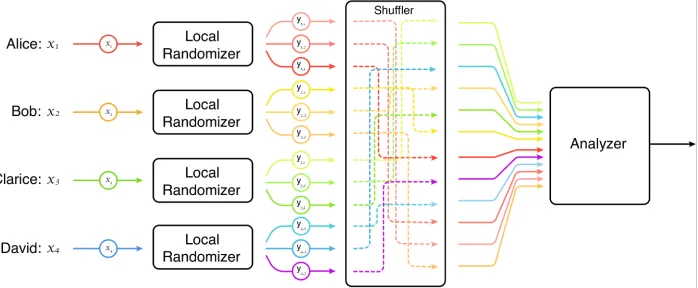
message comes from. This kind of anonymization is a common procedure in data collection and is easy to explain to regulatory agencies and users. The anonymous channel is equivalent to all user messages being randomly shuffled (i.e., permuted) before being operated on by the analyzer, leading to the model illustrated in Figure 1; see Section 2.2 for a formal description of the shuffled model. In this work, we treat the shuffler as a black box, but note that various efficient cryptographic implementations of the shuffler have been considered, including onion routing, mixnets,
third-party servers, and secure hardware (see, e.g., [IKOS06, BEM`17]). A comprehensive overview of recent work
on anonymous communication can be found on Free Haven’s Selected Papers in Anonymity website1.
1https://www.freehaven.net/anonbib/
The DP properties of the shuffled model were first analytically studied, independently, in the works of Erlingsson
et al. [EFM`19] and Cheu et al. [CSU`19]. Protocols within the shuffled model are non-interactive and fall into
two categories: single-messageprotocols, in which each user sends one message (as in the local model), and
multi-messageprotocols, in which a user can send more than one message. In both variants, the messages sent by all users are shuffled before being passed to the analyzer. The goal is to design private protocols in the shuffled model with as small error and total communication as possible. An example of the power of the shuffled model was established
by Erlingsson et al. [EFM`19] and extended by Balle et al. [BBGN19c], who showed that every local DP algorithm
directly yields a single-message protocol in the shuffled model with significantly better privacy.
1.1 Results
In this work, we study several basic problems related tocountingin the shuffled model of DP. In these problems,
each of n users holds an element from a domain of size B. We consider the problems of frequency estimation,
variable selection, heavy hitters, median, and range counting and study whether it is possible to obtainpε, δq-DP2in
the shuffled model with accuracy close to what is possible in the central model, while keeping communication low. The frequency estimation problem (a.k.a. histograms orfrequency oracles) is at the core of all the problems we study. In the simplest version, each ofnusers gets an element of a domainrBs :“ t1, . . . , Buand the goal is
to estimate the number of users holding elementj, for any query elementj P rBs. Frequency estimation has been
extensively studied in DP where in the central model, the smallest possible error isΘpminplogp1{δq{ε,logpBq{ε, nqq
(see, e.g., [Vad17, Section 7.1]). By contrast, in the local model of DP, the smallest possible error is known to be
ΘpminpanlogpBq{ε, nqunder the assumption thatδă1{n[BS15].
In the high-level exposition of our results given below, we letnandB be any positive integers,ε ą 0be any
constant, andδ ą 0 be inverse polynomial inn. This assumption on εandδ covers a regime of parameters that
is relevant in practice. We will also make use of tilde notation (e.g.,O˜,Θ˜) to indicate the possible suppression of multiplicative factors that are polynomial inlogBandlogn.
Single-Message Bounds for Frequency Estimation. For the frequency estimation problem, we show the follow-ing results in the shuffled model where each user sends a sfollow-ingle message.
Theorem 1.1(Informal version of Theorems 3.1 & 3.4). The optimal error of private frequency estimation in the single-message shuffled model isΘpminp˜ ?4n,?B
qq.
The main contribution of Theorem 1.1 is the lower bound. To prove this result, we obtain improved bounds
on the error needed for frequency estimation in local DP in the weak privacy regime whereεis aroundlnn. The
upper bound in Theorem 1.1 follows by combining the recent result of Balle et al. [BBGN19c] (building on the
earlier result of Erlingsson et al. [EFM`19]) with RAPPOR [EPK14] andB-ary randomized response [War65] (see
Section 1.2 and Appendix A for more details).
Theorem 1.1 implies that in order for a single-message differentially private protocol to get erroropnqone needs
to haven“ω
´
logB log logB
¯
users; see Corollary 3.2. This improves on a result of Cheu et al. [CSU`19, Corollary 32],
which gives a lower bound ofn“ωplog1{17Bqfor this task.
Single-Message Bounds for Selection. It turns out that the techniques that we develop to prove the lower bound
in Theorem 1.1 can be used to get a nearly tightΩpBqlower bound on the number of users necessary to solve the
selectionproblem. In the selection problem3, each useri P rnsis given an arbitrary subset ofrBs, represented by the indicator vectorxi P t0,1uB, and the goal is for the analyzer to output an indexj˚P rBssuch that
ÿ
iPrns
xi,j˚ ěmax jPrBs
ÿ
iPrns
xi,j´
n
10. (1)
2
Formally stated in Definition 2.1.
3
In other words, the analyzer’s output should be the index of a domain element that is held by an approximately
maximal number of users. The choice of the constant10in (1) is arbitrary; any constant larger than1may be used.
The selection problem has been studied in several previous works on differential privacy, and it has many ap-plications to machine learning, hypothesis testing and approximation algorithms (see [DJW13, SU17, Ull18] and
the references therein). Our work improves anΩpB1{17qlower bound in the single-message shuffled model due to
Cheu et al. [CSU`19]. Forε
“1, the exponential mechanism [MT07] implies anpε,0q-DP algorithm for selection
withn“OplogBqusers in the central model, whereas in the local model, it is known that anypε,0q-DP algorithm
for selection requiresn “ ΩpBlogBqusers [Ull18]. Variants of the selection problem appear in several natural
statistical tasks such as feature selection and hypothesis testing (see, e.g., [SU17] and the references therein).
Theorem 1.2 (Informal version of Theorem 3.22). For any single-message differentially private protocol in the shuffled model that solves the selection problem given in Equation (1), the numbernof users should beΩpBq.
The lower bound in Theorem 1.2 nearly matches theOpBlogBqupper bound on the required number of users
that holds even in the local model (and hence in the single-message shuffled model) and that uses theB-randomized
response [War65, Ull18]. Cheu et al. [CSU`19] have previously obtained a multi-message protocol for selection
withOp?Bqusers, and combined with this result Theorem 1.2 yields the first separation between single-message
and multi-message protocols for selection.
Multi-Message Protocols for Frequency Estimation. We next present (non-interactive) multi-message protocols
in the shuffled model of DP for frequency estimation with onlypolylogarithmicerror and communication. This is
in strong contrast with what is possible for any protocol in the single-message shuffled setup where Theorem 1.1
implies that the error has to grow polynomially withminpn, Bq, even with unbounded communication. In addition
to error and communication, a parameter of interest is the query time, which is the time to estimate the frequency of any elementj P rBsfrom the data structure constructed by the analyzer.
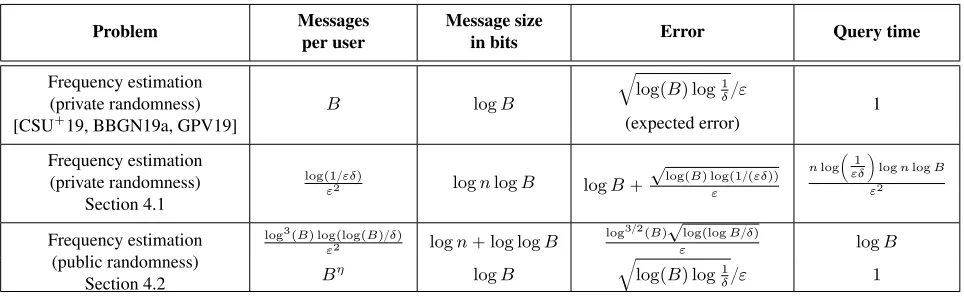
Theorem 1.3(Informal version of Theorems 4.1 & 4.2). There is a private-coin (resp., public-coin) multi-message protocol in the shuffled model for frequency estimation with errorO˜p1q, total communication ofO˜p1qbits per user, and query timeO˜pnq(resp.,O˜p1q).
Combining Theorems 1.1 and 1.3 yields the first separation between single-message and multi-message protocols for frequency estimation. Moreover, Theorem 1.3 can be used to obtain multi-message protocols with small error and small communication for several other widely studied problems (e.g., heavy hitters, range counting, and median and quantiles estimation), discussed in Section 1.4. Finally, Theorem 1.3 implies the following consequence for
statistical query (SQ) algorithms with respect to a distributionDon X (see Appendix B for the basic definitions).
We say that a non-adaptive SQ algorithmAmaking at mostBqueriesq :X Ñ t0,1uisk-sparseif for eachxPX,
the Hamming weight of the output of the queries is at mostk. Then, under the assumption that users’ data is drawn
i.i.d. fromD, the algorithmAcan be efficiently simulated in the shuffled model as follows:
Corollary 1.4(Informal version of Corollary B.1). For any non-adaptivek-sparse SQ algorithmAwithB queries andβ ą0, there is a (private-coin) shuffled model protocol satisfyingpε, δq-DP whose output has total variation dis-tance at mostβ from that ofA, such that the number of users isnďO˜`ετk `τ12
˘
, and the per-user communication
isO˜
´
k2 ε2
¯
, whereO˜p¨qhides logarithmic factors inB, n,1{δ,1{ε, and1{β.
Corollary 1.4 improves upon the simulation of non-adaptive SQ algorithms in thelocal model[KLN`08], for
which the number of users must grow as ε2kτ2 as opposed to τ12 ` ετk in the shuffled model. We emphasize that
the main novelty of Corollary 1.4 is in the regime that k2{ε2 ! B; in particular, though prior work on
low-communication private summation in the shuffled model [CSU`19, GMPV19, BBGN20] implies an algorithm for
simulatingAwith roughly the same bound on the number of usersnas in Corollary 1.4 and communicationΩpBq,
it was unknown whether the communication could be reduced to have logarithmic dependence onB, as in Corollary
Local Local + shuffle Shuffled, single-message
Shuffled,
multi-message Central
Expected max. error O˜p?nq Ω˜p?nq O˜pminp?4n,?Bqq Ω˜pminp?4n,?Bqq Θ˜p1q Θ˜p1q
Communication
per user Θp1q any
OpBq(err?4n)
˜
Op1q(err?B) any Θ˜p1q n.a.
References [BNST17] [BS15] [War65, EPK14, BBGN19c] Theorems 3.4 & 3.1 Theorem 4.1 [MT07, SU17]
Table 1: Upper and lower bounds on expected maximum error (over all B queries, where the sum of all frequencies isn) for frequency estimation in different models of DP. The bounds are stated for fixed, positive privacy parametersεandδ, and
˜
Θ{O˜{Ω˜ asymptotic notation suppresses factors that are polylogarithmic inBandn. The communication per user is in terms of the total number of bits sent. In all upper bounds, the protocol is symmetric with respect to the users, and no public randomness is needed. References are to the first results we are aware of that imply the stated bounds.
1.2 Overview of Single-Message Lower Bounds
We start by giving an overview of the lower bound ofΩpmint˜ n1{4,?Buqin Theorem 1.1 on the error of any
single-message frequency estimation protocol. We first focus on the case wherenďB2 and thusmintn1{4,?Bu “n1{4.
The main component of the proof in this case is a lower bound ofΩp˜ n1{4qfor frequency estimation forpεL, δLq-local
DP protocols4when εL “ lnpnq `Op1q. While lower bounds for local DP frequency estimation were previously
obtained in the seminal works of Bassily and Smith [BS15] and Duchi, Jordan and Wainwright [DJW18], two critical
reasons make them less useful for our purposes: (i) their dependence onεLis sub-optimal whenεL “ ωp1q(i.e.,
low error regime) and (ii) they only apply to the case whereδL“0(i.e., pure privacy).5 We prove new error bounds
in the low error and approximate privacy regime in order to obtain our essentially tight lower bound in Theorem 1.1 for single-message shuffled protocols. We discuss these and outline the proof next.
LetRbe anpεL, δLq-locally differentially private randomizer. The general approach [BS15, DJW18] is to show
that ifV is a random variable drawn uniformly at random fromrBsand ifX is a random variable that is equal to
V with probability parameterα P p0,1q, and is drawn uniformly at random fromrBsotherwise, then the mutual
information betweenV and the local randomizer outputRpXqsatisfies
IpV;RpXqq ď logB
4n . (2)
Once (2) is established, the chain rule of mutual information implies thatIpV;RpX1q, . . . , RpXnqq ď log4B, where
X1, . . . , Xn are independent and identically distributed given V. Fano’s inequality [CT91] then implies that the
probability that any analyzer receivingRpX1q, . . . , RpXnqcorrectly guesses V is at most1{4; on the other hand,
an Ωpαnq-accurate analyzer must be able to determineV with high probability since its frequency in the dataset
X1, . . . , Xnis roughlyαn, greater than the frequency of all othervP rBs. This approach thus yields a lower bound
ofΩpαnqon frequency estimation.
To prove the desiredΩp˜ n1{4qlower bound using this approach, it turns out we need a bound of the form
IpV;RpXqq ďO˜pα4neεLq, (3)
where bothδL ą 0 andεL “ ωp1q. (We will in fact chooseα “ Θp˜ n´3{4q andεL “ lnpnq `Op1q; as we will
discuss later, (3) is essentially tight in this regime.)
Limitations of Previous Approaches We first state the existing upper bounds onIpV;RpXqq, which only use the
privacy of the local randomizer. Bassily and Smith [BS15, Claim 5.4] showed an upper bound ofIpV;RpXqq ď
Opε2Lα2qwithεL “ Op1qandδL “op1{pnlognqq, which thus satisfies (2) withα “ Θ
´b
logB ε2
Ln
¯
. ForδL “ 0,
4
Note that we use the subscripts inεLandδLto distinguish the privacy parameters of thelocalmodel from theεandδparameters (without
a subscript) of the shuffled model.
5
As we discuss in Remark 3.1, generic reductions [CSU`19, BNS18] showing that one can efficiently simulate an approximately
differ-entially private protocol (i.e., withδLą0) with a pure differentially private protocol (i.e., withδL“0) are insufficient to obtain tight lower
Duchi et al. [DJW18] generalized this result to the caseεLě1, proving that6IpV;RpXqq ďOpα2e2εLq. Both of
these bounds are weaker than (3) for the above setting ofαandεL.
However, proving the mutual information bound in (3) turns out to be impossible if we only use the privacy of the local randomizers! In fact, the bound can be shown to befalseif all we assume aboutRis that it ispεL, δLq-locally
differentially private for someεL « lnnandδL “ n´Op1q. For instance, it is violated if one takesR to beRRR,
the local randomizer of theB-randomized response [War65]. Consider for example the regime whereB ďnďB2,
and the setting where RRRpvq is equal to v with probability 1´B{n, and is uniformly random over rBs with
the remaining probability of B{n. In this case, the local randomizer RRRp¨q is plnpnq `Op1q,0q-differentially
private. A simple calculation shows thatIpV;RRRpXqq “ Θp˜ αq. Wheneverα !1{ ?
n, which is the regime we
have to consider in order to obtain any non-trivial lower bound7in the single-message shuffled model, it holds that
α " α4nexpplnpnqq, thus contradicting (3) (see Remark 3.4). The insight derived from this counterexample is actually crucial, as we describe in our new technique next.
Mutual Information Bound from Privacy and Accuracy Departing from previous work, we manage to prove the
stronger bound (3) as follows. Inspecting the counterexample based on theB-randomized response outlined above,
we first observe that any analyzer in this case must have error at leastΩp?Bq, which is larger thanαn, the error that would be ruled out by the subsequent application of Fano’s inequality! This led us to appeal to accuracy, in addition to privacy, when proving the mutual information upper bound. We thus leverage the additional available property that the local randomizerR can be combined with an analyzerAin such a way that the mappingpx1, . . . , xnq ÞÑ
ApRpx1q, . . . , Rpxnqqcomputes the frequencies of elements of every datasetpx1, . . . , xnqaccurately, i.e., to within
an error ofOpαnq. At a high level, our approach for proving the bound in (3) then proceeds by:
(i) Proving a structural property satisfied by the randomizer corresponding to any accurate frequency estimation protocol. Namely, we show in Lemma 3.15 that if there is an accurate analyzer, the total variation distance between the output of the local randomizer on any given input, and its output on a uniform input, is close to 1. (ii) Using thepεL, δLq-DP property of the randomizer along with the structural property in (i) in order to
upper-bound the mutual informationIpV;RpXqq.
We believe that the application of the structural property in (i) to proving bounds of the form (3) is of independent interest. As we further discuss below, this property is, in particular, used (together with privacy ofR) to argue that for most inputsv P rBs, the local randomizer outputRpvq is unlikely to equal a message that is much less likely
occur when the input is uniformly random than when it isv. Note that it is somewhat counter-intuitive that accuracy
is used in the proof of this fact, as one way to achieve very accurate protocols is to ensure thatRpvq is equal to a
message which is unlikely when the input is anyu‰v. We now outline the proofs of (i) and (ii) in more detail.
The gist of the proof of (i) is an anti-concentration statement. Let vbe a fixed element ofrBsand letX be a
random variable uniformly distributed onrBs. Assume that the total variation distance∆pRpvq, RpXqqis not close
to1, and that a small fraction of the users have inputvwhile the rest have uniformly random inputs. LetZdenote
the range of the local randomizerR. First, we consider the special case whereZ ist0,1u. Then the distribution of the shuffled outputs of the users withvas their input is in bijection with a binomial random variable with parameter
p:“PrRpvq “1s, and the same is true for the distribution of the shuffled outputs of the users with uniform random
inputsX (with parameterq :“PrRpXq “1s). Then, we use the anti-concentration properties of binomial random
variables in order to argue that if|p´q| “∆pRpvq, RpXqqis too small, then with nontrivial probability the shuffled outputs of the users with inputvwill be indistinguishable from the shuffled outputs of the users with uniform random inputs. This is then used to contradict the supposed accuracy of the analyzer. To deal with the general case where the rangeZ is any finite set, we repeatedly apply the data processing inequality for total variation distance in order to reduce to the binary case (Lemma 3.20). The full proof appears in Lemma 3.15.
Equipped with the property in (i), we now outline the proof of the mutual information bound in (ii). Denote by
• Tvthe set of messagesmuch more likelyto occur when the input isvthan when it is uniform,
• Yvthe set of messagesless likelyto occur when the input isvthan when it is uniform.
6
This bound is not stated explicitly in [DJW18], though [DJW18, Lemma 7] proves a similar result whose proof can readily be modified appropriately.
Note that the unionTvYYvisnotthe entire rangeZof messages; in particular, it does not include messages that are
a bit more likelyto occur when the input isvthan when it is uniform.8 On a high level, it turns out that the mutual informationIpV;RpXqqwill be large, i.e.,RpXqwill reveal a significant amount of information aboutV, if either of the following events occurs:
(a) There are too many inputsvP rBssuch that the massPrRpXq PYvsis small. Intuitively, for suchv, the local
randomizerRfails to “hide” the fact that a uniform inputXisvgiven thatXindeed equalsvandRpXq PYv.
(b) There are too many inputsv P rBssuch that the massPrRpvq PTvsis large. Such inputs make it too likely
thatX“vgiven thatRpXq PTv, which makes it more likely in turn thatV “v.
We first note that the total variation distance∆pRpvq, RpXqqis upper-bounded byPrRpXq P Yvs. On the other
hand, the accuracy of the protocol along with property (i) imply that∆pRpvq, RpXqqis close to1. By putting these together, we can conclude that event (a) does not occur (see Lemma 3.15 for more details).
To prove that event (b) does not occur, we use the pεL, δLq-DP guarantee of the local randomizerR. Namely,
we will use the inequalityPrRpvq P Ss ď eεL ¨
PrRpXq P Ss `δ for various subsets S ofZ. Unfortunately,
settingS “ Tv does not lead to a good enough upper bound onPrRpvq P Tvs; indeed, for the local randomizer
R “ RRRcorresponding to theB-ary randomized response, we will haveTv “ tvuforn "B, and soPrRpvq P
Tvs “ 1´B{n « 1for anyv. Thus, to establish (b), we need to additionally use the accuracy of the analyzerA
(i.e., property (i) above), together with a careful double-counting argument to enumerate the probabilities thatRpvq
belongs to subsets ofTv of different granularity (with respect to the likelihood of occurrence under inputvversus a
uniform input). For the details, we refer the reader to Section 3.3 and Lemma 3.14.
Having established the above lower bound for locally differentially private estimation in the low-privacy regime,
the final step is to apply a lemma of Cheu et al. [CSU`19] (restated as Lemma 3.5 below), stating that any lower
bound forpε`lnpnq, δq-locally differentially private protocols implies a lower bound forpε, δq-differentially private protocols in the single-message shuffled model (i.e., we takeεL “ε`lnpnq). Moreover, forεL “lnpnq `Op1q
andα “ Θp˜ n´3{4q, we observe that (3) implies (2), and thus a lower bound of Ωp˜ αnq “ Ωp˜ n1{4qfor frequency estimation in the single-message shuffled model follows. Finally, we point out that while the above outline focused
on the case wheren ď B2, it turns out that this is essentially without loss of generality as the other case where
nąB2can be reduced to the former (see Lemma 3.10).
Tightness of Lower Bounds The lower bounds sketched above are nearly tight. The upper bound of Theorem 1.1 follows from combining existing results showing that the single-message shuffled model provides privacy
ampli-fication of locally differentially private protocols [EFM`19, BBGN19c], with known locally differentially private
protocols for frequency estimation [War65, EPK14, DJW18, BBGN19c]. In particular, as recently shown by Balle et al. [BBGN19c], a purepεL,0q-differentially private local randomizer yields a protocol in the shuffled model that
is ˆ
O
ˆ
eεL
b
logp1{δq n
˙
, δ
˙
-differentially private and that has the same level of accuracy.9 Then:
• When combined with RAPPOR [EPK14, DJW18], we get an upper bound ofO˜pn1{4qon the error.
• When combined with theB-randomized response [War65, ASZ19], we get an error upper bound ofO˜p?Bq.
The full details appear in Appendix A. Put together, these imply that the minimum in our lower bound in Theorem 1.1 is tight (up to logarithmic factors). It also follows that the mutual information bound in Equation (3) is tight (up to
logarithmic factors) forεL “ lnpnq `Op1q andα “ n´3{4 (which is the parameter settings corresponding to the
single-message shuffled model); indeed, a stronger bound in Equation (3) would lead to larger lower bounds in the single-message shuffled model thereby contradicting the upper bounds discussed in this paragraph.
Lower Bound for Selection: Sharp Bound on Level-1 Weight of Probability Ratio Functions We now outline
the proof of the nearly tight lower bound on the number of users required to solve the selection problem in the
8
For clarity of exposition in this overview, we refrain from quantifying the likelihoods in each of these cases; for more details on this, we refer the reader to Section 3.3.
9
Note that we cannot use the earlier amplification by shuffling result of [EFM`19], since it is only stated forεL“Op1qwhereas we need
single-message shuffled model (Theorem 1.2). The main component of the proof in this case is a lower bound of
ΩpBqusers for selection forpεL, δLq-localDP protocols whenεL“lnpnq `Op1q.
In the case of localpεL,0q-DP (i.e., pure) protocols, Ullman [Ull18] proved a lower boundn“Ω
´
BlogB pexppεLq´1q2
¯ . There are two different reasons why this lower bound is not sufficient for our purposes:
1. It does not rule out DP protocols withδL ą0(i.e., approximate protocols), which are necessary to consider
for our application to the shuffled model.
2. For the low privacy setting ofεL “lnpnq `Op1q, the bound simplifies ton“Ωp˜ B{n2q, i.e.,n“Ωp˜ B1{3q,
weaker than what we desire.
To prove our near-optimal lower bound, we remedy both of the aforementioned limitations by allowing positive
values ofδLand achieving a better dependence onεL. As in the proof of frequency estimation, we reduce proving
Theorem 1.2 to the task of showing the following mutual information upper bound:
IppL, Jq;RpXL,Jqq ďO˜
ˆ
1
B
˙
`OpδLpB`nqq, (4)
whereLis a uniform random bit,J is a uniform random coordinate inrBs, andXL,J is uniform over the subcube
tx P t0,1uB : xJ “ Lu. Indeed, once (4) holds and δL ă op1{pBnqq, the chain rule implies that the mutual
information between all users’ messages and the pairpL, Jqis at mostO
´
nlnpBq B
¯
. It follows by Fano’s inequality that ifn“opBq, no analyzer can determine the pairpL, Jqwith high probability (which any protocol for selection must be able to do).
For any messagezin the range ofR, define the Boolean functionfzpxq:“ PrRpXPrRpxq“zs
L,Jq“zs wherexP t0,1u B. Let W1rfsdenote the level-1Fourier weight of a Boolean function f. To prove inequalities of the form (4), the prior work of Ullman [Ull18] shows thatIppL, Jq;RpXL,Jqqis determined byW1rfzs, up to normalization constants. In
the case whereδL“0andεL“lnpnq `Op1q,fz P r0, eεLs, and by Parseval’s identityW1rfzs ďOpe2εLqfor any
messagez, leading to
IppL, Jq;RpXL,Jqq ďO
ˆ
e2εL
B
˙
. (5)
Unfortunately, for our choice ofεL“lnpnq `Op1q, (5) is weaker than (4).
To show (4), we depart from the previous approach in the following ways:
(a) We show that the functionsfz take values inr0, OpeεLqsformostinputsx; this uses thepεL, δLq-local DP of
the local randomizerR.
(b) Using theLevel-1inequalityfrom the analysis of Boolean functions [O’D14] (see Theorem 3.26 below), we
upper boundW1rgzsbyOpεLq, wheregzis the truncation offz defined bygzpxq “fzpxqiffzpxq ďOpnq,
andgzpxq “0otherwise.
(c) We boundIppL, Jq;RpXL,JqqbyW1rgzs, using the factfz is sufficiently close to its truncationgz.
The above line of reasoning, formalized in Section 3.5, allows us to show
IppL, Jq;RpXL,Jqq ďO
´ε
L
B `δ¨ pB`e
εLq
¯
,
which is sufficient to establish that (4) holds.
Having proved a lower bound on the error of anypε`lnn, δq-local DP protocol for selection withε “Op1q,
the final step in the proof is to apply a lemma of [CSU`19] to deduce the desired lower bound in the single-message
shuffled model.
1.3 Overview of Multi-Message Protocols
An important consequence of our lower bound in Theorem 1.1 is that one cannot achieve an error ofO˜p1q using
single-messageprotocols. This in particular rules out any approach that uses the following natural two-step recipe for getting a private protocol in the shuffled model with accuracy better than in the local model:
2. Randomly shuffle the messages obtained when each user runs step 1 on their input, and use the privacy
amplification by shuffling bounds [EFM`19, BBGN19c] to improve the privacy guarantees.
Thus, shuffled versions of theB-randomized response [War65, ASZ19], RAPPOR [EPK14, DJW18, ASZ19], the
Bassily–Smith protocol [BS15], TreeHist and Bitstogram [BNST17], and the Hadamard response protocol [ASZ19, AS19], will still incur an error ofΩpminp?4n,?B
qq.
Moreover, although the single-message protocol of Cheu et al. [CSU`19] for binary aggregation (as well as
the multi-message protocols given in [GPV19, BBGN19a, GMPV19, BBGN19b] for the more general task of real-valued aggregation) can be applied to the one-hot encodings of each user’s input to obtain a multi-message protocol
for frequency estimation with errorO˜p1q, the communication per user would beΩpBqbits, which is clearly
unde-sirable.
Recall that the main idea behind (shuffled) randomized response is for each user to send their input with some probability, and random noise with the remaining probability. Similarly, the main idea behind (shuffled) Hadamard response is for each user to send a uniformly random index from the support of the Hadamard codeword correspond-ing to their input with some probability, and a random index from the entire universe with the remaincorrespond-ing probability. In both protocols, the user is sending a message that either depends on their input or is noise; this restriction turns out to be a significant limitation. Our main insight is that multiple messages allows users to simultaneously send both types of messages, leading to a sweet spot with exponentially smaller error or communication.
Our protocols. We design a multi-message version of the private-coin Hadamard response of Acharya et al. [ASZ19,
AS19] where each user sends a small subset of indices sampled uniformly at random from the support of the
Hadamard codeword corresponding to their input, and in addition sends a small subset of indices sampled uniformly at random from the entire universerBs. To get accurate results it is crucial that a subset of indices is sampled, as opposed to just a single index (as in the local model protocol of [ASZ19, AS19]). We show that in the regime where the number of indices sampled from inside the support of the Hadamard codeword and the number of noise indices sent by each user are both logarithmic, the resulting multi-message algorithm is private in the shuffled model, and it has polylogarithmic error and communication per user (see Theorem 4.1, Lemmas 4.4, 4.5, and 4.6 for more details). A limitation of our private-coin algorithm outlined above is that the time for the analyzer to answer a single query isO˜pnq. This might be a drawback in applications where the analyzer is CPU-limited or where it is supposed to produce real-time answers. In the presence of public randomness, we design an algorithm that remedies this limi-tation, having error, communication per user, and query time all equal toO˜p1q. Furthermore, the frequency estimates of this algorithm have one-sided error, and never underestimate the frequency of an element. This algorithm is based on a multi-message version of randomized response combined in a delicate manner with the Count Min data struc-ture [CM05a] (for more details, see Section 4.2). Previous work [BS15, BNST17] on DP have used Count Sketch [CCFC02], which is a close variant of Count Min, to go from frequency estimation to heavy hitters. In contrast, our use of Count Min has the purpose of reducing the amount of communication per user.
1.4 Applications
Heavy Hitters. Another algorithmic task that is closely related to frequency estimation is computing the heavy hitters in a dataset distributed across n users, where the goal of the analyzer is to (approximately) retrieve the identities and counts of all elements that appear at leastτ times, for a given thresholdτ. It is well-known that in
the central DP model, it is possible to computeτ-heavy hitters for anyτ “Θp1q˜ whereas in the local DP model, it
is possible to computeτ-heavy hitters if and only ifτ “Θp˜ ?nq. By combining with known reductions (e.g., from Bassily et al. [BNST17]), our multi-message protocols for frequency estimation yield multi-message protocols for
computing theτ-heavy hitters withτ “Θp1q˜ and total communication ofΘp1q˜ bits per user (for more details, see
Appendix D).
Range Counting. In range counting, each of thenusers is associated with a point in rBsd and the goal of the
in it?10 This is a basic algorithmic primitive that captures an important family of database queries and is useful in geographic applications. This problem has been well-studied in the central model of DP, where Chan et al. [CSS11] obtained an upper bound ofplogBqOpdqon the error (see Section 1.5 for more related work). It has also been studied in the local DP model [CKS19]; in this case, the error has to be at leastΩp?nqeven ford“1.
We obtain private protocols for range counting in the multi-message shuffled model with exponentially smaller error than what is possible in the local model (for a wide range of parameters). Specifically, we give a private-coin
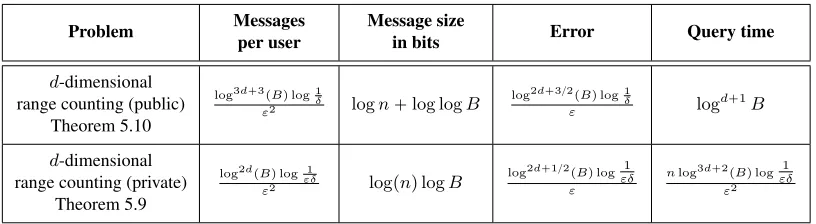
multi-message protocol withplogBqOpdq messages per user each of length Oplognq bits, errorplogBqOpdq, and
query timeO˜pnlogdBq. Moreover, we obtain a public-coin protocol with similar communication and error but with a much smaller query time ofO˜plogdBq(see Section 5 for more details).
We now briefly outline the main ideas behind our multi-message protocols for range counting. We first argue
that even for d “ 2, the total number of queries is ΘpB2q and the number of possible queries to which a user
positively contributes is alsoΘpB2q. Thus, direct applications of DP algorithms for aggregation or for frequency
estimation would result in polynomial error and polynomial communication per user. Instead, we combine our multi-message protocol for frequency estimation (Theorem 1.3) with a communication-efficient implementation, in the multi-message shuffled model, of the space-partitioning data structure used in the central model protocol of Chan et al. [CSS11]. The idea is to use a collectionBofOpBlogdBqd-dimensional rectangles inrBsd(so-calleddyadic intervals) with the property that an arbitrary rectangle can be formed as the disjoint union ofOplogdBqrectangles fromB. Furthermore, each point inrBsdis contained inOplogdBqrectangles fromB. This means that it suffices to
release a private count of the number of points inside each rectangle inB— a frequency estimation task where each
user input contributes toOplogdBqbuckets. To turn this into a protocol with small maximum communication in
the shuffled model, we develop an approach analogous to the matrix mechanism [LHR`10, LM12]. We argue that
the transformation of the aforementioned central model algorithm for range counting into a private protocol in the multi-message shuffled model with small communication and error is non-trivial and relies on the specific protocol structure. In fact, the state-of-the-art range counting algorithm of Dwork et al. [DNRR15] in the central model does not seem to transfer to the shuffled model.
M-Estimation of Median. A very basic statistic of any dataset of real numbers is its median. For simplicity,
suppose our dataset consists of real numbers lying in r0,1s. It is well-known that there is no DP algorithm for
estimating thevalueof the median of such a dataset with errorop1q(i.e., outputting a real number whose absolute
distance to the true median is op1q) [Vad17, Section 3]. This is because the median of a dataset can be highly
sensitive to a single data point when there are not many individual data points near the median. Thus in the context
of DP, one has to settle for weaker notions of median estimation. One such notion isM-estimation, which amounts to
finding a valuex˜that approximately minimizesř
i|xi´x˜|(recall that the median is the minimizer of this objective).
This notion has been studied in previous work on DP including by [Lei11, DJW18] (for more on related work, see Section 1.5 below). Our private range counting protocol described above yields a multi-message protocol with communicationO˜p1qper user and thatM-estimates the median up to error O˜p1q, i.e., outputs a valuey P r0,1s
such thatři|xi´y| ďmin˜x
ř
i|xi´x˜| `O˜p1q(see Theorem E.1 in Appendix E). BeyondM-estimation of the
median, our work implies private multi-message protocols for estimatingquantileswithO˜p1qerror andO˜p1qbits of communication per user (see Appendix E for more details).
1.5 Related Work
Shuffled Privacy Model. Following the proposal of the Encode-Shuffle-Analyze architecture by Bittau et al.
[BEM`17], several recent works have sought to formalize the trade-offs in the shuffled model with respect to
standard local and central DP [EFM`19, BBGN19c] as well as devise private schemes in this model for tasks
such as secure aggregation [CSU`19, BBGN19c, GPV19, BBGN19a, GMPV19, BBGN19b]. In particular, for the
task ofrealaggregation, Balle et al. [BBGN19c] showed that in the single-message shuffled model, the optimal
10
error is Θpn1{6q (which is better than the error in the local model which is known to be Θpn1{2q).11 By
con-trast, recent follow-up work gave multi-message protocols for the same task with error and communication ofO˜p1q
[GPV19, BBGN19a, GMPV19, BBGN19b]12. Our work is largely motivated by the aforementioned body of works
demonstrating the power of the shuffled model, namely, its ability to enable private protocols with lower error than in the local model while placing less trust in a central server or curator.
Wang et al. [WXD`19] recently designed an extension of the shuffled model and analyzed its trust properties and
privacy-utility tradeoffs. They studied the basic task of frequency estimation, and benchmarked several algorithms, including one based on single-message shuffling. However, they did not consider improvements through
multi-message protocols, such as the ones we propose in this work. Very recently, Erlingsson et al. [EFM`20] studied
multi-message (“report fragmenting”) protocols for frequency estimation in a practical shuffled model setup. Though they make use of a sketching technique, like we do, their methods cannot be parameterized to have communication
and error polylogarithmic innandB(which our Theorem 1.3 achieves). This is a result of using an estimator (based
on computing a mean) that does not yield high-probability guarantees.
Private Frequency Estimation, Heavy Hitters, and Median. Frequency estimation and its extensions (consid-ered below) has been extensively studied in concrete computational models including data structures, sketching, streaming, and communication complexity, (e.g., [MG82, CCFC02, EV03, CM05a, CM05b, CH08, MP80, MRL98,
GK`01, GGI`02, YZ13, KLL16]). Heavy hitters and frequency estimation have also been studied extensively in the
standard models of DP, e.g., [War65, HKR12, BS15, BNST17, WBLJ17, BNS18, AS19]. The other problems we consider in the shuffled model, namely, range counting, M-estimation of the median, and quantiles, have been well-studied in the literature on data structures and sketching [CY20] as well as in the context of DP in the central and local models. Dwork and Lei [DL09] initiated work on establishing a connection between DP and robust statistics, and gave private estimators for several problems including the median, using the paradigm of propose-test-release. Subsequently, Lei [Lei11] provided an approach in the central DP model for privately releasing a wide class of M-estimators (including the median) that are statistically consistent. While such M-estimators can also be obtained indirectly from non-interactive release of the density function [WZ10], the aforementioned approach exhibits an im-proved rate of convergence. Furthermore, motivated by risk bounds under privacy constraints, Duchi et al. [DJW18] provided private versions of information-theoretic bounds for minimax risk of M-estimation of the median.
Frequency estimation can be viewed as the problem of distribution estimation in the`8 norm where the
distri-bution to be estimated is the empirical distridistri-bution of a datasetpx1, . . . , xnq. Some works [YB17, KBR16] have
established tight lower bounds for locally differentially private distribution estimation in the weak privacy setting
with loss instead given by either`1or`22. However, their techniques proceed by using Assouad’s method [DJW18]
and are quite different from the approach we use for the`8 norm in the proof of Theorem 1.1 (specifically, in the
proof of Theorem 3.3).
We also note that an anti-concentration lemma qualitatively similar to our Lemma 3.15 was used by Chan et al. [CSS12, Lemma 3] to prove lower bounds on private aggregation, but they operated in a multi-party setting with communication limited by a sparse communication graph. After the initial release of this paper, Ghazi et
al. [GGK`20] proved a similar anti-concentration lemma to establish a lower bound on private summation for
protocols with short messages. The lemmas in both of these papers do not apply to the more general case of
frequency estimation with an arbitrary numberBof buckets, as is the case throughout this paper.
Range Counting. Range counting queries have also been an important subject of study in several areas including database systems and algorithms (see [Cor11] and the references therein). Early works on differentially private frequency estimation , e.g., [Dwo06, HLM12], apply naturally to range counting, though the approach of summing up frequencies yields large errors for queries with large ranges.
11
Although the single-message real summation protocol of Balle et al. [BBGN19c] uses theB-ary randomized response, when combined with their lower bound on single-message protocols, it does not imply any lower bound on single-message frequency estimation protocols. The reason is that their upper bound doe not use the`8error bound for theB-ary randomized response as a black box.
12
For d “ 1, Dwork et al. [DNPR10] obtained an upper bound of O
´
log2B
ε
¯
and a lower bound ofΩplogBq
for obtainingpε,0q-DP. Chan et al. [CSS11] extended the analysis tod-dimensional range counting queries in the
central model, for which they obtained an upper bound of roughly plogBqOpdq. Meanwhile, a lower bound of
Muthukrishnan and Nikolov [MN12] showed that for n « B, the error is lower bounded by Ω`plognqd´Op1q˘.
Since then, the best-known upper bound on the error for generald-dimensional range counting has beenplogB`
logpnqOpdqq{ε[DNRR15], obtained using ideas from [DNPR10, CSS11] along with a k-d tree-like data structure.
We note that for the special case ofd “ 1, it is known how to get a much better dependence on B in the central
model, namely, exponential inlog˚B [BNS13, BNSV15].
Xiao et al. [XWG10] showed how to obtain private range count queries by using Haar wavelets, while Hay et al. [HRMS10] formalized the method of maintaining a hierarchical representation of data; the aforementioned two works were compared and refined by Qardaji et al. [QYL13]. Cormode et al. [CKS19] showed how to translate many
of the previous ideas to the local model of DP. We also note that the matrix mechanism of Li et al. [LHR`10, LM12]
also applies to the problem of range counting queries. An alternate line of work for tackling multi-dimensional range counting that relied on developing private versions of k-d trees and quadtrees was presented by Cormode et al. [CPS`12].
Secure Multi-Party Computation. If we allow user interaction in the computation of the queries, then there is a rich theory, within cryptography, of secure multi-party computation(SMPC) that allows fpx1, . . . , xnqto be
computed without revealing anything aboutxi except what can be inferred fromfpx1, . . . , xnqitself (see, e.g., the
book of Cramer et al. [CDN15]). Kilian et al. [KMSZ08] studied SMPC protocols for heavy hitters, obtaining
near-linear communication complexity with a multi-round protocol. In contrast, all results in this paper are about
non-interactive(single-round) protocols in the shuffled-model (in the multi-message setting, all messages are generated at once). Though generic SMPC protocols can be turned into differentially private protocols (see, e.g., Section 10.2 in [Vad17] and the references therein), they almost always use multiple rounds, and often have large overheads compared to the cost of computingfpx1, . . . , xnqin a non-private setting.
1.6 Organization
We start with some notation and background in Section 2. In Section 3, we prove our lower bounds for single-message protocols in the shuffled model; corresponding upper bounds can be found in Appendix A. In Section 4, we present and analyze our multi-message protocols for frequency estimation (with missing proofs in Appendix C). In Section 5, we give our multi-message protocols for range counting. We conclude with some interesting open questions in Section 6. The proof of Corollary 1.4 is given in Appendix B. The reduction from frequency estimation to heavy hitters appears in Appendix D. The reduction from range counting to M-estimation of the median and quantiles is given in Appendix E.
2
Preliminaries
Notation. For any positive integerB, letrBs “ t1,2, . . . , Bu. For any setY, we denote byY˚ the set consisting
of sequences of elements ofY, i.e.,Y˚ “Ť
ně0Yn. SupposeS is a multiset whose elements are drawn from a set
X. With a slight abuse of notation, we will writeS ĂX and forxPX, we writemSpxqto denote themultiplicity
ofx inS. For an elementx PX and a non-negative integerk, letkˆ txudenote the multiset withkcopies ofx
(e.g.,3ˆ txu “ tx, x, xu). For a positive real numbera, we uselogpaq to denote the logarithm base 2 ofa, and
lnpaqto denote the natural logarithm ofa. LetBinpn, pq denote the binomial distribution with parametersn ą 0
andpP p0,1q.
2.1 Differential Privacy
We now introduce the basics of differential privacy that we will need. Fix a finite setX, the space of reports of
users. A dataset is an element of X˚, namely a tuple consisting of elements ofX. Let histpXq P
histogram ofX: for anyx PX, thexth component ofhistpXqis the number of occurrences ofxin the datasetX.
We will consider datasetsX, X1 to beequivalentif they have the same histogram (i.e., the ordering of the elements
x1, . . . , xn does not matter). For a multisetS whose elements are in X, we will also writehistpSqto denote the
histogram ofS(so that thexth component is the number of copies ofxinS).
LetnPN, and consider a datasetX “ px1, . . . , xnq PXn. For an elementxPX, letfXpxq “ histpXqn x be the
frequencyofxinX, namely the fraction of elements ofXwhich are equal tox. Two datasetsX, X1are said to be
neighboringif they differ in a single element, meaning that we can write (up to equivalence)X“ px1, . . . , xn´1, xnq
andX1
“ px1, . . . , xn´1, x1nq. In this case, we writeX „X1. LetZbe a set; we now define the differential privacy
of a randomized functionP :XnÑZ:
Definition 2.1 (Differential privacy [DMNS06, DKM`06]). A randomized algorithm P : Xn
Ñ Z is pε, δq -differentially privateif for every pair of neighboring datasetsX„X1and for every setS ĂZ, we have
PrPpXq PSs ďeε¨PrPpX1
q PSs `δ,
where the probabilities are taken over the randomness inP. Here,εě0, δP r0,1s.
We will use the following compositional property of differential privacy.
Lemma 2.1(Post-processing, e.g., [DR14a]). IfPispε, δq-differentially private, then for every randomized function
A, the composed functionA˝Pispε, δq-differentially private.
2.2 Shuffled Model
We briefly review theshuffled modelof differential privacy [BEM`17, EFM`19, CSU`19]. The input to the model
is a dataset px1, . . . , xnq P Xn, where item xi P X is held by user i. A protocol in the shuffled model is the
composition of three algorithms:
• The local randomizerR : X Ñ Y˚ takes as input the data of one user, xi P X, and outputs a sequence pyi,1, . . . , yi,miqofmessages; heremiis a positive integer.
• TheshufflerS :Y˚
ÑY˚takes as input a sequence of elements ofY, saypy1, . . . , ymq, and outputs a random
permutation, i.e., the sequencepyπp1q, . . . , yπpmqq, whereπ PSm is a uniformly random permutation onrms.
The input to the shuffler will be the concatenation of the outputs of the local randomizers.
• TheanalyzerA:Y˚
ÑZtakes as input a sequence of elements ofY(which will be taken to be the output of
the shuffler) and outputs an answer inZwhich is taken to be the output of the protocolP.
We will write P “ pR, S, Aq to denote the protocol whose components are given by R, S, and A. The main
distinction between the shuffled and local model is the introduction of the shufflerSbetween the local randomizer
and the analyzer. Similar to the local model, in the shuffled model the analyzer is untrusted; hence privacy must be guaranteed with respect to the input to the analyzer, i.e., the output of the shuffler. Formally, we have:
Definition 2.2 (Differential privacy in the shuffled model, [EFM`19, CSU`19]). A protocol P
“ pR, S, Aq is
pε, δq-differentially privateif, for any datasetX“ px1, . . . , xnq, the algorithm
px1, . . . , xnq ÞÑSpRpx1q, . . . , Rpxnqq
ispε, δq-differentially private.
Notice that the output ofSpRpx1q, . . . , Rpxnqqcan be simulated by an algorithm that takes as input themultiset
consisting of the union of the elements ofRpx1q, . . . , Rpxnq(which we denote as
Ť
iRpxiq, with a slight abuse of
notation) and outputs a uniformly random permutation of them. Thus, by Lemma 2.1, it can be assumed without
loss of generality for privacy analyses that the shuffler simply outputs the multiset ŤiRpxiq. For the purpose
of analyzing accuracy of the protocol P “ pR, S, Aq, we define its output on the dataset X “ px1, . . . , xnq to
be PpXq :“ ApSpRpx1q, . . . , Rpxnqqq. We also remark that the case oflocal differential privacy, formalized in
Definition 2.3 (Local differential privacy [KLN`08]). A protocol P
“ pR, Aq is pε, δq-differentially private in the local model(orpε, δq-locally differentially private) if the functionx ÞÑ Rpxqispε, δq-differentially private in the sense of Definition 2.1. We say that the outputof the protocol P on an input datasetX “ px1, . . . , xnq is
PpXq:“ApRpx1q, . . . , Rpxnqq.
3
Single-Message Lower and Upper Bounds
In this section, we prove Theorem 1.1, which determines (up to polylogarithmic factors) the accuracy of frequency estimation in the single-message shuffled model. Using similar techniques, we also prove Theorem 1.2, which establishes a tight (up to polylogarithmic factors) lower bound on the number of users required to solve the selection problem in the single-message shuffled model. Our theorems give tight versions (see Corollary 3.2) of Corollaries 30
and 32 of [CSU`19], which were each off from the respective optimal bounds by a polynomial of degree 17. We
will use the following definition throughout this section:
Definition 3.1 (pα, βq-accuracy). Let Z be a finite set, let B P N, and let ev P t0,1uB be the binary indicator
vector withpevqj “1if and only ifj “v. We say that a (randomized) protocolP :rBsn Ñ r0,1sBfor frequency
estimation ispα, βq-accurateif for each datasetX “ px1, . . . , xnq P rBsn, we have that
PP
«
max jPrBs
ˇ ˇ ˇ ˇ ˇ
PpXqj´ 1
n
n
ÿ
i“1 pexiqj
ˇ ˇ ˇ ˇ ˇ
ďα
ff
ě1´β.
Often we will either haveP “ pR, Aqfor a local randomizerRand an analyzerA(corresponding to the local
model) orP “ pR, S, Aq(corresponding to the shuffled model). In such a case, we will slightly abuse notation and
refer to the local randomizerR : rBs Ñ Z aspα, βq-accurateif there exists an analyzerA :Zn Ñ r0,1sB such
that the corresponding local or shuffled-model protocol ispα, βq-accurate.
Theorem 3.1 establishes lower bounds on the (additive) error of frequency estimation in the single-message differentially-private shuffled model.
Theorem 3.1(Lower bound for single-message differentially private frequency estimation). There is a sufficiently small constant c ą 0 such that the following holds: Supposen, B P Nwith n ě 1{c, and 0 ă δ ă c{n. Any pε, δq-differentially privaten-user single-message shuffled model protocol that ispα,1{4q-accurate satisfies:
αě
$
’ ’ ’ ’ ’ ’ ’ ’ &
’ ’ ’ ’ ’ ’ ’ ’ %
Ω
ˆ
logB nlog logB
˙
for clog loglogBB ďnď plog2Bqplog logBq, (“Small-sample”) (6)
Ω
ˆ
1
n3{4?4logn ˙
for plog2Bqplog logBq ďnď logB2B, (“Intermediate-sample”) (7)
Ω
˜ ?
B n?logB
¸
for ną logB2B. (“Large-sample”) (8)
Note that the lower bound on the additive error α is divided into 3 cases, which we call the small-sample
regime(6), the intermediate-sample regime(7), and the large-sample regime(8). While the division into separate regimes makes our bounds more technical to state, we point out that this seems necessary in light of the very different protocols that achieve near-optimality in the various regimes (as discussed in Section 1.2 and Appendix B). Moreover, the bound for the low-sample regime of Theorem 3.1 is established in Lemma 3.11, while the bounds for the intermediate-sample and large-sample regimes of Theorem 3.1 are established in Corollary 3.13 and Lemma 3.19, respectively. We note that the proof of the intermediate-sample regime (7) is the most technically involved and constitutes the bulk of the proof of Theorem 3.1.
Furthermore, we observe that the lower bounds (6), (7), and (8) also hold, up to constant factors, for theexpected errorER
“
maxjPrBs
ˇ
ˇPpXqj´ 1
n
řn
i“1pexiqj
ˇ ˇ ‰
ofP on a datasetX. This follows as an immediate consequence of
Theorem 3.1 and Markov’s inequality.
Corollary 3.2 (Lower bound for constant-error frequency estimation). Letc be the constant of Theorem 3.1. If
P is ap1, δq-differentially private protocol for frequency estimation in the shuffled model with δ ă c{nwhich is
p1{10,1{10q-accurate, thenněΩ
´
logB log logB
¯ .
Corollary 3.2 improves upon Corollary 32 of [CSU`19], both in the lower bound on the error (which was
Ωplog1{17Bqin [CSU`19]) and on the dependence onδ(which wasδ
ăOpn´8qin [CSU`19]).
The primary component of the proof of Theorem 3.1 is a lower bound on the additive error ofpεL, δLq-locally
differentially private protocolsP “ pR, Aq, when bothεL"1(thelow-privacysetting) andδLą0simultaneously
hold (see Lemma 3.5). In particular, we prove the following:
Theorem 3.3(Lower bound for locally differentially private frequency estimation). There is a sufficiently small constant c ą 0 such that the following holds. Suppose n, B P N with n ě 1{c, and that εL, δL ą 0 with
δL ă cmint1{pnlognq,expp´εLqu. Any pεL, δLq-locally differentially private protocol that is pα,1{4q-accurate
satisfies: αě $ ’ ’ ’ ’ ’ ’ ’ ’ ’ ’ ’ ’ ’ ’ ’ ’ ’ & ’ ’ ’ ’ ’ ’ ’ ’ ’ ’ ’ ’ ’ ’ ’ ’ ’ % Ω ˆ lnB nεL ˙
for ně lncεB
L, (“Small-sample”) (9)
˜ Ω
ˆ
1
?
n¨exppεL{4q
˙
for ně plnBqexppεL{2q
and23¨lnpnq ďεL`lnp1`εLq`1c ď2 lnpBq, (“Intermediate-sample”) (10) ˜
Ω
ˆ
1 n2{3
˙
for ln3{2pBq ďnďB3andε
Lď 23¨lnpnq, (“Intermediate-sample”) (11)
˜ Ω ˜? B n ¸
for něB2andε
Lď2 lnpBq, (“Large-sample”) (12)
˜ Ω ˆ B n ˙
for něB3andεLď2 lnpBq. (“Large-sample”) (13)
Again, the lower bound is divided into cases—the bound for low-sample regime of Theorem 3.3 (namely, (9)) is established in Lemma 3.11, while the bounds for the intermediate-sample (namely, (10) and (11)) and large-sample (namely, (12) and (13)) regimes are established in Lemma 3.12 and Lemma 3.18, respectively.
It turns out that Theorem 3.1 is tight in each of the three regimes (small-sample, intermediate-sample, and
large-sample), up to polylogarithmic factors inBandn, as shown by Theorem 3.4:
Theorem 3.4(Upper bound for single-message shuffled DP frequency estimation). FixB, nPN,δ “n´Op1q, and
εď1that satisfiesε“ωpln2pnq{mint?B,?nuq. FornPN, there is a shuffled model protocolP “ pR, S, Aqso that for anyX “ px1, . . . , xnq P rBsn, the frequency estimatesPpXq P r0,1sBproduced byP satisfy
E « max jPrBs ˇ ˇ ˇ ˇ ˇ
PpXqj´ 1
n
n
ÿ
i“1 pexiqj
ˇ ˇ ˇ ˇ ˇ ff ď $ ’ ’ ’ ’ ’ ’ ’ ’ ’ & ’ ’ ’ ’ ’ ’ ’ ’ ’ % O ˆ logB n ˙
for nď ε2log 2B
log3logB, (14)
O
˜
ln3{4pnq?logB n3{4?ε
¸
for ε2log2B
log3logB ďnďB
2, (15)
O
˜ a
BlnpnqlnpBq
nε
¸
for nąB2. (16)
The proof of Theorem 3.4 follows by combining existing protocols for locally differentially private frequency estimation with the privacy amplification result of [BBGN19c]. For completeness, we provide the proof in Ap-pendix A.
Remark 3.1. Before proceeding with the proof of Theorem 3.3 (and thus Theorem 3.1), we briefly explain why the
approach of [CSU`19], which establishes a weak variant of Theorem 3.3, cannot obtain the tight bounds that we are
able to achieve here. Recall that this approach used:
(i) in a black-box manner, known lower bounds of Bassily and Smith [BS15] and Duchi et al. [DJW18] on the error of “pure”pεL,0q-locally differentially private frequency estimation protocols, together with
(ii) a result of Bun et al. [BNS18] stating that by modifying anpεL, δLq-locally differentially private protocol, one
can produce anp8εL,0q-locally differentially private protocol without significant loss in accuracy.
It seems to be quite challenging to get tight bounds in the single-message shuffled model using this two-step
technique. This is because when εL « lnn, the error lower bounds for pεL,0q-differentially private frequency
estimation in the local model decay asexpp´aεLqfor some constanta. Suppose that for some constantC ě1, one
could show that by modifying anypεL, δLq-locally differentially private protocol one could obtain apCεL,0q-locally
differentially private protocol without a large loss in accuracy (for instance, Bun et al. [BNS18] achievesC “8.)
Then the resulting error lower bound for shuffled-model protocols would decay asexpp´aClnnq “ n´aC. This
bound will necessarily be off by a polynomial innunless we can determine the optimal constantC. The proof for
C “8[BNS18, CSU`19] is already quite involved, and in order for this approach to guarantee tight bounds in the
single-message setup, we would need to achieveC “1, i.e., turn anypεL, δLq-locally differentially private protocol
into one withδL“0and essentially no increase inεLwhatsoever.
3.1 Preliminaries for Lower Bounds
In this section we collect some useful definitions and lemmas. Throughout this section, we will use the following notational convention:
Definition 3.2(Notationpx,S). For a fixed local randomizerR:X ÑZ(which will be clear from the context), and
forxPX,SĂZ, zPZ, we will writepx,S:“PRrRpxq PSsandpx,z :“PRrRpxq “zs, where the probability is
over the randomness ofR.
Moreover, we will additionally writePxto denote the distribution onZgiven byRpxq. In particular, the density
ofPxatzPZispx,z.
We say that a local randomizer R : X Ñ Z ispε, δq-differentially private in the n-user shuffled model if the
composed protocolpx1, . . . , xnq ÞÑ SpRpx1q, . . . , Rpxnqqis pε, δq-differentially private. Lemma 3.5 establishes
that a protocolRthat ispε, δq-differentially private in the shuffled model is in factpε`lnn, δq-differentially private in thelocalmodel of differential privacy, which means that the functionxÞÑRpxqis itselfpε`lnn, δq-differentially private.
Lemma 3.5(Theorem 6.2, [CSU`19]). SupposeX,Zare finite sets. IfR:X
ÑZ ispε, δq-differentially private in then-user single-message shuffled model, thenRispε`lnn, δq-locally differentially private.
(That is, for allx, yPX, and for allS ĂZ, we have
py,S ďpx,S¨eεn`δ.
Recallpy,S “PrRpyq PSs, px,S “PrRpxq PSsper Definition 3.2.)
As discussed in Section 1, to prove Theorem 3.1 (as well as Theorem 3.22), we use similar ideas to those in the
the results of [DJW18, BS15] todirectly derive a lower bound on the error of locally private frequency estimation
in the low and approximate privacy setting (i.e., forpεL, δLq-locally differentially private protocols withεL «lnn
andδL ą 0). By Lemma 3.5, doing so suffices to derive a lower bound for frequency estimation in the
single-message shuffled model. Our lower bounds for local-model protocols, on their own, may be of independent interest. The locally private frequency estimation lower bounds of [DJW18, BS15], as well as our proof, rely on Fano’s inequality, which we recall as Lemma 3.6 below.
For random variables X, Y distributed on a finite setX, let IpX;Yq denote the mutual information between
Lemma 3.6(Fano’s inequality). SupposeZ, Z1 are jointly distributed random variables on a finite setZ. Then
PrZ “Z1
s ď IpZ;Z 1
q `1 log|Z| .
Additionally, it will be useful to phrase some of our arguments in terms of the hockey stick divergence between distributions:
Definition 3.3(Hockey stick divergence). SupposeD, F are probability distributions on a spaceX that are abso-lutely continuous with respect to some measureGonX; let the densities ofD, F with respect toGbe given byd, f.
For anyρě1, thehockey stick divergence of orderρbetweenD, F is defined as:
DρpD||Fq:“
ż
X
rdpxq ´ρ¨fpxqs`dGpxq,
whereras`“maxta,0uforaPR.
Thetotal variation distance∆pD, Fqbetween two distributionsD, F on a setX is defined as
sup
SĎX|
DpSq ´FpSq| .
Note that for ρ “ 1 the hockey stick divergence of order ρ is the total variation distance, i.e., D1pD||Fq “
D1pF||Dq “∆pD, Fq. The following fact is well-known:
Fact 3.7(Characterization of hockey stick divergence). Using the notation of Definition 3.3, we have:
DρpD||Fq “sup SPX
pDpSq ´ρ¨FpSqq.
For a boolean function f : t0,1uB Ñ R, the Fourier transform of f is given by the function fˆpSq :“
Ex„Unifpt0,1uBq
”
fpxq ¨ p´1q
řB
j“1xj¨1rjPSs
ı
, whereS Ď rBsis any subset. TheFourier weight at degree 1of such
a function is defined byW1rfs:“řjPrBsfˆptjuq2. We refer the reader to [O’D14] for further background on the Fourier analysis of boolean functions.
3.2 Small-Sample Regime
In this section we establish Theorem 3.1 in the case thatn ď log2B (i.e., we prove (6)). As we noted following
Lemma 3.5, we will prove a slightly more general statement, allowing Rto be any pε`lnn, δq-locally
differen-tially private randomizer for someεą0. Similar results are known [DJW18, BS15]; however, the work of [BS15]
only applies to the case that R ispεL, δLq-locally differentially private withεL “ Op1q, and [DJW18] only
con-siderpεL,0q-locally differentially private protocols. Moreover, their dependence on the privacy parameterεLis not
tight: in particular, for the “small-sample regime” ofn ď Oplog2Bq that we consider in this section, the bounds
of [DJW18] decay ase´2εL, whereas we will be able to derive bounds scaling as1{ε
L. We will then apply this
bound with εL “ ε`lnnbeing the privacy parameter of the locally differentially private protocol furnished by
Lemma 3.5.
The proof of the error lower bound relies on the following Lemma 3.8, which bounds the mutual information
between a uniformly random indexV P rBs, andRpVq. It improves upon analogous results in [DJW18, BS15], for
which the dependence onεLispeεL´1q2, whenεLis large.
Lemma 3.8 (Mutual information upper bound for small-sample regime). Fix n P N. Let R be an pεL, δLq
-differentially private local randomizer (in the sense of Definition 2.1). LetV „ rBsbe chosen uniformly at random. Then