Visualising Number:
A Study of Children's Developing Sense of Number
in the Computational Medium of Boxer.
Declan O'Reilly
Thesis Submitted in fulfilment of the requirement for the
Ph.D. degree of the University of London
Abstract
The aim of this study is to investigate children's developing sense of number in the computational medium of Boxer. Boxer's combination of graphical and symbolic elements afforded the opportunity for children to visualise numbers in an operational way while simultaneously offering insights into how this operational approach mediated their thinking. There were three inter-related aspects to the study, with visualisation being the common feature of all three.
• (i) How does the visual structure of Boxer influence students' (aged 9 - 11) ability to program?
• (ii) What interpretations do students place on a number system extended beyond the natural numbers and how did they choose to represent these?
• (iii) How can the learning environment of Boxer be exploited as a context for developing students' sense of number?
Following an exploratory study, pedagogical models for investigating issues (i) and (iii) were developed. For issue (i), Boxer was exploited as a means of introducing itself. This, in turn, meant documenting the issues involved in a process of iterative design. For issue (iii), a model of learning was developed which proposed that the children should construct their own microworlds. Following an off-computer investigation of issue (ii), the model was refined to that of children constructing operational computational objects, and the research aim broadened to include an investigation of how these objects mediated their expression of number. This part of the research consisted of a longitudinal study lasting two years. It entailed case studies with four pairs of children, while the rest of the class learned Boxer independently. None of the children had previous Boxer or Logo experience. The research setting was a normal classroom in an inner-London primary school. Data for issues (i) and (iii) was obtained by means of video recordings and annotated print-outs, while data for issue (ii) was obtained by written records and audio recordings.
Acknowledgements
I would like to express my thanks to my supervisor Dr. Richard Noss for all his help and advice throughout the writing of this thesis, and to Richard and Professor Celia Hoyles for their support and friendship during this period.
Table of Contents
Table of Contents 4
List of Tables 9
List of Figures... 10
Chapter 1: Introduction 13
1.1: Background to the Research 13
1.2: An Overview of the Research 16
1.2.1: Theoretical Perspective 17
1.2.2: Methodology 18
1.2.3: The Exploratory study 19
1.2.4: The Longitudinal study 19
1.2.5: Summary and Implications 21
Chapter 2: Learning Mathematics and Learning about Number 22
2.0: Overview 22
2.1: Learning Mathematics — A Theoretical Perspective 22
2.1.1: Epistemology 22
2.1.2: Constructivism 24
2.1.3: Contextualising Constructivism 26
2.1.4: Concepts 28
2.1.5: Intuitions 29
2.1.6: Constructing Learning Environments 30
2.2: Learning Number — A Research Perspective 32
2.2.1: Introduction 32
2.2.2: Number Sense 33
2.2.3: Directed Numbers 34
2.2.4: Place Value and Decimals 36
2.2.5: Conceptual and Procedural knowledge 39
2.3: Summary 42
Chapter 3: Visualisation.. 45
3.0: Overview 45
3.1: Visual Thinking 45
3.1.2: Visual Thinking in Computer Environments 48
3.2: Visual Representations 50
3.2.1: Visual Representations in Mathematics 50 3.2.2: Visual Representations Computer Environments 53
3.3: Programming and Boxer 56
3.3.1: Visualisation and Programming 56
3.3.2: Visualisation and Boxer 58
3.4: Summary 70
Chapter 4: Research Methodology 72
4.0: Introduction 72
4.1: Issues for Research Methodology 72
4.1.1: Theoretical Perspective 72
4.1.2: Pre-conceptions 74
4.1.3: Research Setting 74
4.1.4: Field Relations: 75
4.2: Data Collection 76
4.2.1: Research Timetable 77
4.2.2: The Exploratory Study 78
4.2.3: The Longitudinal Study 79
4.3: Case study students 82
4.4: Data Analysis 83
4.4.1: The Interviews 83
4.4.2: Triangulation 84
4.4.3: The process of Analysis 85
4.5: Summary 86
Chapter 5: Exploring the Medium 88
5.1: Introduction 88
5.2: Exploring Programming in Boxer 88
5.2.1: Working at a Syntactical Level 88
5.2.2: 'Making Sense Of' 90
5.2.3: Goal-directed Activity 93
5.3: Exploring Number in Boxer 95
5.3.1: Number Issues arising from the 'line-numbers'
5.3.2: Design Issues arising from the 'line-numbers'
representation 100
5.4: Developing a Pedagogical Approach 101
5.5: Summary and Implications 102
5.5.1: Programming Issues 102
5.5.2: Number Issues 102
5.5.3: Pedagogical Approach 103
5.5.4: Implications for the remainder of the thesis 103
Chapter 6: Exploiting the Medium 104
6.1: Introduction and Overview 104
6.1.1: Introduction 104
6.1.2: Overview 104
6.2: Programming 106
6.2.1: Developing a sense of command 106
6.2.2: Procedure as an entity 109
6.2.3: Structured Programming 111
6.2.4: Variables 113
6.3: Number 117
6.3.1: Investigating Number in the context of Area 117 6.3.2: Investigating Number in the context of Co-ordinates 120 6.3.3: Investigating Number in the context of a screen Counter 123 6.3.4: Investigating Number in the context of List Processing 127
6.4: Design Issues 129
6.4.1: Presentation 129
6.4.2: Programming 132
6.5: Summary and Implications 136
6.5.1: Design Issues: 136
6.5.2: Programming Issues: 137
6.5.3: Number Issues• 138
6.5.4: Implications for the rest of the thesis 138
Chapter 7: Students' Interpretations and Representations of Numbers ...» 139
7.1: Introduction and Overview 139
7.1.1: Introduction 139
7.1.2: Overview 140
7.2.1: Natural Numbers 140
7.2.2: Rational Numbers 141
7.2.2: Directed Numbers 143
7.3: Students' Representations of Numbers 146
7.3.1: Natural Numbers 146
7.3.2: Rational Numbers 149
7.3.3: Directed Numbers 151
7.4: Summary and Implications 152
7.4.1: Students' Interpretations of Numbers 152 7.4.2: Students' Representations of Numbers 153 7.4.3: Implications for the Remainder of the Thesis 154
Chapter 8: The Number Line Study 156
8.1: Introduction and Overview 156
8.1.1: Introduction 156
8.1.2: Overview 157
8.2: Constructing the Boxer Number Line 157
8.2.1: Constructing the Number line 1 157
8.2.2: Constructing the Number line 2 162
8.2.3: Linking Programming and Number 165
8.3: Interacting with the Boxer Number Line 165
8.3.1: Visualising Natural Numbers 166
8.3.2: Visualising Directed Numbers 169
8.3.3: Visualising Decimals 172
8.4: Summary and Implications 185
8.4.1: Programming Findings 186
8.4.2: Number Findings 187
8.4.3: Implications for the Remainder of the Thesis 189
Chapter 9: The Function Machine Study 190
9.1: Introduction and Overview 190
9.1.1: Introduction 190
9.1.2: Overview 191
9.2: Constructing the Boxer Function Machine 191
9.2.1: Students' Programming in Boxer 191
9.2.2: Linking Programming and Number 207
9.3.1: Directed Numbers 212
9.3.2: Decimals 220
9.4: Conclusions and Implications for Research 230
9.4.1: Programming Findings 230
9.4.2: Number Findings 234
9.4.3: Implications for the Thesis as a whole 237
Chapter 10: Overall Conclusions and Implications of Research... 238
10.1: Programming 238
10.1.1: The General Programming Environment 238
10.1.2: Procedures 240
10.1.3: Variables 242
10.1.4: Discussion of Programming Issues 243
10.2: Number 245
10.2.1: The Boxer Number Line Object 245
10.2.2: The Boxer Function Machine Object 247
10.2.3: Discussion of Number Issues 250
10.3: Pedagogy 251
10.3.1: Developing a Pedagogy for Introductory Programming 251 10.3.2: Creating a Constructionist Pedagogy for Number 253
10.4: Implications for Research 254
References 256
Appendices 275
Appendix 1: The Line-Numbers Representation 275
Appendix 2: First Boxer 279
Appendix 3: Second Boxer 287
Appendix 4: Third Boxer 295
List of Tables
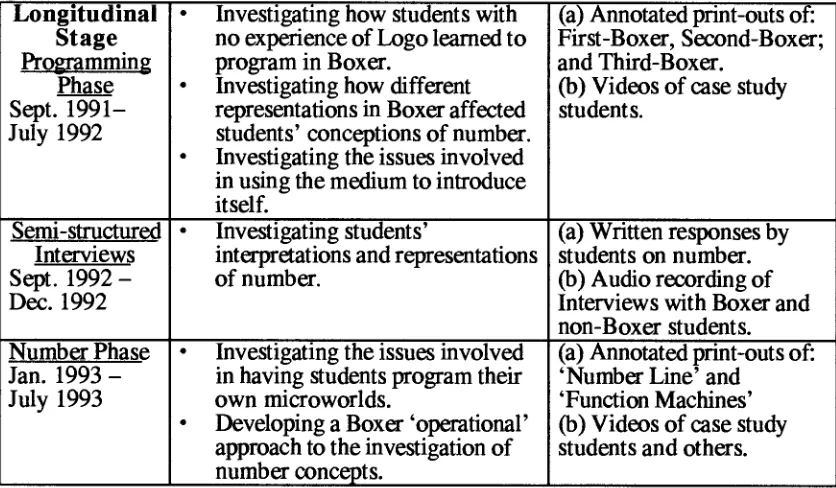
4.1: Timetable for the Research 77
4.2: Timetable of Data Collection 77
4.3: Task Domains for Phase 1 of Exploratory Research 78
4.4: Video Record for Programming Phase 80
4.5: Year 6 Students interviewed on Number 81
4.6: Video Record for Number Phase 82
4.7: Composition of the Case Study Pairs (September 1991) 82
5.1: Results from the on-screen Comparison Questions 96
5.2: Leonie and Jermaine's Number Challenges 96
5.3: Ella and Steven's Number Challenges 97
5.4: James and Sian's Number Challenges 99
6.1: Programming and Number Organisation of First- to Third-Boxer 105
7.1: Students' choice of whole numbers 141
7.2: Students' choice of non-integers 142
7.3: Students' knowledge of Decimals 143
7.4: Students' choice of smallest number 144
7.5: Students' comparison of Directed Numbers 145
List of Figures
1.1: Theoretical areas for this research 13
1.2: A diagrammatic representation of the research 18
3.1: Placing rational numbers on a number line 52
3.2: Students' number line representations 52
3.3: Common representations of functions 53
3.4: Programming languages and generality 56
3.5: The boxes of Boxer 58
4.1: Theoretical social roles for fieldwork 76
4.2: A typical print-out with annotations 79
5.1: The 'saw-tooth' pattern 89
5.2: Finneas and Tariq's cup doit box and drawing 90
5.3: Tom and Tavis's dodecagon pattern 92
5.4: Anoushka and Natasha's house 94
5.5: The line-numbers' representation 95
5.6: Controlling the 'scale' and `start-number' 100
6.1: First-Boxer 105
6.2: Shapes-1 partially opened 106
6.3: Shapes-1 fully opened showing the 'window' challenge 107 6.4: Shapes-2 fully opened showing the 'staircase' challenge 109 6.5: Shapes-5 fully opened showing the 'fence' challenge 112 6.6: Nico and Joanna's first attempts at the 'fence' challenge 112
6.7: Variables-1 113
6.8: Variables-2 115
6.9: Variables-3 117
6.10: Variables-4 118
6.11: Lines 120
6.12: Writing 121
6.13: Joanna and Faye's use of 'move' for writing 123
6.14: Build-it 124
6.15: Lots-at-once 128
6.16: Changes to the presentation mode 131
6.17: Changes to the presentation of commands 132
6.18: Combining 'repeat' with doit boxes 133
6.20: The two versions of 'counter' 135
7.1: Students' representations to compare whole numbers 147
7.2: Students' representations to compare rational numbers 149
7.3: Students' representations to compare directed numbers 151
8.1: The 'T' challenge 158
8.2: Jessie and Kathleen's buggy procedure 'green' 159
8.3: Stage 1 of Kathleen and Jessie's Number Line 160
8.4: Stage 1 of Liam and Jason's Number Line 162
8.5: Liam and Jason's 'op-5', 'op-6' and 'ear' procedures 163
8.6: Stage 2 of Liam and Jason's Number Line 164
8.7: Expressing Patterns with Kathleen and Jessie's Number Line 166 8.8: Visualising the 12 time table with Courtney and Laura's Number Line 168 8.9: Visualising Directed Numbers with Kathleen and Jessie's Number Line 170 8.10: Visualising Decimals with Courtney and Laura's Number Line 173 8.11: Visualising the Number Continuum through Liam and Jason's Number
Line 175
8.12: Visualising the Number Continuum through Kathleen and Jessie's
Number Line 178
8.13: Expressing small decimal quantities with Joanna and Nico's Number
Line 180
8.14: Expressing small decimal quantities with Liam and Jason's Number
Line 181
8.15: Expressing small decimal quantities with Kathleen and Jessie's Number
Line 184
9.1: A typical cardboard model of a Function Machine 190
9.2: Laura and Courtney's cardboard face function model for 2x — 1 193
9.3: Laura and Courtney's 'cryu' procedure 193
9.4: Laura and Courtney's 'semi-modular' programming 194
9.5: Liam and Jason's cardboard function model for 7x — 11 195
9.6: Liam and Jason's 'make' procedure and the first bug 195
9.7: Liam and Jason's 'live' procedure and the second bug 196
9.8: Liam and Jason's third bug 197
9.9: Naomi's cardboard spider function model for 3.5x — 6 198
9.10: Naomi's Spider Function Machine 199
9.11: Modularity and Complexity in Naomi's Spider Machine 200
9.12: Nico and Joanna's cardboard function model for 7x — 5 201
9.14: Rosie and Chloe's cardboard function model for x/2 + 3 203 9.15: Rosie and Chloe's named sub-procedures 'in' and 'out' inside an un-
named super-procedure 204
9.16: Sara and Natalie's cardboard Nintendo Gameboy function model for 8x
+ 94 205
9.17: Sara and Natalie's named sub-procedure 'red' inside a named super-
procedure `gameboy' 205
9.18: Sara and Natalie's developing use of structured programming 206 9.19: Changing the Domain and Range for Liam and Jason's Function
Machine 208
9.20: Articulating informal algebraic expressions through Rosie and Chloe's
function doit boxes 210
9.21: Expressing functions through informal algebra with Liam and Jason's k-
5 doit box 211
9.22: Approaching Directed numbers through subtraction with Naomi's
Function Machine 213
9.23: Approaching Directed Numbers through functions with Joanna and
Nico's Function Machine 215
9.24: Approaching Directed Numbers through inverse functions with Sara and
Natalie's Function Machine 217
9.25: Approaching Directed Numbers through functions with Liam and
Jason's Function Machine 218
9.26: Approaching Decimals through functions with Liam and Jason's
Function Machine 220
9.27: Approaching Decimals through division with Naomi's Function
Machine 223
9.28: Relating Decimals through inverse functions with Sara and Natalie's
Function Machine 226
9.29: Relating Decimals through inverse functions with Liam and Jason's
Function Machine 228
Chapter 1: Introduction
Arithmetic, even its elementary aspects, deals with very important mathematical concepts. To establish the link between ordinary mathematical situations and the relevant mathematical concepts is probably the most challenging question in mathematical education. (Vergnaud, 1978, p. 344)
1.1: Background to the Research
This thesis has been undertaken to investigate children's developing sense of number in the computational medium of Boxer. It asserts that the critical factor in developing students' understandings is their construction of meaning for number, and it presents evidence to show how programming in Boxer offers a powerful way for constructing such meaning.
It draws together three distinct knowledge domains: theory and research relating the learning of programming with the learning of mathematics in general; theory and research concerned with the learning of number; and theory and research linking each of these to visualisation (Figure 1.1). These domains do not stand alone but are located in more general theories of learning.
/
Visualisation
Mathematics
4
-01.
Microworlds4-00-
ProgrammingNumber 4111---III■ Boxer
Figure 1.1: Theoretical areas for this research
Sfard, 1991; Gray and Tall, 1994) pertaining to conceptual and procedural knowledge in mathematics. These two strands are bound together by the twin threads of visualisation and 'connectedness', particularly in relation to number.
In the first case, advances in technology have led to a renaissance in visualisation in mathematics (Zimmermann and Cunningham, 1993), in mathematics education (Bishop, 1989), and in the design of computer interfaces themselves (Shneidnerman, 1983). In the second case, the notion of 'connectedness' arises both with regards to revaluating the concrete/abstract dichotomy (Wilensky, 1993; Ackermann, 1993), but also in the number sense literature where meaning is seen to be attained through the establishment of multiple links between different nodes of knowledge (Sowder, 1989). Hoyles and Noss (in press) put forward a case for learning as the construction of a web of connections and have located as a central question for learning and teaching: "... how to assist students in building on their own meanings in ways which are concurrent with mathematical ways of knowing by interactions within computational microworlds." (p. 5.1) an expression which articulates my Boxer endeavours with respect to number.
The findings of major research studies in this country such as the C.S.M.S. (Hart et al., 1981), the A.P.U. (Foxman et al, 1985), and the N.C.T.M. (Carpenter et al., 1981) in the United States leave little doubt as to the difficulties which many students experience in dealing with number, difficulties which persist well into the secondary school. Moreover, these difficulties cannot be simply reduced to the mathematical properties of the task.
Problems that have the same logical structure and that call for the same mathematical operations can be handled quite differently by young children. Changes in the content or context of a task can have a marked effect on task difficulty. (Bergerons and Herscovics, 1990; Kiichemann, 1981). Both the CSMS research (Hart, op cit.) and the APU research (Foxman, op cit.) found that changes in the numerical elements, for example, from positive to negative numbers or from whole numbers to fractions or decimals, had a pronounced affect on facility levels. These changes, Kiichemann (op cit.) notes, can in each case be described as a shift towards elements that are less
`intuitable' or 'concrete'.
the Piagetian concrete level stage, then: "... their learning should be through `concrete' experiences." (p. 3), the implicit assumption being that these concrete experiences will form the basis for more formal learning of the same ideas. However, he reports the results of a research project (Children's Mathematical Frameworks) which appears to show that, even when teaching is designed to foster the transition between learning mathematics from practical or concrete work to using formalised versions of the same mathematical ideas, children do not connect the two sets of experiences. This is expressed in stark terms by one of the participants, Hart (1987), who writes: "The results showed overwhelmingly that the recipients of a series of practical experiences, leading up to a formalisation did not appreciate that the latter was a synthesis of the former." (p. 410).
Such insights serve to alert us to the dangers of an over-simplification of the link between practical activities and formal understanding, and points to the need to create contexts which help students develop meanings for mathematical entities. As Vergnaud (1988a) argues:
It is our job to organise didactic situations and to experiment with them, both with the short-term objective of enabling students to develop new competencies and conceptions for immediate use and with the long-term perspective of offering a basis for concepts that will be essential a few years later. For instance, it may be interesting to introduce negative and positive numbers in elementary school not only to help students to deal immediately with the combination of directed transformations but also to prevent them from sticking to a narrow conception of numbers as positive quantities, a conception that later will be an obstacle to the learning of algebra. (Vergnaud, 1988a, p. 143)
In this research, pedagogical situations were organised in which primary school students (aged 9 — 11) encountered directed numbers and decimals in the course of interacting with computational objects in Boxer. The concern was not to measure or improve facility levels, but to investigate how this interaction might affect students' construction of meaning.
diSessa (1987c) emphasises that: "... computers have a character that better adapts them to some areas than others — in particular, to areas where the essential structure is visual, geometric and dynamic." (p. 74). The challenge for this study was to see if the traditionally non-graphical area of number might also be approached in a visual way.
These twin programming and number aims can be summarised as follows: to investigate how students' programmed in Boxer;
However, as the research progressed, other subsidiary questions arose. Following an exploratory study in which students with a Logo background were observed, a key question which emerged for the longitudinal study was how students with no programming experience might be introduced to Boxer? This in turn evolved into a question of whether the medium could be exploited to introduce itself, i.e., of whether the visual facilities of Boxer could be utilised to construct an introductory course in programming, and if so, what issues might this involve? These then became subsidiary aims for the programming phase of the study.
As a result of a series of off-computer interviews with Boxer and non-Boxer students, the notion of using Boxer to construct meaning for number was refined to one of using Boxer to construct operational meanings for number, i.e., it was hypothesised that students would acquire meaning for directed numbers and decimals if they saw these numbers as a consequence of operations. This posed several intermediate problems. Firstly, there was the problem of identifying which Boxer objects might best lend themselves to an operational approach and secondly, there was the question of the programming demands that the construction of such objects set for the students. The number research question now became refined to one of investigating how different Boxer objects mediated students' expression of number.
At this point, it is perhaps worth clarifying my use of the term 'mediate'. Following Vygotsky (1978), the view taken here is that the tools at our disposal mediate the ideas we can express. Thus expressing a number sequence with a spreadsheet, for example, will summon up different kinds of knowledge than that for pen-and-paper. The task for this research was to investigate on the one hand how Boxer's visual constructs mediated students' learning of programming, and on the other how the objects of their programming mediated their sense of number.
1.2: An Overview of the Research
1.2.1: Theoretical Perspective
In chapter 2, 'Learning Mathematics and Learning Number', theoretical issues that relate to learning mathematics are discussed in general. Issues of particular relevance to this research were those relating to: the origins and growth of students' knowledge; the need for the child to be an active participant in her or his learning; how such learning might be affected by contexts; and how situations might be created to build bridges from intuitive to formal knowledge. Thus, this section ranges over issues of epistemology, constructivism, the nature of mathematical concepts and the effects of mathematical intuition.
It then considers how the insights derived from these theoretical perspectives might affect practice, and it finds exemplification in the accumulated body of Logo research in ways that are especially apt for this study. This section addresses how Piagetian learning might be mediated by programming, and it draws on Papert's notion of `constructionism' as a means of analysis. It re-examines the relationship between the concrete and the abstract and sees considerable merit in the idea of 'connectedness'.
In the second half of chapter 2, the discussion focuses on number. It considers the meaning of the expression 'number sense', how this relates to 'connectedness', and what these might mean for students' developing sense of number. This is then followed by a review of the research literature relating to those aspects of Decimals and Directed Numbers which the students met in this study. This review reveals two facts: students encounter considerable difficulties with number concepts, and there is an accumulating literature suggesting why this occurs and giving a broad framework for its resolution. The chapter ends by examining what seems to be the writings of most relevance to this research, namely that pertaining to the distinction between procedural and conceptual knowledge.
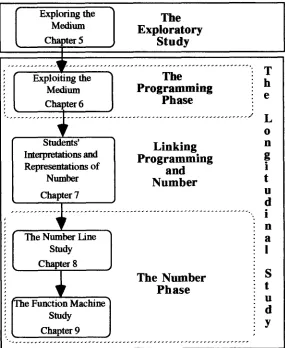
.---4 The Number Line
Study Chapter 8
The Number
V
Phasethe Function Machine Study Chapter 9 The Programming Phase , Linking Programming and Number e L 0 n g 1 t u d i n a 1 S t u d y The Exploratory Study Exploring the Medium Chapter 5 Iiir Exploiting the Medium Chapter 6 Students' Interpretations and Representations of Number Chapter 7
these intentions are then considered in terms of Boxer's design and implementation. Moving from a general discussion of structural and functional modelling, the chapter outlines the underlying models of Boxer's design and the two central principles (`naive reality' and 'the 'spatial metaphor') which guided that design. Finally, the chapter reviews currently available Boxer research.
1.2.2: Methodology
Chapter 4 'Methodology' details the research methodology employed: the nature of the data collected, the methodology for collection, and describes the classroom setting and the role of the researcher. It also records how these changed during the course of the research both as a consequence of the findings of the exploratory study and in order to adapt to the modified classroom conditions from the exploratory to the longitudinal stage. The empirical stages of the research form the subjects of chapters 5 to 9, as depicted in Figure 1.2.
Writing on the role of intervention in learning, Hoyles and Noss (1992b, p. 32) describe "a critical tension between the need to allow students room for manoeuvre and exploration on the one hand, and our own intentions and structuring on the other". The methodology of this thesis can be seen as attempting to resolve this tension over the course of longitudinal study. From an initial structured setting which aimed to establish a baseline of programming knowledge, it devolved increasing degrees of freedom to the learner as the research progressed to and through the number phase. Each of these phases were characterised by their own distinctive methodology: the programming phase by the exploitation of the medium to introduce itself; the interview phase by its aim of integrating students' knowledge into the research design, and the number phase by its constructionist nature.
1.23: The Exploratory study
Chapter 5 'Exploring the medium' describes the exploratory stage of the research whose major aim was to identify and refine issues for the longitudinal study. It gives an account of how students who had previous Logo experience adapted their knowledge in learning to program in Boxer, and it relates how a vector representation was used to explore students' understanding of number. In terms of the thesis as a whole, it shows how ethical considerations combined with the aim of establishing a foundation of programming knowledge over the long term led to the iterative design of the programming phase of longitudinal study (chapter 6).
1.2.4: The Longitudinal study
1.2.4.1: the programming phase
1.2.4.2: the semi-structured interviews
Chapter 7 'Students' Interpretations and Representations of Number' gives an account of the semi-structured interviews carried out with students from the Boxer group and those from a parallel year six class. Just as the exploratory study had refined issues for the programming phase, this study helped to refine issues for the number phase. It clarified the ways in which these students thought of number in general, and of directed numbers and decimals in particular. In particular, it highlighted their action-based meaning for fractions and led directly to the 'operational' approach adopted in the two number studies. Moreover, it began to establish some baseline knowledge of the kinds of representations that they used and found useful for depicting these numbers. By comparing the Boxer students with those from a parallel class, it accentuated differences which pointed to medium and thus helped to shape the next phase of the research.
1.2.4.3: The Number Line Study
Chapter 8 'The Number Line Study' recounts the first of two number studies whose design was influenced by the earlier exploratory stage (chapter 5), the number investigations of the programming phase (chapter 6), and the results of the semi-structured interviews (chapter 7). It describes how the case-study students utilised their programming knowledge to construct an 'operational' number line representation in Boxer, and relates how the insight gained through this construction influenced their subsequent interactions with it.
The study shows that, within the medium of the Boxer students displayed a facility for manipulating directed numbers and decimals which was at odds with research with older students in conventional media — differences all the more remarkable since no direct teaching was involved. Chapter 8 acknowledges the situated nature of such learning, but it gives specific instances of the ways that the number line device mediated students' expression of number, and asserts that the evidence points to the students' own constructs of the Boxer number line as being a powerful mathematical object through which they constructed meaning for number.
1.2.4.3: The Function Machine Study
their programming knowledge. It shows how the insight gained through this construction influenced their subsequent interactions with it. It then analyses the ways this 'operational' Boxer object mediated their expression of number.
In doing so, it both reinforces and differs from the findings reported in chapter 8. In reinforces them to the extend that it demonstrates again how students developed an extraordinary fluency in dealing with directed numbers and decimals within the medium. It differs in the manner that the function machine mediated their expression of number. Whereas the Boxer number line seemed to dispose students to attend to what might be categorised as geometrical aspects of number, such as those relating to the number continuum, the function machine seemed to push them towards algebraic aspects. The function machine context entailed approaching number through algebra (in opposition to the usual school approach) and student activities and descriptions reflect that approach. They sought and adapted functions to map one set of numbers to another, and they constructed meaning in terms of operations or inverse operations.
1.2.5: Summary and Implications
Chapter 2: Learning Mathematics and Learning about
Number
2.0: Overview
This chapter is about learning mathematics generally, about learning number in particular, and about how learning environments can be created through programming. It draws on theory and research relating to each of these. From a theoretical perspective, it discusses issues relating epistemology, constructivism, social constructivism, concept analysis and intuition. From a research perspective, it considers the body of knowledge that has been built up by Logo researchers over the years, and explicates Papert's notion of constructionism and concreteness. It then narrows the focus to number, discusses the literature relating to 'number sense' and recounts the research findings relating to the learning of decimals and directed numbers. Finally, it considers the relationship between conceptual and procedural knowledge.
2.1: Learning Mathematics — A Theoretical Perspective
Theory is essential to organise our knowledge on mathematics education in coherent systems of description and in powerful concepts. In order to understand how individuals develop or fail to develop knowledge, it is essential to discuss alternative interpretations of constructivism and other theoretical frameworks. (Vergnaud, 1987a p. 43)
2.1.1: Epistemology
Like many theses in mathematics, this one begins with Piaget. The Piaget of stage theory is, of course, well known. But this Piaget is, in Papert's words: "essentially conservative, almost reactionary, in emphasising what children cannot do." He, by contrast, identifies: "more revolutionary Piaget, one whose epistemological ideas might expand the known bounds of the human mind." (1980, p. 157). Other writers have uncovered similar ideas in Piaget, but use different phrases to express what they have found, e.g., 'revolutionary constructivist epistemology' (Cobb, 1986) 'dialectical constructivist' (Higginson, 1980; Sinclair, 1987)
suggests, is compatible with views of 'the child as scientist', and he draws on the work of Ginsburg (1977) as evidence of the ingenuity of children's attempts to make sense of certain concepts and processes.
Traditionally, epistemology has been used to describe the study of the conditions of validity of knowledge. Papert (1980) writes that Piaget's epistemology is concerned not with validity of knowledge but with its origin and growth. When Piaget writes about the developing child, he is in fact writing about the development of knowledge. This statement allows a contrast to be drawn between epistemological and psychological ways of understanding learning. In a purely psychological perspective, the focus is on the laws that govern the learner rather than on what is being learned. "For Piaget, the separation between the learning process and what is being learned is a mistake: the way to understand how children learn number is through a deeper understanding of what number is" (Papert, op cit. p. 158).
Vergnaud (1990) distinguishes three interweaving strands of knowledge: epistemology of mathematics, epistemology of psychology, and epistemology of mathematics education. There are, he suggests, several approaches to the epistemology of mathematics. Firstly, there is the spontaneous reflection by mathematicians themselves on the nature of their knowledge and on the nature of the invention and discovery process. (cf. Poincare, 1913, 1920; Hadamard, 1949). Secondly, there is the historical approach. Its aim is to understand the scientific and social environment in which new mathematical concepts and techniques have emerged and developed (cf. Davies and Hersh, 1981). Thirdly, there is the mathematical-philosophical debate on the foundations of mathematics, e.g., logicism, intuitionism, formalism, constructivism etc.
as the education of future mathematicians and the education of rank-and-file citizens." (Vergnaud et al., 1990, p. 15).
2.1.2: Constructivism
Piaget, according to Vergnaud (1987a) was, in his day, the most systematic theorist of constructivism. But, what exactly is constructivism, and what are its implications for the teaching and learning of mathematics? One answer to the first of these two questions is given by Novak (1986) who sets constructivism in opposition to behaviourism and positivism:
As long as we were saddled with behaviourism and positivism, ... there was no need to discuss the concept of number, line, point, slope, and so on. And few worried where the concepts came from, who created them, and how concept meanings evolve over time, or change with context. But cognitive psychologies and constructive epistemologies tell us that we must concern ourselves with the latter issues. (Novak, 1986, p. 181)
A more definitive approach is taken by Kilpatrick (1987) who writes that the constructivist view involves two principles: (1) Knowledge is actively constructed by the cognizing subject, not passively received from the environment. (2) Coming to know is an adaptive process that organises one's experiential world; it does not discover an independent pre-existing world outside of the knower. He observes that the first principle is much more acceptable than the second by many who call themselves constructivists. He writes (cf. Davis and Mason, 1986) that this second principle separates 'simple' constructivism from 'radical' constructivism.
Von Glasersfeld (1987) refers to this latter principle as 'viability', i.e., a concept works or is viable to the extent that it does what we need it to do. Confrey (1995) points out that radical constructivism is itself subject to this principle, which she refers to as 'recursive fidelity'. Cobb (1986) uses the expressions 'empiricist-oriented constructivists' and 'radical constructivists' to express the same divide. Vergnaud (1987a) sees two independent ideas in the second principle: the adaptive process, and the radical constructivist's denial of an independent pre-existing world for the other. He does not see the necessity to accept the latter of these in order to be a radical constructivist.
points to the role of others in the construction process. This corresponds with Piaget's view, according to Sinclair (1987) who says that the quality of knowledge gathered through our actions on the real world is determined by the ways in which reality reacts to our interventions and by its correspondence to the knowledge that other people have constructed. She quotes (op cit., p. 32) Piaget as saying "Objective knowledge is only attained when it has been discussed and checked by others". This seems to accord well with Vergnaud's position who writes:
I see constructivism as the best way to consider the process of appropriation by which a student makes mathematics his own knowledge. Rather than a pure and lonely construction, the learning of mathematics is for me the difficult appropriation of a social knowledge.
(Vergnaud, 1987a, p. 53)
Kilpatrick (op cit.) cites Von Glasersfeld (1983) as setting out the pedagogical implications of constructivism as follows:
(i) teaching is sharply distinguished from training (the former is aimed at understanding, the latter at repetition);
(ii) processes inferred as inside the student's head become more interesting than overt behaviour;
(iii) linguistic communication becomes a process for guiding a student's learning, not a process for transferring knowledge;
(iv) students' deviations from the teacher's expectations become means for understanding their efforts to understand;
(v) teaching interviews become attempts not only to infer cognitive structures but also to modify them.
Constructivists, according to Kilpatrick, need to clarify and develop their ontological commitments. They need to think through and spell out more clearly than they have done thus far the relationships between constructivism and mathematics as a discipline and mathematics as a school subject. Finally, he says that constructivism needs to become connected to reality: the reality of everyday scientific activity, mathematical investigation, and classroom practice.
Confrey (1994) acknowledges limitations in constructivism, amongst which she lists its assumption that: "a theory of learning provides an adequate theory of instruction." (p. 7) and its heavy dependence on the autonomy of the individual. Simon (1995) contends that constructivism: "does not tell us how to teach; that is it does not stipulate a particular model" (p. 114), an interpretation accepted by Steffe and D'Ambrosia (1995) who reply: "We expect different mathematics educators working in a constructivist epistemology to generate different specimens of teaching" (p. 147). Dubinsky (1991), while not using the term `constructivism,' nevertheless emphasises the importance of the constructive process. Moreover, he goes some way in setting out an instructional approach and indicates the importance of computers in fostering `reflective abstraction', a concept which he writes was: "... introduced by Piaget to describe the construction of logico-mathematical structures by an individual during the course of cognitive development." (p. 95).
2.13: Contextualising Constructivism
One theorist who attempts to connect constructivism with pedagogy is Bruner. Bruner's theory of cognitive development is marked by his attention to representation, language and the influence of the social setting. He writes that the child first knows her world principally through the action she directs towards it. Later, she is able to form images of objects in their absence and this helps to free her from purely action-guided representation. Finally, she can convert both action and image into symbols such as words. Bruner (1968) calls these three modes of representation: enactive representation, iconic representation and symbolic representation. They appear in that order and all three remain with us throughout our lives.
myths and language. In contrast to Piaget, he stresses the importance of language. He argues (1980) that: "language provides a means not only for representing experience but also for transforming it." (p. 330).
Bruner, again departs from Piaget, in that he is concerned with pedagogical issues. The teacher, he argues, should not slavishly follow the course of cognitive growth. Rather, he says that the aim should be that of tempting the child into the next stage of development. We can see in Bruner's theories the unmistakable influence of Vygotsky with respect to culture, with respect to language and with respect to the `zone of proximal development'.
According to Confrey (1995), the attention to the role of tools in mediating knowledge is a clear focus of Vygotsky theory. This focus, she writes: "led him to propose that language is itself a form of psychological tool" (p. 41). Forman and Cazden (1985) stress that Vygotsky is not simply claiming that social interaction leads to the development of the child's abilities. "Rather, he is saying that the very means (especially speech) used in social interaction are taken over by the individual child and internalised." (p. 323).
They write that, whereas for Piaget social experiences derive their importance from their potential for cognitive conflict, Vygotsky's ideas offer insights in situations where mutual guidance and support are evident. They say that he acknowledged the discrepancy between solitary and social problem solving when he developed his notion of the zone of proximal development. He defined this zone as "the distance between the actual developmental level as determined by independent problem solving and the level of potential development as determined through problem solving under adult guidance or in collaboration with more capable peers" (1978, p. 86). According to Vygotsky, development proceeds when inter-psychological regulation is transformed into intra-psychological regulation.
If the child is enabled to advance by being under the tutelage of an adult or a more competent peer, then the tutor or aiding peer serves the learner as a vicarious form of consciousness until such time as the learner is able to master his own action through his own consciousness and control. When the child achieves that conscious control over a new function or conceptual system, it is then able to use it as a tool. Up to that point, the tutor in effect performs the critical function of "scaffolding" the learning task to make it possible for the child, in Vygotsky's word, to internalise external knowledge and convert it into a tool for conscious control. (Bruner, 1985, p. 24)
Vygotskian perspectives have served as a starting point for many studies. Some have focused on the teacher-pupil relationship whilst others have chosen the pupil-pupil as their focus. Jaworski (1990) has studied the "acts a teacher undertakes to facilitate a pupil's mathematical progress" (p. 94) while Forman and Cazden (1985) have explored instead the value of peer-interaction. The notion of 'scaffolding' has also been extended from that of adults and capable peers to include the computer (Hoyles and Noss 1993c; Noss and Hoyles, 1987).
However, Hoyles and Noss (1993c) explicate differences between their formulation of scaffolding and that of Bruner and his colleagues. Firstly, they place the computer in the role of the human tutor, yet seek to do so in such a way that the learner retains control. Secondly, they observe that the traditional view of scaffolding is 'universal' in that it is independent of context. Their notion, by contrast, is domain contingent. Finally, they write that their notion is concerned with scaffolding of concepts rather than skills.
2.1.4: Concepts
Another theorist who attempts to connect the constructivism of Piaget with the realities of pedagogy is Vergnaud. He (1987a) equates Piaget's 'normative facts' (Sinclair, 1987) with his own 'invariants', or 'theorems-in-action'. But, whereas Piaget analysed tasks in terms of their logical structure, Vergnaud begins with an analysis of concepts. He writes (1984, p. 19) that a concept can be considered as a triplet of three sets: C = {S, I, where:
S: the set of situations that make the concept meaningful;
the set of invariants (or 'theorems-in-action') that constitute the concept and insure its stability under certain classes of transformations and variations; t: the set of symbolic representations that may represent the concept and the
situations in which it is involved.
He argues that the core of cognition lies in the operational invariants that students gradually discover or appropriate. He proposes that a large part of our knowledge is only implicit: we take up information with the help of invariants without expressing or even being able to express these invariants. This is especially visible in students' mathematical behaviour. Very often, they choose the right thing to do without being able to articulate the reasons for it. The cognitive analysis of such behaviours very often reveals the existence of powerful implicit mathematical concepts and theorems, which Vergnaud calls concepts-in-action or theorems-in-action.
The situation, he says, is made more complex by the fact that not only does a concept refer to a variety of situations, but each single situation cannot usually be analysed with only one concept. He uses the expression 'conceptual-field' to describe such entities, and adds (1983a) that conceptual fields develop over a long period of time. Elsewhere, Vergnaud (1988a) writes that the main reason that mathematics researchers should study such comprehensive systems as conceptual fields is to understand the filiations and jumps in students' acquisition of knowledge; while theorems-in-action are a way for us to analyse students' intuitive strategies and to help them in transforming intuitive knowledge into explicit knowledge.
2.1.5: Intuitions
This latter appeal begs the question: "What exactly do we mean by intuitive knowledge?" Like visualisation (chapter 3), it is very often taken as a primitive concept, i.e., one which requires no further explanation. But, as Fischbein (1978) writes, it is not enough that we use the term 'intuition' to describes certain forms of thinking. Rather we must characterise and analyse the nature of intuitions:
Intuition has an important impact on mathematical thinking, whether positive or negative. So it cannot be neglected by mathematical education. Both in trying to use its beneficial qualities and in striving to eliminate intuition from pupils' mathematical reasoning, we have to take into account its possible effects. (Fischbein, 1978, p. 151)
(1) They seem to be self-evident. No arguments appear to be necessary to convince us of their truth, and this explains their great impact on the course of thinking. In educational terms, students may not see the necessity to prove what is obvious. (ii) As a consequence of their self-evidence, intuitions exert a coercive effect on the
processes of conjecturing, explaining, and interpreting various facts. Several educational results of this can be seen. Firstly, the intuition may be so strong that it dominates any alternative explanation. Secondly, two opposite interpretations may co-exist for a long time without the subject being aware of the contradiction.
(iii) Intuitions are marked by their capacity to extrapolate. Whereas logical thinking makes predictions on the basis of rigorously and explicitly established arguments, intuition represents a leap which cannot be completely justified. (iv) Intuitive judgements are inclined to be global. They are also frequently
expressed by a visual symbolisation.
He proposes a classification of intuitions and analyses certain mechanisms like over-confidence, premature closure (a halt to the search for new information), and the primacy effect (giving privilege to first interpretations). Fischbein gives examples of correct mathematical intuitions (transitivity of equivalence) and over-generalised intuitions (multiplication makes larger, division makes smaller). He also gives examples of primary intuitions (the more space, the more things), and secondary or constructed intuitions (conservation of quantity). He observes that intuitions change in the course of cognitive development: the intuition of subtraction is different for a 5-year-old and a 16-5-year-old, as is the intuition of similarity. The feeling of immediacy that we have with our intuitions is therefore misleading and needs to be analysed as the result of accommodation to experience and as a change in implicit knowledge.
Fischbein's analysis of intuitions, Vergnaud's analysis of concepts, and Bruner's theory of cognitive development with its constituent themes of representation, language and social interaction together form a backdrop to the work of mathematics educators who have explored the creation of learning environments through Logo.
2.1.6: Constructing Learning Environments
successful. Elsewhere (1993b), they conclude that Logo is best viewed as a `conceptual framework' with which children learn mathematics. The critical question, they write, is: "whether and how the computer might offer support structures which fulfil a scaffolding role" (p. 418). Their tentative conclusion is that the computer can indeed fulfil this function by providing an environment through which intuitions can be made explicit, tested, and changed if necessary, thus making robust mathematical ideas built on intuitions.
They consider such environments in relation to the role of concrete materials in the learning of mathematics, and observe (cf. Resnick, 1981; Hart, 1981) that the connection in the child's mind between the concrete and the abstract may not be at all clear. The problem, they say, is to lay connections between the concrete and the abstract in such a way that the child creates meaningful links between the two. The way to do this, they argue, "lies not in the use of concrete activity and then its formalisation, but in the continued use of concrete embodiments — moving backwards and forwards between the concrete and the abstract, between the general and the particular, and between pupil's conceptions and their formalisations" (1987, p. 586).
Papert gives theoretical underpinnings to this conclusion through his notion of constructionism:
Constructionism ... shares constructivism's connotation of learning as "building knowledge structures" irrespective of the circumstances of the learning. It then adds the idea that this happens especially felicitously in a context where the learner is consciously engaged in constructing a public entity ... (Papert, 1993b, p. 1)
Wilensky (1993) takes this as his starting point. He writes that concreteness is not a property of an object but rather a property of a person's relationship to an object. The more connections we make between an object and other objects, the more concrete it becomes for us. Once we see this, he continues, it is not difficult to go further and see that any object/concept can become concrete for someone.
The pivotal point on which the determination of concreteness turns is not some intensive examination of the object, but rather an examination of the modes of interaction and the models which the person uses to understand the object. This view will lead us to allow objects not mediated by the senses, objects which are usually considered abstract — such as mathematical objects — to be concrete; provided that we have multiple modes of engagement with them and a sufficiently rich collection of models to represent them.
(Wilensky, 1993, p. 199)
This notion of concreteness as a relational property, he writes, turns the standard Piagetian view on its head. "The lesson we take from Piaget is not that the child develops by leaving behind the primitive world of concrete operations and leaping into the enlightened world of adult formal operations. Rather ... the child concretises his or her world by engaging in multiple and complex relationships with it" (p. 199).
How this might occur in practice is the theme of Harel's (1991) research. She describes how fourth grade children designed a piece of software with the aim of teaching fractions. In doing so, they were learning about Logo and learning about fractions. She writes that whereas conventional approaches to teaching fractions have focused on manipulative aids, i.e., helping the child to move from the concrete to the abstract, her research design provided students with an environment in which to explore relationships between different representational modes.
2.2: Learning Number — A Research Perspective
To understand how a child learns number, we have to study number. And we have to study number in a particular way: We have to study the structure of number, a mathematically serious undertaking. (Papert, 1980, p. 158)
2.2.1: Introduction
areas, with the hierarchy: Whole Numbers --> Fractions --> Decimals --> Directed Numbers reflecting the order in which children are taught these topics.
Moreover, there is a depth to the acquisition of number concepts that further defines research in this field. Researchers such as Piaget (1965) have alerted us to the complexity involved in the acquisition of number concepts by very young children; for example, in discriminating between ordinal and cardinal aspects. Post-Piagetian researchers (Gelman and Gallistel, 1978; Donaldson, 1987, Ackermann, 1993) have shown us that the situation is even more complex than Piaget thought, by demonstrating the powerful influences of language and context. In research with primary school children aged 9 - 11, a review of the number literature pertaining to early childhood was deemed inappropriate. On the other hand, my desire to explore children's 'developing sense of number' in a Boxer environment clearly pointed to the need to consider context. As Vergnaud (1978) points out:
It is hopeless to try to understand the acquisition of arithmetical concepts and to propose better conditions for the child to understand them if one does not make the effort to analyse the tasks through which these concepts are made meaningful and useful to the child.
(Vergnaud, 1978, p. 347)
A third approach to number is that usually adopted by researchers interested in topics such as estimation and is labelled 'number sense'. Thus, Sowder (1989) writes that "... number sense refers to a well-organised conceptual network that enables one to relate number and number operations, and to solve number problems in flexible and creative ways." (p. 381). These three categories are not intended to be exhaustive of all number research. Rather, they identify three trends which intersect in the present research. The review of the literature will reflect that intersection.
2.2.2: Number Sense
McIntosh, Reys and Reys (1992) trace the origins of the phrase 'number sense' to a desire to replace the word 'numeracy' by one which does not have its abstract ring or its association with a conservative and sterile view of mathematical needs. But, they remark that the phrase itself is open to different interpretations. For them:
Number sense refers to a person's general understanding of number and operations along with the ability and inclination to use this understanding in flexible ways to make mathematical judgements and to develop useful strategies for handling numbers and operations. (McIntosh, Reys and Reys, 1992, p. 3)
Other characteristics which they say typify 'number sense' include:
• the theme of learning mathematics as a sense-making activity;
• its acquisition as a gradual, evolutionary process, beginning long before the start of formal schooling;
• growing older does not necessarily ensure either its development or utilisation;
• it is triggered by the context in which the mathematics evolves;
• it is highly personalised and is related to what ideas about numbers have been established and also how these ideas were established
However, they acknowledge that merely listing the components of number sense or the attributes of the students who possess it is insufficient in itself. They agree with Greeno (1991) who suggests that 'number sense' is a term that requires theoretical analysis, rather than a definition. Often it seems that 'number sense' is apparent by its absence, and, as the following section indicates, its absence is frequently marked by the lack of connectedness between number concepts and number algorithms.
2.23: Directed Numbers
In this country, children are not usually taught directed numbers until the secondary school. One reason for this seems to be the general recognition of the difficulties which children have in this area (Bell, Costello and Kiichemann, 1983). In this, they are in good company, for, as the history of mathematics shows (Vergnaud, 1990; Hefendehl-Hebeker, 1991), negative numbers provided intellectual obstacles which many great mathematicians failed to overcome. However, acknowledging difficulty need not imply avoidance or even postponement:
Studies on the acquisition of negative numbers reveal long-lasting obstacles in 15- to 16-year old students, especially when they have to multiply a negative by a negative or when they come to a negative solution. Paradoxically, there are some aspects of negative numbers that can easily be understood by primary school students: a negative transformation (decrease, loss, consumption, backward displacement), a negative relationship (less than, debt), or even a negative abscissa (below the ground floor).
With respect to operations on directed numbers, both the CSMS and APU studies found that addition was considerably easier than subtraction. The approach used in each was different with only the former employing explicit models, and so a direct comparison is not possible. In the CSMS research (Hart et al., op cit.), the facilities for these operations were typically of the order 80 - 90% and 36 - 77% respectively, whilst in the APU research (Foxman et al., op cit.), they were of the order 65% and 50% respectively. Kfichemann (1981) reports on the misapplication of the rule 'two minuses make a plus in the case of subtraction but not multiplication. Arcavi and Bruckheimer (1981), in a comparison of different strategies for introducing the latter, found surprisingly little differences between them and the rote method which they characterised by reproducing the old adage: "Minus time minus equals plus - the reason for this we need not discuss" (p. 31).
Kiichemann (op cit.) suggests that there are two main approaches to the teaching of directed numbers; an abstract axiomatic approach and one in which various models are used to elucidate the operation being used. The first of these, he argues, has advantages in terms of mathematical consistency but he doubts whether such an approach would be accessible to all but a minority of secondary school children. This conclusion, he claims, is supported by the work of Collis (1975, 1978) who argues that the ability to work consistently within an abstract mathematical system requires formal operational thought.
On the other hand, he says that the concrete approach suffers the disadvantage that the models are not consistent across operations. Thus shifts along the number line appears to succeed for addition but not for subtraction. He suggests abandoning the number line model completely in favour of one in which the positive numbers are seen in terms of cancelling out the negative numbers. Rowland (1982) reports some success using such a model.
2.2.4: Place Value and Decimals
It is above all clear that the learning of whole numbers and decimals is not just a matter of recalling some place-names and a few rules of computation, as it often appears from the textbooks. Indeed the children who did rely blindly on rules more often misapplied them than not. Instead, it involves internalising a whole chain of relationships and connections, some within place-structure itself (e.g., 0.9 is equivalent to 0.90), some linking to other concepts like those of fractions (e.g., the notion of one hundredth and its relationship to one tenth), some visual correspondences and some connecting to applications in the 'real' world.
(Brown, 1981, p. 64)
In the APU surveys (Foxman et al., 1985), the most difficult whole number items for 11 year-olds were those concerned with the relationship between the column values of a number. For example, children presented with the numbers 107, 71, 7, 710 and asked to 'Put a ring round the number in which the 7 stands for 7 tens', only 69% chose the correct answer (ibid., p. 42). The facility level for the item 'The number which is one less than 2010 is' was similar: 71% (ibid., p. 42). Another item which asked 'Which number is ten times 1000?' received a correct response of only 62% (ibid., P. 44). The attainment band analyses suggested that the bottom band, in particular, at age 11 had considerable difficulty with items which relate to place value.
This finding is corroborated by Brown (1981) who reports that, the weakest children when interviewed showed only a superficial knowledge of place value. For example, 8030 was read as 'eight hundred and thirty'. Conversely, the correct oral answer was given in response to 'add ten to 3597' but recorded as 367. She noted that items containing numbers over a thousand exposed uncertainties even among children of average attainment.
Carpenter et al. (1981) note that in order to construct an understanding of decimals, students needed to have an appreciation of place value and a firm grasp of the relationship between decimals and common fractions. Their results suggest an absence of each. They say that, since the 9-year-olds in their research had not yet studied decimals, it was not surprising that they ignored the decimal and interpreted the number as a whole number. They also noted that fewer than 1 percent of the 9-year-olds gave the correct decimal equivalent for a fraction expressed in tenths. 55 percent of 13-year-olds could undertake this latter task, but "as many chose 0.5 for the decimal equivalent of 1/5 as chose the correct response 0.2." (p. 35).
of places to the right of the decimal point." (p. 33). Certainly, in the present research, children did consider 0.25 to be bigger than 0.3, but since they also thought 0.5 and 0.50 to be different numbers, Grossman's explanation may be inadequate in itself.
Nesher (op cit.) observes that when asked to write the rational number 3/4 in decimal form, some of the students wrote 3.4, 0.3 or 0.34. She goes on to claim that children are consistent in the rules that they apply, each of which emerges from previous knowledge: the DPI error from the domain of whole numbers and the LS error from the domain of rational numbers. This theory of a 'retrieval of incorrect frames' (Davies, 1984) is supported by Zazkis and Khoury's (1993) study of pre-service teachers' understanding of rational numbers in bases other than ten. They record similar examples of students over-generalising and ignoring the 'separating point'. How schooling influences such errors is considered by Resnick et al. (1989) who conclude that: "different curriculum sequences produce different patterns of rule invention." (p. 25).
On the other hand, Fischbein et al. (1985) in their research with Italian children (grades 5, 7 and 9) appear to confirm the universality of certain strategies. They hypothesise that: "Each fundamental operation of arithmetic generally remains linked to an implicit, unconscious, and primitive model." (p. 4), and write that: "A next step in this line of research would be to attempt to provide learners with efficient mental strategies that would enable them to control the impact of these primitive models." (p. 16). The widely reported 'multiplication makes it bigger' and 'division makes it smaller' syndrome is a case in point (Brown, 1981; Foxman et al., 1985). They argue that the misconceptions follow from the model of multiplication as repeated addition. Greer and Mangan (1985) report changing the multiplier from an integer to a decimal less than one lowered performance by about 46% while Graeber and Tirosh (1990) report that such beliefs are held by students as early as the fourth and fifth grade.
comparable whole number tasks. Typical results, at age eleven, for giving decimal equivalents of 3/100 or 4/100 were 40 to 45%. Tasks which involved ordering or selecting the largest or smallest of decimals less than one saw an even more dramatic fall in facility to 20% (ibid., p. 48).
When asked to "Put these decimals: 0.07, 0.23, 0.1 in order of size, smallest first.", the correct response was given by 23% of the children. On the other hand, if each item contained the same number of decimal places, the facility level increased substantially. Asked to "Put these decimals: 0.3, 0.1, 0.7, 0.6 in order of size, smallest first.", the responses increased to 75%. The large discrepancy in the success rates of these two items was attributed in Primary Report No 2 to the greater complexity of the first item in that only one decimal place was involved in the latter. The 1985 Report recognised two distinctive errors which occurred: 'Decimal Point Ignored (DPW and 'After the decimal point, largest is smallest (LS).' The APU authors made the observation with respect to these errors: "The DPI and LS rules are empirical descriptions which fit the results so far obtained; they do not indicate how individual pupils who make these errors think about decimals." (Foxman et al., p. 59). Brown (op cit.) gave one pupil's explanation of the first of these errors (in comparing 0.75 and 0.8): "This is nothing before and seventy-five; this is nothing before and just eight" (p. 52).
Brown writes that the major difficulty which the weaker children seemed to have was in understanding that the figures after the point indicated that part of the number which was less than one unit. "Instead, children seemed to think that the figures after the point represented a 'different' number which also had tens, units etc." (op cit., p. 51), a finding corroborated by Carpenter et al (1981). In the present study, this way of thinking was often revealed by the way the students articulated decimals, e.g., `Two point forty three.' instead of say: 'Two point four three.' However, (Klein, 1990) suggests that the latter way of verbalising decimals may not be much better. He argues that a number such as 2.43 should be expressed instead by: "the more meaningful two and forty-three hundredths" (p. 31).
represented by the symbols and understand the elements of the representational systems." (op cit., p. 58)
Students' difficulties with the number continuum have been reported elsewhere. On being asked: "How many different numbers can you get which lie between 0.41 and 0.42?", (Hart, 1981) reports that the most popular answer was 8, 9 or 10. Similarly, when children (aged 14 — 15) were asked how many fractions came between 1/4 and 1/2, over 50% gave a number less than 20, whilst 30% gave the answer 'one'. This latter answer, she attributes to their thinking in terms of unit fractions so that the only possible answer then is 1/3. (Hart, 1981). A follow-up study on fractions with 13 to 14 year olds (Kerslake, 1986) found a related result. When asked to plot three numbers between 1 and 2 on a number line, ten children (out of a total of 59) said that there were none, and a further nine children made no response. She records two limitations in students' conceptions of fractions: "... that children find it difficult to think of a fraction as a number, and that they do not make a connection between alb and a ÷ b." (p. 98).
Markovits and Sowder (1991), in their research with grade 6 students, record similar misconceptions. They conclude: "It would seem that instruction that focuses on the meaning of fractions and of decimals form a basis on which to build understanding of the relationship." (p. 11). Goldenberg's (1991) experiment would seem to support this conclusion. He relates how students' initial uncertainty about the existence of decimal quantities could be transformed by a carefully thought-out problem.
2.2.5: Conceptual and Procedural knowledge