channel resistant
C Ashokkumar, Bholanath Roy, M Bhargav Sri Venkatesh, and Bernard L. Menezes
Department of Computer Science and Engineering, Indian Institute of Technology Bombay, Mumbai, India
{ashokkumar,bholanath,bhargav,bernard}@cse.iitb.ac.in
Abstract. Several successful cache-based attacks have provided strong impetus for developing side channel resistant software implementations of AES. One of the best-known countermeasures - use of a “minimal-ist” 256-byte look-up table - has been employed in the latest (assembly language) versions. Software and hardware prefetching and out-of-order execution in modern processors have served to further shrink the attack surface. Despite these odds, we devise and implement two strategies to retrieve the complete AES key. The first uses adaptively chosen plaintext and random plaintext in a 2-round attack. The second strategy employs only about 50 blocks of random plaintext in a novel single round attack. The attack can be extended to spying on table accesses during decryp-tion in a ciphertext-only attack. We also present an analytical model to explain the effect of false positives and false negatives and capture var-ious practical tradeoffs involving number of blocks of plaintext, offline computation time for key retrieval and success probability.
Keywords: AES · Side channel · Cache · Lookup table · 2-round attack.
1 Introduction
AES is the most widely used secret key cipher and is known to be hard to crack even with highly advanced cryptanalytic techniques such as those described in [7–9, 26]. However, its software implementation, while extremely efficient, has been shown to be susceptible to various side channel attacks. Not surprisingly, “hardened” implementations have been developed. One of these, included in cryptographic libraries such as OpenSSL [23], is now the default software version. The primary goal of this work is the design and implementation of a cache-based side channel attack that makes even the latest OpenSSL version vulnerable.
partial knowledge of the sequence of blocks accessed during encryption, it has been shown that the entire AES key may be retrieved [4]. In the sequel, we con-fine usage of the terms block and line to “block of plaintext” and “line of cache” respectively.
Various measures have been put in place to thwart cache-based attacks. Be-ginning with OpenSSL-1.0.0a, for example, a single 256-byte S-Box table has been employed. Such a table occupies only 4 lines of cache and so accesses to the table cause 2 bits of each byte of the AES key to be leaked (rather than 4 bits as in the four table implementation). This “minimalist” look-up table archi-tecture has been acknowledged to be very hard to compromise in [1, 15, 27, 11, 3]. Indeed, almost all cache attacks on AES have targeted the 4 table [24, 5, 2, 22, 15] or a “compressed” 2KB table implementation [11] rather than the single 256-byte table. The latter was intended to provide resistance to side channel attacks at the expense of reduced performance. To partly offset the performance hit, it was coded in x86 assembly and is commonly referred to as the “assembly” version.
To further defend against cache attacks, the default software implementation (OpenSSL Version 1.0.0a and beyond) pre-fetches the S-Box table at the start of each round of encryption. Thus, the attacker or spy is unable to distinguish be-tween a line pre-fetched and one actually accessed as part of encryption resulting in false positives. Another source of false positives is the out-of-order execution in all modern processors. In the event of a stall caused by, for example, a cache miss, the processor attempts to execute instructions further upstream from the current instruction. This results in an even larger number of false positives as explained in Section 3. Finally, aggressive hardware prefetching further increases the rate of false positives.
The principal contribution of this work is the design of two attacks on the side-channel resistant version of the OpenSSL implementation of AES. Both of these attacks leak out the complete 128-bit AES key. The first (called the Two Round Attack), uses information obtained by the spy about cache-resident table accesses made by the victim during the first two rounds of encryption. It uses adaptively chosen plaintexts for the first round attack and random plaintexts for the second round attack. The second attack (called the Single Round At-tack) uses a less restrictive attack scenario based only on table accesses in the second round with random plaintexts. We demonstrate experimentally that we require fewer than 50 blocks of plaintext to recover the entire AES key. We also develop an analytical model to predict the number of plaintexts required and compare these estimates with experimentally obtained values. While the attacks described here use known plaintext, the second attack could also be adapted to work by snooping on the decryption of known ciphertext.
strategy to obtain the AES key in a less restrictive attack scenario. Section 5 summarizes related work and Section 6 concludes the paper.
2 Background
We first review the basics of AES and cache. Various cache-based attacks and scenarios are summarized. Finally, we outline the experimental setup used to test our key retrieval approaches.
2.1 AES Basics
AES is a substitution-permutation network. It supports a key size of 128, 192 or 256 bits and block size = 128 bits. A round function is repeated a fixed number of times (10 for key size of 128 bits) to convert 128 bits of plaintext to 128 bits of ciphertext. The 16-byte input or plaintext P= (p0,p1, ..., p15)may be arranged column wise in a 4×4 array of bytes. This “state array” gets transformed after each step in a round. At the end of the last round, the state array contains the ciphertext.
All rounds except the last involve four steps – Byte Substitution, Row Shift, Column Mixing and a Round Key operation (the last round skips the Column Mixing step). The round operations are defined using algebraic operations over the field GF(28). For example, in the Column Mixing step, the state array is pre-multiplied by the matrix B given below.
B=
02 03 01 01 01 02 03 01 01 01 02 03 03 01 01 02
The original 16-byte secret key K = (k0, k1, ..., k15) (arranged column wise in a 4×4 array of bytes) is used to derive 10 different round keys to be used in the round key operation of each round. The round keys are denoted K(r),
r= 1,2, ...10. Each element inP, K, C andBbelong to the field GF(28)and is represented as two hexadecimal characters. Letx(r) = (x0(r), . . ., x(15r))denote the input to round r (i.e. the state array at the start of round r). The initial statex(1)= (x(1)
0 , . . ., x (1)
15)is computed byx (1)
i =pi⊕ki,0≤i≤15.
In a software implementation, field operations are replaced by relatively inex-pensive table lookups thereby speeding encryption and decryption. In the version of OpenSSL targeted in this paper, a single 256-byte S-Box table is used. Theith entry (byte) of the table containsS(i)whereS is the AES substitution function.
2.2 Cache Basics
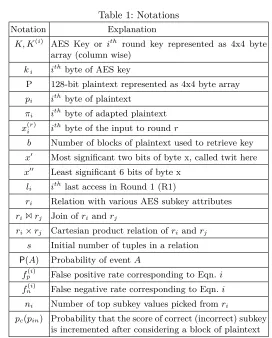
Table 1: Notations
Notation Explanation
K, K(i) AES Key or ith round key represented as 4x4 byte array (column wise)
ki ith byte of AES key
P 128-bit plaintext represented as 4x4 byte array
pi ith byte of plaintext
πi ith byte of adapted plaintext
x(ir) ith byte of the input to roundr
b Number of blocks of plaintext used to retrieve key
x′ Most significant two bits of byte x, called twit here
x′′ Least significant 6 bits of byte x
li ith last access in Round 1 (R1)
ri Relation with various AES subkey attributes
ri1rj Join ofriandrj
ri×rj Cartesian product relation ofriandrj
s Initial number of tuples in a relation P(A) Probability of eventA
fp(i) False positive rate corresponding to Eqn.i
fn(i) False negative rate corresponding to Eqn.i
ni Number of top subkey values picked fromri
pc(pin) Probability that the score of correct (incorrect) subkey is incremented after considering a block of plaintext
are Intel Core i3-2100 and Intel Core i7-3770. These have three levels of cache (private L1 32KB I-cache and 32KB D-cache, 256KB L2 cache and 3MB L3 cache shared between all cores).
The granularity of data transfer between different levels of cache is a block or line. On our targeted machines, the line size = 64 bytes. The lines of a cache are grouped into sets – a line from main memory is mapped to exactly one set though it may occupy any position in that set. The number of lines in a set is the associativity of the cache. In the machines we worked with, L1 and L2 caches are 8-way set associative while L3 is 12-way set associative.
2.3 Types of attacks and Attack scenarios
Cache-based side channel attacks belong to several categories. Timing-driven [5] attacks measure the time to complete an encryption. Trace-driven [25] attacks create profiles of a cache hit or miss for every access to memory during an en-cryption. Access-driven [24] attacks need information only about which lines of cache have been accessed, not their precise order. The attacks presented in this paper belong to the last category.
Various techniques are used to determine which cache lines have been ac-cessed by a victim process. In the Prime+Probe approach [24], the attacker fills the cache with its own data. It waits for the victim to perform an encryption whereby some of the attacker data is evicted. The attacker then probes each cache line - a higher reload time for a cache line indicates that the cache line was evicted by the victim. In the Evict and Time method [24], the attacker first measures the time (T1) to complete an encryption, evicts a specific cache set and then again measures the time (T2) taken to complete an encryption on the same plaintext. IfT2 is greater thanT1it concludes that the evicted line is used in encryption.
In the Flush+Reload technique [11, 28], the attacker first flushes a line from all levels of cache, then waits for the victim to perform the encryption and fi-nally calculates the reload time of the previously flushed line. A lower reload time indicates that the line is in cache and was brought by the victim.
We consider two possible attack scenarios. In the first, a victim process runs on behalf of a data storage service provider who securely stores documents from multiple clients and furnishes them on request after due authentication. The same key or set of keys is used to encrypt documents from different clients prior to storage. In the second scenario, two entities, A and B, exchange encrypted messages. The victim, on B’s machine, decrypts blocks of ciphertext received from A. Thus, in the first scenario, the spy attempts to obtain the cache line numbers during encryption of plaintext while in the second scenario it obtains the line numbers during decryption of ciphertext.
2.4 Experiment Setup
To test our key retrieval algorithms we used the following experiment setup. The victim V, performs AES encryptions using the assembly version of OpenSSL (v-1.0.2p). A multithreaded spy, co-located on the same core as the victim, attempts to infer the line numbers of the AES table accessed. The experiments were per-formed on Intel(R) Core(TM) i3-2100 CPU @ 3.10GHz and Intel(R) Core(TM) i7-3770 CPU @ 3.40GHz running Debian 8.0 with kernel version 3.18.26.
The following is the sequence of events involved in probing the cache lines ac-cessed by V.
(1) The unblocked thread sayT hreadi
(a) probes each of the four cache lines of the table to determine which has/have been accessed by V.
(b) it flushes all four lines of the cache-resident table
(c) it initializes a timer to∼850 nanoseconds in Core i7 (∼1100 nanoseconds in Core i3) and then blocks on its semaphore.
(2) At this point, all spy threads are blocked on their semaphores and V is scheduled next (its resumes performing encryptions).
(3) On expiration of the timer, the kernel sends a signal to a signal handler which unblocksT hreadi+1. V is preempted andT hreadi+1 begins execution.
The spy code spawns about 200 threads which execute in round robin fash-ion. Each thread receives about 20000 nanoseconds of CPU time. Between two successive threads, V runs for about 850-1100 nanoseconds. Due to the large number of cache misses encountered by V, it is able to complete only about ( 1
160 )th
of an encryption during this time. Thus, V should be scheduled roughly 160 times for it to complete a single encryption.
A cache miss results in the next (or previous) line [6] being prefetched caus-ing the spy to wrongly infer that the latter was accessed in the previous run of the victim. To defeat the effect of lines prefetched during the execution of the victim process, the number of accesses made by the victim during each of its runs was minimized. This was accomplished by limiting the POSIX timer interval to ∼850/1100 nanoseconds.
The Intel Core i3/i7 incorporates aggressive prefetchers which track and re-member the forward and backward strides of the 16 most recently accessed 4KB pages [13]. So, we programmed the spy to access 32 randomly selected pages between two consecutive accesses to the AES tables.
3 Strategy I - Two Round Attack
The first attack strategy involves two steps. The first step determines which lines of the AES table were accessed by the victim in the first round to obtain the first two bits of each of the 16 bytes of the AES key. The second round attack snoops on the accesses made in the second round to obtain the remaining six bits of each byte of the AES key.
3.1 First Round Attack
bits of the byte are denotedx′′.
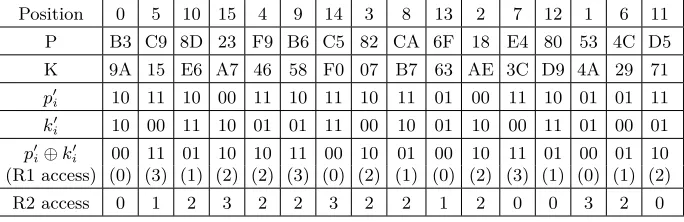
The sequence of cache line numbers accessed during the first round (R1) of encryption is shown in the sixth row and is the XOR of the corresponding twits of P and K. The sequence of cache line numbers accessed in Round 2 (R2) is shown in the last row.
A spy thread attempts to infer the line or lines of the AES table accessed
Table 2: Plaintext, Key and Cache Accesses (First Two Rounds)
Position 0 5 10 15 4 9 14 3 8 13 2 7 12 1 6 11
P B3 C9 8D 23 F9 B6 C5 82 CA 6F 18 E4 80 53 4C D5 K 9A 15 E6 A7 46 58 F0 07 B7 63 AE 3C D9 4A 29 71
p′i 10 11 10 00 11 10 11 10 11 01 00 11 10 01 01 11
k′i 10 00 11 10 01 01 11 00 10 01 10 00 11 01 00 01
p′i⊕ki′ 00 11 01 10 10 11 00 10 01 00 10 11 01 00 01 10 (R1 access) (0) (3) (1) (2) (2) (3) (0) (2) (1) (0) (2) (3) (1) (0) (1) (2)
R2 access 0 1 2 3 2 2 3 2 2 1 2 0 0 3 2 0
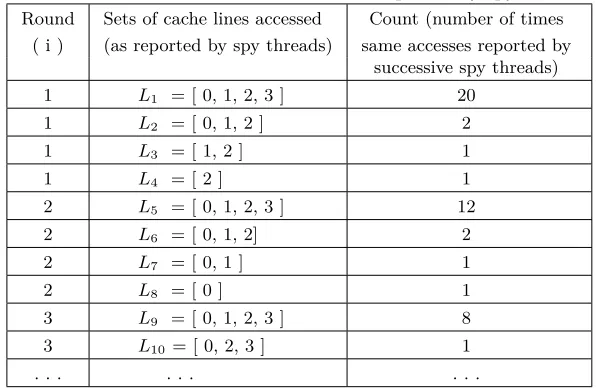
by V during its previous run. Table 3 indicates that the first 20 threads observe all four lines accessed. Lines 0, 1 and 2 are reported as accessed by the next two scheduled threads while only lines 1 and 2 are reported as accessed by the next thread and so on. (L1={0,1,2,3}, L2={0,1,2} andL3={1,2}). In virtually all of our measurements, |L1| = 4, |L2| = 3, |L3| = 2, and |L4| = 1. Also,
L1 ⊃L2 ⊃ L3 ⊃ L4. Another observation is that the cardinalities of the Li’s exhibit a periodicity which helps identify the end of a round and the beginning of the next round.
The OpenSSL software prefetches all four lines of the S-Box table at the start of each round. Hence the first thread scheduled in a round sees all four lines accessed. A spy thread flushes all four lines of the table before it is blocked. Further, the design of the spy code ensures that a run of the victim is sufficiently small so that only one or two lines are accessed. Yet, the next scheduled thread and indeed many more also see all four lines accessed. This is attributed to the out of order execution in modern processors.
Table 3: Cache Lines Accessed as reported by spy Round Sets of cache lines accessed Count (number of times
( i ) (as reported by spy threads) same accesses reported by successive spy threads)
1 L1 = [ 0, 1, 2, 3 ] 20
1 L2 = [ 0, 1, 2 ] 2
1 L3 = [ 1, 2 ] 1
1 L4 = [ 2 ] 1
2 L5 = [ 0, 1, 2, 3 ] 12
2 L6 = [ 0, 1, 2] 2
2 L7 = [ 0, 1 ] 1
2 L8 = [ 0 ] 1
3 L9 = [ 0, 1, 2, 3 ] 8
3 L10= [ 0, 2, 3 ] 1
. . . .
During the execution of a round, 16 byte-sized table elements are first ac-cessed and loaded into the CPU registers. This is followed by a computation phase wherein field multiplications and additions involved in the MixColumn step are performed. Consider the last access to an element in a round. As before, while this element is being fetched, the processor attempts to execute instruc-tions upstream from the current instruction. These instrucinstruc-tions involve only computation, not memory access. So the spy thread scheduled next sees a soli-tary access to the table(|L4|= 1). So the last (or last few) accesses in a round will be unambiguously reported by spy threads but there exists considerable ambiguity in identifying the lines accessed early on in each round.
The goal of the First Round Attack is to deduce the twit of each byte of the AES key. For this purpose, we need the complete set of cache line accesses. However, as shown in Table 3, successive spy threads report that all four lines have been accessed - in effect revealing no useful information about the first eight or so accesses. We next devise a strategy whereby we can still obtain the twits of all 16 bytes of the AES key.
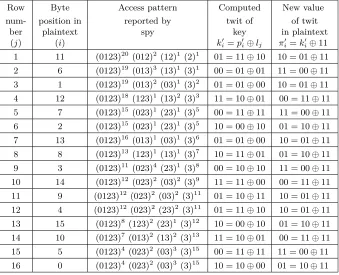
Starting with a random block of plaintext, we construct a set of 16 blocks such that the encryption of theithblock results in all of the lasticache accesses to the same line of the lookup table. From the line number of the(i−1)thaccess, the twit of the(i−1)thbyte of the AES key is obtained and the next block of plaintext to be encrypted is crafted. We exemplify our approach with the same initial random plaintext and random key from Table 2.
3 1. For this purpose, we modify the twit of eleventh byte of the plaintext to
π′11=k11′ ⊕11 = 01⊕11 = 10.
Row 2 shows the access pattern during encryption of the modified plaintext.
Table 4: Adaptively Choosing Plaintext for Round 1 Attack
Row Byte Access pattern Computed New value
num- position in reported by twit of of twit
ber plaintext spy key in plaintext
(j) (i) k′i=pi′⊕lj πi′=k′i⊕11 1 11 (0123)20 (012)2 (12)1(2)1 01 = 11⊕10 10 = 01⊕11
2 6 (0123)19 (013)3 (13)1(3)1 00 = 01⊕01 11 = 00⊕11
3 1 (0123)19 (013)2 (03)1(3)2 01 = 01⊕00 10 = 01⊕11
4 12 (0123)18 (123)1 (13)2(3)3 11 = 10⊕01 00 = 11⊕11
5 7 (0123)15 (023)1 (23)1(3)5 00 = 11⊕11 11 = 00⊕11
6 2 (0123)15 (023)1 (23)1(3)5 10 = 00⊕10 01 = 10⊕11
7 13 (0123)16 (013)1 (03)1(3)6 01 = 01⊕00 10 = 01⊕11
8 8 (0123)13 (123)1 (13)1(3)7 10 = 11⊕01 01 = 10⊕11
9 3 (0123)11 (023)4 (23)1(3)8 00 = 10⊕10 11 = 00⊕11
10 14 (0123)12 (023)2 (03)2(3)9 11 = 11⊕00 00 = 11⊕11
11 9 (0123)12(023)2 (03)2 (3)11 01 = 10⊕11 10 = 01⊕11
12 4 (0123)12(023)2 (23)2 (3)11 01 = 11⊕10 10 = 01⊕11
13 15 (0123)8 (123)2(23)1 (3)12 10 = 00⊕10 01 = 10⊕11
14 10 (0123)7 (013)2(13)2 (3)13 11 = 10⊕01 00 = 11⊕11
15 5 (0123)4 (023)2(03)3 (3)15 00 = 11⊕11 11 = 00⊕11
16 0 (0123)4 (023)2(03)3 (3)15 10 = 10⊕00 01 = 10⊕11
The last access is to line 3 (as desired) but the2ndlast access is to line 1(l 2= 1). Row 2 shows the derivation ofk′6and the value ofπ6′ (the new twit value ofp6). As shown in Table 4, each successive plaintext is chosen so that the number of accesses to the last cache line within a row increases with row number. The twits of all 16 bytes of the key are obtained with fewer than 16 blocks of plaintext and encryptions. In practice, however, this may not be the case. Experimental error could cause an unexpected pattern to occur. In that event, we rollback and proceed from an earlier row. On average, roughly 6 errors occur per sam-ple. Overall, we require approximately 15 distinct plaintexts to obtain the twits
1 When we targeted lines 0, 1 or 2, we observed that lines 1, 2 or 3 respectively would
of each of the 16 key bytes. Due to the rollbacks, the number of encryptions performed is about21.5on average per sample.
3.2 Second Round Attack
Algorithm and Description Inputs to a round expressed as a 4×4 byte matrix are indices to the AES table (S-Box). This matrix is also the output of the previous round. Based on the transformations that the state array undergoes in the first round, we can relate each element of the input of the second round to bytes of the plaintext and key.
Given that it is easiest to identify the line accesses made at the end of a round, we focus on expressions for the indices of the last 4 table accesses, i.e.,
x(2)11,x(2)6 ,x(2)1 andx(2)12 (Equations 1-4). Collectively, these equations involve all 16bytes of the AES key. The known variables on the RHS of these equations are bytes of the plaintext and twits of the bytes of the AES key. The first two bits of the table index (LHS) comprise the cache line number obtained (with some ambiguity) from the spy input.
x(2)11 = 03•s(p8⊕k8)⊕01•s(p13⊕k13)⊕01•s(p2⊕k2)
⊕02•s(p7⊕k7)⊕s(k12)⊕k3⊕k7⊕k11 (1)
x(2)6 = 01•s(p4⊕k4)⊕01•s(p9⊕k9)⊕02•s(p14⊕k14)
⊕03•s(p3⊕k3)⊕s(k15)⊕k2⊕k6 (2)
x(2)1 = 01•s(p0⊕k0)⊕02•s(p5⊕k5)⊕03•s(p10⊕k10)
⊕01•s(p15⊕k15)⊕s(k14)⊕k1 (3)
x(2)12 = 02•s(p12⊕k12)⊕03•s(p1⊕k1)⊕01•s(p6⊕k6)
⊕01•s(p11⊕k11)⊕s(k13)⊕k12⊕k0⊕k4⊕k8⊕01 (4)
Our strategy is to compute the two most significant bits of the byte value of the RHS as a function of known quantities and the minimum possible number of unknown bits of the key. Algorithm 1 outlines the procedure to obtain a set of candidate keys containing the correct key with very high probability.
Algorithm 1: Second Round Attack
Input:bblocks of plaintext, first two bits of each byte of AES key, last four cache line accesses in Round 2 of encryption of each block
Output:Correct AES key with high probability
Initialization:
1 Construct 4 relational schema
r1
(
k8′′, k′′13, k2′′, k7′′, s(k12)′
)
,
r2
(
k4′′, k′′9, k14′′, k3′′, s(k15)′
)
, r3
(
k0′′, k′′5, k10′′, k15′′, s(k14)′
)
,
r4
(
k12′′, k′′1, k6′′, k11′′, s(k13)′
)
2 Populateri,1≤i≤4with each of the226 possible values of its attributes. 3 Initialize four histograms,hi,1≤i≤4with226bins.
Scoring and Elimination:
4 foreach relation,ri, 1≤i≤4do
5 foreach block of plaintextpj,1≤j≤bdo
6 foreach tuple,tk inri, 1≤k≤226do
7 Substitute relevant bits ofpj,tkand known key bits into RHS of Equationi
8 if twit of RHS∈ {cache lines reported as accessed inith last access
of table with plaintextpj}then 9 Incrementhi[k]
10 end
11 end
12 end
13 end
14 Retain topni scorers in each relationri.
Joins and Cartesian Product:
15 Perform joinsr11r4 andr21r3.
16 Construct set of candidate key values by combining a subkey value fromr11r4
and a subkey value fromr21r3.
Verification:
17 Use accesses reported by spy threads for rounds 3, 4 ... 10 in each plaintext to discard incorrect keys from above Cartesian product.
encryption of that plaintext. This is repeated for each tuple and for all the blocks of plaintext.
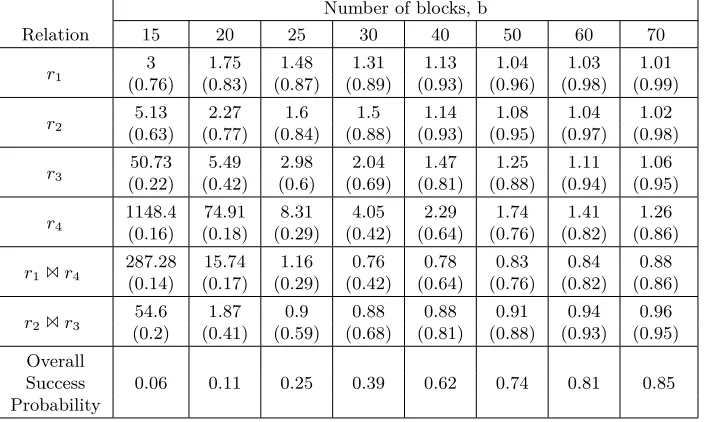
Table 5: Average number of top scorers and success probability Number of blocks, b
Relation 15 20 25 30 40 50 60 70
r1
3 1.75 1.48 1.31 1.13 1.04 1.03 1.01
(0.76) (0.83) (0.87) (0.89) (0.93) (0.96) (0.98) (0.99)
r2
5.13 2.27 1.6 1.5 1.14 1.08 1.04 1.02
(0.63) (0.77) (0.84) (0.88) (0.93) (0.95) (0.97) (0.98)
r3
50.73 5.49 2.98 2.04 1.47 1.25 1.11 1.06
(0.22) (0.42) (0.6) (0.69) (0.81) (0.88) (0.94) (0.95)
r4
1148.4 74.91 8.31 4.05 2.29 1.74 1.41 1.26 (0.16) (0.18) (0.29) (0.42) (0.64) (0.76) (0.82) (0.86)
r11r4
287.28 15.74 1.16 0.76 0.78 0.83 0.84 0.88 (0.14) (0.17) (0.29) (0.42) (0.64) (0.76) (0.82) (0.86)
r21r3
54.6 1.87 0.9 0.88 0.88 0.91 0.94 0.96
(0.2) (0.41) (0.59) (0.68) (0.81) (0.88) (0.93) (0.95) Overall
Success 0.06 0.11 0.25 0.39 0.62 0.74 0.81 0.85
Probability
Each tuple inr11r4is paired with a tuple inr21r3which, together with the bits obtained in the Round 1 attack, form a possible AES key. These potential keys are each tested for correctness by a verification program which produces a sequence of cache line numbers accessed during encryption of successive blocks of plaintext. In particular, the last two accesses in rounds 3-10 are matched against those provided by the spy. The correct key will be inferred because only in that case will the inputs provided by the spy match those provided by the verification program in all/most cases.
The join predicate is actually the conjunction of two sub-predicates. Consider for example, r1 1 r4. To join a tuple, t1 from r1 with a tuple, t2 from r4, we assemblek12 from k′′12 (int2) and k′12 (from the First Round Attack). We then compute s(k12)′ and compare it with the value of the fifth attribute in t1. To check for a match of the second sub-predicate, computes(k13)′ and compare it with the value of the fifth attribute int2. Only if both sub-predicates are satisfied is the tuple formed by concatenating t1 and t2 included in r1 1 r4. A similar computation is performed to computer21r3.
scorers.
The number of top scorers is highest in r4 across all values of b. In each relation, the number of top scorers decreases with increasing b. Also, the prob-ability of netting the correct key in the set of top scorers increases withb. Thus it is mostly possible to find the correct subkeys in r1 and r2 with only about 30blocks of plaintext but it requires about50and70plaintexts respectively to harvest the correct subkeys fromr3andr4.
After picking the top scorers inr1 and r4, we found that r1 1r4 returned zero tuples in some samples (Table 5 shows that the cardinality ofr11r4is less than 1 forb= 30,40, ...). Another interesting observation is that the probability of the correct subkey appearing in the set of top scores is close to the overall success probability and hence is the key factor in the overall success of obtaining the complete AES key.
The probability of successfully retrieving the AES key is directly related to the quality of inputs provided by the spy threads. False positives (spurious cache line accesses) and false negatives (failing to report the correct line accesses) both, have a detrimental effect. Further, the above strategy of selecting subkeys with the top scores yields very limited success. To improve the success probability of finding the correct key, we should include many more subkeys especially from
r4.
The false positive and false negative rates are dependent on noise-induced experimental error and a host of design parameters such as the number of spy threads and the timer setting (Section 2). The model presented next provides insight into the dependence of success probability on false positive/false nega-tive rate and also onni- the number of top-ranking subkeys collected from each relationri (prior to the join).
LetXcandX (k)
in ,1≤k≤s−1, s= 2
26, respectively denote the random vari-ables associated with the scores of the correct and incorrect subkey values and letpc and pin denote their respective success probabilities. These variables are binomially distributed, i.e., Xc ∼B(pc, b) andX
(k)
in ∼B(pin, b), 1≤k≤s−1 whereb is the number blocks of plaintexts used.
Letfn(i),fp(i)respectively denote the experimentally determined average rates of false negatives and false positives corresponding to Eqn.i. Where understood, we drop the superscript for brevity. The rate of false negatives may be inter-preted as the probability of occurrence of a false negative. The occurrence of a false negative and the correct subkey receiving a boost are events that are complements of each other. Hence,
pc= 1−fn (5)
Each line number reported by the spy contributes to an increase by 1 of the scores of roughly 25% of the incorrect subkeys (since the number of cache line numbers is 4). In the event of a false negative, the number of reported accesses on average isfp while it isfp+ 1 in the absence of a false negative. So,
pin=fn (
fp 4
)
+ (1−fn) (
1 +fp 4
pin=
1 +fp−fn
4 (6)
In Algorithm 1, we pick the topniscorers. We are interested in the probability of the correct subkey being one among the topni scorers. This is equivalent to having, at leasts−niincorrect subkeys scoring less than the correct subkey. Let
Yin(k) denote the random variable associated with the score of kth lowest scorer among incorrect subkey values. So,
Yin(1) ≤Yin(2) ≤ · · · ≤Yin(k)≤ · · · ≤Yin(s−1)
Yin(1), Yin(2), …,Yin(k), …,Yin(s−1) are called order statistics ofXin(1),Xin(2), …,Xin(k), …,Xin(s−1). The following result from order statistics is used in our model.
Lemma 1:LetX(1), …,X(s−1)bes−1random samples from a discrete distri-bution with cumulative mass function, FX(n) =P(X ≤n) =Pn. LetY(1), …,
Y(s−1)denote the order statistics of the sample. Then,
P(Y(j)≤n) = s−1 ∑
k=j (
s−1
k
)
Pnk(1−Pn)s−1−k ■
To have the correct subkey value among topni scorers whenXc=n+ 1, we should have Y(s−ni)
in ≤n. So, the probability of the correct subkey value being amongni top scorers is
b−1 ∑
n=0 {
P(Xc=n+ 1)×P(Y (s−ni)
in ≤n) }
Substituting from Lemma 1 into above expression yields the following.
Theorem 1: After scoring s = 226 candidate subkey values using b blocks of plaintext, the probability of the correct subkey ending up as one of the top ni scorers is
b−1 ∑
n=0 {
P(Xc =n+ 1)× [ ∑s−1
k=s−ni
(
s−1
k
)
Pnk(1−Pn)s−1−k ]}
wherePn=P(Xin≤n). ■
Success in finding the correct key is limited by the difficulty in finding the correct subkey inr4. So we studied the effect off
(4)
Fig. 1: Variation of success probability inr4 withf (4)
n ,fp(4) andn4 atb= 25
values of fp(4) were 0.81 and 0.94 respectively. Based on the analytical model, success probability versusn4for each set of false positive and false negative rates was plotted (Fig. 1).
To obtain a reasonable subset of samples with lowfn(4), we selected samples withfn(4)between 0.04 and 0.12 (average value = 0.08). Our preliminary findings indicated that the success probability is not highly co-related withfp(4), so it was not used as a filter in selecting the subset. We plotted the number of samples resulting in success withn4 equal to each value on the X-Axis of the Figure 1. A similar plot was obtained for samples withfn(4)in the higher range between 0.16 and 0.24. As shown in Figure 1, the graphs for the two subsets are well separated with a close match between model and experimental results. The model estimates tend to be generally conservative and especially so in the case of higher false negatives at higher values ofn4.
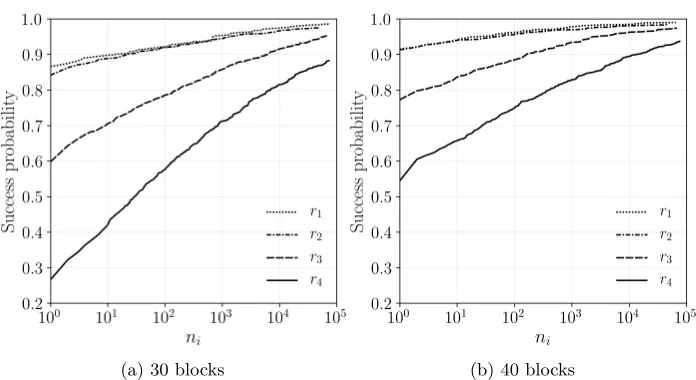
We conducted a limited investigation on the effect of individual success prob-abilities (inr1,r2,r3,r4) on the overall success probability. To achieve individual success probability = 0.9 for each ri, at b= 30 we required n1 = n2 = 10, n3 = 103 and n
(a) 30 blocks (b) 40 blocks
Fig. 2: Variation of success probability inri withni for 30, 40 blocks
false negatives (and false positives) in the four relations are co-related across a large number of samples. For b = 40 and with the same choice of ni values (Figure 2b), the overall success probability is about 90%.
4 Strategy II - Single Round Attack
The next attack is both simpler and more realistic compared to the attack of the previous section. It is simpler because it relies on the cache line accesses occurring in only the second round of encryption and that too only the last four accesses. It is more realistic since it obviates the need to craft plaintext based on cache accesses made during encryption of the previous block of plaintext.
As in Strategy I, we create four relations, each with five attributes. However, unlike the Round 2 Attack in Strategy I, we need to determine all eight bits (not just six) of each byte of the AES key. So the relational schema employed are
r1(k8, k13, k2, k7, a1), a1= (s(k12)⊕k3⊕k7⊕k11)′
r2(k4, k9, k14, k3, a2), a2= (s(k15)⊕k2⊕k6)′
r3(k0, k5, k10, k15, a3), a3= (s(k14)⊕k1)′
r4(k12, k1, k6, k11, a4), a4= (s(k13)⊕k12⊕k0⊕k4⊕k8⊕01)′ The initial number of the tuples in each relation is now 234 (unlike 226 in Round 2 of Approach I). Otherwise, the steps in this approach are very similar to those of Algorithm 1.
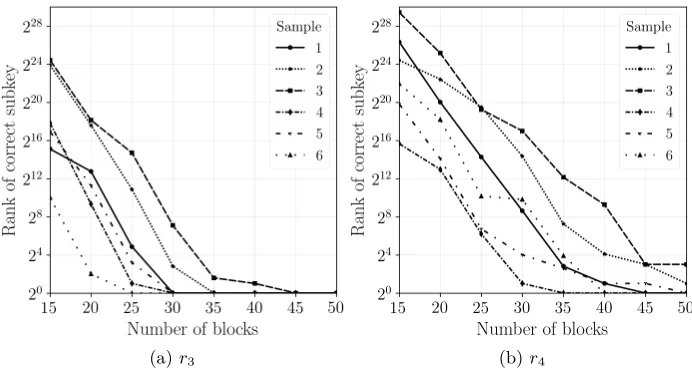
tuples in each relation for varying number of plaintexts. Figure 3a and 3b re-spectively show plots of the rank of the correct subkey inr3andr4as a function of the number of blocks of plaintext used (for 6samples).
With40blocks, individual success probability of 0.9 is achieved in each re-lation, with n1 =n2 = 1, n3 = 103, n4 = 106. The overall success probability at these values is around 0.85. With the same choice of ni values but with 50 blocks, overall success probability increases to0.9.
In this strategy, the “Joins and Cartesian Product” step is slightly different from Algorithm 1. Due to the nature of the fifth attribute in relations considered, the join predicate is the conjunction of four sub-predicates. Each sub-predicate checks for the equality of two twits where the first twit is the fifth attribute of a tuple. To illustrate the computation of say, the second sub-predicate, consider joining four tuplest1, t2, t3 and t4 from r1, r2, r3 andr4 respectively. The ex-pressions(k15)⊕k2⊕k6 is computed using the value ofk15 int3, k2 int1 and
k6 int4. The two most significant bits of the result are then compared with the value of attribute,a2 in t2. If they match, three other sub-predicates involving
a2, a3 and a4 are computed. Only if all four sub-predicates are satisfied is the tuple obtained by concatenatingt1,t2,t3 andt4 included inr11r21r31r4.
After the Scoring and Elimination step but before the join (for same choice ofnivalues as above), we have1×1×103×106= 109≈230candidate keys. The probability of a candidate satisfying a sub-predicate is 0.25, since we have four roughly equi-probable outcomes. So, on average the number of candidate keys reduces by a factor of28after the join involving a match on four sub-predicates. So, roughly222 candidate keys survive for Verification.
In the Verification step, we compare last 2 accesses of Rounds 3-10 (8 rounds). Using this information, we can score candidate keys as earlier. Each candidate key’s score starts with zero and is incremented whenever an access matches with spy reported access. For each block of plaintext, we can score a maximum of 8×2 = 16times. Even if we consider accesses corresponding to10blocks (which are already used in initial scoring), we can score each candidate key160 times. By comparison, the maximum achievable score is considerably higher than the maximum score of, say 50, with r4 using Strategy 1 (relation size = 226 and
b= 50).
In practice, a scoreboard for each relationriwith five attributes (each of size 1 byte) requires 5∗234 bytes or 85.89GB storage. It is not feasible to maintain such a massive scoreboard in main memory and moving it partially to secondary memory will increase overall time. With an increase in the number of plaintext blocks, the number of top-scoring subkeys greatly reduces and only subkeys with higher scores could be saved. Another possibility is to store the subkey count on the first pass through the tuples and then store only the top scorers in the second pass.
(a)r3 (b)r4
Fig. 3: Variation in rank of correct subkey with no. of blocks in r3 andr4
compute intensive portion of Algorithm 1 (lines 9 to 18) which scores 226 pos-sible subkeys per equation. This was integrated into the Python code to bring down the time taken for retrieving the subkeys to under a minute. The same ap-proach was used for Strategy II implementation, where234subkeys were scored. It took around 3 - 4 hours to get the key using 50 blocks of plaintext on a 4 core machine. Since the application is highly parallelizable, the speedup is expected to be close to the number of cores even with around 50 cores.
5
Related Work
It was first mentioned by Hu [12] that cache memory can be considered as a potential vulnerability in the context of covert channels to extract sensitive in-formation. Later Kocher [18] demonstrated the data-dependent timing response of cryptographic algorithms against various public-key systems. Based on his work, Kelsey et al. [17] mentioned the prospects of using cache memory to per-form attacks based on cache hits in S-box ciphers like Blowfish. One per-formal study of such attacks using cache misses was conducted by Page [25].
Gullasch et al. [11] proposed an efficient access-driven cache based attack when attacker and victim use a shared crypto library. They targeted OpenSSL-0.9.8n 4 table (4KB lookup table) implementation and the compressed 2KB lookup table based implementation of AES to retrieve the key using 100 blocks of plaintext. Yarom and Falkner [28] introduced the Flush+Reload technique which is effective across multiple cores and virtual machine boundaries. They conducted a cross-core attack on the Last Level Cache (LLC) with the spy and the victim executing concurrently on two different cores. Later Irazoqui et al. [15] used the Flush + Reload technique for cross virtual machine attack and recov-ered the AES secret key with219 encryptions.
[14] introduced a new shared Last Level Cache attack by exploiting huge pages to work across virtual machines using the Prime+Probe technique. A similar attack was proposed in [19] on various versions of GnuPG. In [16] an attack on LLC was introduced which does not use the huge pages or shared data or the knowledge of virtual-to-physical page mappings.
Gotzfried et al. [10] demonstrated that Intel SGX enclaves are vulnerable to cache based side channel attack by attacking OpenSSL-0.9.7a AES using Prime+Probe technique when the victim is running inside the enclave. They assumed that the victim and attacker run as a single process in two different threads running in two logical CPUs sharing the same physical core.
The above attacks targeted OpenSSL’s 4 table or 5 table (T-Table) based C implementation of AES. Moghimi et al. [20] attacked both the T-Table based and S-Box implementations of AES using Prime+Probe method in Intel SGX. They modified the kernel to interrupt the victim running inside SGX enclave and obtain information about cache accesses during encryption. With noise-free simulated data, they recovered 64 bits of the key with 500 blocks of plaintext, 80 bits of the key with 1500 blocks of plaintext, 96 bytes of the key with thousands of blocks of plaintext. Our attack doesn’t use a compromised OS and recovers the full key with 40 - 50 plaintext blocks.
6 Conclusions
We successfully launched two cache-based side channel attacks on the assembly implementation of AES which uses a single 256-byte lookup table. The first of these attacks involves two rounds. In the first round, we crafted about 15 blocks of plaintext to recover the first two bits of each of the 16 bytes of the AES key. In the second round, we obtained the remaining 6 bits of each byte of the key with 40 blocks.
about 5 hours on a 4-core machine. However, since it is highly parallelizable, we expect it to take under 30 minutes on 50 cores.
References
1. It’s all a question of time - AES timing attacks on OpenSSL (Jul 2014), https://access.redhat.com/blogs/766093/posts/1976303
2. Acıiçmez, O., Brumley, B.B., Grabher, P.: New results on instruction cache attacks. In: Cryptographic Hardware and Embedded Systems, CHES 2010, pp. 110–124. Springer (2010)
3. Apecechea, G.I., Inci, M.S., Eisenbarth, T., Sunar, B.: Fine grain Cross-VM At-tacks on Xen and VMware are possible! IACR Cryptology ePrint Archive p. 248 (2014)
4. Ashokkumar, C., Giri, R.P., Menezes, B.: Highly efficient algorithms for aes key retrieval in cache access attacks. In: 2016 IEEE European Sym-posium on Security and Privacy (EuroS P). pp. 261–275 (March 2016). https://doi.org/10.1109/EuroSP.2016.29
5. Bernstein, D.J.: Cache-timing attacks on AES (2005), http://cr.yp.to/papers.html#cachetiming
6. Bhattacharya, S., Rebeiro, C., Mukhopadhyay, D.: A formal security analysis of even-odd sequential prefetching in profiled cache-timing attacks. In: Proceedings of the Hardware and Architectural Support for Security and Privacy 2016. p. 6. ACM (2016)
7. Biryukov, A., Dunkelman, O., Keller, N., Khovratovich, D., Shamir, A.: Key recov-ery attacks of practical complexity on aes variants with up to 10 rounds. Cryptology ePrint Archive, Report 2009/374 (2009), https://eprint.iacr.org/2009/374 8. Bogdanov, A., Khovratovich, D., Rechberger, C.: Biclique cryptanalysis of the full
AES. In: International Conference on the Theory and Application of Cryptology and Information Security. pp. 344–371. Springer (2011)
9. Gilbert, H., Peyrin, T.: Super-Sbox Cryptanalysis: Improved Attacks for AES-like permutations. Cryptology ePrint Archive, Report 2009/531 (2009), https://eprint.iacr.org/2009/531
10. Götzfried, J., Eckert, M., Schinzel, S., Müller, T.: Cache attacks on Intel SGX. In: Proceedings of the 10th European Workshop on Systems Security. p. 2. ACM (2017)
11. Gullasch, D., Bangerter, E., Krenn, S.: Cache Games – Bringing Access-Based Cache Attacks on AES to Practice. In: Proceedings of the 2011 IEEE Symposium on Security and Privacy. pp. 490–505. SP ’11, IEEE Com-puter Society, Washington, DC, USA (2011). https://doi.org/10.1109/SP.2011.22, http://dx.doi.org/10.1109/SP.2011.22
12. Hu, W.M.: Lattice scheduling and covert channels. In: Proceedings of the IEEE Symposium on Security and Privacy. pp. 52–61. SP ’92, IEEE Computer Society, Washington, DC, USA (1992), http://dl.acm.org/citation.cfm?id=882488.884165 13. Intel Corporation: Intel® 64 and IA-32 Architectures
Op-timization Reference Manual. No. 248966-033, 2016 (2016), http://www.intel.com/content/dam/www/public/us/en/documents/manuals/64-ia-32-architectures-optimization-manual.pdf
15. Irazoqui, G., Inci, M.S., Eisenbarth, T., Sunar, B.: Wait a minute! A fast, Cross-VM attack on AES. In: Research in Attacks, Intrusions and Defenses, pp. 299–319. Springer (2014)
16. Kayaalp, M., Abu-Ghazaleh, N., Ponomarev, D., Jaleel, A.: A high-resolution side-channel attack on last-level cache. In: Proceedings of the 53rd Annual Design Automation Conference. p. 72. ACM (2016)
17. Kelsey, J., Schneier, B., Wagner, D., Hall, C.: Side Channel Cryptanal-ysis of Product Ciphers. J. Comput. Secur. 8, 141–158 (Aug 2000), http://dl.acm.org/citation.cfm?id=1297828.1297833
18. Kocher, P.C.: Timing Attacks on Implementations of Diffie-Hellman, RSA, DSS, and Other Systems. In: Proceedings of the 16th Annual International Cryptol-ogy Conference on Advances in CryptolCryptol-ogy. pp. 104–113. CRYPTO ’96, Springer, London, UK (1996), http://dl.acm.org/citation.cfm?id=646761.706156
19. Liu, F., Yarom, Y., Ge, Q., Heiser, G., Lee, R.B.: Last-level cache side-channel attacks are practical. In: IEEE Symposium on Security and Privacy. pp. 605–622 (2015)
20. Moghimi, A., Irazoqui, G., Eisenbarth, T.: CacheZoom: How SGX amplifies the power of cache attacks. In: International Conference on Cryptographic Hardware and Embedded Systems. pp. 69–90. Springer (2017)
21. Neve, M., Seifert, J.P.: Advances on access-driven cache attacks on AES. In: In-ternational Workshop on Selected Areas in Cryptography. pp. 147–162. Springer (2006)
22. Neve, M., Seifert, J.P., Wang, Z.: A refined look at Bernstein’s AES side-channel analysis. In: Proceedings of the ACM Symposium on Infor-mation, computer and communications security. pp. 369–369. ACM (2006), http://doi.acm.org/10.1145/1128817.1128887
23. OpenSSL Software Foundation: Openssl project, URL: https://www.openssl.org/ 24. Osvik, D., Shamir, A., Tromer, E.: Cache Attacks and Countermeasures: The Case
of AES. In: Pointcheval, D. (ed.) Topics in Cryptology CT-RSA 2006, Lecture Notes in Computer Science, vol. 3860, pp. 1–20. Springer (2006)
25. Page, D.: Theoretical Use of Cache Memory as a Cryptanalytic Side-Channel. IACR Cryptology ePrint Archive p. 169 (2002)
26. Tao, B., Wu, H.: Improving the biclique cryptanalysis of AES. In: Australasian Conference on Information Security and Privacy. pp. 39–56. Springer (2015) 27. Tromer, E., Osvik, D., Shamir, A.: Efficient Cache Attacks on AES
and Countermeasures. Journal of Cryptology 23(1), 37–71 (2010). https://doi.org/10.1007/s00145-009-9049-y, http://dx.doi.org/10.1007/s00145-009-9049-y