Available Online atwww.ijcsmc.com
International Journal of Computer Science and Mobile Computing
A Monthly Journal of Computer Science and Information Technology
ISSN 2320–088X
IMPACT FACTOR: 5.258
IJCSMC, Vol. 5, Issue. 4, April 2016, pg.236 – 244
Development of a Routing Protocol for
Data Flow in Hierarchical Systems
using Wireless Sensor Network
Dr. Kamlendu Kumar Pandey
Asst Professor, Dept of Information and Communication Technology, Veer Narmad South Gujarat University, Surat Email: [email protected]
Abstract: Wireless Sensor Networks can be helpful for the problems where real time data sensing, data dissemination and data gathering is required to operate a system. Most of the hierarchical data operation systems require gathering the data hierarchically from the lowest point of sensing to upstream towards the highest point. The data observed at all the level of hierarchy becomes indicator of the scenario at downstream of that point. The larger geographical area presents a major challenge to WSN nodes due to their transmission distance limit. This paper proposes a protocol which can be worked out for such a problem using wireless sensor networks.
Keywords: wireless sensor networks, routing protocol, hierarchical systems, ns2, micaz motes
I. INTRODUCTION
Several problem domains require collection of data in hierarchical manner so as to operate the system in effective manner. In these problems the topmost hierarchy should checks the quantum of requirements in the downstream as per data collected and thus supplies the physical quantities so as to satisfy the requirement at various points in downstream. Wireless sensor networks can be very helpful in such problems. The WSN can sense the data in question and propagate that data to the other nodes using radio links. The WSN works on 802.15.4 IEEE standards and using ZIGBEE standard it can encapsulate the data into the communication headers and relay the data to neighbouring nodes or cluster nodes. The data then ultimately moved to the highest hierarchy called SINK. The systems like water supply system, Irrigation systems, electric power supply, real-time sales and inventory control, Flood management Systems etc are the target for the application model proposed in this paper. The problem with ZIGBEE based motes is the limit of their transmission range.
II. RELATED WORK
© 2016, IJCSMC All Rights Reserved 237
The protocols mentioned above do not take care any spatial parameters like position or distance. The sole criteria of deciding the cluster head is energy. There are two reasons to go for a new protocol
1) The problem of data monitoring requires spatial distribution of the parameter
2) The area in consideration is large and sensors are located quite sparse as compared to the above protocols. As the relay limit of radio antenna in sensor networks is quite limited the distance between the node a important factor for deciding the cluster head. The cluster head must me located at the optimal distance where all the all the sensing nodes can access them. The energy consideration on nodes is also combined to decide the cluster head.
So this paper presents a protocol suitable for wireless sensor network especially to be deployed for the systems which collect data in hierarchical manner
III. REPRESENTATION OF SYSTEMS IN CONSIDERATION AND DEPLOYMENT OF SENSORS To understand the purpose of paper one has to understand the nature of problem being considered. The system here is moreover a hierarchical network for collection of data towards upstream and supply of data in the downstream as given in fig 1 and Fig 2.
Fig.3 Command with one cluster head Fig.4 A command with multiple clusters and Sink at centre
Fig.3 shows a macroscopic view of the effective command under data accumulation point. For a smaller area WSN nodes can be deployed in the command randomly to sense the local data and all the sensors report their data to the cluster head. The cluster head finally supply the data to sink (data accumulation node). In fig.4 The size of the command may be very large , so it requires more no of cluster heads. (An area of 300m by 300m is shown). This is because of limiting distance of the ZIGBEE based motes. Two operations are generally expected from the system
1) Getting the real-time data from the extreme downstream to upstream in accumulated manner. Each node on fig.1 will have the aggregate function of all the requirements in the downstream.
2) Querying the entire system using the relational operator for the data concerned . In this the query travels from the topmost point to the last point as shown in Fig.2
3) Proactive supply of data to the system if critical condition of the observed parameter is encountered 4) Relay of action from the control point , which are to be taken to mitigate the critical condition.
All the above actions require a different kind of routing protocol to be a part of application in the WSN mote nodes and the cluster heads. The data from the accumulation points can be relayed using long distance propagation mechanism like microwave or radio transmissions. The data propagation is done in two phases.
a) Inter-command routing using cluster based topology for Wireless sensor Network. b) Inter-Node routing for data accumulation node
IV. CLUSTER BASED LOCATION AWARE ROUTING PROTOCOL –INTER-COMMAND ROUTING
© 2016, IJCSMC All Rights Reserved 240
ALGORITHM FOR INTER – COMMAND ROUTING (CALAR):
1. ALGORITHM TO DETERMINE CLUSTER HEAD
var i as int
var n → No of Nodes
var c → node no of cluster head
var N[i](xi,yi) → Node no. i at coordinates xi and yi var N[0] → Access Point
var NBUFFER[128] → buffer memory on cluster head to store xi an yi of different nodes var SUM_NCH → Sum of distances of Nodes and the cluster head
var SUM_NA → sum of distances from nodes to Access Point var EDR → effective distance ratio
var MIN → find minimum
Function ADV → Network Advertisement
Function JOIN-REQ → Request for joining the cluster head
Function FRIIS → Friis equation to find distances based on signal strength Function DIST → find distance between nodes
Function RND → Randomizer
PROCEDURE
// Initialisation for x,y at Access Point 1. N[0[(xi) = 0, N[0](yi) =0
2. ADV N[0] with xi, yi
3. For I = 1 To N JOIN-REQ N[i] 4. FRIIS N[0] → N[i]
5. ADV N[0] with xi,yi to N[i] I = 1 to n 6. FOR k = 1 to n
c = RND (1 to n) 7. ADV N[c]
8. JOIN-REQ N[i] for 1 to n 9. FOR I = I to N
SUM_NCH = SUM_NCH + DIST(N[i[, N[c]) SUM_NA = SUM_NA + DIST(N[i], N[0])
NEXT
10. EDR[c] = SUM_NCH / SUM_NA NEXT k
11 Find c with MIN (EDR[]) 12 Node c is Cluster Head
2. ALGORITHM TO SENSE AND DISSEMINATE
var n → no of nodes
var c → cluster head node no var si → sensing interval var di → disseminating_interval var N[i] → node no I
var N[c] → cluster head node var N[0] → Access Point
© 2016, IJCSMC All Rights Reserved 241
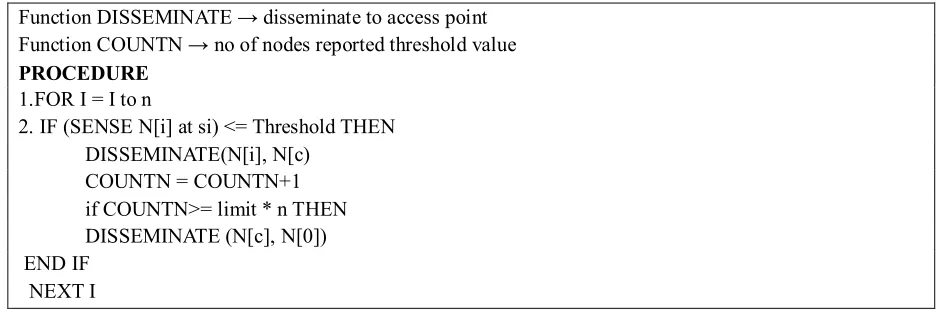
Function DISSEMINATE → disseminate to access point Function COUNTN → no of nodes reported threshold value
PROCEDURE
1.FOR I = I to n
2. IF (SENSE N[i] at si) <= Threshold THEN DISSEMINATE(N[i], N[c)
COUNTN = COUNTN+1 if COUNTN>= limit * n THEN DISSEMINATE (N[c], N[0]) END IF
NEXT I
V. DATA ROUTING FOR INTER-ACCUMULATION POINTS
The data disseminated from cluster head to routing point will be carried for over the nodes in the upstream using GSM or Any Radio Based Networks. The data accumulation node (DAN) consists of TxRx combination of ZIGBEE and GSM The Proposed algorithm is as under
ZIGBEE TxRx CONVERTER (Zigbee-Gsm)
+
Data Accumulator
GSM (TxRx
Fig 5. A schematic diagram of Data Accumulation Node (DAN)
ALGORITHM For ACCUMULATION
1. Data(DAN)current = Data(DN)current + Data (DAN) child 2. Search Parent of (DAN)current
3. Go to 1
ALGORITHM For QUERY EXECUTION
1. If Data(DAN) (RELATIONAL_OPERATOR) Value 2. Data(DAN)current = Data(DN)current + Data (DAN) child 3. Search Parent of (DAN)current
4. Go to 1 5. End IF
5.0SIMULATION SCENARIO
The simulation parameter are given as under
Channel Type: Wireless Channel
Radio-Propagation Model: TwoRayGround Network Interface Type: WirelessPhy/802_15_4 MAC type: Mac/802_15_4
Interface Queue Type: DropTail/PriQueue Link Layer Type: LL
Antenna Model: Omni Antenna Queue Length: 50
Network Layer Protocol: AODV/DSDV/ DSR/ TORA/ LEACH/ CALAR Size of the Topography: 500 X 500
Sensor Data Size: 64 Bytes Fused Data Size: 512
Sensor Data Interval: 1 Data Packet per 15 min Channel Error Rate: 0.15
Total Simulation Time: 10 sec to 100 sec
The Variable Simulation Parameter has Total Sensor Instructions Per Second_ 8000000
Nodes : 10,20,30,40,50,60,70,80,90,100
The simulation is performed in ns2 simulator using the TCL script . The trace files obtained from all the protocols in consideration were analyzed for various performance parameter. Some of them are given in the result. The behavior of these parameter on single node as well as the entire network was observed.
VI. RESULTS
1) Simulation Result at the cluster node
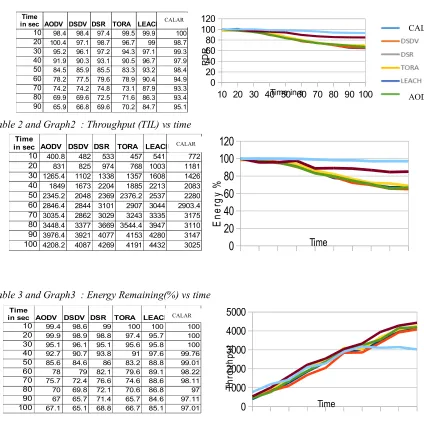
Table 1 and Graph1 : Packet delivery ratio vs time
Table 2 and Graph2 : Throughput (TIL) vs time
Table 3 and Graph3 : Energy Remaining(%) vs time
Simulation Results for different no of nodes in layout AODV DSDV DSR TORA LEACHLATHAR
10 98.4 98.4 97.4 99.5 99.9 100 20 100.4 97.1 98.7 96.7 99 98.7 30 95.2 96.1 97.2 94.3 97.1 99.3 40 91.9 90.3 93.1 90.5 96.7 97.9 50 84.5 85.9 85.5 83.3 93.2 98.4 60 78.2 77.5 79.6 78.9 90.4 94.9 70 74.2 74.2 74.8 73.1 87.9 93.3 80 69.9 69.6 72.5 71.6 86.3 93.4 90 65.9 66.8 69.6 70.2 84.7 95.1
Time in sec
AODV DSDV DSR TORA LEACHLATHAR
10 400.8 482 533 457 541 772 20 831 825 974 768 1003 1181 30 1265.4 1102 1338 1357 1608 1426 40 1849 1673 2204 1885 2213 2083 50 2345.2 2048 2369 2376.2 2537 2280 60 2846.4 2844 3101 2907 3044 2903.4 70 3035.4 2862 3029 3243 3335 3175 80 3448.4 3377 3669 3544.4 3947 3110 90 3976.4 3921 4077 4153 4280 3147 100 4208.2 4087 4269 4191 4432 3025
Time in sec 0 1000 2000 3000 4000 5000 Time T h ro u h p u t
0
20
40
60
80
100
120
Time E n e rg y %AODV DSDV DSR TORA LEACHLATHAR
10 99.4 98.6 99 100 100 100 20 99.9 98.9 98.8 97.4 95.7 100 30 95.1 96.1 95.1 95.6 95.8 100
40 92.7 90.7 93.8 91 97.6 99.76
50 85.6 84.6 86 83.2 88.8 99.01
60 78 79 82.1 79.6 89.1 98.22
70 75.7 72.4 76.6 74.6 88.6 98.11
80 70 69.8 72.1 70.6 86.8 97
90 67 65.7 71.4 65.7 84.6 97.11
100 67.1 65.1 68.8 66.7 85.1 97.01
Time in sec
10 20 30 40 50 60 70 80 90 100 0 20 40 60 80 100 120
Time in s
© 2016, IJCSMC All Rights Reserved 243
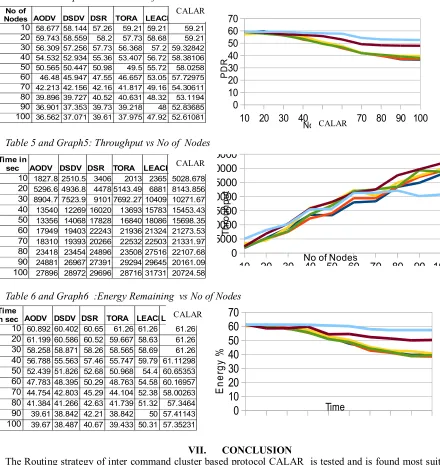
Table 4 and Graph4 : PDR vs No of Nodes
Table 5 and Graph5: Throughput vs No of Nodes
Table 6 and Graph6 :Energy Remaining vs No of Nodes
VII. CONCLUSION
The Routing strategy of inter command cluster based protocol CALAR is tested and is found most suitable for the critera of Packet delivery ratio, throughput and remaining energy. These simulations were run on ns2 network simulator. The simulation was done for the single node with varying time and collection of nodes in the cluster with time. It was found that CALAR protocol gives 15-20% better performance in the testing criteria. The algorithm of Data Accumulation node is presented for forwarding the data from leaf node to the root node of the system domain tree.
References :
[1] Kemal Akkaya and amed Younis “ A Survey of Routing Protocols” Ad Hoc Networks 3 (2005) 325– 349
[2] S. Hedetniemi, A. Liestman, A survey of gossiping and broadcasting in communication networks, Networks 18 (4) (1988) 319–349.
[3] W. Heinzelman, J. Kulik, H. Balakrishnan, Adaptive protocols for information dissemination in wireless sensor networks, in: Proceedings of the 5th Annual ACM/IEEE International Conference on Mobile Computing and Networking (MobiCom99), Seattle, WA, August 1999.
[4] C. Intanagonwiwat, R. Govindan, D. Estrin, Directed diffusion: a scalable and robust communication paradigm for sensor networks, in: Proceedings of the 6th Annual ACM/IEEE International
10 20 30 40 50 60 70 80 90 100 0 5000 10000 15000 20000 25000 30000 35000
No of Nodes
T h ro u h p u t
0
10
20
30
40
50
60
70
Time E n e rg y %AODV DSDV DSR TORA LEACHLATHAR
10 60.892 60.402 60.65 61.26 61.26 61.26
20 61.199 60.586 60.52 59.667 58.63 61.26
30 58.258 58.871 58.26 58.565 58.69 61.26
40 56.788 55.563 57.46 55.747 59.79 61.11298
50 52.439 51.826 52.68 50.968 54.4 60.65353
60 47.783 48.395 50.29 48.763 54.58 60.16957
70 44.754 42.803 45.29 44.104 52.38 58.00263
80 41.384 41.266 42.63 41.739 51.32 57.3464
90 39.61 38.842 42.21 38.842 50 57.41143
100 39.67 38.487 40.67 39.433 50.31 57.35231
Time in sec
AODV DSDV DSR TORA LEACHLATHAR
10 1827.8 2510.5 3406 2013 2365 5028.678
20 5296.6 4936.8 4478 5143.49 6881 8143.856
30 8904.7 7523.9 9101 7692.27 10409 10271.67
40 13540 12269 16020 13693 15783 15453.43
50 13356 14068 17828 16840 18086 15698.35
60 17949 19403 22243 21936 21324 21273.53
70 18310 19393 20266 22532 22503 21331.97
80 23418 23454 24896 23508 27516 22107.68
90 24881 26967 27391 29294 29645 20161.09
100 27896 28972 29696 28716 31731 20724.58
Time in sec
10 20 30 40 50 60 70 80 90 100 0 10 20 30 40 50 60 70
No of Nodes
P
D
R
AODV DSDV DSR TORA LEACHLATHAR
10 58.677 58.144 57.26 59.21 59.21 59.21 20 59.743 58.559 58.2 57.73 58.68 59.21 30 56.309 57.256 57.73 56.368 57.2 59.32842 40 54.532 52.934 55.36 53.407 56.72 58.38106 50 50.565 50.447 50.98 49.5 55.72 58.0258 60 46.48 45.947 47.55 46.657 53.05 57.72975 70 42.213 42.156 42.16 41.817 49.16 54.30611 80 39.896 39.727 40.52 40.631 48.32 53.1194 90 36.901 37.353 39.73 39.218 48 52.83685 100 36.562 37.071 39.61 37.975 47.92 52.61081
© 2016, IJCSMC All Rights Reserved 244
Conference on Mobile Computing and Networking (MobiCom00), Boston, MA, August 2000.
[5] Perkins, Charles E., and Pravin Bhagwat. "Highly dynamic destination-sequenced distance-vector routing (DSDV) for mobile computers." ACM SIGCOMM Computer Communication Review. Vol. 24. No. 4. ACM, 1994.
[6] Chakeres, Ian D., and Elizabeth M. Belding-Royer. "AODV routing protocol implementation design." Distributed Computing Systems Workshops, 2004. Proceedings. 24th International Conference on. IEEE, 2004.
[7] Royer, Elizabeth M., and Charles E. Perkins. "Multicast operation of the ad-hoc on-demand distance vector routing protocol." Proceedings of the 5th annual ACM/IEEE international conference on Mobile computing and networking. ACM, 1999.
[8] Johnson, D., Y. Hu, and D. Maltz. The dynamic source routing protocol (DSR) for mobile ad hoc networks for IPv4. Vol. 260. RFC 4728, 2007.
[9] W. Heinzelman, A. Chandrakasan, H. Balakrishnan, Energy-efficient communication protocol for wireless sensor networks, in: Proceeding of the Hawaii International Conference System Sciences, Hawaii, January 2000.
[10]A. Manjeshwar, D.P. Agrawal, TEEN: a protocol for enhanced efficiency in wireless sensor networks, in: Proceedings of the 1st International Workshop on Parallel and Distributed Computing Issues in Wireless Networks and Mobile Computing, San Francisco, CA, April 2001.