NON INVASIVE BLOOD GLUCOMETER
Komal Lawand
1, Shital Patil
2, Mahesh Parihar
3 1 2 3Dept of Instrumentation, RAIT, Navi Mumbai, (India)
ABSTRACT
Diabetes is a metabolic pathological condition of concern, which affects vital organs of body if not diagnosed
and treated on time. Regular monitoring of blood glucose is important to avoid complication of diabetes.
Commonly used glucose measurement methods are invasive which generally involves finger puncturing. These
methods are painful and frequent pricking cause calluses on the skin and have risk of spreading infectious
diseases. Therefore there is need to develop a non-invasive monitoring system which can measure blood glucose
continuously without much problem. The present work is focused on development of non-invasive blood glucose
measurement sensor system using Near-infrared (NIR) technique. In this study, near infrared optical
measurement is applied to overcome the invasive issues. The designed device consists of an infrared emitter
which placed over the fingertip for measurement of blood glucose optically. The near-infrared light will be
sensed by the photo diode which having a certain wavelength. The intensity of received light is depending on the
glucose molecules inside the blood. By analyzing the variation in voltages received after reflection in the cases
the current diabetic condition as well as the approximate glucose level of the individual is going to be predicted.
The obtained results are going to be validated with glucose meter readings and statistical analysis of the
readings is to be done.
Keywords: Diabetes, Non Invasive, NIR, Intensity
I. INTRODUCTION
Diabetes mellitus has become the serious medical condition in which it may cause blindness, obesity, heart
disease, renal failure and the stroke. These killer disease effects on the ability of human bodies in producing and
utilization of the insulin. It is a hormone which is essential in processing the blood glucose. The World Health
Organization estimated that there will be 177 million who suffered diabetes in 2000[1]. By the year 2025, the
value will increase up o 300 million minimally. Regular blood glucose monitoring is the key step in efficient
management of diabetes to control blood glucose. Most of commercially available glucose measurement devices
are invasive. Diabetic patients need to monitor their blood glucose two to three times a day. The invasive
methods are painful, have high recurring cost and danger of spreading infectious diseases [2]. Non-invasive
methods are more desirable and excellent alternatives to these devices. Enhancing glucose measurement
techniques to allow easy and continuous monitoring has received a lot of attention from both academic and
industrial researchers over the past three decades. Non-invasive glucose monitoring could make millions of
people more relaxed and comfortable about blood glucose testing. Thus it is necessary to develop a non invasive
There many new methods in order to improve the blood-glucose measurement and the optical method has
become interest in the most research studies. It is more reliability and has effective cost. The optical method of
blood-glucose measurement is the most popular method which has been studied and research in regard to
provide a non-invasive measurement. There are a variety of the optical methods for the non-invasive technique,
including near-infrared (NIR), Raman's spectroscopy, photo acoustic spectroscopy, polarization technique,
polarimetry and light scattering.
So, developing a non invasive way of measuring blood glucose would be much more user friendly from the end
user. The main advantage of non invasive methods is the aid from pain and malaise due to frequent finger
pricks. Non invasive determination of the glucose reduces all the above difficulties involved and hence reduces
the healthcare cost. The method proposed, represents a possible design and development of a sensor system to
detect blood glucose non-invasively using Near-infrared (NIR) radiation. It describes the principle of glucose
measurement using NIR method .System details are presented along with the criteria of selection of wavelength
and sensor. System makes use of the difference in voltage measured in both the before and after meal of the
received signal from the NIR sensor, to detect whether the patient is diabetic or not along with the approximate
glucose level.
The remaining portion the paper is organized into different sections. In section II related works done in
noninvasive field have been discussed, while section III discusses the theory of operation, section IV discusses
the proposed system architecture and section V discusses about the measurement procedure and VI the
experimental results and application . Conclusions and future developments have been illustrated in section VII.
II. RELATED WORK
Current methods for measuring blood glucose include pricking the finger piercing the vein and collecting the
blood. But the major problem with the existing method is that it is not proper for continuous monitoring of
blood glucose level. The difficulties associated with this can be removed by making used of the proposed
non-invasive way of measurement.
Gelao et. al describes an architecture based on dielectric spectroscopy for non- invasive, continuous blood
glucose monitoring using a blood glucose sensor [3]. The electrical circuit, schematic and the PCB design were
made. Using a dielectric constant for measurement, the frequency of both, amplitude and phase indicate the
blood glucose level. Using dielectric spectroscopy through the change in tissue permittivity glucose level is
measured. Ashok et. al describes a method for assessment of blood glucose level of diabetic and non-diabetic
patients using Transilluminated laser beam. The laser used here is an atomic gas laser also called a He-Ne laser,
operating at a 632.8 nm wavelength [4]. Here a single mode laser was used as a monochromatic light source to
eliminate mode interference noise. Making use of this method it was able to monitor blood glucose level of the
diabetic patient continuously and non invasively. The result obtained shows that blood flow is directly
proportional to blood glucose level. Abdallah et. al describes different kinds of methods for detecting blood
glucose. Elastic and inelastic (Raman) scattering as well as fluorescence and IR Spectroscopy measurements
was discussed for the development of a solid non-invasive device for home monitoring [5].
Burmeister et. al describes collecting non-invasive human spectra by an experimental protocol that is designed
across the tongues of five humans who have diabetes [6]. Despite the high degree of scattering, it was observed
that correlations were not related to temporal variances as the protocol separates glucose concentration and time.
Wang et. al describes a method based on metabolic heat conformation (MHC) and developed a prototype. In this
method glucose level is estimated from the quantity of heat dissipation, local tissue blood flow rate and degree
of blood oxygen saturation [7]. Clinical tests were conducted and correlation coefficient of the blood flow rate
between this method and theDoppler blood flow meter were found to be equal to 0.914. This result is closer, yet
still not acceptable for clinical use. Amir et. al has developed a successful method acceptable for clinical use,
which was used in our research. Amir et. al describes a noninvasive method for detecting blood glucose using
the technology of occlusion spectroscopy, developed using a NBM device by Orsense Ltd. Here the technology
is being presented and the efficiency of the device is evaluated [8]. In this experiment a light is passed through
the finger and the amount of light present on the other side of the finger is measured as photons. The presence of
glucose blocks the light from passing through the finger. Therefore, the blood glucose can be measured as light
intensity varies. Analyzing the transmission spectra shows that with a decrease in transmitted light intensity
concentration, hematocrit increases.
III. THEORY OF OPERATION
Basically, the non-invasive technique designed is based on the principle of the absorbance transmittance
photometry. In the process to develop the system, it is divided into several main parts and need crucial designs
in each stage. The absorption value of light energy is dependent on the number of molecules present in
absorbing material. Hence, the intensity of the light energy when leaved the absorbing material is consumed as
an indication of concentration of that particular material. In quantitative, the absorbance is expressed by the
Beer Lambert Law [11].
As the radiation interacts with biological tissue, it is attenuated by absorption as well as scattering. The
attenuation of light can be described by light transport theory:
I (1)
In equation (1) I is the reflected light intensity, Io the incident light intensity, L is the optical path-length in
tissue, and the term μeff is defined in equation (2) in terms of absorption coefficient μa and reduced scattering coefficient μs′.
(2)
With the addition of glucose concentration in blood, leads to decrease in the scattering properties of tissue. This
leads to a smaller scattering coefficient and consequently shorter optical path. Thus with the increase in glucose
concentration, scattering properties of skin decreases [13]. Fig. 1 shows the Schematic description of affect of
glucose on light path
.
IV. METHODOLOGY
In the process to develop the system, kindly it is divided into several main parts and need crucial designs in each
stage. The research paper [12] state that, to analyze and predict glucose concentration, it is possible by using
glucose spectroscopy between wavelengths 1100nm to 2450nm.The proposed system setup consists of a
reflective optical sensor, for transmission and reception of NIR rays with the fingertip as the body site. The
proposed system architecture is shown in Fig 2.
Figure 2: Block Diagram of Proposed Method
The optical sensor used is Infra red sensor operating at a wavelength of 1550nm. NIR signals are passed
through the fingertip and detected at photodiode. The photodiode current output s converted into voltage signal
by current to voltage converter. This output is filtered and amplified and conditioned for better result. The
output is then fed to a microcontroller unit, to perform voltage variation analysis of the received signal, so as to
monitor whether the obtained value is within threshold. Here intensity is inversely proportional to voltage. LED
based sensor system is preferred for present work as it overcomes all the limitations of LASER [10].
V. MEASUREMENT PROCEDURE
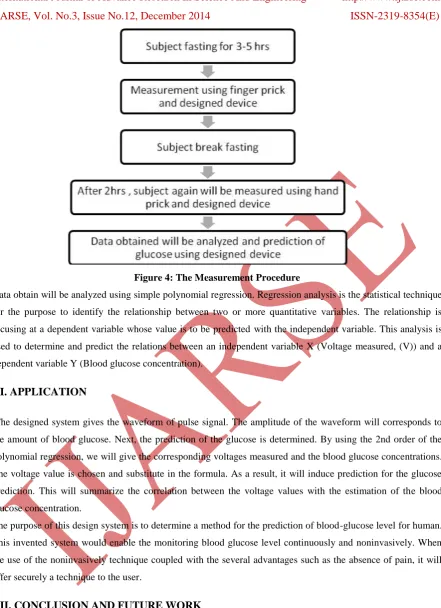
The experimental procedure established is to have an accurate and valid data among the subjects. Figure 3 hows
the block diagram on procedure of experiment. There are some assumptions would be made during the
experiment as the skin temperature for each subject is almost the same, 36.5°C. The fingertip diameter is
assumed same among the subjects. The skin color is light intermediate among the subjects which is depends on
Figure 4: The Measurement Procedure
Data obtain will be analyzed using simple polynomial regression. Regression analysis is the statistical technique
for the purpose to identify the relationship between two or more quantitative variables. The relationship is
focusing at a dependent variable whose value is to be predicted with the independent variable. This analysis is
used to determine and predict the relations between an independent variable X (Voltage measured, (V)) and a
dependent variable Y (Blood glucose concentration).
VI. APPLICATION
The designed system gives the waveform of pulse signal. The amplitude of the waveform will corresponds to
the amount of blood glucose. Next, the prediction of the glucose is determined. By using the 2nd order of the
polynomial regression, we will give the corresponding voltages measured and the blood glucose concentrations.
The voltage value is chosen and substitute in the formula. As a result, it will induce prediction for the glucose
prediction. This will summarize the correlation between the voltage values with the estimation of the blood
glucose concentration.
The purpose of this design system is to determine a method for the prediction of blood-glucose level for human.
This invented system would enable the monitoring blood glucose level continuously and noninvasively. When
the use of the noninvasively technique coupled with the several advantages such as the absence of pain, it will
offer securely a technique to the user.
VII. CONCLUSION AND FUTURE WORK
A lot of research work has been performed over the years to develop noninvasive measurements of glucose. Our
research work provides an innovative idea to solve the existing problems, which patients are facing with the
current glucose meter technique. A framework for non-invasive blood glucose measurement is been designed.
The results obtained from intensity variation analysis shows that there exists a correlation between the variation
REFERENCES
[1] S Coster, MC Gulliford, PT Seed, JK Powrie, R Swaminathan,”Monitoring blood glucose control in
diabetes mellitus”, a systematic review, Health Technology Assessment, vol. 4, no.12, 2000.
[2] B. Paul, M.P. Manuel, Z.C. Alex, ”Design and development of non invasive blood glucose measurement
system”, Physics and Technology of Sensors (ISPTS), 2012 1st International Symposium,Pune, India,7-10
March 2012, pp.43 46.
[3] Gennaro Gelao, Roberto Marani, Vito Carriero and Anna Gina Perri, ”Design of a Dielectric Spectroscopy
Sensor for Continuous and Non-Invasive Blood Glucose Monitoring”, International Journal of Advances
in Engineering and Technology,Vol. 3, Issue 2, pp. 55-64 May 2012.
[4] V.Ashok, A.Nirmalkumar, N.Jeyashanthi, ” A Novel Method for Blood Glucose Measurement by
Noninvasive Technique Using Laser”, World Academy of Science, Engineering and Technology, Vol:5
2011-03-24 2011.
[5] O. Abdallah, A. Bolz, J. Hansmann, H. Walles, and T. Hirth, ” Design of a Compact Multi-Sensor System
for Non-Invasive Glucose Monitoring Using Optical Spectroscopy” , IEEE Conference on Electronics,
Biomedical Engineering and its Applications (ICEBEA’2012), Jan. 7-8, 2012 Dubai.
[6] Jason J Burmeister, Mark A Arnold and Gary W Small,” Noninvasive Blood Glucose Measurements by
Near-Infrared Transmission Spectroscopy across Human Tongues”, Journal on Diabetes Technology and
Therapeutics, Volume: 2 Issue 1: July 5, 2004.
[7] Maximilian Hofmann, GeorgFischer, Robert Weigel and Dietmar Kissinger, Member, IEEE,”
Microwave-Based Noninvasive Concentration Measurements for Biomedical Applications” , Pulished in IEEE
Transaction on Microwave Theory and Techniques,VOL. 61, NO. 5, MAY 2013.
[8] O. Amir, D. Weinstein, S. Zilberman, M. lka Less, D. Perl-Treves, H. Pri-mack, A. Weinstein, E. Gabis,
B. Fikhte, and A. Karasik, ”Continuous Noninvasive Glucose Monitoring Technology Based on Occlusion
Spectroscopy”, Journal of Diabetes Science and Technology, pg no. 463-469 July 2007.
[9] K. Yamakoshi, Y. Yamakoshi, ”Pulse Glucometry- New approach for measurement of blood glucose non
invasively ”,Journal of Biomedical Optics 11(5), pg no.1-11 September/October 2006.
[10] S. F.Malin, T. L. Ruchiti, T. B. Blank, S. U. Thennadil, and S. L. Monfre,” Noninvasive prediction of
glucose by near-infrared diffuse reflectance spectroscopy,” Journal of Clinical Chemistry, vol. 45, pp.
16511658, 1999.
[11] O. S. Khalil, ”Spectroscopic and clinical aspects of noninvasive glucose measurements,” Journal of
Clinical Chemistry, vol. 45, no. 2, pp. 165-177, 1999.
[12] M. Taufiq Bin Zainul , Abidin, ”Initial Quantitative Comparison of 940nm and 950nm Infrared Sensor
Performance for Measuring Glucose Non-invasively”, Proc. of the IEEE Conference on Smart
Instrumentation, Measurement and Applications (ICSIMA), Kuala Lumpur, Malaysia pg no 13-18, 26-27
November 2013.
[13] K A Unnikrishna Menon ,Deepak Hemachandran , ”Voltage Intensity Based Non-Invasive Blood Glucose
Monitoring”,Proceedings of the 4th IEEE conference on Computing Communication, Networking
![Figure 1: Affect Of Glucose on Light Path [9]](https://thumb-us.123doks.com/thumbv2/123dok_us/7757291.1272447/3.595.69.520.205.721/figure-affect-glucose-light-path.webp)