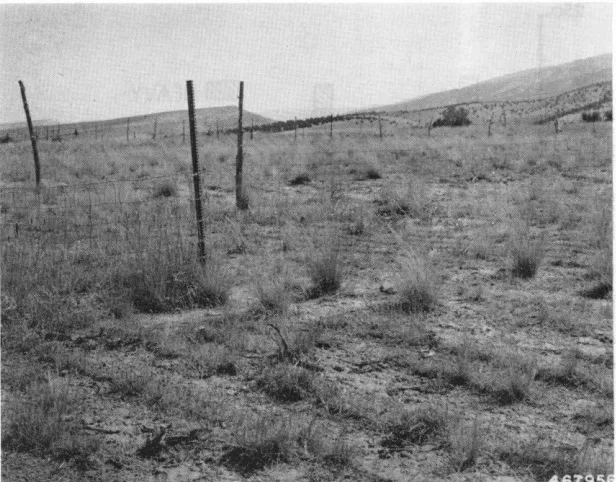
Grazing Crested Wheatgrass by Sheep
A. ‘I’. BLEAK AND A. PERKY PLUMMER Range Conservationists, Intermountain Forest and ment Station. U. S. Forest Service, Ogden, Utah
Range Experi-
P
LANTING depleted spring-fall range with adapted grasses in the Intermountain region is now an important enterprise. Crested wheatgrass (Agropyron cristatum) is presently the best for seeding these ranges and is in widespread use. This species has already been planted on approximately 1 million acres in the Intermountain West and prospects are t,hat there are at least 10 million acres where crested wheatgrass will be sown and where the grazing industry will ultimately depend on it. Seeded ranges repre- sent an outlay of from 5 to 12 dollars per acre and the grass usually requires protection from 2 to 4 years for successful establishment. To retain the income-producing value of such an investment these ranges should be grazed in a manner t>o maintain highest produ&ion over a long period of time. As a guide to management this paper reports the results of the first 7 years’ grazing of crested wheat- grass and secondary grasses with sheep on typically spring-fall range near Ephraim, Ut)ah. Although results are not final, they provide information that is useful in guiding management of seeded spring-fall ranges.Methods
Six I>$-acre pastures were con- structed on a 1940 seeding in which crested wheatgrass was the dominant species. Other seeded grasses occurring in the stand were beardless bluebunch wheat- grass (Agropyron inerme) and bulb- ous bluegrass (Pea bulbosa). These were included in the mixt(ure af a rate of 1 pound per acre. Five other grasses and two forbs were in- cluded at 5/i to 2 pounds per acre.
Three of the grasses, Sandberg bluegrass (Pea secunda), tall oat- grass (Arrhenatherum elatius) and slender wheatgrass (Agropyron tra- chycaulum) failed to establish them- selves as part of the stand. The two forbs Viguiera multijlora and arrow- leaf balsamroot (Balsamorhixa sagit- tutu) also failed to successfully establish. Indian ricegrass (Oryxop- sis hymenoides) and low creeping wildrye (Elymus simplex) were established as very minor COll- stituents.
Beginning in the spring of 1945 and continuing through 1951 t)he crested wheatgrass has been grazed with ewes and lambs to average utilization intensities of 59 percent (light), 7 1 percent, (moderate), and 88 percent (heavy), which are reasonably close to the original standards of 55, 70, and 90 percent planned for the respectjive inten- sities. In no year did removal of crested wheatgrass vary more than 5 percent from the desired utiliza- tion. These int)ensities may be unduly heavy for adequate soil protection, since recent research has indicated the importance of a cover of vegetation and litter for minimiz- ing surface runoff and soil erosion (Packer, 1951; Ellison, Croft and Bailey, 1952). Pastures have been moderately grazed in the fall (usually in November) in years when regrowth was adequate.
Percentage utilization by weight was determined by estimate (Pech- anec and Pickford, 1937) on thirty 9.6-square-foot plotIs in each pasture (Frischknecht and Plummer, 1949). Two pastures were assigned at random to each grazing intensity. Grazing was start)ed on one pasture of each grazing intensity when crested wheatgrass was 2 to 3
63
inches high (early), and on the other at an average of 13 days later when grass was 4 to 5 inches high (de- ferred). Spring grazing closed on all pastures at about the same date. April 14 and 27 have been the average starting dates for the respective grazing treatments and May 25 the average spring closing date.
Rambouillet sheep were used throughout the study. From two to five mature ewes between 3 and 6 years of age with single lambs were put in each pasture in the spring. Holdover ewe lambs, yearling ewes, and mature ewes were used in the fall. All sheep were weighed in the morning after a 12-hour shrink. A sheep day is considered to be a ewe for one day or a lamb for one day, since a ewe and her lamb will con- sume twice as much green forage as a dry ewe (Fleming, Miller and Young, 1930, 1931, and 1938).
64 A. T. BLEAK AND A. P. PLUMMER
bind (Convotvulus arvensis) occurred, but they were not thick enough to be a particular problem in getting the seeded grasses established.
Effects on Vegetation
As far as can be seen from the first 7 years of record, there is no dif- ference in vegetation between pas- tures where spring grazing started when crested wheatgrass was 2 to 3 inches high (early) or approxi- mately 13 days later when crested wheatgrass was 4 to 5 inches high (deferred).
Spring herbage production fluc- tuat,ed from year to year due to the effects of climate (Table I). Spring growing conditions were better than average in 1945, 1947 and 1949, about, average in 1946 and 1948, and below average in 1950 and 1951. The general reduction in grass yields in all treatments in 1950 and 1951 is largely associated with the
lowest available moisture for growth in any period since 1934. Some of the general decrease in grass pro- duction after 1947 probably re- sulted from natural causes associ- ated with aging of the stand and commonly referred to as decadence. Similar trends after 1947 were determined in each pasture on a 12 x 14 foot plot that was com- pletely protected from grazing dur- ing the I-i-year period. This paral- lelism in trends indicates that factors other than grazing caused the general decline in yield. Barnes and Nelson (1950) noted a similar trend in Wyoming where seeded pastures, including crested wheat- grass, declined 25 percent from the second to the seventh year and 55 percent by the ninth year.
Table 1 reflects the differential effect of the three grazing intensities on production of crested wheatgrass just prior to early grazing. Yields at
Table 1. Green weight production at time sheep entered early-grazed pastures
Year
1945* 220
1947 382
1948 264
1949 303
1950 228
1951 116
Crested Wheatgrass
Bluebunch
Wheatgrass ) $$$~~s ) chge~~~~s 1 ‘Kg1 1 Total
Pounds per acre
Lightly Grazed
- - T T 315
46 247 10 4 689
24 86 T 1 375
50 78 T 6 437
74 46 T 4 352
47 58 T 2 223
Moderately Grazed
1945* 250 - -
1947 334 33 260
1948 293 12 101
1949 300 52 94
1950 198 70 48
1951 115 35 59
358 633 406 449 318 211
Heavily Grazed
1945* 243
1947 287
1948 236
1949 244
1950 133
1951 68
- 18
6 2
T
- 226
76 112 54 51
T
3 T
T 8
T 6
T 2
T 341
536 321 366 194 121
* In 1945 no separation was made between bluebunch wheatgrass and bulbous bluegrass.
this period are used because they permit an evaluation without the complication of current grazing and are a fairly good indicator of vigor. Production of crested wheatgrass under the three grazing intensities was similar at the beginning of the study. A relative decline in produc- tion was apparent under heavy grazing after 2 years of treatment, as shown in the 1947 herbage inventory. By the seventh year pronounced differences were mani- fest under heavy as compared with light and moderate grazing. Little difference could be detected between light and moderate grazing.
Evidently taking as much as 71 percent of the herbage permitted crested wheatgrass to maintain production that was comparable on the average to production under 59 percent utilization. Even under 88 percent utilization, crested wheat- grass shows remarkable ability to persist, although there is 110 doubt that the plants have been severely injured. One of the first signs of heavy use was the tendency of the grass foliage to lie almost prostrate on the ground in the early spring. Another indicator of deterioration was the marked tendency for crested wheatgrass clumps to die in the middle and break up into ap- parently individual plants.
GRAZING CRESTED WHEATGRASS 65
t,he summer, it provided no forage in the spring months.
Bluebunch wheatgrass and bulb- “us bluegrass occur as secondary components in the pastures. By 1948, the third year of grazing, many bluebunch \vhcatgrass plants had died in t,he heavily-grazed pastures, and by 1951, t,he seventh year, very little of this grass xvas left. This high mort,ality resulted despite the fact that bluebunrh wheatgrass was utilized to an average of only 67 perrent in the heavily-grazed pasture compared to an average of 88 percent for crested wheatgrass. Because of its upright habit and lack of basal leaves 67- perrent use removed practically all the foliage of this grass. Under light and moderate grazing, where
Table 2. Number of plants and yield of Russian thistle in ,951 under three
intensities of sheep use
Intensity 1 Y”& 1 Production
crested whcatgrass MXS utilized to an average of 69 and il percent, bluebunch vheatgrasa was utilized only 14 and 1G percent. IYnder this use it is maintaining itself and many plants arc becoming large, ungrazed ‘%olf planta” (Fig. 1).
There is no evidenre that grazing bulbous bluegrass t,o an average of 61 percent in the heavily-grazed pasture has materially affected its production or vigor. A much lighter average utilization of this grass, 30 and 34 percent, was “bt,ained in the lightly- and moderately-grazed pas- tures. Bulbous bluegrass shorn a fluctuating production under all ‘intensities of use. It has a prolif-
erating bulb vith a shallow, temporary root system. Former studies (Plummer, 1943) have show1 that the roots of this grass dry up and deteriorate wit,h the onset of
high tcmperntures, and when mois- turc and temperatures are suitable
in the fall new roots grow out from the bulb. Consequent~ly its main groxi-th is made before the middle of May, and since t,he foliage was usually drying at this time sheep reased to graze it. However the bulblets produced on the seed stalk in place of seed are avidly eaten. This study has furnished some information on the seeding of blue- burwh wheatgrass and bulbous blocgrass in mixture v+th crested x-h&grass. Beanwz of the low prrference of shwp for bluebunrh whcatgrass vhen grwing with rrcstrd wheat,grass under light and modcrate grazing, its use in mixture with crested whcatgraas is not rwommended. If bluebunch wheat- grass is used these results suggest that it should br planted alone in separate units and used in rotation \vith crested wheatgrass.
Considerable conjwture exists as t,o the value of bulbous bluegrass in mixture \vith crested n.heatgrass. Bulbous bluegrass does servr a “se- ful pupow by producing highly pslatahle forage soon after the snow
melts in spring. Even in dry years there is enough moisture for this grass to make fair growth. Biggest fluctuations in yield are caused by periods of low temperature after spriug growth begins, rather t,han by lack of moisture. Whether one should use it in a mixture is a matter of personal choice and need.
Some feel the presence of bulbous bluegrass with crested wheatgrass rrsults in less total yield because of less efficient use of moisture hy bulbous bluegrass. Honww, this as- pect must be determined by future nwarch.
Sheep Days
66
A. T. BLEAK AND A. P. PLUMMER
YEAP ! 1945 1946 1947 1948 1949 1950 1951
FIGURE 2. Sheep days per acre under three intensities of spring grazing during a
m HEAVY
m MODERAT
m LIGHT
E
7-year period.
grazing, and in 1951, the seventh year, light grazing produced very nearly the same number of sheep days as heavy grazing. The relative difference in sheep days furnished by moderate and light grazing re- mained fairly constant during the study period.
Sheep days provided by the pastures varied widely in different years. The fluctuations between 1945 and 1948 are presumably attrib- utable to more favorable conditions for plant growth in 1945 and 1947 than in 1946 and 1948. The decline in sheep days in 1949, a year in which early production was fairly high as Table 1 shows, may possibly be due to the fact that the ewes were in very poor condition because of the shortage of feed they had suffered on their winter range in a winter of exceptionally deep snow, so that they ate more green grass than in other years. The pro- nounced decreases in 1950 and 1951 are to a large extent attributable to decreased forage production in two very dry years. Part of the decline between 1947 and 1951 is attribut-
able to decadence in the seeded stand already described.
Sheep Gains
Lamb gains per acre under the three intensities of use followed a pattern like that for sheep days. As shown in Table 3, average lamb gains per acre were greatest under the heavy intensity in 1946 and 1947, the first two years in which weights were taken. During the last 4 years, average gain per acre was greatest under the moderate inten- sity. This convergence of lamb gains between the heavy intensity and the moderate and light intensities parallels the similar convergence noted for sheep days. Although the heavily-grazed pastures produced slightly more lamb per acre for the six years in which weights were taken, the pronounced decline in lamb gains reflects deterioration of the grass stand under heavy use. Average lamb gains for all in- tensities averaged 0.60 pound per day per head and ranged from 0.51 in 1947 to 0.70 pound per day in 1951. Lambs in the moderately- and
heavily-grazed pastures made the same average gain per day, 0.58 pound, while lambs in the lightly- grazed pastures made a slightly greater gain, 0.64 pound. The dif- ference between light and heavy is statistically significant, but that between light and moderate is not. Although the gain in favor of light grazing appears small, over a 6- weeks’ grazing period it means a difference of 235 pounds per lamb.
Gain by mother ewes for the 6- year period averaged 0.18, 0.30, and 0.08 pound per day and 8.2, 15.7, and 5.6 pounds per acre in the lightly-, moderately-, and heavily- grazed pastures. However these gains are so variable between years that it is not possible to say that they represent a real difference be- tween treatments.
Table 3. Average lamb gain per acre under three intensities of use
Year
Intensity
Light 1 Moderate [ Heavy
1946 21.3
1947 30.3
1948 1 31.3
1949 29.7
1950 32.0
1951 24.3
Average . . 28.2
Pounds
27.3 35.0
33.0 50.3
44.7 35.0
28.3 31.7
32.3 37.7
26.3 22.7. --
32.0 35.4
~~__
Fall Grazing
In two years, 1950 and 1951, there was not enough regrowth to permit fall grazing in the heavily-grazed pastures. For this reason no fall grazing use was allowed in the other pastures. During the five years that the pastures were grazed in the fall, the average number of sheep days’ use for light, moderate and heavy averaged 51,42 and 27, respectively. Greater production from lightly- and moderately-grazed pastures re- sulted from greater availability of old growth.
GRAZING CRESTED WHEATGRASS 67
during the fall grazing period. In general sheep evidenced an ability to gain or maintain weight in the fall, particularly if their teeth were good. Average gain per day for all intensities was 0.23, 0.35 and 0.15 pound (Table 4). In 1949 sheep in the heavily-grazed pastures merely maintained their weights. This is attributed to the fact that snow covered the low regrowth, and since there was very little old growth above the snow the sheep couldn’t get enough to fill up.
In 1948 and 1949, light and moderate grazing in the fall pro- duced more gain per acre than heavy grazing because of the greater number of sheep days available and the higher gain per day. When fall gains are added to spring gains of ewes and lambs, the total gains per acre in 1948 were 53.3, 73.4, and 52.7, and in 1949, 55.0, 60.6, and 41.0 pounds for the lightly-, moderately- and heavily-grazed pastures, respectively. Thus sheep gains from moderate grazing are substantially greater than from heavy grazing when spring and fall grazing periods are considered to- gether.
Early Versus Deferred Grazing During the T--year study, the de- ferred pastures furnished 20 more sheep-days per acre per year than the early pastures. Nevertheless lambs in the early pastures made about 0.08 pound more gain per day, a difference that is statistically significant. This advantage tends to make gains per acre in the early and deferred pastures about equal. Since ewes and lambs in the early pastures made better gains per acre with fewer sheep days, it would ap- pear that sheep starting t,o graze early actually consumed a greater volume of grass per head than sheep starting to graze about 2 weeks later. This is largely attributable to greater succulence of grass in the early period. The question arises as
Table 4. Sheep gains in the fall grazing period in three years of record
Gain per day Gain per acre
Year
Light Moderate Heavy Average Light 1 Moderate 1 Heavy 1 Average
1945 1948 1949
Pounds
11.9 9.6 4.1
to which would be the best date to start grazing crested wheatgrass. From the standpoint of the vegeta- tion it evidently makes no dif- ference so long as the grass is not too heavily used at the close of the grazing season. If the primary con- cern is getting the lambs to gain as fast as possible, grazing early is to be preferred.
Summary and Conclusions
Because of the low preference of sheep for beardless bluebunch wheatgrass under light and moder- ate grazing as compared to crested A grazing study with sheep was conducted on six I$&acre dryland pastures in typical spring-fall range in Utah with crested wheatgrass as the dominant species. Beardless bluebunch wheatgrass and bulbous bluegrass occurred as secondary components. Three intensities of use were applied (light, moderate and heavy) with grazing starting when crested wheatgrass was 2 to 3 inches high (early) and 4 to 5 inches high (deferred). After seven years of grazing, injurious effects are obvious where crested wheatgrass has been heavily utilized (88 per- cent use). Under heavy grazing, production has decreased, most grass clumps have died in the middle, plants are small, and there is a marked growth of Russian thistle generally over the pastures. Although production has declined with aging of the seeded stands, crested wheatgrass appears to have maintained equally good production under light (59 percent) and moder- ate (71 percent) use during this first seven years.
wheatgrass, its use in mixtures with crested wheatgrass is not recom- mended. Bulbous bluegrass has maintained itself well in stands of crested wheatgrass. Its use in mixtures with crested wheatgrass depends on the need for early forage and on personal preference. If grazing is deferred until late spring, inclusion of bulbous bluegrass in mixtures with crested wheatgrass is of questionable value.
Sheep days’ use declined sharply in the heavily-grazed pastures as compared with t’he lightly- and moderately-grazed pastures after three years of treatment. During the ’ following four years, the moder- ately- and heavily-grazed pastures each furnished about the same number of sheep days.
The trend in lamb production per acre was similar t’o the trend in sheep days. Lamb gains were slightly greater in lightly-grazed pastures than in moderately- and heavily-grazed pastures. Average lamb gain for all intensities varied from 0.51 to 0.70 pound per day.
No permanent differences in vegetation were apparent between pastures where spring grazing started when crested wheatgrass
68 A. T. BLEAK AND A. P. PLUMMER
was 2 to 3 inches high and those - LITERATURE CITED nique for determining herbage where grazing started approximately BARNES, 0. K. AND A. L. NELSON. 1950. production on range and pasture
land. Agron. Jour. 41: 63-65. 13 days later when crested wheat- Dryland pastures for the Great Plains. Wyo. Agr. Expt. Sta. Bull. PACKER, PAUL E. 1951. An approach grass was 4 to 5 inches high. During 302. 30 pp. to watershed protection criteria. the 7- year period, the deferred ELLISON, LINCOLN, A. R. CROFT AND Jour. Forestry 49(9) : 639-644.
REED W. BAILEY. 1951. Indicators PECHANEC, J. F. AND G. D. PICKFORD. pastures furnished an average of 20 of condition and trend on high range 1937. A weight estimate method more sheep-days per acre per year watersheds of the Intermountain Re-
than the early pastures. Never- FLEMING, CHARLES E., M. R. MILLER gion. U. S.Dept. Agr. Hdbk. 19.66 pp.
for the determination of range or pasture production. Amer. Sot. Agron. Jour. 29 : 894-904.
theless, in the early pastures, lambs _ _ AND A. YOUNG. i930, 1931, and PLUMMER, A. P. 1943. The germina- made 0.08 pound greater gain per 1938. Nevada Reprints. tion and early seedling development
FRISCHKNECHT, NEIL C. AND A. PERRY of twelve range grasses. Amer. Sot.
day. PLUMMER. 1949. A simplified tech- Agron. Jour. 35 : 19-34.
I .
NUMBER ONE OBJECTIVE FOR 19544,000 MEMBERS
What will that do to help the Society?
1. It will put that many more broad shoulders to the wheel of progress in achieving the objectives of our Society.
2. It will strengthen our financial position by: a. Bringing in more dues.
b. Putting our Journal in a higher bracket of payments for advertising space.
c. Making our Journal more attractive to ad- vertisers because of wider distribution.
Does our financial position need strengthening? Yes. It’s not shaky, but that is because we are operat- ing to a great extent on contributed services. Con-
tributed services are “when-we-can” services. Our Society must this year begin paying a partial salary to our Executive Secretary. We need a full-time executive secretary and a full-time editor. We also need a “home”. The pay-off to you will be a better Journal, more and better sectional activities and a better Society all-round.
Our figures show that we are nowhere near saturation point in any class of membership. We can reach our objective among the same high classes of people we have in the Society now.
We’ve given the special reasons for making this a
special objective. Now, what is needed is a special
effort . OK?--FEoyd D. Larson, President.
CONSERVATION AWARDS MADE BY NASH COMMITTEE
Awards of $500 each were presented on January 7, 1954 by GEORGE W. MASON, presi- dent of the Nash-Kelvinator Corporation, to ten professional workers for their outstanding contributions to the field of conservation of our national resources. In addition, the Nash Conservation Awards Committee presented medals to ten individuals in recognition of their acts of good citizenship in fostering better conservation methods. Award winners were selected from among more than 700 nominations submitted by officials of state, federal and private conservation agencies, and professional writers on conservation topics.