c
Owned by the authors, published by EDP Sciences, 2017
ICARUS detector: present and future
F. Varanini (on behalf of the ICARUS Collaboration) 1INFN Sezione di Padova, via Marzolo 8, Padova, Italy
Abstract. The ICARUS-T600 detector is the first large-scale liquid Argon TPC ever operated; its successful data-taking campaign at Gran Sasso laboratory, with CNGS beam and atmospheric neutrinos, proved the maturity of this innovative detection technology. In particular, it performed a search for sterile neutrinos throughνµ to νe oscillations, observing no excess w.r.t. backgrounds and allowing to strongly constrain the parameter space, indicating a narrow region in agreement with all experimental data.
A definitive answer to the sterile neutrino puzzle will be given by the SBN experiment at the Booster beam at FNAL, where ICARUS-T600 will act as far detector, by performing both appearance and disappearance measurements.
1 The sterile neutrino puzzle
Neutrino oscillations represent one of the greatest discoveries in recent particle physics; the vast majority of experimental results in the last 20 years appear consistent with a 3-neutrino scenario, characterized by three flavor eigenstates (νe, νµ, ντ) and three corresponding mass eigenstates, with
small mass differences (∆m212 ∼ 8·10−5eV2,∆m223 ∼ 2.5·10−3eV2). However, a few anomalous results pointed out to possible oscillations mediated by a much larger∆m2, suggesting the existence of (at least) a fourth mass eigenstate:
• The observation of aνeexcess inνµbeams from accelerators, at experiments such as LSND (∼3.8σ
effect) and MiniBoone;
• A deficit w.r.t. expectations (also∼3σ) in theνeflux from nuclear reactors;
• A similarly lower signal from high-intensity νesources used in the calibration of solar neutrino
experiments.
While these results are not statistically compelling, the experimental scenario concerning the possible sterile neutrinos is far from clear, and requires a full clarification.
2 The ICARUS-T600 experiment at LNGS
The ICARUS-T600 data-taking run at the underground LNGS laboratory, lasting from 2010 to 2013, represents the first large-scale physics experiment with a liquid Argon Time Projection Chamber ( LAr-TPC), with a detector active mass of∼470 tons.
of wire signals allows a 3D reconstruction of any ionizing track with a millimeter-scale resolution. Moreover, the VUV scintillation light produced in the Argon, detected by PMTs immersed in the detector, is used for signal timing and trigger generation.
The ICARUS-T600 detector [1, 2] was exposed to the CNGS neutrino beam from CERN, collect-ing a total statistics of 8.6·1019protons on target, with a detector live-time higher than 93%. It also
recorded atmospheric neutrinos with a total exposure of 0.73 kton×year.
The concentration of electronegative impurities (essentiallyO2) in LAr is a crucial parameter for
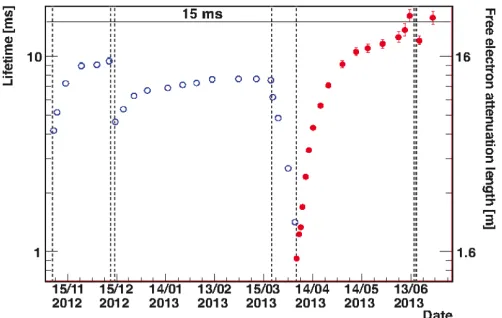
the operation of a LAr-TPC; a large contamination would absorb a significant fraction of drift elec-trons, resulting in a degradation of signals. Significant experimental effort must be devoted to the Argon purification and recirculation; in the ICARUS-T600 case, the drift electron lifetime was kept higher than 7 ms during the whole data-taking period, as shown in figure 1; this results, obtained through continuous Argon recirculation both in the liquid and gas state, ensures a small signal attenu-ation during the drift (12% for a drift length of 1.5 meters) and represents an important milestone for future LAr-TPC with much larger drift lengths [3].
Figure 1.Electron lifetime as a function of time, during the last 7 months of the ICARUS-T600 run at LNGS. Dashed lines indicate periods were recirculation was not active, while the increase in the final weeks is due to the installation of a new, more powerful recirculation pump.
2.1 Search for atmospheric neutrinos
The analysis of the sample of atmospheric neutrinos recorded by ICARUS-T600 at LNGS (∼0.73 kt) is ongoing; about 25% of the collected statistics has been analyzed so far. The search concentrated on multi-prong interaction vertex topologies with at least two charged particles, corresponding to∼30% ofνµCC events.
of wire signals allows a 3D reconstruction of any ionizing track with a millimeter-scale resolution. Moreover, the VUV scintillation light produced in the Argon, detected by PMTs immersed in the detector, is used for signal timing and trigger generation.
The ICARUS-T600 detector [1, 2] was exposed to the CNGS neutrino beam from CERN, collect-ing a total statistics of 8.6·1019protons on target, with a detector live-time higher than 93%. It also
recorded atmospheric neutrinos with a total exposure of 0.73 kton×year.
The concentration of electronegative impurities (essentiallyO2) in LAr is a crucial parameter for
the operation of a LAr-TPC; a large contamination would absorb a significant fraction of drift elec-trons, resulting in a degradation of signals. Significant experimental effort must be devoted to the Argon purification and recirculation; in the ICARUS-T600 case, the drift electron lifetime was kept higher than 7 ms during the whole data-taking period, as shown in figure 1; this results, obtained through continuous Argon recirculation both in the liquid and gas state, ensures a small signal attenu-ation during the drift (12% for a drift length of 1.5 meters) and represents an important milestone for future LAr-TPC with much larger drift lengths [3].
Figure 1.Electron lifetime as a function of time, during the last 7 months of the ICARUS-T600 run at LNGS. Dashed lines indicate periods were recirculation was not active, while the increase in the final weeks is due to the installation of a new, more powerful recirculation pump.
2.1 Search for atmospheric neutrinos
The analysis of the sample of atmospheric neutrinos recorded by ICARUS-T600 at LNGS (∼0.73 kt) is ongoing; about 25% of the collected statistics has been analyzed so far. The search concentrated on multi-prong interaction vertex topologies with at least two charged particles, corresponding to∼30% ofνµCC events.
An automatic filter algorithm allows identifying this kind of topologies, reducing the amount of events to be visually scanned by a factor∼200; in the analyzed statistics, 12 atmospheric neutrino interactions (2 electron-like, 3 muon-like) have been identified, in agreement with the expectation of 10±2 events.
2.2 Measurement of muon momentum via multiple Coulomb scattering
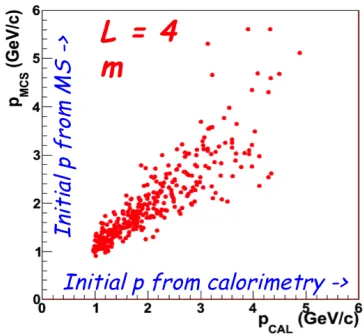
Multiple Coulomb scattering (MCS) is the only way to compute the momentum of non-contained muons, such as the ones fromνµcharged current interactions. A dedicated algorithm developed for ICARUS-T600 was tested on a sample of∼1000stopping muons, i.e. muons from CNGS neutrino interactions in the upstream rock, entering the active TPC volume and stopping or decaying there. This sample is an ideal benchmark for the MCS measurement, providing an independent calorimetric estimate of momentum, in an energy range (1÷5 GeV/c) relevant for future neutrino experiments.
The MCS and calorimetric estimates result in good agreement, as shown in Figure 2; the average resolution of the MCS estimates on the stopping muon sample is about 15%. A small (∼ 15%) underestimation of the MCS measurement w.r.t. calorimetry, appearing forp3 GeV/c, is related to the non-perfect planarity of the TPC cathode. This distortion was directly and independently measured after the end of the LNGS run, showing deviations that extend to∼3 cm (see Figure 3). They generate a non-uniformity of the electric field, resulting in spurious track deflections that mimic the effect of MCS. A full 3D field simulation showed that this effect can result in a momentum underestimation of ∼10%, largely accounting for the observed underestimation.
Figure 2.Momentum measured from MCS compared with momentum estimated by calorimetry, for the CNGS stopping muon sample. Muons with track lengths larger than 5 meters were considered, and only the first 4 meter of the muon tracks were used for MCS measurement.
2.3 Electron/photon separation
Since electron neutrino interactions usually represent the main signal in many present and future neutrino oscillation experiments, an efficient identification of electrons is a crucial feature of neutrino detectors; in particular, it is very important to efficiently reject the main background given by neutral current interactions withπ0production.
Figure 3.Deviationsδy from cathode planarity as a function of the longitudinal coordinatez, at a height of 75 cm and a distance of 30 cm from the cathode plane. Theδy values have been interpolated from direct measurements with a laser-meter, performed during the T600 refurbishing at CERN.
Figure 4.Example of an identified CNGSνecharged current interaction in ICARUS-T600 at LNGS.
Figure 5. Ionization density as a function of wire number (along the track direction) for the first wires of the event in Figure 4. The grey bands represents dE/dx values corresponding to a single m.i.p. (∼2.1 MeV/cm) and
a double m.i.p.
3 Search for sterile neutrinos at the CNGS beam
ICARUS-T600 searched for possible oscillations mediated by a sterile neutrino in the range identified by LSND (∼1eV2), by looking for aν
Figure 3.Deviationsδy from cathode planarity as a function of the longitudinal coordinatez, at a height of 75 cm and a distance of 30 cm from the cathode plane. Theδy values have been interpolated from direct measurements with a laser-meter, performed during the T600 refurbishing at CERN.
Figure 4.Example of an identified CNGSνecharged current interaction in ICARUS-T600 at LNGS.
Figure 5. Ionization density as a function of wire number (along the track direction) for the first wires of the event in Figure 4. The grey bands represents dE/dx values corresponding to a single m.i.p. (∼2.1 MeV/cm) and
a double m.i.p.
3 Search for sterile neutrinos at the CNGS beam
ICARUS-T600 searched for possible oscillations mediated by a sterile neutrino in the range identified by LSND (∼1eV2), by looking for aν
eeccess in the CNGSνµbeam. A sample of∼7.9·1019 pot, corresponding to∼2650 neutrinos, was considered; the analysis was limited to the energy range be-tween 10 and 30 GeV. In this sample, 7 electron neutrino events were found, compared to an expected background of 8.5±1.1, dominated by the intrinsicalνebeam contamination; theνe identification
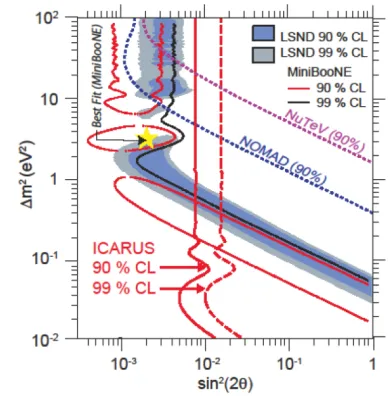
efficiency was estimated from a detailed MonteCarlo study, resulting∼74% with a negligible con-tamination from neutral current backgrounds. No excess was therefore observed, allowing to strongly constrain the allowed region for sterile neutrino oscillation in the (sin22θ,∆m2) parameter space,
identifying a small area (sin22θ,∆m2)∼(0.005,0.5eV2) where all available experimental data can be
accommodated at 90% confidence level [4], as summarized in figure 6.
Figure 6. Limits in the sterile neutrino parameter space obtained by the ICARUS-T600νµ → νeappearance
search, compared with LSND and MiniBoone allowed regions and limits from previous experiments.
4 The SBN experiment
The phenomenological scenario of sterile neutrino results still shows tension between different ex-perimental results, and requires a solid verification of the flavour change "hints" provided by several experiments. In this complex scenario, the SBN experiment has the goal to clarify this issue by per-forming both appearance and disappearance measurements with the same beam and detectors.
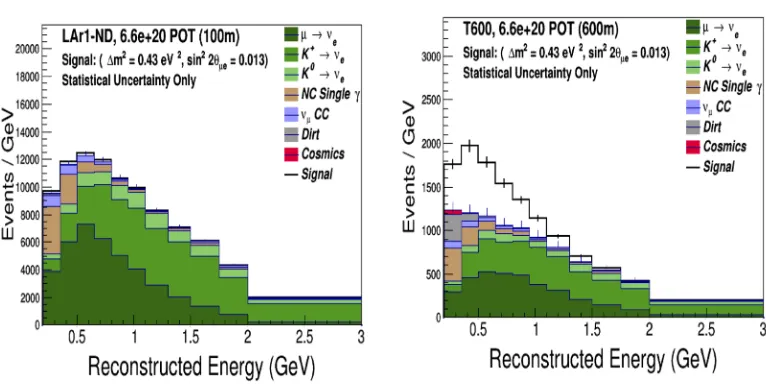
In this experiment, neutrinos from the Booster beam at FNAL, with an average energy of∼800 MeV, will be detected by three different LAr-TPC detectors (SBND, MicroBoone and ICARUS-T600) at different distances from the target (about 100, 470 and 600 m respectively). This approach will allow a greater oscillation sensitivity, based on comparison of spectra at the near and far detector; in absence of anomalous signals due to sterile neutrinos, signals in these detectors should be identical, except for an obvious solid-angle factor, as illustrated in Figure 7. Moreover, the use of the same technology for all detectors will allow a strong reduction of systematics related toν-Ar cross sections and to event identification and selection.
The appearance measurement will allow to fully cover the currently allowed region in the parame-ter space with 99% confidence level in 3 years of data taking, corresponding to 6.6·1020pot, as shown
Figure 7.Energy spectrum of allνeevents expected at SBND near detector (left) and ICARUS-T600 far detector
(right) for 3 years of data taking at the Booster beam. The expected signal for a reference sterile neutrino case is shown in white, while the various background components are in colors.
mixing angles, parametrizing the mixing of the active flavors to the hypothetical sterile neutrino; this will allow to test both these mixings with the same experiment.
5 ICARUS-T600 overhauling at CERN
The ICARUS-T600 detector is currently undergoing a massive overhauling at CERN, in view of its use for the SBN experiment. This program (WA104) will introduce substantial improvements while keeping the present detector performance. In particular, the refurbishing work will involve several detector subsystems:
• New cold vessels, with a purely passive insulation; • Renovated cryogenics and purification equipment;
• Reduction of the cathode non-planarity discussed in section 2.2 to a few millimeters;
• Upgrade of the light collection system, in order to achieve a high timing resolution (few ns), needed for the precise localization of events within the drift window; this is required for an efficient rejec-tion of cosmic background. The number of PMTs will also be increased to 360, corresponding to ∼5% coverage.
• New faster, higher-performance read-out electronics. In particular, the synchronous sampling on the whole detector will allow to improve MCS momentum resolution to∼12%.
Figure 7.Energy spectrum of allνeevents expected at SBND near detector (left) and ICARUS-T600 far detector
(right) for 3 years of data taking at the Booster beam. The expected signal for a reference sterile neutrino case is shown in white, while the various background components are in colors.
mixing angles, parametrizing the mixing of the active flavors to the hypothetical sterile neutrino; this will allow to test both these mixings with the same experiment.
5 ICARUS-T600 overhauling at CERN
The ICARUS-T600 detector is currently undergoing a massive overhauling at CERN, in view of its use for the SBN experiment. This program (WA104) will introduce substantial improvements while keeping the present detector performance. In particular, the refurbishing work will involve several detector subsystems:
• New cold vessels, with a purely passive insulation; • Renovated cryogenics and purification equipment;
• Reduction of the cathode non-planarity discussed in section 2.2 to a few millimeters;
• Upgrade of the light collection system, in order to achieve a high timing resolution (few ns), needed for the precise localization of events within the drift window; this is required for an efficient rejec-tion of cosmic background. The number of PMTs will also be increased to 360, corresponding to ∼5% coverage.
• New faster, higher-performance read-out electronics. In particular, the synchronous sampling on the whole detector will allow to improve MCS momentum resolution to∼12%.
The T600 detector is scheduled to be transported to FNAL during 2017, to start installation and commissioning.
Figure 8. Expected sensitivity of the SBN programνµ → νeappearance search for 3 years of data taking,
compared with the LSND allowed region and two different global fits to all experimental data (see figure for
references).
6 Conclusions
The successful ICARUS-T600 run at LNGS proved the maturity of the LAr-TPC technology, and rep-resents a milestone towards future larger-scale detectors. It also provided interesting physics results, including strong constraints on sterile neutrinos.
Nevertheless, the sterile neutrino puzzle remains open and further experimental tests of this hy-pothesis are needed. The SBN experiment will definitely clarify the situation, by performing high-statistics, accurate searches in both the appearance (νµ→νe) and disappearance (νµ→νµ) channels.
References
[1] S. Amerio et al. (ICARUS Coll.), NIMA527, 329 (2004) [2] C. Rubbia et al. (ICARUS Coll.), JINST6, P07011 (2011) [3] M. Antonello et al. (ICARUS Coll.), JINST9, P12006 (2014) [4] M. Antonello et al. (ICARUS Coll.), Eur.Phys.JC73, 2599 (2013)