© 2015, IJCSMC All Rights Reserved 617 Available Online atwww.ijcsmc.com
International Journal of Computer Science and Mobile Computing
A Monthly Journal of Computer Science and Information Technology
ISSN 2320–088X
IJCSMC, Vol. 4, Issue. 5, May 2015, pg.617 – 621
SURVEY ARTICLE
Cooperative Caching in Wireless
Sensor Networks: A Survey
Kiran Bala
1, Vikas Wasson
2Research Scholar of Master of Engineering, Chandigarh University Gharuan,Punjab, India 1404131 Assistant Professor, Dept. of Computer Science, Chandigarh University Gharuan, Punjab, India 1404132
[email protected] 1, [email protected] 2
Abstract— Wireless Sensor Network is application based network. Sensor is divided in different parts. Sink nodes sends query messages based upon temperature suppose. If temperature not arises then no reply is given by the nodes to the sink. But battery degrades due to processing. In cache cooperative networks is deployed in same manners as sensor networks. Nodes are selected on the basis of some assumptions. Sensor nodes are store data on cache. Sink nodes do not flood messages. It sends to message only to selected node of each part. Then these nodes give data called cooperative cache. To overcome problem of cooperative cache a new algorithm is proposed which gives better results than existing one.
Keywords— WSN, Cooperative caching
I. INTRODUCTION
A wireless network is the collection of mobile nodes without the requirement of any centralized access point. Now a days, wireless networking is used for the commercial uses and it becomes the newly trend to adapt the wireless networks. There are the many applications for the wireless networks as it lies in the military, tactical and other security sensitive operations.
Figure 1.1: Wireless Sensor Network as Subset of Wireless Network.
There are basically two components are used for the wireless network:- 1)Wireless access point
2)Wireless clients
(i) Wireless Access Points
The wireless networks act as the middle man between the wired and wireless network. The wireless access points
are basically the base stations which are attached to the wired network.
(ii) Wireless Clients
Wireless clients are act as the network interface. The wireless clients are work with the various computer devices
such as laptops, pc‟s that communicate with the access points.
In clustering, the sensor nodes are partitioned into different clusters. Each cluster is managed by a node referred as cluster head (CH) and other nodes are referred as cluster nodes. Cluster nodes do not communicate directly with the sink node. They have to pass the collected data to the cluster head [5]. Cluster head will aggregate the data, received from cluster nodes and transmits it to the base station. Thus minimizes the energy consumption and number of messages communicated to base station. Also number of active nodes in communication is reduced. Ultimate result of clustering the sensor nodes is prolonged network lifetime [8].
II. COOPERATIVE CACHING
In cooperative caching, multiple sensor nodes share and coordinate cache data to cut communication cost and exploit the aggregate cache space of cooperating sensors. The plain assumption we make, is that each sensor node has a moderate local storage capacity associated with it, i.e., a flash memory. Although, there exist flash memories with several gigabytes storage capacity. Each sensor node caches the frequently accessed data items in its non-volatile memory such as flash memory. The data items in the cache satisfy not only the node‟s own requests but also the data requests passing through it from other nodes. For a data miss in the local cache, the node first searches the data in its zone before forwarding the request to the next node that lies on a path towards the data source. The process of cache admission control is based on the distance criteria of a node from the sink and gives higher priority to the nodes located nearer to the sink. Utility based data replacement policy has been devised to ensure that more useful data is retained in the local cache of a node.
Protocols that deviated from such approaches:
• CacheData: In cache data intermediate nodes cache the data to serve future requests as a replacement for
of fetching data from their source.
• CachePath: In cache path mobile nodes cache the data path and use it to redirect future requests to the close to node which has the data instead of the faraway origin node.
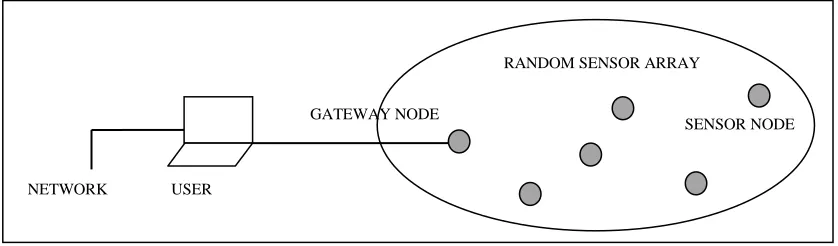
Providing continuous information to mobile sinks with uninterrupted communication is a big challenge in designing large-scale sensor networks. A lot of research in data routing, data compression and in-network aggregation has been proposed in recent years. If caching Implemented optimally can reduce a lot of network traffic and helps in providing higher data availability to the sink [4].Each concentric circular cache layer gets a
RANDOM SENSOR ARRAY
USER
SENSOR NODE
NETWORK
© 2015, IJCSMC All Rights Reserved 619 token which decides which cache layer will caches the data. The Circular Cache layers (CCL) are formed by the Circular Cache Formation (CCF) algorithm. The algorithm searches for the geographical coordinates of the nodes around the sink, by flooding request messages to determine their distance from the sink. A cache layer is forms when the nodes which fall under a particular distance from the sink [9]. The discovery of cached data is operated by a simple cache discovery scheme. Finally, a data replacement policy is given which helps in removing obsolete data from the caches. Cooperative caching plays an important role to handle the request. This helps to reduce availability, reduce requirements for bandwidth and decided which data should be cached or not in wireless sensors networks [10].
III. RELEVANT WORK
E. Ilker Oyman and Cem Ersoy in this paper [1], the author focus on the multiple sink location problem in the large scale wireless sensor network. The multiple sinks show the problems that are depending upon the design criteria. The sink nodes are locating in the sensor network. The operational time for the sensor network required is minimum. In order to maximize the lifetime of a sensor network, energy resources of each individual sensor node must be consumed. In large scale sensor networks, the network must be divided into smaller sub networks. It is used not only to increase manageability of the network, but also to increase the network lifetime. They have introduced the multiple sink network design problem. The sink nodes should be calculated depending on several different design criteria. They have demonstrated a simple sink location case, where the number of sink nodes was known before the deployment phase. They have implemented the solution for BSL problem, and presented the corresponding energy and disconnected region maps on a sample sensor network for different snapshots in time. They observed that how the disconnected region increases with time. Tarique Haider and Mariam Yusuf [2] in this paper, the author discussed about the approach that is based upon the fuzzy logic. This approach is used as the energy awareness approach. It is soft, hence it can accommodate sensor networks comprising of different types of sensor nodes having different energy metrics. In this paper, they present a fuzzy model for energy aware routing in wireless sensor networks. Existing proposed routing protocols for WSNs use fixed metrics for making energy aware routing decisions. This has the disadvantage of not being easily adaptive to changes in sensor types because energy metrics vary widely with the type of sensor node implementation platform. Some of the factors for calculating routing metric are conflicting. For example, short multiple hops reduces transmission power. Fuzzy logic, on the other hand, has potential for dealing with conflicting situations and imprecision in data using heuristic human reasoning without needing complex mathematical modeling. The potential of fuzzy logic is being fully explored in the fields of signal processing, speech recognition, aerospace, robotics, embedded controllers, networking, business and marketing. In this work, they present a soft, tune able parameter based approach to energy optimized routing using fuzzy variables and rule base. This results in soft accommodating way of routing in WSNs capable of handling a wide range of energy metrics of different sensor implementation platform.
Naveen Chauhan et al. [8]have presented Global Cooperative Caching for Sensor Networks (GCCS) to improve wireless sensor network performance is analyzed .GCCS exploits cooperation among SNs and decision regarding data items are depend [3]. Grid based approach is used to utilize energy consumption. Then this technique is further enhancing to improve network performance. The proposed work is working well in real world situations. Kiran Maraiya et al. [12]has described an overview of WSN and how it is different from traditional network and advantage over it [7]. How wireless sensor network works and its silent features all are discussed in it. They also discussed about the design challenges and key features of the protocol used in this network. What is the different network topologies used in the network, what are the different types of its applications, types of its constrain and protocol stack architecture all are studied in this paper. Wireless sensor networking has a bright future in the field of computer networking because we can solve the monitoring problems at an advanced level in the future with the help of such technology of networking. Md Ashiqur Rahman and Sajid Hussain [3] in this paper they propose few ways of improving WSN energy efficiency. The energy efficient data is used to monitor the control applications via the routing protocols.
The proposed improvements are (i) data negotiation
(ii) development of data change expectancy and
(iii) data vanishing.
state. All nodes stay in their low power state until the next round begins. The controllable activities within a round that are the primary reason for sensors energy consumption are data routing and sensing. Since the ultimate goal of an energy efficient WSN is to minimize the sensors energy consumption, these activities should be controlled appropriately. For example, energy efficient data routing can be done by an energy efficient data routing protocol. Some of these protocols minimize sensors total energy consumption at each round. Others first equalize and then minimize sensors energy consumption. This paper proposes few ways of improving a WSN‟s energy efficiency that already uses an energy efficient data routing protocol for continuous monitoring application. The proposed improvements are (i) data negotiation between the BS and sensors (ii) development of data change expectancy and (iii) data vanishing. In DNBS, an active sensor sends its sensed data only when the data changes. Ms Manisha Rana , Gurpreet Kaur [4] in this paper, the author discussed about the battery consumption of the sensor nodes in the wireless sensor network. The energy is consumed in the WSN during data transmission, processing etc. The critical task in WSN is to deal with optimizing power consumption. One possible way to minimize power consumption is by the use of caching the data. Generally data transmission in WSN consumes more energy than processing so it is good to utilize the benefits of caching. It can make the data access faster. Caching is used to reduce the overall network traffic and energy consumption if it is used frequently. In the previous work broadcasting is used if any query hit but here they use uni casting because sink node stores the location of cache node and direct link is established between sink and cache node. Hence battery consumption of nodes get reduced also the query path and network life is improved.
The idea is to provide data nearer to the sink by caching the data in the nodes nearby the sink. The diagonal of each cell should not exceed the range of high power antenna of the sensor nodes. For storing data a node uses its low power antenna to communicate with each other.
IV. CONCLUSION
This paper presents a comparative review of techniques of cooperative caching that use caching to enhance the performance of wireless sensor networks. It explains cooperative caching in ad-hoc using CacheData, CachePath and HybridCache and ZCS (zone cooperation at sensor) scheme in WSN, NICoCa protocols in the wireless multimedia sensor networks (WMSN) etc. by using different parameters. In all above described paper main concern is to minimize energy consumption. We hope that this comparative work will give better understanding to those researchers who are new in the research area of the WSN.
REFERENCES
[1] E. Ilker Oyman and Cem Ersoy,”Multiple Sink Network Design Problem in Large Scale Wireless Sensor
[2] Tarique Haider and Mariam Yusuf, “A Fuzzy Approach to Energy Optimized Routing for Wireless Sensor Networks”, The International Arab Journal of Information Technology, Vol. 6, No. 2, pp.179-188, April 2009.
[3] Md Ashiqur Rahman and Sajid Hussain, “Effective Caching in Wireless Sensor Network”, 21st International Conference on Advanced Information Networking and Application Workshops, IEEE Computer Society Washington, DC, USA, Vol.1, pp.43-47, 2007.
[4] Ms Manisha Rana , Gurpreet Kaur “Improved Circular Caching Based On WSN With Multisink”, INTERNATIONAL JOURNAL OF ENGINEERING SCIENCE & HUMANITIES, Vol. 2 Issue 2, pp. 1-4, JUNE 2012.
[5] Narottam Chand “Cooperative Data Caching in WSN”, World Academy of Science, Engineering and Technology 63, pp.90-94, 2012.
[6] Pan, Y. Hou, L. Cai, Y. Shi and S. X. Shen, „Topology Control for Wireless Sensor Networks‟ Proc. 9th ACM Int. Conf. on Mobile Computing and Networking, San Diego, USA, pp. 286-29, September, 2003.
[7] Raymond, R.C. Marchany, M.I. Brownfield, and S.F. Midkiff. Effects of Denial-of-Sleep Attacks on Wireless Sensor Network MAC Protocols. IEEE Transactions on Vehicular Technology, vol. 58 no. 1, pp. 367-380, 2009.
© 2015, IJCSMC All Rights Reserved 621 [9] Teerawat Issariyakul and Ekram Hossain, “Introduction to Network Simulator NS2”, Springer Publication, 2009.
[10] Wint Yi Poe, Jens B. Schmitt, “Sink Placement without Location Information in Large-Scale Wireless Sensor Networks”, 5th ACM SIGCOMM Asian Internet Engineering Conference (AINTEC), Bangkok, Thailand, November 2009.
[11] Xu Xu and Weifa Liang, “Placing Optimal Number of Sinks in Sensor Networks for network Lifetime Maximization”, IEEE International Conference Communications (ICC), pp. 1-6, June 2011.
[12] Chauhan, N.; Awasthi, L.K.; Chand, N., "Global cooperative caching for Wireless Sensor Networks," Information and Communication Technologies (WICT), 2011 World Congress on , vol., no., pp.235,239, 11-14 Dec. 2011