© 2014, IJCSMC All Rights Reserved 751
Available Online atwww.ijcsmc.com
International Journal of Computer Science and Mobile Computing
A Monthly Journal of Computer Science and Information Technology
ISSN 2320–088X
IJCSMC, Vol. 3, Issue. 7, July 2014, pg.751 – 758
RESEARCH ARTICLE
A Comparison and Selection on Basic Type of
Searching Algorithm in Data Structure
Kamlesh Kumar Pandey
1, Narendra Pradhan
2¹Computer Science, IGNTU Amarkantak, India
² Computer Science, SS College of Education, Pendra Road, India
1
[email protected];
2[email protected]
Abstract— A lot of problems in different practical fields of Computer Science, Database Management System, Networks, Data Mining and Artificial intelligence. Searching is common fundamental operation and solve to searching problem in a different formats of these field. This research paper are presents the basic type of searching algorithms of data structure like linear search, binary search, and hash search. We have try to cover some technical aspects to this searching algorithm. This research is provides a detailed study of searching algorithms working process, select on Searching Algorithm according To Problem and compares them on the basis of different parameters like total number of comparison, type of data Structure, time complexity and space complexity.
Keywords — Sequential Search, Binary Search, Hashing, Hash function, Comparisons, Application, Time Complexity
I. INTRODUCTION
© 2014, IJCSMC All Rights Reserved 752
The searching technique can be divided into two categories: 1. Internal Searches: - if file or table are kept in main memory this type of searching is called internal search. 2. External Searches: - if file or table is kept in auxiliary memory (hard disk, floppy, tape etc) this type of searching is called External Search.
II. WORKINGPROCEDUREOFSEARCHINGALGORITHMS
1. Sequential Search:- Simplest form of searching technique is a sequence search or linear search. This search is applicable to a small size of array or linked list data structure. Find out on searching element in sequential manner on unordered list or ordered list. In this method searching process are started at begins to end, scans the elements one by one of the list from left to right until the searching record/element is found. If we taken on ordered list or table then time it given to fast searching and good efficient as a comparison on unordered list.
Algorithm: Here L is a location variable, I is a variable which value is a element position and A is Array/List[0-N]. SE is search element.
LINEAR _SEARCH (A,I,SE)
1. Initialize L=0
2. For I=0 to length[A] //scan on element start to end 3. If (SE = =A [I])
//check on searching element 4. L=L+1
// increment on location variable
5
.
Return A[I]//print on finding element
6. END If
7. END For LOOP
8.If L=0 then return “not find out element”
9.
ExitExample:
© 2014, IJCSMC All Rights Reserved 753
Divide: In sorted list is divided into two parts.
Conquer: We first compare to search/input element with the mid element of the list. If do not match then we check search element and mid element if search element is less then to mid element then go to first part/left part otherwise go to second/right part.
Combine: we apply to divide and conquer part whenever our search element is not found. When our search element is found then list are automatic combined and return.
Algorithm: Here L is a location variable, LOW is start index and HIGHT is last index element position of Sorted Array/List A[0-N]. SE is search element
BINARY _SEARCH (A,LOW,HIGHT,MID,SE)
1. Initialize LOW=0, HIGHT=N,L=0
2. While(LOW<=HIGHT) //scan on element start to end 3. MID=(LOW+HIGHT)/2
//divide on list
4. IF (SE==A[MID])
// check on searching element 5. L=L+1
// increment on location variable 6. Return A[MID]
//print on finding element
7
. Else If(SE<A[MID])8
. HIGHT=MID-1// go to Left/first part
9
. Else10
. LOW=MID+1// go to right/second part
11
. END If Statement11.
END While LOO
12. If L=0 then return “not find out element”
13. Exit
© 2014, IJCSMC All Rights Reserved 754
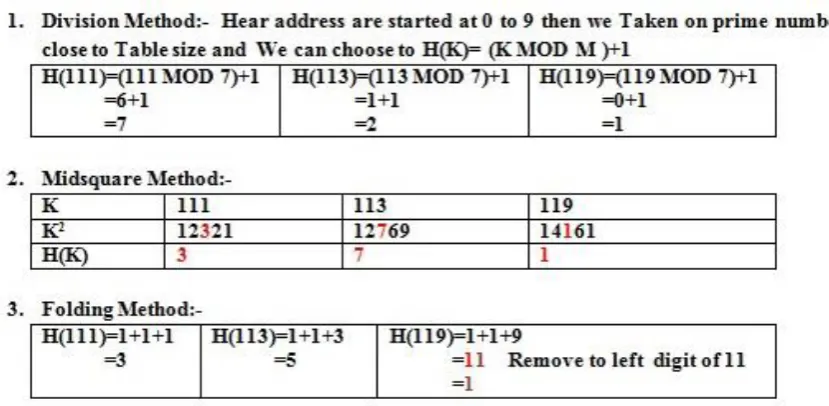
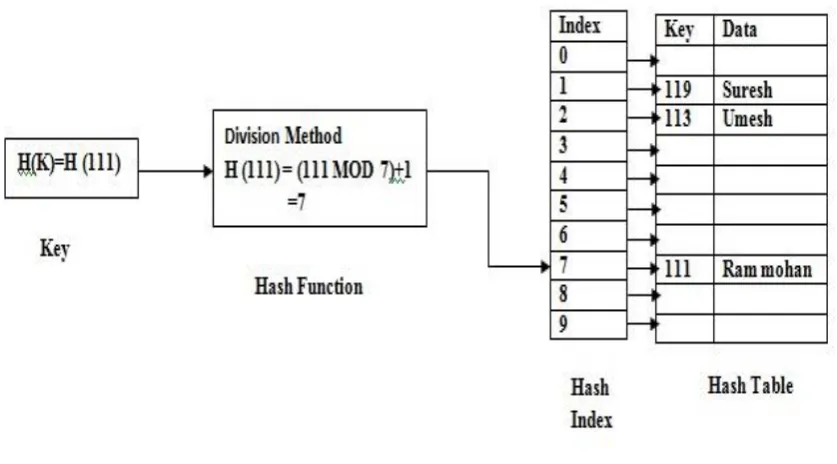
3. Hashing: - Best searching Technique and most efficient method is a hash search. It searches technique whose search times can be independent of the number of entries in a table. Hashing has a worst-casebehavior that is linear for finding a target value, but with some case, hashing can be dramatically fast in the average-case. With this approach, the position of a particular entry in the table is determined by the key for every record. This association is realized through the use of a hashing function. If H is a hash function and K is key, H(K) is called hash of key. So a hash function H(K) transforms a key into an address/hash table index position. if key is a non integer value then we convert to a integer value. Some hashing function is
1. Division Method (tablesize = prime):- choose a prime number M which are equal to a table size and K is a key. The hash function H is define as H(K)= K MOD M or H(K)= (K MOD M) +1. First function denotes the remainder when K is divided by M. second function is used when we want the hash table to range from 1 to M rather than from 0 to M-1.
2. Midsquare Method (tablesize = 2n):- The multiplication method may be used for a HashTableSize that is a power of 2. In this method a key is multiplied by itself and the address is obtained by selecting a number from the middle of the square. The hash function H is define as H(K)= L is obtained K2.
3. Folding Method:- in this method key is portioned into a equal number of parts. this part are added together and ignoring the final carry, to from an address. The hash function H is define as H(K)=K1+K2+………+Kn
4.
Variable string exclusive-or method (tablesize = 256):- To obtain a hash value in the range 0-255, all bytes in the set of character are exclusive-or together. However, in the process of doing each exclusive-or, a random component is introduced. The exclusive-or method has its basis in cryptographySome time hash function given to map several key into the same address this situation is called Collision. And remove this collision using Buckets and Chaining method.
Algorithm: Many algorithms are use to hashing according to problem. Basically algorithm are divided in four categories Cyclic Redundancy Checks Algorithm, Checksum Algorithm, Cryptographic hash Algorithm(SECURE HASH ALGORITHM ) and searching on data(Open addressing, Static and dynamic hashing).
© 2014, IJCSMC All Rights Reserved 755
Example:Hashing Process
III.PROBLEMDEFINITIONANDSEARCHINGALGORITHM
All searching algorithm are problem specific. In this section we described some problem and analysis which searching algorithm is more suitable for that problem
TABLE 1:-SEARCHING ALGORITHM ACCORDING TO PROBLRM
Problem Definition Searching Algorithm
1. Find out a particular value in a small size of data origination 2. Resource Efficient Problem
3. Searching on unsorted data list
4. Find out data at a time, without jumping
Sequential Search
1. Used to access ordered data quickly when memory space is tight 2. Fast searching in large data origination and mid data origination 3. Find out path on mixed analog circuits
4. Maintains a contiguous subsequence of the starting sequence 5. where the target value is surely located
Binary Search
1. Constructing Indices
2. Storage for Object-Oriented Databases
3. Achieve Authentication and Data Integrity in a Cryptography
4. Fast searching in large data origination
5. How to Search documents on the internet for documents similar to a given one
© 2014, IJCSMC All Rights Reserved 756
IV.COMPARITIVESTUDYOFALLALGORITHMS
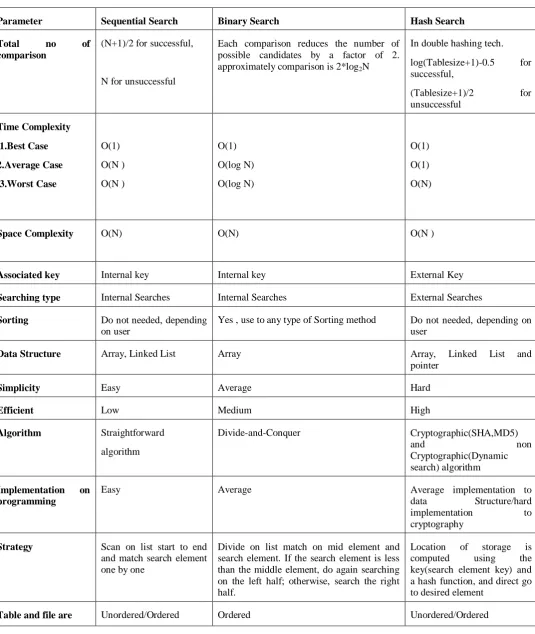
TABLE 2:- COMPARISONS OF COMPARISON BASED SEARCHING TECHNIQUES ON VARIOUS PARAMETERS
Parameter Sequential Search Binary Search Hash Search
Total no of
comparison
(N+1)/2 for successful,
N for unsuccessful
Each comparison reduces the number of possible candidates by a factor of 2. approximately comparison is 2*log2N
In double hashing tech.
log(Tablesize+1)-0.5 for successful,
(Tablesize+1)/2 for unsuccessful Time Complexity 1.Best Case 2.Average Case 3.Worst Case O(1) O(N ) O(N ) O(1) O(log N) O(log N) O(1) O(1) O(N)
Space Complexity O(N) O(N) O(N )
Associated key Internal key Internal key External Key
Searching type Internal Searches Internal Searches External Searches
Sorting Do not needed, depending
on user
Yes , use to any type of Sorting method Do not needed, depending on user
Data Structure Array, Linked List Array Array, Linked List and
pointer
Simplicity Easy Average Hard
Efficient Low Medium High
Algorithm Straightforward
algorithm
Divide-and-Conquer Cryptographic(SHA,MD5)
and non
Cryptographic(Dynamic search) algorithm
Implementation on programming
Easy Average Average implementation to data Structure/hard implementation to cryptography
Strategy Scan on list start to end and match search element one by one
Divide on list match on mid element and search element. If the search element is less than the middle element, do again searching on the left half; otherwise, search the right half.
Location of storage is computed using the key(search element key) and a hash function, and direct go to desired element
© 2014, IJCSMC All Rights Reserved 757
Size of table/file Suitable for small size Suitable for mid size/large size Suitable for large size of
Java function on implementation
No specific function binarySearch(array,search_key) hashcode()
V. ADVANTAGE/DISADVANTAGEANDAPPLICATIONOFSEARCHINGALGORITHM
. In this section we cover some basic Advantage/Disadvantage and Application of searching algorithm which helpful to select on search algorithm according to our needed.
TABLE 3 ADVANTAGE/DISADVANTAGE OF SEARCHING TECHNIQUES
Searching Techniques
Advantage Disadvantage
Sequential Search For smaller lists linear search may be faster because the speed of the simple increment.
Linear search very simplicity, resource efficient and memory efficient.
It can operate sorted and unsorted array and link list.
Linear search technique is low efficient and slower than other searching algorithm.
Not suitable for large data set.
Binary Search The general moral is that for large lists binary search is very much faster than linear search.
This search technique given a searching approach on binary search tree and other tree.
Binary search is not appropriate for linked list structures (no random access for the middle term)
Apply searching before we needed searching Algorithm.
Not suitable for inserted/deleted a data in a searching time as a compare to other searching algorithm.
Hash Search Searching is faster and more efficient in large list as compares to other searching algorithm.
More reliable and flexible of data retrieval then other Data Structure. Various type of Hashing Algorithm
is use to different filed of computer. Hashing use in network security for Authentication and Data Integrity
Hash function and key are must be needed.
Large Memory size is required. Some time hash function given to
same index in hash index table in different key. Then time we needed a collision remove technique.
It is not efficient in a small Hash Table.
TABLE 4:- APPLICATION OF SEARCHING ALGORITHM
Sequential Search Binary Search Hash Search
Index sequential search implementations
Recognition system
Analysis to Hacking system Phonebook
Binary search Tree/Tree search implementations
Microprocessor and many analog mixed signal circuits 3D games
Application of Hashing
Construction on symbol table for compiler
© 2014, IJCSMC All Rights Reserved 758
Cable and Telephone Networks for Data Transmission
Address Mapping in computer network
Find out an object in a raster-scan system display.
Checking for spell-checking
Number guessing game Searching a telephone book Packing rectangles
Prefix search
Client and server communication
by name
Maintain a transposition table in games
Dictionary lookups
Application of Hash function Construction on message
authentication code(MAC) Use to digital signature Cryptography
Time stamping
VI.CONCLUSIONS
This paper discusses three basic type of searching algorithms and their example. Searching is the process to finding to location of The given data elements in the data structure. Hashing are faster for large lists as a compare Binary search and Binary search are faster for mid size lists or small list as a compare Linear search. We have compared the searching algorithm on the basis of various factors like complexity, data structure, searching type, application etc. we introduced which type of problem solve through which type of searching algorithm it help to selection on best searching algorithm.
REFERENCES
[1] Data structures using c and c++ by Yedidyah langsam,Aaron M. Tenenbaum second Indian printing (Prentice Hall of India private limited), New Delhi-110001
[2] An Introduction to Data Structures with Application by Jean-paul Tremblay Tata McGraw Hill
[3] Data Structures by Seymour Lipschutz and G A Vijayalakshmi Pai (Tata McGraw Hill companies), Indian adapted edition-2006,7 west patel nagar,New Delhi-110063
[4] Debadrita Roy, Arnab Kundu,” A Comparative Analysis of Three Different Types of Searching Algorithms in Data Structure” International Journal of Advanced Research in Computer and Communication Engineering) Vol. 3, Issue 5, 2014
[5] Sorting and Searching Algorithms: A Cookbook by Thomas Niemann in Portland, Oregon [6] NOTES ON HASHING by Jayakanth Srinivasan
[7] Knuth, D.E., 1988. The Art of programming-Sorting and Searching. 2nd Edn.,Addison Wesley, ISBN: 020103803X. [8] Cormen, T.H. et al. Introduction to Algorithms. 2nd Edn., 2001. ISBN: 0262032937
[9] Asagba P. O, Osaghae E. O. and Ogheneovo, E. E.Department of Computer Science, University of Port Harcourt, Choba, Port Harcourt, Rivers State. Is Binary search technique faster than Linear search technique?
[10] Web help in wikipedia.org and stackoverflow.com
[11] Cryptography and Network Security Principles and Practice, Fifth Edition EDITION by William Stallings,Pearson [12] Database System Concepts, Fourth Edition by Silberschatz−Korth−Sudarshan
[13] Data Structures and Algorithms Alfred V. Aho, John E. HopCroft and Jelfrey D. Ullman, Addison –Wesley, 1983 [14] Data Structures and Algorithm Analysis in C++ by Mark Allen Weiss.