International Journal of Computer Science and Mobile Computing
A Monthly Journal of Computer Science and Information Technology
ISSN 2320–088X
IMPACT FACTOR: 5.258IJCSMC, Vol. 5, Issue. 5, May 2016, pg.178 – 183
Review of Character
Recognition of Offline
Handwritten Devanagari Script
Naveen Malik, Aashdeep
Singh
CSE & Kurukshetra University, India CSE & Kurukshetra University, India
[email protected]; [email protected]
Abstract— Character recognition of Handwritten Devanagari script has been a very difficult task due to large characters sets, complex shapes and presence of modifiers in it. Devanagari is mainly used for documentation purposes. In this paper a comparative analysis of all the researches done so far is performed. We aim to improve the efficiency of character recognition and also discuss merits which help in improvement of existing recognition techniques in near future.
I. INTRODUCTION
Devanagari is mainly a script used for writing many official languages in India, such as Hindi, Sindhi, Marathi,
Nepali, Sanskrit and Konkani. Hindi is the national language of the country and also the third most popular
language in the world.
Character Recognition has been broadly studied in the last half century and progress to a level, satisfactory to
produce technology driven applications. Handwritten character recognition has always been a challenging task
in image processing and pattern recognition.
Character Segmentation is a crucial phase for recognition process, so successful segmentation brings about
better recognition. Segmentation of Offline Handwritten content is more entangled because of varieties in
writing styles of distinctive users, furthermore the complex structure of Hindi characters. Presence of touching,
overlapping, broken, half characters and uneven header line makes this process all the more difficult. A
considerable measure of research has been performed on these issues yet more proficiency is still needed. Character recognition is considered as an important technology for today‟s world and is used in many fields
There are two types of character recognition systems:
1. Optical character recognition: - It is also known as offline character recognition. In this type either
handwritten, type written or printed text is converted into digital format. It does not have any advantage of
recognizing the direction of the movements while writing the character.
2. Intelligent character recognition: - It is also known as online character recognition. It recognizes characters
on the basis of the direction of the motion while writing character. This method is commonly available on
touchpad, touch screen, cell phones etc.
Four main stages in the optical CR problem are:
Scanning, Segmentation, Classification and Feature extraction.
Properties of Devanagari Script:
Devanagari Script is considered as principal script in India, it is utilized inside Hindi, Sindhi, Nepali, Konkani,
Marathi and Sanskrit languages. Hindi is the most noticeable language in India and third most well known in the
world, so loads of research work might be performed in recognition of Hindi text.
There are 34 Consonants, 13 vowels and 14 modifiers or the “Matras” in Hindi language. A single word or
character could be vertically differentiated into three sections: The Upper Area, the center area and the lower
area. Centre area holds vowels, consonants or synthesis of both. The Upper area and the Lower areas hold
vowels, modifiers and their parts. Vowels could be formed as free or by using different diacritical imprints, i.e. modifiers or „matras‟, which are created above, below, before or after the consonant or vowel.
Developing the Devanagari Handwritten character recognition and segmentation system has some greater
challenge because of the following reasons:
The character set is very large: In Devanagari the vowel, consonants, matra, Chandra Bindu, Visarg and many
more different symbols are present. To make a system which recognizes all of these complicated shapes is a
difficult task.
Similarity between the characters is high: Many similarities in shapes so it is difficult to segment the character
and recognize the desired result. This ambiguity arises a problem in the segmentation of Devanagari characters.
Recognition of Handwritten in Indian script is one of challenging task due to several reasons because of the
complex structure of characters with their modifiers and presence of compound character. The style of writing in
Devanagari script is from left to right. The concept of upper/lower case is lacking in Devanagari script.
Compound characters have one half character connected to full character to produce a special character. There
are large variations in shapes of character like writing style, pen quality (thick/thin), strokes that substantial
extent the recognition accuracy.
In an offline handwriting recognition task, usually, the input gray level image is binarized at the pre-processing
stage. A binary image can be converted into certain other suitable representations for feature computation. Two
such image representations are contour and skeleton representations. The basic goal of considering such a
power of the resulting classification scheme. In this article, we report our recent study combining the
discriminating power of the contour based features with that of the skeleton based features towards the
designing of a robust recognition scheme for offline handwritten Devanagari words. Major weakness in contour
based features is that they work on shape (word) boundary while in many cases the contour for a part of the
shape (word) may not be available.
Skeleton based features mainly work on word skeleton obtained by thinning the binary raster representation of
the word image. Such features contain the basic shape information of the interior of a word image, but they do
not have the boundary information. They can cope up with non rigid transformations is an important aspect of
skeleton based features.
Thus, the features obtained from the contour and the skeleton complement each other. The conclusion is that , a
combination of these two features should provide more resistant recognition performance in case of large intra
class variations, inter class similarities and occlusions.
In this paper, we will propose a variation of Gradient, Structural and Concavity (GSC) features originally
proposed by Favata et al. [11].The original GSC features were used on the contour image. But, in the present
study, we extract them from the skeletal representation of the word, and apply certain variation to its
representation scheme as compared to the originally proposed one.
At the first level, experimentation will be performed by considering only the above variation of the GSC
features.
In the next level of experimentation, we extract these features from the contour representation of the word and
concatenated them with the above skeletal features to find any possible improvement in the recognition
performance. Results of this experimentation, reveals that the combination of these two features improves the
recognition accuracy.
Gradient Features: These features are computed by convolving two 3×3 Canny operators on the binary image.
These operators approximate the x and y derivatives of the image. The gradient feature of a centre pixel is
computed as a function of its eight neighbours. The vector addition of the operator‟s output is used to compute
the gradient of the image at a pixel position. While the gradient is a vector with direction and magnitude, only
the direction is used in the computation of feature vector.
Structural Features: These features capture certain patterns embed in the gradient map. These patterns are
micro strokes of the image. Several 3 x 3 operators are passed over the gradient map to locate small strokes
pointing up/down and diagonally. These strokes are combined into a large feature using a rule table.
Artificial neural networks are presented as systems of interconnected "neurons" which compute values from
inputs, and are able of machine learning as well as pattern recognition. For handwritten character recognition
process, a neural network is clear by a set of input neurons which may be activated by the pixels of an input
image. Once being weighted and transformed by a function, the activations of these neurons are passed to other
neurons. This process is repetitive until finally, an output neuron is activated. This determines which character
Figure 1: A Neural Network
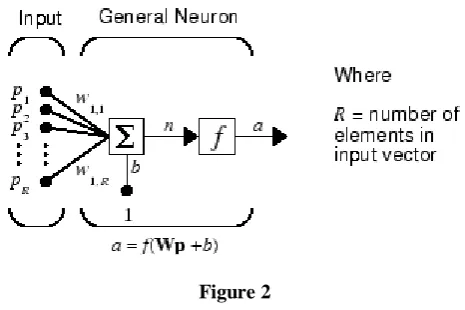
An elementary neuron with R inputs is shown below. Each input is weighted with an appropriate w. The sum of
the weighted inputs and the bias forms the input to the transfer function f. Neurons can use any differentiable
transfer function f to generate their output.
Figure 2
II. LITERATUREREVIEW
Jayadevan et. al (2011): In India, more than 300 million people use Devanagari script for documentation.
There has been a important improvement in the research related to the recognition of printed as well as
handwritten Devanagari text in the past years. State of the art from 1970s of machine printed and handwritten
Devanagari optical character recognition (OCR) is discussed in this paper.
All feature-extraction techniques and training, matching and classification techniques useful for the recognition
are discussed in this paper. An attempt is made to address the most important results reported so far and also
tried to emphasize the beneficial directions of the research till date.
Dr. Latesh Malik et. al (2012): A graph based holistic application for handwritten Devanagari OCR is
presented as part of a knowledge-based word interpretation model.
This method is based on the recognition of sub graphs homeomorphism to earlier defined prototypes of words.
image by identifying the text present. This paper presents a new approach towards segmentation of characters in
an image containing Devanagari script.
K.V.Kale et. al (2013): Handwritten Compound Devanagari character recognition is one of the new tough task
for the researcher, because Compound character are complex in structure and they are written by combining two
or more characters. Their occurrence in the script is up to 12 to 15%. In this paper, a recognition system for
handwritten Devanagari Compound Character is proposed bases on Legendre moment feature descriptor .
Moment function have been effectively applied to loads of pattern recognition problem, due to this they tend to
capture global features which makes them suitable as feature descriptor.
Bikash Shaw et. al (2014): In this the author had described the recent study of a novel combination of two
feature vectors for holistic recognition of offline handwritten word images. In the documentation, both contour
and skeleton based feature representations have been studied for offline handwritten recognition purpose.
The author had implemented the proposed approach for holistic recognition of Devanagari handwritten town
names and tested its performance on a handwritten large word sample database of 100 Indian town names that
are written in Devanagari.
Binny Thakral et. al (2014): Optical Character Recognition alluded to the method of taking photos or images
of letters or typewritten content and changing over them into the information that a machine can easily
understand.
This research paper shows a new approach for the segmentation of conjuncts and overlapping characters in
Devanagari script of Hindi language.
Prof. Mukund R. Joshi et. al (2015): English characters has been widely studied in last half century and
progressed to a level adequate to produce technology driven applications.
But equivalent is not the case for Indian languages which are complicated in terms of structure and
computations. The problem arise in Devanagari character recognition is that it provides less correctness and
efficiency so author had used neural network and genetic algorithm to overcome that problem.
This report is proposed to serve as a guide and revise for the readers, working in the Devanagari Character Recognition area and it is now extensively accepted that a single classification algorithm can‟t yield better
performance rate.
S.N O.
AUTHOR YEAR TECHNIQUES USED MERITS
1. R. Jayadevan 2011 All feature-extraction techniques and training, matching and classification techniques useful for the recognition are discussed.
2. Dr. Latesh Malik 2012 Graph based holistic application for handwritten Devanagari OCR.
Word level accuracy is 84% on the test set. 3. Kunal Shah 2013 Division of text into individual
basic characters that can be identified by the identification mechanism of the OCR.
III.CONCLUSIONS
In this paper, we have studied the different character recognition techniques used by various authors. Dr. Latesh
Malik has used Graph based holistic approach, Kunal Shah has done division of text into individual basic
characters, K.V.Kale has proposed bases on Legendre moment feature descriptor, Bikash Shaw have studied
both contour and skeleton based feature representations , Binny Thakral uses Optical Character Recognition,
Prof. Mukund R. Joshi has done using Neural network and Genetic algorithm.
R
EFERENCES[1] R. Jayadevan, "Offline Recognition of Devanagari Script
[2] Dr. Latesh Malik, "A Graph Based Approach for Handwritten Devnagari Word Recognition“ [3] Kunal Shah, "A New Approach for Segmentation of Devnagari Characters"
[4] K.V.Kale, "Handwritten Devanagari Compound Character Recognition using Legendre Moment an Artificial Neural Network Approach“
[5] Bikash Shaw, "Combination of Features for Efficient Recognition of Offline Handwritten Devanagari Words"
[6] Binny Thakral, " Devanagari Handwritten Text Segmentation for Overlapping and Conjunct Characters- A Proficient Technique"
[7] Prof. Mukund R. Joshi, "Offline character recognition for printed text in Devanagari using Neural Network and Genetic Algorithm"
4. K.V.Kale 2013 A recognition system for handwritten Devanagari Compound Character is proposed bases on Legendre moment feature descriptor
Moment function have been effectively applied to loads of pattern recognition problem, due to this they tend to capture global features which makes them suitable as feature descriptor.
5. Bikash Shaw 2014 Both contour and skeleton based feature representations have been studied for offline handwritten recognition purpose.
An approach for holistic recognition of Devanagari handwritten town names and tested its performance on a large handwritten word sample database of 100 Indian town names written in Devanagari 6. Binny Thakral 2014 Optical Character Recognition A new strategy for the
segmentation of conjuncts, and overlapping characters in Devanagari script on Hindi language.
7. Prof. Mukund R. Joshi
2015 Neural network and Genetic algorithm