SOCIAL MIKEGKS AND THE BBAIN
including a functional imaging study of role-play and verse
PhD Thesis
Charles Beresford Whitehead Department of Anthropology TJniversit}' College London
ProQuest Number: 10016118
All rights reserved
INFORMATION TO ALL USERS
The quality of this reproduction is dependent upon the quality of the copy submitted.
In the unlikely event that the author did not send a complete manuscript and there are missing pages, these will be noted. Also, if material had to be removed,
a note will indicate the deletion.
uest.
ProQuest 10016118
Published by ProQuest LLC(2016). Copyright of the Dissertation is held by the Author.
All rights reserved.
This work is protected against unauthorized copying under Title 17, United States Code. Microform Edition © ProQuest LLC.
ProQuest LLC
789 East Eisenhower Parkway P.O. Box 1346
Abstract
This thesis attempts to bridge the conceptual gulf dividing social from biological anthropology using three main lines of argument:
1. Enculturated human cooperation originated in expanded systems of kinship and reciprocity which require obfuscation of selfish bodies. Disembodied self perceptions characterize all human belief systems including the behavioural sciences. This prevents our fully appreciating that the most distinctive feature of human behaviour is a
formidable armamentarium of social displays. ‘Social mirrors’ underpin human self- awareness, social intelligence, and innate altruism (the ability to identify with others). 2. Social displays engage multiple sensorimotor systems and probably account in part for our large brains. I present a study of role-play and verse, the first in a proposed programme aiming to map social mirroring functions in the brain. There were three main findings:
1. Cortical areas that are most expanded in humans, and would be expected to show increased activity during role-play, were only apparent when ‘switching o ff role-play
2. The subjectively ‘easy’ control tasks showed greater brain activity than the ‘difficult’ role-play tasks
3. Verse and prose activations were indistinguishable
Since role-play activations were not apparent in role-minus-control conditions, role- play may be a continuous mental activity in awake human adults. Cognitive effort may be required to suppress social imagination during non-social tasks. The brief flash of increased activity in presumed role-play areas during the role-to-control switch may implicate dissociation. The findings are at least consistent with a ‘play and display’ hypothesis of hominid brain expansion.
Contents
7 Acknowledgements 8 Introduction
PART 1. SOCIAL MIRRORS AND SOCIAL ORDER
12 Chapter 1. The Anthropological ‘Other*
12 Five features of cultural difference
15 One hundred years of anthropological denials
(1) Theories that blame the camera; (2) Theories that invoke real-world experience; (3) Otherworld theories and non-theories
52 Summary and conclusion
57 Chapter 2. Behaviour and B elief
57 Nature versus culture
Culture and selfish-genes; Rules, genitals, and bodies; Kinship and reciprocity
60 Five bases of human cooperation
(I) Kinship; (2) Exchange; (3) Belief; (4) Self!other-perception; (5) Ritual
93 Summary and conclusion
95 Chapter 3. Social Display
95 Self/other-awareness
Theory o f mind; Social mirror theory; Theatre o f mind; Shared experiential worlds; Language and theatre
107 Social display
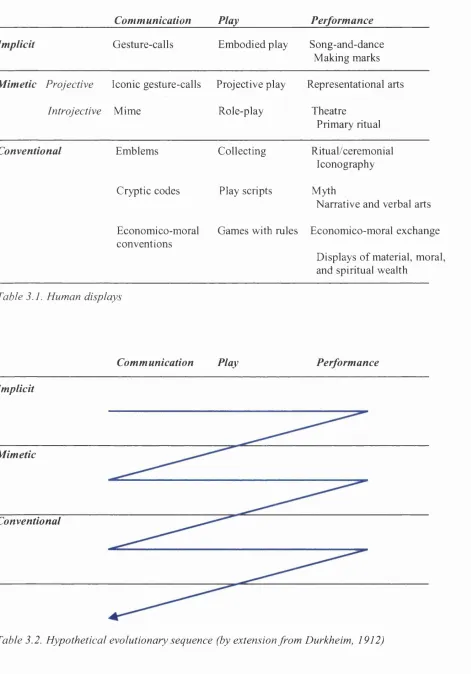
(I) Three modes o f communication; (2) Three modes o f play; (3) Three modes o f performance; Symbolism’ versus social display
122 Social display and self/other-awareness
Social display as a phylogenetic sequence; (I) Social displays in humans and animals; (2) Selflother-awareness in humans and animals; (3) Social displays during childhood development; (4) Selflother-awareness during childhood development
136 Self/other-awareness and society
Emergent orders o f need; Wholty-believed-in make-believe; Subliminal signals and hypnosis
PART 2, SOCIAL MIRRORS AND THE BRAIN
page 145 Chapter 4. The Social Brain 145 Why we have large brains
‘Intelligence ’ and language; Play and display
152 Areas of neocortical expansion
Primary cortices; Secondary cortices; Major expansions.
155 Current views of the social brain
(I) Temporal lobes and amygdalae; (2) Frontal lobes; (3) Parietal lobes
159 Towards a broader concept of the social brain
Cognition and behaviour; Motor aspects o f cognition; Social and non-social perception; Multimodal integration
171 Mapping social mirroring functions in the brain
(I) Implicit performance; (2) Mimetic representation; (3) Conventional communication
189 Summary and conclusion
A ‘play and display’ hypothesis o f brain expansion
194 Chapter 5. Role-Play and the Brain:
A Junctional imaging study of role-play and verse
194 Background 198 Method
Subjects; Task materials; Task briejing and rehearsal; Study design; Data acquisition; Statistical analysis
206 Results
Individual results; Group results
212 Discussion
(I) Switching from role to control tasks (RC); (2) Maintaining the non-role state (NC); Interpretation o f the ‘wrong way round’ Jindings; (3) Verse and prose
PART 3. EVOLUTION OF SOCIAL MIRRORS AND THE BRAIN
page 246 Chapter 6. Evolution o f the Brain
248 The phased pattern of hominid brain expansion
Three stages in the evolution o f display; Three grade shifts in cranial capacity
294 Summary and conclusion
295 Chapter 7. The Emergence o f Modem Culture
295 Was there a ‘cultural explosion’?
‘Symbolic behaviour' and ‘symbolic culture'
301 The archaeology of social display
304 Evidence from Eurasia and the Middle East
Collecting behaviour; Other objects with ‘added value'; Self adornment; Use o f pigments; Mark-making and geometric designs; Iconic representation; Intention
al burial o f the dead
320 Evidence from Africa
The first anatomically modem humans; Variability in the MSA; Objects with ‘added value '; Burials; The difference between Africa and Eurasia; Use o f pigments in Africa
340 Summary and conclusion
CONCLUSIONS
344 Conclusions
344 The main argument 357 Some final thoughts
Play and education; Science and religious experience
Tables
page 108 3. 1. Human displays
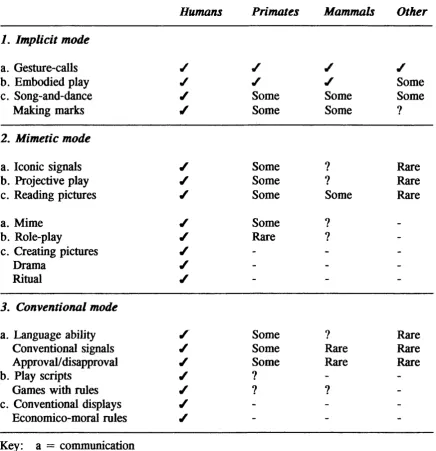
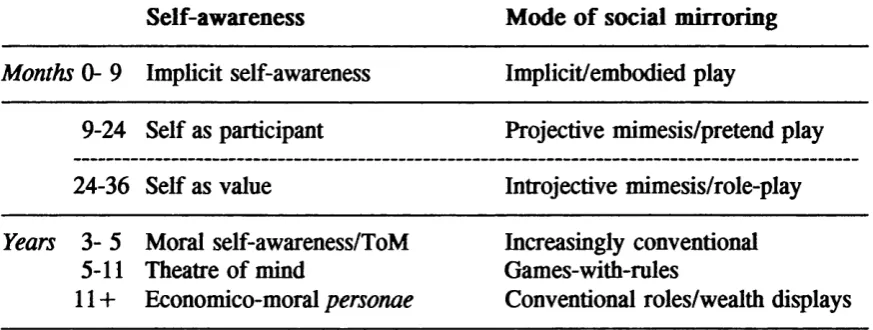
108 3. 2. Hypothetical evolutionary sequence 125 3, 3. Human and non-human displays 129 3 . 4 . Ontogenesis of social displays
135 3 . 5 . Co-development of self-awareness and social mirroring
153 4. 1. Areas of expansion of human relative to chimpanzee neocortex 208 5. 1. Major areas of increased activity during the role-to-control switch 209 5 . 2 . Major areas of decreased activity during the role-to-control switch 210 5 . 3 . Major areas of increased activity during control tasks
210 5 . 4 . Contrasts between switching to a role and role-play 232 5. 5. Activations during ‘inner speech’ and ‘auditory verbal imagery’
compared with deactivations during role-to-control switch 250 6. 1. Geological and archaeological ages
296 7. 1. Earliest appearances of industries/cultures
303 1 .1 . Overt evidence of display behaviour in relation to grade shifts and archaeological ages
321 7. 3. Hominids and archaeological ages
339 7. 4. Stone Age/Palaeolithic analogues according to Watts (1999)
Figures
page 153 4. 1. Areas of differential expansion of human neocortex 174 4. 2. Brodmann’s areas activated by musical performance
174 4. 3. Glass brain’ diagrams showing areas significantly more active during ToM tasks than non-ToM tasks
184 4.4a. Brain areas activated when reading written English
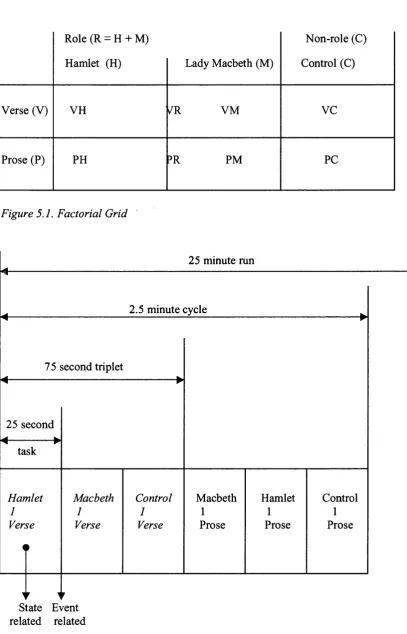
185 4.4b. Brain areas activated when reading American Sign Language 203 5. 1. Factorial grid
203 5. 2. Study design showing cycle 1
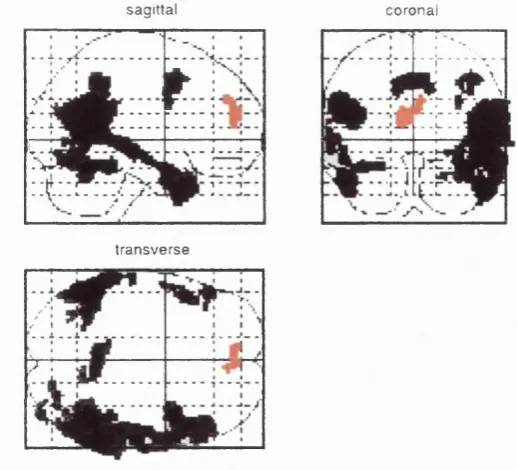
208 5 . 3 . Glass brain’ views of activations during the role-to-control switch 209 5. 4. ‘Glass brain’ views of deactivations during the role-to-control switch 210 5 . 5 . Activations during control tasks contrasted with role-play
211 5. 6. Role-play contrasted with control 211 5. 7. Control minus role-play
214 5 . 8 . Switching from role-play to control: ventromedial prefrontal cortex 214 5. 9. Switching from role-play to control: inferior parietal cortex
215 5.10. Switching from role-play to control: dorsolateral prefrontal cortex 215 5.11. Inferior parietal lobe in relation to sensorimotor cortices
226 5.12. Right dorsolateral/orbital frontal and prefrontal activations during role-to-control switch
235 5.13. Maintaining the non-role state: intraparietal sulci 235 5.14. Surface anatomy of the intraparietal sulcus 251 6. 1. Hominid grade shifts
Acknowledgements
The mapping study presented here was conducted at the Wellcome Department of Imaging Neuroscience. I particularly thank Professor R. Turner, Principal of the Functional Imaging Laboratoiy, for the opportunity to conduct the study, and for his guidance, collaboration, and supervision of the scanning. I also thank Drs. Bal Ashwal and John Ashbumer for help with SPM software; Dr. Hugo Critchley for advice on anterior cingulate cortex; Chris Freemantle, Data Manager, for assistance with visuals; and Professor Christopher Frith, Principal Research Fellow, for suggestions on
interpretation.
David Craik, Director of Quest Theatre Company and the International School of Screen Acting, and Senior Lecturer in Drama, dedicated many hours to discussing theatrical aspects of my study, recruiting volunteers, and rehearsing their performances for the study. My thanks also go to his present and former students who likewise spent many hours rehearsing the tasks and performing them within the scanner.
In addition I would like to thank my supervisors. Professor Roland Littlewood, Director of the University College Centre for Medical Anthropology and Consultant Psychiatrist at University College Hospital, who has been closely and constantly involved in the preparation of this thesis, and Professor Volker Sommer, of the
Introduction
On an average evening, just by watching television, you can see a rich variety of human behaviour, little of which conforms in any obvious way to conventional biological predictions. Recently I especially noted:
* a cartoon movie in which animals behaved like humans, and much of the humour depended on our intuitive recognition that animals do not behave like humans;
* a news item in which an athlete received a biologically useless gold medal for throwing a javelin and not hitting anything edible such as an antelope;
* a Channel Five ‘documentary’ which showed a half-naked woman copulating with an invisible partner, before an audience of men who made no attempt to compete for the exclusive privilege of inseminating her.
There were also remarkable scenes of cooperation, where rescuers sacrificed their lives to save people unrelated to themselves and from whom they expected nothing in
return, or soldiers died in someone else’s civil war because they believed Islam was under threat.
Social anthropologists commonly describe apparently unbiological human
This essay is about universals of everyday human behaviour and the cognitive substrates of human culture. I will argue that much of what we call ‘culture’ is wholly- believed-in make-believe, and that human self/other-awareness depends on social play and display, including song, dance, art, and role-play.
My PhD research, a functional brain imaging study of role-play and verse, is presented in Chapter 5. The other six chapters contextualize and explore the
implications of my research. My aim is to bridge the conceptual gulf currently dividing social from biological anthropology, using cognitive science, and to show what all three disciplines can gain from a better understanding of each other. I wül also show that all three disciplines are hampered by disembodied perceptions of the self, and that these have curious parallels in animistic belief systems. Obfuscation of the body would seem to be a major mechanism of enculturation. Why else, for example, should we always wear clothes in public, even in the swimming pool?
There are three parts to my thesis:
1. Social m irrors and social order
2. Social m irrors and the brain
The second part examines some current blind spots in cognitive neuroscience, attempts a broader understanding of the social brain, and proposes a ‘play and display’
hypothesis of human brain expansion (Chapter 4). I then present my own research on role-play and verse, which appears to be at least consistent with the hypothesis (Chapter 5).
3. Evolution o f social m irrors and the brain
PART 1
Chapter 1. The Anthropological ‘Other’
FIVE FEATURES OF CULTURAL DIFFERENCE
Social anthropologists study cultural diversity, though traditionally this has meant studying primarily non-industrial, non-western, and non-literate peoples - the anthropological ‘other’. It is alterity - the strangeness of ‘other’ peoples - that
intrigued the first anthropologists, and demanded special explanation or interpretation. Whilst it may not surprise anyone to learn that people around the world differ in their modes of subsistence, or even their mores and customs, what did surprise the first ethnologists were systems of kinship and economic exchange which violated all western expectations, and ritual practices and beliefs that seemed counter-intuitive, counter-experiential, and counter-factual.
So, for well over a hundred years, ethnographers have been reporting everything that struck them as interesting, relevant, and worthy of report, which of course includes everything strange, everything that is not so commonsensically taken- for-granted that it passes without notice. Consequently, we have amassed a great deal of data which violates our unspoken assumptions about ‘human nature’, and reveals them to be false. It follows that we cannot really claim to understand ourselves until we have understood others, and what prevents us from understanding others is the fact that we do not understand ourselves.
non-human. Few of us, I suspect, are immune to feelings of difference towards ‘other’ groups. This apparently universal experience of alterity would seem to imply that, in creating group identities, we are actively manufacturing our ignorance of ourselves.
So, to the four features of cultural difference which I have mentioned - (1) kinship, (2) economic exchange, (3) ritual, and (4) belief - we can now add (5) self/other perception. Universal self-ignorance is hardly an auspicious basis for anthropological understanding.
‘Here be symbols’
You might think that after a hundred years of studying strangeness, it should not seem quite so strange any more. But ‘other’ people still say and do things which have the power to surprise or baffle ethnographers. When Dan Sperber (1975: 3) was told, by a Dorze informant in southern Ethiopia, that the local leopards were devout Christians, he suspected symbolism’, and coined his own rule-of-thumb: "‘That’s symbolic.’ Why? Because it’s false." Nigel Barley (1983: 10), who writes about anthropologists with much good humour, parodied this as "That looks crazy. It must be symbolism". The more acerbic Ernest Gellner (1992) tells us that, in anthropology, "if a native says something sensible, that’s primitive technology; but if he says something really odd, that’s symbolic. "
knowledge with ‘symbolism’ and ‘symbolic behaviour’. Our faith in symbols often assumes that same unshakable air of factuality that we find in the beliefs of our informants (Bourdieu, 1977), but, equally often, is professed with a passion which betrays its ideological origin. I can do no better than quote a recent American view:
The symbol is the origin and basis of human behaviour’, as White put it in the title of a well known essay (1949: 22-39). In all its dimensions, including the social and the material, human existence is symbolically constituted, which is to say, culturally ordered. That is a position I was not then, nor have ever been since, prepared to give away. White used to say that no ape could appreciate the difference between holy water and distilled water - because there isn’t any, chemically. How would an ape be able to apply, let alone devise, a marriage rule that proscribes parallel cousins and enjoins unions with classificatory cross cousins? (Sahlins, 1999)
What on earth (or in heaven) could holy water ‘symbolize’? Holy’ derives from an Anglo-Saxon term meaning whole, hale, or healthy, and holy water is water with imagined (but not necessarily ineffective) healing or prophylactic properties. It does not ‘symbolize’ some other substance which is not water or not holy. Neither does a marriage rule ‘symbolize’ something which is not marital or not a rule. A rule is just a rule. Qualifying it as ‘symbolic’ adds nothing to our understanding.
What makes the concept so pernicious is its apparent reasonableness. It sounds
perfectly logical to say that the word ‘cat’ symbolizes or refers to a quadrupedal mammal which purrs and chases mice, or that a red light is a symbolic command to stop. But this overt meaning of ‘symbolism’ is not its covert meaning. It is just
itself? The covert answer, of course, is because such signals and codes are not uniquely human.
‘Symbolism’ is a rationalistic concept which shifts its meaning according to the data being examined; an anthropocentric article of faith, sustaining the imaginary opposition between ‘nature’ and ‘culture’, and preventing us from recognising the source of our own self-ignorance. Despite the slipperiness and opacity of the term,
‘symbolism’ remains a core concept throughout the social and cognitive sciences, and ‘symbolic culture’ is virtually definitive of the social anthropologist’s field of study. As the term is delusory, so are the boundaries of the field.
ONE HUNDRED YEARS OF ANTHROPOLOGICAL DENIALS
Many anthropologists have assumed that, if others represent reality differently from the way we do, then their representational processes must be different. This is rather like explaining a photograph of a UFO by arguing that there must be something wrong with the camera. It is not the only, or even the most likely, possible explanation: unless the camera produces similar anomalies with some regularity, an origin in real- world experience, such as odd weather conditions, brand, vested political interests, or even an extraterrestrial visitation, is at least worth considering.
Theories that blame the camera: 1. Faulty camera theories 2. Normal camera theories
Theories that invoke real-world experience: 3. Political deception theories
4. Theatrical theories
Otherworld theories and non-theories: 5. The supernatural world
6. The Platonic world of meaning 7. Denial of any verifiable world at all
The point I am making here has nothing to do with the reality or unreality of UFOs. What I aim to show follows from the nature of human culture itself. Culture could not sustain its hold over us unless its workings were opaque, and the taken-for-granted ‘naturalness’ with which we invest our own culture makes others appear anomalous. When we confiront an anomaly - something we are not intellectually or experientially equipped to understand - we are forced to fall back on generic confabulatory
Theories that blame the camera
1. Faulty camera theories
Anthropologists such as Boas (1911), Levy-Bruhl (1926), J.V. Taylor (1963), and Hallpike (1979) variously characterized the minds of non-literate peoples as primitive, childlike, pre-logical, mystical, and emotional, in contrast to those of ‘modem’ people which are rational, adult, objective, and ‘scientific’. Such authors, in postulating two types of people - ‘primitive’ and ‘modem’ - represent both in an ill-defined and one sided manner, and neglect to wonder why ‘modem’ people read their children stories about talking animals, give them non-human toys which have personal names and are treated as persons, or tell them that Santa Claus lives at the North Pole.
Many of these ‘faulty camera’ views were influenced by the child-development theories of Freud or Piaget. Hallpike in particular has been accused of mshing in
"where even Piaget feared to tread" (Schweder, 1982: in Morris, 1987: 311), daring to name the Piagetian stage of immaturity at which ‘primitive thought’ was held to be
arrested’. The assumption that our species evolved to produce ‘immature’ adults, in anticipation of a long historical and cultural process of ‘maturation’, would seem to demand too much foresight of the blind watchmaker.
Lévy-Bmhl (1926) explained animism as the consequence of participation mystique, a blurring or extension of ego boundaries, and a sense of continuity between self and universe. Individuals in non-literate societies seemed to live their lives
experience - the ‘oceanic’ feeling of unity with the cosmos - and the theory of
‘projection’ (the attribution of one’s own internal states, or remembered persons from the past, to outside agents in the present) which Freud attributed to an infantile phase, when ego boundaries were not yet firmly drawn.
Although Lévy-Bruhl’s thesis remains at least thought-provoking, and is still occasionally invoked (e.g. in Tambiah, 1990), the division of humanity into two ideal types, ‘primitive’ and modem’, has been widely challenged. Malinowski (1922, 1935) stressed the pragmatic, rational, and ‘scientific’ aspects of Trobriand life. Myths, for example, were not erroneous explanatory schemata, but ‘charters’ legitimating the social order. Evans-Pritchard, in his landmark study of the Azande (1937: 439), was much concerned to explore the relations between ‘ritual’ and ‘empirical’ behaviour, with an implied critique of Lévy-Bruhl (Morris 1987: 185). There has been increasing recognition that people with animistic beliefs, outside certain contexts of a ceremonial or sacred nature, think very much as ‘we’ do (Viveiros de Castro, 1998). So why do they not think like ‘us’ all of the time?
2. Normal camera theories
Nowadays political correctness and empirical research have impoverished our
vocabulary for describing ‘otherness’. We can no longer refer to non-literate peoples as mad, primitive, barbaric, pre-logical, childlike, or ‘emotional’, and we are left with that ubiquitous euphemism ‘symbolic’. If we cannot have two kinds of people, but still insist on a cognitivist explanation, then we have to assume that all cameras produce photographs of UFOs. This was the position taken by the intellectualists in the
1. Intellectualism
The intellectualist tradition associated with Edward Tylor (1866), Herbert Spencer (1876), and James Frazer (1922) held that ‘primitive’ world views could be the result of rational hypothesizing in the absence of sufficient data. Animistic beliefs are theories just like those of modem science, and worthy ancestors of our own enlightened views. Ritual and magic, in this view, become rational technologies derived from rational theories.
The fundamental flaw in intellectualism is its assumption that spiritual and magical thinking can be explained in vacuo, without reference to more embodied aspects of ‘otherness’, such as classificatory kinship and gift exchange. As we shall see, the same error persisted throughout the twentieth century, in structuralist and cognitive anthropology. However, the intellectualists did acknowledge the potential importance of real-world experience. Tylor (1873) suggested that belief in spiritual beings could be inferred quite rationally from dreams, ritual trances, visions, and experiences of change such as disease and death. His suggestion that non-rational mental processes might play a part in generating religious ideas has a modem ring, and
"up to a point, makes good horse sense" (Lewis, 1986: 15). There is now plenty of evidence that people with animistic world-views do regard trance and dream
experiences as revelations of veridical other worlds; they frequently discuss their dreams, and base collective decisions on their interpretation; they actively seek visionary experiences and use them to determine their future life path, and so on (Bourguignon, 1973; Katz, 1982; Domhoff, 1985; Jennings, 1995; Schieffelin, n.d).
hallucinogens (reviews/anthologies include Lincoln, 1935; D’Andrade, 1961; Eggan, 1961; Bourguignon, 1972; Furst, 1972; O’Neil, 1976; Kennedy & Langness, 1981; Rudgley, 1993). The numinous and noetic qualities of ‘altered states’ (Otto, 1958; James, 1882; Ludwig, 1969), particularly when they occur in sacred or ritual contexts (Bourguignon, 1973), must surely commend them for consideration in any attempt to explain the origins or transmission of religious beliefs. Nevertheless, they are
systematically ignored or dismissed by theorists of a structuralist or cognitivist bent.
2. Structuralism
Lévi-Strauss attempted to go beyond the rationalist supremacism that treated
‘primitive’ people as child like, uneducated, or pre-logical. In The Savage Mind (1966) he argued that the ‘science of the concrete’ (i.e. magic and the like) is no less rational than western science, but that the preliterate thinker is, necessarily, a bricoleur
cobbling ideas out of whatever comes to hand - basically, re cycled images from moribund myths. So far, this looks like a real-world experiential explanation for
primitive’ representations of reality. The UFO, so to speak, is actually an odd-shaped piece of cumulonimbus. But then he argues that the ‘savage mind’ thinks in ‘images’ rather than ‘concepts’. Exactly what this means, how it is supposed to work, how the brain might have evolved to handle ‘images’ and ‘concepts’ whilst declining to employ the latter, or what inferential utility it might have, is not made clear. He seems to be saying that there is nothing wrong with the camera, but Polaroid and Kodak have not yet learned how to make proper film, and are selling everyone a load of junk instead.
experiential theory of their origins, he is forced back into a cognitivist stance. The U-tum occurs in Mythologiques (1969-1981). Recurring features of myths, he tells us, are determined by ‘binary oppositions’ wired into the human brain. His reason for reverting to a cognitive rather than experiential explanation would seem to be the curious prejudice which he developed against ritual. Myths, he asserted, are "good to think with" - the very stuff of culture - whereas rituals represent "the bastardization of thought", the antithesis of culture and unworthy of serious scientific attention (1981: 674-5). Thus he denied himself firom the outset any possibility of deriving mythic cosmologies from ritual experience, despite numerous arguments that could be mustered to support this view (cf. Durkheim, 1912; Turner, 1982; Knight, 1991).
Mythologiques was a four-volume study of over eight hundred New World myths (Lévi-Strauss, 1970, 1973, 1978, 1981). Using his ingenious new method of ‘structuralism’ - which involved identitying the binary oppositions in myths and analyzing their relationships - Lévi-Strauss was able to show that all these myths were variants of "one myth only". This is an extraordinary claim, and it is remarkable that so little attention has been paid to it since. The Belgian structuralist, Luc de Heusch (1972), confirmed close parallels in Bantu myths and rituals, across much of sub- saharan Africa. De Heusch pointed out that the Bantu myths were homologues, even duplicates, of the New World ones identified by Lévi-Strauss. Related or identical ‘mythemes’ can also be found among non-Bantu Africans (Biesele, 1993), in
comparative and theoretical anthropology began, in the Overture to volume one, with a fanfare of triumphal optimism, extolling the power of Structuralism and promising at last a truly scientific anthropology. It was certainly a great venture, and attracted considerable attention - even "near religious enthusiasm" (Morris, 1987), and probably the only whiff of real anthropological excitement in the twentieth century. Contrast this with the deafening bathos of the Finale.
After the hubris of the Overture, the grand analysis of eight hundred myths, and the resounding claim of ‘one myth only’, Lévi-Strauss gives us his conclusion, quoting directly from Hamlet: "To be or not to be," that is the answer. In a
meaningless world of death, disease, and human frailty, he suggests, we all need to cling to some sort of ‘meaning’, however fragile. Like Geertz a few years earlier, he resorts to the simplistic psychology of Malinowski, and could have spared himself (and us) four volumes of hard labour. Strangely enough, this soliloquy on human frailty slides seamlessly into a lament on the futility of science itself.
The structuralist project failed because of its disembodied cognocentrism (ideas come from brain structure not from experience) and logocentrism (culture as a kind of ‘communication’ with an abstract grammar-like structure). Binary oppositions - like wet and dry, or raw and cooked - whether they are wired into the brain or not, obviously depend on embodied experience for their meaning. Various experiential interpretations of binary schemes of classification have been made (Durkheim & Mauss, 1903; Hertz, 1909; Needham, 1961, 1967, 1973; Knight, Power & Watts,
-even though this was the position taken by his acknowledged guru, Durkheim. Too much enthusiasm at the outset led to premature despair over a simple error, the abandonment of a powerful and proven methodology, and the rise of a new kind of anti-science. To date, there has been no significant counter blast to
Mythologiques. Most of us prefer to leave it gathering dust, a skeleton in the
anthropological cupboard. Though I only know of one other outright skull-of-Yorick soliloquy lamenting the futility of science - The Gender o f the Gift (Strathem, 1988) - the relativising of all cultures, including ‘western scientific mythology’, is now endemic in social anthropology.
3. Cognitive anthropology
The traditional approach in cognitive anthropology has been to ignore the UFO and study all the ordinary photographs instead. Religious practice and belief is just too mysterious: we have no hope of understanding it until ordinary’ cultural phenomena have been explained first. This makes the convenient assumption that ‘ordinary’ human behaviour is rational, explicable in its own terms, and discontinuous with ‘strange’ human behaviour. It is like losing your wallet in a dark alley, and looking for it in the
high street.
(1959) in his landmark work The Presentation o f Self in Everyday Life, which established the importance of role-play in anthropology, but also introduced the unfortunate notion of scripts. Goffman pointed out that there are many routines in everyday life which conform to a template, not unlike a miniplay script. An example is ‘going to the doctor’, which prescribes a fairly standard sequence of events, and establishes the conventional roles played by ‘doctor’, ‘receptionist’, ‘patient’, and
‘pharmacist’. The script-like nature of everyday routines is an undeniable part of our experience, but the term ‘script’ is itself a misleading metaphor derived from a literary culture. Had Goffman used a term like screen play’, pointing out that movies, mime, and strip cartoons do not depend on words, he might have helped to avoid the
subsequent leap into logocentrism.
Early cognitive anthropologists set themselves the task of understanding ‘cultural knowledge’, or cultural competence - what you need to know or believe in order to operate in a manner acceptable to your community (Goodenough, 1957: 32, in Boyer, 1993). A direct analogy was drawn with language competence - what you need to know in order to construct grammatical sentences. The goal was generally seen to be the construction of an ideal ‘cultural grammar’ underlying social behaviour (Boyer, 1993: 19). This is the same logocentric error - the notion of culture as communication’ - that led to the collapse of structuralism and the confabulatory
natural sciences.
Actually, such self-enclosed logic is more like mathematics than science, but the real irony is that Saussurian linguistics is itself a product of ex vacuo
rationalization, and cognitive anthropologists continued to dig themselves into the same pit at a time when linguisticians were recognising its inadequacy, and stressing the
performative nature of language (Boyer, 1993).
The extraordinary development of the cognitive sciences in the 1970s did lead to a shift in emphasis, and a move away from ‘cultural grammars’ to ‘contextualized organizations of knowledge’ (Dougherty-Keller, 1985: 7: in Boyer, 1993). Basically, the notions of ‘schemata’ and ‘mental models’ were added to that of ‘scripts’, and became mainstays of most current cognitive anthropology (Boyer, 1993: 20). Disembodied logocentrism expanded its horizons slightly, and became disembodied cognocentrism.
The results were often interesting and useful. For example, Scott Atran (1990) has explored Fodor’s (1983) theory of domain-specific learning abilities, with a mass of cross-cultural data relating to the conceptualization and classification of knowledge. This is necessary and important work, though still in the tradition of ignoring the UFO. Others began to address the central enigma head on. With few exceptions (such as Hallpike, 1979), anthropologists no longer believed in two kinds of people,
primitive’ and ‘modem’. But the exciting idea that there might be two kinds o f thought still seemed tenable. Unlike Lévi-Strauss (1966), who attributed ‘imagistic’ and ‘conceptual’ thought to two kinds of people, the new idea was two kinds of
and the other takes pictures of UFOs. Boyer (1993: 24) calls this the ‘domain specificity fallacy’. Despite the obvious Darwinian problem (how does a real environment select genes for an unreal adaptation?), the idea gained impetus from Fodor’s ‘domain specific module’ thesis and, alas, from un-biological ideas fostered by Darwinians themselves, such as ‘macromutations’ to explain human culture (e.g.
Mithen, 1996).
Dan Sperber (1975) recognised the absurdity of a domain specific module for ‘religious thinking’, but accepted the idea of a macromutation for ‘non-rational’ thought. The emergence of modem human culture, he suggests, depended on a hard wired ‘symbolic’ alternative to reasoning - a kind of Fodorian module that is data- specific rather than domain-specific. The ‘symbolic mode’ clocks in by default whenever the ‘rational mode’ fails to compute.
This repeats the intellectualist assumption that primitive’ people develop religious theories because they are somehow short of data, and is almost a re-run of Lévi-Strauss’s theory of ‘imagistic thought’. Lévi-Strauss, however, began by thinking in terms of cultural environments, and only later resorted to a brain-wiring argument, whereas Sperber plumps for hardware from the start. The theory has numerous
precedents, including the Freudian notion of primary process thought and the symbolic content of dreams, Jungian archetypes, and Gazzaniga’s (1988) more modem emphasis on confabulation - the process of ‘filling in the gaps’ with fabricated data. What is missing is some explanation of how ‘symbolic’ thought is supposed to differ from ‘rational’ thought, why it is adaptive, and why it should be less primitive despite its primary-process functioning and universally erroneous conclusions. If the term
1997). Since we cannot cram real chairs, telephones, and mountains into our heads,
our thoughts about such objects have to be metaphorical or representational in some sense. In his enthusiasm to prove that representational art is ‘symbolic’, Sperber (1994) even makes a similar point himself. The assumption that religious cosmologies are erroneous ‘theories’ intended to explain unknowns, confabulations without
experiential origin or function, reflects the negative view of religion bequeathed to us by the Enlightenment (Jordanova, 1980). The decline in religious belief in post industrial societies is assumed to reflect the increasing ‘rationality’ of the west.
This is no real advance on ‘the science of the concrete’, and assumes similar evolutionary and cognitive non sequiturs. Sperber specifically tells us that ‘symbolic thought’ generates a maximum of hypotheses fi'om a minimum of data "without caring to put them to the test" (1975: 4). But what is not tested is not an adaptation, and makes no biological or social sense - an inexplicable epiphenomenon. Once again we find religion being denied its social function, and ascribed to a failure of reason.
Pascal Boyer (1993) continues to plough the same cognitive furrow. He accuses anthropologists in the past of ad hoc psychologising, pointing out that cognitive
science has made vast strides forwards in recent decades, and suggesting it is high time we anthropologists took account of this, instead of continuing to reinvent psychology
positively hungry for enculturation; why, as Trevarthen (1995) puts it, children take such delight in cultural objects precisely because of their ‘human-made unreality’.
Three years later, in a paper entitled ‘What makes anthropomorphism natural?’, Boyer (1996) points out a paradox. In traditional anthropological thought, animism has been assumed to be natural or child like; but cognitive psychologists have now shown that children have intuitive ontologies which preclude animism (reviewed cross-
culturally by Atran, 1990). He is referring to domain-specific modules: the notion that we have little black boxes inside our brains which are specialized for learning specific domains of knowledge (Fodor, 1983). So children are pre-adapted from birth to acquire their own intuitive physics, intuitive biology, intuitive psychology, and so on. The point is that domain-specific intelligence is never applied to the wrong domain.
He proposes to resolve the paradox with his ‘cognitive theory of cultural representations’, which says that
Representations are likely to become stable and widespread i f they have both salience and inferential potential
This is a kind of Darwinian selection theory, rather like Dawkins’s memes, and we might expect a theory of random mutations to go with it. Sure enough, in the small print, he says religious representations must originate at random in arbitrary
contingent fantasies’ in individual minds. So a Rainbow Snake, for example, is an arbitrary fantasy, dreamed up by some hunter-gatherer in an idle moment, which achieved cultural dominance in Africa, America, and Australia, because of its superior utility or persuasive power - and despite being counter-experiential and counter
his theory like this:
Anthropomorphic projections have (1) inferential potential because they activate a powerful modular capacity for mentalistic accounts of behaviour. He is referring to the Theory of Mind Mechanism, or ToMM, and other domain-specific modules thought to underlie intuitive psychology (Baron-Cohen, 1995). ‘Theory of mind’ means the ability to interpret behaviour - our own as well as that of others - in terms of epistemological mental states (such as knowing, believing, guessing, imagining, dreaming, pretending, etc). Without ‘theory of mind’ the behaviour of others, and even of ourselves, remains a mystery to us.
Boyer is contradicting himself here. The reason domain-specific intelligence is not generally applied to the wrong domain is because, if it were, the inferential potential would be worse than zero. As Steven Mithen points out (Mithen & Boyer,
1996), any animal doing this would qualify for rapid extinction. What is the inferential value of applying intuitive psychology to a mountain, a tree, a ‘useless trade object’, or the roof beam of a house? So why should anyone do this?
Boyer specifically dismisses the importance of ritual as liminal pantomime or make-believe play, and sweeps it under the carpet of asocial ‘contingent fantasy’ - as though fantasy is not make-believe - and so cannot begin to understand religious representations.
Theories that invoke real-world experience
‘Camera-based’ explanations, such as I have mentioned above, have never succeeded in dominating anthropological thought. A more common reaction has been to regard the UFO as something real, but not what it appears to be. It could be an obfuscatory misrepresentation of society for political ends (Marx & Engels, 1846); a true reflection of society projected onto the sky (Durkheim, 1912); or an ‘anti-structural’ inversion of society (Turner, 1969, 1982).
3. Political deception theories
The theory of historical materialism presents religion as part of an ideological superstructure, built upon an economic base. In this view, religions evolve as a secondary consequence of economic change. Ideology - ‘false consciousness’ - serves several Machiavellian functions: concealing inequities of distribution, legitimating authority, making social injustice appear inevitable and right, and providing imaginary solace to exploited lower orders of society (the ‘opium of the people’ thesis). Marx and Engels (1846) attributed religious beliefs to the ‘forces and relations of
parallels between Freud and Marx: ‘repression’ is an adaptation to parental approval just as ‘false consciousness’ is an adaptation to approval by the socially dominant.
Freud saw social authority as modelled on the patriarchal family, whereas Marx and Engels saw the family as a miniature system of capitalist exploitation. Both views represent God as a patriarchal authority figure, and both are essentially political theories.
Marx and Engels also regarded human self-consciousness as an emergent property of economic processes: we become conscious by acting on the world. The idea originates with Hegel (1807), as does the notion of alienation, which follows from self-consciousness: in becoming aware of ourselves in contrast to the changes we make in the world, we become alienated firom our own creation. For Hegel, the solution to alienation was ‘sublation’ - making our creations our own. He saw this as the task of philosophy, and his own work (1840) as the solution to all human ills, and the end of history, since once you have cracked the problem intellectually there is nothing left to achieve. Such idealistic naivety did not impress Marx, though he saw the theory as inspired, and derived his own theory by turning Hegel on his head: making ‘man’ the creator of ‘spirit’, and not the other way round. Alienation, in Marxist theory, results from the appropriation of the labour of others and the separation of labour from capital, whilst ‘sublation’ is replaced by ‘communism’ - restoring to labour that which is its own, and re-establishing a primordial freedom (primitive communism) in a more highly evolved form: "From each according to his ability; to each according to his need".
they made little impact on anthropologists for some hundred years (Morris, 1987: 139), and seem to have again fallen out of favour. We should at least give Marx and Engels credit for hitting one important nail on the head. It should have been obvious, but wasn’t, and still isn’t for many of us, that even in the most egalitarian of human societies, there is usually someone who gets the dirty end of the stick. This is a truism for biologists, but not, apparently, for all social anthropologists, whose approach to religion tends to be "neutral and apologetic" (Morris, 1987: 140). And there is plenty of evidence that religious beliefs and cosmologies do reflect the socio-economic order, and are used in all the ways suggested by the theory of historical materialism (for example, the hierarchic cosmology of Hinduism reflects and justifies the caste system, whilst the principle of karma promises elevation to a higher caste, in a future
incarnation, for those who fulfil the obligations of their present status).
I cannot review here all the anthropological attempts to make Marxist theory fit ethnographic data (see Keesing, 1981). Marx and Engels were profoundly affected by the western experience of industrialization, and the often appalling exploitation of those deprived of land by the propertied classes. From the Hegelian insight that we become conscious by ‘acting on the world’, they leapt to the conclusion that we become conscious through labour. However, we do not begin ‘acting on the world’ through work, but through childhood play.
4. Theatrical theories
challenge the traditional Marxist model of religious ‘superstructure’ built upon an economic ‘base’.
Performance theories attribute the origin and maintenance of religious
cosmologies and economico-moral structures to collective performances and practices. Some authors, such as Turner (1982) and Bateson (1955, 1974), specifically consider the psychological implications of ritual practices; others, such as Knight (1991), allow them to remain implicit. Durkheim (1912), setting the precedent for a dominant attitude in social anthropology, denied the relevance of psychology entirely. In his view, social systems are emergent orders with their own sui generis logic and top- down causality, irreducible to lower levels of explanation in psychological or biological terms.
1. Collective representations
Furthermore, both religious cosmology and language are derived from ritual practice (the opposite of what the intellectualists assumed). Language is syntactical, and syntax is only needed for displaced reference (i.e. reference to things imagined or imaginary, as opposed to direct observables in the here-and-now). Language therefore cannot begin to develop before imagined realities are made public by ritual
pantomime. ‘Collective representations’ are necessary to solve what has been called "the problem of the first utterance" (Whiten, 1993): how can you encrypt an intangible unless it is already public? This Durkheimian argument has never been refuted, and is simply ignored by theorists who derive ritual from intellectualist ‘discourse’ (e.g. Boyer, 1996), put myth before ritual (e.g. Lévi-Strauss, 1981), or assume language could evolve by gradualistic genetic change (e.g. Pinker, 1994).
For Durkheim, then, the primordial form of ‘collective representation’ depends on preverbal performative abilities, especially pantomime or role-play. Public
performances make visible and tangible such social abstractions as values and
economico-moral obligations. In so doing, they make the invisible and intangible real, create the experience of immaterial forces which are genuinely ‘outside’ the minds of social members, and so establish a transcendent world of powers, spirits, ancestors, or gods, which mirrors and sanctifies the social order itself.
2. Anti-structure
phases of social transition. Life-crisis rites mark changes of state or station in the lives of individuals or groups: birth, initiation, marriage, illness, and death. Calendrical
rites mark the passage of society as a whole, especially from season of plenty to season of lack, and back again. Van Gennep showed that rituals typically involve three phases:
1. separation from the mundane world
2. transition, which takes place in a kind of limbo, a betwixt-and-between world which he called ‘liminal’ (from the Latin limen, meaning margin)
3. incorporation, or return to the mundane world transformed
In the transitional or liminal phase, there is suspension or inversion of the normative social order. So, in many life-crisis rites, all signs of personal identity and status in the everyday world are erased. In calendrical rituals, on the other hand, there is often a Satumalian inversion of everyday status, with the humble temporarily elevated to dominate the powerful (Turner, 1969, 1982). Or again, if cannibalism is regarded as abhorrent in the everyday world, it becomes mandatory in ritual - real cannibalism, as among the Avatip (Harrison, 1993), or make-believe cannibalism, as in Christian communion. Several authors (Huizinga, 1955; Winnicott, 1974; Bateson, 1955; Scheduler, 1977; Turner, 1982; Jennings, 1995), have noted that the creation of a ‘transitional space’ and suspension of the rules or demands of everyday reality are typical also of childhood play, and essential to enculturation. Childhood itself might be regarded as a transitional space - an extended period of irresponsibility in which
and expand their powers of play and make-believe. What we appear to have in ritual is a formal institutionalization of human play, adapted to specific cultural ends.
Victor Turner (1969) coined the term ‘anti-structure’ to describe the transitional topsy-turveydom of the liminal phase of ritual - "a transformative self-immolation of order as presently constituted, even sometimes a voluntary sparagmos or self
dismemberment of order, " whence the normative social world can emerge revitalized (1982: 83). Sleep, too, could be regarded as a ‘self-immolation’ of our normative waking state, with similar restorative effect.
Turner’s views conflicted with those of the French structuralist, Claude Lévi- Strauss. Turner was trained in the British school of structural-functionalism, whose focus was the structure of the ‘everyday’ or non-ritual’ world: roles, statuses, institutions, and the relations between them (Turner, 1982: 62). The Gallo-
structuralists, on the other hand, focused on liminal phenomena - rituals and myths - and saw structure where Turner saw anti-structure.
In fact the conflict between Turner and the structuralists was more imaginary than real. Lévi-Strauss (1981: 674-5) did indeed recognise the ‘disorderly’ aspects of ritual, to which he reacted with disgust. He even discussed, without recognising their significance, myths which expressly state that culture originated in the ritual
by shamans, of their own trance-joumeys into other worlds, have myth-like features (Eliade, 1951). Shamanic initiation is also a ‘transformative self-immolation’ (Turner, 1982: 83-4) in which the shaman’s old body is killed and dismembered, and then reassembled in a new way, often with incorruptible organs made of rock crystal (Eliade, 1951). It is this new, magical body that enables him to fly at will between
experiential worlds, conducting souls to the land of the dead, or bringing messages from the gods.
the transformative power of play to create socially conforming roles and relations and a normative social order.
The term ‘anti-structure’ was borrowed by Brian Sutton-Smith (1972) for his research into order and disorder in children’s and adult games. He concluded that:
the ‘anti-structure’ represents the latent system.. .from which novelty will arise when contingencies in the normative system require it...It is the source of new culture (1972, p. 18-19).
This leaves open the question of whether ‘contingencies in the normative system’ are necessarily economic changes imposed by aristocratic, capitalist, or colonial force (the
base’ in Marxist theory), or whether the adaptive solution generated in liminal states is necessarily ‘false consciousness’. We know that religious beliefs and practices can and do undergo revolutionary change, often under the leadership of a charismatic prophet with visionary inspiration, when for whatever reason traditional faith and practice ceases to meet communal needs. ‘Cargo cults’ are a common response to colonialism (Lawrence, 1964; Worsley, 1970), and although they may begin by offering a false promise (that the cargo sent by the ancestors will eventually be redirected to its rightful recipients), by an empirical process of trial and error such cults can generate politically realistic strategies. Wallace (1956) subsumed cargo cults, and movements such as the North American Ghost Dance, within his concept of
‘revitalization movements’, and presented evidence that major world religions,
lost its experiential vitality and transformative power. ‘Goodwill to all humankind’ would seem to have some universal appeal, reflects the holistic aim of all religious practice, and is in fact the goal of Marxist ideology itself (Turner, 1982; cf. James,
1902).
The theories we are looking at here do not come from the school of suspicion but regard religions as in some sense ‘true’. But whereas Durkheim held religions to be true in so far as they were metaphoric reflections of the social order, theories of anti-structure find experiential ‘truth’ in the negation or inversion of social structure. Turner (1982) in particular addressed the apparent paradox that it is in ritual,
childhood make-believe, and theatre - the world of artifice, pretence, collective deception, fantasy, the miming of animals and otherness, etc. - that many people, including mystics and artists, assert we have the only possibility of glimpsing ‘truth’, or of knowing who we really are. ‘Everyday reality’, in which we earn our daily bread, satisfy our needs, and face the problems of a contrary environment, is held to be the ultimate falsehood: a world of masks, customs, habits, static paradigms, and conventions; of fossilised pasts and intended futures rather than the immediacy of here- and-now reality. It is in the sparagmos, the sleep of culture, that we are held to be most conscious; and when culturally awake most truly asleep - seeing life through a glass darkly.
mature work, From Ritual to Theatre, opens with an account of the ‘social drama’ (1982: 9) - of which Watergate was an example - which he saw as a universal dramatic process aimed at the resolution of social contradictions, and accounting for social change.
Otherworld theories and non-theories
5. The supernatural world
Perhaps the most obvious and popular response to the UFO is to accept it at face value as an extraterrestrial spacecraft, from a realm currently inaccessible to science. Maybe, through magico-ritual practices, human beings really do contact and influence some kind of alternative, transpersonal, paranormal, or spiritual reality. Anthropologists, like the people they study, do have beliefs, and some are religious. Most adopt a stance of ‘professional agnosticism’ towards their scientific work (Gell, 1992), eschewing deus ex machina explanations. However, this is not the case with neo- shamanic anthropologists, many of whom have taken Michael Hamer’s course in ‘core shamanism’ and refer to themselves as ‘shamanic practitioners’ (Conton, 2(XX)).
In America, more than twenty years ago, Marvin Harris (1978: in Ortner, 1985) complained that anthropology was being taken over by mystics, religious fanatics, and California cultists; that meetings were dominated by panels on
extraction” (Whitehead, 2(X)0a).
The SAC owes its origins, at least in part, to the work of Carlos Castenada and the apparently traumatic blow this dealt to the collective psyche of the American anthropological establishment. Castenada’s writings, beginning with his 1968 PhD dissertation at UCLA, roused passionate debate, notably at meetings of the American
Anthropological Association in Mexico City in 1974. Castenada claimed that no one could study or understand shamanism without becoming a shaman, and that shamans wield superhuman powers in a world that transcends time, space, and the mundane limitations of western technology. The resulting furore broke out between those who believed and disbelieved - with irreconcilable fervour - in Castenada’s claims
(Schwartz, 2000).
How is it possible for western graduate scientists to reject the authority of their own science, and replace it with a world-view that is more typical of foraging
(Ferguson, 1981). The ‘new age’ has not been without its impact on anthropologists, and we may be seeing signs of a new Counter-Enlightenment, particularly in the field of ‘consciousness studies’ (Whitehead, 1998; Murinbata & Whitehead, 1998).
6. The Platonic world o f meaning
The denial of explanation
At the end of the eighteenth century many of the essential premises of the
Enlightenment were being challenged, and even the value of rationality and reason itself. The Counter-Enlightenment, at least in part, was fuelled by repugnance at the thought that human consciousness, moral responsibility, and free-will could be reduced to mechanism and determinism. In 1789 the French Revolution broke out, and in Germany, the writings of Goethe, Schelling, and Schiller launched the Age of
Imagination, which eventually gave birth to the Romantic Movement. The reaction to mechanistic materialism, a kind of re-enchantment of science, was under way.
rise of postmodernism two hundred years later.
A more inunediate consequence was the rise of the German idealist tradition towards the end of the nineteenth century, originating with the Heidelberg school, represented notably by the philosophers Windelbrand, Rickert, and Dilthey, and the sociologist Georg Simmel (Morris, 1987). Like Durkheim, the Heidelberg school asserted a radical discontinuity between society and the natural world on the grounds of the former’s emergent character, but unlike Durkheim they denied that human societies can be explained at all. Essentially, they were reviving Kant’s distinction between ‘scientific’ and ‘practical’ reason. They held that social institutions, practices, and beliefs are fundamentally determined by meanings, which are causally independent of natural phenomena. Whereas the physical sciences quite properly attempt
explanations of facts and are essentially logical, the social sciences demand
interpretations of meanings, which can only be intuitive. Interpretative science is called hermeneutic’ (after Hermes, messenger of the Gods).
The Heidelberg school contributed two important ideas which influenced the ‘anthropological tradition’ beginning with Durkheim.
The first was Simmel’s (1968) view of social institutions as sui generis systems with top-down causality. In a stock market, for example, the collective behaviour of investors assumes a life of its own, which drives market sentiment and constrains the behaviour of individuals. The structure of the market itself, like the Great Red Spot on Jupiter (Gleick, 1988), is a kind of spontaneous order emerging from and controlling the ‘chaos’ of individual acts.
Marx (we become conscious through labour), turned to Dilthey in his analysis of ritual and childhood play (1982). ‘Social mirror theory’, first expressed by Dilthey, is the subject of Chapter 3.
The rejection of evolutionary approaches
The end of the nineteenth century also saw the birth of field research, based on first hand observation and personal confrontation with the ‘anthropological other’. It is worth noting that Hegel, Marx, Dilthey, and Weber all stressed that analysis should begin with the empirical data of history, and this gave an evidential substance even to hermeneutic thinking. Field anthropologists, however, studied non-literate peoples without history, and made use of data gathered in the ‘ethnographic present’ - the brief period of years or months in which the anthropologist makes his observations - and largely from first-hand observation at one place at a time (the ‘ethnographic here-and- now’). In America, Franz Boas invited native informants to New York to be
interviewed by him. The ‘ethnographic present’, in that case, shrank to a few hours of second-hand reportage. Further, the evolutionist assumptions of Spencer, Tylor, and Frazer came increasingly under suspicion, both in America and Britain, because of their ethnocentricity and the assumption that contemporary societies could be living fossils from an evolutionary past.
The founding fathers of American cultural anthropology’ (Lewis Henry
Morgan and Franz Boas) and British ‘social anthropology’ (Bronislaw Malinowski and A.R. Radcliffe-Brown), effectively outlawed historical and evolutionary approaches. As Radcliffe-Brown put it: "speculative history cannot give us results of any
contribution to anthropology was the exact opposite of Darwin’s to biology: they deprived their discipline of the only possible basis for cross-cultural scientific
understanding, and created a gulf between biology and social anthropology which, like the fall of the Tower of Babel, has made most attempts at dialogue between the two disciplines unintelligible ever since.
Radcliffe-Brown, like Malinowski, advocated a synchronic approach (i.e. one more or less frozen in time). Social structures, myths, and ritual behaviour were to be understood in two respects: their ‘meaning’ and their ‘function’. His notion of function is similar to that of Malinowski, and regards "culture as an adaptive mechanism by which a certain number of human beings are enabled to live a social life as an ordered community in a given environment" {ibid: ix). But in contrast to Malinowski, his notion of ‘meaning’ was not psychologistic, and he specifically rejected an origin for religious ideas in the fears and frustrations of individuals. Religious ideas, he pointed out, can just as well be argued to cause anxiety and frustration. Just as words have meanings, so do customary gestures, ritual actions and avoidances, symbolic objects, myths, etc. - they are ‘expressive signs’. The meaning of a sign "is determined by its associations within a system of ideas, sentiments and mental attitudes" {ibid: viii). This very Durkheimian view anticipates the later development of French structuralism, and being based on a semiological model - the Platonic abstraction of a ‘system’ - helped to consolidate the anti-psychological bias in social anthropology, originating with Durkheim.
observable. Boas, however, saw ‘primitive thought’ as united by symbolic associations suffused with affect (1911: 135) - the ‘faulty camera’ theory - whereas the British structural-functionalists, who liked to call a spade a spade, regarded such fluffy notions of ‘culture’ as mere ivory-tower speculation (Leach, 1976), and treated ‘symbols’ as social rather than psychological phenomena. Hence the difference between ‘cultural’ and ‘social’ anthropology, and transatlantic debates about whether the American version should be consigned to the humanities, or the British to a mechanistic sociology (Sahlins, 1999). The British essentially followed Durkheim in treating social structure as a sui generis Platonic world that could be studied in isolation, and showed little curiosity about psychology or anything outside field
anthropology that might illuminate the human condition - a British habit that persists to this day.
The denial of objectivity
Accumulating experience made anthropologists increasingly aware of the pitfalls of field research - the reliability and even honesty of informants, the prodigious
difficulties of understanding and translation, the unwarranted presumption of scientific positivism, and the naiveties of the early ethnographers who thought that ‘empirical facts’ simply lay there waiting to be known’.
The anthropologist goes into the field wearing cultural blinkers that lead him to interpret indigenous ideas and practices in terms of his own (Evans-Pritchard, 1965:
Radcliffe-Brown. By setting out to apply the comparative method to individual studies, the data collection was conditioned by the hypotheses supposedly derived from it (Turner, 1982: 62-3). Lewis-Williams (1991) put it more bluntly: "There is no such thing as theory-free data. "
During this soul-searching period of anthropological self-doubt, Evans-Pritchard and others also expressed dissatisfaction with the ‘frozen-in-time’ vision of society created by the synchronic approach of early Anglo-American ethnography. With the bathwater of speculative history "the functionalists have also thrown out the baby of valid history" (Evans-Pritchard, 1965 : 21). Evans-Pritchard recognised that this kind of analysis, taken to extremes, could only lead to absolute relativism (Morris 1987: 189). He had little idea of the extremes to come.
The denial of psychology
In the late 1970s and ’80s, in an attempt to go beyond the structuralist-functionalist paradigm, a new variant of hermeneutic anthropology developed, influenced by Dilthey and Weber, and the anti-psychologistic stance of Durkheim (Morris, 1987: 312). The influence of Weber (1904-5) is already present in Clifford Geertz’s study of religion in Java (1960). Geertz saw religion as primarily a solution to the problem of meaning’: explaining anomalous events and experiences (Tylor), solving the problem of theodicy (why a loving God should create a painful world: Weber), and assuaging human anxieties (Malinowski):
The existence of bafflement, pain, and moral paradox - of the Problem of Meaning - is one of the things that drives men toward belief in gods, devils, Spirits, totemic principles, or the spiritual efficacy of cannibalism