IJEDR1602360
International Journal of Engineering Development and Research (www.ijedr.org)2047
Improving Performance in Engine Cooling System
using Nanofluid-Based Coolant
1
Ummal Salmaan N,
2Senthilnathan A K,
3Suseendran K.
1Assistant Professor, 23Student, Department of Mechanical Engineering, KGISL Institute of Technology, Tamilnadu, India
________________________________________________________________________________________________________ Abstract – In this paper the experimental analysis of the thermal behavior of the single phase flows through an automobile radiator. The radiator is an important accessory of vehicle cooling system in the engine. Normally, it is used as a cooling system of the engine and generally, the water is the heat transfer medium. For this liquid-cooling system, the heat is removed via the circulating coolant surrounding the devices or entering the cooling channels in devices. Nanofluids have attracted attention as a new generation of heat transfer fluids in automotive cooling applications because of their excellent thermal performance. This paper attempts to improve the heat transfer characteristics of a vehicle cooling system using water combination based Graphene nanofluids as coolant. The thermal performance of a radiator operated with nanofluids is compared with a radiator using conventional coolant.
Index Terms – Radiator, Nanofluids, Graphene, Carbon nanotube, Heat transfer performance.
________________________________________________________________________________________________________
I. INTRODUCTION
Improving the fuel economy for automotive applications has a higher priority this decade. The driver of this strong focus is concern over Global Warming and the connection between fuel consumption and emission of the greenhouse gas, carbon dioxide, etc. The European Automotive Manufacturers required the average emissions for new cars reduced to 130 g/km by 2015. This implies a reduction in fuel consumption of more than 25% from a 1995 baseline. An even more stringent CO2 target of 95 g/km is under consideration for 2021.
The advancement in technology in the automotive industry has increased the need for high performance engines. The engine performance is based on the fuel economy and less emission. Reducing the vehicle weight by optimizing design and size of a radiator is a necessity for making the world green. By using the nanofluid high thermal conductivity coolant increase the performance more 50% compared to conventional coolant.
Nanofluids (Graphene) have attracted attention as a new generation of heat transfer fluids in vehicle cooling system because of their excellent thermal performance.
II. COOLING SYSTEM INVESTIGATION
The experimental study figure 2.1 represents the changing material of coolant and radiator tube. Normally, radiator ethylene glycol as coolant and aluminum tubes is used low thermal conductivity compared to graphene nanofluids and CNT’s. The thermal conductivity measurement of nanofluids was the main focus in the early stages of nanofluid research. Recently studies have been carried out on the heat transfer coefficient of nanofluids in natural and forced flow. Most studies carried out to date are limited to the thermal characterization of nanofluids without phase change. However, nanoparticles in nanofluids play a vital role in two-phase heat transfer systems and there is a great need to characterize nanofluids in boiling and condensation heat transfer. In any case the heat transfer coefficient depends not only on the thermal conductivity but also on the other properties such as the specific heat, density and dynamic viscosity of a nanofluid (table 2.1).
IJEDR1602360
International Journal of Engineering Development and Research (www.ijedr.org)2048
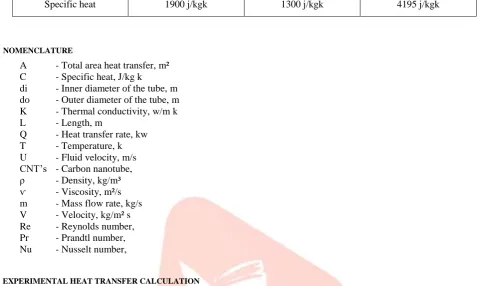
Table 2.1: Properties of coolants and tubesProperty Graphene Carbon nanotubes water
Thermal conductivity 500-600 w/mk >3000 w/mk 0.605 w/mk
Density 1500 kg/m³ 1000 kg/m³ 997.1 kg/m³
Specific heat 1900 j/kgk 1300 j/kgk 4195 j/kgk
III. NOMENCLATURE
A - Total area heat transfer, m² C - Specific heat, J/kg k
di - Inner diameter of the tube, m do - Outer diameter of the tube, m K - Thermal conductivity, w/m k L - Length, m
Q - Heat transfer rate, kw T - Temperature, k U - Fluid velocity, m/s CNT’s - Carbon nanotube, ρ - Density, kg/m³ ⱱ - Viscosity, m²/s m - Mass flow rate, kg/s V - Velocity, kg/m² s Re - Reynolds number, Pr - Prandtl number, Nu - Nusselt number,
IV. EXPERIMENTAL HEAT TRANSFER CALCULATION
Experimental analysis is taken from mathematical formulation. In this paper a comparison is made between the heat transfer performance of radiator by operating with conventional and nanofluids coolants. It highlights not only the influence of nanofluids but also volume fraction of graphene particles to the heat transfer rate of a radiator.
Table 4.1Experimental of coolant Coolant Air velocity
m/s
Mass flow rate Kg/s
Inlet temperature ˚C
Outlet temperature ˚C
Heat transfer rate Kw
Water
22 0.487 120 30 12.65
22 0.490 120 30 11.5
22 0.623 120 30 11.8
Graphene + Water[15%]
22 0.386 120 30 18.2
22 0.410 120 30 18.5
22 0.433 120 30 19.3
Graphene + Water[50%]
22 0.345 120 30 30.0
22 0.450 120 30 29.5
22 0.489 120 30 29.3
4.1 Mathematical Formulation
The parameters needed for nanofluid side calculation are nanofluid heat transfer coefficient, nanofluid heat capacity rate, heat exchanger performance, heat transfer coefficient based on air side, total heat transfer rate.
Density of nanofluids, ρ= [1-ΦS] ρf + ΦS ρp Specific density, c = [1-ΦS] ρf Cf + ΦS ρp Cp/ ρ Mass flow rate, m = ρ.A.V
Reynolds number, Re = ud/ⱱ, Re <2*10^5 [Laminar flow]
Nusselt number, Nu = 3.66 + [0.104.Re.Pr.{d/l}]/[1+0.16Re.Pr.{d/l}^0.8] Heat transfer co-efficient, h = Nu.k/d
IJEDR1602360
International Journal of Engineering Development and Research (www.ijedr.org)2049
Table 4.2 Experimental reading of temperatureMass flow rate [kg/sec]
Inlet temperature [˚C]
Outlet temperature [˚C]
Ambient temperature [˚C]
0.345 120 30 30
V. EXPERIMENTAL RESULTS AND DISCUSSION
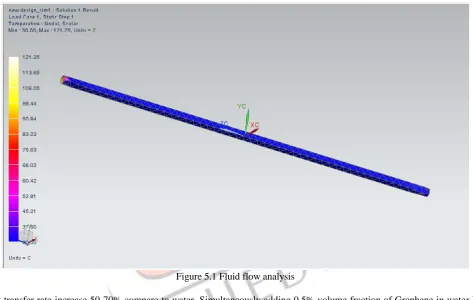
In this section, analysis of thermal performance of an automotive radiator single phase heat transfer at constant Reynolds number of coolant and air have been carried out. With the result temperature flow in the radiator was calculated using by NX-Nastran (figure 5.1). This parameters influences heat transfer in an automotive radiator. The heat transfer rate in automobile radiator increases by adding nanoparticles of Graphene in water. The heat transfer rate in radiator, using water as coolant is 7.5 kg load at coolant flow rate of 10 l pm whereas heat transfer rate is 12.65 KW now adding 0.5% volume fractions Graphene in water.
Figure 5.1 Fluid flow analysis
Heat transfer rate increase 50-70% compare to water. Simultaneously adding 0.5% volume fraction of Graphene in water heat transfer rate is increased. There is an increase of about 50-70% in heat transfer rate in automobile radiator compare to use water as coolant. Table 4 shows the comparison of area previous and optimized radiator
Table 5.1 Comparison of area
Heat transfer rate Q [kw]
Area m²
Previous radiator Optimized radiator
15% Graphene 50% Graphene
IJEDR1602360
International Journal of Engineering Development and Research (www.ijedr.org)2050
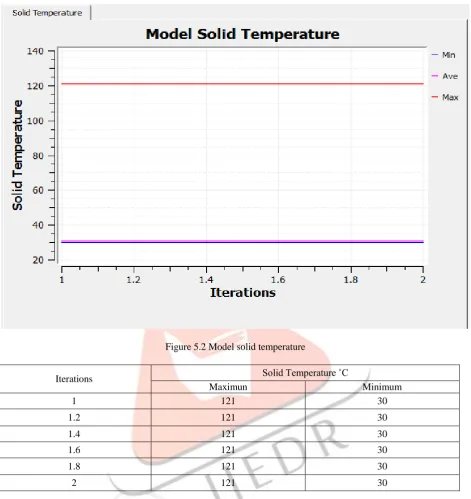
Figure 5.2 Model solid temperature
Iterations Solid Temperature ˚C
Maximun Minimum
1 121 30
1.2 121 30
1.4 121 30
1.6 121 30
1.8 121 30
2 121 30
From the above graphs shows using Graphene /water nanofluid as a coolant and optimum performance of radiator can be performed. For each iteration, experiments are conducted for one complete cycle of solid temperature. The results show that the nanofluids have large thermal conductivity than the original base fluids.
VI. CONCLUSION
IJEDR1602360
International Journal of Engineering Development and Research (www.ijedr.org)2051
REFERENCES[1] D.P. Kulkarni, R.S. Vajjha, D.K. Das, D. Oliva, (2008), Application of aluminum oxide nanofluids in diesel electric generator as jacket water coolant, Applied Thermal Engineering 28 pp.14-15, pp.1774-1781.
[2] Y. Hwang, J.K. Lee, C.H. Lee, Y.M. Jung, S.I. Cheong, C.G. Lee, (2007), Stability and thermal conductivity characteristics of nanofluids, Thermochimica Act 455, pp.70-74.
[3] Xuan Y., Roetzel W., (2000), Conceptions of heat transfer correlation of nanofluids, International Journal of Heat and Mass Transfer, Vol. 43, no. 19, pp. 3701-3707.
[4] H.A. Mintsa, G. Roy, C.T. Nguyen, D. Doucet, (2009), New temperature dependent thermal conductivity data for water-based nanofluids, International Journal of Thermal Sciences 48 , pp. 363-371.
[5] Calvin H.Li & G.P.Peterson , Journal of applied Physics, A review- The effect of particle size on the effective thermal conductivity of Al2O3-water nanofluids,Vol.-044312,pp.101,2007.
[6] M. Chopkar, S. Kumar, D.R. Bhandari, P.K. Das, & Manna , ʻDevelopment and characterization of Al2Cu and Ag2Al nanoparticle dispersed water and ethylene glycol based nanofluid Materialsʼ, Science and Engineering B, vol. 139, pp. 141– 148,2007.
[7] Allen, P. W., Lee, “Experimental and Numerical Investigation of Fluid Flow and Heat Transfer in Microchannels” Msc Thesis, Mechanical Engineering Department, Louisiana State University, 2007.
[8] Al-Nimr, M.A., Maqableh, M., Khadrawi, A.F. and. Ammourah, S.A. “Fully developed thermal behaviors for parallel flow microchannel heat exchanger”, International Communications in Heat and Mass Transfer. 36, pp. 385-390, 2009
[9] Bianco, V., Chiacchio, F., Manca, O. and Nardini, S. “Numerical investigation of nanofluids forced convection in circular tubes”. Applied Thermal Engineering, 29 [17-18], 2009, pp. 3632–3642.
[10] Choi, S.U.S., Tuckermann, “Enhancing thermal conductivity of fluids with nanoparticles”. In: Proceedings of the 1997 ASME International Mechanical Engineering Congress and Exposition, San Francisco, CA, USA. 66, 1997, pp.99-105. [11]Das, S.K., Putra, N., Roetzel, W., “Pool boiling of nano-fluids on horizontal narrow tubes”. International Journal of
Multiphase Flow 29, 2003, pp.1237–1247.
[12]Ding, Y., Chen, H., He, Y., Lapkin, Y., Yeganeh, M., Šiller, L. Butenko, Y. V. “Forced convective heat transfer of nanofluids”. Advanced Powder Technol., 18, 2007, [6, pp. 813– 824].
[13]Eastman, J.A., Choi, S.U.S., Li, S., Yu, W., Thompson, L.J, “Anomalously increased effective thermal conductivities of ethylene glycol-based nanofluids containing copper nanoparticles”. Applied Physics Letters 78, 2001, pp. 718–720.
[14]D.P. Kulkarni, R.S. Vajjha, D.K. Das, D. Oliva, (2008), Application of aluminum oxide nanofluids in diesel electric generator as jacket water coolant, Applied Thermal Engineering 28 pp.14-15, pp.1774-1781.
[15]Vlassov, V. V., de Sousa, F. L. and Takahashi, W. K., (2006), Comprehensive optimization of a heat pipe radiator assembly filled with ammonia or acetone, International Journal of Heat and Mass Transfer, pp.4584-4595.
[16]W. Yu, D.M. France, S.U.S. Choi, J.L. Routbort, (2007), Review and Assessment of Nanofluid Technology for Transportation and Other Applications, (No. ANL/ ESD/07-9). Energy System Division, Argonne National Laboratory, Argonne.
[17]L. Syam Sundar, E. Venkata Ramana, M.K. Singh & A.C.M. De Sousa 2012, viscosity of low volume concentrations of magnetic Fe3O4 nanoparticles dispersed in ethylene glycol and water mixtureʼ, Chemical physics letters, vol. 554, pp. 236-242,2012.
[18]M. Eftekhar, A. Keshavarz A. Ghasemian, and J. Mahdavinia, “The Impact of Nano-fluid Concentration Used as an Engine Coolant on the Warm-up Timing”, International Journal of Automotive Engineering, Vol. 3, Number 1, March 2013.
[19]Heris S., Nassan T., Noie S.H., Sardarabadi H., Sardarabadi M., (2013) “Laminar convective heat transfer of Al2O3/water nanofluid through square cross-sectional duct” International Journal of Heat and Fluid Flow, vol. 44, August 2013, pp. 375-382.