2 8 0 5 2 3 9 6 4 7
In vestigation s in th e d yn am ics o f
th ree different classes o f
m erom orphic fu n ction s
A thesis presented for the degree of
Doctor of Philosophy of the University of London
and the
Diploma of Imperial College
by
Patricia Dominguez Soto
Department of Mathematics
Imperial College of Science, Technology and Medicine
Queen’s Gate, London SW7 2BZ
ProQuest Number: U643408
All rights reserved
INFORMATION TO ALL USERS
The quality of this reproduction is dependent upon the quality of the copy submitted.
In the unlikely event that the author did not send a complete manuscript and there are missing pages, these will be noted. Also, if material had to be removed,
a note will indicate the deletion.
uest.
ProQuest U643408
Published by ProQuest LLC(2016). Copyright of the Dissertation is held by the Author.
All rights reserved.
This work is protected against unauthorized copying under Title 17, United States Code. Microform Edition © ProQuest LLC.
ProQuest LLC
789 East Eisenhower Parkway P.O. Box 1346
A b stract
This thesis discusses problems about the dynamics of the following three classes of
functions: I. Transcendental entire, II, Analytic self-maps of C* = C \ {0,oo}, and III.
Transcendental meromorphic functions.
For an entire function / the Fatou set F{ f ) is the maximal open set where the
iterates / ” form a normal family. The Julia set J ( / ) is th e complement of F ( / ) . For
meromorphic functions some modifications of this definition are needed.
In C hapter 2 for a transcendental entire function / we investigate the connectedness
properties of the Julia set J { f ) in the plane and in the Riemann sphere. We give
examples where J ( / ) contains buried components, th a t is, com ponents which do not
meet the boundary of any component of the complement F { f ) of J ( / ) . In connection
with an old question of Fatou we show th a t if F{ f ) has a multiply-connected component,
then J { f ) has buried components which are singletons. Such com ponents are dense in
m
-In C hapter 3 we let / be a non-Mobius analytic self-map of C* W rite J * ( /) for
the Julia set of / in C* and J ( / ) for the closure of J * ( /) in C . Then we have one of
the three cases (i) J ( / ) , J * (/) are connected, (ii) J ( / ) is connected, J * ( /) has infinitely
many components, (iii) J ( / ) has two components, J*{f ) has infinitely many components.
All three cases can occur.
It is known th a t F{ f ) has at most one multiply-connected domain A whose connec
tivity must in fact be two. If in addition A is relatively com pact in C*, then either A
is a Herman ring, A is pre-periodic but not periodic, or A is a wandering component.
Examples of all three cases are constructed.
In C hapter 4 we examine some properties of the dynamics of entire functions which
extend to general meromorphic functions and also some properties which do not. For
a transcendental meromorphic function f {z ) whose Fatou set F{ f ) has a com ponent of
connectivity a t least three, it is shown th a t singleton com ponents are dense in the Julia
set J ( / ) . Some problems remain open if all components are simply or doubly connected.
Let / ( / ) denote the set of points whose forward orbits tend to oo but never land a t oo.
For a transcendental meromorphic function f {z ) we have J ( / ) = dl { f ) ^ I { f ) f ] J { f ) ^ 0.
However in contrast to the entire case, the components of / ( / ) need not be unbounded,
If f ( z ) has finitely many poles then, as in the entire case, F { f ) has a t most one
completely invariant component.
C hapter 5 concerns the disconnectedness of J { f ) for a transcendental entire func
tion in the case F { f ) has an unbounded invariant component U. Then U is simply-
connected and if ^ : D = D ( 0 ,1) —> C/ is a Riemann map, define 0qo = :
radial limit exists and = 0 0}.
If 0 0 is accessible in U and U is either (i) an attractin g basin, (ii) a parabolic basin
or (iii) a Siegel disc, then 0qo is dense in dD. If f / is a Baker domain and f / U is not
univalent, then 0qo contains a non-empty perfect set in dD. Examples are given to show
A cknow ledgem ents
I wish to th an k my supervisor Professor LN Baker for sharing his knowledge of
iteration theory and for his continuous guidance and support throughout my years of
PhD studies. It is a great pleasure to have this opportunity to record my immense
indebtedness to my supervisor, who was the main source of encouragement behind me
presenting two seminars in Cambridge and one at Imperial College.
I would like to express my gratitude to Mrs. G. Baker, who was always very enthu
siastic in teaching me about English customs, am ongst other things, and in taking me
to have lovely walks which I enjoyed tremendously.
I am deeply indebted to friends M aria Alvarez, Adrian Ramirez, Zaineb Bashir-Ali,
April Chen, Maxine Garcia, Jonathan Tanner, and Ursula Iturraran who stood by me
throughout my PhD studies. My sincere thanks to all.
I wish to thank the D epartm ent of M athem atics a t Imperial College, especially to
Dr. S. Velani, Prof. C. Atkinson, Dr. C. B arnett, Miss J. Brown, Mrs. C. Boey, Mr. R.
Perera, and Mr. A.M. Clark.
Thanks are also due to CONACyT (Consejo Nacional de Ciencia y Tecnologia) and
Universidad A utonom a de Puebla for their financial support.
Finally, this thesis is dedicated to my mother M aria, my sister Elizabeth and my
niece Karen who supported me with their very nice letters, which gave me motivation
C on ten ts
L ist o f F ig u res 7
C h a p t e r 1 : I n t r o d u c t i o n 8
1 . 1 A brief history of the iteration of complex analytic fu n c tio n s... 8
1.2 The story of this t h e s i s ... 10
1.3 P r e lim in a r ie s ... 10
C h a p ter 2 : C o n n ec ted n e ss p ro p erties o f th e J u lia se ts o f tra n sce n d en ta l en tire fu n ctio n s 13 2.1 Introduction to C hapter 2 ... 13
2.2 The Julia set of f { z ) = 15 2.3 Buried components of f {z ) = 21 2.4 The Julia set of sin z ...22
2.5 Buried points of sin z ...24
2.6 M ultiply-connected components like r i n g s ... 24
2.7 Preliminary l e m m a s ...25
2.8 Proof of the main th e o re m ... 27
C h a p ter 3 : S elf-m ap s o f th e p u n ctu red p lan e 29 3.1 Introduction to C hapter 3 ... 29
3.2 Components of the Fatou s e t ...33
3.3 Connectivity of the Julia s e t ... 34
3.4 Buried points and buried components ...37
3.5 The doubly-connected c o m p o n en t... 38
3.6 Proof of Theorem 3 .1 .5 ... 39
3.7 Proof of Theorem 3 .1 .6 ... 41
3.8 Proof of Theorem 3 .1 .7 ... 45
3.9 Final r e m a r k s ... 50
C h a p ter 4 : D y n a m ics o f tra n scen d en ta l m erom orp h ic fu n ctio n s 52 4.1 Introduction to C hapter 4 ... 52
4.2 Proof of Theorem A ... 59
4.3 Proofs of Theorems B and C ... 61
4.4 Proofs of Theorems D and E ... 62
4.5 Functions with finitely many p o l e s ...6 6 4.6 O rbits which tend to o o ...70
4.7 Completely invariant d o m a in s ... 72
4.8 Singularities of f ~^ of a transcendental meromorphic function / ... 75
4.9 E x a m p le s ...76
C h a p ter 5 : B o u n d a ries o f u n b ou n d ed F atou c o m p o n e n ts o f en tir e fu n c tio n s 81 5.1 Introduction to C hapter 5 ...81
5.2 Lemmas on inner f u n c t i o n s ... 85
5.3 Dynamics of inner fu n c tio n s ... 89
5.4 Proof of Theorems 5.1.1 and 5.1.2 92
5.5 An example which has a Baker d o m a in ...94
5.6 Further properties of the preceding e x a m p le ... 97
5.7 Further e x a m p le s ... 105
5.8 The results of Devaney and Goldberg on Xe^ ...107
List o f Figures
2.1 Each branch of f ~^ gives a different component of f ~ ^ { D p )...18
2.2 The branches of f ~^ map Fi to an infinity of paths 7^ in Dp ...20
2.3 The component Nn of F{ f ) between Un and Un+i ...26
2.4 The points ^ G F and ^ G F belong to J ( / ) ...28
4.1 The interiors 1 < z < 2, and the exterior D3 ...61
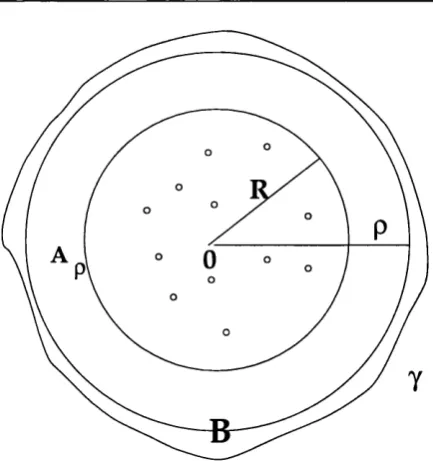
4.2 B is the region between and 7 ...6 8 4.3 The p r o c e s s ...71
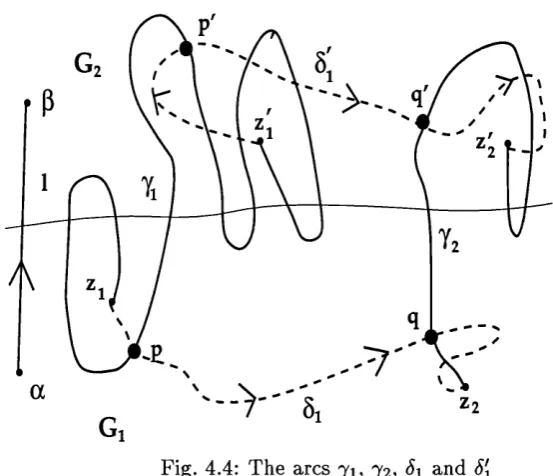
4.4 The arcs 7 1, 7 2, Si and ...74
4.5 The domain H ... 77
4.6 T = S r\ { z : \z — Tv\ > p} ...78
5.1 The curve j i...87
5.2 e may be continued along \ { t )...8 8 5.3 (left) T C Djj, (right) 0 G dT^ then 0 G ...91
5.4 U is contained in the strip \y\ < tt and the lines y = ±7r are in J { f ) . Figure computed by the boundary game method of Weinreich [72] . . . . 96
5.5 (Ji° /^n = U « 2 U « 3 U . . . is a Jordan curve C ... 100
5.6 The component Dn ...101
5.7 f - ^(L~) n 5 = L ” U M + and (L+) D 5 = L+ U M “ ...103
5.8 S j J e Z ... 108
5.9 ^ - i ( ^ o ) ...109
5.10 Diagram showing Tj, g~^{rj) = f~^{(7j ) ...110
C H A P T E R . 1
In trod u ction
1.1
A brief history o f th e iteration o f com plex analytic
functions
Probably the oldest and most famous iterative process to be found in m athem atics
is N ew ton’s method
z J.-1 — z
-" f { z „ y
It can be used to approxim ate both real and complex solutions to the equation f { z ) = 0.
The iteration of complex analytic functions has its origins in two detailed exami
nations of Newton’s method. The first paper, containing two parts (1870 and 1871),
was w ritten by the German m athem atician Ernest Schroder (1841-1902) and the second
(appeared in 1897) by the British m athem atician A rthur Cayley (1821-1895).
Schroder and Cayley each studied the convergence of Newton’s method for the com
plex quadratic function. Since then many other m athem aticians have worked on the
problem of analytic iteration and the iteration of complex functions, see e.g. [3].
In 1907 Paul Montel (1876-1975), a French m athem atician, received his doctorate
in Paris which was related to infinite sequences of both real and complex functions. A
few years later Montel worked in complex function theory and introduced the theory of
normal families. In his papers published in 1912 and 1916 he treated P icard’s theory.
Montel considered his study of P icard’s theory to be one of the most im portant applica
tions of his theory of normal families. In 1917 Montel used normal families to prove the
Riemann mapping theorem together with several other theorems related to conformai
mapping.
M ontel’s theory of normal families was quite im portant in the iteration of analytic
functions. Between 1918 and 1920, two French m athem aticians, Pierre Fatou (1878-1929)
and G aston Julia (1893-1978) obtained several results related to the iteration of rational
functions of a single complex variable. Each of them based his approach on M ontel’s
theory of normal families. The main objects of the theory are the Fatou or stable set
where the iterates form a normal family and the Julia set which is the complement of
1.1 A b rie f h isto ry o f th e itera tio n o f co m p lex a n a ly tic fu n ctio n s
the entire case. However, LN. Baker in [9] showed th a t some dynamical properties of
entire functions may be quite different from those of rational maps.
In 1926 Fatou put forward the following conjecture: J{e^) = C. The first example (1975) of an entire function with the above property was given by I.N. Baker who proved
th a t J(Xze^) = C for suitable value of A. Later in 1981 Misiurewicz proved F ato u ’s conjecture.
In 1953 H. Radstrom [67] showed th a t among planar domains with holomorphic self-
maps f : D —)■ D, the most dynamically interesting cases are D = C, f rational, Z) = C,
/ entire, or D = C* = C \ {0}. In all other cases every point of D is a stable point for
/ .
In 1969 P. B attacharyya, in his PhD thesis [25], proved th a t J ( / ) is the closure of
the repelling fixed points in the case when D = C*.
The dynamics of analytic self-maps of the punctured plane has been studied by many
other authors since Radstrom and B attacharyya, see [21] for a survey.
The iteration of general meromorphic functions was mainly studied in 1990 and 1991
by LN Baker, J. Kotus, and Lü Yinian who produced three papers [14]-[16]. The third
of those is related to the classification theorem of periodic components. Theorem 2 . 2 and
Theorem 2.3. For a survey of general meromorphic functions the readers are referred to
[21].
The above introduction suggests th a t meromorphic functions fall into four disjoint
classes.
• The rational functions (assuming the degree to be a t least two).
• The class E of transcendental entire functions.
• The class P of transcendental functions of the type
f {z ) = a + {z
-for some k £ N and some entire function g{z).
• M , the class called general meromorphic functions in [16], of transcendental mero
morphic functions, for which oo is not in the set of the exceptional points.
A further generalisation is to study the iteration of functions which are meromorphic
outside some set of essential singularities which is in some sense small. See e.g. [44] and
1.2 T h e sto r y o f th is th e sis 10
1.2
T he story o f this th esis
The idea of this thesis started when we found a paper which was w ritten by Jian-
Yong Qiao [6 6] who studied an example of a transcendental entire function which has
buried points in the Julia set which are dense in the Julia set (see C hapter 2 for a
definition of buried points). C. McMullen [59] had already shown the existence of a
rational function whose Julia set contains buried components. Jian-Yong Qiao did not
discuss buried components, so we tried to see w hat happen with buried com ponents for
transcendental entire functions. This suggested examining the connectivity of the Julia
set.
F ato u ’s original paper [40] posed the question of w hether J ( / ) could be totally discon
nected for transcendental entire functions, as may happen for polynomials. A negative
answer was given by I.N Baker [8]. However until now it seems an open question whether
singleton components can occur at all for transcendental entire functions. We prove th a t
if the Fatou set of the transcendental entire function f { z ) has a multiply-connected com
ponent, then J ( / ) has buried components which are singletons and such com ponents are
dense in the Julia set.
After we proved the above result it was natural to try to extend it to th e classes P
and M . For the class P we found out th a t the Julia set has no singleton components
but we studied the connectivity of the Julia set.
For the class M we prove the existence of examples with singleton com ponents which
are dense in J ( / ) . Also we study the connectivity of the Julia set for this class of
functions, beside the dynamics of meromorphic functions with only finitely many poles.
In [50] Masashi Kisaka study the connectivity of the Julia set for entire functions. He
proved th a t J { f ) is disconnected in the cases when t/, an invariant unbounded domain
component of F{ f ) , is either an attracting basin, parabolic basin, Siegel disc, or a Baker
domain in which the function is not univalent. His results are really about the boundary
of U in this case and we are able to strengthen them by om itting some of Kisaka’s
hypotheses.
1.3
Prelim inaries
In this section we shall give some definitions and notations which can be found in
1.3 P relim in a r ies 11
De f in it io n. A set E isd e n s e in i t s e l f if E C E' , that is if every point o f E is a lim it point o f the set. The set E is p e r f e c t if E = E ', i.e. if E is both dense in itself and closed.
De f in it io n. E is a C a n t o r s e t if E is both perfect and nowhere dense.
De f in it io n. A compact connected set with at least two points is called a c o n t in u u m .
A non-null open connected set in any space is called a d o m a in .
We denote the Riemann sphere by C , with its canonical complex stru cture and
topology, by C the complex plane, and by C* = C \ {0, oo} the punctured plane.
According to the Riemann-Koebe uniformization theorem an arb itrary simply-connected
Riemann surface is conformally equivalent to one of th e following three spaces.
• The unit disc D ( 0 ,1).
• The complex plane.
• The sphere.
The sphere is called an elliptic Riemann surface. The plane and the punctured plane are
called parabolic Riemann surfaces; their universal coverings are conformally equivalent to
the plane. The remaining Riemann surfaces, whose universal coverings are conformally
equivalent to the disc, are called hyperbolic Riemann surfaces.
On any Riemann surfaces S there exists a conformai metric p s of constant curvature.
This metric is said to be hyperbolic (or a Poincaré metric) in the case of a hyperbolic
surface 5 , Euclidean in the parabolic case, and spherical in the case of C.
De f in it io n. We say that f ( z ) is m e r o m o r p h ic on U, where U is an open set, if f {z )
is defined on U except at a discrete set o f points which are poles.
Some im portant cases of this situation are when:
1. f { z ) is entire, analytic m U = C with no poles. If f {z ) covers C a finite number of
times, then f { z ) is a polynomial otherwise f { z ) is a transcendental entire function.
1.3 P relim in a r ies 12 S. U = D (0,1) and f {z ) is analytic.
P i c a r d ’s th e o r e m states th a t a single valued function f{t ), meromorphic for ^ / oo,
which omits three values reduces to a constant. For a proof e.g. [2].
Thus if f { z ) is a transcendental entire it already omits oo, so it can only omit one
more value. This om itted value is called a Picard exceptional value.
Dd e f in it i o n. a fam ily F o f functions is n o r m a l in a domain G o f C if every sequence
o f functions in F contains a subsequence uniformly convergent (in the spherical m etric)
in each compact subset o f G. Note that convergence to an infinite constant is allowed.
W ith this definition we shall give the following theorem as derived by Montel.
M o n te l’s th e o r e m . I f F / K is a fam ily o f analytic functions defined on a domain K
and the range o f F / K omits at least three values in C , then F / K is normal.
S in g u la ritie s
Let f { z ) be a meromorphic function. The singularities of f ~^ can arise in two
different ways,
1. If f ( z ) ^ 0 0 and f ' ( z ) = 0, then f ( z ) is an a lg e b ra ic s in g u la r ity of f ~^ and is
known as a critical value of /( z ) , z is called a critical point of f {z ) . If /( z ) has a
pole of order A; > 1 a t z, then oo is a critical value and z is a critical point.
2. If /( z ) is transcendental and there is a path P in C such th a t, as z —>■ oo on P,
/( z ) —> o, o G C on /( P ) , a is said to be a tr a n s c e n d e n ta l s in g u la r ity of / " ^ .
More definitions and results for iteration theory are provided as required in C hapters
c
H A p T E R 2
C on n ected n ess p roperties o f th e
Ju lia sets o f tran scen d en tal entire
fu n ction s
2.1
Introduction to C hapter 2
For a transcendental entire function / we investigate the connectedness properties
of the Julia set J { f ) in the plane and in the Riemann sphere. We give examples where
J { f ) contains buried components, th a t is, components which do not meet the boundary
of any component of the complement F{ f ) of J ( / ) . In connection with an old question
of Fatou we show th a t if F ( f ) has a multiply-conncted component, then J ( / ) has buried
com ponents which are singletons. Such components are dense in J ( / ) .
If f {z ) is a transcendental entire function of the complex variable z, we denote
by / ”', n G N, the n-th iterate of f {z ) . The Fatou set is defined by F{ f ) = {z : {/"■} is
a normal family in some neighbourhood of z}. The complement J ( / ) of F ( f ) is called
the Julia set.
The iterations of entire functions were first studied by Fatou [39, 40] who proved the
facts which follow.
The Julia set J ( / ) is non-empty and perfect. F urther J [ f ) is completely invariant,
th a t is, z is in J ( / ) if and only if /( z ) is in J ( / ) . The Fatou set is also completely
invariant. This implies th a t for a component G of F{ f ) and each n G N there is a
component On of F{ f ) such th a t f ^ { G) C Gn- If the Gn are different for different n
then G (and all Gn) are called wandering components.
A point zq is a cyclic point of /( z ) with period n if (zo) = zq and f^{zo) ^ zq
for k < n. The derivative is called the multiplier of zq and all points of a cycle
have the same multiplier. In the case n = 1 we say zq is a fixed point. A cyclic point
Zq of period n is said to be attracting, repelling or neutral according as | ( / ”')^(^o)| is
< 1, > 1 or = 1.
2.1 In tr o d u ctio n to C h a p ter 2 14
The Julia set of transcendental entire functions is unbounded and some w riters in
clude oo as a member of J { f ) . For clarity we write J { f ) for the Julia set containing
00 and Jo{f ) for J ( / ) fl C . The connectivity properties of J ( / ) cts a subset of C and
J o (/) cLS a subset of C may differ. If we say th a t J { f ) is connected we mean th a t it is
connected as a subset of C, while the connectedness of Jo{f ) refers to its properties as
a subset of C.
An im portant class of entire functions is the class S of functions f { z ) such th a t the
set of singular points of f ~^ is finite. S contains the functions sin z and for constant
A. For f { z ) G S' it is always true by Theorem 2.2.3 th a t J { f ) is connected but Jo{f )
may or may not be. It will be shown in Sections 2.2 and 2.4 th a t Jo (sin z) is connected
(Theorem 2.4.1) but for many values of A Jo(e^^) is not (Theorem 2.2.8).
In [10] functions f {z ) were constructed such th a t F{ f ) contains some com ponents
which roughly speaking are an unbounded sequence of concentric rings. For such func
tions neither J q ( /) nor J ( / ) is connected. Finally, whenever J q (/) is connected, then so
is its closure J ( / ) .
F ato u ’s original paper [40] posed the question of w hether J ( / ) could be totally discon
nected for transcendental entire functions, as may happen for polynomials. A negative
answer was given in [8]. However until now it seems an open question whether singleton
components can occur at all for transcendental entire functions. One of our main results
in Section 2.8 is
Th e o r em A. I f f ( z) is a transcendental entire function and F( f ) has a multiply-connected
component, then J( f ) has some singleton components and such components are dense in
j { f )
-M any examples of such f { z ) are known, for example those from [10] referred to above.
There has been some recent work on buried points and components of J ( / ) . If some
component of J ( / ) does not meet the boundary of any component of F { f ) it is called
a buried com ponent of J ( / ) . Similarly if a point of J ( / ) is not in the boundary of any
component of F { f ) it is called a buried point. We remark th a t for a point to be buried
is a stronger property than for it to be inaccessible from all com ponents of F { f) .
Thus, for example, if e^^ has an attracting fixed point (th at is, if A = te~* where
1 i |< 1 ), then F(e^^) is a single connected domain whose boundary is J(e^^). As
remarked in Devaney and Goldberg [30] for these values of A the set J{e^^) consists of a
2 .2 T h e J u lia s e t o f f {z ) = 15
However, these points are certainly boundary points of the domain F{ f ) and J ( / ) has
no buried points.
The first example of buried components of a rational function was given by C. Mc
Mullen [59] (see also A.F, Beardon [20]). The first discussion for transcendental entire
functions was given by Jian-Yong Qiao [6 6] who showed th a t for 0 < /i < 2.5 the function
f { z ) = z exp(z-f- fl) has buried points in J ( / ) (repelling periodic points) and th a t these
points are dense in J ( / ) ; he did not discuss buried components. It is shown in Section
2.3 th a t for values of A such th a t f [ z ) = has an attractin g p cycle with p > 2,
J o ( /) has unbounded buried components (there are many such values of A including all
A < —e, see, for example, [18]).
In Section 2.5 we show th a t Jo{g) has buried points for g{z) = sin z. Since Jo{g) is
connected and contains 0, which is accessible from one of the components of the Fatou
set, there is no buried component.
Finally, Theorem A is strengthened by the following result.
Th e o r e m 2 .8 .1 . I f the Fatou set o f the transcendental entire function f { z ) has a
multiply-connected component, then J { f ) has buried components which are singletons.
Such components are dense in J { f ) .
2.2
T he Julia set o f
f { z ) =In this section we shall prove in Theorem 2.2.8 and Theorem 2.2.9 th a t Jo{f ) is not
connected and th a t its components are unbounded.
We shall often use the following topological lemmas.
Le m m a 1 [60, p .143]. I f X and Y are two components o f a closed set F in C there is a
polygon in F^ separating X and Y.
Le m m a 2. For any closed set A in C a bounded component K o f A is also a component
o f A U {oo} in C.
Proof. The proof follows easily from e.g. Exercise 4 in [73, p.38].
2 .2 T h e J u lia set o f f { z ) = 16
Th e o r e m 2.2 . 2 [35]. Let f { z ) Ç: S be a transcendental entire function. I f z G F { f ) then
the orbit does not tend to oo.
Th e o r em 2.2.3. For any transcendental entire f [ z ) in class S, J { f ) is connected in C .
In particular this holds fo r f ( z ) = e^^.
Proof. We su p p o se t h a t J ( / ) is n o t c o n n e cted in C a n d t h a t th e re is a c o m p o n e n t
C l of J ( / ) C C d is tin c t fro m th e c o m p o n e n t C2 o f J ( f ) w hich c o n ta in s 00.
It follows from Lemma 1 th a t there is a simple polygon 7 in [ J { f ) Y = F{ f ) which
separates Ci and Cg. Since 7 G F i, where F\ is a component of F ( / ) which is multiply- connected then it follows from Theorem 2.2.1 th a t f ^ { z ) —>• 00 uniformly in F\. But this contradicts Theorem 2.2.2.
Co r o l la r y 2.2 .4 [18]. I f f { z ) = A / 0, then any component o f F { f ) is
simply-connected.
In [18] there is a discussion of the set Lp of values of A such th a t f { z ) = e^^ has an attractin g cycle of period p > I. It is shown th a t for every p > 1 the set Lp ^ ^ and
in particular all real A < —e are in L2. Further, for p > 2 the set Lp meets the strip
|ImA| < 27t in points such th a t Re A is arbitrarily large.
Now we shall need the following theorems which were proved by Fatou and by Baker
and Rippon.
Th e o r e m 2.2.5 [39]. I f oi i , . . . . , ap is an attracting periodic cycle o f an entire function
f {z ) , then all o f the components of F{ f ) which contain points CKi, . . . , are
simply-connected and one o f them contains a singular point o f f ~ ^ .
T h e o r e m 2.2.6 [18]. For f ( z ) = A 7^ 0 , there is no component D o f F ( f ) and no sequence o f integers ni such that —>• 00 and {z) —> 00 in D.
Th e o r em 2 .2 .7 [18]. Let f { z ) = e^^ where A G Fp, p > 1, so that there is a cy
cle D i, D2, . . . , Dp of components o f F{ f ) , such that fo r 1 < i < p, / ( A ) =
A + i, f {Dp) = Di , and converges to a fixed point o f f ^ in each D{. Then every
component D o f F{ f ) satisfies F ^ { D ) C Di fo r some N, i.
Now suppose A is any value such th a t f [ z ) = e^^ has an attractin g p-cycle p > 2 . Let
2.2 T h e J u lia se t o f f { z ) = 17
periodic cycle cni,. . Op. Then one of the D j, which we may assume to be D i, contains
the unique singular point zero of f ~^ by Theorem 2.2.5.
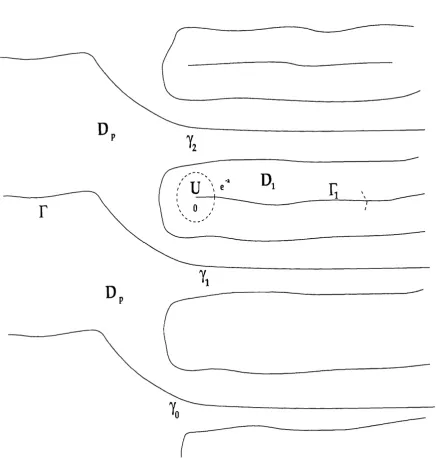
Let U = D (0 ,e ~ “), a > 0, be a small disc around zero in Di . So Dp contains a full
inverse image f ~^ {U) = j \n U, th a t is, a half-plane. Thus Dp is unbounded and all
components of F{ f ) are simply-connected by Corollary 2.2.4. Further, Dp contains a
path r : where t > 1 and a > 0. F runs to oo in the image of F under is the
real segment (0, e“ “) C U.
Each branch of f ~^ is univalent in the simply-connected component Dp , so each
branch gives a different component of f ~^{Dp) = D p -i 4- k £ Z , which contains
a p ath Fp_i to oo (see Figure 2.1).
r,_. :
i { l n g + i a r g ( :
= i | l n 4- z(2u -1- l )7r - ia rg a | , for some integer ü.
— { A -f- i B} , say.
Thus on
ReAz = A —> o o a s i —>-oo
ImAz = B is a constant.
Now we shall prove the following lemma.
Lemma 3. I f T : y(A (i) -f iB{t)), t > to is a curve on which ReAz = A{t) —>■ oo and
ImAz = B{t) ^ a constant 9, then fo r any branch f~'^ o f the inverse o f F^ =
(T) is given by z{t), where ReAz —> oo and ImAz ^ a constant On as t ^ oo.
Proof. We shall prove this lemma by induction. For n = 1, we define r]i = arg(A (i)
-\-iB{t)), t > (o, so th a t 771 —> 0 as i —>■ oo. For sufficiently large t\ we have A{t) 7^ 0 for
t > ti and for this param eter range
p'l
P'l
2 .2 T h e J u lia se t o f f { z ) = 19
i{
MlA I |A|
= ^ { ^ 1 + -Si},
+ i [rji + (2v)7t - arg A) | , for some integer v,
where
A i = In and Bi = 7 /1 + (2u)7t - arg A, Ml
B i is continuous on F and 771 —>• 0. Hence for large |z|, u is constant on F, thus B \ —>
constant Oi, A i 0 0.
Repeating this argum ent we obtain th a t for each curve F = / “ ^(F)
ReAz = A n ^ o o 3 i & t - ^ o o
I mXz = Bn constant
On-Here
A 1 I- ^ 7 1 — 1 "h ^Bn— 11 J 7 1 I f o \ \
An = I n p-j and = 7y„ + (2u)7t - arg A,
Ml
Bn is continuous on F and 77^ —>• 0. Hence for large |z|, u is constant on F, thus Bn —>•
constant 6ni An ^ 0 0.
Now we shall give an application of this lemma.
We know th a t Dp contains a path F and D p -i contains a path Fp_i, By Lemma 3,
we can affirm th a t each of D i, D2, . . . , Dp contains a p ath to 0 0 where ReAz —>• 0 0 and
ImAz constant. Even more, D i contains a path Fi to 0 0 and we can assume th a t Fi
starts a t 0 with the segment [0, e“ “], does not otherwise pass through 0 and th a t ImAz
is bounded on Fi (|ImAz| < k).
Now the branches of f~ ^ map Fi to an infinity of paths jn in Dp which tend to 0 0
in the half plane ReAz > 0. One of these, 7 1 say, contains the path F = > 1},
so we have Az —>■ — 0 0 along this p art of F while Az + 0 0 along another. Moreover
7n+i = 7n + ^ - Thus each jn divides the plane and D j, j 7^ p, lies between two of
these paths 7^, say 7% 7" (shown in Figure 2.2 as 7 1 and 7 2).
T h e o r e m 2.2.8. I f f {z ) = has an attracting p-cycle p > 1, then Jo{f ) is not
2.2 T h e Ju lia set o f f { z ) = e— 20
2.3 B u ried co m p o n en ts o f f [ z ) = 21 Proof. For the case p > 2 we continue the preceding discussion. Then D i lies between
7i and 7 2. The curves 7 1 U7 2 in F{ f ) separate d D i C Jo{f ) from d{ Di + in Jo{f ),
so J q ( /) is not connected.
For the case p = 1 the discussion is simpler. In this case Jo{f ) consists of separate
C antor bouquets, [30], separated by strips which belong to F ( / ) .
Th e o r e m 2.2.9. I f f { z ) = has an attracting p-cyclep > 1, then every component o f
J o ( /) is unbounded.
Proof. We suppose th a t there is a bounded component K of Jo{f ). It follows from
Lemma 2 th a t K is also a component of J o (/) U {0 0} = J(f). B ut by Theorem 2.2.3,
J { f ) is connected in C and unbounded. Hence we have a contradiction.
2.3
B uried com pon en ts o f
f { z ) =If there is some component of J { f ) which does not meet the boundary of any com
ponent of F ( / ) , then it is called a buried component of J{ f )
-We shall be interested in proving some results about buried components of the tra n
scendental entire function f { z ) = e^^.
Th e o r e m 2.3.1. Suppose X any value such that f ( z ) = e^^ has an attracting p-cycle,
p > 2, then all the repelling fixed points o f f { z ) are buried points o f Jo{f ), with at
most finitely many exceptions.
Proof. Note th a t for f { z ) = e^^ all solutions of = z of large modulus are repelling
fixed points and hence belong to J o
(/)-We take such a repelling fixed point ^ and suppose th a t ^ G dF i, where Fi is a
component of F{ f ) with boundary dF i. Then ^ G dFk+i where F^+i = f ^{Fi ) .
Hence ^ G dDj for each Dj of the periodic cycle, since Fk is eventually in Dj . In
particular, ^ G d D i. Also D i lies in a region where the ImAz is bounded.
On the other hand the solutions z„ of e^^ = z have \zn\ 0 0, which shows th a t
ReAzn = In |z„| = o(|zn|), so ImAzn -4- 0 0. Thus for all but a finite number of choices
of ^ = z„ we have th a t ^ does not belong to the boundary of D i. Consequently ^ is not
in the boundary of any component Fi of F ( / ) . For this reason ^ is a buried point of
2 .4 T h e J u lia s e t o f sin z 22
Th e o r e m 2.3.2. I f X satisfies the assumptions o f Theorem 2.8.1, then some components
o f Jo{f ) are buried components.
Proof. Let ^ be some repelling fixed point of f { z ) , ^ G Jo{f ) and let 7 be the
component of Jo{f ) which contains Since 7 is closed and connected, f { j ) has the
same properties as 7 and ^ G /(7 )- Since by invariance of the Julia set f f y ) belongs to
some component of </(/), we have /( 7 ) C 7 and 7^(7) C 7 for all A; G N .
Now we take 7 to be the component of J o (/) which contains a repelling fixed point
^ not between 71,72 in Figure 2.2, Thus 7 lies between 7%, 7i+i for some i / 1.
Now we take ^1 a point in 7, ^17^^ and suppose th a t ^1 G dF i. Then /^ (^ i) G 7
and /^ (^ i) G dFk+i where = f ^{Fi ) , dFk+i meets the strip between j i , 7i+i thus
Fk+i lies in this strip.
But for some k, Fk+i = D \. Since D i does not lie between 7*,7i+i, this is a
contradiction. Hence 7 is a buried component.
We recall th a t by Theorem 2.2.9 every component of Jo{f ) is unbounded. We also
remark th a t since the inverse image under / ”■ of a buried component of Jo{f ) is buried,
such components are dense in J o
(/)-2.4
T he Julia set o f sinz
We know th a t f { z ) = sin z belongs to the class S and all finite singularities of f ~^
are algebraic branch points over +1 or -1.
From the local behavior of iterations of sin z = z — ^ + . . . , F{ f ) has two leaves near
0 and each of these, D_|_, D _, is an invariant component of F{ f ) in which f ^ { z ) 0.
These are the only periodic domains, since they contain the singular points + 1, —1 of
Since there are no wandering domains [35], every com ponent D of F{ f ) has f ^ { D) C D_|_ (or D - ) for n >
no-If D+ is the ‘leaf’ of F ( f ) a t 0 which contains (0,e) we see th a t for any x G (0,7t),
f ^ { x ) —>■ 0 through positive values, so x G -D+. On the other hand a; = 0 belongs to
J o ( /) and so t t also belongs to J o (/) ( / (t t) = 0).
We know by Theorem 2.2.2 th a t / ” (z) -> 00 implies z G J o (/) for /( z ) in S. Thus the
2 .4 T h e Ju lia set o f sin z 23
th a t J o (/) is invariant under z -> z + tt and z —z. Thus every line = {z : Rez =
n7T,n G Z ] belongs to Jo{f ).
For z = (x -\- iy) G D+ we have f ( z ) G D+ which implies
0 < sin a; cosh y < t t.
We shall use the above result to show th a t D+ is bounded.
Le m m a 4. D+ is bounded
Proof. We choose Y so th a t, for y > F ,
i) ^ > 2
V
2ii) 3 3 ^ < ^ = ^i^
T-Then if |y| > Y and 0 < sin x cosh y < tt, we have 0 < sin z < ^ so | cos a; |> ^
and I cos a; sinh y | > > 2 | y |.
Now if D+ contains a point z = x iy such th a t |y| > Y , then zi = /( z ) G -D+
and I yi |= | c o sx sin h y |> 2 | y |. By induction | Im /"'(z) |> 2”' | y |—>■ 0 0 which is
impossible. Hence D+ is indeed bounded.
By symmetry D_ = — D+ = jD+ — t t is also bounded.
T h e o r e m 2.4.1. I f f { z ) = sin z, then Jo{f ) is connected in C ,
Proof. From the periodicity of /( z ) , each D+ + titt is a component of F ( f )
( D- = D_|_ — 7t),
If 7 = the union Fi = U n e z il + ^tt) is a connected set in Jo{f ).
If F = d D ^ U d D - then Unqz{D+ + mr) = U D _) and Fi = / “ ^(F).
For instance, we have + 1 G D+ and -1 G D_ and all sin“ ^(± 1) = odd multiples of | , which are all in Unez{D+ + nir), so there are no other domains in f ~ ^ ( D+ U D _).
We prove the following result by induction.
(1) If F^ = and F„ = the p art of F„ in the strip JT, where K : 0 < x < 7T, y > 0 , then F^ is connected and F ^ -i C F„.
For n = 1, Fl = dD+ D K and Fi C Fq = d D ^ D K. We now prove the general
2.5 B u ried p o in ts o f sin z 24 We define H to be the right half-^-plane slit along [0,1]. Let (f) denote the branch of
sin“ ^(z) which maps H to the half-strip K. If (1) holds for n then using the sym m etry
and periodicity of Jo{f ) and the fact th a t it contains all (n7r), we see th a t is connected
and F n -i C F^,. Also we see th a t F^HZf is connected and = F^+i is connected,
and Fn C F^+i implies th a t F^ C F„+i.
Now (1) shows th a t F^, is connected for all n and is increasing so th a t U^F^ = Î7 is
also connected. By the invariance of J o (/) we have U C
Jo{f)-B ut taking any point zq G F, preimages of zq under f { z ) are dense in Jo{f ). Thus
U C Jo{f ) C U and indeed Jo{f ) = U. Hence J o (/) is connected in C.
2.5
B uried points o f sin
2:
Pr o p o s i t i o n 2.5.1. I f f {z ) = sin z, then any point iy 0 o f the imaginary axis is
buried.
Proof. Let G be some component of F{ f ) . If iy is in dO, then f ^{i y) G d f ^ ( G) . But,
for large n, f ^ { G) = D+ or D_ which are bounded components, while f ^ { i y) —>• oo.
The contradiction proves our result.
Of course Jo (sin z) has only one component so it is not true th a t the whole component
is buried.
2.6
M ultip ly-con nected com pon en ts like rings
We may observe: if J ( / ) ( or equivalently J q (/)) has a singleton component {^} 7^
00 then F { f ) has a multiply-connected component. This suggests a question. Is the
converse true? The answer is yes and we will prove it later. F irst we shall give a lemma
proved by I.N. Baker [10] about multiply-connected components.
L em m a 5. I f f { z ) is a transcendental entire function and F{ f ) has a multiply-connected component U, then U and all its iterates are bounded wandering components and
in U {n ^ 00). Also there is a simple curve 7 in U such that (7) is a curve in
f ^ [ U) = Un on which \ z \ is large and which winds round 0.
Thus Un also contains a simple curve jn whose distance from 0 is large and whose
2 .7 P r elim in a ry lem m as 25
In the following section we will prove some lemmas which extend the result of Lemma
5.
2.7
Prelim inary lem m as
We continue with the assumptions and notation of Lemma 5.
W ith the above description 7 ^1 is a simple curve in C7n, so this suggests the following
lemma.
Lem m a 6. f { j n ) is in Un+i / Un, winds round zero and m ust be outside 7^.
Proof. For otherwise since / (7n) cannot meet jn and has some points inside jn we
m ust have / (7n) all inside 7„, Un+i all inside 7^. Now note th a t the simple curve 7 ^ + 1
analogous to 7^, is inside 7^ and 7n+i C
C/n+i-Since f { i nt jn+ i) C f { i n t 7») and d f { i n t 7^) C / { j n ) C Un+i C in t 7^, we have
f { i n t 7n) is inside 7^. Un+i C in t 7^ thus Un+2 = f{Un+i) has some points inside 7^
and Un+2 is inside 7^. Continuing this process by induction we have th a t all Un+k are
inside 7^ which contradicts the fact th a t —>• 0 0 as n —¥0 0.
Le m m a 7. There is a component Nn o f F{ f ) between Un,Un+i and an integer m > 2
such that f ' ^ ( Nn) C
t/n-Proof. It follows from Lemma 6 th a t each 7„+i is outside 7^ and Un+i is outside
Un- The components Un look like rings but might have further holes in them to give
connectivity > 2. Thus dUn has an outer component o>n and an inner component where an is the boundary of the component of U^ which contains 0 0 and (3n is the
boundary of the component of U^ which contains zero.
Now between o;„ and j3n+i there are points of J ( / ) . By replacing / by /^ , which
does not change J ( / ) , we may assume th a t there is a point ^ £ J { f ) which is between
Un and Un+i, and such th a t ^ 0 «n U
Pn+i-Take r) £ Un such th a t 77 is not a Fatou exceptional point, then there is a sequence ^
with integers ->• 0 0 so th a t f ^^i zn^) = "H- Thus for large Uk, Zn^ is between Un, Un+i,
and thus there is a component Nn of F{ f ) between Un, Un+i such th a t / ”'*=(A^n) C I7n-
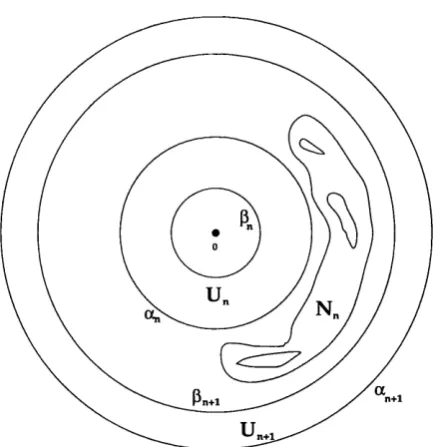
If we w rite m = nk, then f ^ { N n ) C Un- See Figure 2.3 where th e com ponents Un are shown schematically as if they were circular annuli. W ith the above argum ent we shall
Nn-2 .7 P re lim in a ry lem m as 26
Fig. 2.3: The component Nn of F{ f ) between Un and Un+i
Lem m a 8 . Nn is a multiply-connected component o f F(f ).
Proof. We know th a t d f ^ { N n ) C f ^ ( d N n ) is tru e for all bounded domains. In
our case we also have d f ^ ( N n ) D f ^ { d Nn ) - In effect we take w € f ^ { d N n ) then
w = f ^ { z i ) ^ zi £ dNn- Then zi £ J { f ) which implies w £ J { f ) . Thus w 0 / ”^(A^n)-
B ut also there exists a sequence Zy £ such th a t Zy —>■ zi so f ^ { z y ) £ Un and
f ^ { z y ) —>■ f ^ { z i ) = w so w £ f ^ { N n ) . Hence w £ d f ^ { N n ) . Now since d f ^ { N n ) =
f ^ { d N n ) we have th a t if dNn is connected ( -O- Nn simply-connected), then f^ { d N n )
is connected and so f ^ [ N n ) = Un is simply-connected which is a contradiction.
One may also derive Lemma 8 from the Riemann-Hurwitz formula.
Lem m a 9. Nn does not wind round zero i.e., zero is in the unbounded component of Nn
fo r n > no.
Proof. If Lemma 9 is false then Nn^ has at least two components, one G, say, contain
ing zero, another, H , unbounded. Now G is simply-connected and dG is a continuum.
Take (3 = dG and an as in Lemma 7, so dG C dNn C J { f ) then j3 is outside Un- Also
there exists some m such th a t f ^ { N n ) C
Un-We see th a t C f ^ ( d N n C d ( f ‘^ ( Nn) ) C dUn then C dUn so this is
inside or on Now G D Un so f ^ { G ) D / ’^(C/n) = thus d f ^ ( G ) C f ^ { d G ) =
an-2 .8 P r o o f o f th e m ain th e o rem 27
Since f ^ { G ) contains Un+m outside it must contain all points outside 0!„. But
f ^ { G ) must be bounded (see Figure 2.3). This contradiction shows th a t the lemma is
valid.
2.8
P r o o f o f th e m ain theorem
We shall need a lemma which was proved by L. Ahlfors [1], see [5] for its use in
iteration theory.
Le m m a 10. Let f { z ) be meromorphic in the disc \z\ < R and let E \ ^ .. .E ^ be
simply-connected regions o f the w- plane bounded by sectionally analytic Jordan curves and such
that the closures o f Ei are mutually disjoint. Then there is a constant G which depends
only on the regions Ei and not on f {z ) such that, provided that
A i r (0)1
^
_1 + I/(0 )P ’
the disc \z\ < R contains a domain which is mapped univalently by f { z ) onto one o f the
Ei.
Th e o r e m 2.8.1. I f f {z ) is a transcendental entire function and F{ f ) has a
multiply-connected component, then J ( / ) has some single point component {C} 7^ oo which is a
buried component o f J ( /) . Such points are dense in J ( /) .
Proof. Let ^ be any point of J { f ) and take a neighbourhood V such th a t ^ G y .
Now pick a repelling periodic point rj with period p ( f^{r}) = rj, | {f^Y{r)) |> 1). We
can assume V to be D{tj, R) and choose m £ N so th a t the spherical derivative of
a t Tj is
„(fmp _ I
irn'iv)
I _ I
{FYiv)
r
W
1+
1/"»’(>;) P l + h l ^ ’
which satisfies R p ^ f ^ ^ , rj) > G, where C is a certain constant to be defined below.
Pick Nn as in Lemmas 8 and 9 for five different values of n = Ui, w rite = Ni
and let 1 < z < 5, be simply connected regions of the lü-plane with sm ooth boundary
such th a t Ni C Ei and the closures of the Ei are mutually disjoint.
Then it follows from Lemma 10 th a t there is a C which depends only on the regions
E l , . . . , Es and not on f {z ) such th a t Rp{f ^^, T}) > G implies th a t the disc D{r], R)
2.8 P r o o f o f th e m ain th e o rem 28
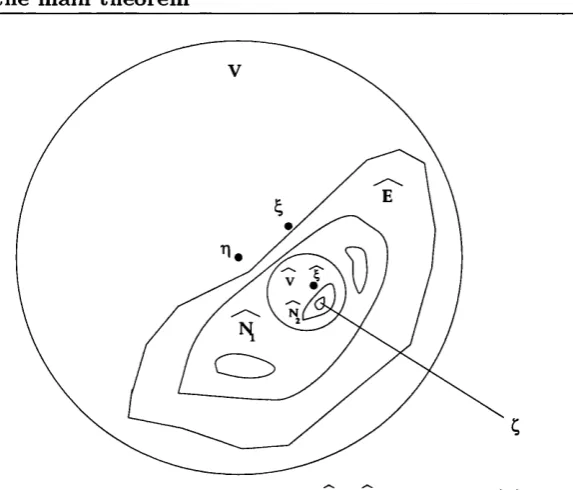
Fig. 2.4: The points ^ E F and ^ £ V belong to J ( / )
In particular maps a subset N i of E univalently onto and N i is thus a
multiply connected component of F{ f ) which lies entirely inside V. Now since N \ is
multiply-connected, there is some point ^ of J { f ) which lies inside the outer boundary
of Ni .
We repeat the above argum ent using a neighbourhood ÿ of ^ so small th a t V is
inside the outer boundary of TVi, see Figure 2.4, then V contains a multiply-connected
component N2 of F ( f ) which is mapped onto one of the Ei by some f^ 'p ' where we
may take the m 'p' arbitrarily large, so large th a t m 'p' > m p {N2 ^ N i because Nn are
wandering domains).
Thus N2 is inside one of the inner boundary com ponents of so we obtain
inductively a sequence of different multiply-connected components Nk of F { f ) with
diam(jV)k) 0 and Nk+i is inside one of the inner boundary com ponents of Nk- A
sequence ^k E d{Nk) is a Cauchy sequence which converges to a point E J { f )
c H A P T E R 3
Self-m aps o f th e p u n ctu red plane
3.1
Introduction to C hapter 3
Let / be a non-Mobius analytic self-map of C*. W rite for th e Julia set of /
in C* and J ( / ) for the closure of J * (/) in C. Then we have one of the three cases (i)
J ( / ) , J * ( /) are connected, (ii) J ( / ) is connected, J * ( /) has infinitely many components,
(iii) J { f ) has two components, J*{f ) has infinitely many components. All three cases
can occur.
It is known th a t F{ f ) has at most one multiply-connected domain A whose connec
tivity m ust in fact be two. If in addition A is relatively com pact in C*, then either
(i) A is a Herman ring,
(ii) A is pre-periodic but not periodic, or
(iii) A is a wandering component.
Example of all three cases are constructed.
Let f { z ) be an analytic self-map of a domain D of C . Complex dynamics studies the
Fatou set, E ( / ) , which is defined as the maximal open subset of D where the iterates
{ f ^ } of f {z ) form a normal family. The complement of F{ f ) is the Julia set. By
M ontel’s theorem the theory is trivial unless the complement of D contains fewer than
three points. We may therefore consider the cases I. D = C , f { z ) rational, II. Z) = C,
f { z ) entire, and III. D = = {z : 0 < \z\ < oo}. Case I has been well studied, see e.g.
the book [20]. Case II was first studied by Fatou [40] in 1926, see e.g. [21] for a survey.
Case III was first studied by Radstrom [67] in 1953 and then by P. B hattacharyya [25]
and later by e.g. [12, 36, 37, 38, 48, 49, 51, 52, 55, 56, 58]
Throughout the chapter we shall exclude the possibility th a t f { z ) is a constant or a
Mobius transform ation. Then, provided we make the normalisation th a t if f { z ) has ju st
one essential singularity this is at oo, we have the following cases for f {z) .
(a) f ( z ) = kz'^, fc / 0, n G Z, n 7^ 0, ±1,
(b) f { z ) = exp(^(z)), g{z) non-constant entire, n G N U {0},
(c) f { z ) = exp(5f(z)), g(z) non-constant entire, n G N ,
(d) f ( z ) = z'^ exp{gf(z) -|- h (J)} , g{z), h(z) non-constant entire functions, m G Z.
3.1 In tr o d u ctio n to C h ap ter 3 30
To emphasize th a t we are working in C* we shall write J * (/) (which of course is a
subset of C*) for the Julia set of f {z) . We write Jo{f ) for the Julia set of an entire
function in C and J { f ) for the closure of J * (/) or Jo{f ) in C.
Given an analytic self-map f { z ) of C* and 7t(z) = exp(z) or exp(zz), there exists an
entire function g{z) such th a t the diagram
7r | | 7T (3.1)
/
C* C ,
commutes. It was shown by Bergweiler [22] th a t, provided f { z ) is not linear or constant,
so provided g{z) is not of the form g{z) = A:z” , 0, n G Z, we have
(3.2)
The principle has been asserted by various authors bu t the first rigorous proof valid
in this generality appears to be th a t of Bergweiler.
We note th a t if 7t(z) = exp(z) the function g{z) in (3.1) has the property g{z-\-27ri) =
g{z) + 27rmz for some integer m.
In view of (3.1) and (3.2) it is not surprising th a t the dynamics of f { z ) has similar
properties to the entire case. We mention the following, first proved directly by R adstrom
[67] or B hattacharyya [25].
(A) J * ( /) is a (non-empty) perfect set in C*. It is completely invariant (that is f { z ) G
J*{f ) if and only if z e J * ( / ) / For p G N , J*{f ^) = J*{f ).
(B) Repelling periodic points are dense in J* ( /) .
(C) I f A is an open set which meets J * ( /) and K is any compact subset o f C*, then
there is a natural number no such that fo r n > no we have / ”'°(A) D K .
Concerning components of the Fatou set we have the following theorem given by I.N.
3.1 In tr o d u c tio n to C h a p ter 3 31
Th e o r e m 3.1.1. I f f {z ) is a (non-Mobius) analytic map o f to itself, then the com
ponents o f F {f ) are simply or doubly-connected. There is at most one doubly-connected
component, (which must separate 0 from oo) except in the simple case when f [ z ) has the
form f { z ) = kz'^. A; 7^ 0, n G Z, n / 0, ± 1.
— 1
For f { z ) = kz'^ it is clear th a t J*( f ) is the circumference \z\ = and F { f ) has
two com ponents, each a punctured disc.
Since Theorem 3.1.1 is basic to our results, for completeness we give in Section 3.2 a
proof which is ju s t a little simpler than th a t given in Section 3 of [1 2].
We study th e connectivity of the Julia set in Section 3.3 and prove the following
results.
T h e o r e m 3.1.2. I f f ( z ) is a transcendental map o / C * - 4 C*, then J * ( / ) has no compo nent A compact in C*; in particular has no singleton component.
We rem ark th a t this contrcists with the entire case where it is indeed possible th a t
for an entire function h{z) singleton components are dense in the Julia set of h{z), see
C hapter 2, Section 2.8.
Concerning the number of components of J { f ) , we have th a t J { f ) has either one or
two components, each of which contains 0 or 0 0, except in the trivial case f { z ) = kz'^.
T h e o r e m 3.1.3. I f f {z ) is an analytic self-map 0/ C*, then J * ( / ) has either one or infinitely m any components.
Co r o l l a r y. I f J { f ) has two components, then has infinitely m any components.
Also in Section 3.3 we see th a t there are only three possible cases for the connectivity
o f J { f ) , M f ) :
(1) J { f ) , J * ( /) are both connected,
(2) J { f ) is connected, J * (/) has infinitely many components,
(3) J { f ) has two components, J * ( /) has infinitely m any components,
and we give some examples of the three cases.
A com ponent (or a point) of J^{f ) is ‘buried’ if it does not meet the boundary of
any com ponent of F{ f ) . In Section 3.4 we give some examples when buried com ponents
3.1 In tr o d u c tio n to C h ap ter 3 32
A com ponent G of F{ f ) maps under f ( z ) to another component. If f ^ { G ) ^ f ^ { G)
for all m / 71 G N we say th a t G is wandering. Otherwise G is preperiodic or periodic.
It was shown in [12] th a t wandering components can occur. On the other hand, several
authors [9, 1 0, 1 1, 34, 46, 67] have shown th a t Sullivan’s theorem may be extended to
a class of maps of C*: if the inverse function of f { z ) has singularities over a t most
finitely many points then F{ f ) contains no wandering domains.
The behaviour of the sequence of iterates in a periodic component of F { f ) has the
same range of possibilities as for general meromorphic functions, th a t is, the cases which
arise from either rational or entire maps. W ithout loss of generality we may consider an
invariant com ponent G. This may be either a Siegel disc, a Herman ring, or the iterates
may converge to a constant o;, which is an attracting fixed point if a G G, is a parabolic fixed point w ith f'{oi) = 1 if a G dG \ {0, oo}, or may be 0 or oo. See e.g. [21].
In Section 3.5 we consider the orbit of the unique doubly-connected com ponent A (if
there is one) and discuss the possibilities for A and its orbit. In examples given by I.N
Baker [12] and A.N. Mukhamedshin [58] is not clear w hether the ring A has 0, oo in its
boundary. Concerning ring domains we prove the following theorem.
Th e o r e m 3.1.4. I f A is a doubly-connected component o f F{ f ) fo r a self-map f { z ) of
C* and A is relatively compact in C*, then either
(i) A is a Herman ring,
(ii) A is pre-periodic hut not periodic, or
(iii) A is a wandering component.
In cases (ii) and (iii) all f ^ { A) are relatively compact simply-connected components.
Examples of all three cases occur and we use Runge’s theorem and complex approx
im ation theory to prove Theorem 3.1.5 in Section 3.6.
Th e o r e m 3.1.5. There is an analytic self-map f {z ) o f C* such that F { f ) contains a
relatively compact doubly-connected component A, bounded by two Jordan curves in C*,
and a simply-connected component G, bounded by a Jordan curve. Moreover G contains
an attracting fixed point, f { G) C G and f { A) = G. Thus A is preperiodic but not
periodic.
In particular there are a constant k and a polynomial g{z) such th a t f { z ) = exp{4e(z-|-
z~^) k g (z)} has the properties listed in Theorem 3.1.5 for some small e > 0. Thus
3.2 C o m p o n en ts o f th e F atou set 33
In Section 3,7 we use stronger approximation theorems to give an example of case
(iii).
Th e o r e m 3.1.6. There is an analytic self-map f { z ) o /C * such that F { f ) contains a rel
atively compact doubly-connected component A and a relatively compact simply-connected
component G, such that G is a wandering component in which —> oo, and f { A ) = G.
In Section 3.8 the case (i) is covered by the following theorem. The argum ent is
given in a m anuscript of M.R. Herman [47] who describes it as a generalisation of a
construction of E. Ghys. He constructs a rational function but the m ethod is equally
applicable to transcendental functions.
Th e o r e m 3.1.7. There is an analytic transcendental self-map f { z ) o /C * such that F{ f )
has a relatively compact doubly-connected component A which is a Herman ring, whose
boundaries are quasicircles in C*
In Section 3.9 we discuss examples of a doubly-connected component A which extends
to 0 and oo.
3.2
C om ponents o f th e Fatou set
For completeness we shall give the proof of the following lemmas. The proof of 11
and 12 differs somewhat from th a t given in [12]. Together these lemmas imply Theorem
3.1.1.
L em m a 1 1. Suppose that f [ z ) ^ kz"^ is an analytic self-map o f C* and that G is a component of F[ f ) . Then if ^ is a simple closed curve in G, either (i) j separates 0, oo
or (ii) the complement o f j has a relatively compact component which belongs to G.
Proof. Suppose th a t neither (i) nor (ii) holds. Thus 7 is a simple closed curve in G
such th a t C* \ 7 has a component A, with A com pact in C*, which meets </♦(/). Then
/""(A) covers any compact part of C* for n > no.
Let f'^’^ be uniformly convergent on 7 . Since ^ 0, 0 0 in G, it follows from
H urw itz’s theorem th a t the limit function (p is either (a) never equal to 0, 0 0 in G or (b)
a constant. In case (a) (f>(y) is bounded away from 0, 0 0 which contradicts the above
![Figure computed by the boundary game method of Weinreich [72]](https://thumb-us.123doks.com/thumbv2/123dok_us/8616539.1406247/9.595.80.484.183.649/figure-computed-boundary-game-method-weinreich.webp)


![Fig. 4.6: T = S n {z : \z - 7t\ > p]](https://thumb-us.123doks.com/thumbv2/123dok_us/8616539.1406247/80.595.118.426.95.348/fig-t-s-n-z-z-t-p.webp)