ISSN (Print) : 2320 – 3765 ISSN (Online): 2278 – 8875
I
nternational
J
ournal of
A
dvanced
R
esearch in
E
lectrical,
E
lectronics and
I
nstrumentation
E
ngineering
(An ISO 3297: 2007 Certified Organization)
Website: www.ijareeie.com
Vol. 6, Issue 3, March 2017
Density Based Traffic Light Control System
Using Image Processing
D.Prakash(1),B.Sandhya Devi(2) , R.Naveen Kumar(3), S.Thiyagarajan(4), P.Shabarinath(5)
Assistant Professor, Department of Electrical and Electronic Engineering, S.A. Engineering College, Chennai, India1
UG Scholar, Department of Electrical and Electronic Engineering, S.A. Engineering College, Chennai, India 2,3,4
Managing Director, Respro Labs, Chennai, India5
ABSTRACT: Nowadays, the number of road users constantly increases; vehicle population also increased to an extreme level. So the traffic problem causes major time delay and more issues. So, we are in need to find better solution for traffic control. There are several types of traffic control system; we focus on optimization of traffic light controller in a city using image processing.
To overcome this problem, this proposed system contains camera and microcontroller to process image and measures density of traffic and the traffic controller changes signal timing automatically based on the traffic density at junction and the cameras are mounted on roadside respectively. This project is to design a density based dynamic traffic control system. The number of vehicles passing on road is get counted by microcontroller. The microcontroller takes decision based on different vehicles count, and updates the traffic light delays as a result. The traffic light is situated at a certain distance away from the camera system. In the proposed system, we measure the traffic density using image processing by matlab and ARM processor to control the traffic signal.
KEYWORDS: Matlab, ARM, HEX code, RISC, CISC, LPC, UND, ABT
I. INTRODUCTION
As the number of road users constantly uprighed, and resources provided by current infrastructures are not get satisfied, intelligent control of traffic will become a very important research criteria in the future. However, some limitations to the usage of intelligent traffic control exist. There are several models for traffic simulation; we focus on optimization of traffic light controller using image processing and microcontroller. The traffic control system reduces possibilities of traffic jamsbased on vehicle density calculation to an extent.
OBJECTIVE OF THE PROJECT
ISSN (Print) : 2320 – 3765 ISSN (Online): 2278 – 8875
I
nternational
J
ournal of
A
dvanced
R
esearch in
E
lectrical,
E
lectronics and
I
nstrumentation
E
ngineering
(An ISO 3297: 2007 Certified Organization)
Website: www.ijareeie.com
Vol. 6, Issue 3, March 2017
II. GENERAL BLOCK DIAGRAM
OVERALL BLOCK DIAGRAM
Figure 1 Flow of operation
BLOCK DIAGRAMDESCRIPTION
The Figure 1 shows the flow of operation of vehicle detection and counting vehicles and vehicle density from an image using matlab and ARM development board and LPC 2148 microcontroller pre-doctered images are processed in matlab and its density is calculated. A microcontroller, LPC2148 ARM processor is used to control the traffic signal. The road density data of four roads was sent to arm processor and corresponding road signal with highest road density signals green colour.
III.SIMULATION DESCRIPTION
MATLAB CODE
MATLAB is a software package for computation in engineering, science, and applied mathematics. It offers a powerful programming language, with a wide range of expert knowledge and excellent graphics. MATLAB is published by and a trademark of The Math WorksInc .The focus in MATLAB is on computation, not mathematics, Symbolic expressions and manipulations are not possible.The pre-doctered image is fed to matlab and is converted into a readable matrix data using “imread” command in Matlab
i.imread Syntax
A = imread(filename, fmt)
The text string fmt specifies the format of the file by its standard file extension. . If imread cannot find a file named filename, it looks for a file named filename.fmt.
ISSN (Print) : 2320 – 3765 ISSN (Online): 2278 – 8875
I
nternational
J
ournal of
A
dvanced
R
esearch in
E
lectrical,
E
lectronics and
I
nstrumentation
E
ngineering
(An ISO 3297: 2007 Certified Organization)
Website: www.ijareeie.com
Vol. 6, Issue 3, March 2017
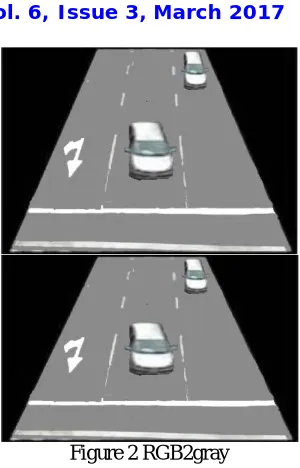
Figure 2 RGB2gray
The Figure 2 shows the Conversion of RGB image or colourmap to Gray scale
IV. HARDWARE DESCRIPTION
POWER SUPPLY
There are many types of power supply. Probably most of them are designed to convert high voltage to low DC voltage supply for electronic circuits. A power supply can by broken down into a series of blocks, each of which performs a particular function.
Figure3Regulated power supply system
Each of the blocks in Figure 3 is described in more detail below: Transformer - steps down high voltage AC mains to low voltage AC. Rectifier - converts AC to DC, but the DC output is varying.
Smoothing - the DC from varying greatly to a small ripple gets smoothes. Regulator - eliminates ripple by setting DC output to a fixed voltage.
ISSN (Print) : 2320 – 3765 ISSN (Online): 2278 – 8875
I
nternational
J
ournal of
A
dvanced
R
esearch in
E
lectrical,
E
lectronics and
I
nstrumentation
E
ngineering
(An ISO 3297: 2007 Certified Organization)
Website: www.ijareeie.com
Vol. 6, Issue 3, March 2017
The secondary output of transformer is connected to regulator through full bridge rectifier and filtering capacitor. Diode is used for convert the AC voltage to DC voltage with AC ripples; capacitor is used for remove the AC ripples. Regulator output is regulating the DC output voltage. The Figure 3.2 gives the regulated supply.
THE ARM ARCHITECTURE
The ARM architecture is a 32-bit. Because of their power saving features, ARM CPUs are dominant in the mobile electronics market, where low power consumption is a critical design goal.
ARM Limited has incorporated a novel mechanism, called the Thumb architecture. The Thumb instruction set is a 16-bit compressed form of the original 32-16-bit ARM instruction set, and employs dynamic decompression hardware in the instruction pipeline.
ARM Limited has incorporated a novel mechanism, called the Thumb architecture. The Thumb instruction set is a 16-bit compressed form of the original 32-bit ARM instruction set, and hardware in the instruction pipeline gets employs dynamic decompression.
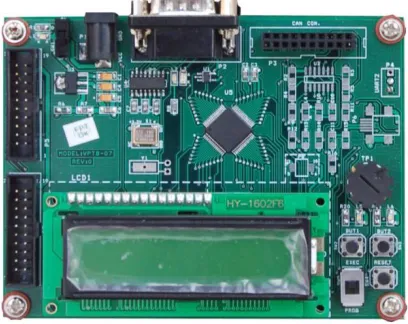
Figure 5 ARM development board
The ARM architecture is based on Reduced Instruction Set Computer (RISC) principles. The instruction set of RISC and related decode mechanism are much simpler than those of Complex Instruction Set Computer (CISC) designs. 32-bit ARM instruction set for maximum flexibilityand performance
16-bit Thumb instruction set for increased code density
Registers
ARM processors have 37 registers. The registers of ARM processor are arranged in a criteria of partially overlapping banks. There is a different register bank for each processor mode.
i. 30 general-purpose, 32-bit registers (GPR) ii. The program counter (PC)
iii. The Current Program Status Register (CPSR) i.Five Saved Program Status Registers (SPSR).
The general-purpose registers R0 to R15 can be split into three groups.
ARM Processor Modes
ISSN (Print) : 2320 – 3765 ISSN (Online): 2278 – 8875
I
nternational
J
ournal of
A
dvanced
R
esearch in
E
lectrical,
E
lectronics and
I
nstrumentation
E
ngineering
(An ISO 3297: 2007 Certified Organization)
Website: www.ijareeie.com
Vol. 6, Issue 3, March 2017
Pipelining
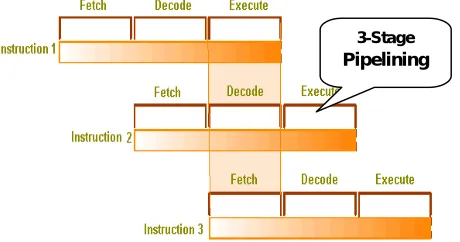
Pipelining, a standard feature in RISC processors, is much like an assembly line. Because the processor workstart the same time on different steps of the instruction, more instructions can be executed in a shorter period of time.
The original 3-stage ARM pipeline in Figure 3.4 is give that remained essentially unchanged from the first ARM processor.It is a classical fetch-decode-execute pipeline, which completes one instruction per cycle. Instruction cycle consists of the operations such as
1. Instruction fetched from memory 2. Decoding of registers used in instruction
Register(s) read from register bank, Shift and ALU operation, Write register(s) back to register bank
Figure 6 stage Pipelining
LPC2148 MICROCONTROLLER
Philips has developed a family of ARM-based Microcontrollers For the purpose of low –cost high volume applications with Embedded Flash and SRAM,
On-board AMBA-bus Peripherals (Advanced Microcontroller Bus Architecture) Real-Time Deterministic behavior (no Cache required)
Full Debug, Real-time Monitoring and Trace facilities
The LPC2148 can count external events on one of the capture inputs if the minimum external pulse is equal orlonger than a period of the PCLK. In this configuration, unused capture lines can be selected as regulator timer capture inputs
SPI serial I/O controller:
The LPC2148 contains one SPI controller. The SPI is a serial interface with full duplex, designed to handle multiple masters and slaves connected to a given bus.
SSP serial I/O controller:
The LPC2148 contains one SSP.It can interact with multiple masters and slaves on the bus. However, during a given data transfer only a single master and a single slave can communicate on the bus. The SSP supports full duplex transfers, with data frames of 4 bits to 16 bits of data flowing from the slave to the master from the master to the slave and. Often only one of these data flows carries meaningful data.
10-bit ADC:
The LPC2148 contains two analog to digital converters. While ADC0 has six channels, ADC1 has eight channels. Therefore, total number of available ADC inputs for is 14.
10-bit DAC:
The maximum DAC output voltage is the VREF voltage. The features include 10-bit DAC,Buffered output.
3-Stage
ISSN (Print) : 2320 – 3765 ISSN (Online): 2278 – 8875
I
nternational
J
ournal of
A
dvanced
R
esearch in
E
lectrical,
E
lectronics and
I
nstrumentation
E
ngineering
(An ISO 3297: 2007 Certified Organization)
Website: www.ijareeie.com
Vol. 6, Issue 3, March 2017
Watchdog timer:
The purpose of the watchdog is to reset the microcontroller for a reasonable time if it enters an erroneous state. When enabled, the system reset by watchdog will generate a if the user program fails to ‘feed’ (or reload) the watchdog within a predetermined amount of time.
Real-time clock:
The RTC real time clock is well designed to provide a set of counters to measure time when normal or idle operating mode is selected.
Memory Organization
The ARM7TDMI-S has Von Neumann architecture, carrying both instructions and data with a single 32-bit data bus. Only load, store, and swap instructions can access data from memory. Data can be 8-bit bytes, 16-bit half words, or 32-bit words. Words must be aligned to 4-byte boundaries. Half words must be aligned to 2-byte boundaries.
The LPC2148 incorporates several distinct memory regions, shown in the following figures. The basic concept on the LPC2148 is that each memory area has a "natural" location in the memory map. The bulk of each memory space remains permanently fixed in the same location, eliminating the need to have portions of the code designed to run in different address ranges.
Serial communication
It is the way that enables the different equipments to communicate to the outside world. It is called Serial because the data bits will be sent in a serial way over a single line
V. MODELLING OF THE PROTOTYPE
A Prototype Implementation
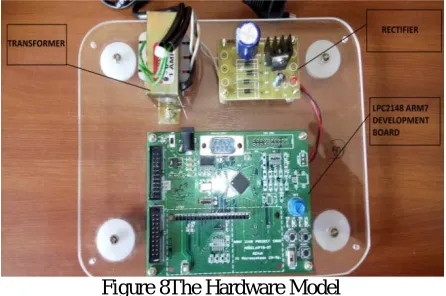
The prototype consist of several components such as the ARM development board, traffic signal, camera, sensors. The ARMdevelopmentboard consist of LPC2148 microcontroller which plays a major role. The traffic signal has a junction with the necessary component.
The first main component is the video camera sensor. It captures the images of traffic condition at every intersection of each lane. The next component is the traffic engine.
Figure 8The Hardware Model
ISSN (Print) : 2320 – 3765 ISSN (Online): 2278 – 8875
I
nternational
J
ournal of
A
dvanced
R
esearch in
E
lectrical,
E
lectronics and
I
nstrumentation
E
ngineering
(An ISO 3297: 2007 Certified Organization)
Website: www.ijareeie.com
Vol. 6, Issue 3, March 2017
VI. SIMULATION RESULTS
IMAGE CONVERSION CHART.
Figure 9Vehicle object extraction
The image conversion chart is shown in figure 9.The color image is converted to the gray scale image,which is then converted tothe black and white image.
VII.CONCLUSION
The method of vehicle detection and counting from an image has been implemented using matlab and ARM development board and LPC 2148 microcontroller pre-doctored images were processed in matlab and its density was calculated.
A microcontroller, LPC2148 ARM processor was used to control the traffic signal. The road density data of four roads was sent to arm processor and corresponding road signal with highest road density signals green colour. The accuracy of vehicle detection depends on the weather conditions.
Further modification in the algorithm can improve the system accuracy.ARM7 TDMI processor is used because of its fast processing power.so the hardware capability is enhanced.
FUTURE SCOPE
To realize the dream of developed India, we must have smart cities. To have smart cities, a smart commuting system must be implemented. We look forward to develop and implement this in the near future.
The future scope of this project lies in successful implementation of real time control system with the help of guidance from public transport authorities.System accuracy ispossible to be improved by further training or othermodification on the algorithm.
REFERENCES
[1] CelilOzkurt “Automatic Traffic Density Estimation And Vehicle Classification For Traffic Surveillance Systems Using Neural Networks. Mathematical and Computational Applications,” Vol. 14, No. 3, pp. 187- 196, 2009.
[2] Ronan O’Malley “Rear-Lamp Vehicle Detection and Tracking in Low- Exposure Color Video for Night Conditions”. IEEE Transactions on Intelligent Transportation Systems, Vol. 11, No. 2, June 2010
[3] WisnuJatmiko,,“Detection and Counting of Vehicles Based on Video Processing In Distributed Traffic System”, International Conference on Advance Computer Science and Information System 2010.
[4]EhsanAzimirad, NaserPariz, and M. BagherNaghibi Sistani.“A Novel Fuzzy Model and Control of Single Intersection at Urban Traffic Network”. IEEE Systems Journal, VOL. 4, NO. 1, MARCH 2010.
[5]W. Jatmiko,Hariyadi, F., Krisnadhi, A. A., Takagawa, I., Sekiyama, K., &Fukuda,ng Self-Organizing Urban Traffic Control Architecture Signal Control System And Simulator. “International Journal on Smart Sensing and Intelligent Systems” September 2010.