Heavy quark dynamics in the QGP:
Towards a solution of the
R
AAand
v
2puzzle
F. Scardina1,2, S. K. Das2, S. Plumari1,2 and V. Greco1,2
1Department of Physics and Astronomy, University of Catania,
Via S. Sofia 64, I-95123 Catania, Italy
2INFN-Laboratori Nazionali del Sud, Via S. Sofia 62, I-95123 Catania,
Italy
Abstract
The two key observables related to heavy quarks that have been measured in experiments are the nuclear suppression factorRAA and the elliptic flow v2. The simultaneous reproduction of these two ob-servables is a puzzle which have challenged all the existing models. We discuss two ingredients responsible for addressing a large part of such a puzzle: the temperature dependence of the energy loss and the full solution of the Boltzmann collision integral for the scattering between the heavy quarks and the particle of the bulk.
1
Introduction
trajectory of the heavy quarks. Therefore the propagation of heavy quarks has been usually treated as a Brownian motion that is described by means of the Fokker-Planck (FP) equation.
The two key observables related to HQ that have been measured in
experi-ments are the nuclear suppression factorRAA and the elliptic flowv2 [3–5].
Several theoretical efforts have been made to study theRAAand thev2
mea-sured in experiments within the Fokker Planck (FP) approach [6–9, 11, 12] and the relativistic Boltzmann approach (BM) [13–16]. However all the approaches show some difficulties to describe both the nuclear modification factor and the elliptic flow simultaneously.
To study the time evolution ofRAAandv2we have solved the Fokker Planck
(FP) equation stochastically in terms of the Langevin equation, for detail we refer to our previous work [11]. The evolution of the bulk is provided by
a 3+1D relativistic transport code tuned at fixedη/s [18] which is able to
reproduce the same results of hydrodynamical simulations. We have carried
out simulations ofAu+Aucollisions at √s= 200 AGeV for the minimum
bias. The HQ distribution in momentum space is in accordance with the one in proton-proton rescaled by the number of binary collisions. We have used three different modelings to calculate the drag coefficient. The diffu-sion coefficient is instead calculated in accordance with the Einstein relation
D= ΓET.
In the first modeling we have evaluated the drag coefficient from (pQCD) and we have considered elastic interaction among HQ and the bulk (light
quarks and gluons). The scattering matrix related to these processesMgHQ,
MqHQ and MqHQ¯ in leading order are the well known Combridge matrix.
The infrared singularity in thet-channel is regularized introducing a Debye
screening massmD =√4παsT with a running coupling.
We have also considered another modeling in which the drag coefficient is evaluated considering a bulk consisting of particles with a T-dependent quasi-particle masses, mq = 1/3g2T2,mg = 3/4g2T2. This model is able to
reproduce the thermodynamics of lattice QCD [20] (see also [21]) by fitting
the coupling g(T). Such a fit leads to the following coupling [20]:
g2(T) = 48π2
[(11Nc−2Nf)ln[λ(TTc − TTsc)]2
(1)
whereλ=2.6 and T/Ts=0.57.
Finally we have considered a model in which the light quarks and gluons are massless but the coupling is from the QPM as indicated in Eq. 1. This
0 1 2 3 4 5 6 7 pT (GeV)
0 0,5 1 1,5
RAA (pT
)
pQCD - K factor
QPM
Ds-QPM(T) BM Ds-QPM(T)
BM pQCD - K factor
Au+Au @ 200 GeV
0 0,5 1 1,5 2 2,5 3 3,5 4
pT (GeV)
0 0,02 0,04 0,06 0,08 0,1 0,12 0,14 0,16
v2 (pT
)
pQCD - K factor QPM
Ds-QPM(T)
BM pQCD - K factor BM Ds-QPM(T)
Au+Au @ 200 GeV
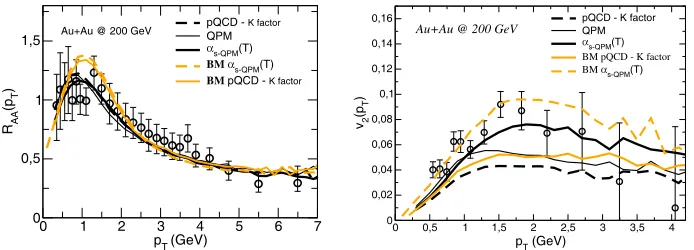
Figure 1: Comparison of the experimental data for theRAA (left) andv2 (right)at (200AGeV) with the results we get using the different models. See text.
to be considered as an expedient to have a drag which increases when the temperature decreases.
For all the three cases considered the interaction has been rescaled to
re-produce the RAA observed in experiments. We have performed simulations
of HQ propagation with the Langevin dynamics for the three different mod-els presented above. The Langevin equation gives as output the
momen-tum distributions of HQ at the quark-Hadron transition temperature Tc.
The momenta distributions are convoluted with the Peterson fragmentation functions of the heavy quark to get the momentum distribution of D and B mesons.
In Fig. 1 (left) the nuclear modification factorRAA of the D and B mesons
is shown as a function ofpT for RHIC (200AGeV). Instead in Fig. 1 (right)
the elliptic flow (v2) at the same energy as a function of pT is depicted. We
observe that the larger is the interaction in the region of low temperature the larger is the elliptic flow. The same conclusions has been discussed also in the light flavor sector as shown in Ref. [22]. The reason of such a strong dependence of the elliptic flow on the temperature dependence of the drag coefficient is due to the fact that the elliptic flow is generated in the final stage of the evolution of the fireball when the temperature is lower. This
is shown in the Fig. 2 where the RAA (left) and v2 (right) are depicted at
different times. We observe that the RAA is generated in the early stage of
the QGP when the temperature is larger and is not sensitive to the final stage of the evolution, while the elliptic flow is generated later. This results refer to the pQCD case, however the behavior is similar also for the other models.
0 1 2 3 4 5 6 7 8
pT (GeV)
0 0.5 1 1.5
RAA
(p
T
)
t=1 fm t=2 fm t=3 fm t= 4 fm
t=tmax
0 0.5 1 1.5 2 2.5 3 3.5 4 4.5 5
pT (GeV) 0
0.02 0.04 0.06 0.08 0.1
v2
(pT
)
t= 1fm t=2 fm t=3 fm t=4 fm t=tmax
Figure 2: RAA (left) and v2 (right) evaluated at different time at RHIC energies (200AGeV).
indicated here
pμ∂
μfQ(x, p) =C[fQ](x, p) (2)
whereC[fQ](x, p) is the relativistic Boltzmann-like collision integral which is
solved by means of a stochastic algorithm. We use the Boltzmann equation to describe the propagation of the heavy quark as well as the evolution of the bulk.
The comparison between LV and BM approach has been thoroughly studied in these references [15,16] where it is shown that for charm quark the results that one gets using the Fokker-Planck approach deviate significantly from those obtained using the Boltzmann approach and such a deviation signifi-cantly depends on the the values of the Debye screening mass, whereas for bottom quarks the FP is a very good approximation. We considered in
ref-erences [15, 16] three values of mD: 0.4 GeV, 0.83 GeV and 1.6 GeV. Here
we have not considered a fixed value of the Debye screening mass but a value
which depends on the temperature according to mD = gT. In Fig. 1 the
comparison for theRAA(left) andv2(right) at RHIC between the BM (light
gray lines) and the FP (black lines) are shown. We found that using the
BM for the same values of theRAA we get larger values forv2 with respect
to those obtained using the FP.
Our results show a non-negligible impact of the approximation in the colli-sion integral involved in the Fokker Plack equation on the relation between
RAA and v2. We found that for the same RAA we get a larger v2 using the
BM with respect to thev2 we get with the FP.
To summarize our results, regarding the different values of elliptic flow that can be obtained using the different models of energy loss, we have introduced
in Fig. 3 a new plot in which RAA vs v2 at a given momentum (pT = 1.3
0 0,02 0,04 0,06 0,08 0,1 v2(pT)
0 0,4 0,8 1,2 1,6
RAA (pT
)
RHIC data (pT=1.3 GeV)
pQCD -K factor QPM
Ds-QPM(T)
BM pQCD- K factor BM Ds-QPM(T)
Figure 3: RAA vs v2 obtained with the FP for the three different T-dependences of the drag coefficient with the experimental data at RHIC energy at pT = 1.3GeV. The open light gray simbols indicates the results obtained using the BM approach.
This plot clearly shows how the building up of the v2 can differ up to
a factor 3 for the same RAA depending on the temperature dependence of
the energy loss and on the approach used to describe the HQ propagation.
Other two ingredients that can have an impact on the relation betweenRAA
and v2 are the hadronization via coalescence that we are going to include
in our description and the role of the hadronic phase that we have studied in [23]. We have found in such a study that the hadronic medium further
enhance the v2 by around 20% without affecting the nuclear modification
factor.
Acknowledgments
The authors acknowledge the support by the ERC StG under the QGPDyn Grant n. 259684.
References
[1] Svetitsky B 1988 Phys. Rev.D37, 2484
[2] R.Rapp and H van Hees, R. C. Hwa, X. N. Wang (Ed.) Quark Gluon
Plasma 4, 2010,World Scientific,111
[3] B. I. Abeleb (STAR Collaboration), Phys. Rev. Lett.98, 192301 (2007).
[4] A. Adareet al.(PHENIX Collaboration) A. Adare et al. (PHENIX
Col-laboration), Phys. Rev. C84, 044905 (2011)
[5] B. Abelevet al.,(ALICE Collaboration) JHEP1209(2012) 112
[6] Hees H van, Greco V and Rapp R 2006Phys. Rev.C73, 034913; Hees
H van, Mannearelli M, Greco V and Rapp R 2008Phys. Rev. Lett.100
[7] Das S K, Alam J, Mohanty 2009Phys. Rev. C80054916;
[8] Alberico W M et al. 2011Eur. Phys. J.C 711666;
[9] S. Cao, G. Y. Qin and S. A. Bass, Phys. Rev. C 88(2013) 4, 044907
[10] M. He, R. J. Fries and R. Rapp, Phys. Rev. Lett.110, 112301 (2013)
[11] S. K. Das, F. Scardina, S. Plumari and V. Greco, Phys Lett. B747 (2015) 260-264
[12] F. Scardina,S. K. Das, S. Plumari,J. I. Bellone and V. Greco, arXiv:1509.01551
[13] Gossiaux P B, Aichelin J 2008Phys. Rev. C78014904
[14] Uphoff J, Fochler O, Xu Z and Greiner C 2011Phys. Rev.C84024908
[15] S. K. Das, F. Scardina, S. Plumari and V. Greco,Phys. Rev. C 90
044901 (2014)
[16] F. Scardina,S. K. Das, S. Plumari and V. Greco, J.Phys.Conf.Ser.
535 (2014) 012019; F. Scardina,S. K. Das, S. Plumari and V. Greco,
J.Phys.Conf.Ser.636 (2015) 012017
[17] Younus M, Coleman-Smith C E,Bass S A and Srivastava D K,
Phys.Rev. C91(2015) 2, 024912
[18] S. Plumari,A. Puglisi, F. Scardina and V. Greco, Phys. Rev. C 86
(2012) 054902
[19] V. Greco, C. M. Ko and P. Levai, Phys. Rev. Lett.90 (2003) 202302;
V. Greco, C. M. Ko and P. Levai, Phys. Rev. C68(2003) 034904
[20] S. Plumari, W. M. Alberico, V. Greco and C. Ratti, Phys. Rev. D,84,
094004 (2011)
[21] H. Berrehrah, E. Bratkovskaya, W. Cassing, P.B. Gossiaux, J. Aichelin,
and M. Bleicher, Phys.Rev. C89, 054901 (2014),
[22] F. Scardina, M. Di Toro and V. Greco, Phys. Rev. C82(2010) 054901.