Scholarship@Western
Scholarship@Western
Electronic Thesis and Dissertation Repository
9-24-2015 12:00 AM
Flows in Vibrating Channels
Flows in Vibrating Channels
Sahab ZandiThe University of Western Ontario
Supervisor
Dr. Jerzy Maciej Floryan
The University of Western Ontario
Graduate Program in Mechanical and Materials Engineering
A thesis submitted in partial fulfillment of the requirements for the degree in Master of Engineering Science
© Sahab Zandi 2015
Follow this and additional works at: https://ir.lib.uwo.ca/etd
Part of the Mechanical Engineering Commons
Recommended Citation Recommended Citation
Zandi, Sahab, "Flows in Vibrating Channels" (2015). Electronic Thesis and Dissertation Repository. 3250.
https://ir.lib.uwo.ca/etd/3250
This Dissertation/Thesis is brought to you for free and open access by Scholarship@Western. It has been accepted for inclusion in Electronic Thesis and Dissertation Repository by an authorized administrator of
(Thesis format: Monograph)
by
Sahab Zandi
Graduate Program in Mechanical and Materials Engineering
A thesis submitted in partial fulfillment of the requirements for the degree of
Master of Engineering Science
The School of Graduate and Postdoctoral Studies The University of Western Ontario
London, Ontario, Canada
ii
Abstract
A spectral algorithm based on the immersed boundary conditions (IBC) concept has been
developed for the analysis of flows in channels bounded by vibrating walls. The vibrations
take the form of travelling waves of arbitrary profile. The algorithm uses a fixed
computational domain with the flow domain immersed in its interior. Boundary conditions
enter the algorithm in the form of constraints. The spatial discretization uses a Fourier
expansion in the stream-wise direction and a Chebyshev expansion in the wall-normal
direction. Use of the Galileo transformation converts the unsteady problem into a steady one.
An efficient solver which takes advantage of the structure of the coefficient matrix has been
used. It is demonstrated that the method can be extended to more extreme geometries using
the over-determined formulation. Various tests confirm the spectral accuracy of the
algorithm. Pressure losses in these types of channels have been analyzed. Mechanisms of
drag generation have been studied. Analytical solutions have been determined in the limit of
long wavelength waves and small amplitude waves in order to simplify identification of these
mechanisms. The numerical algorithm has also been validated with the help of analytical
solutions. Detailed analyses of different cases, i.e. wave propagation along one wall and both
walls have been carried out. Different wave profiles have been considered in order to find
forms of waves which minimize pressure losses in vibrating channels. The results show
dependence of the pressure losses on the phase speed of the waves, with the waves
propagating in the downstream direction reducing the pressure gradient required to maintain
a fixed flow rate. A drag increase is observed when the waves propagate with a phase speed
similar to the flow velocity.
Keywords
Spectral discretization, vibrating walls, immersed boundary conditions method,
Navier-Stokes equations, pressure-driven flows, efficient solvers, over-determined formulation,
iii
Co-Authorship Statement
This dissertation is prepared in the monograph format. Sections 2, 3, and 4 are based on
manuscripts that have been previously published or finalized for submission.
Sections 2 and 3: S. Zandi, A. Mohammadi & J. M. Floryan, “Spectrally-Accurate
Algorithm for the Analysis of Flows in Two-Dimensional Vibrating Channels”, Journal of
Computational Physics 301 (2015) 425–455, DOI: 10.1016/j.jcp.2015.08.025.
Section 4: S. Zandi & J. M. Floryan, “Pressure Losses in Vibrating Channels”, in preparation
iv
Dedication
v
Acknowledgments
It is a pleasure to thank the many people who made this thesis possible. I greatly appreciate
the unparalleled assistance and encouragement of my supervisor Prof. J. M. Floryan. The
completion of this dissertation would not have been possible without his incomparable
assistance and invaluable guidance.
I would like to express my gratitude to the members of my advisory committee, Prof. C.
Zhang and Prof. A. G. Straatman for their invaluable suggestions and constructive comments.
I would also like to thank all of my colleagues (past and present), Dr. Alireza Mohammadi,
Dr. Hadi Vafadar Moradi, Md Nazmus Sakib, Amirreza Seddighi, Seyed Arman Abtahi and
Alan Kalbfleisch for their friendship and encouragement. I am particularly grateful to Alireza
not only for his insightful scientific comments but also because of support and motivation I
have received from him.
Words are not enough to express my gratitude towards my family. Without the unconditional
love, encouragement, tremendous patience and understanding of parents, Soheila and
Masoud, and my sister, Saghar, I would not have been able to accomplish my goals. I wish I
could show them how much I love and appreciate them.
Finally I would like to mention that the support from The University of Western Ontario and
the Natural Sciences and Engineering Research Council (NSERC) of Canada is gratefully
vi
Table of Contents
Abstract ... ii
Co-Authorship Statement ... iii
Dedication ... iv
Acknowledgments ... v
Table of Contents ... vi
List of Figures ... viii
List of Appendices ... xiv
List of Abbreviations, Symbols, Nomenclature ... xv
Section 1 ... 1
1 Introduction ... 1
Section 2 ... 6
2 Formulation of the Problem ... 6
2.1 Problem Formulation ... 6
Section 3 ... 9
3 Spectrally-Accurate Algorithm ... 9
3.1 Field Equations Suitable for the Numerical Solution ... 9
3.2 Discretization of the field Equations ... 12
3.3 Discretization of the Boundary Conditions ... 17
3.4 Evaluation of the Pressure Field ... 21
3.5 Solution Process ... 24
3.6 The Linear Solver ... 26
3.7 Performance of the Algorithm ... 28
3.8 The Over-Determined Formulation... 40
vii
4.1 Determination of Forces ... 49
4.2 Mechanics of Drag Generation ... 51
4.3 Waves with Small Amplitudes ... 62
4.4 Arbitrary Waves ... 67
4.4.1 Sinusoidal Waves on One Wall... 67
4.4.2 Sinusoidal Waves on Both Walls ... 75
4.4.3 Different Wave Profiles ... 77
Section 5 ... 81
5 Conclusions ... 81
References ... 83
Appendices ... 88
viii
List of Figures
Figure 2.1: Sketch of the flow domain. ... 7
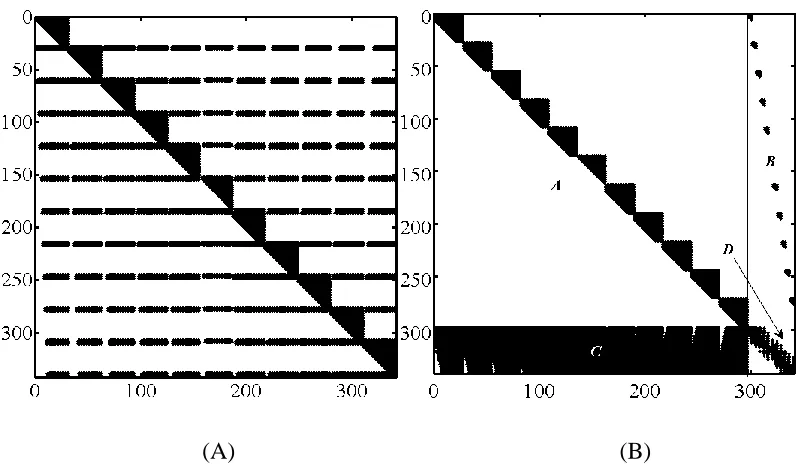
Figure 3.1: Structure of the coefficient matrix 𝐿 for 𝑁𝑀 = 5 and 𝑁𝑇 = 31. Black identifies
the non-zero elements. Figure 3.1A displays the coefficient matrix before the re-arrangement
whereas Figure 3.1B displays its structure after the re-arrangement (see Subsection 3.6). .. 28
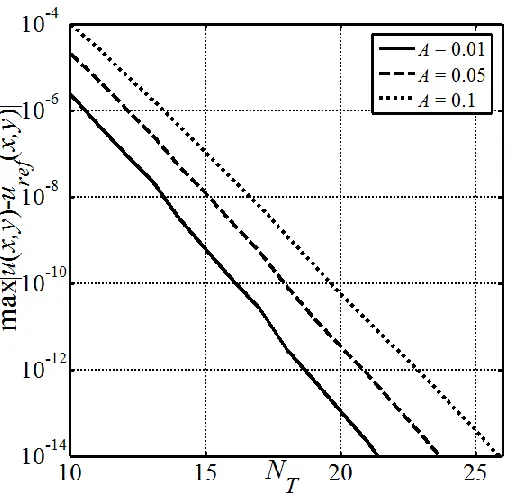
Figure 3.2: Variations of the error 𝐸𝑟 (see Eq. (3.65)) for the wave shape described by Eq.
(3.64) with the wave number = 1, Reynolds number 𝑅𝑒 = 5, phase speed 𝑐 = 1.3 and wave amplitudes 𝐴 shown on the graph. ... 30
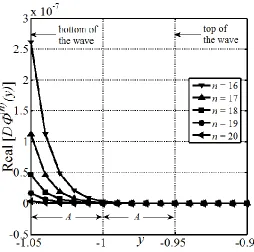
Figure 3.3: Distribution of the real part of 𝐷Ф(𝑛) as a function of 𝑦 for higher Fourier modes
(𝑛 > 15) in the region very close to the lower wall for the wave shape described by Eq.
(3.64) with the wave number = 5, amplitude 𝐴 = 0.05, Reynolds number 𝑅𝑒 = 5 and phase speed 𝑐 = 1.3 obtained using 𝑁𝑀 = 20 Fourier modes and 𝑁𝑇 = 80 Chebyshev
polynomials. .... ... 31
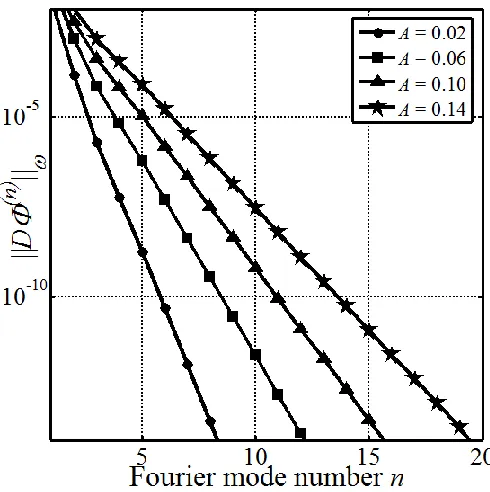
Figure 3.4: Variations of the Chebyshev norm of 𝐷Ф(𝑛) as a function of the Fourier mode
number determined for the wave shape described by Eq. (3.64) with the wave number = 1
and with different wave amplitudes 𝐴. Calculations were carried out for Reynolds number
𝑅𝑒 = 5 and wave phase speed 𝑐 = 1.3 using 𝑁𝑀 = 20 Fourier modes and 𝑁𝑇 = 80
Chebyshev polynomials. .... ... 32
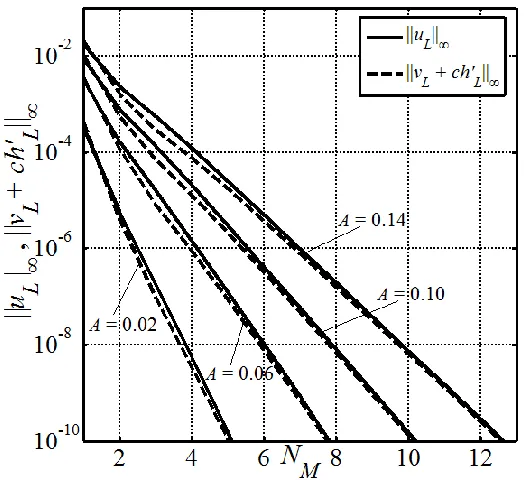
Figure 3.5: Variations of the ‖𝑢𝐿‖∞, ‖𝑣𝐿+ 𝑐ℎ𝐿′‖∞ norms as functions of the total number of
Fourier modes 𝑁𝑀 used in the calculation for the wave shape described by Eq. (3.64) with the
wave number = 1 and with different amplitudes 𝐴. Calculations have been carried out for Reynolds number 𝑅𝑒 = 5 and phase speed 𝑐 = 1.3 using 𝑁𝑇 = 80 Chebyshev polynomials.
... 33
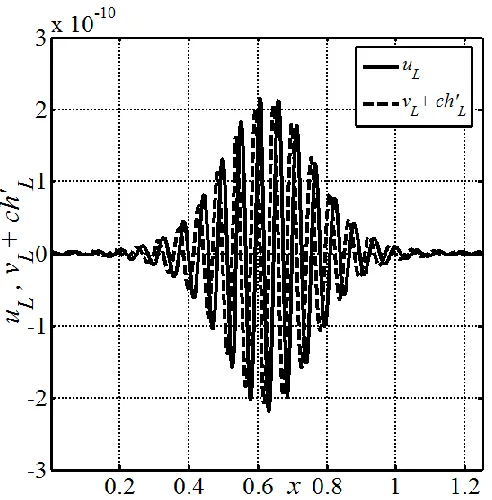
Figure 3.6: Distributions of the error in the enforcement of the boundary conditions along
the vibrating wall, i.e. 𝑢𝐿 and 𝑣𝐿+ 𝑐ℎ𝐿′, for the wave with shape described by Eq. (3.64) with
ix
𝑅𝑒 = 5 𝑐 = 1.3 𝑁𝑀 = 20 𝑁𝑇 = 80
Chebyshev polynomials. ... 34
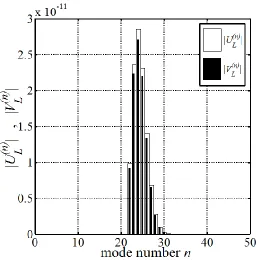
Figure 3.7: Fourier spectra of the error in the enforcement of the boundary conditions along
the vibrating wall, i.e. Eq. (3.68), for the wave with shape described by Eq. (3.64) with wave
number = 5 and amplitude 𝐴 = 0.05. Calculations were carried out for the Reynolds number 𝑅𝑒 = 5 and phase speed 𝑐 = 1.3 using 𝑁𝑀 = 20 Fourier modes and 𝑁𝑇 = 80
Chebyshev polynomials. The reader should note the absence of the first 20 Fourier modes. 35
Figure 3.8: Fourier spectra of 𝑢𝐿(𝑥) for the wave shape described by Eq. (3.64) with the
amplitude 𝐴 = 0.04 and wavelength 𝜆𝑥= 2𝜋/3. Solutions have been obtained in case A
using 𝑁𝑀 = 10 Fourier modes, in case B using 𝑁𝑀 = 20 Fourier modes, and in case C using
𝑁𝑀 = 30 Fourier modes. Calculations were carried out with Reynolds number 𝑅𝑒 = 5 and
phase speed 𝑐 = 1.3 using 𝑁𝑇 = 80 Chebyshev polynomials. ... 36
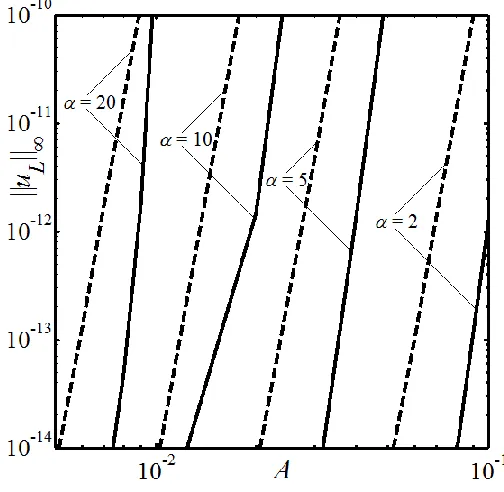
Figure 3.9: Variations of the ‖𝑢𝐿‖∞ norm for the wave shape described by Eq. (3.64) as a
function of the wave amplitude 𝐴 for selected wave numbers . Dashed and solid lines correspond to results obtained with 𝑁𝑀 = 15 and 𝑁𝑀 = 20 Fourier modes, respectively.
Calculations have been carried out for the Reynolds number 𝑅𝑒 = 5 and phase speed 𝑐 = 1.3
using 𝑁𝑇 = 80 Chebyshev polynomials. ... 37
Figure 3.10: Variations of the ‖𝑢𝐿‖∞ norm for the wave shape described by Eq. (3.64)as a
function of the wave number for selected amplitudes 𝐴. Dashed and solid lines correspond to results obtained with 𝑁𝑀 = 15 and 𝑁𝑀 = 20 Fourier modes, respectively. Calculations
have been carried out with Reynolds number 𝑅𝑒 = 5 and phase speed 𝑐 = 1.3 using 𝑁𝑇 =
80 Chebyshev polynomials. ... 38
Figure 3.11: Variations of the ‖𝑢𝐿‖∞ norm for the wave shape described by Eq. (3.64) with
the wave number = 2, the amplitude 𝐴 = 0.06 and the phase speed 𝑐 = 1.3 as a function of Reynolds number computed using different numbers of Fourier modes 𝑁𝑀 and 𝑁𝑇 = 80
Chebyshev polynomials. ... 39
Figure 3.12: Variations of the ‖𝑢𝐿‖∞ norm for the wave shape described by Eq. (3.64) with
x
phase speed 𝑐 determined using different numbers of Fourier modes 𝑁𝑀 and 𝑁𝑇 = 80
Chebyshev polynomials. ... 40
Figure 3.13: Structure of the coefficient matrix 𝐿0 for 𝑁𝑀 = 5, 𝑀𝑀 = 10 and 𝑁𝑇 = 31
resulting from the use of the over-determined IBC method. Black identifies the non-zero
elements. Figure 3.13A displays the coefficient matrix before the re-arrangement whereas
Figure 3.13B displays its structure after the re-arrangement (see Subsection 3.8). ... 43
Figure 3.14: Fourier spectra of the error in the enforcement of the boundary conditions along
the vibrating wall (see Eq. (3.68)) for the wave with shape described by Eq. (3.64) with wave
number = 5 and amplitude 𝐴 = 0.05. Calculations have been carried out for 𝑅𝑒 = 5 and
𝑐 = 1.3 using 𝑁𝑀 = 20 Fourier modes, 𝑀𝑀 = 30 boundary relations and 𝑁𝑇 = 80
Chebyshev polynomials. ... 44
Figure 3.15: Variations of the ‖𝑢𝐿‖∞ norm as a function of the wave amplitude 𝐴 for the
wave shape described by Eq. (3.64) with wave number 𝛼 = 2 and phase speed 𝑐 = 1.3 for
𝑅𝑒 = 1 resulting from the use of the over-determined method. Dashed and dotted lines
correspond to results obtained using the SVD and QR factorization techniques, respectively.
Calculations have been carried out using 𝑁𝑀 = 20 Fourier modes and 𝑁𝑇 = 100 Chebyshev
polynomials. ... 45
Figure 3.16: Variations of the ‖𝑢𝐿‖∞ norm as a function of the wave amplitude 𝐴 for the
wave shape described by Eq. (3.64) with phase speed 𝑐 = 1.3 and wave number 𝛼 = 2 for Re
= 1 determined using the over-determined formulation. Dashed and dotted lines correspond
to results obtained using SVD and QR factorization techniques, respectively. Calculations
have been carried out using 𝑁𝑇 = 100 Chebyshev polynomials and different numbers 𝑁𝑀 of
Fourier modes and an optimal number 𝑀𝑀 of boundary relations. ... 46
Figure 3.17: Plots of the velocity field in a vibrating channel whose geometry is described
by Eq. (3.75) with 𝛼 = 1, 𝐴 = 0.02, 𝑅𝑒 = 5 and 𝑐 = 1.3. The black dot represents a
reference point moving with the phase speed. Figures 3.17 A–D correspond to times𝑡 = 𝑡0,
𝑡 = 𝑡0 + 𝑇 4⁄ , 𝑡 = 𝑡0+ 𝑇 2⁄ , 𝑡 = 𝑡0+ 3𝑇 4⁄ , respectively, where 𝑇 = 2𝜋 𝛼𝑐⁄ stands for a
period of vibration and 𝑡0 denotes the time when the black dot was located at 𝑋 = 0. 𝑁𝑇 =
xi
Figure 4.1: Variations of the critical wave speed of the long wavelength waves as a function
of the wave amplitude 𝐴 for waves with profile described by Eq. (4.7). ... 59
Figure 4.2: Variations of forces acting on the fluid at the lower wall in the limit of 𝛼 → 0 as
functions of the wave speed 𝑐 for the wave form described by Eq. (4.7) with: (A) 𝐴 = 0.1;
(B) 𝐴 = 0.3; (C) 𝐴 = 0.5. Solid, dashed, dash-dotted lines and lines with circles on them
correspond to 𝑅𝑒 ∗ 𝐹𝑥,𝑣𝑖𝑠𝑐, 𝑅𝑒 ∗ 𝐹𝑥,𝑓𝑜𝑟𝑚, 𝑅𝑒 ∗ 𝐹𝑥,𝑖𝑛𝑡𝑒𝑟, and 𝑅𝑒 ∗ 𝐹𝑥,𝑡𝑜𝑡𝑎𝑙(= 𝑅𝑒 ∗ (𝐹𝑥,𝑣𝑖𝑠𝑐+
𝐹𝑥,𝑓𝑜𝑟𝑚+ 𝐹𝑥,𝑖𝑛𝑡𝑒𝑟)), respectively. ... 60
Figure 4.3: Variations of the norm ‖𝑑𝑝1⁄𝑑𝑥‖𝑚𝑎𝑥 as a function of the wave number 𝛼 for the
flow Reynolds numbers 𝑅𝑒 = 0.1 (dashed lines) and 𝑅𝑒 = 200 (solid lines) and phase speed
𝑐 = 1.3. ... 62
Figure 4.4: Variations of 𝑅𝑒(𝑑𝑝1⁄𝑑𝑥) as a function of phase speed 𝑐 for the wave form
defined by (4.45) for selected 𝛼 and 𝐴. Dashed and solid lines correspond to 𝑅𝑒 = 1 and
𝑅𝑒 = 200, respectively. ... 68
Figure 4.5: Variations of 𝑅𝑒(𝑑𝑝1⁄𝑑𝑥) as a function of the phase speed 𝑐 for the wave
profile defined by (4.45) with 𝑅𝑒 = 200 and 𝐴 = 0.03, and different wave numbers 𝛼. .... 69
Figure 4.6: Variations of forces per unit length of the channel acting on the fluid at (A) the
lower and (B) the upper walls as functions of the wave speed 𝑐 for the wave form described
by Eq. (4.45) with Reynolds number 𝑅𝑒 = 200, wave amplitude 𝐴 = 0.03, and wave
number 𝛼 = 2. Dashed, dotted, and solid lines correspond to viscous forces (𝐹𝑥,𝑣𝑖𝑠𝑐, 𝐺𝑥,𝑣𝑖𝑠𝑐),
pressure forces (𝐹𝑥,𝑝𝑟𝑒𝑠, 𝐺𝑥,𝑝𝑟𝑒𝑠), and total forces (𝐹𝑥,𝑡𝑜𝑡𝑎𝑙 = 𝐹𝑥,𝑣𝑖𝑠𝑐+ 𝐹𝑥,𝑝𝑟𝑒𝑠, 𝐺𝑥,𝑡𝑜𝑡𝑎𝑙 =
𝐺𝑥,𝑣𝑖𝑠𝑐+ 𝐺𝑥,𝑝𝑟𝑒𝑠 ), respectively. ... 70
Figure 4.7: Plots of velocity field in a vibrating channel whose geometry is described by Eq.
(4.45) with 𝛼 = 2, 𝐴 = 0.03, 𝑅𝑒 = 200. Figures 4.7 A–C correspond to 𝑐 = 0, 𝑐 = 0.58,
xii
Figure 4.8: Plots of 𝑅𝑒 ∗ 𝑝𝑇 in a vibrating channel whose geometry is described by Eq.
(4.45) with 𝛼 = 2, 𝐴 = 0.03, 𝑅𝑒 = 1. Figures 4.8 A–C correspond to 𝑐 = 0, 𝑐 = 0.58, and
𝑐 = 1, respectively. ... 72
Figure 4.9: Plots of 𝑅𝑒 ∗ 𝑝𝑇 in a vibrating channel whose geometry is described by Eq.
(4.45) with 𝛼 = 2, 𝐴 = 0.03, 𝑅𝑒 = 200. Figures 4.9 A–C correspond to 𝑐 = 0, 𝑐 = 0.58,
and 𝑐 = 1, respectively. ... 72
Figure 4.10: Variations of 𝑅𝑒(𝑑𝑝1⁄𝑑𝑥) as a function of the phase speed 𝑐 and the wave
number 𝛼 for the wave form defined by (6.1) with 𝐴 = 0.03 and: (A) 𝑅𝑒 = 1; (B) 𝑅𝑒 = 100;
(C) 𝑅𝑒 = 200. ... 73
Figure 4.11: Distributions of (A) the 𝑥-component of the shear force 𝑓𝑥,𝑣𝑖𝑠𝑐 and (B) the 𝑥
-component of the form force 𝑓𝑥,𝑓𝑜𝑟𝑚 and (C) the 𝑥-component of the interaction force 𝑓𝑥,𝑖𝑛𝑡𝑒𝑟
acting on the fluid at the lower wall and (D) the 𝑥-component of the shear force 𝑔𝑥,𝑣𝑖𝑠𝑐 acting
on the fluid at the upper wall for the wave profile described by (4.45) with 𝐴 = 0.03, 𝑅𝑒 =
1, and 𝛼 = 2. The solid, dashed, and dotted lines correspond to 𝑐 = −5, 𝑐 = 0, and 𝑐 = 5,
respectively. Thick and thin lines identify local and mean values, respectively. ... 73
Figure 4.12: Distributions of (A) the 𝑥-component of the shear force 𝑓𝑥,𝑣𝑖𝑠𝑐 and (B) the 𝑥
-component of the form force 𝑓𝑥,𝑓𝑜𝑟𝑚 and (C) the 𝑥-component of the interaction force 𝑓𝑥,𝑖𝑛𝑡𝑒𝑟
acting on the fluid at the lower wall and (D) the 𝑥-component of the shear force 𝑔𝑥,𝑣𝑖𝑠𝑐 acting
on the fluid at the upper wall for the wave profile described by (4.45) with 𝐴 = 0.03, 𝑅𝑒 =
100, and 𝛼 = 2. The solid, dashed, and dotted lines correspond to 𝑐 = −5, 𝑐 = 0, and 𝑐 = 5,
respectively. Thick and thin lines identify local and mean values, respectively. ... 74
Figure 4.13: Distributions of (A) the 𝑥-component of the shear force 𝑓𝑥,𝑣𝑖𝑠𝑐 and (B) the 𝑥
-component of the form force 𝑓𝑥,𝑓𝑜𝑟𝑚 and (C) the 𝑥-component of the interaction force 𝑓𝑥,𝑖𝑛𝑡𝑒𝑟
acting on the fluid at the lower wall and (D) the 𝑥-component of the shear force 𝑔𝑥,𝑣𝑖𝑠𝑐 acting
on the fluid at the upper wall for the wave profile described by (4.45) with 𝐴 = 0.03, 𝑅𝑒 =
200, and 𝛼 = 2. The solid, dashed, and dotted lines correspond to 𝑐 = −5, 𝑐 = 0, and 𝑐 = 5,
xiii
𝑐
Conditions in Figures 4.14 A–C are the same as conditions in Figures 4.11–4.13,
respectively. Solid, dashed, dotted, and dash-dotted lines and line with circles on it
correspond to 𝑓𝑥,𝑣,𝑚, 𝑓𝑥,𝑓,𝑚, 𝑓𝑥,𝑖,𝑚, 𝑔𝑥,𝑣,𝑚, and 𝑓𝑥,𝑡,𝑚(= 𝑓𝑥,𝑣,𝑚+ 𝑓𝑥,𝑓,𝑚+ 𝑓𝑥,𝑖,𝑚+ 𝑔𝑥,𝑣,𝑚),
respectively. ... 75
Figure 4.15: Variations of 𝑅𝑒(𝑑𝑝1⁄𝑑𝑥) as a function of the phase shift 𝜙 for the wave form
defined by (4.45) for selected 𝛼 and 𝐴 and: (A) 𝑐 = −5; (B) 𝑐 = 0; (C) 𝑐 = 5. Dashed and
solid lines correspond to 𝑅𝑒 = 1 and 𝑅𝑒 = 200, respectively. ... 76
Figure 4.16: Variations of 𝑅𝑒(𝑑𝑝1⁄𝑑𝑥) as a function of phase shift 𝜙 and the phase speed 𝑐
for the wave form defined by (4.45) with 𝛼 = 3, 𝐴 = 0.03 for 𝑅𝑒 = 1. ... 77
Figure 4.17: Triangular wave profiles used in the study. 𝐴, 𝜆 and 𝛼 = 2𝜋 𝜆⁄ denote the wave
amplitude, wavelength and wave number, respectively. ... 77
Figure 4.18: Variations of 𝑅𝑒(𝑑𝑝1⁄𝑑𝑥) as a function of 𝑎 𝜆⁄ for waves with triangular
profiles (see Figure 4.17) for selected 𝛼 and 𝐴 with: (A) 𝑐 = −5; (B) 𝑐 = 0; (C) 𝑐 = 5.
Dashed and solid lines correspond to 𝑅𝑒 = 1 and 𝑅𝑒 = 200, respectively. The reader may
note that 𝑎 < 𝜆 2⁄ corresponds to the waves tilting upstream. ... 78
Figure 4.19: Channel with triangular waves at both walls. The parametrization of each wave
is the same as in Figure 4.17. ... 79
Figure 4.20: Variations of 𝑅𝑒(𝑑𝑝1⁄𝑑𝑥) as a function of the phase shift 𝜙 for wave forms
defined in Figure 4.19 for 𝛼 = 1, 𝐴 = 0.01, 𝑎 𝜆 = 0.1⁄ and: (A) 𝑐 = −5; (B) 𝑐 = 0; (C) 𝑐 =
5. Cases A and B correspond to configurations A and B in Figure 4.19. Dashed and solid
xiv
List of Appendices
Appendix A: Evaluation of the inner products……….…….…….…88
Appendix B: Definitions of functions used in Subsection 4.2………...……….93
Appendix C: Definitions of functions used in Subsection 4.3……...……….95
xv
List of Abbreviations, Symbols, Nomenclature
Abbreviations
VOF Volume of fluid
MAC Marker and Cell
IBC Immersed boundary conditions
RHS Right-hand side
RF Relaxation factor
FFT Fast Fourier transform
SVD Singular value decomposition
Nomenclature used in Section 2
ℎ Half of the average channel height
𝑅𝑒 The flow Reynolds number
𝑢𝑚𝑎𝑥 Maximum of the streamwise velocity component of the reference
flow
(𝑡, 𝑋, 𝑌) Time-dependent physical coordinate system
𝜌, 𝜈 Density and kinematic viscosity
𝑢𝑇, 𝑣𝑇 Velocity components in the 𝑥- and 𝑦- directions
xvi
𝑢1, 𝑣1 Modification velocity components in the 𝑥- and 𝑦- directions
𝑝𝑇, 𝑝0, 𝑝1 Total pressure, reference pressure and pressure modification
𝑄0, 𝛹0 Flow rate and stream function of the reference flow
𝑌𝑈, 𝑌𝐿 Shapes of the waves at the upper and lower walls in the physical
coordinate system
ℎ𝑈, ℎ𝐿 Functions used to define Shapes of the waves at the upper and
lower walls in the physical coordinate system
𝐻𝑈〈𝑛〉, 𝐻𝐿〈𝑛〉 Fourier coefficients of wave geometries at the upper and lower
walls in the physical coordinate system
𝑐 Wave speed
𝛼 Wave number
𝑁𝐴 Number of Fourier modes used in description of wave geometry
𝑦𝑡, 𝑦𝑏 Upper and lower extremities of the flow domain
ℎ𝑈′, ℎ𝐿′ Derivative of ℎ𝑈′, ℎ𝐿′ with respect to time
𝑄 The net flow rate through vibrating channel
𝑈, 𝐿 Upper and lower walls (as subscript)
0,1 Reference flow and flow modifications (as subscript)
∗ Complex conjugate (as superscript)
〈𝑛〉 Fourier mode (as superscript)
xvii
(𝑥, 𝑦) Coordinate system after Galileo transformation
𝑦𝑈, 𝑦𝐿 Shapes of the waves at the upper and the lower walls in the
transformed coordinate system
𝛹𝑇, 𝛹0, 𝛹1 Total, reference and modification stream functions
𝑈𝑇, 𝑉𝑇 Velocity components in the 𝑥- and 𝑦- directions in the moving
reference frame
𝑈0, 𝑉0 Reference velocity components in the 𝑥- and 𝑦- directions in the
moving reference frame
𝑈1, 𝑉1 Modification velocity components in the 𝑥- and 𝑦- directions in the
moving reference frame
𝑃0, 𝑃1 Total pressure, reference pressure and pressure modification in the
moving reference frame
𝛹̅𝑇, 𝛹̅1 Total and modification stream functions in the moving reference
frame
𝑄̅ The flow rate through vibrating channel in the moving reference
frame
(𝑥, 𝑦̂) Computational coordinate system
𝛤 Constant of coordinate transformation for the IBC method
𝑢̂ , 𝑢1𝑢1 ̂, 𝑣1𝑣1 ̂1𝑣1 Velocity products in the physical space
𝑦̂𝑈, 𝑦̂𝐿 Shapes of the waves at the upper and the lower walls in the
computational coordinate system
𝐴𝑈〈𝑛〉, 𝐴𝐿〈𝑛〉 Fourier coefficients of waves geometries at the upper and lower
xviii
𝛷〈𝑛〉 Modal function in the Fourier expansion representing the stream
function
𝑁𝑀 Number of Fourier modes used for discretization in the 𝑥-direction
𝑢𝑢̂〈𝑛〉, 𝑢𝑣̂〈𝑛〉, 𝑣𝑣̂〈𝑛〉 Modal function of velocity products 𝑢̂ , 𝑢1𝑢1 ̂, 𝑣1𝑣1 ̂1𝑣1
𝐷 Derivative with respect to the transverse direction
𝐺𝑘〈𝑛〉 Chebyshev coefficients in Chebyshev expansion of 𝛷〈𝑛〉
𝑇𝑘 𝑘th Chebyshev polynomials of the first kind
𝑁𝑇 Order of Chebyshev polynomials used for discretization of the
modal functions in the 𝑦̂-direction
𝐺𝑢𝑢̂𝑘〈𝑛〉, 𝐺𝑢𝑣̂𝑘〈𝑛〉, 𝐺𝑣𝑣̂𝑘〈𝑛〉 Coefficients of the Chebyshev expansions of the modal functions in the Fourier expansions representing velocity products
𝑖 Imaginary unit
𝜔 Weight function
〈𝑓, 𝑔〉 Inner product of two functions
𝐹𝑈〈𝑛〉, 𝐹𝐿〈𝑛〉 Coefficients of Fourier expansions for 𝑢0(𝑦̂𝑈(𝑥)) and 𝑢0(𝑦̂𝐿(𝑥))
(𝑤𝑈)𝑘〈𝑚〉, (𝑤𝐿)𝑘〈𝑚〉 Coefficients of the Fourier expansions for the Chebyshev polynomials evaluated at the upper and lower walls
(𝑑𝑈)𝑘 〈𝑚〉
, (𝑑𝐿)𝑘
〈𝑚〉 Coefficients of the Fourier expansions for the first derivative of the
Chebyshev polynomials evaluated at the upper and lower walls
𝑁𝑆 Number of Fourier modes used to describe the Chebyshev
polynomials and their derivatives evaluated at the upper and lower
xix
𝑁𝑓 Number of Fourier modes in the Fourier expansions for the
modification velocity components evaluated along the walls
𝛩𝑈〈𝑛〉, 𝛩𝐿〈𝑛〉 Coefficients of Fourier expansions for 𝛹0,𝑈(𝑥) and 𝛹0,𝐿(𝑥)
𝐴𝑝 Pressure gradient correction
𝑝1〈𝑛〉 Modal functions of Fourier expansions for the periodic part of the pressure modification
𝛱𝑘〈𝑛〉 Coefficients of Chebyshev expansions for 𝑝1〈𝑛〉(𝑦̂)
𝑘 Iteration number
𝑁𝑥 Number of grids along 𝑥-direction in (𝑥, 𝑦̂) plane
𝑳, 𝒙, 𝑹 Coefficients matrix, vector of unknowns and right-hand side vector
for problem in (𝑥, 𝑦̂) plane
𝑨, 𝑩, 𝑪, 𝑫 Different sections of the rearranged coefficients matrix 𝑳
𝒙𝟏 Contains unknowns 𝐺
𝑘 〈𝑛〉
for 𝑛 ∈ 〈−𝑁𝑀, 𝑁𝑀〉 and 𝑘 ∈ 〈4, 𝑁𝑇− 1〉
𝒙𝟐 Contains unknowns 𝐺
𝑘 〈𝑛〉
for 𝑛 ∈ 〈−𝑁𝑀, 𝑁𝑀〉 and 𝑘 ∈ 〈0,3〉
𝐴 Wave amplitude
‖𝐷𝛷〈𝑛〉‖
𝜔 Chebyshev norm for 𝐷𝛷
〈𝑛〉
‖𝑢𝐿‖∞, ‖𝑣𝐿+ 𝑐ℎ𝐿′‖∞ 𝐿∞ norm of error in the enforcement of the boundary conditions
𝑈𝐿〈𝑛〉, 𝑉𝐿〈𝑛〉 Coefficients of the Fourier expansions for ‖𝑢𝐿‖∞ and ‖𝑣𝐿 + 𝑐ℎ𝐿′‖∞
𝜆 wavelength
over-xx determined formulation
𝑳𝟎, 𝒙, 𝒛𝟎 Coefficients matrix, vector of unknowns and right-hand side vector
for problem in (𝑥, 𝑦̂) plane using over-determined formulation
𝑯, 𝑲𝟎 Different sections of the rearranged coefficients matrix 𝑳𝟎
𝑳𝟎+ Generalized inverse of 𝑳𝟎
𝑸, 𝑹, 𝑹𝟏 Matrices used in QR factorization method
𝑼, 𝑺, 𝑽, 𝑺𝟏 Matrices used in SVD method
𝑨, 𝑩, 𝑪𝟎, 𝑫𝟎 Different sections of the rearranged coefficients matrix 𝑳𝟎
𝑡0 Time when the black dot was located at 𝑋 = 0 in Figure 3.17
𝑇 Period of vibration
𝐻 Conjugate transpose (as superscript)
𝑇 Transpose (as superscript)
Nomenclature used in Section 4
𝒏𝑈, 𝒏𝐿 Outwards normal unit vectors at the upper and lower walls
𝒏𝑈,𝑥, 𝒏𝑈,𝑦 Components of 𝒏𝑈
𝒏𝐿,𝑥, 𝒏𝐿,𝑦 Components of 𝒏𝐿
𝝈
⃗⃗ Stress tensor
𝜎𝑥𝑥, 𝜎𝑥𝑦, 𝜎𝑦𝑥, 𝜎𝑦𝑦 Components of stress tensor
𝑓, 𝑔 Distribution of the local forces action on the fluid at the lower and
xxi
𝑓𝑥, 𝑓𝑦, 𝑔𝑥, 𝑔𝑦 Components of 𝑓 and 𝑔
𝑓𝑥,𝑣𝑖𝑠𝑐, 𝐹𝑥,𝑣𝑖𝑠𝑐
Distribution of the 𝑥-component of local and total viscous forces
per unit length of the channel acting on the fluid at the lower wall
𝑓𝑥,𝑝𝑟𝑒𝑠, 𝐹𝑥,𝑝𝑟𝑒𝑠 Distribution of the 𝑥-component of local and total pressure forces
per unit length of the channel acting on the fluid at the lower wall
𝑓𝑦,𝑣𝑖𝑠𝑐, 𝐹𝑦,𝑣𝑖𝑠𝑐 Distribution of the 𝑦-component of local and total viscous forces
per unit length of the channel acting on the fluid at the lower wall
𝑓𝑦,𝑝𝑟𝑒𝑠, 𝐹𝑦,𝑝𝑟𝑒𝑠 Distribution of the 𝑦-component of local and total pressure forces
per unit length of the channel acting on the fluid at the lower wall
𝑔𝑥,𝑣𝑖𝑠𝑐, 𝐺𝑥,𝑣𝑖𝑠𝑐 Distribution of the 𝑥-component of local and total viscous forces
per unit length of the channel acting on the fluid at the upper wall
𝑔𝑥,𝑝𝑟𝑒𝑠, 𝐺𝑥,𝑝𝑟𝑒𝑠 Distribution of the 𝑥-component of local and total pressure forces
per unit length of the channel acting on the fluid at the upper wall
𝑔𝑦,𝑣𝑖𝑠𝑐, 𝐺𝑦,𝑣𝑖𝑠𝑐 Distribution of the 𝑦-component of local and total viscous forces
per unit length of the channel acting on the fluid at the upper wall
𝑔𝑦,𝑝𝑟𝑒𝑠, 𝐺𝑦,𝑝𝑟𝑒𝑠 Distribution of the 𝑦-component of local and total pressure forces
per unit length of the channel acting on the fluid at the upper wall
𝜉, 𝜂 Horizontal and vertical coordinates in the transformed coordinate
system
𝐹1, … , 𝐹8 Coefficients given in Appendix B
𝐺1, … , 𝐺3 Coefficients given in Appendix B
𝐻1, … , 𝐻11 Coefficients given in Appendix B
𝑢̃0, 𝑢̃1, 𝑣̃0, 𝑣̃1, 𝑝̃−1, 𝑝̃0 Terms in asymptotic expansions for velocity components and
xxii
𝑝̃̃−1 Normalized 𝑝̃−1 at a stationary point in the laboratory frame, say at
𝑋 = 0
𝐹𝑥,𝑓𝑜𝑟𝑚, 𝐹𝑥,𝑖𝑛𝑡𝑒𝑟 Pressure form drag and pressure interaction drag acting on the fluid
at the lower wall
𝐹𝑥,𝑡𝑜𝑡𝑎𝑙 Sum of 𝐹𝑥,𝑣𝑖𝑠𝑐 and 𝐹𝑥,𝑝𝑟𝑒𝑠
𝑐𝑐𝑟 Critical wave speed at which drag can be eliminated in the limit of
𝛼 → 0
𝑐𝑐𝑟,𝑣 Critical wave speed at which 𝐹𝑥,𝑣𝑖𝑠𝑐 reaches zero in the limit of 𝛼 →
0
𝑐𝑐𝑟,𝑝𝑓 Critical wave speed at which 𝐹𝑥,𝑓𝑜𝑟𝑚 reaches zero in the limit of
𝛼 → 0
𝑐𝑐𝑟,𝑝𝑖 Critical wave speed at which 𝐹𝑥,𝑖𝑛𝑡𝑒𝑟 reaches zero in the limit of
𝛼 → 0
𝑐𝑐𝑟,𝑡𝑜𝑡 Critical wave speed at which 𝐹𝑥,𝑡𝑜𝑡𝑎𝑙 reaches zero in the limit of
𝛼 → 0
𝛾 Lower bound of interval for integration
‖𝑑𝑝1 𝑑𝑥‖𝑚𝑎𝑥
𝐿∞ norm of error in pressure gradient correction obtained using
asymptotic and complete solutions
𝐼1, … , 𝐹8 Coefficients given in Appendix C
𝐿1, … , 𝐿3 Coefficients given in Appendix C
𝑔1, … , 𝑔3 Coefficients given in Appendix C
𝑢̃0, 𝑢̃1, 𝑢̃2, 𝑣̃0, 𝑣̃1, 𝑣̃2 Terms in asymptotic expansions for velocity components and
xxiii 𝑝̃0, 𝑝̃1, 𝑝̃2
𝑢̃1(1)(𝜂), 𝑣̃1(1)(𝜂)
𝑝̃1(1)(𝜂)
Modal functions of 𝑢̃1(𝜉, 𝜂), 𝑣̃1(𝜉, 𝜂), 𝑝̃1(𝜉, 𝜂)
𝑢̃1(−1)(𝜂), 𝑣̃1(−1)(𝜂)
𝑝̃1(−1)(𝜂)
Complex conjugates of 𝑢̃1(1)(𝜂), 𝑣̃1(1)(𝜂), 𝑝̃1(1)(𝜂)
𝑢̃2(𝑛)(𝜂), 𝑣̃2(𝑛)(𝜂)
𝑝̃2(𝑛)(𝜂)
Modal functions of 𝑢̃2(𝜉, 𝜂), 𝑣̃2(𝜉, 𝜂), 𝑝̃2(𝜉, 𝜂)
𝐴𝑝𝑐 Contribution of 𝑝̃2(𝜉, 𝜂) to the pressure gradient correction
𝑅𝑒(𝑑𝑝1⁄𝑑𝑥) Pressure gradient correction multiplied by Reynolds number
𝑓𝑥,𝑣, 𝑓𝑥,𝑓, 𝑓𝑥,𝑖, 𝑔𝑥,𝑣 Short forms for 𝑓𝑥,𝑣𝑖𝑠𝑐, 𝑓𝑥,𝑓𝑜𝑟𝑚, 𝑓𝑥,𝑖𝑛𝑡𝑒𝑟, 𝑔𝑥,𝑣𝑖𝑠𝑐
𝑓𝑥,𝑣,𝑚, 𝑓𝑥,𝑓,𝑚, 𝑓𝑥,𝑖,𝑚
𝑔𝑥,𝑣,𝑚, 𝑓𝑥,𝑡,𝑚
Mean values for 𝑓𝑥,𝑣𝑖𝑠𝑐, 𝑓𝑥,𝑓𝑜𝑟𝑚, 𝑓𝑥,𝑖𝑛𝑡𝑒𝑟, 𝑔𝑥,𝑣𝑖𝑠𝑐, and 𝑓𝑥,𝑡𝑜𝑡𝑎𝑙
𝜙 Phase shift between the upper and lower waves
𝑎, 𝑏 Lengths specified in Figure 4.17
Section 1
1
Introduction
Determination of flows in channels with vibrating walls requires solution of the moving
boundary problem. This class of problems has been of interest in many application areas
including surface waves, interfacial problems, phase change problems, flow induced
vibrations, peristaltic and pulsatile flows in the esophagus and flows through the
vasculatures due to cardiac actions to name just a few. The available algorithms can be
classified either as Lagrangian or Eulerian [1]. Mixed methods involving combinations
of the Lagrangian and Eulerian techniques have also been pursued [1]. Each fluid element
is followed individually in the Lagrangian algorithms resulting in a need for a coordinate
system that moves with the fluid. Mesh tangling leads to significant restrictions on the
overall applicability of these methods [1]. The Eulerian algorithms rely on the coordinate
systems that are stationary in a laboratory frame of reference or may move in a prescribed
manner. Such algorithms can be divided for convenience into the fixed grid methods, the
adaptive grid methods and various mapping methods.
In the fixed grid methods, grid is fixed in the solution domain and locations of the
moving boundaries are tracked using either surface [1, 2] or volume tracking procedures
[1, 3]. The surface tracking relies on a set of points whose motion is tracked during the
solution process allowing precise identification of the boundary locations; these
boundaries are represented as a set of interpolated curves [3, 4]. The volume tracking
algorithms on the other hand work by reconstructing the boundary whenever necessary
instead of storing the boundary locations. The presence of a convenient marker within a
computational cell and its quantity form the basis of the various reconstruction
methodologies. Different versions of volume tracking algorithms exist, e.g. VOF
(Volume of Fluid) [5], MAC (Marker and Cell) [6] and Level Set [7, 8] methods. These
methods are based on the standard spatial discretization schemes with the low-order
the tracking procedures.
The adaptive grid methods use numerical mappings to adjust grids at each time step so
that one of the grid lines always overlaps with the boundary location. The computational
costs are very high due to grid reconstruction at each time step, e.g. the grid construction
consumed about 75% of the computational cost for the problem discussed in [9]. The
spatial discretization technique has a smaller effect on the overall computational costs.
The need for high solution accuracy leads to numerous challenges as the total error has
contributions from the grid generation as well as from the spatial and temporal
discretizations of the field equations. Use of mappings based of the Schwarz-Christoffel
transformation provides access to higher accuracy at a reasonable cost as one need to
determine mapping parameters only and these parameters can be determined with the
near spectral accuracy [10–12]. Analytical mapping of the irregular physical domain into
a rectangular computational domain can help in improving the accuracy at the cost of
increased complexity of the field equations [13, 14]. However, such mappings are
available only for a limited class of geometries [1] and reconstruction of the coefficient
matrix during each time step can add to the overall computational cost by a substantial
margin [14–20].
The immersed or fictitious boundaries represent a new concept which has potential to
increase the accuracy while maintaining the computational efficiency. This concept is due
to Peskin [21] and has been developed in the context of cardiac dynamics; see [22, 23]
for reviews.The common limitation is the spatial accuracy, as most of these methods are
based on either low-order finite-difference, or finite-volume or finite-element techniques
[22–26]. The second, less known limitation is the use of the local fictitious forces
required to enforce the no-slip and no-penetration conditions. These forces locally affect
the flow physics and this may lead to the incorrect estimates of derivatives of flow
quantities, i.e. misrepresentation of the local wall shear. This problem is likely to be more
pronounced in the case of methods with high spatial accuracy.
Spectral methods provide the lowest error for the spatial discretization but are generally
implementation of the immersed boundary concept is given in [27]. We shall refer to this
method as the immersed boundary conditions (IBC) method in the rest of this
presentation. IBC method relies on a purely formal construction of boundary constraints
in order to generate the required closing relations. Spatial discretization relies on the
Fourier and Chebyshev expansions in the stream-wise and normal-to-the-wall directions,
respectively, and, thus, provides the ability to reach the machine level accuracy. The
method could be viewed as a gridless as it uses global basis functions which span the
complete solution domain. The construction of boundary constraints relies on the
representation of the physical boundaries in the spectral space and nullifying the relevant
Fourier modes. The method involves two types of Fourier expansions, one for the field
equations and one for the boundary relations and, thus, the rate of convergence of both
expansions determines the limits of its applicability. The programming effort associated
with accounting for geometry changes is reduced to specification of a set of Fourier
coefficients which need to be provided as an input. The additional attractiveness of the
IBC method is associated with the precise mathematical formalism, high accuracy and
sharp identification of the location of time-dependent physical boundaries. The method
has been extended to two-dimensional unsteady problems [28], moving boundary
problems involving Laplace [29] and biharmonic [30] operators, the complete
Navier-Stokes system [31], to operators involving different classes of non-Newtonian fluids [32,
33], to three-dimensional operators [34, 35] as well as to operators expressed in
cylindrical coordinate systems [36]. Its accuracy has been improved through the use of
the over-determined formulation [37]. The efficiency has been increased by an order of
magnitude through the development of specialized solvers which account for the special
structure of the coefficient matrix [38, 39]. The method has been used to identify the
laminar drag-reducing grooves [16–20] and to study effects of various grooves on the
flow stability [40–46].
This work is focused on the development of an efficient algorithm suitable for analysis of
changes of the pressure gradient required to drive a specified flow rate through a
vibrating channel. Vibrations in the form of travelling waves, such as those found in the
peristaltic pumping, are of primary interest. The identification of the most effective forms
Vibrating boundaries can be found in many engineering and biological applications.
Effects of surface vibrations on fluid flows are very important in different fields and have
been of interest for a long time. Fundamental knowledge on flows through vibrating
conduits is important in various applications and is widely used in developing strategies
for flow control.
We shall refer to the flow in vibrating channels as peristaltic flow. Peristaltic action is a
vital process and can be seen in many parts of the human body. An example of this is the
use of peristaltic action to push urine from the kidney to the bladder. Peristaltic action
also helps to push food forward through the gullet. Bile moving from the gall-bladder to
the duodenum is caused by peristaltic action as well as ovum movement in the fallopian
tube. Along with biological processes, peristaltic action can be used for industrial
processes. One example of this is in the design of roller pumps which allows for the
pumping of fluids without pump components coming into contact with the fluid.
The numerous applications of peristaltic flow have led to many studies on the topic. The
use of deformed conduit walls for flow control has been studied by several researchers
[47] and has been extensively employed to control turbulent flows. Along with flow
control, features that affect the reduction of friction have been studied to allow an optimal
shape of deformation to be determined [48-55].
In peristaltic flow, the fluid motions are affected by the vibrations of flexible walls
caused by the propagation of a traveling wave along the channel. Numerous studies have
been published about this topic. The first study of non-steady peristaltic transport in a
finite-length tube for an arbitrary wave is described in [56]. A novel pumping mechanism
in a microchannel with moving wall contractions is studied in [57]. Analysis of peristaltic
flow for Jeffrey fluid within a circular tube is provided by [58]. A model which involves
slip effects on the peristaltic flow of a Maxwellian fluid is given by [59]. Analysis of
effects of peristaltic waves in a curved channel on non-Newtonian fluid flows is provided
by [60]. A more detailed analysis of peristaltic flow within an asymmetric channel is
Most of the studies mentioned above are focused on pumping effects of peristaltic action.
In the current work such pumping effects have not been studied; however, peristaltic
action has been considered as a drag-reducing tool and effects of vibrations on drag
reduction have been analyzed. It has been assumed that fluid is Newtonian,
incompressible and viscous while flow remains laminar in the whole problem.
This work is focused on the problem of channel flow subjected to transverse solid wall
vibrations in the form of travelling waves of arbitrary profiles. The analysis has primarily
been motivated by the lack of information on the response of fluid flows to surface
vibrations, and the possibility of using these vibrations in different aspects of flow
control. Waves propagate along a channel where a laminar flow is driven by a constant
pressure gradient. The waves’ effect is assessed by determining the additional pressure
gradient required to maintain the same mass flow rate as in the smooth channel. The
Reynolds number is kept sufficiently small as computational cost increases with
increasing its magnitude. Variations and distributions of surface forces acting on the fluid
are investigated and mechanic of drag generation is studied with the help of analytical
solutions in the limit of long wavelength waves and small amplitude waves. The critical
wave speeds and their effects are illustrated. Unusual responses of flow are observed
when wave propagates with speed similar to the flow velocity. The responses were also
studied in [62]. This work provides a more thorough explanation for these responses and
illustrates effects of these responses on drag variations. Also, effects of vibrations in the
form of waves of different profiles, which have not been studied previously, are of
primary interest.
This dissertation is organized as follows: Section 2 presents formulation of the problem;
Section 3 presents a spectrally-accurate algorithm that is specifically developed for the
analysis of flows in vibrating channels; Section 4 is devoted to parametrization of
features of wave geometry that is relevant to pressure losses. Details of variations of drag
in the limit of long wavelength waves and small amplitude waves as well as the analyses
of mechanisms contributing to the formation of drag are given in this Section; Section 5
Section 2
2
Formulation of the Problem
This Section is focused on the development of physical formulation of the problem.
Subsection 2.1 provides the physical formulation.
2.1 Problem Formulation
We shall use formulation described in Zandi et al. (2015). Consider steady,
two-dimensional flow of a fluid confined in a channel bounded by two parallel walls
extending to in the 𝑋-direction and placed at a distance 2ℎ apart as shown in Figure 2.1. The flow is driven in the positive 𝑋-direction by a pressure gradient resulting in the
velocity and pressure fields, and the flow rate of the form
𝒗𝟎(𝑋, 𝑌) = (1 − 𝑌2, 0), 𝑝0(𝑋, 𝑌) = −2𝑋 𝑅𝑒⁄ , 𝛹0 = 𝑌 − 𝑌3
3 +
2
3, 𝑄0 = 4
3 (2.1)
where 𝒗𝟎= (𝑢0, 𝑣0) denotes the velocity vector scaled with the maximum of the 𝑋
-velocity 𝑢𝑚𝑎𝑥, 𝑝0 stands for the pressure scaled with 𝜌𝑢𝑚𝑎𝑥2 where 𝜌 stands for the
density, 𝛹0 stands for the stream function, 𝑄0 denotes the flow rate, the Reynolds number
is defined as 𝑅𝑒 = 𝑢𝑚𝑎𝑥ℎ 𝜈⁄ where 𝜈 stands for the kinematic viscosity, and ℎ has been
used as the length scale. The flow is modified by imposing wall vibrations in the form of
travelling waves with known amplitudes. The resulting time-dependent channel geometry
is described as
𝑌𝑈 (𝑡, 𝑋) = 1 + ℎ𝑈(𝑋 − 𝑐𝑡) = 1 + ∑ 𝐻𝑈 〈𝑛〉 𝑛=𝑁𝐴
𝑛=−𝑁𝐴 𝑒
𝑖𝑛𝛼(𝑋−𝑐𝑡), (2.2a)
𝑌𝐿 (𝑡, 𝑋) = −1 + ℎ𝐿(𝑋 − 𝑐𝑡) = −1 + ∑ 𝐻𝐿 〈𝑛〉 𝑛=𝑁𝐴
𝑛=−𝑁𝐴 𝑒
𝑖𝑛𝛼(𝑋−𝑐𝑡) (2.2b)
where ℎ𝑈 and ℎ𝐿 are known, the subscripts 𝐿 and 𝑈 refer to the lower and upper walls,
respectively, 𝑁𝐴 denotes the number of Fourier modes required to describe the shape of
𝐻𝑈〈−𝑛〉= 𝐻𝑈〈𝑛〉∗ and 𝐻𝐿〈−𝑛〉 = 𝐻𝐿〈𝑛〉∗ are the reality conditions with * denoting the complex
conjugates. Our interests are in waves that do not affect the mean channel opening and,
thus, coefficients of modes zero in (2.2) have been set to zero, i.e. 𝐻𝑈〈0〉= 𝐻𝐿〈0〉 = 0. In
general, (2.2) cannot accurately describe shapes with discontinuities due to the Gibbs
phenomenon [63–65], but the error can be controlled by using a proper filtering method
[66].
Figure 2.1: Sketch of the flow domain.
We shall represent all flow quantities as sums of the reference flow and the
vibration-induced modifications, i.e.
𝑢𝑇(𝑡, 𝑋, 𝑌) = 𝑢0(𝑌) + 𝑢1(𝑡, 𝑋, 𝑌), 𝑣𝑇(𝑡, 𝑋, 𝑌) = 𝑣1(𝑡, 𝑋, 𝑌),
𝑝𝑇(𝑡, 𝑋, 𝑌) = 𝑝0(𝑋) + 𝑝1(𝑡, 𝑋, 𝑌).
(2.3)
In the above, (𝑢𝑇, 𝑣𝑇) and 𝑝𝑇 denote the complete velocity and pressure fields,
respectively, and (𝑢1, 𝑣1) and 𝑝1 denote the velocity and pressure field modifications
caused by the vibrations, respectively. Substitution of (2.3) into the Navier-Stokes and
continuity equations and use of (2.1) lead to the field equations for the flow modifications
𝜕𝑢1
𝜕𝑡 + (𝑢0 + 𝑢1) 𝜕𝑢1
𝜕𝑋 + 𝑣1 𝑑𝑢0
𝑑𝑌 + 𝑣1 𝜕𝑢1
𝜕𝑌 = −
𝜕𝑝1
𝜕𝑋 + 𝑅𝑒
−1(𝜕2𝑢1
𝜕𝑋2 +
𝜕2𝑢 1
𝜕𝑌2), (2.4a)
𝜕𝑣1
𝜕𝑡 + (𝑢0+ 𝑢1) 𝜕𝑣1
𝜕𝑋 + 𝑣1 𝜕𝑣1
𝜕𝑌 = −
𝜕𝑝1
𝜕𝑌 + 𝑅𝑒
−1(𝜕2𝑣1
𝜕𝑋2 +
𝜕2𝑣1
𝜕𝑌2), (2.4b)
𝜕𝑢1
𝜕𝑋 +
𝜕𝑣1
𝜕𝑌 = 0 (2.4c)
subject to boundary conditions of the form
𝑢𝑇 (𝑡, 𝑋, 𝑌𝑈(𝑡, 𝑋)) = 0, 𝑣𝑇 (𝑡, 𝑋, 𝑌𝑈(𝑡, 𝑋)) =
𝜕𝑌𝑈(𝑡,𝑋)
𝜕𝑡 = − 𝑐ℎ ′
𝑈(𝑋 − 𝑐𝑡), (2.4d,e)
𝑢𝑇 (𝑡, 𝑋, 𝑌𝐿(𝑡, 𝑋)) = 0, 𝑣𝑇 (𝑡, 𝑋, 𝑌𝐿(𝑡, 𝑋)) =𝜕𝑌𝐿(𝑡,𝑋)
𝜕𝑡 = − 𝑐ℎ ′
𝐿(𝑋 − 𝑐𝑡) (2.4f,g)
where ℎ 𝑢⁄ 𝑚𝑎𝑥 has been used as the time scale, 𝜕 denotes partial differentiation and
prime denotes differentiation with respect to the argument. We are interested in
determining if the surface vibrations can lead to a reduction of the pressure gradient
required to maintain the specified flow rate. Accordingly, we impose the mass flow rate
constraint of the form
𝑄(𝑡, 𝑋)|𝑚𝑒𝑎𝑛 = (∫ 𝑢(𝑡, 𝑋, 𝑌) 𝑌𝑈(𝑡,𝑥)
𝑌𝐿(𝑡,𝑥) 𝑑𝑌)|𝑚𝑒𝑎𝑛 =
4
3, (2.4h)
i.e. the net flow rate through the vibrating channel at any 𝑋-location must be the same as
Section 3
3
Spectrally-Accurate Algorithm
Subsection 3.1 describes the form of the field equation suitable for the numerical
solution. Subsection 3.2 discusses discretization of the field equations. Subsection 3.3
provides a description of the proper construction of the boundary constraints. Subsection
3.4 illustrates the evaluation of the pressure field. Subsection 3.5 discusses the iterative
solution procedure. Subsection 3.6 describes the linear solver used in the solution.
Subsection 3.7 provides descriptions of various numerical tests which demonstrate the
spectral accuracy of the algorithm. Subsection 3.8 describes improvements resulting from
the over-determined formulation.
3.1 Field Equations Suitable for the Numerical Solution
We shall use solution method described in Zandi et al. (2015). Introduction of the Galileo
transformation of the form
𝑦 = 𝑌, 𝑥 = 𝑋 – 𝑐𝑡, (3.1)
converts the unsteady problem (2.4) into the steady problem of the form
(𝑢0+ 𝑢1 − 𝑐) 𝜕𝑢1
𝜕𝑥 + 𝑣1 𝑑𝑢0
𝑑𝑦 + 𝑣1 𝜕𝑢1
𝜕𝑦 = −
𝜕𝑝1
𝜕𝑥 + 𝑅𝑒
−1(𝜕2𝑢1
𝜕𝑥2 +
𝜕2𝑢1
𝜕𝑦2), (3.2a)
(𝑢0+ 𝑢1 − 𝑐)𝜕𝑣1
𝜕𝑥 + 𝑣1 𝜕𝑣1
𝜕𝑦 = −
𝜕𝑝1
𝜕𝑦 + 𝑅𝑒
−1(𝜕2𝑣1
𝜕𝑥2 +
𝜕2𝑣 1
𝜕𝑦2), (3.2b)
𝜕𝑢1
𝜕𝑥 +
𝜕𝑣1
𝜕𝑦 = 0, (3.2c)
𝑦 = 𝑦𝐿(𝑥): 𝑢1 = −𝑢0, 𝑣1 = − 𝑐ℎ′𝐿(𝑥), (3.2e)
𝑄(𝑥)|𝑚𝑒𝑎𝑛= (∫ 𝑢𝑇 (𝑥, 𝑦) 𝑦𝑈(𝑥)
𝑦𝐿(𝑥) 𝑑𝑦)|𝑚𝑒𝑎𝑛=
4
3 (3.2f)
where the locations of the boundaries are given as
𝑦𝑈(𝑥) = 1 + ℎ𝑈(𝑥) = 1 + ∑𝑛=𝑁𝐴 𝐻𝑈〈𝑛〉
𝑛=−𝑁𝐴 𝑒
𝑖𝑛𝛼𝑥, (3.3a)
𝑦𝐿(𝑥) = −1 + ℎ𝐿(𝑥) = −1 + ∑𝑛=𝑁𝐴 𝐻𝐿〈𝑛〉
𝑛=−𝑁𝐴 𝑒
𝑖𝑛𝛼𝑥. (3.3b)
The reader may note that 𝑄(𝑥) is a periodic function of 𝑥 and its mean value corresponds
to the 0th mode of its Fourier expansion. The continuity equation can be satisfied
identically by introducing functions 𝛹𝑇,𝛹1defined as
𝑢𝑇 = 𝑢0+ 𝑢1 = 𝜕𝛹𝑇
𝜕𝑦 =
𝑑𝛹0
𝑑𝑦 +
𝜕𝛹1
𝜕𝑦 , 𝑣𝑇 = 𝑣1 = − 𝜕𝛹1
𝜕𝑥 , 𝛹𝑇 = 𝛹0+ 𝛹1. (3.4)
Pressure can be eliminated by taking the derivative of (3.2a) with respect to 𝑦 and the
derivative of (3.2b) with respect to 𝑥 and subtracting the resulting equations. The use of
(3.4) leads to the flow problem of the form
−𝑅𝑒−1𝛻2(𝛻2𝛹
1) + (𝑢0− 𝑐) 𝜕 𝜕𝑥𝛻
2𝛹
1−
𝑑2𝑢0
𝑑𝑦2 𝜕𝛹1 𝜕𝑥 = − ( 𝜕𝛹1 𝜕𝑦 𝜕 𝜕𝑥− 𝜕𝛹1 𝜕𝑥 𝜕 𝜕𝑦) 𝛻 2𝛹
1, (3.5)
𝑦 = 𝑦𝑈(𝑥): 𝜕𝛹1
𝜕𝑦 = −𝑢0, 𝜕𝛹1
𝜕𝑥 = 𝑐ℎ ′
𝑈(𝑥), (3.6a,b)
𝑦 = 𝑦𝐿(𝑥): 𝜕𝛹1
𝜕𝑦 = −𝑢0, 𝜕𝛹1
𝜕𝑥 = 𝑐ℎ ′
𝐿(𝑥), (3.7a,b)
𝑄(𝑥)|𝑚𝑒𝑎𝑛= [(𝛹0+ 𝛹1)|𝑦𝑈(𝑥)− (𝛹0+ 𝛹1)|𝑦𝐿(𝑥)]|𝑚𝑒𝑎𝑛 =
4
3. (3.8)
Condition (3.7b) can be written in a different form by noting that variations of 𝛹𝑇 along
the lower wall can be expressed as
𝑑𝛹𝑇,𝐿 = (𝜕𝛹𝑇 𝜕𝑥 𝑑𝑥 + 𝜕𝛹𝑇 𝜕𝑦 𝑑𝑦)|𝑦 𝐿(𝑥) = 𝑐 𝑑𝑦𝐿
Integration along the wall results in
𝛹𝑇,𝐿(𝑥) = 𝑐[𝑦𝐿(𝑥) − 𝑦𝐿(𝑥0)] (3.10)
where the constant of integration has been selected by assuming that 𝛹𝑇,𝐿(𝑥0) = 0 with
𝑥0 representing an arbitrary point on the lower wall. A similar analysis carried out for the
upper wall leads to an alternative form of (3.6b), i.e.
𝛹𝑇,𝑈(𝑥) = 𝑐[𝑦𝑈(𝑥) − 𝑦𝐿(𝑥0)] − 2𝑐 +4
3 (3.11)
where the constraint (3.8) has been used in order to determine the integration constant.
Equations (3.5), (3.6a), (3.7a), (3.10) and (3.11) represent an alternative problem
formulation. This particular formulation is better suited for the theoretical analysis while
(3.5)–(3.8) is better suited for the numerical solution [20].
The flow problem can be formulated using the velocity with respect to the moving
reference frame, i.e. 𝑈1 = 𝑢1 − 𝑐 , 𝑉1 = 𝑣1. Equations (3.2) assume the following form
(𝑈0+ 𝑈1) 𝜕𝑈1
𝜕𝑥 + 𝑉1 𝑑𝑈0
𝑑𝑦 + 𝑉1 𝜕𝑈1
𝜕𝑦 = −
𝜕𝑃1
𝜕𝑥 + 𝑅𝑒
−1(𝜕2𝑈1
𝜕𝑥2 +
𝜕2𝑈1
𝜕𝑦2), (3.12a)
(𝑈0+ 𝑈1) 𝜕𝑉1
𝜕𝑥 + 𝑉1 𝜕𝑉1
𝜕𝑦 = −
𝜕𝑃1
𝜕𝑦 + 𝑅𝑒
−1(𝜕2𝑉1
𝜕𝑥2 +
𝜕2𝑉1
𝜕𝑦2), (3.12b)
𝜕𝑈1
𝜕𝑥 +
𝜕𝑉1
𝜕𝑦 = 0, (3.12c)
𝑦 = 𝑦𝑈(𝑥): 𝑈1 = −𝑈0 − 𝑐, 𝑉1 = − 𝑐ℎ′𝑈(𝑥), (3.12d)
𝑦 = 𝑦𝐿(𝑥): 𝑈1 = −𝑈0 − 𝑐, 𝑉1 = − 𝑐ℎ′𝐿(𝑥), (3.12e)
𝑄̅(𝑥)|𝑚𝑒𝑎𝑛= (∫𝑦𝑈(𝑥)𝑈 (𝑥, 𝑦)
𝑦𝐿(𝑥) 𝑑𝑦)|𝑚𝑒𝑎𝑛 =
4
3− 2𝑐. (3.12f)
Introducing the functions 𝛹̅𝑇 = 𝛹0 + 𝛹̅1 defined as
𝑈𝑇 = 𝑈0+ 𝑈1 = 𝑑𝛹0
𝑑𝑦 +
𝜕𝛹̅1
𝜕𝑦 , 𝑉𝑇 = 𝑉1 = −
𝜕𝛹̅1
and eliminating the pressure lead to the flow problem of the form
−𝑅𝑒−1𝛻2(𝛻2𝛹̅
1) + 𝑈0 𝜕 𝜕𝑥𝛻
2𝛹̅
1−
𝑑2𝑈0
𝑑𝑦2
𝜕𝛹̅1 𝜕𝑥 = − (
𝜕𝛹̅1 𝜕𝑦
𝜕
𝜕𝑥−
𝜕𝛹̅1 𝜕𝑥
𝜕 𝜕𝑦) 𝛻
2𝛹̅
1, (3.14a)
𝑦 = 𝑦𝑈(𝑥): 𝜕𝛹̅1
𝜕𝑦 = −𝑐 − 𝑢0, 𝜕𝛹̅1
𝜕𝑥 = 𝑐ℎ ′
𝑈(𝑥), (3.14b)
𝑦 = 𝑦𝐿(𝑥): 𝜕𝛹̅1
𝜕𝑦 = −𝑐 − 𝑢0, 𝜕𝛹̅1
𝜕𝑥 = 𝑐ℎ ′
𝐿(𝑥), (3.14c)
[(𝛹0+ 𝛹̅1)|𝑦𝑈(𝑥)− (𝛹0+ 𝛹̅1)|𝑦𝐿(𝑥)]|
𝑚𝑒𝑎𝑛 =
4
3− 2𝑐. (3.14d)
Evaluation of 𝛹̅𝑇 at the walls results in
𝛹̅𝑇(𝑦𝑈) =4
3− 2𝑐, 𝛹̅𝑇(𝑦𝐿) = 0. (3.14e)
We shall address the dependence of the algorithm performance on the formulation used
later in this presentation.
3.2 Discretization of the field Equations
We seek a spectrally accurate solution to the above problem with the channel geometry
expressed by (3.3). The immersed boundary conditions (IBC) method is used to deal with
the complexities associated with the irregular geometry. In this method, a fixed
computational domain with the physical domain immersed in its interior is used and the
flow boundary conditions are replaced with constraints. The size of the computational
domain in the 𝑦-direction cannot be smaller than −1 − 𝑦𝑏< 𝑦 < 1 + 𝑦𝑡 where 𝑦𝑡, 𝑦𝑏
denote locations of extremities of the upper and lower walls, respectively (see Figure
2.1). The locations of these extremities determine the minimum 𝑦-expanse of the
computational domain which needs to be used and a transformation of the form
𝑦̂ = 2 [𝑦−(1+𝑦𝑡)
maps this domain into [−1, 1] to facilitate the use of the standard form of Chebyshev
polynomials. The flow problem expressed using 𝑦̂ rather than the 𝑦 coordinate has the
form
−𝑅𝑒−1(𝛤4 𝜕4𝛹1
𝜕𝑦̂4 + 2𝛤2 𝜕 2
𝜕𝑥2(
𝜕2𝛹1
𝜕𝑦̂2) +
𝜕4𝛹1
𝜕𝑥4) +
(𝑢0− 𝑐) 𝜕 𝜕𝑥(
𝜕2𝛹1
𝜕𝑥2 + 𝛤
2 𝜕2𝛹1
𝜕𝑦̂2) − 𝛤
2 𝑑2𝑢0
𝑑𝑦̂2
𝜕𝛹1
𝜕𝑥 =
−𝛤 𝜕
𝜕𝑦̂( 𝜕𝑢̂1𝑢1
𝜕𝑥 + 𝛤
𝜕𝑢̂1𝑣1
𝜕𝑦̂ ) +
𝜕 𝜕𝑥(
𝜕𝑢̂1𝑣1
𝜕𝑥 + 𝛤
𝜕𝑣̂1𝑣1
𝜕𝑦̂ ), (3.16a) 𝑦̂ = 𝑦̂𝑈(𝑥): 𝜕𝛹1 𝜕𝑦̂ = − 𝛤 −1𝑢
0, (3.16b)
𝛹𝑇,𝑈(𝑥) = 𝑐𝛤−1[𝑦̂
𝑈(𝑥) − 𝑦̂𝐿(𝑥0)] − 2𝑐 + 4 3or
𝜕𝛹1
𝜕𝑥 = 𝑐𝛤
−1 𝑑𝑦̂𝑈(𝑥)
𝑑𝑥 , (3.16c)
𝑦̂ = 𝑦̂𝐿(𝑥): 𝜕𝛹1
𝜕𝑦̂ = −𝛤
−1𝑢
0, (3.16d)
𝛹𝑇,𝐿(𝑥) = 𝑐𝛤−1[𝑦̂
𝐿(𝑥) − 𝑦̂𝐿(𝑥0)] or 𝜕𝛹1
𝜕𝑥 = 𝑐𝛤
−1 𝑑𝑦̂𝐿(𝑥)
𝑑𝑥 , (3.16e)
𝑄(𝑥)|𝑚𝑒𝑎𝑛= [(𝛹0+ 𝛹1)|𝑦̂𝑈(𝑥)− (𝛹0+ 𝛹1)|𝑦̂𝐿(𝑥)]|𝑚𝑒𝑎𝑛 =
4
3, (3.16f)
𝑦̂𝑈 = ∑𝑁𝐴 𝐴𝑈〈𝑛〉𝑒𝑖𝑛𝛼𝑥
𝑛=−𝑁𝐴 with 𝐴𝑈
〈0〉
= 1 − 𝛤𝑦𝑡, 𝐴𝑈〈𝑛〉 = 𝛤𝐻𝑈〈𝑛〉 for 𝑛 ≠ 0, (3.16g)
𝑦̂𝐿 = ∑ 𝐴𝐿 〈𝑛〉
𝑒𝑖𝑛𝛼𝑥
𝑁𝐴
𝑛=−𝑁𝐴 with𝐴𝐿
〈0〉
= 1 + 𝛤(−2 − 𝑦𝑡), 𝐴𝐿 〈𝑛〉
= 𝛤𝐻𝐿〈𝑛〉for 𝑛 ≠ 0 (3.16h)
where 𝛤 =𝑑𝑦̂
𝑑𝑦=
2
𝑦𝑡+𝑦𝑏+2 and 𝐴𝑈
〈𝑛〉
= 𝐴𝑈〈−𝑛〉∗ and 𝐴𝐿〈𝑛〉= 𝐴𝐿〈−𝑛〉∗ represent the reality
conditions. We shall keep two forms of (3.16c) and (3.16e) as the use of boundary
conditions in the form of derivatives is more computationally efficient (see Subsection
3.5) while the specification of 𝛹𝑇 along the walls is more convenient for the enforcement
of the flow rate constraint [20].
The 𝑥-periodicity of the solution domain suggests expressing the unknown 𝛹1 as a
𝛹1(𝑥, 𝑦̂) = ∑ 𝛷〈𝑛〉(𝑦̂)𝑒𝑖𝑛𝛼𝑥≈ ∑𝑁𝑛=−𝑁𝑀 𝑀𝛷〈𝑛〉(𝑦̂)𝑒𝑖𝑛𝛼𝑥
∞
𝑛=−∞ (3.17)
where 𝛷〈𝑛〉 are the modal functions satisfying the reality conditions of the form 𝛷〈𝑛〉 =
𝛷〈−𝑛〉∗ and 𝑁𝑀 is the number of Fourier modes used in the solution.
The discretization of the field equations begins with the substitution of (3.17) into
(3.16a). The resulting equation can be expressed in terms of a system of modal equations
if the nonlinear terms on the right hand side of (3.16a) can be expressed as Fourier
expansions. Such expansions can be written in the following form
[𝑢̂ , 𝑢1𝑢1 ̂, 𝑣1𝑣1 ̂](𝑥, 𝑦̂) = ∑1𝑣1 ∞𝑛=−∞[𝑢𝑢̂〈𝑛〉, 𝑢𝑣̂〈𝑛〉, 𝑣𝑣̂〈𝑛〉](𝑦̂)𝑒𝑖𝑛𝛼𝑥 ≈
∑𝑁𝑀 [𝑢𝑢̂〈𝑛〉, 𝑢𝑣̂〈𝑛〉, 𝑣𝑣̂〈𝑛〉](𝑦̂)𝑒𝑖𝑛𝛼𝑥
𝑛=−𝑁𝑀 .
(3.18)
Substitution of (3.18) into (3.16a) and separation of Fourier modes lead to the modal
equations of the form
−𝑅𝑒−1[𝛤4𝐷4− 2𝛤2(𝑛𝛼)2𝐷2+ (𝑛𝛼)4]𝛷〈𝑛〉+
𝑖𝑛𝛼(𝑢0− 𝑐)[𝛤2𝐷2− (𝑛𝛼)2]𝛷〈𝑛〉− 𝑖𝑛𝛼𝛤2𝐷2𝑢
0𝛷〈𝑛〉 =
−𝛤𝐷[𝑖𝑛𝛼 𝑢𝑢̂〈𝑛〉+ 𝛤𝐷𝑢𝑣̂〈𝑛〉] + 𝑖𝑛𝛼[𝑖𝑛𝛼 𝑢𝑣̂〈𝑛〉+ 𝛤𝐷𝑣𝑣̂〈𝑛〉]
(3.19)
where – 𝑁𝑀 < 𝑛 < 𝑁𝑀, 𝐷 = 𝑑/𝑑𝑦̂. These equations are coupled explicitly through the
nonlinear terms and coupled implicitly through the boundary conditions which we shall
discuss later.
The differential system (3.19) needs to be converted into an algebraic system before the
actual computations can begin. Discretization begins with representing 𝛷〈𝑛〉 in terms of
Chebyshev expansions of the form
𝛷〈𝑛〉(𝑦̂) = ∑ 𝐺𝑘〈𝑛〉𝑇𝑘(𝑦̂) ≈ ∑ 𝐺𝑘 〈𝑛〉
𝑇𝑘(𝑦̂) 𝑁𝑇−1
𝑘=0 ∞