1300 | P a g e
Flexible Pavement Construction with Lime-Soil
Stabilization
Er. Asif Ali
1, Dr. Rakesh Gupta
21
M TECH Scholar, Civil Dept, SRMIET, Bhurewala, Ambala, Haryana, (India) 2
Professor and Director, Civil Engineering Department, SRMIET, Bhurewala, Ambala, Haryana, (India)
ABSTRACT
This research study is aimed to identifying the desirable percentage of lime which is suitable for stabilization of soil used in flexible pavement. An extensive laboratory testing program is conducted to determine suitability of the above recycled stabilizers for stabilization for common problematic soil. The laboratory investigative program involved determining the basic soil properties, developing mix designs to select proper stabilizer percentage for each soil type, California bearing ratio (CBR) testing to determine pavement design parameters and compaction test is performed to determine the strength of soil treated with different percentage of lime. Weight friction of lime of 01%, 04%, 08%, and 10%, were used to mix with silty sand samples 1 & 2 collected from two different locations. Optimum moisture content (OMC) and maximum dry density (MDD) values are determined for the different percentage of lime mixed with silty sand and unconfined compressive strength (UCS) tests are conducted. A total of 12 samples are tested. The aim of the tests is to check the desirable percentage of lime which gives maximum strength to the sub-grade soil for stabilization.
Key words - Lime, Soil Stabilization, Liquid Limit, Plastic Limit, Unconfined Compression
strength. Maximum dry Density, Optimum Moisture Content.
I. INTRODUCTION
Soil containing different levels of silt and clay, have changing geotechnical characteristics, they swell and
become plastic when water present in soil, shrink when dry and expand when exposed to moisture. Site traffic is
always a difficult issue when projects are carried out on such soil. In other words, the re-use of these materials is
difficult. Once the soil is treated with lime, it can be used to create the embankments or sub-grade of structures,
thus it will help in reducing the expensive excavation works and transport. Use of lime changes the
characteristics of the soil to produce long-term permanent strength and stability. Soil is used for construction of
roads. It contains sand, silt and clay.
Sand is the largest part of soil particles and on rubbing, it feels rough. This is because it has sharp edges.
Sand does not hold many nutrients.
Silt is different from sand whose size is in between sand and clay. Silt feels smooth and powdery. When wet,
it feels smooth but not sticky.
Clay is the smallest part of soil particles then sand and silt. Clay is smooth when in dry form and sticky when
wet. Soil is called heavy soil if it is high in clay content. Clay also holds a lot of nutrients but does not let air
1301 | P a g e To understand the properties of soil drainage and nutrients holding capacity the particle size of soil have a lot to
do. One approach is to use lime to stabilize the soft soil. The strength values of the soil-lime mixture were
evaluated to characterise the performance of stabilized soil as a road sub-base. California bearing ratio (CBR)
and unconfined compression strength (UCS) tests were executed to determine the optimum moisture contents
(OMC) and strength properties of the soil-lime mixture for construction.
II. SOIL SUITABLE FOR LIME STABILIZATION
The beneficial effects of lime stabilization are the products of various reactions between the soil and lime,
(fine-grained soils, such as clay and silty-clay). For low plasticity index sand and non-plastic soil, a pozzolana is
needed to produce the necessary lime-silica reaction. The least one is to dry and temporarily modify soil. Such
treatment produces a working platform for construction A greater degree of treatment supported by testing in lab,
design, and use of proper construction techniques which a result of permanent structural stabilization of soil.
Lime has many different manufacturing and environmental applications. Its largest construction related use is
for stabilization of foundation soils and materials that underlie highway and airfield pavements, building
structures, drainage canals, and earth dams. In 2003, more than 1.6 million metric tons of lime is used for the
soil stabilization in the U.S. (Miller, 2004).
III. SOIL CLASSIFICATION
Soil classification is a way of consistently categorizing soil according to their probable engineering
characteristics. The classification of soil is based on its particle size distribution and if the soil is fine-grained
then on its plasticity (liquid limit and plastic limit). The most widely used classification systems used in road
engineering are the Unified Soil Classification System, American Association of State Highways and Transport
Officials (AASHTO) classification and British Standard Classification but in India they are classified as per
Indian Soil Classification System. Soil classification should only be esteemed as the means of received a general
idea of soil behaviour and it should never be used as us substitute for detailed investigation of soil properties.
IV. OBJECTIVES
The main objectives of this work “Soil Stabilization with Lime for Construction of Flexible Pavement” at Mouli
chowk, Burewala, Haryana and Khangesra, Haryana on NH-7 where construction of fly-over at Mouli Chowk,
and reconstruction of highways are going on are:
To study the effect of lime on optimum moisture content (OMC) and maximum dry density (MDD) of the
soil.
To study the strength and stabilization of soil using different percentages of lime.
To study the unconfined compression strength (UCS) of soil used in flexible pavement on replacing with
different percentages of lime.
1302 | P a g e V. STUDY AREA
The areas selected for study are two locations on NH-7 (from Panchkula, Haryana to Yamuna Nagar, Haryana),
Khangesra, Haryana, and Mouli Chowk, Burewala, Haryana. The soil sample is collected from Khangesra,
Haryana where 4-laning highway project is going on under Sadbhav Engineering
Limited (SEL), Ahmadaba.
Fig. 1 Lay out plan of sample collection sites on National Highways-7 (NH-7).
(Panchkula to Yamuna Nagar via Saha, Haryana)
VI. ANALYSIS OF DATA AND DISSUCSSION OF RESULTS
Comparison of the Results Soil sample (Liquid Limit, Plastic Limit, Plasticity Index).
Table 1 Comparison of the results of soil and soil-lime mixture (LL), (PL), (PI) (sample 1)
S. No Property Sub-grade
soil
99% SS + 1% Li
96% SS + 4% Li
92% SS + 8% Li
90%SS + 10% Li
1 Liquid Limit (%) 29.6 29.6 30.4 30.20 31.20
2 Plastic Limit (%) 20.94 20.94 21.2 21.8 23.06
3 Plasticity Index (%) 8.7 8.7 9.2 8.4 8.14
29.6
29.6
30.4
30.2
31.2
20.94
20.94
21.2
21.8
23.06
8.7
8.7
9.2
8.4
8.14
0
5
10
15
20
25
30
35
Sub-grade Soil
96% SS + 4% Li
90% SS + 10%
Li
(
L
L
),
(
P
L
),
(
P
I)
(
%
)
Soil Sample + Lime Percentage
Liquid Limit Plastic Limit Plasticity Index
1303 | P a g e Comparison of the Results Soil Sample (Maximum Dry Density, Optimum Moisture Content, Unconfined
Compression Strength).
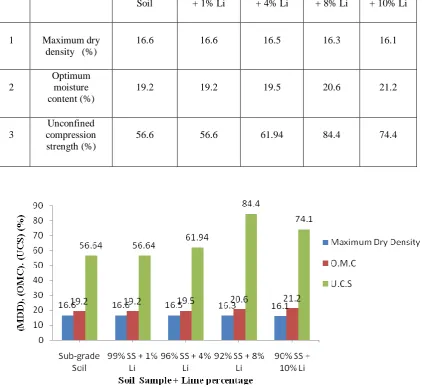
Table 2 Comparison of the results of soil and soil-lime mixture (M.D.D, O.M.C, U.C.S)
S. No Property Sub-grade
Soil
99% SS + 1% Li
96% SS + 4% Li
92% SS + 8% Li
90% SS + 10% Li
1 Maximum dry
density (%)
16.6 16.6 16.5 16.3 16.1
2
Optimum moisture content (%)
19.2 19.2 19.5 20.6 21.2
3
Unconfined compression strength (%)
56.6 56.6 61.94 84.4 74.4
Fig. 3 M.D.D, O.M.C, & U.C.S, of soil sample replaced with different percentages of lime
VII. DISCUSSION
In the table the values represent the increase or decrease the value of unmodified soil property results of soil
sample. Analysis the data of all the cases of soil + lime, the 92% SS + 8% Li set give the optimum result to
soil sample then other as the value of unconfined compression strength comes out to the maximum. The set of
99% SS + 1% Li does not change the soil property. By observing the results of 99% SS + 1% Li, 96% SS + 4%
Li, 92% SS + 8% Li and 90% SS + 10% Li, 8% of lime give the optimum strength to soil for stabilization. On
further addition of lime the unconfined compression strength (UCS) drops down due to this it is not suitable for
1304 | P a g e VIII. CONCLUSIONS
As per experimentation and observations evaluated and discussed, the following are the conclusions:
On replacing the sub-grade soil with 1% lime soil does not show any change in its property.
It is observed in soil sample that optimum moisture content increases and maximum dry density decreases
with increase in percentage of lime with silty sand. The optimum value of lime is obtained for stabilization
of soil is approximately 8%.
The liquid limit as well as the plastic limit increases with the increase in lime content in soil and has been
tested for lime content 4%, 8% and 10% by weight of soil.
In soil sample plasticity index increases up to 4% lime content then decreases with increase in percentage of
lime.
The unconfined compression strength increases up to 8% of lime content by weight of soil.
Stabilization of soil with lime is economical than other addictive like cement, chloride, rusk ash, etc.
because lime is easily available.
REFERENCES
[1] Dempsey et al.,(1968) “The Climatic-Material-Structural Pavement Analysis Program”, Federal Highway
Administration, vol.3, pp. 84/115.
[2] Thompson, M.R., (1970) “Shear Strength and Elastic Properties of Lime-Soil Mixtures,” Transportation
Research Board, Washington D.C., Record No. 139.
[3] Locat et al.,(1990) “Mechanical and hydraulic behaviour of soft inorganic clay treated with lime ”, Journal
of Applied Sciences, Canada, 1994, pp. 654-669.
[4] Little, D.L., (2000) “Evaluation of Structural Properties of Lime Stabilized Soils and Aggregates”,National
Lime Association report. vol. 1,
[5] Joel H. Beeghly., (2003) “Recent Experiences with Lime-Fly Ash Stabilization of Pavements Subgrade
Soils, Base, and Recycled Asphalt”, International Ash Utilization Symposium, University of Kentucky,
USA, 2003 Paper 46.
[6] Bolt et al., (2008) “Flexural Fatigue Strength of Lime–Soil Mixtures,” Highway Research Board,
Washington, D.C., Record No. 198,
[7] Nilo et al., (2009) “Key Parameters for the Strength Control of Lime Stabilized Soils”, Journal of Materials
in Civil Engineering, Concordia University, Canada, 2009, pp. 210-216.
[8] Khelifa et al., (2011) “Use of Natural Pozzolana and Lime for Stabilization of Cohesive Soils, Journal of
Geotechnical and Geological Engineering,University of Chlef, Algeria, 2011, pp. 759-769
[8] Kavak., Baykal., (2012) “Behaviour and mineralogy changes in lime-treated expansive soil at 20 °C”,
Journal of Applied Clay Science, Germany, 2012, pp.191-198.
[9] Negi et al., (2013) “Design Procedure for Soil-Lime Stabilization for Road and Railways Embankments”,
Journal of Design Methods for Road and Railway, USA, 2013, pp. 755-764.
[10] Chee-Ming Chan., (2016) “Strength Improvement Characteristics of Cement Solidified Dredged Marine
Clay with Relation to Water-Cement ratio”, International Journal of GEOMATE, Malaysia, 2016, vol. 11,