IEEE Copyright Notice
Copyright (c) 2019 IEEE Personal use of this material is permitted. Permission from IEEE must be obtained for all other uses, in any current or future media, including reprinting/republishing this material for advertising or promotional purposes, creating new collective works, for resale or redistribution to servers or lists, or reuse of any copyrighted component of this work in other works.
Blind Certificate Authorities
Liang Wang ⇤ Gilad Asharov† Rafael Pass‡ Thomas Ristenpart§ abhi shelat¶
October 24, 2018
Abstract
We explore how to build a blind certificate authority (CA). Unlike conventional CAs, which learn the exact identity of those registering a public key, a blind CA can simultaneously validate an identity and provide a certificate binding a public key to it, without ever learning the identity. Blind CAs would therefore allow bootstrapping truly anonymous systems in which no party ever learns who participates. In this work we focus on constructing blind CAs that can bind an email address to a public key.
To do so, we first introduce secure channel injection (SCI) protocols. These allow one party (in our setting, the blind CA) to insert a private message into another party’s encrypted communications. We construct an efficient SCI protocol for communications delivered over TLS, and use it to realize anonymous proofs of account ownership for SMTP servers. Combined with a zero-knowledge certificate signing protocol, we build the first blind CA that allows Alice to obtain a X.509 certificate binding her email address [email protected] to a public key of her choosing without ever revealing “alice” to the CA. We show experimentally that our system works with standard email server implementations as well as Gmail.
1
Introduction
Cryptography in practice relies on certificate authorities (CAs) that validate identities and provide a cryptographic assertion binding a public key to that identity. In addition to their use in systems like TLS, CAs are required in privacy-preserving or anonymous credential systems, first introduced by Chaum [16], subsequently studied extensively in the academic literature (c.f., [3, 6,10, 11,32,48]), and practically realized with systems like IBM’s Identity Mixer [12] and Cinderella [18]. These systems have a user register with a CA (also called an identity provider) to obtain cryptographic credentials attesting to their identity or some attribute. The credential can then be used in an unlinkable, privacy-preserving way to subsequently authenticate with other systems.
But in all existing systems, registration reveals to the CA the identity of participants. This makes the CA a single point of privacy failure in settings where simply using a privacy tool is sensitive, such as journalists or dissidents living within repressive regimes, or whistleblowers at a large corporation. We call a system that does not disclose to any party the identities of participants as achieving participation privacy, and ask in this work whether it is possible to build participation-private systems that nevertheless utilize validated identities. A priori the answer would appear to be “no”, because validating an identity would seem to fundamentally require knowing it.
⇤UW-Madison,[email protected]
†Cornell Tech,[email protected] ‡Cornell Tech,[email protected] §Cornell Tech,[email protected]
In this work we make progress on this question by designing the first ever blind CA for email identities. Our blind CA validates ownership of an email address and issues a credential binding that email address to a public key, but never learns the email address being used. What’s more, our system achieves this in a legacy-compatible way, utilizing existing email systems and producing X.509 certificates. By combining our blind CA with Cinderella [18], one can achieve the first anonymous credential system achieving participation privacy.
The main challenge involves the tension between the need to validate an identity while not learning it. We resolve this tension using what we call an anonymous proof of account ownership (PAO). Consider an email provider, such as Gmail, a verifier (the blind CA), and the prover that owns an email account with the provider. To achieve participation privacy, the verifier should be able to validate ownership of the account by the prover, without the prover revealing which account and without the email provider learning that the prover is participating.
To do this, we introduce a more general tool called secure channel injection (SCI). An SCI protocol allows the prover and verifier to jointly generate a sequence of encrypted messages sent to a server, with the ability of the verifier to insert a private message at a designated point in the sequence. In our proof of ownership context, the server is run by the email provider, and the injected message will be a random challenge inserted into an email. To complete the proof of ownership, the prover can later retrieve the challenge from the service using a separate connection, and send the challenge back to the verifier.
Our SCI construction targets protocols running over TLS, which is the most widely used secure channel protocol. Recall that TLS consists of a handshake that establishes a shared secret, and then encrypts application-layer messages (SMTP in our context) using a record layer protocol that uses an authenticated encryption scheme. We design efficient, special-purpose secure two-party computation protocols that allow the prover and verifier to efficiently compute a TLS session with the server. For most of the session, the verifier acts as a simple TCP-layer proxy that forwards messages back and forth. The prover negotiates a TLS session key directly with the destination server. At some point in the stream, however, the verifier must inject a message, and here the prover (which has the session key) and the verifier (which has the secret challenge to inject) perform an interactive protocol to compute the record layer encryption of the message. By exploiting the cryptographic structure of the TLS record layer encryption scheme, we securely achieve this using a protocol whose most expensive step is a two-party secure computation protocol [60] on a circuit consisting of a small number of AES computations (plus exclusive-or operations). Whereas direct use of secure computation to perform the entire record layer construction would be expensive, our approach is demonstrably feasible and leverages recent advances in two-party secure computation of AES. Unlike Multi-context TLS [44], our protocol can modify TLS sessions in a fully legacy-compatible way, without changing existing network infrastructures and collaborations with network providers.
Our SCI-based anonymous PAO protocol can additionally output a cryptographic commitment to the prover’s identity (the email account name). The prover can then construct an X.509 certificate for a public key of their choosing, hash it, and prove in zero-knowledge to the verifier that the identity field of the X.509 matches the email account name in the commitment. We use the ZKBoo framework for this step [27]. If the proof verifies, then the verifier obliviously signs the hash. In this way, the verifier never learns the identity but provides the certificate only should the prover have a valid email account with the agreed-upon service.
We implement a prototype and test it with various SMTP servers, showing that it is fast enough for deployment. (We plan to make our implementation public and open source.) Running the prover on a laptop connected via a public wireless network to a verifier running on EC2, the median time to complete an SCI-based anonymous PAO is 760 milliseconds. More performance results are given in the body.
In summary, our contributions include the following:
• We introduce the notion of secure channel injection and show how to realize it efficiently in the case of TLS. Our techniques can be adapted to other secure channels such as SSH and IPsec.
• We use SCI to build anonymous proof of account ownership protocols for SMTP over TLS.
• We show how to combine all this to construct a blind CA that generates certificates binding a public key to an account after verifying ownership of the account, all without having the CA learn which account was used.
By combining our blind CA with Cinderella, we achieve the first participation-private anonymous credential system. Our results therefore provide a foundation for privacy tools in contexts where revealing usage of privacy tools can be dangerous. Finally, we note that there is nothing fundamental about our use of email for identities. Future work could use our techniques to build blind CAs for other types of identities, e.g., accounts on popular web services.
2
Background and Overview
We show how to build a blind CA service that can verify a user’s ownership of an account, and then sign an X.509 certificate binding the user’s public key to the account—without the CA learning the account or public key of the user. Our blind CA is based on an anonymous proof-of-account ownership (PAO) for email. We proceed with an overview of a standard PAO, and then with a high-level idea underlying our construction of an anonymous PAO.
Proofs of account ownership. Proofs of email ownership are a primary form of authentication on the web today and form a backstop in case of loss of other credentials (e.g., a forgotten password). A conventional proof of email ownership works as follows. The alleged owner of an email address, say
[email protected], is who we will refer to as the prover. The prover tells a verifier her email address, and in response the verifier challenges her by sending to [email protected] an email containing a random, unpredictable challenge. The prover must recover this challenge and submit it back to the verifier. If successful, the verifier is convinced that the prover can, indeed, access the account and presumably owns it. (Of course it could be anyone with access to the email account, including rogue insider admins or those who have compromised the account credentials.) See Figure 1 for an illustration. Email is one example of a broader class of account ownership challenge-response protocols. Ownership of a domain name is often proven by having the owner set a field of the DNS record to a challenge value supplied by a verifier. Ownership of websites can be proven by adding a webpage that contains a challenge value, and similar approaches work with Twitter and Facebook accounts [35]. Common to all proofs of account ownership is the fact that the verifier learns the identity of the prover.
(a)Proof of account ownership:
(1) The prover wishes to prove the verifier that she is the owner [email protected]; (2) The verifier interacts with the service domain.com, and sends an email to
[email protected] with some unpredictable challenge; (3) The prover accesses her account at domain.com
and extracts the challenge; (4) The prover sends the challenge to the verifier, proving ownership of the account
(b) Anonymous proof of account ownership:
(1) The prover wishes to prove the verifier that she is some eligible user of domain.com without revealing her identity; (2) Secure channel injection: the prover sends an email from [email protected] to some other email account she owns; the verifier sees that the interaction is withdomain.comand injects a challenge into this email at some designated point; (3) The prover accesses her other email account and extracts the challenge; (4) The prover sends the challenge to the verifier, proving ownership of some account indomain.com.
Figure 1: A regular proof of account ownership versus our anonymous proof of account ownership. P is the prover, S is the email server ofdomain.com, and V is the verifier. The black circles represent challenges.
page proof of ownership. Keybase.io signs PGP keys based on proofs of ownership of social media accounts [35]. Traditional CAs also need to do PAOs, e.g., proof ownership of the administrative email of the domain, to validate one’s ownership of a domain, before issuing a certificate binding a public key to the domain. In these contexts, the user sends her identity and public key to the CA, the latter invokes a proof of ownership protocol, and if the proof verifies then the CA provides the user with an appropriate certificate. Importantly, the CA in all existing systems learns the identity of the user.
Anonymous proofs of account ownership. The conventional protocols discussed so far reveal to the verifier the identity of the account owner. Sometimes revealing the specific identity is important for security, for example if one needs to log users and detect fraudulent requests. But in some settings the provers may be unwilling to reveal their identities. In the end-to-end encryption setting, privacy is an often mentioned critique of certificate transparency mechanisms like CONIKS [42]. Existing anonymous credential systems might seem to solve this problem, but in fact current systems rely on a trusted third party (TTP) to perform identity checks (via conventional PAOs) and distribute pseudonyms to users. The pseudonym can be used to request a certificate from a CA, who checks the legitimacy of the pseudonym with the TTP [6, 12, 32, 48, 49]. However, these systems are vulnerable if the TTP misbehaves.
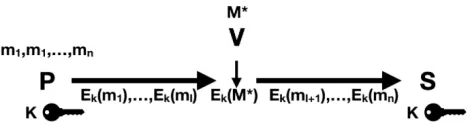
Figure 2: Secure channel injection: The prover (P) interacts with the service (S) while all the interaction is performed through the proxy of the verifier (V). At some designated point in the interaction, the proxy injects a secret message into the encrypted stream (without knowing the secret keyK). This is done using a secure protocol between the prover and the verifier, while the server is unaware of this injection.
other domain (or even to the same email address,[email protected]). However, all communication between the prover and the domain would be performed via a proxy, which would be the verifier. Using secure computation techniques, we show how to allow the verifier to inject a secret challenge at some designated point into this encrypted connection. We call this subprotocol secure channel injection. Our techniques guarantee that the prover has no information about the secret challenge, and the only way to recover it is by accessing the recipient email account. To prove ownership, the prover accesses her other email account, extracts the challenge and presents it to the verifier. A diagram of secure-channel injection appears in Figure 2.
Secure channel injection. To build an anonymous PAO and blind CA, we will develop an underlying primitive that we refer to as secure channel injection (SCI). The idea is to allow a party to inject a (relatively) small amount of information into a secure connection between a client and server. In the ownership proof context, the client will be the prover, the server will be the authenticated service, and the verifier will be the party injecting data. In our realizations the latter will end up being a specialized proxy that relays traffic between the prover and the service. While we explore use of SCI protocols in the context of anonymous PAOs, future work might surface other applications.
General tools for secure computation enable computing SCI for any ciphersuite of TLS, but could be expensive. We demonstrate efficient realization of secure channel injections for TLS with two ciphersuites: (1) TLS with cipher block chaining mode of operation (AES-CBC) with HMAC-SHA256 authentication, and (2) AES with Galois counter mode (AES-GCM). In the first case, we construct a protocol whose most expensive step is a two-party secure computation protocol [60] on a circuit consisting of a small number of AES computations (plus exclusive-or operations). Our approach is demonstrably feasible and leverages all of the recent advancements in two-party secure protocol construction for computing AES. In the second case we construct a protocol which the only expensive operation is an oblivious polynomial evaluation [26, 29, 30, 43] needed for computing the authentication data, and no secure computation of AES is necessary. We prove security of our protocols in the random oracle model.
In both cases the role of the proxy is constrained — our protocols ensure that even an actively malicious proxy cannot mount an arbitrary man-in-the-middle attack, but only are able to insert a constrained amount of data.
In the next couple of sections we go through the details of our approach. We first present secure-channel injection protocols (§3) and how to realize them for TLS (§4). We then show how to use SCI to build anonymous PAOs for email and, ultimately, our blind CA for email (§5).
(2) Cinderella, an anonymous credential system that can perform X.509 certificate verification via zero-knowledge proofs, can be used with anonymous voting services to hide voters’ identities (i.e., subject id in the X.509 certificate) [18]. However, it assumes each voter already has a unique X.509-compatible, personal certificate, and uses a voter’s public key and other public information to generate a pseudonym for the voter. Once CAs cooperate with the voting services, it’s easy to recover the true identity of a voter under a given pseudonym. If one used a blind CA instead, then identities are never learned, let alone collected, by the CA (assuming no collusion with the email service).
3
Secure Channel Injection
A secure channel injection (SCI) protocol is a three-party protocol between a client, a proxy, and a server, parameterized by a message template Mt = (|Mtp|,|M⇤|,|Mts|), which can be thought of as a “placeholder” for actual messages. The client holds as input a message prefix Mtp 2{0,1}|Mtp| and a message suffix Ms
t 2{0,1}|M s
t|, communicates with the server, where the proxy is interested in “injecting” a random message/challenge M⇤ 2 {0,1}|M⇤| into that interaction. We follow the standard definition for secure computation in the malicious adversarial model (e.g., [13, 28]). The secure channel injection protocol computes Functionality 1.
Functionality 1: Message Injection (parameterized with a message template: Mt = (|Mtp|,|M⇤|,|Mts|))
• Input: The client holds some input prefix message Mtp2{0,1}|
Mtp|and suffixMs
t 2{0,1}| Ms
t|. The proxy holds some messageM⇤2{0,1}|M⇤| that was chosen from some high-entropy source. The server has no input.
• Output: The server outputs (Mtp, M⇤, Mts). The proxy and the client have no output.
The following simple protocol computes the aforementioned functionality: The proxy chooses a message M⇤ uniformly at random, and both client and proxy just transmit their messages to the server. However, we are interested in protocols that compute this functionality but also satisfy the following two properties:
• First, we are interested in protocols where the code of the server is already “fixed”, and the messages that the client and the proxy send to the server must match some specific syntax. Specifically, the protocol is additionally parameterized by a secure channel protocol SC = (SCCl,SCS). The code of the server in the secure channel injected protocol is fixed to SCS,1 modeling the fact that the proxy has to “inject” a message into an existing secure channel communicationSC between the client and the server.
• Second, the network setting is such that there is no direct communication channel between the client and the server. All messages between these parties are delivered through the proxy. In particular, this already requires the client to encrypt its messages as the proxy should not learn any information aboutMtp, Mts(besides the already known message template, i.e., known sizes).
For the purposes of description it suffices to give a simplified view of secure channel (SC) protocols. Let SC = (SCCl,SCS) consist of a key exchange phase followed by transmitting r ciphertexts
E(K, M1), . . . , E(K, Mr) from the client to the server encrypted under a symmetric encryption algorithm E and session key K, regardless of whether it is stateful or not. Recall that we follow the standard definition for secure computation in the malicious adversarial model (e.g., [13, 28]), for analyzing whether a protocol securely realizes a given functionality. This leads us to the following definition of a secure channel injection:
Definition 2(Secure Channel Injection). LetSC= (SCCl,SCS)be a secure channel protocol between a client and a server. We say that a three party protocol SCI = (⇧Cl,⇧P r,⇧S) is a secure channel
injection protocol forSC, if the following conditions hold: (1) SCI securely realizes Functionality 1,
and (2)⇧S=SCS.
Security properties. As for condition (1) in Definition 2, we require that security holds when either the client or the proxy is malicious (meaning, it can deviate arbitrarily from the protocol specification), or the server is an honest-but-curious adversary, meaning it might try to violate security by inspecting the sequence of packets sent to and from it and the sequence of plaintext messages, but it won’t maliciously deviate from the protocol specification. Our definition guarantees the following basic security goals:
(1) Injection secrecy: The client cannot learnM⇤ during the protocol interaction.2
(2) Transcript privacy: The proxy does not learn anything about messages other than M⇤.
(3) Transcript integrity: The proxy should not be able to modify parts of the message transcript besidesM⇤.
(4) Server obliviousness: Condition (2) in Definition 2 guarantees that the server cannot distinguish an SCI execution from a standard execution of the underlying SC protocol with the client.
We assume that the IP address of the proxy does not, by itself, suffice to violate server obliviousness. We emphasize that as opposed to the server (which is oblivious to the fact that it is not participating in a standard execution of the underlying SC protocol with the client), the client is well-aware that this is not a standard execution. In fact, the client intentionally collaborates with the proxy in order to enable it to inject the secret message M⇤, and the two parties together compute a valid record that contains the injected message. The client and the proxy together can therefore be viewed as a single unified client interacting with the server in a standard secure channel protocol.
Network assumptions. As mentioned before, we assume that the client and the server cannot communicate directly, and their communication is delivered through the proxy. We also assume each party can only observe their local network traffic. That is, the server cannot access the network transcripts between the client and the proxy (otherwise, we can never achieve server obliviousness), and the client cannot access the network transcripts between the proxy and the server (otherwise, we cannot simultaneously achieve transcript injection secrecy with server obliviousness).
We will not consider attackers who are capable of manipulating network routing and injecting spoofed packets. This rules that the situation that the client bypasses the proxy and spoofs and session between the proxy and the server. Other types of attacks that are not directly related to
the goals of adversaries as mentioned above, such as denial-of-service attacks, are not taken into account. We also don’t yet consider implementation-specific attacks such as vulnerabilities in the proxy software.
Relaxations of Functionality 1. For conceptual simplicity, we presented Functionality 1 for the most simplified settings. In order to design more efficient protocols, however, a somewhat more complicated functionality is necessary. In a nutshell, the modifications allow the proxy to learn some leakage onMtp, Mts (such as known headers or part of the messages the client does not have to hide). For the AES-GCM SCI protocol (see Appendix .2) the ideal functionality additional allows the client to “shift” the injected message M⇤ by sending the trusted party some message (and letting the output of the server be (Mtp, M⇤ + , Mts)). This suffices for our application as this functionality satisfies injection secrecy.
We now turn to design cryptographic protocols for which we can prove that they realize the SCI ideal functionality (without relying on any trusted third party).
4
SCI for TLS
We focus in this paper on TLS as the secure channel. Using common MPC techniques, such as Yao’s protocol [60] or fully homomorphic encryption [25], every secure channel protocol can be converted into an SCI. However, these general techniques would be expensive due to the complexity of the TLS record construction, which involves computations for HMAC, AES, and record padding. We can do better by taking advantage of the way TLS encryption works. While there are several options supported in the wild, we focus on the currently commonly used ones:
(1) AES using CBC with HMAC-SHA-256. This mode is widely used in TLS 1.1 and 1.2, and we show how to build for it an SCI in Section 4.1. Our protocol requires general-purpose MPC on just a few invocations of AES, making it fast.
(2) AES with Galois / Counter mode (AES-GCM). We provide the SCI protocol in Appendix .2. Our protocol relies on oblivious polynomial evaluation.
In the sequel, we focus on AES using CBC with HMAC-SHA-256 (Section 4.1).
4.1 TLS with AES-CBC and HMAC-SHA256
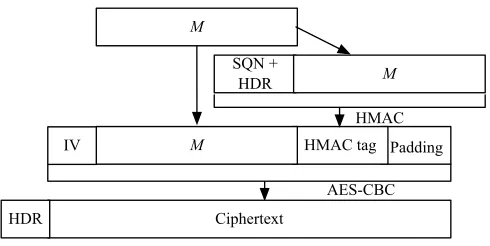
The TLS record is described in Figure 3. We need to design a protocol that allows two parties to jointly compute such a TLS record, where the client provides the TLS session keys and part of the message, and the proxy provides the injected message. We first introduce two sub-protocols called
2P-HMAC and 2P-CBC, and design SCI-TLS based on the two protocols. In a nutshell, 2P-HMAC
boils down to submitting two partial tags, one from the client to the proxy and one from the proxy to the client, and its overhead is minor. In 2P-CBC, the client computes the AES ciphertexts of
Mtp, Ms
t locally, and the parties engage in a secure protocol for computingAESon the blocks ofM⇤ (where the proxy inputs the blocks ofM⇤ and the client inputs the key, i.e., we realize an oblivious PRF). We fully specify the protocols and then analyze the security of SCI-TLS. We remark that we do not formalize the ideal counterparts of 2P-HMAC and 2P-CBC, and we analyze the security of SCI-TLS protocol as a whole. We divide the protocol into these subprotocols just for expositional clarity.
Assume the clientClholds keysKhmacand Kaesas well as an injection template prefixMtp and suffix Ms
SQN + HDR
HMAC tag HMAC
AES-CBC
Ciphertext M
M M
Padding
HDR IV
Figure 3: The MAC-then-encrypt construction in TLS (version> 1.1). HDR is a 40-bit TLS record header and SQN is a 64-bit sequence number. IV has a fixed size of 128-bits. The size of the HMAC tag depends on the hash functions being used in HMAC. Before AES encryption, the record will be padded to a multiple of 128 bits [21, 22].
HMAC with the first key over MtpkM⇤kMts and CBC mode with the second key over the same composed message. We denote the HMAC chunk size byd(in bits), and assume CBC mode uses a blockcipher whose block size in bits we denote by n. Looking ahead, we will require that Mtp and
M⇤ each have length a multiple of d(after headers are prepended) during the HMAC computation and nduring CBC.
2P-HMAC. Recall that HMAC is a pseudorandom function (PRF) constructed on top of a hash function that we denote H. We assume that H is a Merkle-Damg˚ard based hash function, which aligns with the hashes used in TLS.3 We take advantage of the fact that one can outsource computation of HMAC over portions of messages without revealing other parts of the message or the key.
Letf :{0,1}v⇥{0,1}d!{0,1}vbe the compression function underlyingH. It accepts messages of lengthdbits and a string called the chaining variable of lengthvbits. It outputs av-bit value. For any string S 2{0,1}v and string M =M
1, . . . , Mm where each Mi isd bits long, we let f+(S, M) be defined recursively by Si = f(Si 1, Mi) for i = 1 to m and S0 = S. Finally f+(S, M) = Sm. For the hash functions of interest one appends to a message M a padding string PadH|M| so that
MkPadH|M|is a multiple ofdbits. For SHA-256 for example PadH` = 10rkh`i64where the last part
is a 64-bit encoding of` and r is defined to produce enough zeros to make `+r+ 65 a multiple of
d. Finally the full hash is defined as H(M) =f+(IV, MkPadH|M|). HMAC on a key K and message M is built usingH as follows:
HMAC(K, M) =H((K opad)kH((K ipad)kM))
whereipadandopadare the inner and outer padding constants each of lengthdbits [38]. In our usage |K|< d, so one first pads it with zero bits to get ad-bit string before applying the pad constants. To perform a joint computation ofHMAC(Khmac, MtpkM⇤kMts) the parties follow the protocol detailed in Protocol 3. We denote an execution of this protocol by2P-HMAC((Khmac, Mtp, Mts), M⇤).
2P-CBC. We now turn to how to jointly compute a CBC encryption over MtpkM⇤kMs
t. Since we are working now with n-bit strings, we let Mtp = (P1, . . . , Pq), M⇤ = (Pq+1, . . . , Pq+r), and Mts= (Pq+r+1, . . . , Pt), where each Pi is ann-bit block.
The CBC mode on message M = (P1, . . . , Pt) is defined by choosing a random n-bit C0 =IV
Protocol 3: 2P-HMAC((Khmac, Mtp, Mts), M⇤)
Input: The client holdsKhmac, Mtp = (M1, . . . , M`), andMts= (M`+k+1, . . . , Mm). The proxy holds M⇤= (M
`+1, . . . , M`+k) where eachMi2{0,1}d.
The protocol:
(1) The client computes s0 = f(IV, Khmac ipad), and for every i = 1, . . . ,`, it computes si = f(si 1, Mi).
Sends`to the proxy.
(2) The proxy computes si=f(si 1, Mi) fori=`+ 1, . . . ,`+k. Send s`+k to the client.
(3) The client proceedssi =f(si 1, Mi) for all i=`+k+ 1, . . . , m, and thens⇤ =f(sm,PadH|M|) =
H((Khmac opad)||M).
Output: The client outputsT =H((Khmac opad)ks⇤).
in length. Our2P-CBCprotocol is described in Protocol 4. In order to compute the ciphertexts, the two parties use a general-purpose MPC protocol to compute AESKaes(Pi0) where the client inputs
Kaes, the proxy inputs some block Pi0, and receives ciphertext Ci. We denote this functionality as
FAES.
Protocol 4: 2P-CBC((Kaes, Mtp, Mts), M⇤) (in theFAES-hybrid model)
Input: The client holdsKaes, messagesMtp= (P1, . . . , Pq), andMts= (Pq+r+1, . . . , Pt), the proxy holds M⇤= (Pq+1, . . . , Pq+r), where eachPi2{0,1}n.
The protocol:
(1) The client sets C0 =IV, and computes Ci =AESKaes(Ci 1 Pi) for everyi= 1, . . . , q. It sends C0, . . . , Cq to the proxy.
(2) Fori=q+ 1, . . . , q+r, the client and the proxyFAES-functionality for computingAESKaes(Ci 1
Pi), where the client inputs the key and the proxy inputs the message. The proxy receives as outputsCq+1, . . . , Cq+r, and sendsCq+r to the client.
(3) The client proceeds to computeCi=AESKaes(Ci 1 Mi) for everyi=q+r+ 1, . . . , tand sends all the ciphertext to the proxy.
Output: The proxy outputsC0, . . . , Ct.
We assume that |M⇤|>2n(i.e.,r >2). If r= 1, the proxy cannot sendCp+1 back to the client
because the client can easily recoverM⇤ based on her knowledge of Cp and Kaes. In this case, we can alternatively require that |Ms
t|= 0; that is, |M⇤|is the last block of the plaintext.
The SCI protocol. We are now in a position to describe our solution for SCI with TLS where the proxy wants to inject a message at some designated point into the stream of encrypted client-to-server message data. Let Q1, . . . , Q⇤u, . . . , Qv be the sequence of TLS plaintext fragments sent from the client to the server in separate record layer encryptions, withQ⇤urepresenting the fragment within which the proxy will inject its private message M⇤.
Recall that HMAC-SHA256 works on blocks of sized= 512 bits (64 bytes) and AES is on blocks of sizen = 128 bits. Moreover, we recall thatSQN and HDR (of total length 40 + 64 = 104 bits) should be added to the message when computing the HMAC, whereas these are not included when encrypting with CBC (see Figure 3).
512 (104+408) 512 (232+256+24) 104
640 256 (2 blocks) 2P-HMAC
2P-CBC M⇤
Ms2 t SQN + HDR +Mp1
t
Mtp
Mp2
t +M⇤+Mts1
Mts+T
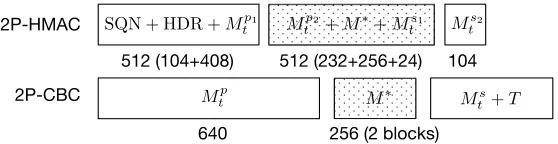
Figure 4: An example of injecting a 256-bitM⇤. The messages with dots are input by the proxy, and the other (portions of) messages are provided by the client. The numbers are message sizes in bits.
where|Mts1|= 24 bits andMts2 = 104 bits. The client sendsMtp2 and Mts1 to the proxy4. As such, the blocks (SQN, HDR, Mtp1) and (Mtp2, M⇤, Mts1) are each multiplies ofdand|Mtp|=|(Mtp1, Mtp2)| and |M⇤|are each multiples ofn. See Figure 4.
SCI-TLS proceeds by having the proxy act as a TCP-layer proxy for the TLS handshake between the client and the server and for the first u 1 TLS record layer fragments. Let the client-to-server session keys be Khmac for HMAC and Kaes for AES. To send Q⇤u the client constructs the message prefix SQNkHDRkMtp1. Then the client and the proxy execute
2P-HMAC((Khmac, SQNkHDRkMtp1, Mts2), Mtp2kM⇤kMts1) to compute the HMAC tag T. Next,
they execute2P-CBC((Kaes, Mtp, MtskT), M⇤) to jointly compute the record layer ciphertext if|M⇤| is greater than 128 bits (16 bytes).
A special case is when the proxy wants to inject less than 256 bits. The minimal amount that our approach allows is 152 bits. This case somewhat corresponds to ther= 1 setting in Protocol 4, for which, as we mentioned before, the proxy cannot send back the ciphertext to the client. We can handle this case if|Mts|= 0, as we elaborate in the Appendix .3.
We model the internal function f of the hash function H as a random oracle, and AES as an ideal cipher, and prove the following Theorem in Appendix .3.1:
Theorem 5. The above protocol is a secure channel injection protocol for TLS with AES-CBC and HMAC-SHA-256 (i.e., satisfies Definition 2), assuming that f is a random oracle and AES is an ideal cipher.
AES-GCM. In Appendix .2 we demonstrate how to implement an efficient secure computation protocol for AES-GCM. In CBC mode with HMAC, we had a minor overhead for jointly computing the authentication tag and the expensive part was the joint computation of ciphertexts corresponding toM⇤. In AES-GCM, the situation is the opposite. Here, the client chooses a randomIV and uses counter mode, namely, all messagesM1, . . . , Mtare encrypted using the “key stream” AESK(IV + 1), . . . ,AESK(IV +t). The client can simply send the portion of the key stream that is associated with the injected message of the proxy, and no secure computation of AES is needed. However, the authentication data involves evaluation of a polynomial that is not known to the client, on a point that is known only to the client. We therefore use oblivious polynomial evaluation [29, 30, 43] to perform this part of the computation. See full details in Appendix .2.
Other secure channels. We focused above on TLS using common record layer encryption schemes. Our techniques can be adapted to some other protocols and authenticated encryption schemes, such as Encrypt-then-MAC (e.g., IPsec) and Encrypt-and-MAC (e.g., SSH). There are a number of in-use authenticated encryption schemes such as ChaCha20/Poly1305 [47] and CCM [41] for which we have not yet explored how to perform efficient SCI. Common to them is the use of Encrypt-then-MAC type modes with a “weaker” MAC such as CBC-MAC. Theoretically, constructing SCI for these
secure channels is always possible. We leave constructing efficient SCI protocols for these schemes to future work.
5
Anonymous PAOs and Blind Certificate Authorities
We introduce two applications of SCI in this section: anonymous proofs of account ownership (PAOs) and blind certificate authorities (blind CAs). We focus on SMTP as the application layer protocol. We introduce a basic SMTP-STARTTLS workflow, our requirements of SMTP implementations, and our application design, and briefly discuss potential application-specific attacks and the corresponding defenses towards the end of this section.
5.1 SMTP with STARTTLS
We first briefly discuss the workflow of sending an email in SMTP-STARTTLS as our application is intimately tied to the workings of SMTP implementations. We focus on PLAIN as the target authentication mechanism, which is the most widely used authentication mechanism [33]. The client first sends a STARTTLS command to initialize a TLS-protected SMTP session after checking the SMTP server’s support for TLS. In the session, the client sends the following commands in order:
AUTH PLAIN account name password(authentication),MAILandRCPT(setting the sender/recipient addresses), DATA (notifying the begin of email transactions), the email content, and finally QUIT
(closing the session). The AUTH, MAIL, RCPT, and DATA are mandatory and must be sent in order according to RFC [37], while other commands are optional. The client needs to wait for the server’s response to a command before sending the next one, unless thePIPELININGextension, which allows the client to send several commands in a batch, is enabled by the server. But according to RFC [37], the server should respond to each command individually.
5.2 System Assumptions
The security of anonymous PAOs and blind CAs rely on the security of SCI. So, they have the same threat model and underlying assumptions as SCI (e.g., parties do not collude). See§3 and§4. Besides, we assume that the challenges generated during anonymous PAOs will not be leaked by the prover intentionally or unintentionally. And, the certificate generated by the blind CA should contain sufficient entropy to rule out brute-force inversion of the certificate hash, which is revealed to the CA. This requirement is easily satisfied as long as the certificate includes the prover’s public key. We also assume that the prover might communicate with the verifier (the CA) through an anonymous or pseudonymous channel, such as Tor and public wireless networks, to achieve IP anonymity. The verifier must be associated with a valid certificate that can be used to identify the verifier.
We assume the target STMP server supports the following property: during one SMTP session, only one email, with a secret challenge injected in the designated location, will be generated and sent from the authenticated account, and each TLS message sent from the prover contains exactly one SMTP command as specified by our protocols. Thus, the SMTP server should meet the following requirements:
Prover (Client) Verifier (Proxy) SMTP Service (Server) AUTH TLS handshakes
Hi alice my public key is: abab…..ababab
ababababa
SCI-TLS
Hi alice my public key is: ababbe..efab abababababa challenge =
be…ef
TLS
Fragment MessageSMTP Email body EHLO Prover (Client) CA (Proxy) SMTP Service (Server) TLS handshakes SCI-TLS (start authentication)
Email Email + challenge (end authentication)
(end session)
challenge, H(cert), proof
Verify proof EHLO
DATA, RCPT, MAIL
Generate
cert&ZK proof Sign(H(cert))
AUTH PLAIN “alice pwd” commitment MAIL RCPT DATA AUTH PLAIN “alice pwd” QUIT OK
(a) SMTP-based anonymous PAO (b) Blind CA
1
2
3
Figure 5: Technical flows of (a) SMTP-based anonymous PAO and (b) blind CA. For blind CA: 1 The CA saves the first message as the commitment; 2 The CA and the prover use anonymous PAO to inject a challenge; 3 The CA and the prover run a zero-knowledge protocol to generate a legitimate X.509 certificate.
the server must be RFC-compliant in terms of how it responds to pipelined commands, as described in§5.1. These requirements help anonymous PAOs and blind CAs to achieve security (See §5.5).
To understand how stringent these requirements are, we investigated the behavior of 150 popular SMTP servers (supporting STARTTLS) from public lists available on the Internet [2, 24]. Overall, we found 112 SMTP servers (75% of those examined) meet our requirements and can be used for anonymous PAOs and blind CAs, including popular services that have a large user base: Gmail, Outlook, Hotmail, Mail.com, etc.
5.3 Anonymous PAO for SMTP
Using anonymous PAO, a prover (who owns an email account [email protected] that is administered by a service domain.com) can prove to the verifier that she owns an email account from domain.com, without disclosing the exact email address. Unlike conventional PAOs in which a verifier sends a challenge to a prover’s account, our anonymous PAO realizations work in the opposite direction. The setup is shown in Figure 5: the prover runs a modified SMTP client, and uses SMTP-STARTTLS to interact with the private SMTP server of domain.comvia a proxy managed by the verifier using the following protocol:
(1) The verifier (i.e., the proxy in the SCI) determines the address of smtp.domain.com, e.g., via DNS, and checks whether the server satisfies the aforementioned requirements.
(2) The prover (i.e., the client in the SCI) sends an email using the SMTP server, to any location only accessible to the prover, via the verifier. Most of the SMTP messages are sent in separate TLS fragments. For the body of the email the client and proxy use a shared template that specifies the location of the challenge in the body and its format (e.g., the challenge should be a certain-length string of random ASCII characters).
from §4. The resulting TLS record will be sent to the server by the proxy, and then the client can finish the session.
(4) The client will later retrieve the email (via an independent and standard connection to its email provider), and extract the challenge.
(5) The client will verify the verifier’s identity (e.g, proxy’s certificate) and send the challenge to the verifier to complete proof. Assuming only authenticated users can use the server to send emails, this will prove ownership of an account.
Challenge steganography. Recall that one of our security goals is service obliviousness. This is not always important, but could be in some settings. Assuming that SCI-TLS is server oblivious, meaning it is not uniquely identifiable as such, what remains is to ensure that injected messages are not detectable as PAOs. This is fundamentally a task of steganography, but we are aided here by the fact that challenges can be relatively short and the rest of the message can even be hand-crafted. We designed various example message templates that can be used for hiding a challenge. For example, the message template can be an email that contains a public key or encrypted files (PDF, zip file, etc.); It is easy to embed a short random-string challenge in the template, by simply replacing a portion of the random string with the challenge.
5.4 Blind Certificate Authorities
We now show how to extend our SMTP-based anonymous PAO to build a blind certificate authority service. A blind CA can verify a person’s ownership of an email account and then sign an X.509 certificate for the user’s public key. The certificate is mainly for binding the public key to the email account and serves as a proof of email account ownership for uses in other privacy-enhancing systems like Cinderella. Unlike conventional CAs, ours will be blind: the CA does not learn the user’s identity or public key.
At a high level, our blind CA implementation works as follows. (1) The CA runs the SMTP-based anonymous PAO protocol with the client, but additionally extracts from the transcript of the protocol execution a cryptographic commitment to the client’s username, alice. (2) The CA gives the client a certificate template that is completely filled except for the entries subject (the client’s username, e.g., alice) andpublic key. The client fills in these missing entries, and then sends the hash of this certificate and a zero-knowledge proof to the CA to prove that the same username has been used in the commitment and the certificate. (3) The CA verifies that the proof is correct, signs the hash using a standard digital signature scheme and sends it back. The result is that the client obtains a valid certificate, signed by the CA.
We next elaborate on how to generate a valid commitment during the anonymous PAO, and then describe the certificate generation procedures.
Anonymous PAO with binding identity. For blind CA, we need a slightly stronger form of PAO in which upon acceptance of the statement by the proxy (i.e., being convinced that the client is some eligible user of domain.com), it outputs in addition a cryptographic commitment to the identity of the client (henceforth, say, alice). The commitment is hiding (and therefore does not reveal the identity of alice), but it also binding (and so it is infeasible to link this interaction with a di↵erent user rather thanalice).
the server contain the authentication data of the client such as username and password. We refer to this information as the identity of the client, and elaborate how these ciphertexts bind the identity of the client in the sequel. Note that [50] demonstrates an attack that breaks the binding security of AES-GCM, which, however, cannot be directly applied to blind CA because the attacker cannot construct arbitrary messages in our setting — all messages must be semantically meaningful to the SMTP server. Whether AES-GCM can be used as a secure commitment in blind CA remains an open question.
Our SMTP client is instructed to only use the minimum number of commands (AUTH, MAIL,
RCPT, andDATA) to send an email. Each command and the email content will be sent in one message (i.e., TLS fragment). Thus the first message sent, which is the TLS encryption of the messageAUTH PLAIN [sep]alice[sep]password, will contain the client’s email account, and the fifth message will be the email body into which a challenge will be injected. 5 The procedures are shown in Figure 5. The first message will be taken as the commitment C. The client stores the opening of the commitment (the associated CBC-HMAC keys Khmac and Kaes) for late use, The challenge to be injected is a random stringM⇤, and the proxy addsC to a table under the indexM⇤.
While running the anonymous PAO (with binding identity), the proxy expects to see exactly five messages (four commands plus an email) sent from the client, and each message is followed by exactly one response from the server (not counting TLS handshake messages and the cleartextEHLO
at the very beginning). It is important that the proxy aborts after seeing five responses. If it allows more, an attack that abuses the flexibility in number of messages arises; see §5.5.
Some servers might require the EHLOafter STARTTLS. The proxy can check this when examining if the server satisfies the requirements. In this case, the proxy simply needs to let the client use six messages (with six responses) to finish the session, and grabs the second message seen as the commitment.
Certificate generation. The client uses a X.509 certificate template prepared by the CA to generate a legitimate X.509 certificate cert, with the subject field being set to the client’s email account alice and the public key field being set to the client’s public key pkey. The other fields (expiration duration, organization, etc.) in the template are public, and their values will be shared with the client and be validated by the CA during certificate generation. The client generates a hash h = H(cert) of its certificate, and produces a zero-knowledge proof, named CA proof, that demonstrates (1) her knowledge of the necessary information (the email account and the public key) to form a certificate (the hash of which is h); (2) the knowledge of the underlying message and the opening of the commitmentC, namely the secret keys used during the PAO session, and the email account and password in C (which is used to send the challenge M⇤); and (3) the account in the subject field of cert is the same as the account in C. The private witness of the proof consists of the email account, the password, pkey,Khmac, and Kaes. Note that the proxy will not verify the client’s ownership of the public key in the certificate; this can be done by the party to whom the certificate is presented.
Assuming the anonymous PAO is successful, the client can retrieve M⇤. It sendsM⇤,h, as well as the CA proof to the proxy. The proxy retrieves the commitmentC based onM⇤, and verifies the correctness of the proof. Assuming the zero-knowledge proof is accepted by the proxy, the proxy can be certain that the same email account was used in the anonymous PAO and the certificate over which h is computed. Then, the proxy can sign the hash value h and send the result back to the client.
Anonymous registration. In an anonymous credential system [6, 12, 18, 32, 48], a user can prove to a verifier her ownership of a credential from a CA without revealing the credential. Such systems
aim at providing anonymity and unlinkability, i.e., the verifier cannot learn the identity of the user and multiple uses of the same credential cannot be linked. However, during registration to obtain a credential, existing anonymous credential systems all rely on a trusted third party (the CA) to verify the identity of the user, for example by performing a conventional PAO.
In settings in which users do not want to reveal that they have obtained a credential, we can replace the registration with our blind CA protocol. This allows the user to obtain a credential attesting to ownership of an email address, without revealing to any party that a particular user has obtained the credential.
5.5 Security Analysis
In this section, we discuss several potential application-specific attacks.
Client protocol violation. We start by investigating potential security issues arising from abuse of SMTP semantics. A corrupted client may violate the agreed protocol via extra requests, fragmented commands, or multiple commands per request, potentially violating injection secrecy. For example, the client might sendAUTH PLAIN bobin the first message, followed byAUTH PLAIN alice, to get a certificate for an accountbobwhen really onlyaliceis owned; or she might split theAUTHcommand into two pieces, and send the second piece and theMAILcommand in one message. But all will require either more client commands than the number expected or change the request/response sequence. When the target server satisfies the requirement NoPipeline or RFCCompliant, the actual number of client commands sent is visible to the proxy via counting the server’s responses. Thus if the proxy detects that the client deviates from the agreed protocol (sending one message but receiving multiple responses, out-of-order requests/responses, etc.), the proxy will immediately terminate the session before the challenge injection.
Proxy injection attacks. The proxy might attempt to violate transcript privacy and client anonymity by injecting a message that contains meaningful SMTP commands. A concrete example is that the proxy can inject a message like “CRLF.CRLF RCPT:... DATA:...” to initiate a new message that will be sent to a proxy-controlled email and learn the email address of the client. This attack can be ruled out if it suffices to restrict the challenge length to at most 19 bytes (152 bits): the mandatory fixed bytes needed (such as CRLFs, command keywords, spaces and newlines) in the commands would be more than 19 bytes. Since the client enforces message length (it computes the hash tag that covers the length), the proxy can’t insert anything but the agreed upon amount of bytes. Hence, the attacker will not be able to initiate a new email under this length restriction. Actually, if the target server satisfies the requirement NoPipeline, the attack will not work since a message containing multiple commands will be rejected by the server.
6
Implementation and Evaluation
To demonstrate the feasibility of our SMTP-based PAO and blind CA, we focus on AES-CBC with HMAC as a case study. We implemented prototypes of the applications using open-source libraries.
6.1 Implementation
PAO prototype implementation. We usetlslite[57] as the TLS library and modify it to add interfaces for extracting the key materials being used in a TLS session, as well as the internal states used in CBC encryption and SHA-256. We use a Python SMTP librarysmtplibto send emails [51]. The client works similarly to a regular SMTP client and follows the SMTP specification. But we do modify the client greeting message to hide client host information.
Malicious secure 2PC. We implement 2-party secure evaluation of AES that is secure against malicious adversaries based on the protocol from Rindal and Rosulek [53] who optimize their implementation in theo✏ine/onlinemodel. We choose statistical security parameters that o↵er 2 40 security. Two command-line programs are executed by the client and the proxy to compute AES blocks. As in Appendix .3, security is not reduced if the proxy learns the intermediate evaluations of the AES function in the CBC computation. Thus, we implement our overall computation by separately computing each AES block in sequence instead of creating a garbled circuit for the entire computation. The overall computation circuit for one AES block contains less than 32,000 boolean gates, 6,800 of which are AND gates which each require communication between the parties.
Blind CA implementation. We use the ZKBoo framework [27] to create multiple non-interactive zero-knowledge proofs (i.e., ZKBoo proof) to construct the CA proof. A CA proof consists of 136 ZKBoo proofs to achieve a soundness error of roughly 2 80 as in [27]. Although this framework
creates a relatively large CA proof, the operations required to compute the ZKBoo proofs involve only symmetric primitives (unlike other techniques for efficient zero-knowledge which require oblivious transfer). The certificate signature algorithm is 256. We implement ZKBoo versions of SHA-256/HMAC-SHA-256 that support inputs of any length based on the examples provided in [55], and a ZKBoo version of AES-CBC based on the code in [20]. AES S-Boxes are implemented based on [8].
6.2 Evaluation of SMTP-based anonymous PAO
We treat anonymous PAO as a standalone application and measure the latency of the SCI portion across di↵erent settings. We hosted the proxy on an m3.xlarge instance in the US-East region of Amazon EC2. The client was running on an Ubuntu 14.04 (64-bit) virtual machine built by VirtualBox 4.3.26, and was configured with 8 GB RAM and 4 vCPUs. We used a tool called
line profiler [52] to measure the execution time for each line of code. The sizes of the challenge and message template are fixed as 152 bits and 512 bytes, respectively.
Latency of SCI.We set up our own SMTP server (using Postfix 2.9.6, with pipelining disabled) on thesame EC2 instance as our proxy to reduce the network latency between the proxy and server, in order to maximize the relative impact of performing SCI. The client ran from two public wireless networks at di↵erent locations (labeled as Loc1 and Loc2). And in the best-performing location, we configured the client to use Tor, either with the top 3 high-performance routers or randomly selected routers, to communicate with the proxy. We ran the SMTP anonymous PAO for 50 rounds under each of the settings.
Loc1 (No Tor) Loc2 (No Tor) With Tor
2P-HMC 0.01 (0.006) 0.03 (0.01) 0.31 (0.15)
2P-CBC O✏ine 7.24 (1.65) 8.55 (1.64) 8.10 (3.10) Online 0.20 (0.06) 0.35 (0.18) 0.36 (0.16) Total (without o✏ine) 0.76 (0.10) 1.68 (0.11) 4.31 (0.86) Baseline (SMTP-TLS) 0.31 (0.14) 0.77 (0.45) 3.33 (1.79)
Table 6: The median time and standard derivation (in parentheses) in seconds to complete the
2P-HMAC and 2P-CBC steps, as well as the total PAO and normal SMTP-TLS session durations
across 50 executions in each location. “With Tor” show the best-performing setting with Tor being used.
performance in general. The most time-consuming part is o✏ine computation in 2P-CBC; however, it does not rely on inputs and can be even done before establishing the TLS connection. As a baseline, it took the client approximately 0.3 s and 3 to send the same email using conventional SMTP-TLS without and with Tor respectively. Thus the latency overhead of SCI is relatively small.
Tests with real services. We tested our anonymous PAO implementation for SMTP against real services using Loc1 without Tor. The services we chose were Gmail and two SMTP servers at two universities (call them server1 and server2). For each service, we measured 50 times the durations of PAO sessions against normal SMTP-TLS sessions (i.e., the total time spent on issuing a connection, sending an email, and closing the connection). As a baseline, the median duration of normal sessions for Gmail, server1 and server2 were 0.44, 0.93, and 0.79 seconds, while median duration of PAO sessions (without o✏ine stage) were 1.01, 1.64, and 1.53 seconds.
Server obliviousness and session duration. An adversary might attempt to detect SCI by inspecting the SMTP session duration: longer sessions would seemingly be indicative of using SCI. But actually this alone would not be a very good detector. We extracted and analyzed the durations of 8,018 SMTP-STARTTLS sessions from a dataset of terabytes of packet-level traffic traces collected from campus networks.6 The distribution of the SMTP durations is long-tailed, and about 15% of the SMTP sessions analyzed requiring more than 10 s to complete. This indicates that attempting to detect SCI in such a coarse way will have a high false-positive rate. Of course, there could be more refined detection strategies that take advantage of, for example, inter-packet timing. We leave examining other possible traffic analysis techniques to future work.
6.3 Evaluation of blind CA
We used a 475-byte X.509 certificate template with a 128-bit account/password and 2048-bit public key in our testing. The certificate hash is produced by SHA-256.
CA proof generation and verification time. The size of a ZKBoo proof for a given computation is only decided by the number of AND/ADD gates in the corresponding arithmetic circuit. In our implementation, The total number of AND/ADD gates is 78,064. The resulting ZKBoo proof size was 625,768 bytes. The average computation time for generating one ZKBoo proof was 22.3 ms (over 50 rounds): evaluating one AES block and one round of SHA-256 compression took about 672 us and 586 us on average. Note that we used a byte-oriented, optimized algorithm for AES whereas a naive algorithm for SHA-256, which involves time-consuming copy operations. The verification time for one ZKBoo proof was about 16.3 ms. Based on the design of ZKBoo, the upper bound of the verification time can be approximated by the corresponding proof generation time (in the same
setting). The size and computation time of a CA proof increase almost linearly with the number of ZKBoo proofs it has. It took about 2.9 s and 2.3 s to generate and verify a CA proof (136 ZKBoo proofs) respectively. The total size of a CA proof was about 85.1 M. While large, we expect that generating proofs will be an infrequent task in deployments. We also believe that with further code optimization and more advanced ZK techniques, e.g., using Ligero [1], could significantly improve performance.
In Appendix §.1, we estimate the performance impact of using generic MPC techniques for our applications.
7
Related Work
Secure multi–party computation. Secure multi-party computation (MPC) is a technique for multiple parties to jointly compute a function over all their private inputs, while no party can learn anything about the private inputs of the other parties beyond what can be informed from the computation’s output [25, 60]. SCI can be seen as a special-case of MPC, but using general-purpose protocols would be more expensive and we limit their use. As such we benefit from the now long literature on making fast MPC implementations [5, 9, 19, 31].
Group and ring signatures. In a group signature scheme [17], a trusted party gives credentials to a group of participants. Any participant can sign a message on behalf of the entire group, with the privacy guarantee that no one aside from the trusted party can learn which member of the group signed the message. This does not provide the participation privacy we seek: the trusted party learns all participants.
Ring signatures [54] do not require a trusted third party, but nevertheless allow signing on behalf of an ad hoc group of public keys. The public keys, however, must be certified by traditional means, meaning ring signatures do not, by themselves, provide the level of participation privacy we seek. That said, ring signatures give a weaker form of participation privacy should there be some deniability in terms of having an ostensible reason for registration of public keys suitable for ring signatures.
Anonymous credentials. Anonymous credentials systems allows a user to prove to another party that she has a valid certificate issued by a given CA, without revealing the content of the certificate [12, 18, 32, 48]. Some systems focus on solving privacy issues that arise during certificate issuance, and allow a user to obtain the signature for a certificate from a CA without revealing privacy-related information in the certificate or, in some cases, without revealing any part of the certificate [6, 49]. However, all these systems rely on a trusted third party that knows the user’s identity to perform an initial user registration. Our PAO protocol and blind CA do not.
Multi-context TLS. Multi-context TLS (mcTLS) [44] is a modification to TLS that gives on-path middleboxes the ability to read or write specified contexts (i.e., a portion of the plaintext messages) of a TLS session. Each context ends up encrypted under a separate symmetric key, and so some can be shared with the on-path middleboxes. This allows injection of messages, but is not backwards compatible with existing web infrastructure. It also would not be able to achieve service obliviousness, as the server must know which contexts were provided by the proxy.
Mailet relies on ad-hoc countermeasure that randomize order and length of application-layer fields, but these won’t work for many protocols (including SMTP). Finally, while we note that in theory one can perform anonymous PAOs against authenticated HTTPS services, significant care would be needed to ensure proper understanding of the semantics of the service in order to guarantee security.
8
Conclusion
In this work, we built the first blind CA: an authority that can validate identities and issue certificates without learning the identity. Blind CAs provide a way to construct anonymous credential systems that ensure participation privacy, meaning no single system learns of all the participants. This is important in settings where revealing the users of a system may already put them at risk.
We introduced a number of first-of-their-kind sub-protocols in order to build a blind CA. Secure channel injection (SCI) allows a proxy to inject some (constrained) plaintext content into a stream of encrypted data from a client to server. The client learns nothing about the injected data, while the proxy learns nothing about other messages sent in the stream. We then showed how SCI can be used to perform anonymous proofs of account ownership (PAO) for email accounts. The user can prove ownership of some email address on a service, but not reveal to the verifier which one. Our blind CA protocol checks email ownership via an anonymous PAO, and then uses zero-knowledge proofs to validate and sign an X.509 certificate binding the email to a user’s chosen public key, all without ever learning the exact email or public key. Our prototype implementation shows that blind CAs are efficient enough for use in practice, and that they work with existing SMTP services.
Acknowledgments
This work was partially supported by a Junior Fellow award from the Simons Foundation, NSF grants CNS-1330308, CNS-1558500, CNS-1704527, TWC-1646671, TWC-1664445, CNS-1561209, CNS-1217821, CNS-1704788, AFOSR Award FA9550-15-1-0262, a Microsoft Faculty Fellowship, a Google Faculty Research Award, and a gift from Microsoft.
References
[1] S. Ames, C. Hazay, Y. Ishai, and M. Venkitasubramaniam. Ligero: Lightweight sublinear arguments without a trusted setup. InACM CCS, 2017.
[2] Arclab. A list of SMTP and POP3 server. https://www.arclab.com/en/kb/email/ list-of-smtp-and-pop3-servers-mailserver-list.html, 2016.
[3] M. Belenkiy, J. Camenisch, M. Chase, M. Kohlweiss, A. Lysyanskaya, and H. Shacham. Randomizable proofs and delegatable anonymous credentials. InCRYPTO, 2009.
[4] M. Bellare and P. Rogaway. Random oracles are practical: A paradigm for designing efficient protocols.
InACM CCS, 1993.
[5] A. Ben-David, N. Nisan, and B. Pinkas. Fairplaymp: A system for secure multi-party computation. In
ACM CCS, 2008.
[6] V. Benjumea, J. Lopez, J. A. Montenegro, and J. M. Troya. A first approach to provide anonymity in attribute certificates. In PKC. 2004.
[8] J. Boyar and R. Peralta. A depth-16 circuit for the AES S-box. IACR Cryptology ePrint Archive, 2011:332, 2011.
[9] M. Burkhart, M. Strasser, D. Many, and X. Dimitropoulos. Sepia: Privacy-preserving aggregation of multi-domain network events and statistics. Network, 1:101101, 2010.
[10] J. Camenisch and A. Lysyanskaya. An efficient system for non-transferable anonymous credentials with optional anonymity revocation. In EUROCRYPT, 2001.
[11] J. Camenisch and A. Lysyanskaya. Signature schemes and anonymous credentials from bilinear maps.
InCRYPTO, 2004.
[12] J. Camenisch and E. Van Herreweghen. Design and implementation of the idemix anonymous credential system. InACM CCS, 2002.
[13] R. Canetti. Security and composition of multiparty cryptographic protocols. J. Cryptology, 13(1):143– 202, 2000.
[14] D. Chang and M. Yung. Midgame attacks (and their consequences). http://crypto.2012.rump.cr. yp.to/008b781ca9928f2c0d20b91f768047fc.pdf, 2012.
[15] Y. Chang and C. Lu. Oblivious polynomial evaluation and oblivious neural learning. Theor. Comput. Sci., 341(1-3):39–54, 2005.
[16] D. Chaum. Security without identification: Transaction systems to make big brother obsolete.
Communications of the ACM, 28(10):1030–1044, 1985.
[17] D. Chaum and E. Van Heyst. Group signatures. In Workshop on the Theory and Application of of Cryptographic Techniques, 1991.
[18] A. Delignat-Lavaud, C. Fournet, M. Kohlweiss, and B. Parno. Cinderella: Turning shabby x.509 certificates into elegant anonymous credentials with the magic of verifiable computation. In IEEE S&P, 2016.
[19] D. Demmler, T. Schneider, and M. Zohner. Aby-A framework for efficient mixed-protocol secure two-party computation. InNDSS, 2015.
[20] dhuertas. AES algorithm implementation using C. https://github.com/dhuertas/AES, 2016.
[21] T. Dierks and E. Rescorla”. The Transport Layer Security (TLS) Protocol Version 1.1. RFC 4346, 2006.
[22] T. Dierks and E. Rescorla”. The Transport Layer Security (TLS) Protocol Version 1.2. RFC 5246, 2008.
[23] Z. Durumeric, D. Adrian, A. Mirian, J. Kasten, E. Bursztein, N. Lidzborski, K. Thomas, V. Eranti, M. Bailey, and J. A. Halderman. Neither snow nor rain nor mitm...: An empirical analysis of email delivery security. InACM IMC, 2015.
[24] EEasy. SMTP server list. http://www.e-eeasy.com/SMTPServerList.aspx, 2016.
[25] C. Gentry. A fully homomorphic encryption scheme. PhD thesis, Stanford University, 2009.
[26] S. Ghosh, J. B. Nielsen, and T. Nilges. Maliciously secure oblivious linear function evaluation with constant overhead. In ASIACRYPT, 2017.
[27] I. Giacomelli, J. Madsen, and C. Orlandi. Zkboo: Faster zero-knowledge for boolean circuits. InUsenix Security, 2016.
[28] O. Goldreich. The Foundations of Cryptography - Volume 2, Basic Applications. Cambridge University Press, 2004.
[29] C. Hazay. Oblivious polynomial evaluation and secure set-intersection from algebraic prfs. InTCC, 2015.
[31] W. Henecka, A.-R. Sadeghi, T. Schneider, I. Wehrenberg, et al. Tasty: Tool for automating secure two-party computations. InACM CCS, 2010.
[32] S. Hohenberger, S. Myers, R. Pass, and A. Shelat. Anonize: A large-scale anonymous survey system. In
IEEE S&P, 2014.
[33] R. Holz, J. Amann, O. Mehani, M. Wachs, and M. A. Kaafar. TLS in the wild: An internet-wide analysis of tls-based protocols for electronic communication. NDSS, 2016.
[34] Internet Security Research Group. Let’s encrypt - Free SSL/TLS certificates. https://letsencrypt. org/, 2016.
[35] keybase.io. Public key crypto for everyone. https://keybase.io/, 2016.
[36] A. Kiayias and M. Yung. Cryptographic hardness based on the decoding of reed-solomon codes. IEEE Trans. Information Theory, 54(6):2752–2769, 2008.
[37] J. Klensin. Simple Mail Transfer Protocol. RFC 5321, 2008.
[38] H. Krawczyk, M. Bellare, and R. Canetti. HMAC: Keyed-Hashing for Message Authentication. RFC 2104, 1997.
[39] S. Li and N. Hopper. Mailet: Instant social networking under censorship. volume 2016, pages 175–192.
[40] G. Lindberg. Anti-spam recommendations for SMTP MTAs. RFC 2505, 1999.
[41] D. McGrew and D. Bailey. AES-CCM Cipher Suites for Transport Layer Security (TLS). RFC 6655, 2012.
[42] M. S. Melara, A. Blankstein, J. Bonneau, E. W. Felten, and M. J. Freedman. Coniks: Bringing key transparency to end users. InUsenix Security, 2015.
[43] M. Naor and B. Pinkas. Oblivious polynomial evaluation. SIAM J. Comput., 35(5), 2006.
[44] D. Naylor, K. Schomp, M. Varvello, I. Leontiadis, J. Blackburn, D. R. L´opez, K. Papagiannaki, P. Rodriguez Rodriguez, and P. Steenkiste. Multi-context TLS (mcTLS): Enabling secure in-network functionality in TLS. InACM SIGCOMM, 2015.
[45] Nick Sullivan. Padding oracles and the decline of cbc-mode cipher suites. https://blog.cloudflare. com/padding-oracles-and-the-decline-of-cbc-mode-ciphersuites/, 2016.
[46] J. B. Nielsen, T. Schneider, and R. Trifiletti. Constant round maliciously secure 2pc with function-independent preprocessing using LEGO. InNDSS, 2017.
[47] Y. Nir and A. Langley. ChaCha20 and Poly1305 for IETF Protocols. RFC 7539, 2015.
[48] C. Paquin and G. Zaverucha. U-prove cryptographic specification v1.1. Technical report, 2013.
[49] S. Park, H. Park, Y. Won, J. Lee, and S. Kent. Traceable Anonymous Certificate. RFC 5636, 2009.
[50] T. R. Paul Grubbs, Jiahui Lu. Message franking via committing authenticated encryption. InCRYPTO, 2016.
[51] B. Peterson. smtplib — SMTP protocol client. https://docs.python.org/2/library/smtplib.html, 2016.
[52] rkern. Line profiler and kernprof. https://github.com/rkern/line_profiler, 2016.
[53] P. Rindal and M. Rosulek. Faster malicious 2-party secure computation with online/ofine dual execution. InCryptology ePrint Archive, 2016.
[54] R. L. Rivest, A. Shamir, and Y. Tauman. How to leak a secret. InASIACRYPT, 2001.
[55] Sobuno. Zkboo. https://github.com/Sobuno/ZKBoo, 2016.