Secure Outsourced Matrix Computation
and Application to Neural Networks
?Xiaoqian Jiang1, Miran Kim1, Kristin Lauter2, and Yongsoo Song2
1
University of Texas, Health Science Center at Houston, USA {Xiaoqian.Jiang, Miran.Kim}@uth.tmc.edu
2 Microsoft Research, Redmond, USA
{klauter, Yongsoo.Song}@microsoft.com
September 4, 2019
Abstract. Homomorphic Encryption (HE) is a powerful cryptographic primitive to address pri-vacy and security issues in outsourcing computation on sensitive data to an untrusted computation environment. Comparing to secure Multi-Party Computation (MPC), HE has advantages in sup-porting non-interactive operations and saving on communication costs. However, it has not come up with an optimal solution for modern learning frameworks, partially due to a lack of efficient matrix computation mechanisms.
In this work, we present a practical solution to encrypt a matrix homomorphically and perform arithmetic operations on encrypted matrices. Our solution includes a novel matrix encoding method and an efficient evaluation strategy for basic matrix operations such as addition, multiplication, and transposition. We also explain how to encrypt more than one matrix in a single ciphertext, yielding better amortized performance.
Our solution is generic in the sense that it can be applied to most of the existing HE schemes. It also achieves reasonable performance for practical use; for example, our implementation takes 0.6 seconds to multiply two encrypted square matrices of order 64 and 0.09 seconds to transpose a square matrix of order 64.
Our secure matrix computation mechanism has a wide applicability to our new framework E2DM, which stands for encrypted data and encrypted model. To the best of our knowledge, this is the first work that supports secure evaluation of the prediction phase based on both encrypted data and encrypted model, whereas previous work only supported applying a plain model to encrypted data. As a benchmark, we report an experimental result to classify handwritten images using convolutional neural networks (CNN). Our implementation on the MNIST dataset takes 1.69 seconds to compute ten likelihoods of 64 input images simultaneously, yielding an amortized rate of 26 milliseconds per image.
Keywords.Homomorphic encryption; matrix computation; machine learning; neural networks
1
Introduction
Homomorphic Encryption (HE) is an encryption scheme that allows for operations on encrypted inputs so that the decrypted result matches the outcome for the corresponding operations on the plaintext. This property makes it very attractive for secure outsourcing tasks, including financial model evaluation and genetic testing, which can ensure the privacy and security of data communication, storage, and computation [3, 46]. In biomedicine, it is extremely attractive due to the privacy concerns about patients’ sensitive data [27, 47]. Recently deep neural network based models have been demonstrated to achieve great success in a number of health care applications [36], and a natural question is whether we can outsource such learned models to a third party and evaluate new samples in a secure manner?
There are several different scenarios depending on who owns the data and who provides the model. Assuming a few different roles including data owners (e.g. hospital, institution or individuals), cloud computing service providers (e.g. Amazon, Google, or Microsoft), and machine learning model providers
?An early version of this work was published in CCS 2018. In this version, we present better experimental results
(e.g. researchers and companies), we can imagine the following situations: (1) the data owner trains a model and makes it available on a computing service provider to be used to make predictions on encrypted inputs from other data owners; (2) model providers encrypt their trained classifier models and upload them to a cloud service provider to make predictions on encrypted inputs from various data owners; and (3) a cloud service provider trains a model on encrypted data from some data owners and uses the encrypted trained model to make predictions on new encrypted inputs. The first scenario has been previously studied in CryptoNets [23] and subsequent follow-up work [10, 7]. The second scenario was considered by Makri et al. [35] based on Multi-Party Computation (MPC) using polynomial kernel support vector machine classification. However, the second and third scenarios with an HE system have not been studied yet. In particular, classification tasks for these scenarios rely heavily on efficiency of secure matrix computation on encrypted inputs.
1.1 Our Contribution
In this paper, we introduce a generic method to perform arithmetic operations on encrypted matrices using an HE system. Our solution requiresO(d) homomorphic operations to compute a product of two encrypted matrices of sized×d, compared toO(d2) of the previous best method. We extend basic matrix arithmetic to some advanced operations: transposition and rectangular matrix multiplication. We also describe how to encrypt multiple matrices in a single ciphertext, yielding a better amortized performance per matrix.
We apply our matrix computation mechanism to a new frameworkE2DM, which takes encrypted data and encrypted machine learning model to make predictions securely. This is the first HE-based solution that can be applied to the prediction phase of the second and third scenarios described above. As a benchmark of this framework, we implemented an evaluation of convolutional neural networks (CNN) model on the MNIST dataset [33] to compute ten likelihoods of handwritten images.
1.2 Technical Details
After Gentry’s first construction of a fully HE scheme [21], there have been several attempts to improve efficiency and flexibility of HE systems. For example, the ciphertext packing technique allows multiple values to be encrypted in a single ciphertext, thereby performing parallel computation on encrypted vectors in a Single Instruction Multiple Data (SIMD) manner. In the current literature, most of practical HE schemes [9, 8, 18, 13] support their own packing methods to achieve better amortized complexity of homomorphic operations. Besides component-wise addition and multiplication on plaintext vectors, these schemes provide additional functionalities such as scalar multiplication and slot rotation. In particular, permutations on plaintext slots enable us to interact with values located in different plaintext slots.
A naive solution for secure multiplication between two matrices of size d×d is to use d2 distinct ciphertexts to represent each input matrix (one ciphertext per one matrix entry) and apply pure SIMD
a0 a1 a2
a3 a4 a5
a6 a7 a8 ·
b0 b1 b2
b3 b4 b5
b6 b7 b8 =
a0 a1 a2
a4 a5 a3
a8 a6 a7
b0 b4 b8
b3 b7 b2
b6 b1 b5 +
a1 a2 a0
a5 a3 a4
a6 a7 a8
b3 b7 b2
b6 b1 b5
b0 b4 b8 +
a2 a0 a1
a3 a4 a5
a7 a8 a6
b6 b1 b5
b0 b4 b8
b3 b7 b2
operations (addition and multiplication) on encrypted vectors. This method consumes one level for ho-momorphic multiplication, but it takesO(d3) multiplications. Another approach is to consider a matrix multiplication as a series of matrix-vector multiplications. Halevi and Shoup [24] introduced a matrix encoding method based on its diagonal decomposition, putting the matrix in diagonal order and mapping each of them to a single ciphertext. So it requiresdciphertexts to represent the matrix and the matrix-vector multiplication can be computed usingO(d) rotations and multiplications. Therefore, the matrix multiplication takesO(d2) complexity and has a depth of a single multiplication.
We propose an efficient method to perform matrix operations by combining HE-friendly operations on packed ciphertexts such as SIMD arithmetics, scalar multiplication, and slot rotation. We first define a simple encoding map that identifies an arbitrary matrix of sized×dwith a vector of dimensionn=d2
having the same entries. Let denote the component-wise product between matrices. Then matrix multiplication can be expressed asA·B =Pd−1
i=0 AiBi for some matricesAi (resp.Bi) obtained from
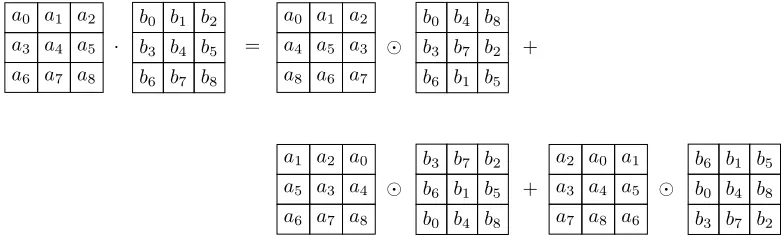
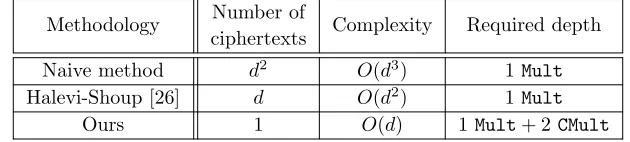
A (resp.B) by taking specific permutations. Figure 1 describes this equality for the case ofd= 3. We remark that the initial matrix A0 (resp. B0) can be computed with O(d) rotations, and that for any 1≤i < dthe permuted matrixAi (resp.Bi) can be obtained by O(1) rotations from the initial matrix. Thus the total computational complexity is bounded by O(d) rotations and multiplications. We refer to Table 1 for comparison of our method with prior work in terms of the number of input ciphertexts for a single matrix, complexity, and the required depth for implementation. We denote homomorphic multiplication and constant multiplication byMultandCMult, respectively.
Table 1: Comparison of secured-dimensional matrix multiplication algorithms
Methodology Number of Complexity Required depth ciphertexts
Naive method d2 O(d3) 1 Mult
Halevi-Shoup [26] d O(d2) 1 Mult
Ours 1 O(d) 1 Mult+ 2 CMult
Our basic solution is based on the assumption that a ciphertext can encryptd2plaintext slots, but it can be extended to support matrix computation of an arbitrary size. When a ciphertext has more thand2
plaintext slots, for example, we can encrypt multiple matrices in a single ciphertext and carry out matrix operations in parallel. On the other hand, if a matrix is too large to be encoded into one ciphertext, one can partition it into several sub-matrices and encrypt them individually. An arithmetic operation over large matrices can be expressed using block-wise operations, and the computation on the sub-matrices can be securely done using our basic matrix algorithms. We use this approach to evaluate an encrypted neural networks model on encrypted data.
Our implementation is based on an HE scheme of Cheon et al. [13], which is optimized in computation over the real numbers. For example, it took 0.6 seconds to securely compute the product of two matrices of size 64×64 and 0.09 seconds to transpose a single matrix of size 64×64. For the evaluation of an encrypted CNN model, we adapted a similar network topology to CryptoNets: one convolution layer and two fully connected (FC) layers with square activation function. This model is obtained from the keras library [14] by training 60,000 images of the MNIST dataset, and used for the classification of handwriting images of size 28×28. It took 1.69 seconds to compute ten likelihoods of encrypted 64 input images using the encrypted CNN model, yielding an amortized rate of 26 milliseconds per image. This model achieves a prediction accuracy of 98.1% on the test set.
2
Preliminaries
(d1+d2)×dmatrix obtained by concatenating two matrices in a vertical direction. If two matricesA1and
A2have the same number of rows, (A1|A2) denotes a matrix formed by horizontal concatenation. We let
λdenote the security parameter throughout the paper: all known valid attacks against the cryptographic scheme under scope should takeΩ(2λ) bit operations.
2.1 Homomorphic Encryption
HE is a cryptographic primitive that allows us to compute on encrypted data without decryption and generate an encrypted result which matches that of operations on plaintext [9, 18, 6, 13]. So it enables us to securely outsource computation to a public cloud. This technology has great potentials in many real-world applications such as statistical testing, machine learning, and neural networks [40, 29, 23, 31]. Let M and C denote the spaces of plaintexts and ciphertexts, respectively. An HE scheme Π = (KeyGen,Enc,Dec,Eval) is a quadruple of algorithms that proceeds as follows:
• KeyGen(1λ). Given the security parameterλ, this algorithm outputs a public keypk, a public evalu-ation keyevkand a secret keysk.
• Encpk(m). Using the public key pk, the encryption algorithm encrypts a message m ∈ M into a
ciphertextct∈ C.
• Decsk(ct). For the secret key sk and a ciphertext ct, the decryption algorithm returns a message
m∈ M.
• Evalevk(f;ct1, . . . ,ctk). Using the evaluation key evk, for a circuit f : Mk → M and a tuple of
ciphertexts (ct1, . . . ,ctk), the evaluation algorithm outputs a ciphertextct0 ∈ C.
An HE scheme Π is called correct if the following statements are satisfied with an overwhelming probability:
• Decsk(ct) =mfor anym∈ Mandct←Encpk(m).
• Decsk(ct0) =f(m1, . . . ,mk) with an overwhelming probability ifct0←Evalevk(f;ct1, . . . ,ctk) for an arithmetic circuitf :Mk → Mand for some ciphertextsct
1, . . . ,ctk ∈ Csuch that Decsk(cti) =mi. An HE system can securely evaluate an arithmetic circuitf consisting of addition and multiplication gates. Throughout this paper, we denote byAdd(ct1,ct2) andMultevk(ct1,ct2) the homomorphic addition
and multiplication between two ciphertextsct1 and ct2, respectively. In addition, we let CMultevk(ct;u)
denote the multiplication of ct with a scalar u ∈ M. For simplicity, we will omit the subscript of the algorithms when it is clear from the context.
2.2 Ciphertext Packing Technique
Ciphertext packing technique allows us to encrypt multiple values into a single ciphertext and perform computation in a SIMD manner. After Smart and Vercauteren [45] first introduced a packing technique based on polynomial-CRT, it has been one of the most important features of HE systems. This method represents a native plaintext space M as a set of n-dimensional vectors in Rn over a ring R using appropriate encoding/decoding methods (each factor is called a plaintext slot). One can encode and encrypt an element ofRn into a ciphertext, and perform component-wise arithmetic operations over the plaintext slots at once. It enables us to reduce the expansion rate and parallelize the computation, thus achieving better performance in terms of amortized space and time complexity.
2.3 Linear Transformations
Halevi and Shoup [24] introduced a method to evaluate an arbitrary linear transformation on encrypted vectors. In general, an arbitrary linear transformation L : Rn → Rn over plaintext vectors can be represented asL:m7→U·mfor some matrixU ∈ Rn×n. We can express the matrix-vector multiplication by combining rotation and constant multiplication operations.
Specifically, for 0 ≤ ` < n, we define the `-th diagonal vector of U by u` = (U0,`, U1,`+1, . . . ,
Un−`−1,n−1, Un−`,0, . . . , Un−1,`−1)∈ Rn. Then we have
U·m= X 0≤`<n
(u`ρ(m;`)) (1)
wheredenotes the component-wise multiplication between vectors. Given a matrixU ∈ Rn×n and an encryptionctof the vectorm, Algorithm 1 describes how to compute a ciphertext of the desired vector
U·m.
Algorithm 1Homomorphic linear transformation
procedureLinTrans(ct;U)
1: ct0 ←CMult(ct;u0)
2: for`= 1 ton−1 do
3: ct0←Add(ct0,CMult(Rot(ct;`);u`))
4: end for
5: returnct0
As shown in Algorithm 1, the computational cost of matrix-vector multiplication is aboutnadditions, constant multiplications, and rotations. Note that rotation operation needs to perform a key-switching operation and thus is comparably expensive than the other two operations. So we can say that the complexity is asymptotically O(n) rotations. It can be reduced when the number of nonzero diagonal vectors ofU is relatively small.
3
Secure Matrix Multiplication via Homomorphic Encryption
In this section, we propose a simple encoding method to convert a matrix into a plaintext vector in a SIMD environment. Based on this encoding method, we devise an efficient algorithm to carry out basic matrix operations over encryption.
3.1 Permutations for Matrix Multiplication
We propose an HE-friendly expression of the matrix multiplication operation. For ad×dsquare matrix
A= (Ai,j)0≤i,j<d, we first define useful permutationsσ,τ,φ, and ψon the setRd×d. For simplicity, we identifyZ∩[0, d) as a representative ofZd and write [i]d to denote the reduction of an integerimodulo
dinto that interval. All the indexes will be considered as integers modulod.
• σ(A)i,j=Ai,i+j. • τ(A)i,j=Ai+j,j. • φ(A)i,j=Ai,j+1. • ψ(A)i,j =Ai+1,j.
Note that φ and ψ represent the column and row shifting functions, respectively. Then for two square matricesAandB of orderd, we can express their matrix productABas follows:
A·B= d−1
X
k=0
φk◦σ(A)
ψk◦τ(B)
where denotes the component-wise multiplication between matrices. The correctness is shown in the following equality by computing the matrix component of the index (i, j):
d−1
X
k=0
φk◦σ(A)i,j· ψk◦τ(B)i,j = d−1
X
k=0
σ(A)i,j+k·τ(B)i+k,j
= d−1
X
k=0
Ai,i+j+k·Bi+j+k,j
= d−1
X
k=0
Ai,k·Bk,j
= (A·B)i,j.
Since Equation (2) consists of permutations on matrix entries and the Hadamard multiplication opera-tions, we can efficiently evaluate it using an HE system with ciphertext packing method.
3.2 Matrix Encoding Method
We propose a row ordering encoding map to transform a vector of dimension n =d2 into a matrix in Rd×d. For a vectora= (a
k)0≤k<n, we define the encoding mapι:Rn → Rd×d by
ι:a7→A= (ad·i+j)0≤i,j<d,
i.e., ais the concatenation of row vectors of A. It is clear that ι(·) is an isomorphism between additive groups, which implies that matrix addition can be securely computed using homomorphic addition in a SIMD manner. In addition, one can perform multiplication by scalars by adapting a constant multiplica-tion of an HE scheme. Throughout this paper, we identify two spacesRn andRd×d with respect to the
ι(·), so a ciphertext will be called an encryption ofAif it encrypts the plaintext vectora=ι−1(A).
3.3 Matrix Multiplication on Packed Ciphertexts
An arbitrary permutation operation onRd×dcan be understood as a linear transformationL:Rn→ Rn such thatn=d2. In general, its matrix representation U ∈ {0,1}n×n⊆ Rn×n hasnnumber of nonzero diagonal vectors. So if we directly evaluate the permutations A 7→ φk◦σ(A) and B 7→ ψk ◦τ(B) for 1 ≤ k < d, each of them requires O(d2) homomorphic operations and thus the total complexity is
O(d3). We provide an efficient algorithm to perform the matrix multiplication on packed ciphertexts by combining Equation (2) and our matrix encoding map.
3.3.1 Tweaks of Permutations
We focus on the following four permutationsσ,τ, φ, andψdescribed above. We let Uσ,Uτ, V, andW denote the matrix representations corresponding to these permutations, respectively. Firstly, the matrix representationsUσ andUτ ofσandτ are expressed as follows:
Udσ·i+j,`=
(
1 if`=d·i+ [i+j]d;
0 otherwise;
Udτ·i+j,`=
(
for 0≤i, j < d and 0≤` < d2. Similarly, for 1≤k < d, the matrix representations of φk andψk can be computed as follows:
Vdk·i+j,` =
(
1 if`=d·i+ [j+k]d;
0 otherwise;
Wdk·i+j,`=
(
1 if`=d·[i+k]d+j;
0 otherwise,
for 0≤i, j < d and 0≤` < d2.
As described in Equation (1), we employ the diagonal decomposition of the matrix representations for multiplications with encrypted vectors. Let us count the number of diagonal vectors to estimate the complexity. We use the same notationu` to write the`-th diagonal vector of a matrixU. For simplicity, we identify ud2−` with u−`. The matrixUσ has exactly (2d−1) number of nonzero diagonal vectors, denoted byuσk fork∈Z∩(−d, d). The`-th diagonal vector ofUτ is nonzero if and only if`is divisible
by the integer d, so Uτ has d nonzero diagonal vectors. For any 1 ≤ k < d, the matrix Vk has two nonzero diagonal vectors vk and vk−d. Similarly, the matrixWk has the only nonzero diagonal vector wd·k. Therefore, homomorphic evaluations of the permutationsσ andτ require O(d) rotations while it takesO(1) rotations to computeψk orφk for any 1≤k < d.
3.3.2 Homomorphic Matrix Multiplication
Suppose that we are given two ciphertexts ct.A and ct.B that encrypt matrices A and B of size d×
d, respectively. In the following, we describe an efficient evaluation strategy for homomorphic matrix multiplication.
Step 1-1:This step performs the linear transformation Uσ on the input ciphertextct.A. As mentioned above, the matrix Uσ is a sparse matrix with (2d−1) number of nonzero diagonal vectors uσ
k for
k∈Z∩(−d, d), so we can represent the linear transformation as
Uσ·a= X −d<k<d
(uσkρ(a;k)) (3)
wherea=ι−1(A)∈ Rn is the vector representation ofA. Ifk≥0, thek-th diagonal vector is computed by
uσk[`] =
(
1 if 0≤`−d·k <(d−k); 0 otherwise,
whereuσ
k[`] denotes the`-th component ofuσk. In the other cases k <0, it is computed by
uσk[`] =
(
1 if −k≤`−(d+k)·d < d; 0 otherwise.
Then Equation (3) can be securely computed as
X
−d<k<d
CMult(Rot(ct.A;k);uσk),
resulting the encryption of the plaintext vectorUσ·a, denoted byct.A(0). Thus, the computational cost is about 2dadditions, constant multiplications, and rotations.
Step 1-2:This step is to evaluate the linear transformationUτon the input ciphertextct.B. As described above, the matrixUτ hasdnonzero diagonal vectors so we can express this matrix-vector multiplication as
Uτ·b= X 0≤k<d
where b = ι−1(B) and uτ
d·k is the (d·k)-th diagonal vector of the matrix U
τ. We note that for any
0≤k < d, the vectoruτ
d·k contains one in the (k+d·i)-th component for 0≤i < dand zeros in all the other entries. Then Equation (4) can be securely computed as
X
0≤k<d
CMult(Rot(ct.B;d·k);uτd·k),
resulting the encryption of the plaintext vectorUτ·b, denoted byct.B(0). The complexity of this procedure is roughly half of the Step 1-1:dadditions, constant multiplications, and rotations.
Step 2:This step securely computes the column and row shifting operations ofσ(A) andτ(B), respec-tively. For 1≤k < d, the column shifting matrixVk has two nonzero diagonal vectorsv
k andvk−d that are computed by
vk[`] =
(
1 if 0≤[`]d<(d−k);
0 otherwise;
vk−d[`] =
(
1 if (d−k)≤[`]d< d; 0 otherwise.
Then we get an encryption ct.A(k) of the matrix φk ◦ σ(A) by adding two ciphertexts
CMult(Rot (ct.A(0);k);v
k) and CMult(Rot(ct.A(0);k−d);vk−d). In the case of the row shifting permutation, the corresponding matrixWk has exactly one nonzero diagonal vectorw
d·k whose entries are all one. Thus we can obtain an encryption of the matrixψk◦τ(B) by computingct.B(k) ← Rot(ct.B(0);d·k). The computational cost of this procedure is aboutdadditions, 2dconstant multiplications, and 3drotations.
Step 3:This step computes the Hadamard multiplication between the ciphertextsct.A(k)andct.B(k)for 0≤k < d, and finally aggregates all the resulting ciphertexts. As a result, we get an encryption ct.AB
of the matrixAB. The running time of this step is dhomomorphic multiplications and additions.
In summary, we can perform the homomorphic matrix multiplication operation as described in Algo-rithm 2.
Algorithm 2Homomorphic matrix multiplication
procedureHE-MatMult(ct.A,ct.B) [Step 1-1]
1: ct.A(0)←LinTrans(ct.A;Uσ) [Step 1-2]
2: ct.B(0) ←
LinTrans(ct.B;Uτ) [Step 2]
3: fork= 1 tod−1do
4: ct.A(k)←LinTrans(ct.A(0);Vk)
5: ct.B(k)←LinTrans(ct.B(0);Wk)
6: end for
[Step 3]
7: ct.AB←Mult(ct.A(0),ct.B(0))
8: fork= 1 tod−1do
9: ct.AB←Add(ct.AB,Mult(ct.A(k),ct.B(k)))
10: end for
3.3.3 Further Improvements
This implementation of matrix multiplication takes about 5dadditions, 5d constant multiplications, 6d
rotations, andd multiplications. The complexity of Steps 1-1 and 1-2 can be reduced by applying the idea of baby-step/giant-step algorithm. Given an integerk∈(−d, d), we can writek=√d·i+jfor some −√d < i <√dand 0≤j <√d. It follows from [25, 26] that Equation (3) can be expressed as
Uσ·a= X
−√d<i<√d 0≤j<√d
uσ√
d·i+jρ(a; √
d·i+j)= X
−√d<i<√d
ρ
X
0≤j<√d ai,j;
√
d·i
where ai,j =ρ(uσ√d·i+j;− √
d·i)ρ(a;j). We first compute encryptions of baby-step rotations ρ(a;j)
for 0≤j <√d. We use them to compute the ciphertexts of ai,j’s using only constant multiplications. After that, we perform √d additions, √d constant multiplications, and a single rotation for each i. In total, Step 1-1 can be homomorphically evaluated with 2d additions, 2dconstant multiplications, and 3√drotations. Step 1-2 can be computed in a similar way usingdadditions,dconstant multiplications, and 2√drotations.
On the other hand, we can further reduce the number of constant multiplications in Step 2 by lever-aging two-input multiplexers. The sum ofρ(vk;−k) andρ(vk−d;d−k) generates a plaintext vector that has 1’s in all the slots, which implies that
CMult(Rot(ct.A(0);k−d);vk−d) = Rot(CMult(ct.A(0);ρ(vk−d;d−k));k−d) = Rot(ct.A(0)−CMult(ct.A(0);ρ(vk,−k));k−d).
For each 1≤k < d, we computeCMult(ct.A(0);ρ(v
k,−k)). Then, using the fact that
CMult(Rot(ct.A(0);k);vk) =Rot(CMult(ct.A(0);ρ(vk,−k));k), we obtain the desired ciphertextct.A(k) with addition and rotation operations.
Table 2 summarizes the complexity and the required depth of each step of Algorithm 2 with the proposed optimization techniques.
Table 2: Complexity and required depth of Algorithm 2
Step Add CMult Rot Mult Depth
1-1 2d 2d 3√d
-1CMult
1-2 d d 2√d
-2 2d d 3d - 1CMult
3 d - - d 1Mult
Total 6d 4d 3d+ 5√d d 1Mult+ 2CMult
4
Advanced Operations for Homomorphic Matrix Computation
In this section, we introduce a method to transpose a matrix over an HE system. We also present a faster rectangular matrix multiplication by employing the ideas from Algorithm 2. We can further extend our algorithms to parallel matrix computation without additional cost.
4.1 Matrix Transposition on Packed Ciphertexts
LetUtbe the matrix representation of the transpose mapA7→AtonRd×d∼=Rn. For 0≤i, j < d, its entries are given by
Udt·i+j,k=
(
The k-th diagonal vector of Ut is nonzero if and only if k = (d−1)·i for some i ∈
Z∩(−d, d), so
the matrix Ut is a sparse matrix with (2d−1) nonzero diagonal vectors. We can represent this linear transformation as
Ut·a= X −d<i<d
(t(d−1)·iρ(a; (d−1)·i)),
where t(d−1)·i denotes the nonzero diagonal vector of Ut. The `-th component of the vectort(d−1)·i is computed by
t(d−1)·i[`] =
(
1 if`−i= (d+ 1)·j, 0≤j < d−i; 0 otherwise,
ifi≥0, or
t(d−1)·i[`] =
(
1 if`−i= (d+ 1)·j, −i≤j < d;
0 otherwise,
ifi <0. The total computational cost is about 2d rotations and the baby-step/giant-step approach can be used to reduce the complexity; the number of automorphism can be reduced down to 3√d.
4.2 Rectangular Matrix Multiplication
In this section, we design an efficient algorithm for rectangular matrix multiplication such as R`×d × Rd×d → R`×d or Rd×d× Rd×` → Rd×`. For convenience, let us consider the former case that A has a smaller number of rows than columns (i.e., ` < d). A naive solution is to generate a square matrix by padding zeros in the bottom of the matrix A and perform the homomorphic matrix multiplication algorithm in Section 3.3, resulting in running time ofO(d) rotations and multiplications. However, we can further optimize the complexity by manipulating its matrix multiplication representation using a special property of permutations described in Section 3.1.
4.2.1 Refinements of Rectangular Matrix Multiplication
Suppose that we are given an`×dmatrixAand ad×dmatrixBsuch that`dividesd. Sinceσandφare defined as row-wise operations, the restrictions to the rectangular matrixAare well-defined permutations onA. By abuse of notation, we use the same symbols σ and φto denote the restrictions. We also use
C`1:`2 to denote the (`2−`1)×dsubmatrix ofCformed by extracting from`1-th row to the (`2−1)-th row ofC. Then their matrix productABhas shape`×dand it can be expressed as follows:
A·B= X 0≤k<d
(φk◦σ(A)) (ψk◦τ(B))0:`
= X
0≤i<`
X
0≤j<d/`
(φj·`+i◦σ(A)) (ψj·`+i◦τ(B))0:`
.
Our key observation is the following lemma, which gives an idea of a faster rectangular matrix mul-tiplication algorithm.
Lemma 1. Two permutationsσandφare commutative. In general, we haveφk◦σ=σ◦φk fork >0.
Similarly, we obtainψk◦τ=τ◦ψk fork >0.
Now let us define a d×d matrix ¯A containing (d/`) copies of A in a vertical direction (i.e., ¯A = (A;. . .;A)). Lemma 1 implies that
(φi◦σ( ¯A))j·`:(j+1)·`=φi◦(σ( ¯A)j·`:(j+1)·`)
=φi◦σ◦φj·`(A)
Similarly, using the commutative property ofτ andψ, it follows
(ψi◦τ(B))j·`:(j+1)·`= (ψj·`+i◦τ(B))0:`.
Therefore, the matrix productABis written as follows:
A·B= X 0≤j<d/`
X
0≤i<`
(φi◦σ( ¯A))(ψi◦τ(B))
j·`:(j+1)·`
.
4.2.2 Homomorphic Rectangular Matrix Multiplication
Suppose that we are given two ciphertexts ct.A¯ and ct.B that encrypt matrices ¯A and B, respectively. We first apply the baby-step/giant-step algorithm to generate the encryptions of σ( ¯A) and τ(B) as in Section 3.3.3. Next, we can securely compute P`−1
i=0(φ
i◦σ( ¯A))(ψi ◦τ(B)) in a similar way to
Algorithm 2, say the output isct.AB¯ . Finally, we perform aggregation and rotation operations to get the final result:Pd/`−1
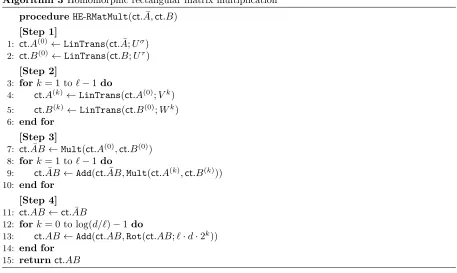
j=0 Rot(ct.AB¯ ;j·`·d). This step can be evaluated using a repeated doubling approach, yielding a running time of log(d/`) additions and rotations. See Algorithm 3 for an explicit description of homomorphic rectangular matrix multiplication.
Algorithm 3Homomorphic rectangular matrix multiplication
procedureHE-RMatMult(ct.A,¯ ct.B) [Step 1]
1: ct.A(0)←
LinTrans(ct.A¯;Uσ)
2: ct.B(0) ←
LinTrans(ct.B;Uτ) [Step 2]
3: fork= 1 to`−1 do
4: ct.A(k)←LinTrans(ct.A(0);Vk)
5: ct.B(k)←
LinTrans(ct.B(0);Wk)
6: end for
[Step 3]
7: ct.AB¯ ←Mult(ct.A(0),ct.B(0))
8: fork= 1 to`−1 do
9: ct.AB¯ ←Add(ct.AB,¯ Mult(ct.A(k),ct.B(k)))
10: end for
[Step 4]
11: ct.AB←ct.AB¯
12: fork= 0 to log(d/`)−1do
13: ct.AB←Add(ct.AB,Rot(ct.AB;`·d·2k))
14: end for
15: returnct.AB
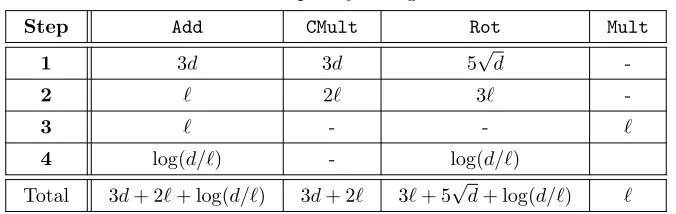
Table 3 summarizes the total complexity of Algorithm 3. Even though we need additional computation for Step 4, we can reduce the complexities of Step 2 and 3 to O(`) rotations and ` multiplications, respectively. We also note that the final outputct.ABencrypts ad×dmatrix containing (d/`) copies of the desired matrix productABin a vertical direction.
Table 3: Complexity of Algorithm 3
Step Add CMult Rot Mult
1 3d 3d 5√d
-2 ` 2` 3`
-3 ` - - `
4 log(d/`) - log(d/`)
Total 3d+ 2`+ log(d/`) 3d+ 2` 3`+ 5√d+ log(d/`) `
4.3 Parallel Matrix Computation
Throughout Sections 3 and 4, we have identified the message spaceM=Rnwith the set of matricesRd×d under the assumption thatn=d2. However, most of HE schemes [9, 18, 13] have a quite large number of plaintext slots (e.g. thousands) compared to the matrix dimension in some real-world applications, i.e.,nd2. If a ciphertext can encrypt only one matrix, most of plaintext slots would be wasted. This subsection introduces an idea that allows multiple matrices to be encrypted in a single ciphertext, thereby performing parallel matrix computation in a SIMD manner.
For simplicity, we assume that n is divisible byd2 and let g =n/d2. We modify the encoding map in Section 3.2 to make a 1-to-1 correspondence ιg between Rn and (Rd×d)g, which transforms an n -dimensional vector into a g-tuple of square matrices of order d. Specifically, for an input vector a = (a`)0≤`<n, we defineιg by
ιg:a7→ Ak = (ag·(d·i+j)+k)
0≤k<g.
The components ofawith indexes congruent to kmodulogare corresponding to thek-th matrixAk. We note that for an integer 0 ≤` < d2, the rotation operation ρ(a;g·`) represents the matrix-wise rotation by`positions. It can be naturally extended to the other matrix-wise operations including scalar linear transformation and matrix multiplication. For example, we can encryptgnumber ofd×dmatrices into a single ciphertext and perform the matrix multiplication operations betweengpairs of matrices at once by applying our matrix multiplication algorithm on two ciphertexts. The total complexity remains the same as Algorithm 2, which results in a less amortized computational complexity of O(d/g) per matrix.
5
Implementation of Homomorphic Matrix Operations
In this section, we report the performance of our homomorphic matrix operations and analyze the per-formance of the implementation. For simplicity, we assume that dis a power-of-two integer. In general, we can pad zeros at the end of each row to setdas a power of two.
5.1 Parameter Setting
We present how to select parameters of our underlying HE scheme to support homomorphic matrix operations described in Sections 3 and 4. Our underlying HE scheme is based on the RLWE assumption over the cyclotomic ring R = Z[X]/(XN + 1) for a power-of-two integer N. Let us denote by [·]
q the reduction moduloqinto the interval (−q/2, q/2]∩Zof the integer. We writeRq =R/qRfor the residue ring of Rmodulo an integerq. The native plaintext space is represented as a set of (N/2)-dimensional complex vectors. We use an RNS by taking a ciphertext modulus q = QL
i=0qi which is a product of distinct primes. Based on the ring isomorphismRq →Q
L
i=0Rqi, a7→(a (modqi))0≤i≤L, a polynomial with a large modulusqcan be represented as a tuple of polynomials with smaller coefficients moduloqi. If needed, we raise a ciphertext modulus fromqtopsqfor a prime numberps, called thespecial modulus, and perform the key-switching procedure overRpsq followed by modulus reduction back toq. We note that the RNS primes should be 1 modulo 2N to utilize an efficient Number Theoretic Transformation (NTT) algorithm.
Suppose that all the elements are scaled by a factor of an integerpand then converted into the nearest integers for quantization. If we are multiplying a ciphertext by a plaintext vector, we assume that the con-stant vector is scaled by a factor of an integerpcto maintain the precision. Thus, the rescaling procedure
after homomorphic multiplication reduces a ciphertext modulus bypwhile the rescaling procedure after a constant multiplication reduces a modulus bypc. For example, Algorithm 2 has depth of two constant
multiplications for Step 1 and 2, and has additional depth of a single homomorphic multiplication for Step 3. This implies that an input ciphertext modulus is reduced by (2 logpc+ logp) bits after the matrix
multiplication algorithm. As a result, we obtain the following lower bound on the bit length of a fresh ciphertext modulus, denoted by logq:
logq=
logq0 forHE-MatAdd;
logq0+ 2 logpc+ logp forHE-MatMult;
logq0+ logpc forHE-MatTrans,
whereq0is the output ciphertext modulus. The final ciphertext represents the desired vector but is scaled by a factor of p, which means that logq0 should be larger than logp for correctness of decryption. In other words, the chain of moduli forHE-MatMultcan be defined via a set of primes{q0, q1, q2, q3, ps}such that logq1 ≈logpand logq2 ≈logq3 ≈logpc. In our implementation, we take logp= logpc = 30 and
logq0= logps= 40.
We use the discrete Gaussian distribution of standard deviationσ= 3.2 to sample error polynomials. The secret-key polynomials were sampled from the discrete ternary uniform distribution over{0,±1}N. The cyclotomic ring dimension is chosen asN = 213 to achieve at least 80-bit security level against the known attacks of the LWE problem based on the estimator of Albrecht et al. [2]. In short, we present three parameter sets and sizes of the corresponding fresh ciphertexts as follows:
(N,logq,size) =
(213,40,80 KB) forHE-MatAdd; (213,130,260 KB) for
HE-MatMult; (213,70,140 KB) forHE-MatTrans.
5.2 Performance of Matrix Operations
Table 4: Benchmarks of homomorphic matrix operations
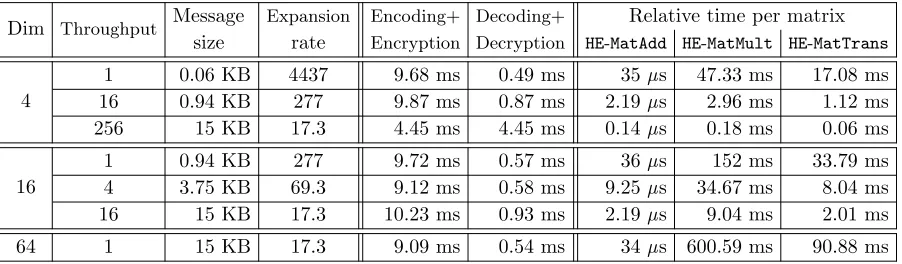
Dim Throughput Message Expansion Encoding+ Decoding+ Relative time per matrix
size rate Encryption Decryption HE-MatAdd HE-MatMult HE-MatTrans
4
1 0.06 KB 4437 9.68 ms 0.49 ms 35µs 47.33 ms 17.08 ms
16 0.94 KB 277 9.87 ms 0.87 ms 2.19µs 2.96 ms 1.12 ms
256 15 KB 17.3 4.45 ms 4.45 ms 0.14µs 0.18 ms 0.06 ms
16
1 0.94 KB 277 9.72 ms 0.57 ms 36µs 152 ms 33.79 ms
4 3.75 KB 69.3 9.12 ms 0.58 ms 9.25µs 34.67 ms 8.04 ms
16 15 KB 17.3 10.23 ms 0.93 ms 2.19µs 9.04 ms 2.01 ms
64 1 15 KB 17.3 9.09 ms 0.54 ms 34µs 600.59 ms 90.88 ms
Ciphertext sizes. As mentioned above, a ciphertext could hold 212 different plaintext slots, and thus we can encrypt one 64×64 matrix into a fully-packed ciphertext. We assumed that all the inputs had logp= 30 bits of precision, which means that an input matrix size is bounded by 64×64×30 bits or 15 KB. Since a single ciphertext is at most 260 KB for an evaluation of matrix multiplication, the encrypted version is 260/15≈17 times larger than the un-encrypted version. In Table 4, the third column gives the size of input matrices and the fourth column gives an expansion ratio of the generated ciphertext to the input matrices.
Timing results. We conducted experiments over ten times and measured the average running times for all the operations. For the parameter setting in Section 5.1, the key generation takes about 60 milliseconds. In Table 4, the fifth column gives timing for encoding input matrices and encrypting the resulting plaintext slots. Since matrix multiplication requires the largest fresh ciphertext modulus and takes more time than others, we just report the encryption timing results for the case. In the sixth column, we give timing for decrypting the output ciphertext and decoding to its matrix form. Note that encryption and decryption timings are similar each other; but encoding and decoding timings depend on the throughput. The last three columns give amortized time per matrix for homomorphic matrix computation. The entire execution time, calledlatency, is similar between the three variant implementations, so the parallel matrix computation provides roughly a speedup as a factor of the throughput.
Performance of rectangular matrix multiplication. We present the performance of Algorithm 3 described in Section 4.2. As a concrete example, we consider the rectangular matrix multiplication R16×64 ×
R64×64→R16×64. As we described above, our optimized method has a better performance than a simple
method exploiting Algorithm 2 for the multiplication between 64×64 matrices.
To be precise, the first step of Algorithms 2 or 3 generates two ciphertexts ct.A(0) and ct.B(0) by applying the linear transformations ofUσ andUτ, thus both approaches have almost the same computa-tional complexity. Next, in the second and third steps, two algorithms apply the same operations to the resulting ciphertexts but with different numbers: Algorithm 2 requires approximately four times more operations compared to Algorithm 3. As a result, Step 2 turns out to be the most time consuming part in Algorithm 2, whereas it is not the dominant procedure in Algorithm 3. Finally, Algorithm 3 requires some additional operations for Step 4, but we need only log(64/16) = 2 automorphisms.
Table 5 shows more detailed experimental results ofHE-MatMultandHE-RMatMultbased on the same parameter as in the above section. The total running times of two algorithms are 600 milliseconds and 283 milliseconds, respectively; therefore, Algorithm 3 achieves a speedup of 2×compared to Algorithm 2.
6
E2DM: Making Prediction based on Encrypted Data and Model
Table 5: Performance comparison of homomorphic square and rectangular matrix multiplications
Algorithm Step 1 Step 2 Step 3 Step 4 Total
HE-MatMult
161.09 ms 418.20 ms 20.99 ms - 600.28 ms HE-RMatMult 114.15 ms 5.44 ms 1.91 ms 282.59 ms
Speedup - 3.66× 3.86× - 2.12×
trained classifier models to a public cloud and the cloud server provides on-line prediction service to data owners who uploaded their encrypted data. In this inference, the cloud should learn nothing about private data of the data owners, nor about the trained models of the model providers.
6.1 Neural Networks Architecture
The first viable example of CNN on image classification was AlexNet by Krizhevsky et al. [32] and it was dramatically improved by Simonyan et al. [44]. It consists of a stack oflinear andnon-linear layers. The linear layers can be convolution layers or FC layers. The non-linear layers can be max pooling (i.e., com-pute the maximal value of some components of the feeding layer), mean pooling (i.e., comcom-pute the average value of some components of the feeding layer), ReLu functions, or sigmoid functions.
Specifically, the convolution operator forms the fundamental basis of the convolutional layer. The convolution has kernels, or windows, of sizek×k, a stride of (s, s), and a mapcount ofh. Given an image
I∈Rw×w and a kernelK∈Rk×k, we compute the convolved imageConv(I, K)∈RdK×dK by
Conv(I, K)i0,j0 =
X
0≤i,j<k
Ki,j·Is·i0+i,s·j0+j
for 0≤i0, j0 < dK =d(w−k)/se+ 1. Hered·ereturns the least integer greater than or equal to the input. It can be extended to multiple kernelsK={K(k)}0≤k<h as
Conv(I,K) = (Conv(I, K(0)),· · · ,Conv(I, K(h−1)))∈RdK×dK×h.
On the other hand, FC layer connects nI nodes tonO nodes, or equivalently, it can be specified by the matrix-vector multiplication of annO×nI matrix. Note that the output of convolution layer has a form of tensor so it should be flatten before FC layer. Throughout this paper, we concatenate the rows of the tensor one by one and output a column vector, denoted byFL(·).
6.2 Homomorphic Evaluation of CNN
We present an efficient strategy to evaluate CNN prediction model on the MNIST dataset. Each image is a 28×28 pixel array, where the value of each pixel represents a level of gray. After an arbitrary number of hidden layers, each image is labeled with 10 possible digits. The training set has 60,000 images and the test set has 10,000 images. We assume that a neural network is trained with the plaintext dataset in the clear. We adapted a similar network topology to CryptoNets: one convolution layer and two FC layers with square activation function. Table 6 describes our neural networks to the MNIST dataset and summarizes the hyperparameters.
The final step of neural networks is usually to apply the softmax activation function for a purpose of probabilistic classification. We note that it is enough to obtain an index of maximum values of outputs in a prediction phase.
Table 6: Description of our CNN on the MNIST dataset Layer Description
Convolution Input image 28×28, kernel size 7×7, stride size of 3, number of output channels 4 1st square Squaring 256 input values
FC-1 Fully connecting with 256 inputs and 64 outputs:R64×256×
R256×1→R64×1
2nd square Squaring 64 input values
FC-2 Fully connecting with 64 inputs and 10 outputs:R10×64×R64×1→R10×1
6.2.1 Encryption of Images
At the encryption phase, the data owner encrypts the data using the public key of an HE scheme. Suppose that the data owner has a two-dimensional image I ∈R28×28. For 0≤i0, j0 < dK = 8, let us define an extracted image feature I[i0, j0] formed by taking the elementsI
3·i0+i,3·j0+j for 0 ≤i, j < 7. That is, a
single image can be represented as the 64 image features of size 7×7. It can be extended to multiple images I ={I(k)}0
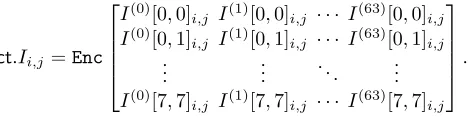
≤k<64. For each 0 ≤i, j <7, the dataset is encoded into a matrix consisting of the (i, j)-th components of 64 features over 64 images and it is encrypted as follows:
ct.Ii,j=Enc
I(0)[0,0]i,j I(1)[0,0]i,j · · · I(63)[0,0]i,j
I(0)[0,1]
i,j I(1)[0,1]i,j · · · I(63)[0,1]i,j ..
. ... . .. ...
I(0)[7,7]
i,j I(1)[7,7]i,j · · · I(63)[7,7]i,j
.
The resulting ciphertexts{ct.Ii,j}0≤i,j<7are sent to the public cloud and stored in their encrypted form.
6.2.2 Encryption of Trained Model
The model provider encrypts the trained prediction model values such as multiple convolution kernels’ values K = {K(k)}
0≤k<4 and weights (matrices) of FC layers. The provider begins with a procedure for encrypting each of the convolution kernels separately. For 0≤i, j < 7 and 0≤k < 4, the (i, j)-th component of the kernel matrixK(k) is copied into plaintext slots and the model provider encrypts the plaintext vector into a ciphertext, denoted byct.Ki,j(k).
Next, the first FC layer is specified by a 64×256 matrix and it can be divided into four square sub-matrices of size 64×64. For 0 ≤k < 4, we writeWk to denote thek-th sub-matrix. Each matrix is encrypted into a single ciphertext using the matrix encoding method in Section 3.2, say the output ciphertextct.Wk.
For the second FC layer, it can be expressed by a 10×64 matrix. The model provider pads zeros in the bottom to obtain a matrixV of size 16×64 and then generates a 64×64 matrix ¯V containing four copies ofV vertically, say the output ciphertextct.V. Finally, the model provider transmits three distinct types of ciphertexts to the cloud:ct.Ki,j(k),ct.Wk, andct.V.
6.2.3 Homomorphic Evaluation of Neural Networks
At the prediction phase, the public cloud takes ciphertexts of the images from the data owner and the neural network prediction model from the model provider. Since the data owner uses a SIMD technique to batch 64 different images, the first FC layer is specified as a matrix multiplication:R64×256×R256×64→ R64×64. Similarly, the second FC layer is represented as a matrix multiplication: R10×64×R64×64 → R10×64.
Homomorphic convolution layer. The public cloud takes the ciphertextsct.Ii,jandct.K (k)
kernel matrices and the extracted image features. For each 0≤k <4, the cloud performs the following computation on ciphertexts:
ct.Ck ←
X
0≤i,j<7
Mult(ct.Ii,j,ct.K (k) i,j).
By the definition of the convolution, the resulting ciphertextctk represents a square matrixCk of order 64 such that
Ck =
..
. ...
FL(Conv(I(0), K(k))) · · ·
FL(Conv(I(63), K(k))) ..
. ...
.
That is, it is an encryption of the matrix Ck having the i-th column as the flatten convolved result between the thei-th imageI(i)and thek-th kernel K(k).
The first square layer. This step applies the square activation function to all the encrypted output images of the convolution in a SIMD manner. That is, for each 0≤k <4, the cloud computes as follows:
ct.Sk(1)←SQR(ct.Ck)
whereSQR(·) denotes the squaring operation of an HE scheme. Note thatct.S(1)k is an encryption of the matrixCkCk.
The FC-1 layer. This procedure requires a matrix multiplication between a 64×256 weight matrix
W = (W0|W1|W2|W3) and a 256×64 input matrix C = (C0C0; C1C1; C2C2; C3C3). The matrix productW ·C is formed by combining the blocks in the same way, that is,
W ·C= X 0≤k<4
(Wk·(CkCk)).
Thus the cloud performs the following computation:
ct.F ← X 0≤k<4
HE-MatMult(ct.Wk,ct.S (1) k ).
The second square layer. This step applies the square activation function to all the output nodes of the first FC layer:
ct.S(2)←SQR(ct.F).
The FC-2 layer. This step performs the rectangular multiplication algorithm between the weight cipher-textct.V and the output ciphertextct.S(2) of the second square layer:
ct.out←HE-RMatMult(ct.V,ct.S(2)).
6.2.4 The Threat Model
Suppose that one can ensure the IND-CPA security of an underlying HE scheme, which means that ciphertexts of any two messages are computationally indistinguishable. Since all the computations on the public cloud are performed over encryption, the cloud learns nothing from the encrypted data so we can ensure the confidentiality of the data against such a semi-honest server.
6.3 Performance Evaluation of E2DM
6.3.1 Optimization Techniques
Suppose that we are given an encryptionct.Aof ad×dmatrixA. Recall from Section 3 that we apply homomorphic liner transformations to generate the encryptionct.A(`)of a matrixφ`◦σ(A) for 0≤` < d. Sometimes one can pre-compute φ`◦σ(A) in the clear and generate the corresponding ciphertexts for free. Thus this approach gives us a space/time trade-off: although it requires more space fordciphertexts rather than a single ciphertext, it reduces the overhead of rotation operations from (3d+5√d) to (d+2√d), achieving a better performance. This method has another advantage, in that an input ciphertext modulus is reduced by (logp+ logpc) bits after matrix multiplication while (logp+ 2 logpc) in the original method.
This is because the encryptions ofφk◦σ(A) are given as fresh ciphertexts and it only requires additional depths to generate the encryptions ofψk◦τ(B).
We can apply this idea to the FC layers. For each 0 ≤k < 4 and 0≤ ` <64, the model provider generates a ciphertext ct.Wk(`) representing the matrixφ`◦σ(W
k) of the first FC layer. For the second FC layer, the provider generates an encryptionct.V(`)of the matrixφ`◦σ( ¯V) for 0≤` <16.
6.3.2 Parameters
The convolution layer and the square activation layers have a depth of one homomorphic multiplication. As discussed before, the FC layers have depth of one homomorphic multiplication and one constant multiplication by applying the pre-computation optimization technique. Therefore, the lower bound on the bit length of a fresh ciphertext modulus is 5 logp+ 2 logpc+ logq0. In our implementation, we assume that all the inputs had logp= 30 bits of precision and we set logpc = 30 for the bit precision
of constant values. We set the bit lengths of the output ciphertext modulus and the special modulus as logq0 = logps = logp+ 10. We could actually obtain the bit length of the largest fresh ciphertext modulus about logq≈250 and took the ring dimension N = 213 to ensure at least 80 bits of security. This security was chosen to be consistent with other performance number reported from CryptoNets. Note that a fresh ciphertext has 0.488 MB under this parameter setting.
6.3.3 Ciphertext Sizes
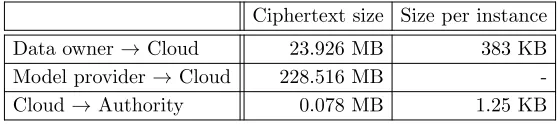
Each image is a 28×28 pixel array, where each pixel is in the range from 0 to 255. The data owner first chooses 64 images in the MNIST dataset, normalizes the data by dividing by the maximum value 255, and generates the ciphertexts{ct.Ii,j}0≤i,j<7. The total size of ciphertexts is 0.488×49≈23.926 MB and a single ciphertext contains information of 64 images, and therefore the total ciphertext size per image is 23.926/64 ≈0.374 MB or 383 KB. Since each image has approximately 28×28×30 bits, it is 133 times smaller than the encrypted one. Meanwhile, the model provider generates three distinct types of ciphertexts:
– ct.Ki,j(k) for 0≤i, j <7 and 0≤k <4; – ct.Wk(`) for 0≤k <4 and 0≤` <64; – ct.V(`) for 0≤` <16.
The total size of ciphertexts is 0.488×468≈228.516 MB. After the homomorphic evaluation of E2DM, the cloud sends only a single ciphertext to an authority who is the legitimate owner of the secret key of the HE scheme. The ciphertext size is around 0.078 MB and the size per image is 0.078/64 MB≈1.25 KB. Table 7 summarizes the numbers in the second and third columns.
Table 7: Total ciphertext sizes of E2DM
Ciphertext size Size per instance
Data owner→Cloud 23.926 MB 383 KB
Model provider→Cloud 228.516 MB
6.3.4 Implementation Details
The key generation takes about 0.87 seconds for the parameters setting in Section 6.3.2. The data owner takes about 121 milliseconds to encrypt 64 different number of images. Meanwhile, the model provider takes about 1.06 seconds to generate the encrypted prediction models. This procedure takes more time than the naive method but it is an one-time process before data outsourcing and so it is a negligible overhead.
In Table 8, we report timing results for the evaluation of E2DM. The third column gives timings for each step and the fourth column gives the relative time per image (if applicable). The dominant cost of evaluating the framework is that of performing the first FC layer. This step requires four matrix multiplication operations over encrypted 64×64 matrices so it expects to take about 0.6×4 ≈ 2.4 seconds from the result of Table 4. We further take advantage of the pre-computation method described in Section 6.3.1, and thereby it only took about 1.36 seconds to evaluate the layer (1.8 times faster). Similarly, we could apply this approach to the second FC layer, which leads to 0.09 seconds for the evaluation. In total, it took about 1.69 seconds to classify encrypted images from the encrypted training model, yielding an amortized rate of 26 milliseconds per image.
Table 8: Experimental results ofE2DMfor MNIST
Stage Latency Amortized time
per image
Data owner Encoding + Encryption 120.91 ms 1.89 ms
Model provider Encoding + Encryption 1059.14 ms
-Cloud
Convolution 219.34 ms 3.42 ms
1st square 16.99 ms 0.27 ms
FC-1 1355.19 ms 21.17 ms
2nd square 6.41 ms 0.10 ms
FC-2 90.41 ms 1.41 ms
Total evaluation 1688.34 ms 26.38 ms
Authority Decoding +Decryption 0.72 ms 0.01 ms
After the evaluation, the cloud returns only a single packed ciphertext that is transmitted the author-ity. Then the output can be decrypted with the secret key and the authority computes the argmax of 10 scores for each image to obtain the prediction. These procedures take around 0.72 milliseconds, yielding an amortized time of 0.01 milliseconds per image. In the end, the data owner gets the results from the authority.
This model achieves an accuracy of 98.1% on the test set. The accuracy is the same as the one obtained by the evaluation of the model in the clear, which implies that there is no precision loss from the approximate homomorphic encryption.
6.4 Comparison with Previous Work
Table 9 compares our result for the MNIST dataset with the state-of-the-art frameworks: CryptoNets [23], MiniONN [34], and GAZELLE [28]. The first column indicates the framework and the second column denotes the method used for preserving privacy. The last columns give running time and communication costs required for image classification.
homomorphic matrix operations. As a result, E2DM achieves 340-fold reduction in latency and 34-fold reduction in message sizes. CryptoNets allows more SIMD parallelism, so it could give better amortized running time. However, this implies that CryptoNets requires a very large number of prediction to yield better amortized complexity, so its framework turns out to be less competitive in practice.
Mixed protocol frameworks. Liu et al. [34] presented MiniONN framework of privacy-preserving neural networks by employing a ciphertext packing technique as a pre-processing tool. Recently, Juvekar et al. [28] presented GAZELLE that deploys automorphism structure of an underlying HE scheme to perform matrix-vector multiplication, thereby improving the performance significantly. It took 30 milliseconds to classify one image from the MNIST dataset and has an online bandwidth cost of 0.5 MB. Even though these mixed protocols achieve relatively fast run-time, they require interaction between protocol participants, resulting in high bandwidth usage.
Table 9: Privacy-preserving neural network frameworks for MNIST
Framework Method Runtime Communication cost
Offline Online Total Amortized Offline Online Total Amortized
CryptoNets HE - - 570 s 70 ms - - 595.5 MB 0.07 MB
MiniONN HE, MPC 0.88 s 0.40 s 1.28 s 1280 ms 3.6 MB 44 MB 47.6 MB 47.6 MB
GAZELLE HE, MPC 0 0.03 s 0.03 s 30 ms 0 0.5 MB 0.5 MB 0.5 MB
E2DM HE - 1.69 s 26 ms - - 23.93 MB 0.37 MB
7
Related Works
7.1 Secure Outsourced Matrix Computation
Matrix multiplication can be performed using a series of inner products. Wu and Haven [48] suggested the first secure inner product method in a SIMD environment. Their approach is to encrypt each row or column of a matrix into an encrypted vector and obtain component-wise product of two input vectors by performing a single homomorphic multiplication. However, it should aggregate all the elements over the plaintext slots in order to get the desired result and this procedure requires at least logdautomorphisms. Since one can apply this solution to each row ofAand each column ofB, the total complexity of secure matrix multiplication is aboutd2 multiplications andd2logdautomorphisms.
Recently, several other approaches have been considered by applying the encoding methods of Lauter et al. [40] and Yasuda et al. [49] on an RLWE-based HE scheme. Duong et al. [17] proposed a method to encode a matrix as a constant polynomial in the native plaintext space. Then secure matrix multiplication requires only one homomorphic multiplication over packed ciphertexts. This method was later improved in [37]. However, this solution has a serious drawback for practical use: the resulting ciphertext has non-meaningful terms in its coefficients, so for more computation, it should be decrypted and re-encoded by removing the terms in the plaintext polynomial.
Most of related works focus on verifiable secure outsourcing of matrix computation [11, 4, 38, 19]. In their protocols, a client delegates a task to an untrusted server and the server returns the computation result with a proof of the correctness of the computation. There are general results [20, 15, 19] of verifiable secure computation outsourcing by applying a fully HE scheme with Yao’s Garbled circuit or pseudo-random functions. However, it is still far from practical to apply these theoretical approaches to real-world applications.
7.2 Privacy-preserving Neural Networks Predictions
works have improved it by normalizing weighted sums prior to applying the approximate activation function [10], or by employing a fully HE to apply an evaluation of an arbitrary deep neural networks [7]. There are other approaches for privacy-preserving deep learning prediction based on MPC [5, 41] or its combination with (additively) HE. The idea behind such hybrid protocols is to evaluate scalar products using HE and compute activation functions (e.g. threshold or sigmoid) using MPC technique. Mohassel and Zhang [39] applied the mixed-protocol framework of [16] to implement neural networks training and evaluation in a two-party computation setting. Liu et al. [34] presented MiniONN to transform an existing neural network to an oblivious neural network by applying a SIMD batching technique. Riazi et al. [42] designed Chameleon, which relies on a trusted third-party. Their frameworks were later improved in [28] by leveraging effective use of packed ciphertexts. Even though these hybrid protocols could improve efficiency, they result in high bandwidth and long network latency.
8
Conclusion and Future Work
In this paper, we presented a practical solution for secure outsourced matrix computation. We did demon-strate its applicability by presenting a novel frameworkE2DM for secure evaluation of encrypted neural networks on encrypted data. Our experimentation shows that E2DM achieves lower size of encrypted messages and latency compared to CryptoNets.
Our secure matrix computation primitive can be applied to various computing applications such as genetic testing and machine learning. In particular, we can investigate financial model evaluation based on ourE2DMframework. Our another future work is to extend the matrix computation mechanism for more advanced operations.
References
1. M. Abadi, A. Agarwal, P. Barham, E. Brevdo, Z. Chen, C. Citro, G. S. Corrado, A. Davis, J. Dean, M. Devin, et al. Tensorflow: Large-scale machine learning on heterogeneous distributed systems, 2015. https://www. tensorflow.org.
2. M. R. Albrecht, R. Player, and S. Scott. On the concrete hardness of learning with errors. Journal of Mathematical Cryptology, 9(3):169–203, 2015.
3. C. S. Alliance. Security guidance for critical areas of focus in cloud computing, 2009. http://www. cloudsecurityalliance.org.
4. M. J. Atallah and K. B. Frikken. Securely outsourcing linear algebra computations. InProceedings of the 5th ACM Symposium on Information, Computer and Communications Security, pages 48–59. ACM, 2010. 5. M. Barni, C. Orlandi, and A. Piva. A privacy-preserving protocol for neural-network-based computation. In
Proceedings of the 8th workshop on Multimedia and security, pages 146–151. ACM, 2006.
6. J. W. Bos, K. Lauter, J. Loftus, and M. Naehrig. Improved security for a ring-based fully homomorphic encryption scheme. InCryptography and Coding, pages 45–64. Springer, 2013.
7. F. Bourse, M. Minelli, M. Minihold, and P. Paillier. Fast homomorphic evaluation of deep discretized neural networks. InAnnual International Cryptology Conference, pages 483–512. Springer, 2018.
8. Z. Brakerski. Fully homomorphic encryption without modulus switching from classical GapSVP. InAdvances in Cryptology–CRYPTO 2012, pages 868–886. Springer, 2012.
9. Z. Brakerski, C. Gentry, and V. Vaikuntanathan. (Leveled) fully homomorphic encryption without bootstrap-ping. InProc. of ITCS, pages 309–325. ACM, 2012.
10. H. Chabanne, A. de Wargny, J. Milgram, C. Morel, and E. Prouff. Privacy-preserving classification on deep neural network. IACR Cryptology ePrint Archive, 2017:35, 2017.
11. D. Chaum and T. P. Pedersen. Wallet databases with observers. InAnnual International Cryptology Confer-ence, pages 89–105. Springer, 1992.
12. J. H. Cheon, K. Han, A. Kim, M. Kim, and Y. Song. A full RNS variant of approximate homomorphic encryption. InInternational Conference on Selected Areas in Cryptography. Springer, 2018.
13. J. H. Cheon, A. Kim, M. Kim, and Y. Song. Homomorphic encryption for arithmetic of approximate numbers. InInternational Conference on the Theory and Application of Cryptology and Information Security, pages 409–437. Springer, 2017.
15. K.-M. Chung, Y. T. Kalai, F.-H. Liu, and R. Raz. Memory delegation. InAnnual Cryptology Conference, pages 151–168. Springer, 2011.
16. D. Demmler, T. Schneider, and M. Zohner. ABY-a framework for efficient mixed-protocol secure two-party computation. InNDSS, 2015.
17. D. H. Duong, P. K. Mishra, and M. Yasuda. Efficient secure matrix multiplication over lwe-based homomorphic encryption. Tatra Mountains Mathematical Publications, 67(1):69–83, 2016.
18. J. Fan and F. Vercauteren. Somewhat practical fully homomorphic encryption. IACR Cryptology ePrint Archive, 2012:144, 2012.
19. D. Fiore and R. Gennaro. Publicly verifiable delegation of large polynomials and matrix computations, with applications. InProceedings of the 2012 ACM conference on Computer and communications security, pages 501–512. ACM, 2012.
20. R. Gennaro, C. Gentry, and B. Parno. Non-interactive verifiable computing: Outsourcing computation to untrusted workers. InAnnual Cryptology Conference, pages 465–482. Springer, 2010.
21. C. Gentry et al. Fully homomorphic encryption using ideal lattices. InSTOC, volume 9, pages 169–178, 2009. 22. C. Gentry, S. Halevi, and N. P. Smart. Homomorphic evaluation of the AES circuit. InAdvances in Cryptology–
CRYPTO 2012, pages 850–867. Springer, 2012.
23. R. Gilad-Bachrach, N. Dowlin, K. Laine, K. Lauter, M. Naehrig, and J. Wernsing. CryptoNets: Applying neural networks to encrypted data with high throughput and accuracy. In International Conference on Machine Learning, pages 201–210, 2016.
24. S. Halevi and V. Shoup. Algorithms in helib. InAnnual Cryptology Conference, pages 554–571. Springer, 2014.
25. S. Halevi and V. Shoup. Bootstrapping for helib. In Annual International conference on the theory and applications of cryptographic techniques, pages 641–670. Springer, 2015.
26. S. Halevi and V. Shoup. Faster homomorphic linear transformations in helib. In Annual International Cryptology Conference, pages 93–120. Springer, 2018.
27. X. Jiang, Y. Zhao, X. Wang, B. Malin, S. Wang, L. Ohno-Machado, and H. Tang. A community assessment of privacy preserving techniques for human genomes. BMC Med. Inform. Decis. Mak., 14 Suppl 1(Suppl 1):S1, Dec. 2014.
28. C. Juvekar, V. Vaikuntanathan, and A. Chandrakasan. GAZELLE: A low latency framework for secure neural network inference. In 27th USENIX Security Symposium (USENIX Security 18), Baltimore, MD, 2018. USENIX Association.
29. M. Kim and K. Lauter. Private genome analysis through homomorphic encryption.BMC medical informatics and decision making, 15(Suppl 5):S3, 2015.
30. M. Kim, Y. Song, B. Li, and D. Micciancio. Semi-parallel logistic regression for gwas on encrypted data. IACR Cryptology ePrint Archive, 2019:294, 2019.
31. M. Kim, Y. Song, S. Wang, Y. Xia, and X. Jiang. Secure logistic regression based on homomorphic encryption: Design and evaluation. JMIR medical informatics, 6(2), 2018.
32. A. Krizhevsky, I. Sutskever, and G. E. Hinton. Imagenet classification with deep convolutional neural net-works. InAdvances in neural information processing systems, pages 1097–1105, 2012.
33. Y. LeCun. The mnist database of handwritten digits. http://yann. lecun. com/exdb/mnist/, 1998.
34. J. Liu, M. Juuti, Y. Lu, and N. Asokan. Oblivious neural network predictions via minionn transformations. In Proceedings of the 2017 ACM SIGSAC Conference on Computer and Communications Security, pages 619–631. ACM, 2017.
35. E. Makri, D. Rotaru, N. P. Smart, and F. Vercauteren. Pics: Private image classification with SVM. Cryp-tology ePrint Archive, Report 2017/1190, 2017. https://eprint.iacr.org/2017/1190.
36. R. Miotto, F. Wang, S. Wang, X. Jiang, and J. T. Dudley. Deep learning for healthcare: review, opportunities and challenges. Brief. Bioinform., May 2017.
37. P. K. Mishra, D. H. Duong, and M. Yasuda. Enhancement for secure multiple matrix multiplications over ring-lwe homomorphic encryption. InInternational Conference on Information Security Practice and Experience, pages 320–330. Springer, 2017.
38. P. Mohassel. Efficient and secure delegation of linear algebra. IACR Cryptology ePrint Archive, 2011:605, 2011.
39. P. Mohassel and Y. Zhang. SecureML: A system for scalable privacy-preserving machine learning. InSecurity and Privacy (SP), 2017 IEEE Symposium on, pages 19–38. IEEE, 2017.
40. M. Naehrig, K. Lauter, and V. Vaikuntanathan. Can homomorphic encryption be practical? InProceedings of the 3rd ACM workshop on Cloud computing security workshop, pages 113–124. ACM, 2011.
42. M. S. Riazi, C. Weinert, O. Tkachenko, E. M. Songhori, T. Schneider, and F. Koushanfar. Chameleon: A hybrid secure computation framework for machine learning applications. InProceedings of the 2018 on Asia Conference on Computer and Communications Security, pages 707–721. ACM, 2018.
43. Microsoft SEAL (release 3.3). https://github.com/Microsoft/SEAL, 2019. Microsoft Research, Redmond, WA.
44. K. Simonyan and A. Zisserman. Very deep convolutional networks for large-scale image recognition. arXiv preprint arXiv:1409.1556, 2014.
45. N. P. Smart and F. Vercauteren. Fully homomorphic SIMD operations. Designs, codes and cryptography, 71(1):57–81, 2014.
46. H. Takabi, J. B. Joshi, and G.-J. Ahn. Security and privacy challenges in cloud computing environments. IEEE Security & Privacy, 8(6):24–31, 2010.
47. S. Wang, X. Jiang, H. Tang, X. Wang, D. Bu, K. Carey, S. O. M. Dyke, D. Fox, C. Jiang, K. Lauter, and Others. A community effort to protect genomic data sharing, collaboration and outsourcing. npj Genomic Medicine, 2(1):33, 2017.
48. D. Wu and J. Haven. Using homomorphic encryption for large scale statistical analysis. Technical report, Technical Report: cs. stanford. edu/people/dwu4/papers/FHESI Report. pdf, 2012.