BLIND
Ranu Dixit
1Navdeep Kaur
2M.Tech Students, Information Technology, Chandigarh Engineering College, Landran, Mohali,Punjab, India1 Faculty of Information Technology, Chandigarh Engineering College, Landran,Mohali, Punjab, India2
ABSTRACT: Till date blind people struggle a lot to live their miserable life. Their problems have made them to lose their hope to live in this competing society. They seek help from others to guide them whole day. This paper aims to make the blind person fully independent. The main goal of this paper is help blind and visually impaired person to find information for their everyday lives when it needed through radio station. It involves the synchronization of different sound signals and reading of each signal bit wise. These signals store in database, apply the HMM algorithm and distribute each sound signal in one information database. Speech recognition system is applies and each sound signal must create sound corresponding to it in database. .Net simulation tool is use to implement our approach. We present experiments result show how effectively it helps blind and visually impair persons.
Keywords: Automatic Speech Recognition, Hidden Markov Model (HMM), .Net simulation tool, classifiers, feature extraction, performance evaluation, Database.
I. INTRODUCTION
A. Blind person and information technology: Sight is consider to be the most essential of all the senses, people lacking this sense are look upon with pity by others. Visually impair persons face numerous difficulties to perform their day to day task. They are totally or partially dependent on someone for help [1]. In order to overcome these drawbacks, we design a system to collect recent information through automatic speech recognition by radio at any time and providing the solution, which would be of immense advantage in comparison to the devices that are using by blind people today. This system is capable of fulfilling all the requisites of visually impair and help them to become independent like normal humans.
II. OBJECTIVE
A. Radio as a tool for information: Traditionally radio programs were broadcast on different frequencies via FM and AM, and the radio had to be tuned into each frequency, as needed. This used up a comparatively large amount of spectrum for a relatively small number of stations, limiting listening choice. For the relay of the program, first it is record and then need to editing, after that at a suitable time table this is relay to the respective frequency. In this process audience may listen to this program if they are free at the same time, if they are busy they may not listen to the program, to avoid this problem real time communication known as live broadcasting is useful, We present experiments result show the help blind and visually impaired to find information for their everyday lives.
Blind user ask for information (to radio station) and the radio station replies for asked information e.g. hospital or Institute. The user selects the option by speech either for hospital by hospital or Institute, one of them. This option acts as input data for machine.
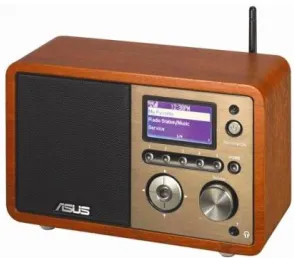
Figure 1: Radio communication steps
we must suppress interference to realize a noise-robust hands-free speech recognition the information of the observed signal in each microphone[2],[3],[4],[5],[6],[7],[8],[9],[10],[11],[12],[13],[14],[15],[16],[17],[18].Research in speech processing and communication for the most part, is motivate by people’s desire to build mechanical models to emulate human verbal communication capabilities [19]. speech processing is one of the most exciting areas of the signal processing. Automatic speech recognition by machines has attracted a great deal of attention for sixty years [20].
III. DESIGN OF THE SYSTEM
Although the present software systems are often sophisticate and user-friendly, they are usually not very convenient for the visually impair people. The reason is the graphical interface and absence of the features fulfilling special needs of the visually impair. Speech synthesizer and screen reader software still represent basic functionalities that are used by the visually impair to obtain information by means of a computer [22].
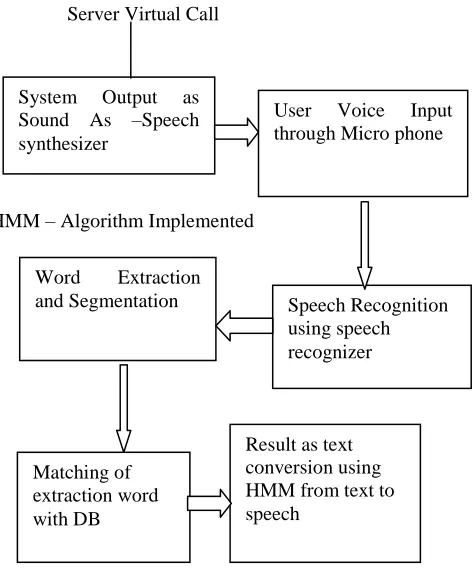
The proposed system is visualized as a block diagram having the following components: Server Virtual Call
HMM – Algorithm Implemented
Figure 2: Block diagram of speech recognition
1. Sound Recording and word detection component
2. Feature extraction component Speech recognition component 3. Acoustic and language model.
System Output as Sound As –Speech synthesizer
User Voice Input through Micro phone
Word Extraction
and Segmentation Speech Recognition using speech recognizer
Matching of extraction word with DB
and zero crossing rate to detect the silent region. Taking both of them is important as only energy tends to miss some parts of sounds which are important.
B. Feature extraction component: The component generated feature vectors for the sound signals given to it. It generates Mel Frequency Cepstrum Coefficients and Normalised energy as the features that should be use to uniquely identify the given sound signal.
c. Recognition component: This is a Continuous, Multi-dimensional Hidden Markov Model base component. It is the most important component of the system and is responsible for finding the best match in the knowledge base, for the incoming feature vectors.
d. Knowledge model: The component consists of Word based acoustic. Acoustic Model has a representation of how a word sounds. Recognition system makes use of this model while recognising the sound signal. The basic flow once the training is done, can be summaries as the sound input is taken from the sound recorder and is feeded to the feature extraction module. The feature extraction module generates feature vectors out of it which are then forward to the recognition component. The recognition component with the help of the knowledge model and comes up with the result. During the training the above flow differs after generation of feature vector. Here the system takes the output of the feature extraction module and feeds it to the recognition system for modifying the knowledge base [21].
Figure 3: Need of radio for real time communication
IV. METHODOLOGY
A. Formulation of the hypotheses: This idea combines two areas. One is real time communication for blind people and second is speech synthesis and recognition. This application will be made on Microsoft .Net. Microsoft provides the features of speech synthesis and speech recognition. Speech synthesis means text to speech conversion and speech recognition means speech to text conversion. Both ideas are combining. Now next task is to generate the sound of text understood. In this what is happening, there is a database which store the sound segments which is use accordingly. The effectiveness of text to speech conversion totally depends on how efficiently the sound segments are store in the database. In speech to text conversion, firstly the audio signal is taken which includes strings, numbers and various pitches. This audio signal needs to check among the data store in the database. For better results recognizer should care about only the require stuff. So for this purpose application is a grammar which enhances the efficiency of the search. This idea is use to make an algorithm for searching the results of subjective questions from the database.
B. System software used
1) Visual Studio – 3.5
2) Sql Server – To create the knowledgebase 3) Speech SDK 5.1 for the conversion of
V. VOICE TO TEXT AND TEXT TO VOICE
Steps are as follows:
Blind user ask for information (to radio station) and the radio station replies for asked information e.g. hospital or Institute. The user selects the option by speech either for hospital by hospital or Institute, one of them.
This option acts as input data for machine.
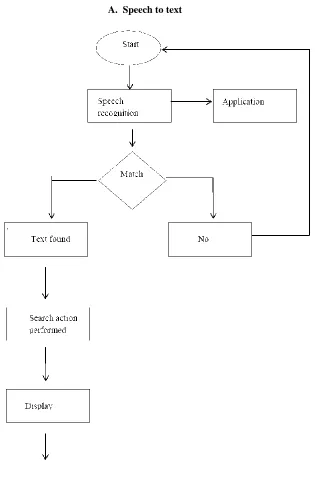
The word is matched by speech recognition engine. It will make use of created grammars.
Check the input from database.
A. Speech to text
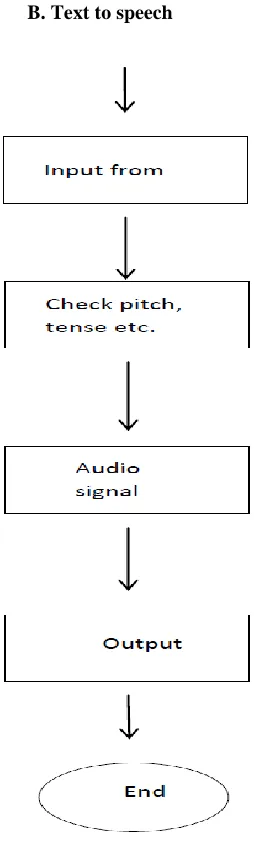
B. Text to speech
Figure 5: Block diagram for text to speech
VII. SPEECH SYNTHESIS ALGORITHM AND DECISION TREES
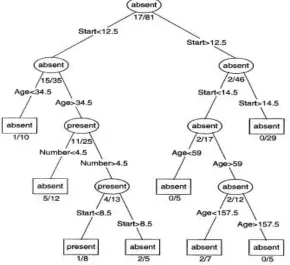
Figure 6: Block diagram for decision trees
A. Input from user array of voice signals {s1,s2,s3….sn} B. If (input) {
signals sent to speech recognition engine }
else {
//ask to provide input or time out break;
}
C. check the speech grammars D. If (true)
{ //search the content } Else
{ // go to step1 } E. Display output
F. Automatic conversion of text to speech G. Pitch and tense checking done H. Audio signal generation
I. Voice result will be provided to user
VIII. TOOLS OF DATA COLLECTION & ANALYSIS
Basically the idea is to convert the text into speech and vice versa. As we are not attaching any hardware into it hence we would start with a virtual call which the software shows of getting connected.
A. System provides options for you to speak hospitals, or Institute. It is done through speech synthesizer class object which is there in .NET framework 3.5 in an addition to speech.
Suppose the user speaks one it means the user wants the information for the hospital. In recognizer class if it is matched with the grammar. Then the data will be fetched from the database accordingly.
C. Then again there is a reverse transformation of text to speech, again the HMM reverser would be applied and the user gets the information.
Before explaining steps required for speech recognition and synthesis lets discuss the reference required for this. 1. Microsoft speech object library needs to be used.
2. System, Speech class need to be referred.
Few header files which are required to perform speech recognition and speech synthesis.
i) Speech lib
ii) Speech recognition iii) Speech synthesis
IX. EXPERIMENTAL RESULTS AND DISCUSSION
The user verification in non noisy area listed in given tables Results of user verification in non noisy area
Serial Number. Word Correct matching (no of users)
Wrong Matching (no of users) 1 Slow pitch 48 2
2 Normal pitch
50 0 3 Fast
pitch
49 1 Total 147 3
Table 1: User verification in non noisy area
Positive Identification:
Total Number of user for each variable: 50 Variables: 3 (Slow, Normal and Fast)
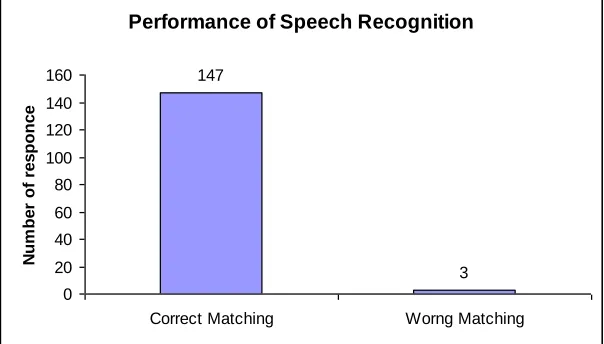
The above result was obtained for 147 users reflect the correct matching out of 150. In this case the results was found to be 98%.
Performance of Speech Recognition
147 3 0 20 40 60 80 100 120 140 160
Correct Matching Worng Matching
N um be r of r e s po nc e
Total 150 0
Table 2: User verification (Different gender) in non noisy area
Positive Identification:
Total Number of male Users: 50 Total Number of female Users: 50 Total Number of child Users: 50
In the gender case the results was found to be 100%.
To test data we used the following shell script:
using System;
using System.Collections.Generic; using System.ComponentModel; using System.Data;
using System.Drawing; using System.Linq; using System.Text;
using System.Windows.Forms; using System.Speech.Recognition; using System.Speech.Synthesis;
namespace voice_calculator {
public partial class Form1 : Form {
SpeechRecognizer speechreco = new SpeechRecognizer(); SpeechSynthesizer sp_sz = new SpeechSynthesizer(); long a = 0;
long b = 0; long res = 0; String opr = "";
X. CONCLUSION AND FUTURE WORKS:
This proposed model enables the visually impaired person to function independently like normal humans. It improved the quality of their life. The problem with the existing system is the delay encountered and lack of efficiency. The main aim of serving the mankind is achieved by providing sense of sight to the needy by this paper. In recent there is no much time for user to achieve the information due to busy life style. So in these days the health and career problems are main things to the youths. We provided a comprehensive solution of real time information communication between user and machine on same time when needed by users. In future we want to do is:
A. Evaluate the learner by means of subjective questions as well with the help of radio.
B. User will give the input to the system. This input will be checked against the database used for the questionnaire. On the basis of most appropriate matching results will be displayed in the sound and this sound broadcast with the help of radio station to the listener.
XI. ACKNOWLEDGEMENT
I would like to express my deepest gratitude to Navdeep Kaur (Dissertation Mentor) for her valuable guidance. It is only with her guidance that I could take up initiative of such a good topic of thesis. I am also very thankful to Mr. D. R Sharma, All India Radio Chandigarh for giving me opportunity to propose and implement my work.
REFERENCES
[1] V.D. Kanna and S.Aswin Amirtharaj, P.V.Deepak Govind Prasad, N.Sriram Prabhu “Design of a FPGA based Virtual Eye for the Blind” 2011 2nd International Conference on Environmental Science and Technology IPCBEE vol.6 (2011 IACSIT Press, Singapore
[2] B. H. Juang and F. K. Soong, “Hands-free telecommunications,” Proc. International Conference on Hands-Free Speech Communication, pp. 5–10, 2001.
[3] J. F. Cardoso, “Eigenstructure of the 4th-order cumulant tensor with application to the blind source separation problem,” Proc. ICASSP’89, pp. 2109–2112, 1989.
[4] C. Jutten and J. Herault, “Blind separation of sources part i: An adaptive algorithm based on neuromimetic architecture,” Signal Processing, vol. 24, pp. 1–10, 1991.
[5] P. Comon, “Independent component analysis, a new concept?” Signal Processing,vol. 36, pp. 287–314, 1994.
[6] A. J. Bell and T. J. Sejnowski, “An information-maximization approach to blind separation and blind deconvolution,” Neural Computation, vol. 7, no. 6, pp. 1129–1159, 1995.
[7] S. Amari, S. Douglas, A. Cichocki, and H. Yang, “Multichannel blind deconvolution and equalization using the natural gradient,” Proceedings IEEE International Workshop on Wireless Communication, pp. 101–104, 1997.
[8] P. Smaragdis, “Blind separation of convolved mixtures in the frequency domain,” Neurocomputing, vol. 22, no. 1-3, pp. 21–34, 1998.
[9] S. Choi, S. Amari, A. Cichocki, and R. Liu, “Natural gradient learning with a nonholonomic constraint for blind deconvolution of multiple channels,”
Proceedings of International Workshop on ICA and BSS, pp. 371–376, 1999.
[10] N. Murata and S. Ikeda, “An on-line algorithm for blind source separation on speech signals,” Proc. of NOLTA98, vol. 3, pp. 923–926, 1998. [11] T. Takatani, T. Nishikawa, H. Saruwatari, and K. Shikano, “Highfidelity blind separation of acoustic signals using simo-model-based ica with
information geometric learning,” Proc. IWAENC2003, pp. 251–254, 2003.
[12] T. Nishikawa, H. Saruwatari, and K. Shikano, “Stable learning algorithm forblind separation of temporally correlated acoustic signals combining multistage ica and linear prediction,” IEICE Trans. Fundamentals, vol. E86-A,no. 8, pp. 2028–2036, 2003.
[13] L. Parra and C. Spence, “Convolutive blind separation of non-stationarysources,” IEEE Transactions on Speech and Audio Processing, vol. 8, pp.320–327, 2000.
[14] H. Saruwatari, T. Kawamura, T. Nishikawa, and K. Shikano, “Fastconvergence algorithm for blind source separation based on array signal
processing,” IEICE Trans. Fundamentals, vol. E86-A, no. 4, pp. 286–291,2003.45
[15] T. Nishikawa, H. Saruwatari, and K. Shikano, “Blind source separation of acoustic signals based on multistage ica combining frequency-domain ica and time-domain ica,” IEICE Trans. Fundamentals, vol. E86-A, no. 4, pp. 846–858, 2003.
[16] H. Sawada, R. Mukai, S. Araki, and S. Makino, “Polar coordinate based nonlinear function for frequency domain blind source separation,” IEICE Trans. Fundamentals, vol. E86-A, no. 3, pp. 590–596, 2003.
[17] S. Araki, S. Makino, Y. Hinamoto, R. Mukai, T. Nishikawa, and H. Saruwatari, “Equivalence between frequency domain blind source separation and frequency domain adaptive beamforming for convolutive mixtures,” EURASIP Journal on Applied Signal Processing, vol. 2003, no. 11, pp. 1157–1166, 2003.
[18] Y. Mori, H. Saruwatari, T. Takatani, S. Ukai, K. Shikano, T. Hiekata,Y. Ikeda, H. Hashimoto, and T. Morita, “Blind separation of acoustic
signalscombining simo-model-based independent component analysis and binary masking,” EURASIP Journal on Applied Signal Processing, vol. 2006, pp. Article ID 34 970, 17 pages, 2006.
[19]M.A.Anusuya, S.K.Katti Sri Jaya chamarajendra College of Engineering Mysore, India International Journal of Computer Science and Information Security, Vol. 6, No. 3, 2009
[20] Dat Tat Tran, “Fuzzy Approaches to Speech and Speaker Recognition ,” A thesis submitted for the degree of Doctor of Philosophy of the university of Canberra.
[21] Simon Kinga and Joe Frankel, Recognition ,Speech production knowledge in automatic speech recognition , Journal of Acoustic Society of America,2006.
[22] Robert Batusek and Ivan Kopecek, “User Interfaces for the Visually Impaired people”, Masaryk University, 2000.
BIOGRAPHY