Using the Technology Acceptance model to
investigate knowledge conversion in Thai public
organisations
Puripat
Charnkit
School of Management and Information Systems
Faculty of Business and Law
A thesis submitted to Victoria University in fulfillment of the requirement
for the degree of Doctor of Business Administration
ii
Declaration
“I, [Puripat charnkit], declare that the DBA thesis entitled [Using the Technology Acceptance model to investigate knowledge conversion in Thai public organisations] is no more than 65,000 words in length including quotes and exclusive of tables, figures, appendices, bibliography, references and footnotes. This thesis contains no material that has been submitted previously, in whole or in part, for the award of any other academic degree or diploma. Except where otherwise indicated, this thesis is my own work”.
iii
Acknowledgements
I wish to express my gratitude to all the people who have contributed to the completion of this dissertation.
I would like to thank Associate Professor Arthur Tattnall, who was able to provide the right balance of support. He was able to guide me towards important references that had a profound influence on my thinking. His in-depth knowledge of information systems and communications provided the opportunity to extend my own knowledge.
I would also like to sincerely thank Associate Professor Geoff Sandy, who gave kindly of his time and expertise to assist me with a complex methodology and to guide me throughout the research procedure.
iv
Abstract
This dissertation investigated the relationship between knowledge conversion processes using the Technology Acceptance Model (TAM) in Thai governmental organisations. There are few studies concerned with the development of sharing and the conversion of knowledge, and none of the Thai public sector. Most Thai research studies are concerned with the development of knowledge management practices and how to use created knowledge in organisations. This study used the relationship between technology support and managing the conversion of knowledge to increase knowledge sharing in organisations. It also contributes to knowledge of technology usage and the conversion of existing knowledge process by applying the Technology Acceptance Model (TAM) to explain uptake and use of this technology. The main benefit of this research is that it is the first study available to the Thai Government on the issue of developing knowledge conversion processes by applying the Technology Acceptance Model. A better knowledge conversion procedure can improve the efficiency of Thai government departments.
The aim of this thesis was to explore the knowledge conversion process in Thai public organisations, identify the external variables that affect the Technology Acceptance Model, and determine ways to enhance knowledge sharing in Thai public organisations. Moreover, the problems and barriers that are inhibitors to knowledge conversion processes in Thai public organisations were investigated.
In an attempt to accomplish this aim, the thesis includes a focused literature review of areas such as knowledge management (KM), the knowledge conversion (SECI) process, knowledge sharing, technology and communication support, and the Technology Acceptance Model.
v
The qualitative findings demonstrated that there were eight external variables that affect TAM and knowledge conversion processes in the sample:
(1) Age , ability, educational background, and skill (2) Training strategies and training period
(3) Techniques and tools to persuade people
(4) Knowledge person (knowledge worker and knowledge receiver)
(5) National background and Thai organisational culture (organisational culture with learning ability, organisational culture with expression ability, organisational culture with achievement, and organisational culture with old practices)
(6) Attitudes, understanding, and behaviour of the employee
(7) Management and policies; knowledge management program; fluctuations in management positions; motivation and attention from head office
(8) Amount of computer and IT support, including support in the workplace, support for knowledge management programs, support for the policies and plans of the organisation, and security issues.
vi
Table of Contents
Declaration ... ii
Acknowledgements ... iii
Abstract ... iv
Table of Contents ... vi
List of Tables ... xiii
List of Figures... xiv
List of Abbreviations ... xv
1. INTRODUCTION ... 1
1.1 Introduction ... 1
1.2 Aims of the Research ... 3
1.3 Definition of Terms ... 3
1.4 Contribution to Knowledge ... 4
1.5 Context of the Project ... 5
1.6 Statement of Significance ... 7
1.7 Conceptual Framework ... 8
1.8 Methodology ... 10
1.9 Sampling ... 11
1.10 Data collection and Data Analysis ... 12
1.11 The background of knowledge management in Thai agencies and governance policy support ... 12
vii
1.11.2 Strategic development plans of the Thai public sector ... 15
1.11.3 Pilot agencies ... 15
1.11.4 Background of Ministry of Commerce ... 16
1.11.5 Role of Office of the Permanent Secretary (OPS): ... 18
1.11.6 Support of knowledge management in the Ministry of Commerce ... 19
1.12 The development of an IT project in Thailand ... 22
1.13 Outline of the thesis ... 24
1.14 Summary ... 26
2. REVIEW OF LITERATURE ... 27
2.1 Introduction ... 27
2.2 The Importance of Knowledge and Sharing Information ... 27
2.3 Nature of knowledge ... 28
2.3.1. Explicit Knowledge and Tacit Knowledge ... 29
2.3.2. Tacit knowledge ... 31
2.4 Exchange of Knowledge in the Network ... 32
2.5 Conversion of Tacit Knowledge and Explicit Knowledge ... 34
2.6 The Knowledge-sharing System ... 37
2.7 The Concept of Knowledge-sharing and Knowledge-sharing Systems ... 38
2.8 Barriers to Knowledge-sharing ... 38
2.9 Using Information Technology to Support Knowledge Transfer... 41
2.10 Knowledge Management (KM) ... 42
2.10.1. The Knowledge Worker ... 44
2.10.2. Knowledge Management and Knowledge Innovation ... 44
viii
2.11.1 Benefits of KM ... 46
2.11.2 Comparison of KM in the Public and Private Sectors ... 47
2.11.3 NPM and KM in the Public Sector ... 47
2.11.4 Importance and Needs of KM for the Government ... 48
2.11.5 Need for a Framework for KM in the Public Sector ... 49
2.11.6 Elements to be considered in the Framework for the Public Sector ... 49
2.12 KM Tools and Techniques ... 52
2.12.1 COP (Communities of Practice) ... 53
2.12.2 Storytelling... 56
2.13 TAM (The Technology Acceptance Model) ... 57
2.14 The Occurrence of New IT/IS and TAM ... 60
2.15 Examples of the use of TAM ... 60
2.16 Impact of External Variables ... 63
2.17 Summary ... 64
3. METHODOLOGY ... 66
3.1. Introduction ... 67
3.2. Semi-structured Interview ... 67
3.3. Tools and Techniques... 70
3.4. Methodology for successful interviews ... 70
3.5. Interview Questions ... 71
3.6. Sample Selection ... 73
3.7. Departments ... 74
3.8. Sample Size... 75
ix
3.10. Summary ... 78
4. RESULTS... 79
4.1 Research Question 1 “Which external variables have an impact on technology acceptance in Thai public organisations by improving or reducing the knowledge conversion process?” ... 79
4.1.1. IT dimension ... 80
4.1.1.1 IT usage ... 80
4.1.1.2 IT and Frequency of usage ... 82
4.1.1.3 External variables that may impact on technology acceptance ... 85
4.1.2. KM dimension ... 86
4.1.2.1. KM Tools ... 87
4.1.2.2. Frequency of use (KM practice and activities in organisation) ... 89
4.1.2.3. Problems of Knowledge management ... 90
4.1.2.4. Key obstructions in implementation ... 92
4.1.2.5. Status of KM ... 94
4.1.2.6. Limitations and Barriers ... 95
4.1.2.7. Key successes of KM ... 96
4.2 Research question 2:“Which technologies have been used with the knowledge conversion processes (SECI) in Thai public organisations?” ... 97
4.2.1. Attitude about SECI process... 98
4.2.1.1. SECI process ... 98
4.3 Summary ... 99
5. DISCUSSION ... 102
5.1 Introduction ... 102
x
5.2.1 Similar variables ... 102
5.2.1.1 The relationship of age and the human factors (ability, skills and people) with the level of technology acceptance ... 105
5.2.1.2 The national background of Thailand can be summarised with two key words: Phu yai and Phu noi. ... 109
5.2.1.3 The impact of management and policy on the level of acceptance of technology and knowledge conversion ... 110
5.2.1.4 Attitude, understanding and behaviour are important in the knowledge conversion process ... 112
5.2.1.5 Thai organisational culture influences the intensity of technology acceptance and the knowledge conversion process ... 116
5.2.1.4.1. Organisational Culture(OC) with learning ability ...118
5.2.1.4.2. Organisational Culture (OC) with expression ability ...123
5.2.1.4.3. Organisational Culture (OC) with achievement orientation ...124
5.2.1.4.4. Organisational Culture (OC) with old practices ...127
5.2.2 Different variables ... 129
5.2.2.1. The acceptance of technology under security issues ... 130
5.2.2.2. Costs and expenditures ... 131
5.2.2.3. Training program and communication ... 131
5.2.2.4. Strategies and activities to persuade people ... 132
5.3 Discussion on Research question 2: ... 134
5.3.1. Socialization ... 134
5.3.1.1. Acceptance of MSN Messenger: A probable effect of increase in knowledge sharing and converting. ... 135
xi
5.3.1.3 MSN Messenger can support knowledge sharing within an organisation
by offering employees a chance to use new technology ... 137
5.3.1.4. MSN Messenger benefits the knowledge conversion process in many respects 138 5.3.2. Externalisation ... 139
5.3.2.1. The problem of different generations and backgrounds in IT ... 139
5.3.3. Combination ... 141
5.3.4. Internalisation ... 142
5.4 Discussion on Research question 3: ... 145
5.5 Discussion on Research question 4: ... 148
5.5.1. TAM theory may not be useful for MOC if people still lack support from other sources ... 150
5.6 Summary ... 153
6. CONCLUSION ... 159
6.1 Introduction ... 159
6.2 Thesis Questions ... 160
6.3 Overview of the research ... 162
6.4 Key findings ... 163
6.5 Contribution of the study ... 165
6.6 Practical Implications of the Research ... 166
6.7 Limitations of the research... 168
6.8 Suggestions of Further research ... 169
6.9 Concluding Comments ... 170
References ... 173
xii
xiii
List of Tables
TABLE 1-1SUMMARY OF MOC’S TECHNOLOGIES, COMMUNICATIONS AND KNOWLEDGE
MANAGEMENT ACTIVITIES ... 21
TABLE 3-1 USES OF COMPUTER SOFTWARE IN QUALITATIVE STUDIES (MILES &HUBERMAN 1994) ... 69
TABLE 3-2CRITERIA FOR CHOOSING THE SAMPLE ... 75
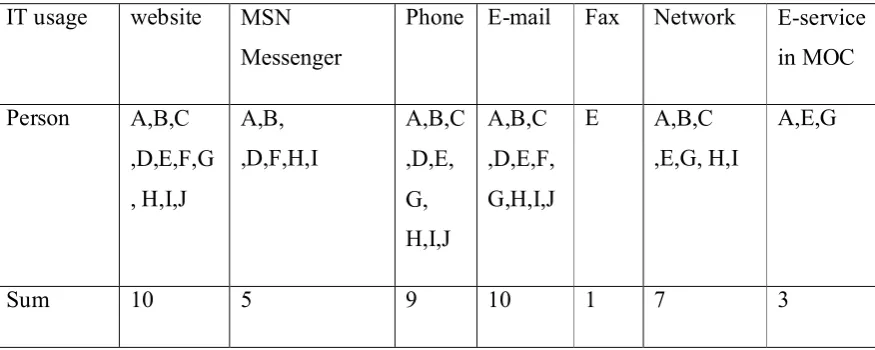
TABLE 4-1IT USAGE IN MOC ... 81
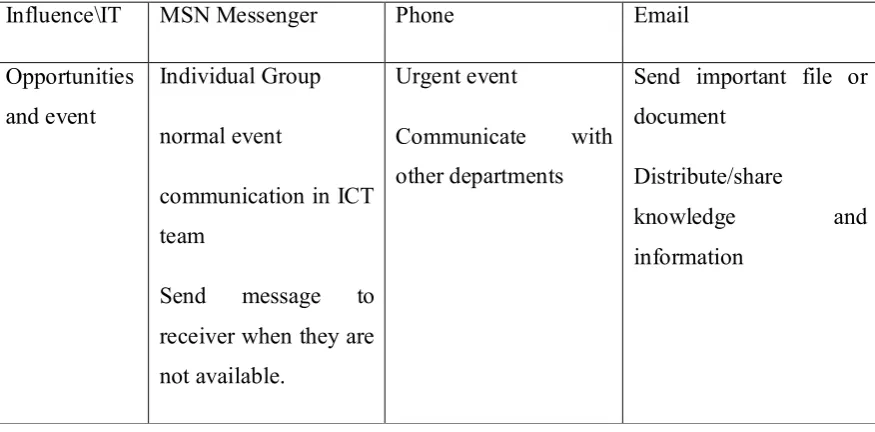
TABLE 4-2IT AND FREQUENCY OF USAGE ... 83
TABLE 4-3KEY FACTORS INFLUENCING THE ACCEPTANCE TECHNOLOGY IN THE MOC ... 85
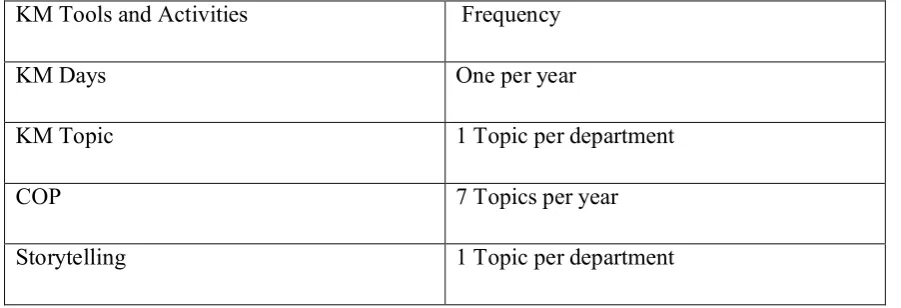
TABLE 4-4FREQUENCY OF USE AND KM PRACTICES AND ACTIVITIES IN ORGANISATION ... 89
TABLE 4-5PROBLEMS OF KNOWLEDGE MANAGEMENT... 90
TABLE 4-5PROBLEMS OF KNOWLEDGE MANAGEMENT (CONTINUE) ... 91
TABLE 4-6KEY OBSTRUCTIONS IN IMPLEMENTATION ... 92
TABLE 4-7ATTITUDES OF THAI ORGANISATIONAL CULTURE IN THE MOC ... 92
TABLE 4-8ATTITUDE TOWARDS KNOWLEDGE MANAGEMENT STATUS IN THE MOC ... 94
TABLE 4-9LIMITATION AND BARRIERS OF KNOWLEDGE MANAGEMENT IMPLEMENTATION .. 95
TABLE 4-10KEY SUCCESSES OF KNOWLEDGE MANAGEMENT ... 96
TABLE 4-11THE RELATIONSHIP BETWEEN IT IN ORGANISATION AND SECI PROCESS IN STUDY. ... 98
TABLE 5-1SIMILAR VARIABLE IN IT DIMENSION, KM DIMENSION, AND LIMITATION AND BARRIERS IN CONVERTING AND SHARING KNOWLEDGE ... 103
xiv
List of Figures
FIGURE 1-1 CONCEPTUAL FRAMEWORK (FINAL VERSION) OF THAI PUBLIC KNOWLEDGE CONVERSION ENHANCEMENT. ... 9 FIGURE 2-1 FOUR MODES OF KNOWLEDGE CONVERSION (ADAPTED FROM NONAKA AND
TAKEUCHI,1995) ... 36
FIGURE 2-2THE TAM MODEL IS PROPOSED BY DAVIS... 59
FIGURE 2-3 THE TAM2 MODEL IS PROPOSED BY VISWANATH VENKATESH AND FRED D. DAVIS ... 62 FIGURE 2-4THE TAM3 MODEL IS PROPOSED BY VISWANAS VENKATESH AND HILLOL BALA
... 63 FIGURE 4-1WEBSITE KM OF MINISTRY OF COMMERCE THAILAND ... 82 FIGURE 5-1TAM2 PROPOSED AN EXTENSION OF TAM,VENKATESH AND DAVIS (2000) .... 107 FIGURE 5-2 THE MODIFIED OUTCOME THAT IMPACT ON TECHNOLOGY ACCEPTANCE AND
xv
List of Abbreviations
ICT Information and Communication Technology
IS Information System
IT Information Technology
KC Knowledge Conversion
KM Knowledge Management
KS Knowledge Sharing
MOC Ministry of Commerce
OPDC Office of the Public Sector Development Commission
PEOU Perceived Ease of Use
PU Perceived Usefulness
SECI Socialisation, Externalisation, Combination, Internalisation
1
1.
INTRODUCTION
1.1
Introduction
Human resource and organisational development are essential for helping organisations achieve the highest efficiency. Using tools, strategies and efficient methods, many organisations are attempting to revamp their old management styles to enhance their ability and be on par or be competitive with other organisations in a similar structure or business. Nowadays, there are many capability tools that can be used by an organisation. For example, Information and Communication Technology (ICT) can serve as a management tool and boost an organisation’s potential, irrespective of the industry or sector. ICT has a multi-faceted role and can be easily integrated with the strategic plans of the organisation. Public and private sector companies in Thailand employ ICT in their organisations, for developing web pages, websites and e-learning content, to enhance their staff’s potential and knowledge. TMB Bank, for example, is a private sector financial institution in Thailand. Their use of ICT is evident on their website and in their e-learning modules, developed to strengthen the skill set of their staff.
Many public sector or government organisations have realized the uses and benefits of ICT. The Thai government, in particular, is keen on utilizing ICT to improve people’s potential in the country and the abilities of the officers in the agency. In 2002, the Thai government acknowledged the benefits and importance of knowledge management after they learned that knowledge management can help them to improve the old Thai public governance system by resolving concerns related to employees’ organisational learning.
2
involves leveraging cost benefits by reducing redundant operational processes and offering end-to-end solutions to make people’s lives more convenient and comfortable—helping them receive everything that they need, including performance evaluation, instantly. The background of knowledge management in Thai agencies and public sector development strategic plans is discussed in the next section.
Many countries consider KM to be very important and useful for retail organisations. It is employed by global organisations such as Xerox and IBM for consolidating and sharing knowledge with employees. They also use KM to manage their organisation as well. Moreover, many government sectors in several countries also use KM strategies to manage their valuable resources and improve and increase their public sector ability. Examples of such countries are Thailand, Australia and Korea (Chowdhury 2006; OPDC 2004; Ritter & Choi 2000; Samarah 2006; Slagter 2007). By reviewing studies and existing literature, the author argues that ICT can be used for knowledge management capabilities.
Modern technology that supports knowledge management depends on the following: 1. Type of knowledge that needs to be consolidated and stored.
2. Type of people in the organisation.
3. Components and technological framework in the organisation.
In Thailand, the government sector is very interested in KM and its uses within the organisation. However, in terms of execution Thailand lags behind other developed countries as the processes for knowledge management are currently being researched.
3
1.2
Aims of the Research
The aim of this research was to study the relationship between knowledge conversion processes and technology acceptance in Thai government organisations.
In particularly, the study aimed to
1. Identify the external variables that have an affect on technology acceptance in organisations.
2. Survey technology usage related to knowledge conversion processes in a Thai public organisation.
3. Identify the main problems inhibiting the use of technology to convert knowledge in a Thai public organisation.
4. Determine ways to enhance knowledge sharing in a Thai public organisation.
5. Find out details of barriers to knowledge conversion processes to reduce these barriers in Thai public organisations by using information and communication technology and external variables.
6. Provide information of knowledge conversion that will help to increase the performance of knowledge conversion in Thai public organisations.
1.3
Definition of Terms
The definition of terms are fully explained later in this thesis, but brief definitions are given here.
4
Information and Communication Technology (ICT): ICT is defined as a technology in a user’s world such as telecommunications networks, Internet, and any associated machinery or equipment (Hendriks 2001; Kling 2000).
Knowledge management (KM): is often defined in several ways. For example Brelade and Harman (2001) consider that “Knowledge management is the acquisition and use of resources to create an environment in which information is accessible to individuals and in which individuals acquire, share and use that information to develop their own knowledge and are encouraged and enabled to apply their knowledge for the benefit of the organisation.”
Knowledge management is described as an innovation with the potential to affect the whole of an organisation’s business, especially its processes and information systems (De Grooijer 2000).
Knowledge conversion (KC): The knowledge conversion process is a critical interaction where human knowledge is created and expanded through social interaction between tacit knowledge and explicit knowledge. This model consists of four different modes of knowledge conversion (Socialisation, Externalisation, Internalisation and Combination - SECI) (Nonaka and Takeuchi 1995).
1.4
Contribution to Knowledge
5
The development of a knowledge conversion model (KC) and knowledge sharing process by using appropriate technologies in the public sector, however, has not been well studied. This study aims to contribute to knowledge by developing such a model to promote good transformation of knowledge to create the greatest value in Thai public organisations.
The study also contribute to knowledge of technology usage and the conversion of existing knowledge processes by applying the Technology Acceptance Model (TAM) (Davis 1989) to explain uptake and use of this technology. The study investigated the external variables which impact on efficient sharing and conversion of knowledge by humans and organisational communications in the Thai public sector.
The two main approaches to investigate adoptions and use of ICT are innovative diffusion and the Technology Acceptance Model (TAM). TAM was chosen for this study because the concept of Perceived usefulness and Perceived ease of use appeared to be more appropriate to investigate knowledge conversion (KC) in the Thai government. To enhance a performance of knowledge conversion in modern organisations, technologies are used in any section of the knowledge conversion process.
Therefore, TAM is used to analyse four types of knowledge conversion processes: Socialisation, Externalisation, Combination, and Internalisation (SECI).
The study use two approaches: firstly to demonstrate technological infrastructure used to increase conversion knowledge processes efficiently in the Thai public sector, and secondly, after using a TAM analysis, to provide knowledge about the way knowledge sharing could best be implemented in organisations.
1.5
Context of the Project
6
with creating knowledge and an understanding of knowledge management in human resources, as people’s involvement is the key to any KM success to aid developing countries (Chowdhury 2006; Hyun-Soo & Yung-Ho 2003; Nair 2005; NUS 2007; O'Leary & Selfridge 2000). In Thailand in 2004 the government set up the Office of Knowledge Management and Development (OKMD) under the Prime Minister’s Office. This organisation constitutes the Centre of Knowledge in Thailand.
Several studies have shown that companies believe that managing knowledge in organisations can increase competitive advantage (Civi 2000; Davenport & Prusak 1998; Morrissey 2006) and is the key to success is human knowledge in organisations (Awad & Ghaziri 2004; Dalkir 2005; Fernandez, Gonzalez & Sabherwal 2004; Figallo & Rhine 2002; Heisig, Vorbeck & Mertins 2003; Hislop 2005; Milton 2005; O'Leary & Selfridge 2000). Therefore, to increase knowledge and competitive advantage in organisations, the Thai government has considered knowledge management strategies for the development of the Thai Public Sector (2003-2007).
7
Information and communication technology (ICT) provides a new strategy for modern organisations that use these technologies to enhance their abilities (Beynon-Davies 2004). In the knowledge sharing process, there are some barriers or limitations. An ICT strategy might be used to solve these problems within an organisation’s knowledge sharing process by reducing barriers to knowledge transfer, reducing barriers of space and time and decreasing social barriers (Huysman 2002; Marshall 1997; McGrath & Hollingshead 1994; Ruggles 1997).
1.6
Statement of Significance
The main benefit of this research will be that it is the first study available to the Thai Government on the issue of developing knowledge conversion processes by applying the Technology Acceptance Model (Davis, F. D., Bagazzi & Warshaw 1989) in the public sector.
8
to the national economy. Developed countries such as Japan and the USA have already launched knowledge management programs in both the public and private sectors and have used their human resource experiences to become leaders of the economic world. In the Thai style of workplace, the result of this study should aid in changing the attitude of co-workers and managers to the use of this technology (i.e. attitude of use of technology and expression of employee’s opinion).
1.7
Conceptual Framework
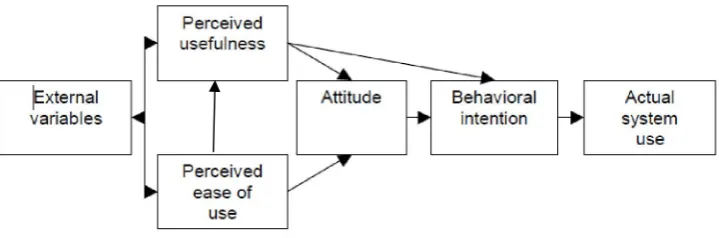
TAM proposes that acceptance or usage is determined by two factors: Perceived Usefulness and Perceived Ease of Use. Davis (1989) defined perceived usefulness (PU) as the degree to which a person believes that using a particular system would enhance his or her job performance. Perceived Ease of Use (PEOU) is defined as the degree to which a person believes that using a particular technology would be free from effort.
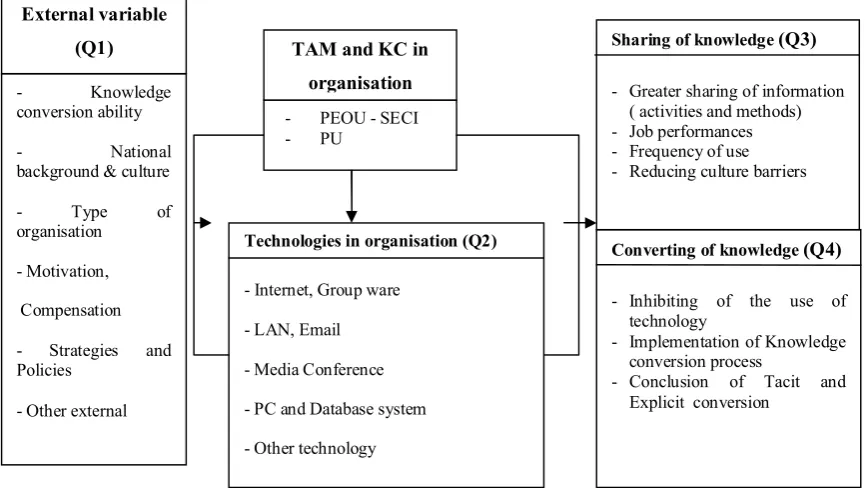
The conceptual framework of this research illustrates the value of TAM’s PU and PEOU to explain the increased effectiveness of the knowledge conversion process. In order to accomplish the aim of this research, four research questions needed to be investigated: 1. Which external variables have an impact on technology acceptance in Thai public organisations by improving or reducing the knowledge conversion processes?
2. Which technologies have been used with knowledge conversion processes (SECI) in Thai public organisations?
3. Does the sharing of knowledge in Thai public organisations increase after improvements in the knowledge conversion process?
9
The relationships in the conceptual framework are described below.
Object 1: External variables
This describes some external variables during and/or after interview. It may include existing and undiscovered variables. These external variables demonstrate the relationship between the Technology Acceptance Model (PU and PEOU) and the method of converting knowledge (SECI). For example, National background and culture may influence Perceived Ease of Use of technology like the Internet and groupware in relation to a process of socialisation.
Converting of knowledge (Q4)
- Inhibiting of the use of technology
- Implementation of Knowledge conversion process
- Conclusion of Tacit and Explicit conversion
Technologies in organisation (Q2)
- Internet, Group ware
- LAN, Email
- Media Conference
- PC and Database system
- Other technology
Sharing of knowledge (Q3)
- Greater sharing of information ( activities and methods) - Job performances - Frequency of use - Reducing culture barriers - PEOU - SECI
- PU
TAM and KC in
organisation
- Knowledge
conversion ability
- National
background & culture
- Type of
organisation
- Motivation,
Compensation
- Strategies and Policies
- Other external External variable
(Q1)
10
Object 2: TAM and KC in organisations
This object considers the link between technologies provided in the organisation, the Technology Acceptance Model (TAM) and process of SECI of knowledge conversion (KC).
Object 3: Technology in organisations
This finds out what technologies have been used with people and processes of transfer/convert/sharing knowledge and information in the organisation.
Object 4: Sharing of knowledge and Converting of knowledge
These show the outcomes of this study after considering the relationship of TAM and SECI by indicating the impact of external variables on both relationships.
1.8
Methodology
11
indicating the relationship between employees in the organisation who have been interviewed (Q1 above).
Finally, methods of creating knowledge and storing information were to learn of the organisational culture of sharing knowledge and the procedure of converting knowledge (Q2-3 above).
The interview schedule was designed to obtain different types of information from the sample group, including perceptions, behaviours and motivations. The list of questions was developed in English and then translated to Thai. Analysis of data and results of data collection were translated from Thai back into English. This presented no problems as I understand both languages.
It is acknowledged that it is not possible to generalise from single case studies, but it is hoped that the study will reveal useful information on the issues involved.
1.9
Sampling
12
1.10
Data collection and Data Analysis
Before collecting data, interview questions were approved by the research ethics committee. Data for this study was collected by conducting semi-structured interviews. These were recorded (with the interviewee’s permission) and transcribed.
Semi structured-interviews were used with head managers who are in teams for knowledge management and ICT. Focus group interviews were used with employees and senior employees.
To provide reliable data, this research used tools including a tape recorder, electronic mail and video recorder with respondents.
This study used content analysis. Data is processed by multiple methods including transcripts, notes, etc. The data is displayed in the form of intermediate representation, for example graphical models, collections of themes and written descriptions. According to Lincoln and Guba (1984), the basic analysis procedure is unitization and categorization. This research identified the meaningful section of text by reading through the data, several times. Therefore, the method of analysis can be described as using the frequencies of most used keywords in the content.
1.11
The background of knowledge management in Thai agencies and
governance policy support
1.11.1 The implementation of knowledge management initiatives in
Thailand
13
and continuity at a policy level. There are some limitations that prevent Thailand from being on par with other international public organisations. For example, the lack of responsible task owners or mechanisms to drive implementation efforts has prevented the bureaucratic system from being significantly changed (OPDC 2006).
Factors limiting the development of Thailand’s bureaucratic system are:
Dwindling capabilities
Overlapping between training and usage
Lack of integration
Delay
Inefficiency and ineffectiveness
Structural problems
Inappropriate roles and size of the public sector and
Widespread corruption.
Owing to the above problems, the implementation of Thailand’s bureaucratic reforms began in early 2002 and was amended in the middle of 2002. The reforms simultaneously targeted a complete overhaul of the administrative processes and the structure of the public sector.
Then, the State Administration Act, Amendment Issue 5 B.E. 2545(2002) was passed to reflect the changes in values, paradigms and working culture of the public sector. Good governance principles were emphasised, and the Royal Decree on Criteria and Procedures for Good Governance was enacted in 2003 (OPDC 2006).
14
“The government agency, for result-based management under this Royal Decree, shall make itself to be global learning organisation. For this
purpose, the government agency shall acknowledge and analyse information
in all aspect and shall then apply analytical result to its administration for
correct, quick, and suitable service. The government agency shall also
promote and develop capability, vision, attitude and co-learning of its
official.”(Thailaws)(Translation)
Moreover, the Royal Decree on Principles and Procedures for Good Public Governance B.E.2546, (section 11) clearly addressed the development of a knowledge- based agency:
“In order to enable the administration of the government agency to be in compliance with the public administration for the efficient result of the
mission of the State, the government agency shall have the duty to develop
knowledge base within its agency regularly so as to make itself as the
knowledge base agency. In this regards, the government agency shall
analyse all received information in order to produce analytical knowledge
which is necessary to its practical use in its public administration correctly,
rapidly and suitably for any circumstance. The government agency shall
also promote and develop knowledge and capability of, and create vision
and alter attitude of, its public servants so as to be efficient and co-learning
personnel.”(Thailaws)(Translation)
15
1.11.2 Strategic development plans of the Thai public sector
To achieve the objectives of Thailand’s bureaucratic reforms and garner general support for good governance policies, the Thai government established the Office of the Public Sector Development Commission (OPDC), which offers support to the new management of all Thai agencies. The desire to act in accordance with the intent of Section 11 of the State Administration Act law and the Royal Decree on Criteria and Procedures for Good Governance directly impacted many agencies because they sincerely strived to achieve these goals. OPDC was a centred public administration unit that developed processes for solving problems during the transition period of the bureaucratic reforms. For solving problems, the OPDC developed the Strategic plan for Thai Public Sector Development of 2003-2007 , which was approved on 19 May 2003 (OPDC 2004). This plan focused on four key target areas: 1) developing better service quality, 2) revision of roles, missions, and improved right sizing, 3) leveraging capabilities, and 4) standard of performance. Knowledge management has been employed to achieve the target of leveraging capabilities. KM can be used to strengthen the capabilities of government agencies and promote efficiency and effectiveness in the Thai public administration (OPDC 2006).
1.11.3 Pilot agencies
After promoting knowledge management in 2004, the government focused on providing training to individuals for undertaking pilot projects for the Ministry and other provinces. More than 2600 executives were trained to serve as management consultants. Plans for knowledge management were drafted as part of the learning innovation for government agencies and provinces to build a public service system of an international standard. Thirty-six departments under 4 ministries were part of the pilot project (OPDC 2006).
16
and performance agreements including key performance indicators (KPI) for the clusters, to the OPDC (OPDC 2004).
In 2005, the OPDC identified two pilot agencies: 1) Department of Internal Trade (DIT) under MOC and 2) Department of Mental Health under Ministry of Public Health. Both pilot agencies were asked to incorporate the Thai public sector development strategic plan into their organisation and to present the public sector development annual report to the OPDC (OPDC 2004). The OPDC’s goal was improvement of public management quality. To realize this goal, more than half the governmental agencies have to achieve an acceptable standard of public management quality, and OPDC, in turn, will nominate them the Public Sector Management Quality Award (PMQA) (OPDC 2004).
In summary, every government agency is expected to improve its processes to ensure that adequate competency shows in the new public management reforms. Knowledge management has been recognised and implemented as an important strategy for recovery of Thailand’s bureaucratic system. MOC was identified as a pilot agency to adopt knowledge management for improving its competencies and for learning new strategies that increase quality, efficiency, effectiveness, and organisational development.
1.11.4 Background of Ministry of Commerce
Background information of the MOC has been described below to give the reader a good understanding of the objectives of the MOC organisation, a preview of the MOC department chart, and implementation of knowledge management in MOC.
1) Responsibilities
17
2) Vision
To be the leading Ministry in driving both domestic and international trade and the economic system to achieve continuous and sustainable growth for a better living standard of all Thai people.
3) Mission
1. To increase national income.
2. To strengthen internal trade and the economic system. 3. To strengthen and protect consumer’s interests. 4) Goals
1. To sustainably expand international trade.
2. To generate higher income among the agriculture workforce.
3. To strengthen competitiveness of entrepreneurs, SMEs and community businesses. 4. To ensure fairness and protect consumer’s interests.
5. To provide best services for all citizens. 5) Main Strategies
1. Agricultural Price Management. 2. Enterprise Development.
3. Value Creation.
18
7. Good Governance.
6) Agencies within the Ministry of Commerce (MOC) include two main Offices and six Departments:
1. Office of the Minister (OTM).
2. Office of the Permanent Secretary (OPS). 3. Department of Foreign Trade (DFT). 4. Department of Internal Trade (DIT). 5. Department of Trade Negotiations (DTN). 6. Department of Intellectual Property (DIP). 7. Department of Business Development (DBD). 8. Department of Export Promotion (DEP).
1.11.5 Role of the Office of the Permanent Secretary (OPS)
The OPS is the Main office of the MOC. They plan economic strategies for the nation and find suitable solutions to sustain organisations. For example: the development of administration in MOC using five strategies:
1. Using ICT to develop Trade intelligence.
2. Increasing capability of ebusiness for competitive advantage by using a Cyber -Mall Idea.
3. Developing an ICT system to support E-government processes.
19
OPS use ICT and KM to support MOC’s main strategies. To improve strategies, the application development by the ICT team was designed to create a highest performance by:
1. Finding suitable software to support staff and working processes.
2. Database software: to store new knowledge that is helpful to develop the organisations.
3. Filtering software: to filter spam that obstructs knowledge management processes in organisations.
4. Antivirus software: to protect data and knowledge assets.
5. Knowledge management software: to manage existing knowledge and information.
1.11.6 Support of knowledge management in the Ministry of Commerce
There are 4 strategies that bring the best advantages of knowledge management to the MOC. These supports below give a key outline to enhance the people knowledge of the MOC and consist of:
1. Knowledge Creation 2. Knowledge Utilisation 3. Application Development 4. Human resource development.
20
The knowledge management support in the MOC is shown in the ICT Master plan for 2008-2011. It consists of:
1. E-Document system: To store important documents that relate to Job descriptions, Rules, Policies and Law.
2. E-Learning System: Staff and people can learn and choose the programs that they intend to learn. This system has been created to develop MOC’s staff and people knowledge.
3. E-Library: To store general documents and technical matter. 4. Knowledge database system.
5. Data warehouse: To collect all important documents that relate to agricultural data and agricultural products transformed including local and international information.
6. Preparing useful software: To collect and analyse internal data in a data warehouse.
In addition, the MOC service system has been developed to support any services in the MOC including:
1. One-stop service: linking all services as a network between department and department.
2. Distribution of information in the Ministry of Commerce.
3. To be a Web portal for linking websites in MOC’s departments and branches including public and private organisations in Thailand.
The computer software in MOC is service system is integrated:
1. Web server: including five features HTTP 1.1, SSL, Basic Authentication, Cookies Support and CGI.
21
3. Sync Server. 4. Mediation server.
The table below summarises the MOC’s technologies including technology and communication provided, and Knowledge management activity.
Table 1-1Summary of MOC’s technologies, communications and knowledge management activities
Technologies Communication Knowledge management activity
MOC service - Web server - FTP server - Sync server - Mediation server
- Intranet, Internet, - Internal mail service, - MSN Messenger - VDO Conference - Phone and cell phone -Web mail, Web site, Web board
-Black office system via intranet system
Storytelling activity
Learning in a community of practice (COP)
E-Service
E-Document, E-Learning, E-Library, Knowledge database system, Data warehouse
Software
22
Antivirus software
Knowledge management software
1.12
The development of an IT project in Thailand
The development of an IT project in the Thai public sector was initiated in the early 1990s. However, the National ICT master plan was not developed then. Thailand has experienced many problems in using IT in the public sector. The Thai government has decided that they should develop a national IT master plan to deal with problems such as governance or e-government strategies. An e-e-government strategy can encourage each public sector unit to improve and develop its own IT system. From a centralized control, the government can act as the centre, developing the IT project for each Thai public sector. This project has been launched to increase efficiency and effectiveness of government services and for the benefit of people who have to contact or coordinate with any of the public sectors. Although, the government will play a central role in developing this project, each public sector unit is also expected to contribute to the development of its own IT projects. However, involvement of individual units in developing their own IT infrastructure leads to problems such as “different types of legacy systems, different types of data standards, inability to directly exchange data because of differences in data formats, data duplication with other existing
23
However, the Thai government recognises that the master plan is not yet complete. Therefore, they prepared IT 2010 – National IT Policy: 2001-2010. Apart from serving as a road map, this policy reiterates the government’s stand as in March 2002 that IT policy aims to use IT for the social and economic development of the country. It is a three-pronged plan that involves “building human capital, strengthening information infrastructure and industry and promoting innovation” (Progress report of Thailand 2002). Moreover, five main flagships have been identified under this policy, namely, e-government, e-Commerce, e-industry, e-Education and e-Society. Each flagship is very important for helping the government develop the IT project. Strategies have been included in the ICT Master plan to enhance the potential of social infrastructure to ensure future competitiveness, to deploy ICT for administrative and service purposes and also for e-government procurement. The use of ICT for improvement of quality of life is also being investigated by the Ministry of Information and Communication Technology.
24
people to contact the government directly, for receiving information or news from government.
1.13
Outline of the thesis
This section provides an overall structure of the thesis and also provides an abstract of each chapter. The structure of this thesis consists of five parts as follows:
Chapter 1 – Introduction
This part of the thesis begins with background and essence of this study. Furthermore, it suggests matters and motives that finally became an inspiration to do the research on applying the knowledge management and ICT (TAM) to the Thai organisations. Other than that, this part also contains the benefit and expectation on what will be gained from studying this topic, including the benefit for government organisations.
Chapter 2 – Literature Review
This chapter is the review on literature used in this study. It introduces background, definition and information obtained from researching, which contained information divided into 6 topics, as follows:
1. Knowledge Management (KM) 2. Knowledge Conversion
3. Type of Knowledge 4. Benefit of ICT 5. TAM Theory
6. Problems and Solutions on Knowledge Management.
25
Chapter 3- Methodology
This part introduces the procedures used in this thesis which uses a qualitative research method. It states how sampling was done and data was collected; questions of the thesis, and the processes went through to achieve the conclusion of the thesis. Moreover, it also describes the reliability and validity instruments, limitations and hypothesis of this study, and ethical issues concerning research question.
Chapter 4 – Data Analysis and Results of the study
As already mentioned in chapter 3, this thesis uses qualitative techniques to study samplings collected from Thai government organisation (MOC). This chapter describes the results obtained from using this type of research technique. Interview was most used in this study. Lots of information was obtained from interviewing which provided in the form of tables and essays. The end of this chapter provides a discussion of applying the qualitative techniques on the results from this study.
For data analysis, there are lots of topics that have been brought up to consider such as knowledge management, knowledge conversion, benefit of ICT and opinions on the use of technology relating to knowledge management, and also relevant research and literature. Chapter 5- Discussion
26
Chapter 6- Conclusion
The conclusion restates what the thesis has studied and investigated. It provides a conclusion to this research and includes a practical discussion on the implications of the research, limitations of the research, suggestions for future research, and recommendations.
1.14
Summary
27
2.
REVIEW OF LITERATURE
2.1
Introduction
Chapter One explains the main objectives of the research and its contribution to the study of knowledge management and the Technology Acceptance Model study. Chapter Two presents background information and an overview of knowledge management. It also evaluates the use of information and communication technologies in contemporary organisations, while presenting a theoretical background of SECI and the Technology Acceptance Model, and discusses the role of knowledge management in public organisations, the importance of e-governance, the implementation of knowledge management and the barriers to the adoption of technology. This chapter introduces the culture and policies along with relevant sources of technology adoption in Thailand.
2.2
The Importance of Knowledge and Sharing Information
“Knowledge is a fluid mix of framed experience, values, contextual
information, expert insight and grounded intuition that provides an
environment and framework for evaluating and incorporating new
experiences and information. It originates and is applied in the minds of
knowers. In organisations, it often becomes embedded not only in
documents or repositories but also in organisational routines, processes,
practices, and norms.” (Davenport & Prusak 1998)
28
organisation. Knowledge is an important asset of global businesses. Amin and Thrift (1994) suggest a characteristic factor of an extending and deepening global economy is the increasing importance assigned to knowledge. It can be argued that knowledge is the economic resource in a new economy (Carlsson 2003). As is well known, knowledge is critical to every business, and knowledge management is one domain that organisations should focus on. This is because the success of business organisations in the future is dependent on creating knowledge and enhancing the ability to learn (Birchall & Tovstiga 1999).
In the organisational network, knowledge-sharing is one strategy that can help companies gain competitive advantage. Some literature reports that organisations try to enter into collaborative partnerships to buy knowledge and extend the company’s capabilities or build intellectual capital (McKenzie 2005).
However, knowledge can be managed within an organisation or network by using several tools such as: the Knowledge Management Process and implementing Information and Communication Technology (ICT) to support the organisation. This thesis aimed to study the characteristics of knowledge and the various procedures of sharing, converting and using knowledge and information in organisations.
2.3
Nature of knowledge
In the relevant literature, Polanyi (1958) is the first discoverer who makes a distinction between tacit and explicit knowledge. The Polanyi’s explanation of distinctive knowledge can be presented at this way:
“A person knows more than he can express in words. For example, A
painter cannot describe in detail how he goes about drafting a new picture.
This category explores the development of knowledge as well as knowledge
29
By the critical thinking of Polanyi, Nonaka and Takeuchi (1995) the above mentioned words can be used to explain the development of knowledge and interaction between these two knowledge forms.
Knowledge is considered intellectual capital and can be used thus in organisations. Negativearacco (1991)and Hamel (1991) reported that there were different types of knowledge. Hamel (1991) claimed that there were two types of knowledge: explicit knowledge and tacit knowledge. Most people are familiar with explicit knowledge which is easily transmissible. However, tacit knowledge refers to an individual’s knowledge which can be transferred, although with greater difficulty than explicit knowledge (Kikoski & Kikoski 2004).
From the relevant literature, the definition of tacit and explicit knowledge is described below.
2.3.1. Explicit Knowledge and Tacit Knowledge
Explicit knowledge can be transmitted through: data forms, handbooks, words, and scientific formulae amongst others. This knowledge can be stored and processed in databases so it can be used by anyone in an organisation (Civi 2000).
Typically, explicit knowledge refers to knowledge that has been expressed in words and numbers. Such knowledge can be shared formally and systematically in the form of data, specifications, manuals, drawings, audio and video tapes, computer programs, and patents (Fernandez, Gonzalez & Sabherwal 2004). For example, the basic principles for stock market analysis contained in a book or manual are considered explicit knowledge. Moreover, this knowledge can be used by investors while making decisions about buying or selling stocks.
30
Basically, tacit knowledge cannot be formally exchanged, and it is difficult to communicate or share with others (Helen 2006; Nonaka, I. 1994). Civi (2000) argues that tacit knowledge can be divided into two dimensions. The first dimension deals with technical skills. Know-how for instance, is an informal skill. The second dimension is the cognitive dimension and it refers to beliefs, values, ideals and mental models (Civi 2000). Moreover, Fernandez et al. (2004) have supported ideas that tacit knowledge includes insights, intuitions, and hunches, which are difficult to express, formalize, and share. Tacit knowledge is more likely to be personal and based on individual experiences and activities. For example, it is through years of observing a particular industry that stock market analysts gain knowledge that helps them make recommendations to investors regrading short-term and long-term prospects of stocks of companies within that industry.
Nonaka and Takeuchi (1995) explain their assumption that knowledge is created by humans and will increase social interaction via a correlation between tacit knowledge and explicit knowledge. They also expounded a conversion model, known as the knowledge creation process, where it would be possible to change knowledge by using tools like concepts, metaphors and hypotheses. They termed this conversion model “externalization”.
Externalization can normally be seen in human activity. For example people write reports after participating in workshops. When they distribute and copy the report, they are actually converting explicit knowledge to tacit knowledge (Civi 2000). A detailed explanation regarding the externalization process is provided when discussing the knowledge conversion process (SECI) subsequently.
31
companies recognize and value the concept of tacit knowledge. The purpose of communication is to convert tacit to explicit knowledge and add value to the organisation (Lehaney et al. 2004).
Therefore, it can be argued that formal organisational systems are limited in scope and cannot capture the culture of the organisation. Alternatively, there may be methods that provide the means to translate tacit knowledge into a comprehensible, explicit language (Lehaney et al. 2004).
2.3.2. Tacit knowledge
When business cycles are dynamic and technology changes rapidly, intellectual capital gets represented as a primary and crucial value created by the firm. Tacit knowledge has been described and defined in the concept of intellectual capital as being one of the important elements supporting business strategies (Saint-Onge 1996).
Tacit knowledge has been termed individual knowledge. A characteristic feature of this knowledge is defined through many concepts. For example, Saint-Onge defined tacit knowledge as including: intuition, perspective, beliefs and values that people drew from their experiences.
Saint-Onge stated in his report that “out of the beliefs and assumptions in our individual mindsets, we make decisions and develop patterns of behaviour for everything we do. Our mindsets feed on themselves both positively and negatively – we believe what we see and we see what we believe.”
He also believed that tacit knowledge could be shared by two entities.
32
filter, interpret and understand personal experiences and communication. Therefore, tacit knowledge can set boundaries for performances and results in humans.
Secondly, tacit knowledge is evident within organisations. It is defined as the collective mindset of the people in that organisation. The organisation believes that tacit knowledge can be constructed as a unique set of beliefs and assumptions to be used as a filter. Knowledge is valuable for everyone in the organisation. However, the organisation adopts values, principles and ways of doing things to support these beliefs and assumptions. Several organisations know that tacit knowledge can probably impact greatly on the collective perceptions and behaviours of the members in the organisation because tacit knowledge can deduce how the organisation makes decisions and shapes the collective behaviours of its members (Saint-Onge 1996).
2.4
Exchange of Knowledge in the Network
Knowledge-exchange is an interesting topic. This section discusses data, information and knowledge-exchange between organisations and within the business network.
Exchange, in contrast, focuses on sharing of explicit knowledge. It is used to communicate or transfer explicit knowledge between individuals, groups and organisations (Grant 1996). In general, the process of exchange of explicit knowledge does not differ from the process of communication of information. For example, employees by transferring a product design manual from one to the other, can use the explicit knowledge contained in the manual (Fernandez, Gonzalez & Sabherwal 2004).
33
The Knowledge Management System is used to manage knowledge-exchange within a network. As knowledge is located in several areas of the network such as: in humans (tacit knowledge) and in the form of physical data (explicit knowledge), a network should develop a common process, including priorities and approaches to produce new knowledge (Nonaka, I. 1994).
Moreover, knowledge-exchange can be used to bring about technology transfer among business networks. In international businesses, members seek mutual assistance to increase mutual profits. Competition in the new markets is the new strategy that is evident in developing countries. New business alliances are created in developing countries to compete with foreign competitors. A technology transfer is conducted during this transaction. In the U.S. and Japan, the host businesses try to transfer their technologies to their foreign operations to help them remain competitive. They establish sub-companies in several countries such as India, Malaysia, and China to produce goods and send and create the necessary tools such as technological systems, operations systems and knowledge systems to gain greater competitive advantages. Moreover, their subsidiaries exchange some knowledge, information and problems with the parent companies to improve and make more efficient, the organisational networks (Agmon & Glinow 1991).
34
While discussing tacit and explicit knowledge, it must be pointed out that the organisation should have the ability to collect this knowledge and store it for future retrieval. In the case of explicit knowledge, it is easy to provide a new partner to perform a task. This is because the knowledge is already internalised so the new partner can absorb the collective knowledge rapidly. On the other hand, if the ratio of tacit knowledge in a relationship is higher than explicit knowledge, then, the ability to absorb knowledge will be difficult for new partners even if they are able to internalise and utilize that knowledge (Anon 2002).
2.5
Conversion of Tacit Knowledge and Explicit Knowledge
Nonaka and Takeuchi (1995) use the distinction of knowledge from Polanyi’s concept (tacit and explicit knowledge) to explain the interaction between two knowledge forms. They have created the ‘knowledge creation spiral’ to illustrate the relationship between the epistemological and ontological dimension of knowledge creation. The objective of this model is to show the new concept in term of creating knowledge.
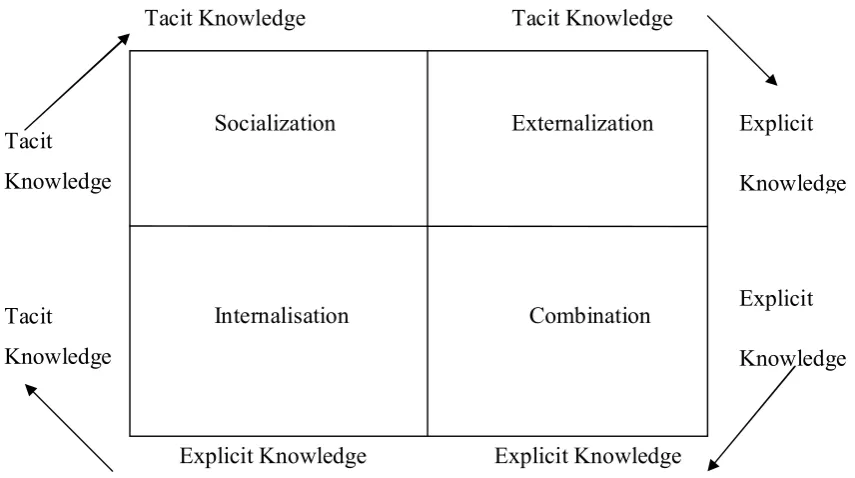
Nonaka and Takeuchi (1995) have explained the four modes of knowledge creation: 1. The socialization mode (from individual tacit knowledge to group tacit knowledge): This is the process of creating common tacit knowledge through shared experiences. People can acquire the technical skills through observation, imitation and practice.
2. The externalization mode (from tacit knowledge to explicit knowledge): This is the process of articulating tacit knowledge as an explicit concept. Tacit knowledge becomes explicit through the use of metaphors, analogies, concepts, hypotheses or models.
35
4. The internalisation (from explicit knowledge to tacit knowledge): This is the process of converting explicit knowledge into operational knowledge such as: know-how. This mode is generated by learning and by doing (Krogh, Kleine & Roos 1998). Each type of knowledge can be converted. The knowledge conversion model is displayed in Figure 2.1. It is obviously seen that Nonaka and Takeuchi use the word ‘conversion’ instead of ‘transfer’ because the knowledge cannot transfer directly without the enablers.
Therefore, this study interestingly focuses on knowledge-conversion between tacit knowledge and explicit knowledge.
Nonaka (1994) proposes that tacit knowledge can be transformed into explicit knowledge through communication. His work focuses on the process of knowledge creation during the new product development phase in an organisation. He also states that organisations can use the benefits of this knowledge and amplify their new knowledge base if they convert tacit knowledge to explicit knowledge.
According to Winter and Zolio (2001) knowledge codification refers to a process of transforming tacit knowledge into the explicit form. In organisations, employees try to use dynamic processes to convert tacit knowledge into explicit knowledge (Nonaka, I. & Takeuchi 1995). Moreover, the concept of knowledge-conversion from tacit to explicit, (Nonaka and Takeuchi, 1995) has shown four different types of process results: operational, sympathetic, conceptual and systemic.
36
However, Numata and Taura (1996) believe that amplifying knowledge brings about an interaction between tacit knowledge and explicit knowledge. Knowledge-conversion is a creative problem solving process. Tacit knowledge is the means of metaphoric language and symbolism. It is not inexpressible. Therefore, processes of conversion from tacit knowledge to explicit knowledge create metaphor and analogy.
In summary, it can be said that the heart of Nonaka’s work has as its foundation the two types of knowledge (tacit and explicit). He stated that the knowledge conversion model can take place in any areas. At a Knowledge Advantage Conference (1997), Nonaka showed his current area of interest and shared some of his ideas regarding the knowledge conversion model. The place of knowledge creation and where the knowledge spiral takes place is explained by the following example.
Tacit Knowledge Tacit Knowledge
Explicit Knowledge Socialization Externalization
Combination Internalisation
Tacit Knowledge Tacit Knowledge
Explicit Knowledge
Explicit Knowledge Explicit Knowledge
37
The knowledge conversion can be physical — Office.
The knowledge conversion can be Virtual — Email, Teleconferencing.
The knowledge conversion can be Mental—shared experiences, ideas and beliefs.
The knowledge conversion can be Relationship— people sharing common goals. However, the knowledge conversion would be conducted more effectively by using suitable enablers. Nonaka shows the five key enablers to support the model. They consist of Vision, Strategy, Structure, System, and Staff. These enablers indentified can support the activities in each of the four knowledge conversion areas (Nonaka, Ikujiro 1997).
2.6
The Knowledge-sharing System
The system of knowledge-sharing can be described as a system that enables members of an organisation to acquire tacit and explicit knowledge from each other. Knowledge-sharing systems must attract a critical volume of knowledge seekers and knowledge owners for them to be effective (Dignum 2002). The main function of a knowledge-sharing system is to enhance the organisation’s competitiveness by improving the way it manages its knowledge (Abecker et al. 1998).
Fernandez et al (2004) stated that knowledge-sharing systems are processes which support sharing of explicit knowledge (supporting exchange) and sharing of tacit knowledge (promoting share). In addition, knowledge-sharing systems also utilize mechanisms and technologies that facilitate exchange. For example: some of the mechanisms that facilitate exchange of knowledge are memos, manuals, progress reports, letters, and presentations. Technologies facilitating such exchanges include groupware, web-based access to data, and databases.
38
2.7
The Concept of Knowledge-sharing and Knowledge-sharing
Systems
Knowledge-sharing is the process by which explicit or tacit knowledge is communicated to other individuals. There are three important clarifications within the concept of knowledge-sharing. First, knowledge-sharing is a means of effective transfer. The recipient of this knowledge can understand it well enough to act on it (Jensen & Meckling 1996). Second, what is shared is knowledge instead of just recommendations based on that knowledge. It simply involves a utilization of knowledge without the recipient internalizing the shared knowledge (Fernandez, Gonzalez & Sabherwal 2004). Third, knowledge-sharing may take place across individuals and groups, departments, or organisations (Alavi & Leidner 2001).
2.8
Barriers to Knowledge-sharing
There are many factors to represent the barriers to knowledge transfer within a network. Szulanski (1994) showed that there are four key reasons why knowledge cannot be easily transferred.
1. Ignorance: This can be explained by people who possess knowledge and do not know whether anybody needs this knowledge or not. Simultaneously, people who need this knowledge are unaware of whether this knowledge is available in the organisation.
2. No Absorbent Capacity: It can be stated that the employees of an organisation require time, money, and management resources to practise and study that knowledge in adequate detail to make it useful.
3. Lack of Pre-existing Relationships: It can be said that a manager cannot create good relationships in an organisation and cannot control a corporate employee’s experience at work though the employee is already learning and practising knowledge garnered from other people.
39
O'Dell and Grayson (1998) and Dixon (2000) show support for ideas about other barriers and problems facing knowledge transfer.
1. As organisations build complex databases and implement platforms which allow employees and managers to record and enter documented knowledge, there emerges a problem about using this data. Most of the important data cannot be processed or written down owing to security concerns and so this data cannot be transformed into explicit data.
2. Some companies do not implement incentive schemes and therefore lack a culture that encourages knowledge transfer. Hence, it can be said that people in such organisations lack the motivation to share their ideas.
3. Some groups do not prefer to use any ideas if these are not born from among their members. This can occur in some companies involved in production or design. Some employees may not be happy if they have to borrow someone else’s ideas.
Additionally, Jessica Keyes discovered that there are a many of barriers to knowledge sharing and willingness to share knowledge. Keyes (2008) presented that there are four key factors that have an impact on effective knowledge sharing: management involvement and oversight, willingness to share knowledge, IT support, and use of metrics. The key reasons of willingness to share knowledge in employees were: 1) available IT, 2) available time and available and organised information, 3) trust, respect, and comfort, and 4) politics and job security.