Indistinguishability up to Correctness
and Its Application to Stateful AE
Phillip Rogaway and Yusi Zhang
Computer Science Department
University of California Davis, One Shields Avenue, USA
Abstract. Often the simplest way of specifying game-based crypto-graphic definitions is apparently barred because the adversary would have some trivial win. Disallowing or invalidating these wins can lead to complex or unconvincing definitions. We suggest a generic way around this difficulty. We call itindistinguishability up to correctness, or IND|C. Given games G and H and a correctness condition C we define an ad-vantage measureAdvindcG,H,C wherein G/H distinguishing attacks are ef-faced to the extent that they are inevitable due to C. We formalize this in the language oforacle silencing, an alternative to exclusion-style and penalty-style definitions. We apply our ideas to a domain where game-based definitions have been cumbersome: stateful authenticated-encryption (sAE). We rework existing sAE notions and encompass new ones, like replay-free AE permitting a specified degree of out-of-order message delivery.
Keywords: indistinguishability ·oracle silencing · provable security · stateful authenticated encryption
1
Introduction
This paper addresses a common difficulty one encounters in giving game-based cryptographic definitions: the need to ensure that adversaries don’t get credit for trivial wins. But what exactly is a trivial win? Sometimes answering this is not trivial. Our simple but previously unexplored idea is to use a scheme’s correctness requirement to automatically determine if a win should or shouldn’t count. We believe that this can lead to simpler and more compelling definitions. Correctness requirements—for example, that a decryption algorithm properly reverses the corresponding encryption algorithm—are normally understood as demands on functionality, not security. Yet we will use correctness to help define security. More specifically, a correctness condition will be used to map a pair of games that an adversarycantrivially distinguish into a pair of games that itcan’t
trivially distinguish. The modified games are identical to the original ones apart from eliminating wins that exploit generic checks on correctness. The adversary’s advantage in distinguishing the modified games is elevated to a definition for
responses to oracle queries aresilencedwhen the correctness requirement renders a responsefixed. A response is fixed when the answer depends only on the query history and the correctness constraint. Once silenced, an oracle will stay so.
Besides developing the idea above, this paper is also about an illustrative application of it. The problem we look at, significant in its own right, is how to find a clean and general treatment for stateful authenticated-encryption (sAE). A sender transmits a sequence of encrypted messages to a receiver. The com-munication channel might be reliable or not, and the parties might or might not maintain state (stateful AE should encompass conventional AE). If the de-crypting party does maintain state, it might have a little or a lot. We seek a metaphorical “knob” with which one can specify precise expectations regard-ing replays, omissions, and out-of-order delivery. Our definition for sAE security does this. Given a set L specifying exactly which message reorderings are con-sidered permissible, we define a matching correctness condition. From it and a pair of simple games, which do not depend onL, one inherits a security notion, courtesy of IND|C. By appropriately setting L we encompass old sAE notions and significant new ones, like sAE permitting reorderings up to a specified lag in message delivery.
Indistinguishability up to correctness. In somewhat greater detail, the methodology we suggest works as follows. To define a cryptographic goal one designs a pair of utopian games G and H that an adversary must try to dis-tinguish. Game G surfaces the real behavior of some underlying protocol Π, while game H surfaces theideal behavior one might wish for. We call the games
utopianbecause there is some simple adversarial attack to distinguish them. For example, if we aim to treat public-key encryption (PKE) secure against chosen-ciphertext attack (CCA), then game G might let the adversary encrypt and decrypt with the underlying encryption scheme Π, while H properly answers decryption queries, but answers encryption queries by encrypting zero bits.
The cryptographer next pins down when a scheme iscorrect. Correctness is a validity requirement, not a security requirement. It captures what needs to happen in the absence of an adversary. In our PKE example, correctness for a scheme Π = (K,E,D) says that (pk,sk)←← K(k) andc←← E(pk, m) implies D(sk, c) = m. Formally, saying that a scheme Π is correct just means that it belongs to some class C of correct schemes: for us, a correctness conditionis a class of scheme.
We generalize conventional indistinguishability (IND) to the notion we call
indistinguishability up to correctness (IND|C). The idea is this. Suppose that the adversary is interacting with a “real” game G that depends on some un-derlying cryptographic schemeΠ. What it wants is to distinguish G from some “ideal” game H (which might also depend onΠ). Suppose, at some point in the adversary’s attack, it asks an oracle query xi. It previously asked x1, . . . , xi−1
and got answersy1, . . . , yi−1. If given this query historytthere is only one
off the oracle: it answers ♢ from that point on. The symbol ψ in the brackets following G and H denotes thesilencing function, and we just described defining it by way of fixedness. Correctness-directed oracle silencing is the automatic adjustment of games (G,H) to modified games (G[ψ],H[ψ]). Using this method, we generalize the IND advantageAdvindG,H(A) = Pr[AG→1]−Pr[AH→1] to the
INDC-advantage AdvindcG,H,C(A) =AdvindG[ψ],H[ψ](A).
There is one more needed element: the adversary needs toknow if an oracle query is going to be silenced—we needψto be efficiently computable. One must show that it is. If it’s not, the intuition that the adversary shouldn’t ask a question because it trivially knows the answer completely falls apart.
Application: PKE.As a first and simple application of IND|C, we revisit the standard IND-CCA security notion for PKE. We provide a utopian pair of games, G1 and H1, and a correctness class C1, thereby obtaining a security notion PKE.new defined by AdvindcG1,H1,C1. We show, unsurprisingly, that PKE.new is equivalent to PKE.old, the customary definition for IND-CCA secure PKE.
But wait: just what definition is it that we callcustomary? Bellare, Hofheinz, and Kiltz (BHK) describe four variants of IND-CCA secure PKE, which they de-note with suffixes SE, SP, BE, and BP [1]. They explain that researchers haven’t always been clear as to what version they intend. And they show that it does
make a difference: while the SE and SP notions are equivalent, all other pairs are inequivalent. BHK suggest that the SE/SP notion is the right definitional variant [1, p. 34 & p. 39], implying that the other two notions are wrong. We agree. But how can one convincingly justify such a claim? The most convincing response, in our view, is to say that the SE/SP notion coincides with what one gets by invalidating all and only the adversarial wins that onemust invalidate because of correctness. The BE and BP notions inappropriately invalidate ad-ditional wins. This is the response that our work formalizes. Similar reasoning can be used to justify definitional choices that might otherwise seem arbitrary.
Application: sAE.Our second application of IND|C is more involved: we con-sider the stateful-AE (sAE) problem, first formalized by Bellare, Kohno, and Namprempre (BKN) [2]. BKN adjust the customary definition of AE to make the decryption process stateful. Trying to model the kind of AE achieved by SSL, they want that ciphertext replays, reorderings, and omissions, as well as forgeries, will all be flagged as invalid. Formalizing this requires care.
Building on the above, Kohno, Palacio, and Black (KPB) describe fivetypes
will explain soon why one might—one would need to start from scratch. The resulting definition might be hard to verify and easy to get wrong.
In our view, sAE is in a muddy state. The BKN, KPB, and BHMS papers use different syntax, making rigorous comparisons problematic. And they live in a sea of disparate and often complex related notions, including UC treatments of secure channels [6,7,12], the ACCE definition of Jager, Kohlar, Sch¨age, and Schwenk [10], and the notion for stream-based channels from Fischlin, G¨unther, Marson, and Paterson [9,8].
We go back to the basics for sAE, specifying a scheme’s syntax and an ex-tremely simple pair of games for the goal, G2 and H2, which the adversarywill
be able to easily distinguish them. We then “cancel” the trivial wins via IND|C. Given a set L that describes the required level of channel fidelity, we define a corresponding class of correct schemes C2(L). The above induces a security notion sAE[L] via IND|C. The flavors of sAE from BKN, KPB, and BHMS cor-respond to sAE[L] for specific choices of L. Many further choices are possible. In particular, the set we call Lℓ
1 bans forgeries and replays, but allows
omis-sions and reordering up to some specified lag ℓ. The level we denote Lℓ
2 bans
forgeries, replays, and reordering, but allows omissions of up toℓmessages. The related levels from KPB and BHMS place no limits onℓ(i.e.,ℓ=∞). Achieving that aim would normally be impractical, as the decrypting party would need to maintain unlimited state, using it to record every nonce received.
Besides defining sAE[L] security, we show that the natural way to achieve it from nonce-based AE does in fact work. We discuss when this scheme is efficient, and describe efficiency and security improvements that are possible for someL.
Alternatives. The way we have chosen to define IND|C security is not the only way possible: there are a variety of natural variants. For each, one uses the correctness condition C to automatically edit utopian games G and H to new games G′ and H′. Oracle-editing generalizes oracle-silencing. We look at about half a dozen definitional variants, and evidence the robustness of IND|C by arguing that, under anticipated side conditions, all but one alternative is equivalent to our original formulation. For that final variant, meant to deal with left-or-right style games, we do not know how to prove or disprove equivalence.
2
Indistinguishability up to Correctness
Games. We recall the notion of games from Bellare and Rogaway [3], making some minor adjustments. See Fig. 1.
z
k
x
iy
iInitialize
Finalize Oracle
G
uj
vj
Π
r
ω
G
Π
A
ρ
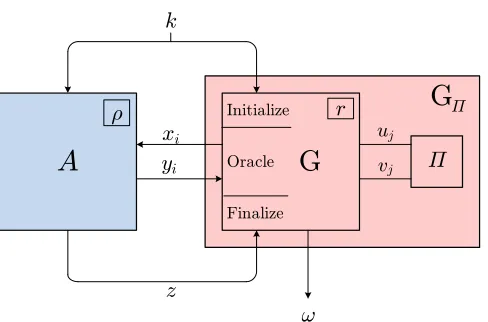
Fig. 1. An adversary interacting with a game. A game G may depend on a cryptographic schemeΠ:{0,1}∗ → {0,1}∗. The game G and adversaryA are both provided an initial valuek. Adversarial and game randomness are provided by random stringsρandr. Pairsxi, yi anduj, vjrepresent sequences of queries, indexed from 1. The adversary’s output iszand the game’s outcome isω.
To execute G withA, the game’s Initialize procedure is first run, passing it an initial valuek. This is normally assumed to be a number, the security parameter, and presented in unary. Nothing is returned. Next, the adversaryAis run, again invoking it on k. The adversary will make a sequence of Oracle calls (oracle queries)x1, . . . , xq obtaining corresponding responsesy1, . . . , yq. The number of queries q is up to the adversary. When the adversary has asked all the queries it wants to ask, it halts with an output z. The game’s Finalize procedure is then called with z. It returns the game outcome ω. Specifying a game entails specifying Initialize, Oracle, and Finalize. If the first is omitted, there is only the default initialization of game variables: 0 for numbers, falsefor booleans, ε for strings, and the empty vectorΛ= ( ) for vectors. If Finalize is omitted, it is the algorithm that outputs its input, making the game’s outcome the adversary’s output. The number Pr[AG(k)→1] is the probability that A outputs 1 after interacting with game G given the initial input k. The Finalize procedure is irrelevant. The number Pr[GA(k)→1] is the probability that G (it’s Finalize procedure) outputs 1 after an interaction withAonk.
We can regard GΠ as a function, with yi = GΠ(k, x1, . . . , xi, r) the value returned by the oracle query when the initial value is k, the queries asked are
x1, . . . , xi, and the coins are r; while ω = GΠ(k, x1, . . . , xq, z, r) is similarly construed, employing encoding conventions such that the Finalize call is clear. If we omit rfrom the arguments then GΠ becomes a randomized function. We omitkwhenever the Initialize procedure does not depend on it.
tran-scripts (x1, y1, x2, y2. . . , xi) have an odd number of strings; response-terminated transcripts (x1, y1, x2, y2. . . , xi, yi) have an even number of strings.
Discussion. There is no loss of generality in regarding the underlying cryp-tographic scheme Π as a function from strings to strings; suitable encoding conventions allow any scheme of interest to be so encoded. Similarly, games are routinely described as supporting differenttypesof queries, like “Enc” and “Dec” queries. This is handled by regarding each query xas encoding a vector whose first component, x[1], is a label drawn from a specified set.
An oracle queryxmight be intended only to adjust the game’s internal state, not to elicit any response. Such queries are calleddeclarative. All other queries areinvestigative. We do not adopt any special syntax to differentiate declarative and investigative queries, but the designer of a game is always free to adopt some convention to serve this purpose.
Correctness. What does it mean to say that a scheme Π is correct? The simplest answer is to sayΠ belongs to some class of schemes C, which are those deemed correct. That is what we will do; for us acorrectness class is a set C of functions from strings to strings, and defining correctness means specifying C.
Graded notions of correctness, where a scheme is (1−ε)-correct if some bad event happens with probability at mostε, are outside the scope of our definitions.
Silencing.Given a correctness class C and a game G we define a predicate on response-terminated transcripts
ValidC,G(x1, y1, . . . , xj, yj) =(∃Π ∈C)(∃k∈ {0,1}∗)(∃r∈ {0,1}∞)(∀i∈[1..j])
[ GΠ(k, x1, x2, . . . , xi, r) =yi].
In English, a response-terminated transcript is valid if there exists a scheme in the specified class that could give rise to it. Since adversaries can ask anything they please, we say that a query-terminated transcript is valid when its longest proper prefix is:ValidC,G(x1, y1, . . . , xj, yj, x) =ValidC,G(x1, y1, . . . , xj, yj).
Building on the notion of validity, we define a boolean function on query-terminated transcripts
FixedC,G(x1, y1, . . . , xj, yj, x) = (∃!y)ValidC,G(x1, y1, . . . , xj, yj, x, y).
Here (∃!y)P(y) means (∃y)P(y)∧(∀y1)(∀y2)((P(y1)∧P(y2))⇒y1=y2). In
En-glish, a query-terminated transcript is fixed if the last indicated query has exactly one valid response. Note that when the transcriptt is invalid thenFixedC,G(t)
isfalse, since (∃!y)P(y)⇒(∃y)P(y).
Finally, given a correctness class C and game G, we define our preferred
silencing function for this pair by
SilenceC,G(x1, y1, . . . , xj) =
∨
1≤i≤j
FixedC,G(x1, y1, . . . , xi).
k
xi
yi
Initialize
Finalize Oracle
G
uj
vj Π
r
ψ yi
G[
ψ
]
z
ω
♦
procedureG[ψ].Initialize(k)
i←0; G.Initialize(k) return
procedureG[ψ].Oracle(x)
i←i+ 1; xi←x
yi←G.Oracle(x)
if ψ(x1, y1, x2, y2, . . . , xi)then return♢
returnyi
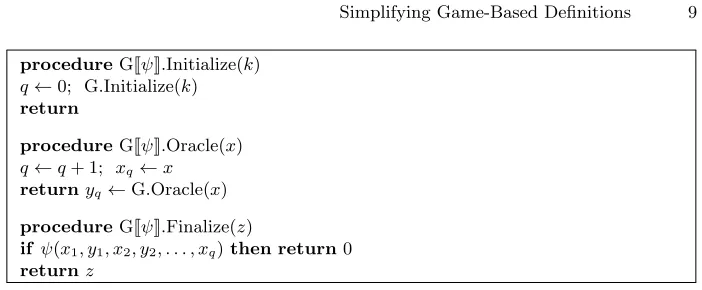
Fig. 2. Oracle silencing. Left:Given a game G and a functionψ:{0,1}∗∗→ {0,1} we define the silenced game G[ψ] by silencing the oracle once the boolean value
ψ(x1, y1, . . . , xi) becomestrue.Right: The formal definition for the game G[ψ]. The game’s Finalize procedure is irrelevant.
IND|C security. Given a game G and a boolean functionψ, which we call a
silencing function, we define thesilenced game G[ψ] in Fig. 2. In that game, or-acle responses are adjusted according toψ: whenψapplied to theyi-terminated transcript istrue, we return♢instead ofyi.
Now given games G and H and a silencing functionψ, letAdvindcG,H,ψ(A, k) = Pr[AG[ψ](k)→1]−Pr[AH[ψ](k)→1].
Finally, given games G and H and a correctness class C, letAdvindcG,H,C(A, k) = Pr[AG[ψ](k)→1]−Pr[AH[ψ](k)→1] where ψ=Silence
C,G. We call this notion
INDC security, or, perhaps more pretty, IND|C security. (The vertical bar is meant to suggest conditioning.) Note that the silencing that is applied to the ideal game H is determined by the real game G.
For an asymptotic notion of INDC security, we assert that games G and H areindistinguishable up to C ifAdvindcG,H,C(A, k) is negligible for any
probabilis-tic polynomial-time (PPT) adversary A. As usual, ε(k) is negligible if for any polynomialpthere exists a numberN such thatε(k)<1/p(k) for all k≥N.
Remember that games G = GΠand H = HΠmay depend on some underlying scheme Π. A cryptographer who specifies G, H and C has specified a security measure on protocols Π∈C defined byAdvΠ(A, k) =AdvindcGΠ,HΠ,C(A, k).
Computability of fixedness. There is no a priori reason to believe that FixedC,G or SilenceC,G will be computable, let alone efficiently. Yet for IND|C
security to be meaningful, we need FixedC,G to be efficiently computable: if
the adversary doesn’tknow that the response to its query is determined by the correctness constraint, then the query isnot trivial, and making it shouldnot be disqualifying. The most straightforward way of capturing the stated expectation is to demand thatFixedC,Gbe polynomial-time (PT) computable (if one is in the
to whichFixedC,Gwill ever be applied are those that arelegitimate—those that
can arise in an interaction between Aand G or betweenAand H.
Based on this, we say thatfixedness is efficiently computable for (C,G,H) if there exists a PT-computable function ϕ such that ϕ(t) = FixedC,G(t) for all
query-terminated transcriptstsatisfyingValidC,G(t)∨ValidC,H(t). Taking this
a step further, we say thatfixedness is efficiently computable for (C,G,H, q) if there exists a PT-computable function ϕ such that ϕ(t) = FixedC,G(t) for all
query-terminated transcriptstsatisfyingValidC,G(t)∨ValidC,H(t) and|t|<2q.
The last part says that tinvolves at mostq queries (where|t|is the number of components int). For positive results, we must verify that fixedness is efficiently computable for (C,G,H), or for (C,G,H, q) withq(k) adequately large.
Further relaxations for efficient computability of fixedness are possible. Since it is safe to silence too little, it is enough to find an efficiently computable functionϕsatisfyingϕ(t)⇒SilenceC,G(t) whenValidC,G(t)∨ValidC,H(t). Our
examples won’t need this relaxation.
Discussion.We have spoken about the efficient computability ofFixed, but we could as well have spoken of the efficient computability ofSilence. The former is the more basic object, and simpler to think about. In fact, we not only anticipate that the boolean Fixed should be efficiently computable, but also the string-valued function fixedG,C that specifies the real-oracle’s response when it is in
fact fixed (or indicates, alternatively, that it is not). See Section 5.
The silencing function ψ used in defining IND|C was not Fixed but the logical-or of it applied to all transcript prefixes. Once an oracle is silenced, it stays silenced. An alternative approach,silence-then-forgive, is essentially equivalent; see Section 5. It is to simplify the description of silence-then-forgive that, in Fig. 2, when a responseyi is silenced, we let the growing “transcript” retain the original (unsilenced) value. This choice is irrelevant for silence-then-shut-down. As already explained, if fixedness is not efficiently computable the intuition underlying oracle silencing breaks down, and IND|C becomes meaningless. It could even happen that silenced games are harder to distinguish than the utopian ones. For example, given a one-way permutationF with hardcore bitB, game G is constructed to select random values x0 and x1 and, on a first oracle query,
provideF(x0) andF(x1). A second oracle query selects b←← {0,1}and returns
B(xb). Now whether or not this query is silenced provides information that the adversary cannot compute. The idea can be elaborated to create indistinguish-able games whose silenced versions are distinguishindistinguish-able.
The usual notion of indistinguishability, AdvindG,H(A, k) = Pr[AG(k)→1]− Pr[AH(k)→1], coincides withAdvindc
G,H,ψ(A, k) whenψ(t) =false. Of course IND-security is symmetric:AdvindG,H(A, k) =AdvindH,G(A, k). This is not true of INDC: it may be that AdvindcG,H,C(A, k)̸=AdvindcH,G,C(A, k). The asymmetry stems from the fact that we silence based on thereal game, listed first in the subscripts.
procedureGJψK.Initialize(k)
q←0; G.Initialize(k) return
procedureGJψK.Oracle(x)
q←q+ 1; xq←x returnyq←G.Oracle(x) procedureGJψK.Finalize(z)
if ψ(x1, y1, x2, y2, . . . , xq)then return0 returnz
Fig. 3. Penalty-style oracle editing.Oracle queries are answered as usual, but if the final transcript triggersψ, the game’s outcome is set to zero.
Penalty-style alternative. Instead of turning off an adversary’s oracle when it asks an offending question, we could answer the query as usual but, at the end of the game, declare it forfeit. This is what Bellare, Hofheinz, and Kiltz call a penalty-style definition [1]. We formalize what is needed in Fig. 3, mapping a game G and a function ψto a corresponding game GJψK. An alter-native version of indistinguishability up to correctness, INDC0, is then defined by saying that Advindc0G,H,C(A, k) = Pr[(GJψK)A(k)→1]−Pr[(HJψK)A(k)→1] where ψ=SilenceC,G. In effect, the adversary’s outputz has been replaced by
z∧∧j¬FixedC,G(x1, y1, . . . , xj). For an asymptotic notion of INDC0 security, we say that games G and H are penalty-style indistinguishable up to C if for any PPT adversaryA, the functionAdvindc0G,H,C(A, k) is negligible.
What is the relationship between oracle-silencing IND|C and penalty-style INDC0? Assuming fixedness is efficiently computable, the two ways of adjusting games are equivalent. For concision, we give an asymptotic version of the result. The proof, which is easy, is in Appendix A.1.
Theorem 1. Let G and H be games and let C be a correctness class. Assume fixedness is efficiently computable for(G,H,C). ThenGandHare indistinguish-able up to Ciff they are penalty-style indistinguishable up toC.
The above might be interpreted as saying that oracle silencing is new language for something that doesn’t need it. That misses the point, that oracle-silencing grounds the natural explanation how and why one edits the utopian games.
Exclusion-style alternative. And what of exclusion-style definitions [1], where one limits consideration to adversaries that are “well-behaved”? It is pos-sible, although awkward, to describe IND|C in this way. After defining games GΠ and HΠ and the correctness class C, we restrict attention from all adversariesU to the subsetAthat, when interacting with GΠor HΠ, never create a transcriptt such thatFixedG,C(t) istrue. One attends only to adversaries inA.
A∈Uand put a “wrapper” around it so that it conforms withA. The wrapped adversary behaves like A unless it is about to ask a query that would make FixedG,H,C(t) true, in which case it outputs 0 and halts. In this way one names
a class of adversaries A such that the ind-advantage among adversaries in it coincides with the indc-advantage over adversaries inU. So security notions that can be described by oracle silencing can be described exclusion-style. Not that doing so is wise. Exclusion-style definitions compel consideration of adversary classes. They disqualify adversaries that only rarely misbehave. They ignore whether or not an adversary can “know” it has misbehaved. And they promote ambiguity, as the relevant restrictions are not expressed in game code.
Further variants. Beyond penalty-style and exclusion-style formulations of IND|C, more alternatives are possible. See Section 5 for some interesting ones.
3
Public-Key Encryption
Let us consider the well-known IND-CCA security notion for a public-key en-cryption (PKE) scheme. We first review the syntax. A PKE schemeΠ is a tuple of algorithms Π = (K,E,D) where probabilistic algorithmK takes in a secu-rity parameterk, encoded in unary, and generates a public key pk and a secret keysk; probabilistic algorithmE takes in a public keypkand a plaintextm, and returns a ciphertextc; and deterministic decryption algorithmDtakes in a secret keyskand a ciphertextc, and returns a messagem. For simplicity, we assume a message space of{0,1}∗. An appropriate encoding of the component algorithms is implicitly assumed whenever we regardΠ as a mapΠ:{0,1}∗→ {0,1}∗.
To apply our techniques, the first step is to specify the class of correct PKE schemes. This is easily done, letting
C1 ={Π = (K,E,D)|(∀k)(∀m) [(pk,sk)←←K(k);c←←E(pk, m):D(sk, c) =m]}
denote the schemes we considercorrect. The condition is absolute: decryption of
c←← E(k, m) mustalways returnm, which is the customary requirement. The second step is to write down the utopian real and ideal games. For this, we ask the adversary to distinguish between a game that encrypts a messagem
of the adversary’s choice and a game that encrypts an equal length string of zero-bits. For both games, the adversary can request the public key and has access to a proper decryption oracle. See Fig. 4. Those games only allow the adversary a single Enc query. This restriction is unnecessary, but including it reduces the gap between our new notion and the traditional one for IND-CCA that we use. The games are indeed utopian: if the adversary queries Enc(1), getting backc, then queries Dec(c), getting back m, it will earn advantage 1 by returning m. Naturally this is where oracle silencing comes into play: if Dec is queried with the response c returned by a previous Enc query then FixedC1,G1 will almost
always be true, resulting in the query being silenced. Why do we say almost
procedureInitialize (k) Game G1
111 (pk,sk)←← K(k)
procedureKey
112 returnpk
procedureEnc (m)
113 if askedreturn⊥
114 asked←true
115 returnE(pk, m)
procedureDec (c)
116 returnD(sk, c)
procedureInitialize (k) Game H1
121 (pk,sk)←← K(k)
procedureKey
122 returnpk
procedureEnc (m)
123 if askedreturn⊥
124 asked←true
125 returnE(pk,0|m|)
procedureDec (c)
126 returnD(sk, c)
Fig. 4. Utopian games used to define PKE.new. The games are easily distin-guished in the ind-sense. The problem is fixed by switching to indc-advantage.
Computing fixedness.As just indicated, even if a transcript t has a Dec(c) follow an Enc(m) that returnsc, it is notalways the case thatFixedC1,G1(t) =
true. At issue is the fact that there are some peculiar transcripts that can arise in the ideal setting but would never arise in the real setting. Recall that our formalization demands that we donot silence a query ending a transcripttthat could never arise in the “real” setting. One such counterexample is a Dec(c) query that returns m, followed by an Enc(m′) query that returns c, where m ̸=m′. This can’t happen in the “real” game, since it would violate correctness. Since we only silence valid transcripts, once such an invalid event takes place, in a run with H, we never silence any further queries—even for a Dec(c) following some Enc(m) query that returnsc.
The code of Fig. 5 attends to such subtleties. There we write out a formula for a candidate functionϕ that efficiently computes fixedness for (C1,G1,H1). Functionϕmakes sure the mentioned counterexample does not occur (first line), and it also checks for the “usual” concern: a decryption query that asks to de-crypt the challenge ciphertext (second line). But there are still some additional, na¨ıve queries to deal with (the last three lines). These are: a Key query subse-quent to the first such query; an Enc query subsesubse-quent to the first such query; and a repeating Dec(c) query, for some valuec. The responses to any of those queries will be silenced. Our result on the computability of fixedness is as follows.
Theorem 2. There is a PT algorithm that computes fixedness for(C1,G1,H1). In fact, the algorithm of Fig. 5 computes it.
For a proof, see Appendix A.2.
To define the security of a PKE scheme against IND-CCA attack, we let
AdvpkeΠ .new(A, k) =AdvindcG1[Π],H1[Π],C1(A, k) for the games and correctness class
procedureϕ(x1, y1, . . . , xt)
201 return((∄i, j)xi= (Dec, yj)∧xj[1] = Enc∧xj[2]̸=yi ) ∧
202
(
(∃j)(xj[1] = Enc∧xt= (Dec, yj) )
∨
203 (∃j)(xj[1] = Key∧xt[1] = Key )
∨
204 (∃j)(xj[1] = Enc∧xt[1] = Enc )
∨
205 (∃j, c)(xj=xt= (Dec, c) ))
Fig. 5. Formula for computing fixedness for PKE.new.Line 201 is the validity check, while line 202–205 are the fixedness checks.
procedureInitialize (k) Game G0
311 (pk,sk)←← K(k)
procedureKey
312 returnpk
procedureTest (m1, m2)
313 if testedreturn⊥
314 tested←true
315 c∗←← E(pk, m1)
316 returnc∗
procedureDec (c)
317 if c=c∗then return⊥
318 returnD(sk, c)
procedureInitialize (k) Game H0
321 (pk,sk)←← K(k)
procedureKey
322 returnpk
procedureTest (m1, m2)
323 if testedreturn⊥
324 tested←true
325 c∗←← E(pk, m2)
326 returnc∗
procedureDec (c)
327 if c=c∗then return⊥
328 returnD(sk, c)
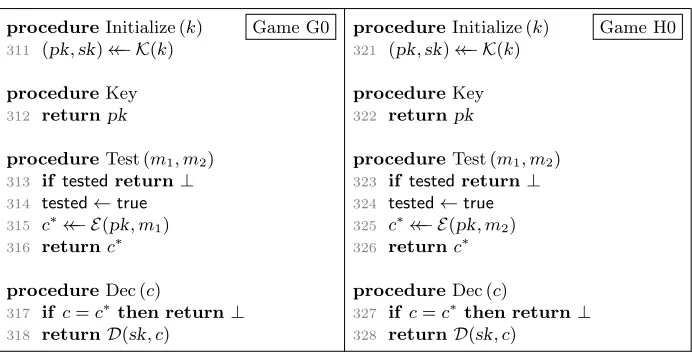
Fig. 6. The PKE.old notion for IND-CCA secure public-key encryption.The formulation is equivalent to the SE and SP notions from BHK [1].
is negligible for all PPT adversariesA. We have already shown that fixedness is efficiently computable for (C1,G1,H1).
How does our PKE.new notion compare with “standard” IND-CCA security for a public-key encryption scheme? By the latter we mean the (equivalent) IND-CCA-SE and IND-CCA-SP notions of BHK [1]. We define it using the G0 and H0 games of Fig. 6. Let AdvpkeΠ .old(A, k) =AdvindG0,H0(A, k) and define Π
as PKE.old-secure ifAdvpkeΠ .old(A, k) is negligible for any PPTA.
The new and old PKE security notions are equivalent. Equivalence isn’t quite obvious, because the silencing criteria not only includes adversaries querying a Dec on the challenge ciphertext—the sole criterion for PKE.old—but, also, adversaries not having triggered any “invalid” events. Less significantly, we’re also looking at a real-vs-ideal game, rather than a left-or-right style one. Still, one can show that the notions are equivalent.
Theorem 3. A PKE scheme is PKE.new-secure iff it is PKE.old-secure.
Theorem 3 supports the idea that the (equivalent) SE and SP notions of BHK areright, while the other two notions are not [1]. One of the uses of IND|C security is to justify or call into question an existing definition by, in effect, looking at what the correctness condition itself has to say.
The structure of the proof of Theorem 3 can be generalized. We observe thatFixedcan always be decomposed into avalidity check and afixedness check:
Fixed(x1, y1, . . . , xq) =Valid(x1, y1, . . . , xq−1, yq−1) (validity)
∧((∀yq, y′q)Valid(x1, y1, . . . , xq, yq)∧ Valid(x1, y1, . . . , xq, yq′)⇒yq=y′q
)
(fixedness)
A recapitulation of the proof with the decomposition above allows us to draw the following conclusion: as long as both validity and fixedness checks are ef-ficiently computable, the removal of validity checks will give us an equivalent indistinguishability notion. Related discussions can be found in section 5.
4
Stateful AE
Syntax.A scheme for stateful AE (sAE) is a tuple of algorithmsΠ= (K,E,D) where key-generation algorithm K is a probabilistic algorithm that returns a string, while encryption algorithm E:K×A×M×S→(C∪ {⊥})×S and de-cryption algorithm D:K×A×C×S→(M∪ {⊥})×S are deterministic. We callK,M,C,A, andSthe key space, message space, ciphertext space, associated-data (AD) space, and state space, respectively. We assume thatKcontains the support ofK, and that there’s a constantτ, theciphertext expansion, such that (c, s′) =E(k, a, m, s) andc̸=⊥implies|c|=|m|+τ. For simplicity, we regard the ciphertext expansion of sAE schemes as a fixed and universal constant (e.g.,
τ = 128), referring toτ without tying it to any specific scheme.
Level sets. Suppose a party encrypts messages 1,2, . . . ,100, sending them, encrypted and in order, to some receiver. Due to an active adversary or an un-reliable transport, that receiver might recover the sequence of messages (1,3,2), or maybe (1,10), or perhaps (1,2,2,3). In each case, should an authentication error be generated? The answer depends on multiple factors: the anticipated properties of the communication channel; your willingness to have the decrypt-ing party maintain state; how much state you think that party should maintain; and the damage you anticipate from omissions, insertions, and reorderings.
How might one specify the targeted level of channel fidelity? It can be done by giving a level-set, a set L ⊆ N∗ (where N = {1,2,3, . . .} excludes 0). An element n∈Lis called a permissible ordering. The intended semantics of n= (n1, . . . , nβ) being in L is thatif the sender transmits a sequence of messages 1,2, . . . ,and the receiver recovers, in order, messagesn1, . . . , nβ, then thisisan acceptable degree of fidelity if and only if n∈L. To make sense, we require of any level-setLthatn∈Limpliesn′∈Lfor any prefixn′ ofn.
Level Definition and description
L0 N∗. This level-set deems all orderings permissible, regardless of omissions, replays, or reorderings. A receiver for this level-set can be stateless. This is the level-set that corresponds to conventional (stateless) AE.
Lℓ1 {n∈N∗:i̸=j⇒ni̸=nj and|nj−max0≤i<jni| ≤ℓ+ 1 for all 1≤j≤|n|}. Here we do not permit replays, but do allow omissions and reorderings up to the specified lag. Whenℓ=∞there is no limit on the lag and the notion roughly corresponds to level-2 in Kohno et al. [11] and Boyd et al. [4].
Lℓ
2 {n ∈ N∗: 1 ≤ ni−ni−1 ≤ ℓ+ 1 for all 1≤i≤ |n|}. This level-set does not permit replays or reorderings, but allows omissions up toℓlost packets. Whenℓ=∞there is no limit on permissible gaps and the notion roughly corresponds to level-3 in Kohno et al. [11] and Boyd et al. [4]
L3 {n∈N∗:ni =ifor all 1≤i≤ |n|}. This is the strictest level-set: the only permissible receipt order is sending order. This matches the notion for sAE put forward by Bellare et al. [2], level-5 in Kohno et al. [11], and level-4 in Boyd et al. [4]. It is what one expects to achieve over a reliable transport.
Fig. 7. Basic level-sets for sAE.The valueℓ≥0, the maximallag, is a number or the value∞. The named sets impose increasingly stringent requirements for rejecting replays, omissions, and out-of-order delivery. Throughout,n= (n1, . . . , nβ) andn0 = 0.
many basic level-sets. The goals associated to levelsL0, L∞1 , L2∞ andL3=L01=
L0
2 are described in prior work [4,11], while the Lℓ1 and Lℓ2 goals, for ℓ ∈ N,
have not been formalized, although they would seem to be targeted by secure messaging apps like Signal [13].
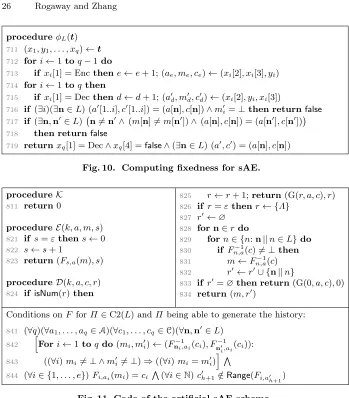
To apply oracle silencing we need to specify a class of correct sAE schemes. That class will depend on the level-set L. Intuitively, a correct sAE scheme for level-L should satisfy the following condition. Suppose you encrypt a sequence of plaintexts to create ciphertexts we number 1,2,3, . . ., and then you decrypt, in order, the ciphertexts numberedn1, n2, . . . , nβ. If (n1, . . . , nβ)∈Lthen you must get back the correct sequence of plaintexts. Correctness places no demands on what happens for sequences outside ofL. Nor does it levy demands once E declines to encrypt a string. The correctness class C2(L) associated to level-set
Lis formalized at the top of Fig. 8.
C2(L) is the set of all sAE schemesΠ = (K,E,D) that satisfy: (
∀k∈K)(∀(a1, m1),(a2, m2), . . .∈A×M )(
∀(n1, . . . , nβ)∈L ) [
s0←ε; r0←ε; α←max(n1, . . . nβ);
fori←1toαdo(ci, si)← E(k, ai, mi, si−1); fori←1toβdo(m′i, ri)← D(k, ani, cni, ri−1):
((∀i∈[1..α]) (ci̸=⊥))⇒((∀i∈[1..β]) (m′i=mni)) ]
procedureInitialize Game G2
511 k←← K
procedureEnc(a, m)
512 (c, s)←← E(k, a, m, s)
513 returnc
procedureDec(a, c, σ)
514 (m, r)← D(k, a, c, r)
515 if σthen returnb←← {0,1}
516 returnm
procedureInitialize Game H2
521 k←← K
procedureEnc(a, m)
522 (c, s)←← E(k, a,0|m|, s)
523 returnc
procedureDec(a, c, σ)
524 if σthen returnb←← {0,1}
525 return⊥
Fig. 8. Top: Correctness classes for sAE.The function maps a level-set Lto a correctness class C2(L). Bottom: The utopian real and ideal games for sAE. The games depend on an underlying sAE schemeΠ = (K,E,D).
Given an sAE protocol Π and a level-set L, we define Advsae[Π L](A) as
AdvindcG2[Π],H2[Π],C2(L)(A). Informally, schemeΠ is sAE[L]-secure ifAdvsae[Π L](A) is small for any reasonable adversaryA. Following prevailing traditions in sym-metric cryptography, our notion is concrete, not asymptotic, although one could always provideK with a security parameter and support an asymptotic notion.
Computing fixedness. It would be nice to give an efficiently computable formula for FixedC2(L),G2, hereinafter abbreviated as FixedL, for an arbitrary level-set L. But this is not possible—there is no such algorithm—because, in our treatment, level-sets can be arbitrarily bizarre. So we content ourselves with showing efficient computability of fixedness for the basic level-sets. We believe that any “natural” level-setLwill have the same property, but stating a sufficient condition onL seems to get rather technical.
Theorem 4. For any basic level-setL the fixedness function is efficiently com-putable for(C2(L),G2,H2,2τ−3).
See Appendix A.4 for the proof.
An nAE scheme Π = (K,E,D) consists of a probabilistic key-generation algorithm that draws a key from the key space K; a deterministic encryption algorithm E:K×N×A×M→C that takes in a key k ∈ K, a nonce n ∈ N, an AD a ∈ A and a message m ∈ M and outputs a ciphertext c ∈ C; and a deterministic decryption algorithmD:K×N×A×C→M∪ {⊥}that takes in a key k ∈K, a nonce n ∈N, an ADa ∈Aand a ciphertext c ∈C and either outputs a decrypted messagem∈Mor a failure symbol⊥. Correctness is defined in the natural way: for all (k, n, a, m)∈K×N×A×Mandc← E(k, n, a, m) it holds thatD(k, n, a, c) =m. We also assume that for all (k, n, a, m)∈K×N× A×M, theexpansion τ=|E(k, n, a, m)| − |m|is a constant.
For the nAE security definition, let $(·,·,·) be an oracle that takes inn∈N
and a∈Aand m∈M and returns a fresh random string of |m|+τ bits; and let⊥(·,·,·) be an oracle that takes inn∈ Nand a∈Aand c ∈Cand always returns⊥. The advantage of an adversaryAagainst an nAE schemeΠ is then defined as
AdvnaeΠ (A) = Pr
[
k∈K:AE(k,·,·,·),D(k,·,·,·)→1
]
−Pr
[
A$(·,·,·),⊥(·,·,·)→1
] .
We require thatAnever asks (n, a, c) of its right oracle if some previous left oracle query (n, a, m) returned c; and thatA does not repeat nonces when asking its left oracle. (The first condition could itself be recovered via IND|C.) Informally, an nAE schemeΠ is secure if for all such adversaries with reasonable resources, the advantageAdvnaeΠ (A) is small.
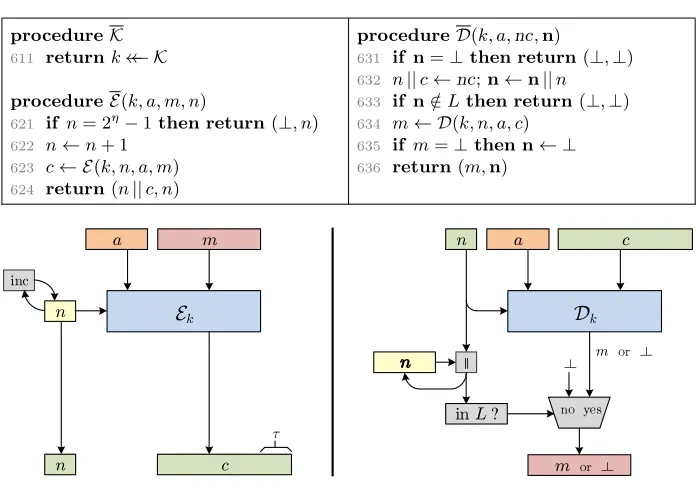
Construction N2S turns an nAE schemeΠwith key spaceK⊆ {0,1}∗, nonce space N={0,1}η, AD spaceA⊆ {0,1}∗ and message space M⊆ {0,1}∗ and ciphertext expansion τ into an sAE scheme Π = (K,E,D) with the same key space, AD space, and message space. Given an nAE schemeΠ and a level-setL, the sAE schemeΠ = N2S(Π, L) is defined and illustrated in Fig. 9.
The construction is quite simple. For encryption, the state is maintained as a counter nthat gets incremented with each message sent. When n is used as a string, it is encoded into η bits. The ciphertext is formed by concatenatingn
and the ciphertext returned by the nAE scheme. For decryption, the state is the vector nof nonces received so far. The decryption algorithm outputs failure if either the underlying nAE scheme says soorthe received nonce, when appended to the list of prior ones, does not comprise a permissible ordering inL. We have the following result for the security of N2S:
Theorem 5. Let Π = (K,E,D) be an nAE scheme with nonce length η and ciphertext expansion τ. Let L be a level-set and let A an adversary that asks q≤min{2η, 2τ−3} queries. Then there exists an adversary B, generically de-scribed in the proof of this theorem, such that
AdvΠnae(B)≥AdvN2S[sae[LΠ,L] ](A).
Adversary B is efficient if Ais efficient and Lis a basic level-set.
procedureK
611 returnk←← K
procedureE(k, a, m, n)
621 if n= 2η−1then return(⊥, n)
622 n←n+ 1
623 c← E(k, n, a, m)
624 return(n||c, n)
procedureD(k, a,nc,n)
631 if n=⊥then return(⊥,⊥)
632 n||c←nc;n←n||n
633 if n∈/Lthen return(⊥,⊥)
634 m← D(k, n, a, c)
635 if m=⊥then n← ⊥ 636 return(m,n)
Ek
n
n c
m a
inc
τ
n c
Dk
a
⊣
inL ?
m or .
m or ⊣
⊣
no yes ||
n n
Fig. 9. Top: Definition of the N2S construction. For Π = (K,E,D) an nAE scheme withη-bit nonces andLa level-set, we construct the sAE scheme N2S(Π, L) = (K,E,D).Bottom: Illustration of the N2S construction.Messages can be rejected becauseDcalls for this or because the provided nonce, once concatenated to the prior ones received, is not inL. Various optimizations are possible, depending onL.
Discussion.While the decrypting party must, in general, maintain an unbound-edly long state vectorn, for many level-sets this is unnecessary: the decryption algorithm will be able to make the decision it needs to make, at line 633, by retaining a finite amount of state. In particular, level-set L0 needs no retained
state; level-setLℓ1needs the lastℓ+ 1 nonces; and level-setsLℓ2andL3 need the
last nonce received.
Addressing the efficiency complaint first, we note that if one is targeting sAE level L3 (a reliable channel), the nonce n need not be included with the
ciphertext, for the receiver will know what it must be if the ciphertext is to be valid. For levels Lℓ
1 and Lℓ2, with ℓ ∈N, we can also reduce the ciphertext
length. Instead of including the entire noncenin the ciphertext, it is sufficient to includenmod (2ℓ+ 2) forLℓ
1ornmod (ℓ+ 1) forLℓ2. From this the receiver can
reconstruct the only possible value ofnfor a valid message. In practical settings, one would expect this information to fit in a single byte. Thus Lℓ
1 and Lℓ2 are
nicer than L∞1 andL∞2 not only for capping the state of the decrypting party but, also, for reducing ciphertext expansion.
As for security, what change to N2S is needed to achieve the stronger IND$ definition? (For that, change line 522 to replace c by |m|+τ many uniformly random bits.) Perhaps the most obvious approach is to include in the ciphertext the enciphered nonce, rather than the nonce itself. One would use a blockcipher and a separate key. Ifη is small, like 32 or 96, one would need a blockcipher with an unusual block length. And the IND$ security would now degrade, unpleas-antly, withq2/2η. So a better construction, perhaps, is to append the noncen
to the plaintext and encrypt using a zero-nonce MRAE scheme [15], rather than a conventional nAE scheme like we used for N2S. This avoids the quantitative security loss and works for any level-setL. ForLℓ
1 andLℓ2 one can use the trick
from the last paragraph and include only nmodℓ within the scope of what is MRAE-encrypted. It is tempting to try to eliminate this too, using the nonce as the AD value and have the decrypting party employ trial decryptions. But this scheme is problematic because it does not achieve perfect correctness, which is required in our treatment of IND|C.
While it is beyond the scope of this paper to formalize and prove all of the claims made in the last couple of paragraphs, it is our contention that all of them are straightforward to establish within the framework of IND|C.
5
Variants
Formalizations of IND|C are quite robust with respect to definitional adjust-ments. In this section we describe three IND|C variants and explain in what sense each is equivalent. The three variants are: (1) whether or not to silence oracle responses from the “ideal” game that are invalid in the “real” game; (2) whether to silence-then-shut-down or silence-then-forgive, the latter mean-ing that oracle responses after silencmean-ing will still be returned to the adversary; and (3) whether to silence ideal-side responses, as we have done throughout, or to replace them with the real-side values.
At the end of Section 2 we described further alternatives, (0) a penalty-style version of IND|C, and (0′) an exclusion-style variant. One concludes from these examples that many of the definitional choices we have made are not significant. We go on to look at a more distant alternative to INDC, which we call
dictates fixed but distinct responses from the two sides. We suspect that this approach is, once again, as expressive as our other treatments of IND|C.
Before we describe our IND|C variants, let us clarify what it means to say that one way of defining advantage is equivalent to another. Suppose first that one has defined security measures AdvxxxΠ (A) and AdvyyyΠ (A). Then we may regard them asequivalent if any adversary Acan be generically converted into an almost-as-efficient adversary B for which AdvyyyΠ (B) is nearly as high as
AdvxxxΠ (A); and the other way around.
Now, for our more abstract setting, suppose we have two ways of associ-ating an advantage measure to a primitive Π, a class C containing it, and a pair of Π-dependent games (G,H). Call these AdvxxxG
Π,HΠ,C andAdv
yyy GΠ,HΠ,C. Then these approaches for defining security are equivalently expressive, or just
equivalent, if there’s a generic method to construct from (G,H) a pair (G′,H′) such thatAdvxxxG
Π,HΠ,CandAdv
yyy
G′Π,H′Π,Care equivalent (in the sense of the last
paragraph); and, also, the other way around.
(1) Silencing invalid transcripts.Recall that the formula we’ve been using for FixedG,C(x1, y1, . . . , xi) is (∃!yi)ValidG,C(x1, y1, . . . , xi, yi) where the sym-bol∃! meansthere exists one and only one.This choice implies that an adversary, when interacting with the ideal gameH, will receive responsesyi (in not yet si-lenced games) for which the yi-ending transcript could not occur with the real game—that is, when ValidG,C(x1, y1, . . . , xi, yi) = false. The rationale behind this choice is that the adversary should be given a chance to win the distinguish-ing game by observdistinguish-ing that a response is invalid—that it could not occur with the “real” oracle—but that determination should still fall on the adversary.
Yet a natural variant is to silence invalid replies, effectively marking tran-scripts where the ideal oracle has failed to provide a plausible response. The new silencing condition would defineFixed1G,C(x1, y1, . . . , xi) as
(∀y, y′) (ValidG,C(x1, y1, . . . , xi, y)∧ValidG,C(x1, y1, . . . , xi, y′)⇒y=y′)
and would silence by
Silence1G,C(x1, y1, . . . , xj) =
∨
1≤i≤j
Fixed1G,C(x1, y1, . . . , xi).
In words, we silence whenever there isat most onevalid response, rather than de-manding that there beexactly onevalid response. We denote the advantage of ad-versaryAunder this new silencing condition byAdvindc1G,H,C(A) =AdvindcG[ψ],H[ψ],C
whereψ=Silence1G,C. We call the notion INDC1 security.
We argue that when ValidG,C is efficiently computable, this alteration is
Conversely, the exact same reduction turns an INDC1 adversaryA′ to an INDC adversaryAof comparable efficiency and undiminished advantage.
(2) Silence-then-forgive. Our INDC formalization effectively punishes the adversary for triggering silencing: once silencing happens, the oracle shuts down and becomes useless. One might argue that this is overly punitive—that there is no reason to do anything other than silence just the offending query. We call this alternativesilence-then-forgive. We explain that, when the silencing function is efficiently computable, the difference is inconsequential.
The silence-then-forgive notion is easy to formalize. We use the sameValid and Fixed predicates as defined in Section 2, but for the silencing function, instead of using the logical-or of Fixed applied to transcript prefixes, we use Fixeddirectly. That is, we let Silence2=Fixedand define
Advind2G,H,C(A) = Pr[AG[ψ]⇒1]−Pr[AH[ψ] ⇒1]
whereψ=Silence2C,G. We call this the INDC2 advantage of adversaryA. Given an INDC adversaryAdifferentiating G and H, an INDC2 adversaryA′
can simply executeAin a black-box manner and whenever Aasks a query that will be silenced according to ψ, adversary A′ would stop its own interaction and continue simulating the ♢response to A. Conversely, given an INDC2 ad-versary A′, an INDC adversary A can simply executeA′ and whenever it asks a query that will be silenced according to ψ, adversary Awould ask the same query, but setting the declarative flag. It then returns a♢response toA′. Since setting the declarative flag guarantees the response would not be silenced, ad-versaryAwould never trigger silencing. The simulation is perfect. The argument implies that the two silencing notions are equally expressive.
(3) Ideal-side editing.So far, all of our INDC variants silence both the real and ideal sides. Consider the following alternative to oracle silencing: the real game G is never changed, while the ideal game H, instead of being silenced when a response is fixed according to G, returns that fixed response.
To formalize this, we change the boolean predicate Fixed into a function fixed that returns the unique string-valued response that is determined when the original predicate returnstrue, and returns∗(for “not-fixed”) otherwise:
fixedC,G(x1, y1, . . . , xi) =
{
y when (∃!y)ValidC,G(x1, y1, . . . , xi, y) ∗ otherwise
We then extend the notion G[ψ] to include the case whereψis a string-or-∗-valued function. Specifically, the Oracle procedure of G[ψ] behaves as below.
procedure G[ψ].Oracle(x)
i←i+ 1;xi←x;yi←G.Oracle(x)
if ψ(x1, y1, . . . , xi)̸=∗ thenyi←ψ(x1, y1, . . . , xi)
Finally, we define INDC3 advantage by Advindc3G,H,C(A) = AdvindG,H[ψ](A) where
ψ=fixedC,G. We call this INDC variantideal-side editing.
We argue that INDC3 is equivalent to INDC assumingfixedG,Cis efficiently
computable. Let Abe an INDC adversary differentiating a real game G and an ideal game H, where C is the underlying class. One can construct an INDC3 ad-versaryA′executingAin a black-box manner. WheneverAasks a queryxisuch that the history so far, when applied tofixedG,C, results in a string responseyi, thenA′ stops its own interaction and provides the silencing mark♢toA. Con-versely, with A′ an INDC3 adversary we can construct an INDC adversary A
executing A′ in a black-box manner. Whenever A′ first asks a query xi such that fixedG,C(x1, y1, . . . , xi) =yi̸=∗, adversaryA would forwardxi to its own game, but would set a declarative flag so that silencing is not triggered. It then returnsyitoA′. Both reductions are perfect in simulating the game interaction.
(4) Symmetric silencing.Our last form of game-editing is meant to deal with left-or-right style games instead of real-or-ideal style games. A typical example was given in Section 3, the treatment of CCA-secure PKE in which an oracle accepts two equal-length plaintexts and encrypts either the left or the right one of them. Can one directly use our INDC definition in such a setting?
One can, but doing so doesn’t make sense. A real game is different from an ideal one, and its privileged position makes it reasonable that AdvindcG,H,Cis not
AdvindcH,G,C. But a left game and a right game ought not be treated differently: it should be the case that the order of naming them doesn’t matter.
Although the rationale just stated is a philosophical one, we have found that trying to apply IND|C to the LR-style games of Section 3 just doesn’t work.
Here is a way to realizesymmetric silencing: silence when the responses of the games are distinct fixed strings. Namely, let
FixedG4,H,C(t) =(fixedC,G(t)̸=fixedC,H(t)∧fixedC,G(t)≠ ∗ ∧fixedC,H(t)̸=∗
) .
Note that the predicate is symmetric: FixedG4,H,C = FixedH4,G,C. Define the silencing function SilenceG4,H,C(t) as the logical-or ofFixedG4,H,C(t′) applied to all prefixest′ oft. The INDC-SYM advantage of an adversaryAis then defined as AdvindcG,H,-Csym(A) =AdvindG[ψ],H[ψ](A) whereψ=SilenceG4,H,C.
We use the games in section 3 to give an example. Let G and H be the left and right games in Fig. 6 with line 317 and line 327 removed, and let C be the class of correct PKE schemes. We remove the two lines so that the decryption does not exclude challenged ciphertext and thus the games become “utopian.” The FixedG4,H,Cpredicate, in this case, evaluates totrueif (1) no two encryptions of the same-side but distinct plaintexts return identical ciphertexts (validity condi-tion); and (2) a decryption ofcis asked while there was a previous ENC(m1, m2)
oracle returningcandm1̸=m2(fixedness condition). Therefore, apart from the
6
Conclusions
Definitions in cryptography often vary in subtle ways, and deciding among them can seem rather subjective. The IND|C framework may help lessen this sub-jectivity. It embodies a thesis that a definition is “right” when it attends to the limits imposed by correctness, but goes no further than that in restricting adversarial behavior.
We suspect there are many cryptographers who have written definitions with an implicit view that what they aim to do is to disallow all and only the adver-sarial behaviors that some correctness condition dictates. The challenge of this work has been in figuring out how to make this vague conception real.
The IND|C approach is rather abstract. Definitions one gets out of it may require significant investigation to concretely characterize or understand. For this reason, one might claim that IND|C doesn’t banish complexity so much as hide it. At least with a complicated game, the argument might go, you can see the complexity before your eyes.
We regard the critique as mostly off-base. Most fundamentally, it is unreal-istic to think that complex cryptographic goals admit simple formulations when described in low-level terms. A more realistic aim is to find abstraction bound-aries that help modularize definitions and enhance intuition.
The situation is reminiscent of UC [6], where an ideal functionality can be simply specified, a definition inherited from it, but it may be quite unclear what that notion means. Yet the hidden complexity behind IND|C isn’t remotely at the level of UC. Nor, in our simpler setting, is there much difficulty with rigor. Perhaps IND|C may come to serve as an alternative to UC, for some cryptographic problems, the utopian gameH corresponding to the specification of the ideal functionality.
Acknowledgments
Many thanks to anonymous reviewers of this paper, whose questions motivated the addition of Section 5. Thanks to the NSF, which provided funding for this work under grants CNS 1314885 and CNS 1717542.
References
1. Bellare, M., Hofheinz, D., Kiltz, E.: Subtleties in the definition of IND-CCA: When and how should challenge decryption be disallowed? Journal of Cryptology 28(1), 29–48 (Jan 2015) 3, 8, 9, 12, 13
2. Bellare, M., Kohno, T., Namprempre, C.: Breaking and provably repairing the SSH authenticated encryption scheme: A case study of the encode-then-encrypt-and-MAC paradigm. ACM Trans. Inf. Syst. Secur. 7(2), 206–241 (2004), https: //doi.acm.org/10.1145/996943.996945 3, 14
![Fig. 2. Oracle silencing. Left: Given a game G and a functionwe define the silenced game G[ψ ψ: {0, 1}∗∗ → {0, 1}ψ] by silencing the oracle once the boolean value(x1, y1,](https://thumb-us.123doks.com/thumbv2/123dok_us/7979951.1323522/7.612.136.480.109.249/oracle-silencing-given-functionwe-dene-silenced-silencing-boolean.webp)