Designing a Network and Systems Computing
Curriculum: The Stakeholders and the Issues
Grace Tan & Anne Venables
Victoria University, Melbourne, Victoria, Australia
[email protected]
;
[email protected]
Executive Summary
Since 2001, there has been a dramatic decline in Information Technology and Computer Science student enrolments worldwide. As a consequence, many institutions have evaluated their offer-ings and revamped their programs to include units designed to capture students’ interests and in-crease subsequent enrolment. Likewise at Victoria University, the trend of declining student numbers warranted examination of the existing computing programs and their viability; extensive reviews recommended that all existing undergraduate computing programs should be replaced by a single, new, three-year offering in network and systems computing. The decision was supported by extensive market research and evidence of a strong market demand and future needs for net-working and systems specialists in Australia.
In designing this new degree program, it was necessary to identify the needs of various stake-holders such as students, academics, the university, industry and the professional body. Surveys of recent graduates and industry partners, reinforced by professional accreditation demands, indi-cated the need for a program to include up-to-date technical competencies and the development of work-readiness skills in students. Aware of University requirements, academics, undertook con-siderable discussion with their peers and thorough research of similar programs elsewhere in preparation for the development of the curriculum in network and systems computing.
The resultant program structure is a divergence from the traditional computer science offering of our Faculty. It is innovative in its incorporation of industry-based certifications to allow students to gain relevant practical, hands-on work-related experience. The program consists of instruction in core competencies in networks and communications, supported by the teaching of skills in computer systems, programming and database systems. Each of these proficiencies is further consolidated by professional development studies. The new program aligns with the University’s strategic directions and satisfies professional body accreditation and it is expected to meet student expectations and fulfil a market need for graduates skilled in systems administration with net-working expertise.
Keywords: network computing education, systems computing education, academic review, cur-riculum development.
Introduction
na-tionally since 2002 and the federal government has identified the shortage of IT students as an issue requiring remedial action in the near future (MMV, 2007).
Against this backdrop, many institutions have evaluated their ICT offerings with a view to mak-ing them more attractive to students. The different strategies employed range from cosmetic changes with minor alterations in content and program titles, through to major shifts in programs’ foci. These foci include interactive digital media, cross-disciplinary applications, like health in-formatics and embedded systems inin-formatics, entertainment technologies and game development (Clemson University, 2007; Monash University, 2007). Such revamped programs, through differ-entiation between themselves from their competitors, have been successful in attracting new en-rolments by fulfilling the needs of the students and by meeting their expectations (Sharda, 2007; Novotny & Doucek, 2007).
Since the early 1990s, Australian governmental changes to higher education funding models have impacted greatly on all curricula design and how courses can be conducted (Skilbeck & Connell, 1999). Today, the bottom line is that education institutes are expected to be financially independ-ent and, within each institute, individual operating units need to attract sufficiindepend-ent studindepend-ents. Prior to 2004, Victoria University enjoyed strong student demand for each of its undergraduate ICT programs attracting students both onshore and offshore (in Hong Kong, China and Malaysia). Since then, there has been a steady decline in students enrolling in computer science courses, which has posed a significant challenge for the ICT programs to remain financially viable. Ac-cordingly, a number of University and external consultant reviews of the traditional computing program offerings were made in 2009 (Booth, 2009; Garnett, 2009). A critical reappraisal of the ICT programs was undertaken, and overwhelmingly, the assessments recommended that the ex-isting programs be discontinued; in their place, a new three-year degree in the area of Network and Systems Computing is to be introduced.
This paper outlines the rationale and method for designing the new Network and Systems Com-puting program together with the challenges in meeting the needs of various stakeholders through the alignment of the new curriculum. An examination of the proposed program structure will be detailed and the expected advantages of adopting the program will be discussed.
Method for Designing a New Network & Systems
Computing Program
In the search for a suitable program to replace the existing traditional computing offerings, anal-yses of online ICT employment opportunities was conducted in 2008 and early 2009. These analyses revealed an increasing trend in vacancies related to networks and systems management. More recently on 22 July 2009, Dang reported an increase of 5% in contractor employment op-portunities in the ICT sector (Dang, 2009). These trends coupled with investments in new broad-band technologies by the Australian federal government predicates future growth in the network and systems areas of the ICT industry, and likely, a strong student demand.
traditional careers of doctor, teacher, or lawyer (ACS, 2009). The ACS is the professional body responsible for all higher education ICT programs accreditation.
Given the evidence of a strong market demand and the future needs for networking and systems specialists, a suitable degree program intended to equip graduates with the skills required to gain an entry level position was proposed. Subsequently, industry experts were approached for com-ment on the draft proposal which included a degree outline, along with individual unit descrip-tions and a feedback form. Comments were solicited on the strengths and weakness of the draft and overall, the feedback was extremely positive concerning the relevance and focus of the pro-posal. Respondents were particularly enthusiastic about the potential of the new proposal to meet the growing market need for skilled graduates in systems administration with networking exper-tise. Specifically, they praised the inclusion of a significant learning in the workplace components through the facilitation of industry certifications within the program.
The mission for the program development team was to flesh the draft proposal into a program structure emphasizing a hands-on approach to learning with a strong industry focus. As pointed out by others (Finkelstein & Hafner, 2002; Lui, 2007), IT programs need to have specialized stud-ies that are of industrial strength and are updated regularly to reflect the progress in the discipline. As well, any IT program should focus on the balance between vocational and intellectual de-mands in order to enhance graduate employment prospects. So by incorporating opportunities for industry certifications within the program, graduates would have the competitive edge for the dif-ferent careers in the field of network and systems computing in sectors including government, banking and finance, retail, and manufacturing.
Meeting the Requirements of Stakeholders
Without question the most significant challenge for any IT program development is meeting the expectations and requirements of the stakeholders (Gruba et al., 2004; Henkel & Kogan, 1999). The stakeholders for this program development are students, academics, the University, industry and the professional body. In conducting an analysis of each group’s major interests, surveys conducted of our recent graduates working within ICT industry revealed that the prime issue of importance when designing a suitable IT curriculum was relevancy. From their perspective, any program must develop up-to-date technical competencies, as well as work-readiness skills in stu-dents, as preparation for their early careers. Not surprisingly, surveys querying other industry consultants reiterated that the same qualities were necessary skills for their incoming graduates. Examination of the accreditation requirements of the professional body reiterates the same mes-sage (ACS, 2003). To achieve suitable vocational outcomes, academics are guided by profession-al bodies’ recommendations for appropriate discipline content whilst being mindful that program content needs to comply with internal university policies, as noted by Gruba et al. (2004).
Academics
The primary focus for academics when designing a new IT program relates to the objectives of excellence, currency and relevance of content. The challenge is in preparing a well-rounded cur-riculum that develops a broad set of technical and soft skills while meeting students’ vocational expectations. Both Gruba et al. (2004) and Hurst et al. (2001) concur with us that the primary driving force for academics involved in the teaching of the IT degree program is the validity and value of curriculum for students, both current and prospective.
offer-ings were made. External consultations with our ICT graduates and industry partners were sought to help distil the most appropriate program structure.
Students
Earlier research undertaken at Victoria University by Venables et al. (2006), found that current ICT students were very pragmatic in their approach to studies. Their expectations were that a degree program be professionally accredited, incorporate cutting edge technologies, and be well considered by employers. Intending students have similar expectations as evidenced in the re-sponses given to our market research. In considering a program of study, respondents placed con-siderable value on real world learning in the workplace and preparation for industry certifications as being of high importance. Additionally, intenders ranked programs with strong industry links and an emphasis with a ‘hands-on’ approach to learning higher than programs with ACS accredi-tation.
The University
Given the imperative that all programs need to be financially viable, the University insists that any proposed program needs to attract sufficient students. Equally, a program should be strongly aligned with stated University priorities and commitments. The broad aim of preparing students at Victoria University is for lifelong learning in the four scholarship categories of discovery, ap-plication, integration and learning. To this end, the “Graduate Capabilities” policy was developed with the stated objective of improving employment outcomes for its graduates (Miliszewska & Tan, 2004). To further improve graduate work-readiness, the University’s Learning in the Work-place and Community (LiWC) policy requires that each program include a workWork-place learning component; the workplace is being seen more favorably as a legitimate site for contextualized learning where the gap between theory and practice can be bridged. Furthermore, the University expects that all programs provide students with multiple entry points so that, regardless of an in-dividual’s academic background, they will have many options to enroll in, study, and complete the degree.
Industry & the Professional Body
The endorsement of a professional accreditation ensures international and local credibility for an ICT program and it enhances marketability (ACS, 2003; Jones & Price, 2002; Ramakrishnan, 2007). The requirements of the ACS accreditation body insist that programs cover essential in-dustry skills, such as project management, interpersonal communication, and professional prac-tice, together with a capstone task providing students with an opportunity to work on a real-life development project (Tan, 2008). Therefore the new course must contain sufficient depth and breadth to satisfy the accreditation requirements to the Professional level. Equally important, ac-creditation panels are interested in quality assurance processes the University has in place to maintain academic standards; their concern centres on outcomes and benchmarking activities as-sociated with these assurance processes.
Deciding the Program Structure
sys-tems administration, system security consultancy, database administration, business analysis, and project management in public and private sectors.
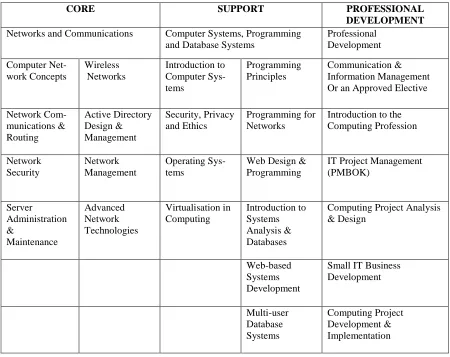
In defining the Bachelor of Information Technology in Network and Systems Computing pro-gram structure, three main areas of study were identified: core, support and professional devel-opment fields, to fulfil accreditation requirements and suitably prepare graduates for roles listed above. With a strong emphasis on all major aspects of networking, the core area of Networks and Communications would necessitate at least 33% of the program content. In support of this major study in networking, units devoted to computer systems, programming and database systems were identified as necessary to prepare students for the rigor of the core material. These support units together with the professional development units help develop skills necessary for professional practice as specified by the accreditation body. The three main areas of study are shown in Table 1 with their composite units.
Table 1: The areas of study and their component units proposed for the Bachelor of Infor-mation Technology in Network and Systems Computing at Victoria University.
CORE SUPPORT PROFESSIONAL DEVELOPMENT
Networks and Communications Computer Systems, Programming and Database Systems
Professional Development Computer Net-work Concepts Wireless Networks Introduction to Computer Sys-tems Programming Principles Communication & Information Management Or an Approved Elective
Network Com-munications & Routing Active Directory Design & Management Security, Privacy and Ethics Programming for Networks
Introduction to the Computing Profession Network Security Network Management Operating Sys-tems
Web Design & Programming
IT Project Management (PMBOK) Server Administration & Maintenance Advanced Network Technologies Virtualisation in Computing Introduction to Systems Analysis & Databases
Computing Project Analysis & Design
Web-based Systems Development
Small IT Business Development Multi-user Database Systems Computing Project Development & Implementation
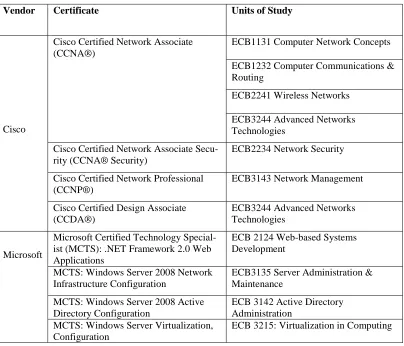
Table 2: Mapping of industry certificates to units of study of the Bachelor of Infor-mation Technology in Networks and Systems Computing at Victoria University.
Vendor Certificate Units of Study
Cisco
Cisco Certified Network Associate (CCNA®)
ECB1131 Computer Network Concepts
ECB1232 Computer Communications & Routing
ECB2241 Wireless Networks
ECB3244 Advanced Networks Technologies
Cisco Certified Network Associate Secu-rity (CCNA® SecuSecu-rity)
ECB2234 Network Security
Cisco Certified Network Professional (CCNP®)
ECB3143 Network Management
Cisco Certified Design Associate (CCDA®)
ECB3244 Advanced Networks Technologies
Microsoft
Microsoft Certified Technology Special-ist (MCTS): .NET Framework 2.0 Web Applications
ECB 2124 Web-based Systems Development
MCTS: Windows Server 2008 Network Infrastructure Configuration
ECB3135 Server Administration & Maintenance
MCTS: Windows Server 2008 Active Directory Configuration
ECB 3142 Active Directory Administration
MCTS: Windows Server Virtualization, Configuration
ECB 3215: Virtualization in Computing
The Issues
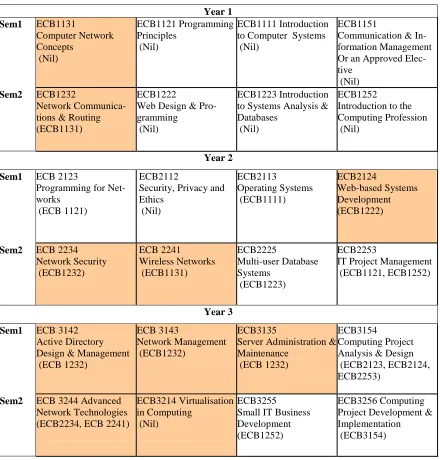
Examination of Table 3 shows that students are progressively introduced to learning in the work-place material and certification opportunities over the three years of their program. Although stu-dents will be nurtured by the incremental development in the core and support areas of study, their participation in certification examinations would be encouraged, but be entirely voluntary. For their professional development skills, students encounter professional development units ear-ly in the program where they are encouraged to improve their communication skills through a study of the computing profession. These communication and organizational skills are
strength-Table 3: Structure of the degree program, Bachelor of Information Technology in Network and Systems Computing at Victoria University. Units that have been shaded to indicate units tied to possible industry certifications.
Year 1 Sem1 ECB1131
Computer Network Concepts (Nil) ECB1121 Programming Principles (Nil) ECB1111 Introduction to Computer Systems (Nil)
ECB1151
Communication & In-formation Management Or an Approved Elec-tive
(Nil)
Sem2 ECB1232
Network Communica-tions & Routing (ECB1131)
ECB1222
Web Design & Pro-gramming
(Nil)
ECB1223 Introduction to Systems Analysis & Databases
(Nil)
ECB1252 Introduction to the Computing Profession (Nil)
Year 2 Sem1 ECB 2123
Programming for Net-works
(ECB 1121)
ECB2112
Security, Privacy and Ethics (Nil) ECB2113 Operating Systems (ECB1111) ECB2124 Web-based Systems Development (ECB1222)
Sem2 ECB 2234 Network Security (ECB1232) ECB 2241 Wireless Networks (ECB1131) ECB2225 Multi-user Database Systems (ECB1223) ECB2253
IT Project Management (ECB1121, ECB1252)
Year 3 Sem1 ECB 3142
Active Directory Design & Management (ECB 1232)
ECB 3143
Network Management (ECB1232)
ECB3135
Server Administration & Maintenance
(ECB 1232)
ECB3154
Computing Project Analysis & Design (ECB2123, ECB2124, ECB2253)
Sem2 ECB 3244 Advanced Network Technologies (ECB2234, ECB 2241)
ECB3214 Virtualisation in Computing
(Nil)
ECB3255
Small IT Business Development (ECB1252)
ECB3256 Computing
Project Development & Implementation
ened by studies in IT project management and through undertaking year-long projects where stu-dents solve real world problems for an industry or community client. Through these projects, students develop practical network and systems computing solutions for their host organizations. The inclusion of this capstone task benefits the students through exposure to technical and busi-ness mentoring, current industry practices, and an opportunity to clarify career goals (Calway, 2006; Trigwell & Reid, 1998) as well as preserving one of the historical strengths of the tradi-tional computing programs.
From the University’s perspective, the proposed Bachelor of Information Technology in Net-works and System Computing holds considerable promise in attracting new cohorts of students as evidenced in the extensive market research data collection. In implementing the new program, a major commitment to resources and staffing will need to be met. To this end, whether there will be an investment in professional development for existing staff to up-skill or a program of staff renewal will take place is yet to be decided. A major investment in network infrastructure and computing facilities for practical work is called for, particularly as 10 units of study have related certification needs. In response, a novel approach has been proposed and accepted in principle. The approach is a joint partnership of the degree program with the University Information Tech-nology Services Department, whereby technicians in the department will liaise with academics to facilitate the necessary hands-on industry related experiences for students.
The new degree program will pose a number of challenges for academic staff. There will be a number of opportunities for staff development and industry liaisons. There will be new demands such as investigating authentic ways of assessing students in a more practically orientated pro-gram. Another consideration in designing the new proposal will be in meeting the academic rigor as required for ACS accreditation for the program.
The proposed program has been designed to take into account a major consideration for prospec-tive students intending to work in the ICT industry, i.e. work-place learning and preparation for industry certifications. With much practical emphasis in the program, it is expected to have ap-peal to those interested in studying networks and system computing and have a wide catchment within the student population. Prospective students will be secondary school graduates, mature-age return-to-study learners and articulating students furnished from pathways with various feed-er colleges. With adequate marketing supported by staff and funded by the Univfeed-ersity, it is hoped that the proposed new structure will appeal to those seeking sought-after industry certifications.
References
ACS – The Australian Computer Society. (2003). Accreditation of courses at the professional level – Guidelines for applicants. ISBN 0909925 64 X.
ACS – The Australian Computer Society. (2009). IT sheds its geeky image – A tech career now the top ca-reer choice for Aussie teens. Retrieved October 2009 from http://www.acs.org.au/news/240709.htm
Booth, D. (2009). Further investigation of ICT programs at Victoria University 2009.An internal report, Victoria University, Melbourne, Australia.
Calway, B. A. (2006). What has work-integrated learning learned? – A WIL philosophy, industry and higher education, IP Publishing UK. Retrieved April 2008 from
http://centreforefs.com/resources/b_calway_2006.pdf
Clemson University. (2007). School of Computing. Retrieved September 2007 from http://www.cs.clemson.edu/.
Dychtwald, K., Erickson, T.J., & Morison, R. (2006).Workforce crisis: How to beat the coming shortage of skills and talent. ISBN I-59139-521-6.
Finkelstein, L., & Hafner, C. (2002). The evolving discipline(s) of IT (and their relation to computer sci-ence): A framework for discussion. Retrieved October 2007 from
http://www.cra.org/Activities/itdeans/finkelstein.pdf
Garnett, P. J. (2009). Investigation of VU’s School of Engineering and Science course and staff profile. An internal report, Victoria University, Melbourne, Australia.
Gruba, P., Moffat, A., Sondergaard, H., & Zobel, J. (2004). What drives curriculum change? Proceedings of Sixth Australasian Computing Education Conference (ACE2004), Dunedin, New Zealand. Confer-ences in Research and Practice in Information Technology, Vol. 30, 109-117.
Henkel, M. & Kogan, M. (1999). Changes in curriculum and institutional structures. C. Gellert (ed) Innova-tion and AdaptaInnova-tion in Higher EducaInnova-tion, Jessica Kingsley Publ., 116 Pentonville Road, London N1 9JB, England, chapter 2.
Hurst, J., Carbone, A., Eley, M., Ellis, A., Hagan, D., Markham, S., Sheard, J., & Tuovinen, J. (2001).
Teaching ICT: The report on learning outcomes and curriculum development in major university dis-ciplines in Information and Communication Technology. Higher Education Division, Department of Education, Training and Youth Affairs.
Jones, L. & Price, A. (2002). Changes in computer science accreditation. Communications of the ACM, 45(8), 99-103.
Liu, J. (2007). Computing as an evolving discipline: 10 Observations. Computer – IEEE Computer Society magazine, May 2007. Retrieved in June, 2007 from
http://www.computer.org/portal/site/computer/menuitem.5d61c1d591162e4b0ef1bd108bcd45f3/index. jsp?&pName=computer_level1_article&TheCat=1015&path=computer/homepage/May07&file=profes sion.xml&xsl=article.xsl&
Melymuka, K. (2006). Workforce crisis: Preparing for the coming IT crunch. ComputerWorld website.
Retrieved in August, 2007 from
http://www.computerworld.com/action/article.do?command=viewArticleBasic&articleId=112240
Miliszewska, I. & Tan, G. (2004). Realising core graduate attributes in computer science through a CPR (Collaboration-Participation-Relevance) approach to teaching. Sheehy, F. & Stäuble, B. (eds). Pro-ceedings of Research and Development in Higher Education Conference, Miri, Malaysia, CD-Rom.
Monash University. (2007). School of Information Technology. Retrieved October 2007 from http://www.infotech.monash.edu.au/.
Multimedia Victoria (MMV) (2007). ICT skills research - Attitudes to ICT careers and study among 14-19 year old Victorians (Year 9-12). Retrieved September 2007 from
http://www.mmv.vic.gov.au/uploads/downloads/Skills_careers/ICTSkillsResearchFINALPDF.pdf
Novotny, O., & Doucek, P. (2007). Is the ICT university degree the best option for being a successful ICT professional? Proceedings of Computer Science + Information Technology Education Conference (CSITEd 2007), November 16-18, 2007, Mauritius, 537-548.
Ramakrishnan, S. (2007). Accreditation of Monash University Software Engineering (MUSE) program,
International Journal of Issues in Informing Science and Information Technology, 4, 73-89.
Sharda, N. (2007). Creating innovative new media programs: need, challenges, and development frame-work. Proceedings of the international workshop on Educational multimedia and multimedia educa-tion, Augsburg, Bavaria, Germany, 77-86.
Skilbeck, M., & Connell, H. (1999). Quality assurance and accreditation in Australia higher education. Department of Education, Training and Youth Affairs (DETYA).
Tan, G. (2008). ACS accreditation: What’s in the name? Proceedings of the EDU-COM 2008Conference, November 19-21, 2008, Khon Kaen, Thailand, 464-473. Retrieved in November, 2009 from
Trigwell, K., & Reid, A. (1998). Introduction: Work-based learning and the students’ perspective. Higher Education Research & Development, 17(2), 141-158.
Venables, A., Tan, G., Devi Nagappan, S. & Ghous, A. (2006). Everything we wanted to know about our course, but were afraid to ask? Views from a students’ perspective. Proceedings of 2006 Information Resources Management Association International Conference (IRMA). May 21-24, 2006, Washing-ton. D.C. USA, 2, 595-598.
Victoria University (VU). (2009). VU Bachelor of Information Technology in Network and Systems Computing – New course feasibility study. An internal university report.