
Private Set Intersection with Linear
Communication from General Assumptions
∗†
Brett Hemenway Falk
1, Daniel Noble
1, and Rafail Ostrovsky
21
University of Pennsylvania
2University of California, Los Angeles
October 2, 2019
Abstract
This work presents a hashing-based algorithm for Private Set Inter-section (PSI) in the honest-but-curious setting. The protocol is generic, modular and provides both asymptotic and concrete efficiency improve-ments over existing PSI protocols.
If each player hasmelements, our scheme requires onlyO(mλ) com-munication between the parties, whereλis a security parameter.
Our protocol builds on the hashing-based PSI protocol of Pinkas et al. (USENIX 2014, USENIX 2015), but we replace one of the sub-protocols (handling the cuckoo “stash”) with a special-purpose PSI protocol that is optimized for comparing sets of unbalanced size. This brings the asymp-totic communication complexity of the overall protocol down fromω(mλ) toO(mλ), and provides concrete performance improvements (10-15% re-duction in communication costs) over Kolesnikov et al. (CCS 2016) under real-world parameter choices.
Our protocol is simple, generic and benefits from the permutation-hashing optimizations of Pinkas et al. (USENIX 2015) and the Batched, Relaxed Oblivious Pseudo Random Functions of Kolesnikov et al. (CCS 2016).
∗This research was sponsored in part by ONR grant (N00014-15-1-2750)
“Syn-Crypt: Automated Synthesis of Cryptographic Constructions”, NSF grant CNS-1513671, DARPA/SPAWAR contract N66001-15-C-4065 and ODNI/IARPA contract 2019-1902070008. The views and conclusions contained herein are those of the authors and should not be in-terpreted as necessarily representing the official policies, either expressed or implied, of the DoD, DARPA, ODNI, IARPA, or the U.S. Government.
†Please cite the conference procedings version of this paper: Brett Hemenway Falk, Daniel
1
Introduction
Private Set Intersection (PSI) is a secure Multi-Party Computation (MPC) pro-tocol that allows two parties, who each hold a private set of elements from some universe,U, to compute the intersection of their (private) sets, without revealing information about the elements outside the intersection. PSI is an important cryptographic tool, and is a building block for many more complex functionali-ties and thus has received a lot of attention from the cryptographic community. In this work, we focus on PSI in the honest-but-curious setting, and thus we focus on comparing our protocol to other protocols that target the honest-but-curious security model.
A simple, generic method for privately computing set intersection would be to securely compute all pairwise comparisons between the elements. If each player has m elements, this would require m2 comparisons. The number of comparisons can be reduced by first hashing the elements into bins. The players would agree on a hash functionh:U →[n], and then hash their elements into bins, where each bin is of sizeb. Then for each bin, the players can perform a secure comparison of all the elements. This basic hashing protocol requiresnb2
secure comparisons. Ifn=O(m), then with high probability, the maximum bin size is logn/log logn, so this would requiren(logn/log logn)2secure comparisons.
If, instead of performing all pair-wise comparisons in each bin, we recursed, hashing each bin into sub-bins, we obtain a protocol that requires O(nlogn) secure comparisons.
This scheme can be improved by replacing one player’s hash table with a cuckoo hash table [PSZ14, PSSZ15, KKRT16]. In this modification, the players choose two hash functions, and Alice hashes each of her elements into two bins, and Bob uses the two hash functions to hash his elements into a cuckoo-hash table with a stash [KMW09]. Then, for each location in Bob’s cuckoo hash ta-ble, the players compute a secure comparison between the single element in that bucket and every element in Alice’s corresponding bucket. Finally, they com-pare every element in Bob’s stash against every element in Alice’s table. Since Bob only has a single element in each of his buckets, this method only requires
O(m) comparisons to compare Bob’s cuckoo table against Alice’s table. Un-fortunately, comparing Bob’s stash (of sizes) against Alice’s table still requires
O(msλ) communication in the protocols of [PSZ14, PSSZ15, KKRT16]. The en-tire protocol then requiresO(msλ) communication, and somewhat counterintu-itively, the asymptotic communication complexity of the protocol is dominated by computing the intersection with the small (ω(1)-sized) stash.
rely on concrete number-theoretic hardness assumptions, but can be realized from OT alone.
In addition to the asymptotic improvements in communication complexity, this protocol provides concrete improvements in communication complexity in set sizes of about 4,000 elements. Many practical PSI applications involve sets of thousands or millions of elements. For instance the High Country Bandits case used the intersection of three cell tower dumps, of total size about 150,000, to find a phone that had been active near three different bank robberies [SFF14]. Another example are the FBI-maintained NCIC hotlists, which combined con-tain over 12 million records such as license plates of stolen vehicles [FBI19]. 1
These are routinely interesected with police agencies who record tens of thou-sands of license plates per day. At present the agencies are given permission to store the lists locally to perform the intersection, however, since the data is restricted to authorized users, the FBI may prefer for intersections with certain lists to be computed privately.
In Section 5.5 we calculate the actual communication cost of our protocol us-ing different implementations of the unbalanced PSI sub-protocol, and compare these with the PSI protocol of Kolesnikov et al. (CCS 16) [KKRT16].
We also observe that in the cuckoo-hashing schemes of [PSZ14, PSSZ15, KKRT16] Bob’s hashing protocol does not need to support dynamic insertions and deletions, and thus we can replace the cuckoo-hashing scheme with a 1-out-of-khashing scheme, and compute the optimal allocation of his elements in an offline pre-processing phase. Although the size of the hash table, n, remains
n=O(m), this allows us to guarantee that an optimal allocation is found. This is described in Section 4.2.
2
Previous work
There have been many approaches to the problem of private set intersection (PSI), and early works focused on building custom protocols to perform PSI (some examples include [FNP04, KS05, HL10, JL09, JL10, DSMRY09, DCT10, DCT12]). Over the years, many special-purpose PSI protocols have been pro-posed and implemented. Many of the early protocols were designed around Oblivious Polynomial Evaluation (OPE). In this framework, Alice interpolates a polynomial with roots at her elements, and then Alice and Bob work to-gether to privately evaluate this polynomial at points given by Bob’s (private) elements. The private evaluation can be done using any additively homomor-phic cryptosystem. Some PSI protocols that fall into this framework include [FNP04, HN10, KS05, DSMRY09]. These protocols typically have good commu-nication complexity (each side sendsO(m) ciphertexts), but high computational cost (each side must doO(m) public-key operations). See [DCT12, Appendix A] for an overview of many of the special-purpose PSI protocols.
1Hotlist contents are not public, so while we here provide an estimate on the total number
Another class of PSI protocols use Oblivious Pseudo-Random Functions (OPRFs) [FIPR05]. An Oblivious PRF is a protocol where Alice holds a PRF key,κ, and Bob holds an input,x, and the OPRF protocol allows Bob to learn PRFκ(x) while Alice learns nothing aboutx.
OPRFs provide a natural method for a linear-communication PSI protocol in the semi-honest model. If Alice has a set,X, and Bob has a set,Y, Alice will generate a key,κ, for an Oblivious PRF, and for everyy∈Y, they will use the OPRF protocol to give Bob PRFκ(y). Then Alice will locally evaluate PRFκ(x)
for allx∈X, and send these evaluations to Bob. Bob can then locally compute the intersection by comparing his evaluations to those received from Alice.
OPRFs can be implemented generically, using secure Multiparty Computa-tion to compute an ordinary PRF, where Alice’s private input is the PRF key, and Bob’s private input is his evaluation point. This approach was taken in [PSSW09] where they used garbled circuits to obliviously compute the AES-based PRF. There have also been many special-purpose constructions of Oblivi-ous PRFs designed specifically for set intersection protocols. The work of [HL10] shows how to instantiate an oblivious version of the Naor-Reingold PRF (based on the DDH assumption), and make it secure against malicious adversaries. The works [DCT10, DCT12] use the one-more RSA assumption in Random Oracle Model to build an OPRF-based linear-time PSI protocol, and the work of [JL10] uses an OPRF-based PSI protocol to provide security against malicious adver-saries based on the one-more gap Diffie-Hellman problem in the Random Oracle Model. The work of [JL09] builds an OPRF secure in the standard model under the Decisional Composite Residuosity assumption.
In [KLS+17] it was observed that the OPRF-based PSI protocols are
well-suited to applications where the parties hold sets of unequal size. In particular, if Bob’s setY is much smaller than Alice’s setX, then using an OPRF-based PSI protocol, they only need |Y| OPRF calls, followed by |X| communication. In particular, they show that the natural approach of using garbled circuits to im-plement an AES-based PRF is extremely efficient when Bob’s set is sufficiently small. The recent work of [CLR17] uses leveled fully homomorphic encryption to create a PSI protocol for unbalanced set sizes, and this work was later ex-tended to the malicious setting [CHLR18]. The work of [RA18] uses cuckoo filters and a pairing-based public-key cryptosystem design and implements an efficient PSI protocol for unbalanced sets.
Unfortunately, when the set sizes are roughly balanced, the generic OPRF protocols that use general-purpose MPC machinery to obliviously evaluate a PRF are not as efficient as the custom-PSI protocols, whereas the custom OPRF-based PSI protocols like [DCT10, DCT12, JL10] achieve linear complex-ity and practical efficiency, but under strong and non-standard cryptographic assumptions.
off-the-shelf MPC protocol. If the universeU of elements is known in advance, and is not too large, the players can simply encode their sets as characteristic vectors in {0,1}|U |, and then perform |U | secure bit-wise AND operations to compute their intersection (called the Bit-Wise And (BWA) protocol). When the uni-verse is not known in advance (or is too large), the players can securely perform all pairwise comparisons (this requiresm2 secure comparisons to intersect two
sets of sizem), this is called the Pair-Wise Comparison (PWC) protocol, and is included only as a baseline, or straw-man protocol. Finally, they introduce the Sort-Compare-Shuffle (SCS) paradigm, where each player locally sorts their sets, then they engage in a secure computation to securely merge their sorted sets (using the bitonic sorting network). After the joint multi-set is sorted, all elements in the intersection will occur twice in two adjacent positions. Thus the intersection can be computed using 2m−1 secure comparisons (comparing elementi andi+ 1 fori= 1, . . . ,2m−1). Finally, before the intersection can be revealed, it must be randomly shuffled (using the Waksman permutation network [Wak68]) to hide information carried by the position of the intersected elements. The bitonic sorting network2 requires O(mlogm) comparisons to merge two sorted lists of lengthm, the Waksman permutation network requires
O(mlogm) gates (each of which could be implemented using a comparison) to randomly permute m elements and thus the total number of comparisons required by the SCS approach isO(mlogm). Another class of protocols uses hashing. If the players agree on a hash function (or hash functions), they can use the hash functions to locally sort their elements into bins, and then perform pairwise comparisons on the bins. In its simplest form, the players agree on a hash function, h : U → [n], and some bucket size b. Then they locally hash their m elements into n buckets of size b. If any bucket receives more than
b elements, the protocol will fail, so b must be chosen to be large enough so that this probability is sufficiently small. Then for each bucket, the players will engage in a secure computation to compare all elements within that bucket. If they use brute-force comparison within the bucket, this requiresb2comparisons, and the entire protocol requiresnb2 comparisons to compute the intersection. If the players use the SCS method (described above) within each bucket, the number of comparisons drops to O(nblogb). If n = O(m), then b must be
O(logm/log logm), and the entire protocol isO(mlogm).
The works of [PSZ14, PSSZ15, PSZ16] outline an optimization of this ap-proach, where Alice uses ak-out-of-k hashing, while Bob uses cuckoo hashing. To do this, Alice and Bob agree onkhash functionsh1, . . . , hk, and Alice hashes
each of her elements into thekbuckets defined by these hash functions. Alice’s buckets will be sized to store as many elements as necessary. Bob, on the other hand, uses h1, . . . , hk to build a cuckoo hash table (with a stash), and hashes
each element into this cuckoo hash table. For each of thenbins, Alice and Bob engage in a secure computation to compare the single element in that bin in
2More precisely, this only uses the final “layer” of a bitonic sorting network, which merges
Bob’s cuckoo hash table to theb elements Alice has in her corresponding bin. Finally, they compare each element in Bob’s stash to every one of Alice’s ele-ments. If the stash has sizes, this requiresnb+mssecure comparisons. Using cuckoo hashing, we can setn=O(m), s=ω(1), and as aboveb=O(log(m)), and thus the protocol uses O(mlogm) secure comparisons. The protocols of [PSZ14, PSSZ15] use an OT-masking protocol to replace the (b+s)n secure comparisons to simply sending (1 +s)npseudo random masks. This reduces the communication complexity of these protocols toω(nλ) =ω(mλ). The primary improvement introduced in [PSSZ15] is the notion ofpermutation-based hashing which reduces the complexity of each secure comparison (but not the number of secure comparisons). Permutation-based hashing can be used to improve the performance of all the hashing-based PSI protocols (including ours), and we re-view the details of permutation-based hashing in Section 4.1. The performance of [PSSZ15] can be further improved by viewing the OT-based solution as a special OPRF-based solution, and instantiating it with novel, special-purpose OPRFs [KKRT16]. It appears that the communication of these OT-masking protocols can be improved by the use of “silent-OT” extension [BCG+19], but this would come at a cost in terms of computation, and to the best of our knowl-edge this modification has never been implemented. We remark, however, that our techniques could still be applied to further improve the communication cost if the traditional OT extension were replaced by silent OT extension.
The recent work of [PRTY19] improves the general cuckoo-hashing technique of [PSZ14, PSSZ15, PSZ16], by replacing the OPRF with amulti-point OPRF. In [PSZ14, PSSZ15, PSZ16] Bob uses cuckoo hashing to ensure that each of his hash buckets contains at most one element. This allows them to use a “one-time” OPRF for each bucket, where Bob learns the OPRF value calculated on the single element in his bucket, while Alice learns the OPRF key, and compute the values on all elements in her bucket. In [PRTY19], Alice and Bob use a one-time multi-point OPRF, which allows Bob to hash to buckets that can hold more than one element, and this drives down both the asymptotic communication cost (to Θ(mλ)) and the concrete cost.
Bloom filters provide a natural, generic method for computing set intersec-tions. If each participant inserts theirmelements into a Bloom filter of sizen, then they can use a secure bitwise-AND calculation to calculate the intersection of their Bloom filters. The players can locally query this “intersected” Bloom filter on each of their elements to find the intersection. This approach was taken in [MBD12]. It is straightforward to check that if an element appears in the intersection, it will also show up in the intersected Bloom filter. It is not too hard to see that the “intersected” Bloom filter created in this way may have extra ones that would not appear in a fresh Bloom filter created by inserting only the elements in the intersection of the two private sets. These extra ones, have the potential to leak information about the underlying sets, and thus this simple method of computing a set intersection using Bloom filters cannot be made to meet the security definitions of PSI.
filter, an empty set is represented by the all-zero vector. An elementxis inserted by setting each of the k locations defined by the hash functions h1, . . . , hk to
1. In a garbled Bloom filter, each entry holds a string (rather than a single bit), and an elementxis inserted by secret-sharingxusing ak-out-of-k secret sharing scheme, (x=s1+· · ·+sk) and inserting the sharessi into the location
determined byhi. If the slothi(x) is occupied, were-use the existing share in
that location. As long as one of thekslots is unoccupied, there will be enough freedom to make thesi sum tox. If allkslots are occupied, then the insertion
fails (just as in a regular Bloom filter). This approach can also be made secure against malicious adversaries [RR17].
The garbled Bloom filter can be made into a PSI protocol as follows. Alice will create a standard Bloom filter encoding her set, while Bob will create a gar-bled Bloom filter encoding his set. Denote these Bloom filtersA∈ {0,1}n and
B∈{0,1}λn. Then for each entryi∈[n], ifA[i] = 0, then setC[i]← {0$ ,1}λ. IfA[i] = 1, thenC[i] =B[i]. It is not hard to check that this is a garbled Bloom filter that encodes all elements in the intersection. The somewhat surprising re-sult from [DCW13] is that this rere-sulting garbled Bloom filter has exactly the same distribution as a garbled Bloom filter created by the intersection, and thus it leaks no information beyond the intersection. Implementing this PSI protocol using MPC requires nsecure (single-bit) comparisons. Note that in the semi-honest setting, Alice can generate all the random values (for whenA[i] = 0) and then Bob can receive the garbled Bloom filter, compute the intersection, and send the intersection to Alice, and thus there is no need to generate the ran-dom values within the MPC protocol. For a false-positive rate, a Bloom filter holdingmelements needs to be of size O(mlog(1/)), thus when =O(m−1),
n=O(mlogm).
Several recent works [CO18, PSWW18, PSTY19] considered the problem of designing PSI protocols that do not reveal the intersection itself, but instead allow the players to computesecret shares of the intersection which could then be used in future secure computation protocols. Both these works build on the based PSI protocols of [PSZ14, PSSZ15, PSZ16]. In these hashing-based schemes, Bob uses cuckoo-hashing to hash each of his elements into one of
inefficient. The primary technical contribution of [CO18] is the development of a novel, efficient PSM protocol that outputs secret shares (or encryptions) of the membership query. At a high-level, their PSM protocol works as fol-lows: the sender constructs a binary tree, each node of which contains a key for a symmetric key cryptosystem. If the tree has depth t (i.e., the sender’s elements are bit-strings of length t), then the sender and receiver engage in t
2 1
-OTs, where the receiver’s inputs are the bits of her element. This allows the receiver to traverse the tree obliviously, and learn a single value, correspond-ing to whether her element was in the sender’s set. Uscorrespond-ing OT-extension, this PSM protocol has comparable efficiency to the one-time OPRF-based schemes of [PSZ14, PSSZ15, PSZ16]. Asymptotically, however, the protocol still requires
ω(mλ) communication.
The work of [PSWW18] takes a different approach, and instead modifies the hashing structure, introducing the notion of two-dimensional cuckoo hashing. In the basic cuckoo-hashing scheme, Bob maps each of his elements into one ofkbuckets, and Alice maps her elements tok-out-of-kbuckets, thus ensuring that if there is an overlap in their sets, it will result in an overlap in exactly one of the buckets. The reason this approach is not amenable to a generic circuit-based protocol is that Alice’s buckets may have many (about logm/log logm) elements. The primary contribution of [PSWW18] is to introduce a new type of hashing scheme, where there are two tables and Alice hashes each of her elements into one of the two tables using a 2-out-of-2 hashing scheme, and Bob hashes each of his elements into both of the two tables using a 1-out-of-2 (cuckoo) hashing scheme. Then a bucket-by-bucket equality test can be instantiated using any generic MPC protocol. The overall communication complexity of this approach is then ω(mλ). As in the cuckoo hashing protocols of [PSZ14, PSSZ15, PSZ16] the protocol isω(mλ) instead ofO(mλ) because asymptotically Bob’s “stash” needs to be of size ω(1). In practice, however, they make do with a constant-sized stash, and this results in an extremely efficient circuit-based PSI that can then be implemented using any generic circuit-circuit-based MPC protocol. Note, however, that this “MPC-friendly” PSI protocol is significantly more communication intensive than existing “cleartext” PSI protocols (e.g., [PSZ14, PSSZ15, PSZ16]).
Bob input only the elements he previously mapped to the stash.
3
Preliminaries
In this section, we review notation and some of the basic functionalities needed for our constructions. Our primitives are standard; we assume the reader has some familiarity with them, and thus we only provide brief reviews. Formal definitions can be found in cryptographic textbooks, e.g., [Gol01, Gol04].
3.1
Common Notation
Below we show notation that is used repeatedly in the paper. U- The universe of possible set elements
m- Number of elements in each set
n- Number of bins
b- Size of bins
s- Size of stash
h- Hash function mapping elements to bins,h:U →[n]
λ- A security parameter
σ- A parameter determining the failure probability
k- Number of hash functions used
κ- Key of a PRF, OPRF, or some variant thereof
X - Alice’s set|X|=m,X⊆ U
Y - Bob’s set|Y|=m,Y ⊆ U
F - A PRF, OPRF, or some variant thereof
A[i][j] - Thejthelement in Alice’sithbin
B[i] - The (unique) element in Bob’sithbin StashB[i] - Theithelement of Bob’s stash
d- Cost of an OPRF (bits)
d0 - Cost of a one-time OPRF (bits, amortized)
t- Length of element bit-representation, typically t=dlog2|U |e
3.2
Pseudorandom Functions
A pseudorandom function (PRF) is an efficiently computable, deterministic, keyed function with the property that for any adversary without the key, the outputs of the functionFκ(·) are indistinguishable from independent uniformly
random values.
Definition 1(PRF). A deterministic functionF :{0,1}λ× {0,1}n → {0,1}m, is a called a pseudorandom function (PRF) if it satisfies the security properties captured by the game below.
2 1
-OT
x0, x1
b xb
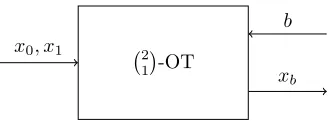
Figure 1: Oblivious Transfer. The sender provides two strings,x0, x1, and the
receiver has a selection bit, b. The receiver receives a string xb. The sender
receives nothing.
• The challenger uniformly chooses a bit b ← {0$ ,1}, and initializes a set
X =∅.
• The challenger and adversary engage in the following protocol where the adversary sends the challenger an input xi ∈ {0,1}
n
, and receives a re-sponseyi∈ {0,1}
m
until the adversary outputs a guessb0. The challenger generates its responses as follows
– If b= 0, the challenger sets yi=Fκ(xi)
– Ifb= 1, the challenger checks if there is a pair(xi, y)∈X, if so the
challenger responds with the valuey. If not, the challenger uniformly selects y ∈ {0,1}m, and sets X =X∪(xi, y), and returnsy to the
adversary.
The adversary is said to win the game if the adversary’s guessb0 is equal to the challenger’s bit b. A PRF is said to be secure if any probabilistic polynomial-time adversary has a negligible (as a function of λ) probability of winning the above game.
3.3
OT
Oblivious Transfer (OT) [Rab81, EGL85] is a two party protocol that allows one party (Bob) to privately select one of two input strings held by the other party (Alice).
Definition 2 (OT). Oblivious Transfer (OT) is a two party protocol that se-curely realizes the following functionality.
inputs: Alice inputs stringsx0, x1. Bob inputs a choice bitb.
outputs: Alice receives nothing. Bob receivesxb.
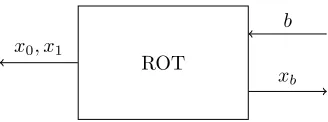
Sender Random-OT (ROT) is similar to oblivious transfer, except the strings
x0, x1 are not provided by Alice, but instead are randomly generated by the
protocol itself. Although ROT seems to be a weaker primitive than OT, they are known to be equivalent [Cr´e87].
ROT
x0, x1
b xb
Figure 2: Random Oblivious Transfer. In the ROT functionality, the sender provides no input to the protocol, and instead the values x0, x1 are generated
uniformly at random by the protocol itself.
OT can be constructed generically from many different cryptographic primitives, including PIR [CMO00], projective hash proofs [Kal05, HK07], dual-mode en-cryption [PVW08] and noisy channels [IKO+11]. On the other hand, a black-box
construction of OT from one-way permutations would implyP 6=N P [IR89], (perfect) OT cannot be constructed from quantum mechanical processes [Lo97], and quantum mechanics doesn’t even allow OT extension [SSS09, WW10].
One of the key features of OT is that a small number of “base” or “seed” OTs can be extended into a huge number of OTs with low overhead in terms of computation and communication [IKNP03]. Thus, although OT is inher-ently a public-key primitive (OT implies public-key encryption, but not vice-versa [GKM+00]), protocols that require a large number of OTs (e.g., [PSZ14,
PSSZ15, PSZ16]) do not require a large number of public-key operations.
3.4
OPRFs
An Oblivious pseudorandom function (OPRF) is a two-party protocol for se-curely computing a PRF. The OPRF protocol sese-curely realizes the functionality where one party (Alice) provides a PRF key,κ, and the other party (Bob) pro-vides an input value, x. In the ideal functionality, Alice learns nothing, while Bob learnsFκ(x). See Figure 3.
OPRFs were introduced in [FIPR05] as a means of achieving private keyword search, and since that time, many OPRF protocols have been introduced. A generic method for realizing the OPRF functionality is to use a general-purpose MPC protocol (e.g., garbled circuits) to implement a PRF.
Definition 3 (OPRF). An Oblivious Pseudo-Random Function (OPRF) is a two party protocol that securely realizes the following functionality, whereF is a cryptographically secure pseudorandom function (PRF).
inputs: Alice inputs a keyκ. Bob inputs a valuex.
outputs: Alice receives nothing. Bob receivesFκ(x).
3.5
One-time OPRFs
OPRF
κ
x Fκ(x)
Figure 3: The Oblivious PRF (OPRF) functionality. The sender provides a PRF key, κ, and the receiver provides an input, x. The receiver learns Fκ(x),
and the sender learns nothing.
one-time OPRF
κ
x Fκ(x)
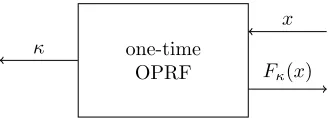
Figure 4: The one-time OPRF functionality. In the one-time OPRF functional-ity, the PRF key is not specified by the sender, but instead is generated by the protocol itself.
sense, the relationship between a one-time OPRF and an OPRF is similar to the relationship between Random OT and OT. The qualifier one-time indicates that the one-time OPRF protocol can only be used to securely evaluateFκ(·)
once, since each additional run of the one-time OPRF will evaluate the PRF at a different key.
Definition 4 (one-time OPRF). A one-time Oblivious Pseudo-Random Func-tion (one-time OPRF) is a two party protocol that securely realizes the follow-ing functionality, whereF is a cryptographically secure pseudorandom function (PRF).
inputs: Alice inputs nothing. Bob inputs a valuex.
outputs: Alice receives a uniformly chosen key,κ. Bob receivesFκ(x).
3.6
Multiple-choice hashing and Cuckoo hashing
Multiple-choice hashing is a technique for representing a setSusing an arrayA, that has efficient space utilization and allows constant look-up time. First, a set of hash functionsh1, . . . , hk is chosen, wherehi:U →[n]. An elementxj ∈S,
is stored in an indexhi(xj) of A, for some i∈[k]. Look-ups of an element, x,
simply require checking whetherA[hi(x)] =x for anyi∈ [k]. Multiple choice
hashing assumes that the entire set is known in advance, so items in the set can be allocated indices inAusing a 2D matching protocol.
Multiple-choice hashing, an elementx∈S will be stored inhi(x) for somei∈[k]. The
name Cuckoo hashing refers to the method used for insertion: a new element
xwill be placed in one of its allowed indices hi(x) and if the spot is already
occupied it will, like a Cuckoo bird taking over a nest, evict the existing element from that location. The evicted element will then seek a new home from its allowed indices, possibly evicting yet another element in the process. This process continues until an element can move to a space that was previously empty, or a pre-determined threshold in the number of evictions is reached, in which case the insertion fails.
Many previous PSI works refer to Cuckoo hashing. However, as outlined in more detail in Section 4.2 in the PSI case the items are known in advance, so static multiple-choice hashing can be used instead of dynamic Cuckoo hashing. This means that an allocation can always be found if one exists.
However, there is the chance that no allocation exists. In the case where
k = 2, if the table is of size 2(1 +)n, for any > 0, the probability that multiple-choice hashing fails is Θ(1/n), where the constant in the Theta-notation depends on[Kut06]. In many situations, a failure probability of Θ(1/n) is not acceptable. A solution to this is to have a “stash”, of maximum size s, in which to store any elements that were unable to be placed in the table. The probability of failure becomes Θ(1/ns+1) [Mit09]. To acheive negligible failure
probability,s=ω(1) is needed. To acheive a fixed statistical failure probability 2−σ, it is required thats≥ σ
log(n)+ log(c)
log(n)−1 wherec is the constant from the
Theta-notation above.
4
Two generic optimizations for hashing-based
PSI protocols
Here we present two improvements which can be used for hashing-based PSI protocols in general. Both are orthogonal to the primary contributions of this paper and the rest of the paper should still make sense if this section is skipped.
4.1
Permutation-based hashing [ANS10, PSSZ15]
When hashing elements into buckets, the size of the representation of each element can be reduced using the notion of permutation-based hashing [ANS10, PSSZ15]. In general, it takes log|U | bits to store an element x ∈ U. In a traditional hash table, a hash function,h:U →[n] is chosen, and the elementx
is stored in the location indexed byh(x). Notice, however, that the bucket index,
ˆ
x= π(x). Suppose ˆx has bit-representation ˆx= ˆx1||xˆ2, where ˆx1 has length
logn, and ˆx2 has length log|U | −logn. Letf :{0,1}
log|U |−logn
→ {0,1}logn be a uniform hash function. Then we defineh(ˆx) = ˆx1⊕f( ˆx2), and we store ˆx2
in the bin defined byh(ˆx). The crucial observation here is that if ˆxand ˆy are in the same bin, and the stored values are the same (i.e., ˆx2 = ˆy2), then that
meansf( ˆx2) =f( ˆy2), and since h(ˆx) =h(ˆy), we conclude that ˆx1= ˆy1, which
means ˆx= ˆy and thereforex=y.
This trick allows us to reduce the size of the representation of elements within the bins, while still providing the property that if two elements have the same representation and are in the same bin, they must be equal. In the context of PSI, this means that secure computations are done on elements with smaller representations, and this can result in noticeable efficiency improvements (quantified in [PSSZ15]). The random permutation,π(·), is needed becauseh(x) may no longer be a uniform hash function, even thoughf(x) is. If the input to
his correlated, this can increase the probability of a high number of hash-table collisions. The permutation guarantees that the inputs tohis uncorrelated. The permutation-based hashing trick can be used in all hashing-based PSI protocols, including ours. In the situation where there are multiple hash functions, the ID of the hash function must also be stored in the bin to allow equality tests [Lam16].
4.2
Static (offline) hashing
In many hashing-based PSI functions, Bob will allocate each element one ofk
possible hash functions, and Bob wishes to choose an optimal allocation, namely one that minimizes the number of elements that need to be stored in his stash. Existing PSI protocols [PSZ14, PSSZ15, KKRT16] have usedonlineCuckoo hashing to compute Bob’s allocation. Cuckoo hashing is designed to allow dy-namicinsertion of elements, but we observe that in the PSI setting, both parties know their sets in advance. In particular, Bob can allocate hash functions to elements based on knowledge of his entire set.
Instead of using dynamic cuckoo hashing, Bob can statically calculate an optimal allocation. He does this by treating the problem as a 2D matching problem (matching elements to potential bins). For dynamic cuckoo hashing, however, it remains an open problem of whether an optimal allocation can be found [Mit09]. As such this simple modification provides a guarantee that hash functions are allocated optimally. It also eases reasoning about the probability of failure for a given stash size.
5
Linear communication PSI via hashing and
OPRFs
scheme for handling the stash. Previous PSI protocols with linear commu-nication tended to rely on oblivious polynomial evaluation, and instantiated the idea with an additively homomorphic cryptosystem [FNP04, HN10, KS05, DSMRY09] or require concrete number-theoretic assumptions [HL10, DCT10, DCT12, JL09, JL10]. By contrast, our protocol uses a hashing-based PSI pro-tocol (like [PSZ14, PSSZ15, KKRT16]) which can be instantiated from OT, combined with an OPRF (which can also be instantiated with OT).
5.1
Construction
At a high level, our construction is as follows: Alice and Bob choose k hash functions, hi : {0,1}∗ → [n]. Then Alice hashes each of her elements into k
bins, and Bob uses multiple-choice hashing to hash each of his elements into 1 (out ofkpossible) bins. Then they perform pairwise comparisons on the bins. For constant k we can set n to be O(m) and the hashing will succeed with probability 1−o(n). To make this failure probability negligible, we allow Bob to keep a super-constant sized “stash” of elements that could not be allocated to a single bin.
Then, for each of Bob’s bins we use secure comparison protocol (like those described in [PSZ14, PSSZ15, KKRT16]) to compare the element in Bob’s bin to the elements in Alice’s corresponding bin. Finally, we need to compare Bob’s stash (of size ω(1)) to Alice’s elements (of size O(m)). To do this, we use an unbalanced PSI protocol like those described in [CLR17, CHLR18, RA18, KLS+17]. For concreteness, we use the OPRF-based unbalanced PSI
proto-col described in [KLS+17] because its use of OPRFs is conceptually closest to
the one-time OPRFs used in [KKRT16], and because many implementations of OPRFs were available for our benchmarks.
Remark 1.Our construction is also compatible with silent-OT extension [BCG+19] that could be used to reduce the communication complexity of [PSZ14, PSSZ15, KKRT16]. This reduction in communication cost would come at an increase in computation cost, and currently silent-OT extension is only known to be secure under a variant of the LPN assumption.
1. Set k ≥2, and n= O(m), and the players choose k hash functions
hi:U →[n].
2. Bob will hash his elements into n bins using a 1-out-of-k hashing scheme, such that each bin obtains at most one element. Elements that cannot be allocated to a single bin will be put in a “stash”,
StashB, of sizes=ω(1). Bob can compute this allocation efficiently. LetB[i] denote the element stored in Bob’sith bin. LetStashB[i] for
3. Alice will hash her elements into n bins, using ak-out-of-k hashing scheme. LetC[i] denote the number of elements in Alice’sith bin, and letA[i][j] denote the element in the bin for 1≤i≤n, 1≤j ≤C[i]. 4. Alice and Bob will engage in n parallel executions of a one-time
OPRF, where for i ∈ [n], Alice learns a key κi, and Bob learns
Si B
def
= PRFκi(B[i]). For each i ∈ [n], Alice will locally compute
Si
A,j = PRFκi(A[i, j]) forj= 1, . . . , C[i]. 5. Alice will shuffleSA,ji
i∈[n],j∈[C[i]]and send the shuffled set to Bob.
Note that this set will have exactlykm elements.
6. Bob will locally compute the intersection of his non-stash set with Alice’s set by finding which of the Si
B are in the set received from
Alice.
7. To handle the stash, Alice will generate a key,κ, for an OPRF, and Alice and Bob will engage insexecutions of an OPRF protocol, where Bob learnsRi
B def
= PRFκ(StashB[i]) fori∈[s].
8. Alice will compute Ri A
def
= PRFκ(A[i][j]) fori∈[n], j ∈[C[i]] shuffle
the set, and send it Bob who will locally compare these values to
Ri
B i∈s to find the intersection of Alice’s set with the stash. Note
that the set Alice sends will have exactlym elements.
Figure 5: The high-level outline of our algorithm
The communication cost of the protocol is the sum of the costs of the following:
• nparallel executions of a one-time OPRF. The cost of this will depend on how the one-time OPRF is instantiated.
• Alice will send Bobkmevaluations of her inputs under the one-time OPRF keys.
• s=ω(1) secure computations of the Stash OPRF.3
• Alice will send Bob m evaluations of her inputs under the Stash OPRF key.
The exact communication cost will depend on how the one-time OPRF and OPRF are instantiated, but standard constructions allow the entire protocol to run with communication linear inm.
3 If the one-time OPRF and the OPRF compute the same PRF, a small optimization is
In Sections 5.2 and 5.3, we review existing methods for implementing the one-time OPRF using methods from [PSSZ15] and [KKRT16], and give the com-munication complexity of each approach. Then we describe how to implement the OPRF using methods from [KLS+17]. Finally, in Section 5.5 we compare the concrete communication complexity of our modified protocol with the best existing protocol [KKRT16].
5.2
An OT-masking-based protocol
In this section, we review the OT-masking-based OPRF protocol from [PSZ16]. When instantiated with OT, this protocol implements a standard (multi-time) OPRF, when instantiated with ROT, this protocol implements a one-time OPRF, which is sufficient for the PSI applications.
1. Bob will represent his element,B[i], (the contents of theith bucket) as a bit vector of length t, including a tag for which of the k hash functions was used. Using permutation-based hashing (Section 4.1), this can be done witht= log2|U | −log2n+ log2k.
2. Alice constructs a vector of length 2t of random masks, M. This
vector is the OPRF key (in fact, actually a truth-table for a truly random function). For input j ∈ [2t], M
j is the evaluation of the
OPRF on input j. Since Alice can choose the key, this is a normal OPRF rather than a one-time OPRF. If Alice and Bob are using ROT (instantiating a one-time OPRF) they can skip this step.
3. To evaluate the (one-time) OPRF on his input,B[i], Alice and Bob engage in a 21t
string-OT (respectively 21t
string-ROT). Bob uses his input B[i] ∈[2t] as the input to the OT. From this, Bob learns
MB[i], which is the evaluation of the PRF onB[i].
Figure 6: Implementing OPRF using Oblivious Transfer
This protocol requires a single 21t-string OTs (for random strings) for each
bucket, and thus a total ofn 21t
-string OTs. Using OT extension [IKNP03], these can be generated usingλbase OTs.
The outline above follows the construction of [PSZ16], which fixed an error in earlier OT-masking approaches [PSZ14, PSSZ15].
5.3
Batching OPRFs
As this is the most efficient instantiation of the one-time OPRF used in our scheme we provide a description in more detail below.
Before outlining the actual construction of [KKRT16], we review some of the necessary terminology. First, arelaxed-PRF is a pair (F,F˜) whereF is a PRF such that 1)Fκ(x) can be computed from ˜Fκ(x) and 2) ˜Fκ(x) does not improve
the adversary’s distinguishing advantage in the PRF security experiment. In other words, given query access to ˜Fκ(·), Fκ(·) appears pseudo-random on all
unqueried points.
The original OT-extension protocol of [IKNP03] relied on acorrelation-robust hash function. In [KKRT16] the notion of correlation-robustness is extended as follows.
Definition 5(k-Hamming Correlation Robustness). LetH :{0,1}∗→ {0,1}v be a hash function such that for all zi ∈ {0,1}∗, and ai, bi ∈ {0,1}n for i =
1, . . . , m, with wt(bi)≥k, we have
n
{H(zi||ai⊕[bi·s])}i∈[m]
s
$
← {0,1}no ≈
n {ri}i∈m
ri
$
← {0,1}vo
The definition of correlation robustness in [IKNP03] requiredk=n, i.e.,bi·s=
s.
A pseudo-random code is a relaxation of an error-correcting code such that for any two distinct messages, their encodings have a large minimum distance with high probability over the choice of a specific code from the family.
Definition 6 (Pseudo-Random Code [KKRT16]). A family of functions, C, is called a(d, )pseudorandom code (PRC) if for all strings x6=x0,
Pr
C←C[wt (C(x)⊕C(x
0))< d]≤2−
The key security definition of [KKRT16] is the notion of related-key, relaxed PRFs. These are PRFs that remain secure when the challenger choosesnkeys,
κ1, . . . , κn, and the adversary sees the relaxed output for each key, then any
m additional outputs (of the PRF, F) corresponding to any of the keys are indistinguishable from random.
Definition 7 (m-related key PRFs [KKRT16]). An m-related key PRF is a pair of functionsF,F˜, and security is defined relative to the following game:
1. The adversary chooses input strings {xj}j∈[n] and pairs {(ji, yi)}i∈[m],
withji∈[n]and yi6=xji fori∈[m].
2. The challenger chooses PRF keys κ∗, κ1, . . . , κn and a challenge bit b ∈
{0,1}.
• If b = 0, the challenger sends nF˜(κ∗,κ j)(xj)
o
j
and nF(κ∗,κ ji)(yi)
o
i
• If b = 1, the challenger generates m random strings zi ← {0,1} v
,
and sendsnF˜(κ∗,κ j)(xj)
o
j
and {zi}i to the adversary.
3. The adversary outputs a guess b0, and the adversary wins if b0 =b. We say the adversary’s advantage is Pr[b0 =b]−1/2.
We say the pair F,F˜ is secure if the adversary’s advantage is negligible. In-tuitively, the pair F,F˜ is an m-related key PRF if the relaxed output, F˜, on
n distinct keys, does not reveal information that would allow an adversary to distinguish F from a true random function, even if the inputs are arbitrarily correlated across keys.
Related-key PRFs can be efficiently instantiated using a pseudo random code, and a correlation robust hash function as follows.
Lemma 1(Lemma 5 in [KKRT16]). IfCis a(d, +logm)-pseudo random code, and2− is negligible and H is a d-Hamming correlation robust hash function,
then
F((C,s),(q,j))(r) =H(j||q⊕[C(r)·s])
˜
F((C,s),(q,j))(r) = (j, C, q⊕[C(r)·s])
is anm-related key PRF as in Definition 7.
1. Alice chooses a random PRCC← C$ and sends the code to Bob. 2. Alice chooses a keys← {0$ ,1}k.
3. Bob generates two matrices T0, T1 ∈ {0,1}m×k as follows. Forj =
1, . . . , m,
(a) The jth row of T0 is generated uniformly at random t0,j $
← {0,1}k.
(b) Thejth row ofT1 is defined ast1,j =C(rj)⊕t0,j.
Theith columns ofT0 andT1 are denoted ti0, ti1respectively.
4. Alice and Bob engage inkparallel instances of 21
-OT for strings of lengthmas follows:
• Bob acts as sender and his inputs are the k columns ofT0 and
T1, i.e., Bob’s inputs to the OT are
ti
0, ti1 i∈[k]
• Alice receiveskoutputs (each of lengthm) denotedqi i∈[k]
Alice creates the m×k matrix Q whose columns are the received vectors
qi . Thus theith column ofQisti
si. Letqj denote thejth row ofQ. Then
qj = ((t0,j ⊕t1,j)·s)⊕t0,j =t0,j⊕(C(rj)·s)
5. Forj∈[m], Alice keeps the PRF seed ((C, s),(j, qj))
6. Forj∈[m], Bob keeps the relaxed PRF output (j, C, t0,j).
Figure 7: Instantiating aBaRK-OPRFusing OT [KKRT16].
At the end of the protocol in Figure 7, Alice has the keys κ∗ = (C, s), and
κj = (j, qj), which allows her to evaluate theBaRK-OPRF
F(κ∗,κ
j)(r) =F((C,s),(j,qj))(r) =H(j||qj⊕[C(r)·s]) for anyr, and Bob has the relaxed PRF outputs
(j, C, t0,j) = (j, C, qj⊕[C(rj)·s]) = ˜F(κ∗,κ j)(rj) which allows him to computeF(κ∗,κ
j)(rj).
TheBaRK-OPRFprotocol allows Alice and Bob to securely computenparallel, one-time OPRFs in a very efficient manner. Since the protocol is inherently “batched,” it does not fit exactly into the one-time OPRF paradigm described in Figure 5. Conceptually, the idea is essentially the same. Alice and Bob will engage in aBaRK-OPRF protocol, where Bob learns ˜F(k∗,k
j)(B[i]) for i = 1, . . . , n, which allows him to learn the PRF outputs F(κ∗,κ
j)(B[i]). Alice will learn the PRF keys,κ∗, κ1, . . . , κn.
1. Bob has inputsB[i], fori= 1, . . . , n
2. Alice has no inputs
3. Alice and Bob will use theBaRK-OPRFprotocol (Figure 7) with Bob providing the contents of his n buckets as his inputs. At the end of the protocol, Alice has keys:
κ∗, κ1, . . . , κn
and Bob has relaxed PRF outputs ˜F(κ∗,κ i)(B[i]) 4. From the relaxed outputs, Bob can computeSi
B def
= F(κ∗,κ
5. From the PRF keysκ∗, κ1, . . . , κn, Alice can compute F(κ∗,κi)(x) for
anyxof her choosing.
Figure 8: UsingBaRK-OPRFs to instantiatenparallel one-time OPRFs. Concretely, our implementation will use theBaRK-OPRFprotocol to compute then parallel one-time OPRFs, and then use a different (multi-use) PRF for the stash comparison. See section 5.5.
5.4
Security
The PSI protocols outlined in Section 5.1 are formed by taking existing one-time OPRF-based PSI protocols (e.g. [PSZ14, PSSZ15, PSZ16, KKRT16]) and combining them (in parallel) with an OPRF-based PSI protocol (e.g. [KLS+17])
to handle the unbalanced stash. The proof of security (against honest-but-curious adversaries) follows in a straightforward manner from the security of the two underlying protocols.
For completeness, we outline the security of our protocol here. We define secu-rity in the standard, simulation paradigm, i.e., a PSI protocol is secure if there exists an efficient (probabilistic polynomial-time) simulator that can simulate the view of each player given the output of the protocol alone.
In our basic protocol (Figure 5), Alice’s view consists ofnparallel executions of a one-time-OPRF (from which she receivesnrandom keys), andsapplications of an OPRF (from which she receives nothing). Thus her view is completely in-dependent of Bob’s input and can be trivially simulated since her view consists solely of random strings. Bob’s view consists ofmPRF-outputs provided by the one-time OPRF protocol,kmPRF outputs provided by Alice, sPRF outputs provided by the OPRF protocol for the stash, andmPRF outputs provided by Alice to compare with the stash. Given the intersection of Alice and Bob’s sets, Bob’s view can be easily simulated by providingkm+m random strings (cor-responding to the one-time OPRF round) with the correct intersection pattern, ands+mrandom strings (corresponding to the OPRF round) with the correct intersection pattern.
5.5
Concrete communication benchmarks
In [KMW09] it was shown that under the assumption that the dynamic (online) cuckoo hashing algorithm achieves the optimal load, allocatingm elements to
n=O(m) buckets with a stash of sizes will succeed with probability at least 1−O n−(s+1)
. The protocols of [PSZ14, PSSZ15, PSZ16, KKRT16] set n= 1.2m. Thus, under the assumption that online cuckoo hashing achieves the optimal offline load, to achieve a negligible probability of failure, the stash size,
s, must bes=ω(1) (e.g.,s=O(logn)).
players’ sets, so the failure probability should be set below the security threshold. In the work of [PSZ14, PSSZ15], they set security threshold to be a constant 2−σ, withσ= 40, independent of the set sizes. The asymptotic failure rate is known to be Θ(n−(s+1)) [KMW09], which impliess≥ σ
log(n)+ log(c)
logn −1 provides failure
probability below 2−σfor some constantc. In [PSSZ15], they empirically tested
the failure probability with 2-way cuckoo hashing, and different stash sizes form
up to about 214. Then they extrapolated these failure probabilities up to larger
set sizes, and used these values to choose the stash sizes to be s∼40/log(n) (see [PSSZ15] Figure 2). This is consistent with the analysis above, assuming the constant c is not very large. The scheme of [KKRT16] uses similar stash parameters even though they are hashing with three hash functions instead of two.
In practice, fixing a concrete security parameter that does not increase withm
means that the necessary stash sizedecreases as the set sizes increase, whereas an asymptotic analysis (which assumes that the failure probability should be negligible inm) requires that the stash sizeincreases as the set sizes increase. Thus this choice of a concrete security parameter means that the concrete and asymptoticperformancemetrics diverge as the set sizes increase.
For a hash table of sizen, and a stash of sizes, the hashing protocol of [KKRT16] requiresnapplications of a one-time OPRF, and the communication ofn (trun-cated) PRF outputs in the main phase, andsone-time OPRF evaluations and the communication ofmsPRF outputs in the stash phase.
We replace the stash computation with an unbalanced PSI protocol based on a standard (reusable) OPRF, reducing the communication in the stash phase to
sevaluations of an OPRF followed by sendingmPRF outputs.
In practice, because equality testing is done by comparing the pseudorandom masks (PRF outputs), there is no need to transmit the entire mask. Instead, to achieve error probability less than 2−σ, it is sufficient to transmit only about
v=σ+ 2 logm bits of the mask, and in this case, by the birthday bound, the probability of a spurious collision between masks is negligible inm. This is what is done in practice by [PSSZ15, KKRT16].
Letddenote the number of bits required for an OPRF application, andd0 < dbe
the number of bits required for a one-time OPRF evaluation. Then our protocol obtains a concrete performance improvement wheneversd+mv < sd0+msv. We therefore obtain a concrete improvement whenever
s(d−d0)
v(s−1) < m
In [ARS+15], they report that a single (GMW-based) AES evaluation using
ABY can be computed using only 170 kb of communication. Using their cus-tom, “MPC-friendly” PRF, the garbled circuit can be computed using only 23 kb of communication ([ARS+15] Table 6). Similarly, 1024 garbled AES
rep-resentations were computed using 185 Mb of communication ([KLS+17] Table
Table 1: This table shows the communication cost of a single OPRF evaluation, and the minimum number of elements for which replacing the OPRF-based comparison of the stash in [KKRT16] would be improved by switching to our protocol. The AES Obliv-C and AES EMP benchmarks were obtained via our internal tests. The ABY benchmarks were taken from [ARS+15], the Yao
benchmarks were taken from [KLS+17], and the LowMC benchmarks were taken
from [ARS+15].
OPRF
Comm. Cost
(d)
m at which our protocol outperforms
[KKRT16] AES (Yao - Obliv-C) 8 Mb 221
AES (Yao - EMP) 212 Kb 216
AES (GMW - ABY) [ARS+15] 170 Kb 215
AES (Yao - ObliVM) [KLS+17] 177 Kb 215
LowMC [ARS+15] 23 Kb 212
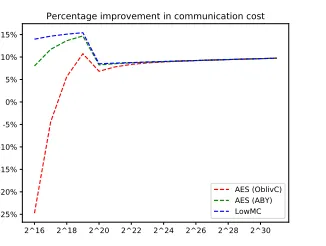
Although our protocol outperforms [KKRT16] asymptotically, the exact point at which it starts to outperform [KKRT16] concretely depends on the exact implementation of the OPRF. In Table 1 we show the communication costs of four different standard OPRF implementations, and give the number of elements (m) at which our protocol starts to outperform that of [KKRT16].
2^12 2^14 2^16 2^18 2^20 2^22 2^24 2^26 2^28 2.5%
5% 7.5% 10% 12.5% 15% 17.5%
Percentage improvement in communication cost
LowMC
Figure 9: The percentage improvement in overall communication cost when modifying the BaRK protocol to use the LowMC-based PRF to compare the stash. For most values ofm, our modification reduces the overall communication cost of the protocol by 10 to 15%. The points of non-differentiability in the graph correspond to the places where the stash sizes drop (we use the same stash sizes as [PSSZ15, KKRT16])
2^16 2^18 2^20 2^22 2^24 2^26 2^28 2^30 -25%
-20% -15% -10% -5% 0% 5% 10% 15%
Percentage improvement in communication cost
AES (OblivC) AES (ABY) LowMC
6
Conclusion
PSI is one of the most basic and fundamental types of secure computation, and numerous diverse types of PSI protocols have been proposed and implemented. Existing PSI protocols are highly optimized and extremely efficient.
In this work, we show how simple, modular composition of existing PSI protocols leads to both asymptotic and concrete improvements in efficiency. Specifically we show that the one-time OPRF protocols of [PSZ14, PSSZ15, KKRT16] can be improved both asymptotically (from super-linear to linear) and, for n ≥ 212, concretely by replacing the stash-comparison step with an unbalanced PSI
protocol [KLS+17].
References
[ANS10] Yuriy Arbitman, Moni Naor, and Gil Segev. Backyard cuckoo hashing: Constant worst-case operations with a succinct represen-tation. InFOCS, pages 787–796. IEEE, 2010.
[AP11] Rasmus Resen Amossen and Rasmus Pagh. A new data layout for set intersection on gpus. In Parallel & Distributed Processing Symposium (IPDPS), 2011 IEEE International, pages 698–708. IEEE, 2011.
[ARS+15] Martin R Albrecht, Christian Rechberger, Thomas Schneider, Tyge Tiessen, and Michael Zohner. Ciphers for MPC and FHE. In EUROCRYPT, pages 430–454. Springer, 2015.
[BCG+19] Elette Boyle, Geoffroy Couteau, Niv Gilboa, Yuval Ishai, Lisa
Kohl, and Peter Scholl. Efficient pseudorandom correlation gen-erators: Silent OT extension and more. IACR ePrint 2019/448, 2019.
[CHLR18] Hao Chen, Zhicong Huang, Kim Laine, and Peter Rindal. Labeled PSI from fully homomorphic encryption with malicious security. InCCS, pages 1223–1237. ACM, 2018.
[CLR17] Hao Chen, Kim Laine, and Peter Rindal. Fast private set inter-section from homomorphic encryption. InCCS, pages 1243–1255, 2017.
[CMO00] Giovanni D. Crescenzo, Tal Malkin, and Rafail Ostrovsky. Single Database Private Information Retrieval Implies Oblivious Trans-fer. InEurocrypt, volume 1807, pages 122–138, 2000.
[CO18] Michele Ciampi and Claudio Orlandi. Combining private set-intersection with secure two-party computation. InSCN, 2018.
[DCT10] Emiliano De Cristofaro and Gene Tsudik. Practical private set intersection protocols with linear complexity. In FC, volume 10, pages 143–159. Springer, 2010.
[DCT12] Emiliano De Cristofaro and Gene Tsudik. Experimenting with fast private set intersection. Trust, 7344:55–73, 2012.
[DCW13] Changyu Dong, Liqun Chen, and Zikai Wen. When private set intersection meets big data: an efficient and scalable protocol. In CCS, pages 789–800, 2013.
[DSMRY09] Dana Dachman-Soled, Tal Malkin, Mariana Raykova, and Moti Yung. Efficient robust private set intersection. InApplied Cryp-tography and Network Security, pages 125–142. Springer, 2009.
[DSZ15] Daniel Demmler, Thomas Schneider, and Michael Zohner. Aby-a framework for efficient mixed-protocol secure two-party computa-tion. InNDSS, 2015.
[EGL85] Shimon Even, Oded Goldreich, and Abraham Lempel. A random-ized protocol for signing contracts. Communications of the ACM, 28(6):637–647, 1985.
[FBI19] FBI. National crime information center (ncic).https://www.fbi. gov/services/cjis/ncic, July 2019.
[FIPR05] Michael J Freedman, Yuval Ishai, Benny Pinkas, and Omer Rein-gold. Keyword search and oblivious pseudorandom functions. In TCC, volume 3378, pages 303–324, 2005.
[FNP04] Michael J Freedman, Kobbi Nissim, and Benny Pinkas. Efficient private matching and set intersection. In EUROCRYPT, pages 1–19, 2004.
[GKM+00] Yael Gertner, Sampath Kannan, Tal Malkin, Omer Reingold, and
Mahesh Viswanathan. The relationship between public key en-cryption and oblivious transfer. InFOCS, page 325, 2000.
[GMW87] Oded Goldreich, Silvio Micali, and Avi Wigderson. How to play any mental game. InSTOC, pages 218–229, 1987.
[Gol01] Oded Goldreich. Foundations of cryptography: volume 1. Cam-bridge university press, 2001.
[Gol04] Oded Goldreich. Foundations of cryptography: volume 2. Cam-bridge university press, 2004.
[HEK12] Yan Huang, David Evans, and Jonathan Katz. Private set inter-section: Are garbled circuits better than custom protocols? In NDSS, 2012.
[HK07] Dennis Hofheinz and Eike Kiltz. Secure hybrid encryption from weakened key encapsulation. In CRYPTO, Berlin, Heidelberg, 2007.
[HL10] Carmit Hazay and Yehuda Lindell. Efficient protocols for set inter-section and pattern matching with security against malicious and covert adversaries. Journal of cryptology, 23(3):422–456, 2010.
[HN10] Carmit Hazay and Kobbi Nissim. Efficient set operations in the presence of malicious adversaries. In PKC, volume 6056, pages 312–331, 2010.
[IKNP03] Yuval Ishai, Joe Kilian, Kobbi Nissim, and Erez Petrank. Extend-ing oblivious transfers efficiently. InCRYPTO, volume 2729, pages 145–161. Springer, 2003.
[IKO+11] Yuval Ishai, Eyal Kushilevitz, Rafail Ostrovsky, Manoj Prab-hakaran, Amit Sahai, and J¨urg Wullschleger. Constant-Rate Obliv-ious Transfer from Noisy Channels. In CRYPTO, volume 6841, chapter 38, pages 667–684. 2011.
[IKOS08] Yuval Ishai, Eyal Kushilevitz, Rafail Ostrovsky, and Amit Sahai. Cryptography with constant computational overhead. In STOC, pages 433–442, 2008.
[IPS08] Yuval Ishai, Manoj Prabhakaran, and Amit Sahai. Founding Cryp-tography on Oblivious Transfer - Efficiently. In CRYPTO, pages 572–591, 2008.
[IR89] Russell Impagliazzo and Steven Rudich. Limits on the Provable Consequences of One-Way Permutations. InSTOC, pages 44–61, 1989.
[JL09] Stanislaw Jarecki and Xiaomin Liu. Efficient oblivious pseudoran-dom function with applications to adaptive ot and secure compu-tation of set intersection. In TCC, volume 5444, pages 577–594. Springer, 2009.
[JL10] Stanis law Jarecki and Xiaomin Liu. Fast secure computation of set intersection. Security and Cryptography for Networks, pages 418–435, 2010.
[Kil88] Joe Kilian. Founding cryptography on oblivious transfer. InSTOC, STOC ’88, pages 20–31, 1988.
[KKRT16] Vladimir Kolesnikov, Ranjit Kumaresan, Mike Rosulek, and Ni Trieu. Efficient batched oblivious PRF with applications to private set intersection. InCCS, pages 818–829, 2016.
[K L02] Micha l Karo´nski and Tomasz Luczak. The phase transition in a random hypergraph.Journal of Computational and Applied Math-ematics, 142(1):125–135, 2002.
[KLS+17] Agnes Kiss, Jian Liu, Thomas Schneider, N Asokan, and Benny´ Pinkas. Private set intersection for unequal set sizes with mobile applications. PoPETs, 4:97–117, 2017.
[KMW09] Adam Kirsch, Michael Mitzenmacher, and Udi Wieder. More ro-bust hashing: Cuckoo hashing with a stash. SIAM Journal on Computing, 39(4):1543–1561, 2009.
[KS05] Lea Kissner and Dawn Song. Privacy-preserving set operations. In CRYPTO, volume 3621, pages 241–257, 2005.
[Kut06] Reinhard Kutzelnigg. Bipartite Random Graphs and Cuckoo Hash-ing. In Philippe Chassaing et al., editors, Fourth Colloquium on Mathematics and Computer Science Algorithms, Trees, Combi-natorics and Probabilities, volume DMTCS Proceedings vol. AG, Fourth Colloquium on Mathematics and Computer Science Algo-rithms, Trees, Combinatorics and Probabilities of DMTCS Pro-ceedings, pages 403–406, Nancy, France, 2006. Discrete Mathemat-ics and Theoretical Computer Science.
[Lam16] Mikkel Lambæk. Breaking and fixing private set intersection pro-tocols. IACR ePrint 2016/665, 2016.
[Lel12] Marc Lelarge. A new approach to the orientation of random hy-pergraphs. InProceedings of the twenty-third annual ACM-SIAM symposium on Discrete Algorithms, pages 251–264. SIAM, 2012.
[Lo97] Hoi K. Lo. Insecurity of quantum secure computations. Physical Review A, 56:1154–1162, 1997.
[LP14] Po-Shen Loh and Rasmus Pagh. Thresholds for extreme orientabil-ity. Algorithmica, 69(3):522–539, 2014.
[MBD12] Dilip Many, Martin Burkhart, and Xenofontas Dimitropoulos. Fast private set operations with SEPIA. Technical Report 345, ETH Zurich, march 2012.
[PRTY19] Benny Pinkas, Mike Rosulek, Ni Trieu, and Avishay Yanai. SpOT-light: Lightweight private set intersection from sparse OT exten-sion. 2019.
[PSSW09] Benny Pinkas, Thomas Schneider, Nigel P Smart, and Stephen C Williams. Secure two-party computation is practical. In ASI-ACRYPT, volume 9, pages 250–267, 2009.
[PSSZ15] Benny Pinkas, Thomas Schneider, Gil Segev, and Michael Zohner. Phasing: Private set intersection using permutation-based hashing. InUSENIX Security Symposium, pages 515–530, 2015.
[PSTY19] Benny Pinkas, Thomas Schneider, Oleksandr Tkachenko, and Avishay Yanai. Efficient circuit-based psi with linear communi-cation. InEUROCRYPTO, pages 122–153, 2019.
[PSWW18] Benny Pinkas, Thomas Schneider, Christian Weinert, and Udi Wieder. Efficient circuit-based PSI via cuckoo hashing. In EU-ROCRYPT, 2018.
[PSZ14] Benny Pinkas, Thomas Schneider, and Michael Zohner. Faster private set intersection based on ot extension. InUSENIX, pages 797–812, 2014.
[PSZ16] Benny Pinkas, Thomas Schneider, and Michael Zohner. Scalable private set intersection based on OT extension. IACR Cryptology ePrint Archive, 2016.
[PVW08] Chris Peikert, Vinod Vaikuntanathan, and Brent Waters. A Frame-work for Efficient and Composable Oblivious Transfer. In David Wagner, editor,CRYPTO, volume 5157, pages 554–571, 2008.
[RA18] Amanda C Davi Resende and Diego F Aranha. Faster unbalanced private set intersection. FC 2018, 2018.
[Rab81] Michael O. Rabin. How to exchange secrets with oblivious transfer. Technical Report TR-81, Harvard University, 1981.
[RR17] Peter Rindal and Mike Rosulek. Improved private set intersection against malicious adversaries. In EUROCRYPT, pages 235–259, 2017.
[SFF14] Aaron Segal, Bryan Ford, and Joan Feigenbaum. Catching ban-dits and only banban-dits: Privacy-preserving intersection warrants for lawful surveillance. In 4th USENIX Workshop on Free and Open Communications on the Internet (FOCI 14), San Diego, CA, 2014. USENIX Association.
[Wak68] Abraham Waksman. A permutation network.Journal of the ACM (JACM), 15(1):159–163, 1968.
[WW06] Stefan Wolf and J¨urg Wullschleger. Oblivious transfer is symmet-ric. InEUROCRYPT, pages 222–232, 2006.
[WW10] Severin Winkler and J¨urg Wullschleger. On the Efficiency of Clas-sical and Quantum Oblivious Transfer Reductions. InCRYPTO, volume 6223, pages 707–723, Berlin, Heidelberg, 2010.
A
Bounds for static (offline) multiple-choice
hashing
In our protocol Bob uses a multiple-choice hashing scheme to hash hism ele-ments inton buckets. In general, each element will be hashed into k out ofd
possible locations. In previous work, the [PSZ14, PSSZ15, KKRT16], Bob uses 1-out-of-kcuckoo hashing with a stash. Cuckoo hashing is designed for dynamic (online) hashing, whereas Bob is assumed to know his entire set at the time he makes the hash allocation.
Since the communication complexity of the resulting protocols depends on n
(the number of hash buckets), we seek the minimum value ofnthat results in an acceptably low failure probability. Error bounds for multiple-choice hashing schemes have been well studied, and most results are obtained by analyzing the orientability of certain hypergraphs. In the following sections, we review some of the pertinant results.
A.1
Orienting hypergraphs
Given k hash functions, hi : U[n], the problem of hashing m elements into
n bins such that each bin contains at most b elements, and each element is hashed usingdfunctions can be analyzed by translating the problem into one of orienting hypergraphs.
Formally, we have,
Definition 8 (Orientability of hypergraphs). A k-uniform hypergraph H = (V, E)is called(d, b)-orientable if there exists an assignment of each hyperedge
e∈Eto exactlydof its verticesv∈esuch that no vertex is assigned more than
bhyperedges.
Translating from our original context, hash-bucket will correspond to a vertex in the hypergraph (thus there arenvertices), and each element will correspond to an hyper-edge (thus there aremhyper-edges). The hyper-edge corresponding to an elementx∈ U will contain thekvertices corresponding toh1(x), . . . , hk(x).
An (d, b) orientation of this hypergraph then corresponds to choosing a set of
The problem of orienting random hypergraphs is well-studied, and many deep results are known [K L02, GW10, Lel12, LP14].
[GW10] give asymptotic thresholds for (d, b)-orientability in terms ofnandm, but their results only hold whenb is “sufficiently large.”
[AP11] show how a similar 2-out-of-3 hash structure can be used to compute set intersections in GPUs. There work focuses on the online setting, and they show the naive insertion algorithm has expected constant running time when
n=O(m).
[Lel12] gives asymptotic thresholds for (d, b)-orientability in terms ofnandm, for almost all values ofd, b. The main result of [Lel12] is the following: for any positive integers,k, d, b there is an explicit (although complicated) c∗ =ck,d,b
such that ifm > c∗nthen the probability a randomn, m, khypergraph is (d, b )-orientable tends to 0 as n → ∞, and if m < c∗n, this probability tends to 1.
Theorem 1(Theorem 1 [Lel12]). For integers k > d≥1, andb≥1, then if ξ
is the unique solution to
kd=ξ E[max(d−Bin(k,1−Q(ξ, b)),0)] Q(ξ, b+ 1) Pr [Bin(k−1,1−Q(ξ, b))< d] and
ck,d,b=
ξ
kPr [Bin(k−1,1−Q(ξ, b))< `] where
Q(x, y)def= e−x
∞
X
j=y
xj
j!
and Bin(n, p) is the binomial distribution with Pr [Bin(n, p) =k] = nk
pk(1−
p)n−k then
lim
n→∞Pr [Hn,m,k is(d, b)-orientable ] =
0if m > ck,d,bn
1if m < ck,d,bn
In the cased=k−1 andb= 1, we haveck,k−1,1= k(k1−1).
A.2
Finding an optimal allocation
Given 2k−1 hash functions, hi : U → [n], and m, we would like to find
an allocation such that each of the m values is hashed into k of its possible locations, and each bucket contains only a single value. As described above, this corresponds to finding a (k,1) orientation on a (2k−1)-regular hypergraph (V, E).
k d b ck,d,b
3 2 1 .1666 5 3 1 .2119 7 4 1 .1747 9 5 1 .1453 11 6 1 .1236 13 7 1 .1074 15 8 1 .0948
Table 2: The threshold for orientability in random hypergraphs. If m is the number of elements, andnis the number of buckets, a random hashing scheme that hashes each element intodout ofkbuckets, where each bucket has size b
will succeed with probability approaching one if and only if m/n < ck,d,b. In
particular, if we hash each element into 3 out of 5 buckets, then (with high probability) there will be no collisions as long asn >5m.
k d b ck,d,b
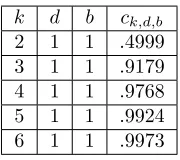
2 1 1 .4999 3 1 1 .9179 4 1 1 .9768 5 1 1 .9924 6 1 1 .9973
Table 3: The threshold for 1-out-of-k orientability in random hypergraphs. If
mis the number of elements, andnis the number of buckets, a random hashing scheme that hashes each element intodout ofkbuckets, where each bucket has sizebwill succeed with probability approaching one if and only ifm/n < ck,d,b.
![Table 1: This table shows the communication cost of a single OPRF evaluation,and the minimum number of elements for which replacing the OPRF-basedcomparison of the stash in [KKRT16] would be improved by switching to ourprotocol.The AES Obliv-C and AES EMP](https://thumb-us.123doks.com/thumbv2/123dok_us/7984772.1324730/23.612.167.444.227.352/communication-evaluation-elements-replacing-basedcomparison-improved-switching-ourprotocol.webp)
![Table 5: Comparing the number of AND gates per element using the best (“It-erative Combined”) scheme of [PSWW18]](https://thumb-us.123doks.com/thumbv2/123dok_us/7984772.1324730/39.612.193.418.123.233/table-comparing-number-gates-element-erative-combined-scheme.webp)
![Table 6: The total communication cost in mb of our MPC-friendly protocol com-pared to the concurrent MPC-friendly works of [PSWW18] and [CO18] as wellprotocols are orders of magnitude more communication intensive than those thatreveal the intersection in t](https://thumb-us.123doks.com/thumbv2/123dok_us/7984772.1324730/40.612.167.445.305.380/communication-concurrent-wellprotocols-magnitude-communication-intensive-thatreveal-intersection.webp)
