900
Survey on Context Aware Architecture
Miss. Pooja Kimatram Khatri
Dept. Of Computer Science and Engineering Anuradha Engineering College
Chikhli, Maharashtra. [email protected]
Prof. Kishor H. Walse
Dept. Of Computer Science and Engineering Anuradha Engineering College
Chikhli, Maharashtra. [email protected]
Abstract:-
The main characteristic of devices during a pervasive (or ubiquitous) ADP system is their context awareness that permits them to supply proactively tailored services to user and to applications consistent with the world context. So as to support the event and to ease the implementation of context-aware systems, several architectures were projected with characteristics associated with the applying domain and techniques used. A survey of such architectures that makes comparison between them and evaluates them is powerfully suggested. Projected surveys are either restricted to a restricted variety of architectures or don't provide an honest comparison or their analysis isn't supported applicable criteria that keep them as easy descriptions. Our aim is to create a survey of relevant architectures that mark the evolution of context-aware systems supported criteria associated with pervasive computing. This survey can function a guide to developers of context-aware systems and facilitate them to create subject selections.
Keywords: architecture, pervasive computing, context-awareness.
1. Introduction
:-
Pervasive computing aims to supply proactively custom-made services to each user and applications per the world context. The most characteristic of devices in such system is their context awareness. Since its apparition, pervasive computing has needed tools (architectures, frameworks and middleware), ways and ideas to support the development of a context-aware system and ease their style and implementation. System design is made early within the development method and permits the creation of a high level style of the system that takes into consideration the fulfillment of requirements’ implementation. The design style is a very important step within the development of context-aware systems. Several researchers have projected many architectures, frameworks and middleware for context-aware systems with particularities associated with the appliance domain and techniques used. to guage these projected architectures, several surveys were done
however they failed to cowl all architectures that mark the evolution of pervasive computing.
They did not offer a solid comparison or evaluation and instead are simple descriptions. Even if they exist (in limited number of surveys), these surveys were not based on criteria related to pervasive computing particularities. Our aim, therefore, is to make a survey of relevant architectures that mark the evolution of context-aware systems beginning from localization-aware systems up to present context- aware systems. This survey presents a comparison and evaluation of architectures on various criteria which are considered important for pervasive computing such as: context abstraction level, communication model, reasoning system, extensibility and reusability. Our objective is to come up with a survey that will serve as a guide to developers and architecture designers of context- aware systems in a pervasive computing environment. The rest of this paper is organized as follows, in section 2. We review some previous surveys done until now on context-aware architectures and show their weaknesses
2.
Related work:-
901 to create an analysis of them that renders their survey as an
easy description. Wingrad [4] did a particular survey on structure models of architectures relative to context-aware human-computer interaction that isn't generic enough and unbroken his survey specific thereto domain. Finally Henrikson et al. [5] did a short survey as a vicinity of their work on 5 architectures that looks to North American nation the foremost attention-grabbing one. It makes a comparison of designs per criteria associated with pervasive computing however this survey doesn't cowl different architectures that mark the evolution of context-aware system architecture. The criteria used for comparison ar rather minded on distributed systems even supposing most of them ar basic for pervasive computing.
3.
Evaluation criteria
A pervasive surroundings has some specific characteristics that ought to be taken under consideration once evaluating context-aware architectures. During this survey, we'll create associate degree analysis of those architectures supported some criteria that we tend to think about relevant for pervasive computing. These criteria are: a) level of context abstraction, b) communication model, c) reasoning system, d) extensibility and e) reusability. we've got chosen these criteria attributable to the subsequent reasons:
• Pervasive system uses sensors of various types to understand discourse data. Computer code design should hide the complexness of the physical devices by providing a higher level of abstraction that makes it freelance of physical sensor and enhances the reusability of design elements.
• Pervasive system consists of proactive devices that adapt to this context while not a precise intervention from the user. this needs that devices imbed a reasoning mechanism so as to require initiatives for an accurate adaptation.
• Devices should be autonomous, freelance from one another and might be simply connected. The peer-to-peer communication model appears the foremost acceptable for a pervasive system. It offers a straightforward thanks to tie devices and also the network are often discovered for a really modest investment and permits a straightforward sharing of discourse data among devices. It will want neither an ardent material (server) nor computer code (operating system, information base management system, etc.)
• A pervasive system is characterised by its speedily dynamic surroundings attributable to mobility; thus devices are often other or removed dynamically while not poignant the whole operation of the world system (hardware extensibility). • Pervasive computing is a new domain of computing. Its design ought to give reusable elements so as to ease their integration and cut back development effort.
4.
Context Aware Architecture
4.1 Active Bridge
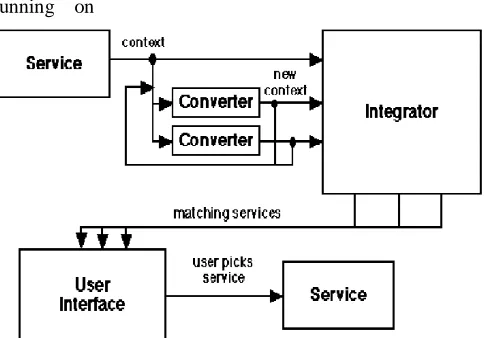
The Active Badge project [6] developed by Olivetti analysis Ltd. aims to designed a system for phone calls delivery in line with the referred to as person’s localization. It permits the transport of telephone call to the phone nearest to the referred to as person. The system uses badges that incessantly emit infra-red signals at a given frequency. These badges area unit carried by personnel of associate enterprise and every badge contains the carrier identification. The signals emitted by these badges area unit perceived by some receivers distributed within the whole construction. The perceived signals area unit then sent to a server. The latter presents to a secretarial assistant the knowledge concerning badges carriers and their localization. This data helps the secretarial assistant to deliver a decision to the place nearest to the referred to as person (this task will be done automatically). The active badge is predicated on a distributed design of sensors. The superimposed design (figure 1) of Associate in Nursing application running on the server consists of the subsequent four layers:
• The network controller that supervises the operation of the detector network.
• The data presentation that is accountable for knowledge management and management of localization data.
• The knowledge process that selects the fascinating data at the time of localization variation.
• The user interface to show the matter data regarding badges variation position.
workstation in a very native space network. This prevents Parctabs from creating plenty of process that consumes their restricted resources. The communication system is predicated on the remote procedure decision (RPC) between ParcTabs and applications running on {a local|an space|a neighborhood} area network digital computer. This infrastructure permits the event of context-aware systems specifically those localization-aware. {for example|for instance|as Associate in Nursing example} we are able to cite Associate in Nursing incoming e-mail notification to a user supported his location and of close folks by displaying the e- mail text on the parcTab displayer or by a straightforward beep (filters are often accustomed advise users for under emergency cases once the user is attending an assembly or a conference). The authors contemplate several others context-aware applications supported this infrastructure like remote program management, aided collaboration, data and resources access per the context, etc. The ParcTab could be a primitive localization-aware system supported hardware infrastructure just like the Active Badge. The software system design is incredibly addicted to hardware and doesn't offer a decent abstraction of discourse data.
context-902 aware system with numerous computer code elements. it's
specific to localization systems and can't be simply used for alternative reasonably context-aware systems. Finally it doesn't build any abstraction of discourse info (localization info during this case) that makes it terribly dependent to the hardware infrastructure.
4.2 ParcTab
The Xerox project ParcTab [7] may be a material infrastructure that enhances the event of applications aware to localization context (person location, encompassing devices, close individuals, etc.). The parcTab may be a personal digital assistant (PDA) carried by the user and operates as a graphical terminal. It uses infra-red communication with a transmitter Associate in Nursing exceedingly|in a very} area of Associate in Nursing building that communicates with space|a neighborhood} area network via an RS- 232 affiliation (figure 2). for every ParcTab there's a corresponding computer code agent that controls its communication with applications running on
Figure 1: The ParcTab infrastructure
4.3 Stick-e-notes
The stick-e-notes project [8] may be a framework to support the development of context-aware application wherever localization is the basic element of context. During this system the most element may be a personal digital assistant (PDA) connected to a localization detector (GPS or Active Badge). The personal organizer could communicate with each other relying on the application. The plan behind the stick-e-notes comes from stick notes wont to prompt user regarding one thing (or to in brief describe something) and stuck on a door, a device, etc. during this case, the notes ar electronic and not hand written. Notes ar written by the user and ar hooked up to a particular context (example localization) and saved on his personal organizer. The electronic notes ar mechanically triggered (displayed by the PDA) whenever identical context seems within the future. For example: the user attaches an
outline of a deposit once he visited one, anytime the user enter identical deposit, the outline note are displayed on his electronic device. Notes are also of various formats like text, HTMl, sound, video, a program to execute, etc. The authors outlined four software package parts for the architecture: • SEPREPARE: allows the user to organize notes.
• SEMANAGE: permits the management of notes • SETRIGGER: allows notes triggering whenever similar context seems.
• SESHOW: allows the show of triggered notes and their storage Notes ar written in SGML language for simple data exchange. The stick-e-notes use a restricted set of discourse data (those associated with localization) ar hardware dependent (dedicated material) and don't offer a big improvement of context abstraction as compared with previous systems.
4.4 Cyberguide and Guide
The cyberguide project [9] equips user with a private electronic traveller guide tuned in to its context (localization, orientation, etc.). The hardware infrastructure consists of a collection of non-public digital assistants (PDA) connected to some world positioning systems (GPS) to observe a tourist’s position. These PDAs will communicate in infra-red among them or with an {area|a neighborhood} area network. the target is to guide a traveller in his visit by providing him with fascinating sites to go to supported his actual location, methods to follow and some helpful data reckoning on his current position. The cyberguide design consists of the subsequent elements:
• associate degree electronic geographical card of the physical surroundings visited by the traveller with a special illustration of exceptional objects (towers, park, museum, etc.) • A browser that allows the detection of the traveller’s current location so as to supply him with data associated with the encompassing surroundings.
• A traveller that provides a message delivery service to the tourist to send request, suggestion, communication with alternative tourists and to receive broadcasted messages Another project known as GUIDE [10] was planned with identical objectives because the cyberguide. For us, it looks that the 2 comes ar terribly similar with minor variations within the hardware used and internet access. These 2 comes ar specific to localization systems, they are doing not interpret discourse data (to come back up with a better level of abstraction), ar terribly dependent to the hardware used associate degreed don't provide an protractile and reusable software package design.
4.5 CASS
903 model for context description. The design (figure 3) relies
on a server containing a info of discourse info ANd a cognitive content with an reasoning engine to infer alternative discourse info employing a back chaining mechanism. The mobile devices square measure equipped with numerous sensors to understand context variation and send them to the server while not native process. Mobile devices and also the server communicate via wireless mode. The server additionally contains a module for context interpretation that gives it with the next level of abstraction. The design provides an honest modularity that enables straightforward modification of server parts above all the reasoning engine. The mobile devices don't build any process (all is finished by the server) that limits the autonomy required for pervasive systems however enhances the extensibility of the system (adding or removing devices need solely the configuration of the server). CASS additionally provides an honest abstraction of context thanks to its interpretation module and a reasoning mechanism that makes it additional proactive but the centralized design is its weakness (if the server is down all the system are going to be affected and becomes non operational).
Figure 2: The CASS design
4.6 CORTEX
Biegel et al. [12] projected the CORTEX framework to ease the event of context-aware mobile applications. The design relies on the “sentient object” that has some helpful characteristics for pervasive computing surroundings such as: • Sensitivity: the potential of perceiving the state of the encircling atmosphere by exploitation sensors.
• Autonomy: the capability of operative severally of human management in a very distributed manner.
• Proactivity: take initiatives to attain a goal the sentient object contains 2 interfaces:
• Detector of events perceived by sensors (sensor or consumer)
• Event emission to adapt to the current context (actuator or producer) The core design (figure 4) consists of:
• A module for fusion and interpretation of discourse info so as to extend their level of abstraction.
• A module for a hierarchical illustration of context so as to limit the particular scenario context then limit the set of attainable actions
• Associate in Nursing illation engine that specifies the applications behavior to a given context and uses the execution model event-condition- action The communication between sentient objects, sensors and actuators that compose the system uses the mechanism primarily based on events that square measure established dynamically throughout the system operation. This design presents several blessings as earlier declared however remains an advertisement hoc answer for a mobile network. The illation engine written in CLIPS language needs qualified personal to make, modify or adapt it to Associate in Nursing alternative application that limit its usability. The invention mechanism isn't well elaborated by authors and doesn't permit a measure of the extensibility of the design. Also, the model of context used doesn't offer a whole set of discourse info required for adaptation task.
4.7 Context management framework
The CMF (context management framework) [13] permits linguistics reasoning on context in real time and even within the presence of noise, doubt and speedy variation of context. It delivers discourse info to applications by exploitation a communication model supported events. The framework proposes a client/server (figure 5) design composed of the subsequent basic components:
• Context manager: accountable for the storage of discourse info on server and also the delivery of context to shoppers exploitation completely different sorts of mechanisms (request/response, subscription/notification, etc.) • Resource server: accountable for the acquisition of discourse info from physical sensors and their interpretation according to a specific format before causation them to the context manager • Context recognition service: to blame for the conversion of {the data|the info|the info} stream to a presentation outlined within the context metaphysics
• Amendment detection service: accountable for the detection of service amendment and thus the context amendment • Security: accountable for the verification and management of discourse information The CMF uses metaphysics for context illustration however doesn't provide a context reasoning module. It contains a decent mechanism for context interpretation that provides a decent abstraction of context and enhances the reusability additionally to a module for context security. It uses a server for context management (centralized system) that is that the main downside since, once the server is down all the system are going to be affected and renders the devices less autonomous that are some things not fascinating in a very pervasive ADP system.
4.8 JCAF
904 applications. The JCAF design consists of a group of elements
referred to as “context service” communication in an exceedingly peer-to-peer mode. These elements square measure to blame for assembling context info in an exceedingly specific surroundings (room, hospital, laboratory, etc.). A context service contains four modules as follows
Figure 3: Context Service Modules.
• Entity container: accountable for context exchange with context purchasers by employing a communication mechanism supported events (subscription/notification). It conjointly contains one or additional entities that describe the context of Associate in Nursing surroundings object (person, computer, doctor, patient, etc.).
• Electrical device repository: provides essentially 2 operations: context aggregation Associate in Nursingd translation between styles of context.
• Surroundings entity: permits communication between entities and management access to shared resources. • Access control: controls access to the entity via correct authentication of client’s question to access entity context. • Entity listener: it will be an entity of another context service and might access the entity context of a context service either by the request/response theme or the subscription/notification theme. It’s attainable to use the subscription/notification theme in keeping with the kind of context.
• Context monitor: permits the acquisition of context via sensing elements and makes transformation of crude context. • Context actuator: permits commanding the actuators of the physical surroundings The JCAF conjointly control the discourse info (trust on the data detected by a specific sensor, error chance of knowledge perceived by a sensing element, etc.). The remote communication between the design elements is completed victimisation java RMI (remote methodology invocation). The context service doesn't have Associate in Nursing automatic discovery mechanism however will use a configuration file containing all others active context services. The JCAF doesn't have a context reasoning mechanism and doesn't offer a decent abstraction of context as a result of there's no part that produces context interpretation in a definite manner. the dearth of Associate in Nursing automatic discovery mechanism limits its extensibility however the
JCAF offers reusable and moveable modules due to its use of java language.
4.9 Context toolkit
The context toolkit [15] was planned as a tool to assist the developers of context-aware systems. It’s a bedded design that allows the separation of context acquisition, illustration and adaptation method. It’s supported context widgets that operate equally to graphical program widgets so as to cover the complexness of physical sensors. These widgets supply a decent abstraction of context and supply reusable blocs for context sensing. The design (figure 7) consists of the subsequent elements: • Sensor: sensing of physical context. • Widgets: change the encapsulation of discourse info offer|and supply} ways to access them within the same manner as graphical widgets • Interpreters: build context transformation so as to provide a higher level of abstraction of context • Aggregator: makes context grouping per a topic or a scenario.
• Discoverer: maintains a register of existing capabilities within the framework (presently accessible components to be used by applications).
• Service: executes actions for applications This design is simple to implement, offers a distributed communication among system devices and reusable widgets however the invention mechanism is centralized that doesn't build it an ideal peer-to- peer communication model. It has a restricted extensibility once the amount of devices will increase. The design takes into consideration events (to apprize context variation) by employing a thread for every event that overloads the system and affects its performance. The design will not contain a layer or a module for context reasoning as a result of the model used for context illustration (key/value) doesn't allow a decent reasoning.
4.10 Atomic numbers 1
905 an honest abstraction of context and limits the reusability of
such part. Also, it makes it terribly dependent to sensors. The design doesn't contain a reasoning module on context to ease the variation task.
4.11SOCAM
SOCAM [17] is associate degree design of a service headed context-aware middleware for building associate degreed speedy prototyping of context-aware mobile services in an intelligent automotive. The design consists of the subsequent components: context supplier, context interpreter, (context information and context reasoner), service locating service, context- aware mobile service and context information. The design uses the client/server model wherever the context interpreter collects discourse info from context suppliers (internal or external) and context information and provides them to the context- aware mobile services and also the service locating service. The most strength of the SOCAM design is its context thinker that uses metaphysics for context description and permits a strong reasoning on context. It uses 2 categories of ontologies: domain specific and generalized ontologies. many reasoning systems will be incorporated within the context interpreter to support a range of reasoning tasks. The design was projected to support the event of alittle non distributed application (intelligent car) that limits its use during a wide selection of pervasive computing applications. The context interpreter is full with a very important quality of data (ontologies of various domains) that affects the world performance of the system however enhances its reusability, additionally to the most important downside of a centralized design that contradicts the nature of a pervasive system that is a distributed one with autonomous devices.
4.12CoBrA
CoBrA [18] is a design supported broke Agent to support the event of context-aware applications in AN intelligent house. The broker is AN autonomous agent that manages and controls the context model of a selected domain. It runs on a fervent laptop (server) with powerful resources. The broker agent encompasses a bedded design containing the subsequent components: context information, context ratiocinator engine, context acquisition module and privacy management module. The broker agent collects context from devices, alternative agents and sensors of its close surroundings and makes their fusion in a very coherent model which is able to be shared among devices and their corresponding agents. elapid uses metaphysics for context description that permits a decent reasoning and a far better sharing of discourse data. It uses a centralized model for the storage and also the process of context so as to avoid wasting the restricted resources of mobile devices and uses a confidentiality policy for the user. The design needs a fervent server for the broker that will
increase its price and limits its usability additionally to the matter of a centralized design.
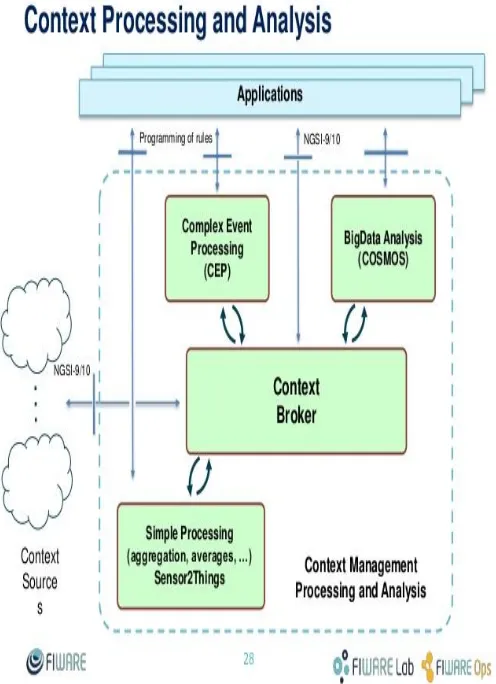
906 Figure 4: Context processing and analysis.
5.
DISCUSSIONS
Except for primitive localization-aware system design, most of the planned architectures build distinction between context sensing processes from its use. this allows Associate in Nursing abstraction of low level sensing details and will increase the extensibility and reusability of design parts. Among planned design, there ar 2 approaches betting on whether or not discourse data ar centralized or distributed. Most of those architectures ar bedded and composed of the subsequent components: • Sensor: physical sensing of discourse data. • Interpretation: transformation of crude data into a additional vital and helpful data. Aspect wasn't deeply mentioned in most architectures and desires additional attention in future systems. Subject field style of context aware systems wants additional efforts so as to supply Associate in nursing applicable design that suits pervasive system necessities. The table below summarizes characteristics of surveyed architectures (table1).
Table 1: Characteristics of Architecture.
6. CONCLUSION
907 for future systems. This survey aim is to serve as a guide to
offer a useful recommendation to developers and designers of context-aware systems and help them decide on available architectural choice.
REFERENCES
[1] M. Baldauf, S. Dustdar, F. Rosenberg, "A Survey On Context-Aware Systems", International Journal of Ad Hoc and Ubiquitous Computing, 2(4), 63-277, Inderscience Publishers, 2007.
[2] K.E. Kjær, "A Survey of Context-Aware Middleware", Proceedings of the IASTED software engineering conference, 2007.
[3] A. Singh, M. Conway, "Survey of Context aware Frameworks – Analysis and Criticism", UNC-Chapel Hill ITS Version: 1, 2006.
[4] T. Winograd, "Architectures for Context", in Human-Computer Interaction Journal, 16:2-3, Special Issue on Context Aware Computing, 2001.
[5]K. Henricksen, J. Indulska, T. McFadden, S. Balasubramaniam, "Middleware for Distributed Context-Aware Systems", OTM Conferences, pp. 846-863, 2005.
[6] R. Want, A. Hopper, V. Falcao, and J. Gibbons, "The Active Badge Location System", ACM Transcation onInformation Systems 10 (1), pp. 42-47, 1992.
[7] R. Want, B. N. Schilit, N. I. Adams, R. Gold, K. Petersen, D. Goldberg, J. R. Ellis and M. Weiser, "An overview of the ParcTab ubiquitous computing experiment", IEEE Personal Communications, vol. 2, n. 6, pp. 28–43, December 1995.
[8] J. Pascoe, "The Stick-e Note Architecture: Extending the Interface Beyond the User", In Proceedings of International Conference on Intelligent User Interfaces. pp. 261-264, 1997.
[9] G. Abowd, C. Atkeson, .J Hong, S. Long, R. Kooper, and M. Pinkerton, "Cyberguide: A mobile context-aware tour guide" CHI'96 Short paper, 1997.
[10] K. Cheverest, D. Nigel, M. Keith, F. Adrian, E.Christos, "Developing a Context-aware Electronic Tourist Guide: Some Issues and Experiences", CHI Letters, Volume 2, Issue No. 1, 2000.
[11] P. Fahy, S. Clarke, "CASS – a middleware for mobile context-aware applications", Workshop on Context-Awareness, MobiSys 2004.
[12] G. Biegel, V. Cahill, "A framework for developing mobile, context-aware applications", Proceedings of the 2nd IEEE Conference on Pervasive Computing and Communication, pp.361– 365, 2004.
[13] P. Korpipää, J. Mantyjarvi, J. Kela, H. Keranen, E-J. Malm, "Managing context information in mobile devices", IEEE Pervasive Computing, Vol. 2, No. 3, July–September, pp.42–51, 2003.
[14] J. E. Bardram, "The Java Context Awareness Framework (JCAF) – A Service Infrastructure and Programming Framework for Context-Aware Applications", In Hans Gellersen, Roy Want, and Albrecht Schmidt, editors, Proceedings of the 3rd International Conference on Pervasive Computing (Pervasive 2005), volume 3468 of Lecture Notes in Computer Science, pages 98–115, Munich, Germany, May 2005. Springer Verlag.