ISSN(Online): 2319-8753 ISSN (Print): 2347-6710
I
nternational
J
ournal of
I
nnovative
R
esearch in
S
cience,
E
ngineering and
T
echnology
(A High Impact Factor, Monthly, Peer Reviewed Journal) Visit: www.ijirset.com
Vol. 8, Issue 9, September 2019
Home Security and Automation Using
Internet of Things
Jaya Dewangan, Ajay Kushwaha
M. Tech Student, Department of CSE, RCET, Bhilai, India
Associate Professor, Department of CSE, RCET, Bhilai, India
ABSTRACT: With headway of Automation innovation, life is getting less complex and simpler in all perspectives. In this day and age Automatic frameworks are being favored over manual framework. With the fast increment in the quantity of clients of web over the previous decade has made Internet an integral part of life, and IoT is the most recent and developing web innovation. Web of things is a developing system of ordinary article from modern machine to buyer products that can share data and complete undertakings while you are occupied with different exercises. Remote Home Automation system utilizing IoT is a framework that utilizations PCs or cell phones to control fundamental home capacities and highlights naturally through web from anyplace around the globe, a mechanized home is once in a while called a keen home. It is intended to spare the electric power and human vitality. The home computerization framework contrasts from other framework by enabling the client to work the framework from anyplace around the globe through web association.
In this paper we present a Home Automation system (HAS) utilizing Arduino that utilizes the coordination of cloud organizing, remote correspondence, to give the client remote control of different lights, fingerprint based door lock and apparatuses inside their home and putting away the information in the cloud. The framework will consequently change based on sensors' information. This framework is intended to be minimal effort and expandable enabling an assortment of gadgets to be controlled.
KEYWORDS: Home automation System (HAS), Internet of Things (IoT), Cloud networking, Wi-Fi network, Arduino, ESP8266, DHT11, R307.
I. INTRODUCTION
1.1 Overview:
Homes of the 21st century will turn out to be increasingly more self-controlled and robotized because of the solace it gives, particularly when utilized in a private home. A home automation framework is implies that enable clients to control electric apparatuses of fluctuating kind.
Many existing, settled home computerization frameworks depend on wired correspondence. This does not represent an issue until the framework is arranged well ahead of time and introduced during the physical development of the structure. Yet, for officially existing structures the usage cost goes exceptionally high.
ISSN(Online): 2319-8753 ISSN (Print): 2347-6710
I
nternational
J
ournal of
I
nnovative
R
esearch in
S
cience,
E
ngineering and
T
echnology
(A High Impact Factor, Monthly, Peer Reviewed Journal) Visit: www.ijirset.com
Vol. 8, Issue 9, September 2019
1.2 Advantages of Home automation systems:
As of late, remote frameworks like Wi-Fi have turned out to be increasingly more typical in home systems administration. Additionally in home and building mechanization frameworks, the utilization of remote advancements gives a few focal points that couldn't be accomplished utilizing a wired system as it were.
1) Reduced establishment costs: First and chief, establishment expenses are essentially decreased since no cabling is important. Wired arrangements require cabling, where material just as the expert laying of links (for example into dividers) is costly.
2) System versatility and simple expansion: Deploying a remote system is particularly worthwhile when, because of new or changed prerequisites, augmentation of the system is fundamental. Rather than wired establishments, in which cabling augmentation is dull. This makes remote establishments an original venture.
3) Aesthetical advantages: Apart from covering a bigger region, this ascribes fulfill aesthetical necessities too. Models incorporate delegate structures with all-glass engineering and chronicled structures where plan or studio reasons don't permit laying of links.
4) Integration of cell phones: With remote systems, partner cell phones, for example, PDAs and Smart phones with the automation framework winds up conceivable all over and whenever, as a gadget's careful physical area is never again significant for an association (as long as the gadget is in reach of the system).
For every one of these reasons, remote innovation isn't just an appealing decision in remodel and restoration, yet additionally for new establishments.
II. LITERATURE SURVEY
Sirsath N. S, Dhole P. S. et al.[1] proposed a Home Automation system that employs the integration of multi-touch mobile devices, cloud networking, wireless communication, and power-line communication to provide the user with remote control of various lights and appliances within their home. This system uses a consolidation of a mobile phone application, handheld wireless remote, and PC based program to provide a means of user interface to the consumer.
ISSN(Online): 2319-8753 ISSN (Print): 2347-6710
I
nternational
J
ournal of
I
nnovative
R
esearch in
S
cience,
E
ngineering and
T
echnology
(A High Impact Factor, Monthly, Peer Reviewed Journal) Visit: www.ijirset.com
Vol. 8, Issue 9, September 2019
structure of the system is described and the incorporated communications are analyzed, also an estimation for the whole system cost is given which is something lacking in a lot of other smart home designs offers. WB-SH is designed to be capable of incorporating in a building automation system and it can be applied to offices, clinics, and other places. The paper ends with an imagination for the future of the smart home when employs the biometric technology in a larger and more comprehensive form.
III. PROBLEM IDENTIFICATION
3.1 Problem Definition
Home automation frameworks face four primary difficulties; these are mind-boiling expense of proprietorship, firmness, poor sensibility, and trouble in accomplishing security. The fundamental destinations of this examination is to plan and execute a home automation framework utilizing IoT that is fit for controlling and mechanizing a large portion of the house apparatuses through a simple sensible web interface. The proposed framework has an incredible adaptability by utilizing Wi-Fi innovation to interconnect its appropriated sensors to home automation server. This will diminish the organization cost and will build the capacity of updating, and framework reconfiguration.
3.2 Proposed System Feature
The proposed framework is a disseminated home automation framework, comprises of server, sensors. Server controls and screens the different sensors, and can be effectively arranged to deal with more equipment interface module (sensors). The Arduino improvement board, with implicit WiFi card port to which the card is embedded, goes about as web server. Automation System can be gotten to from the internet browser of any neighborhood PC in a similar LAN utilizing server IP, or remotely from many PC or portable handheld gadget associated with the web with proper internet browser through server genuine IP (web IP). WiFi innovation is chosen to be the system foundation that interfaces server and the sensors. WiFi is picked to improve framework security (by utilizing secure WiFi association), and to expand framework portability and adaptability.
IV. PROPOSED METHODOLOGY
4.1Proposed Home Automation System:
1. The fingerprint sensor module is small, and nicely built and it uses some advanced DSP (Digital Signal
Processing) chips inside.
2. It is an optical sensor, which means it analyzes the photo of a finger. It then renders the image, makes some
calculations, finds the features of that finger and then searches in its memory for a fingerprint with the same characteristics. It can achieve all that in less than a second!
3. This module can store up to 1000 fingerprints in its memory and its false acceptance rate is less than
ISSN(Online): 2319-8753 ISSN (Print): 2347-6710
I
nternational
J
ournal of
I
nnovative
R
esearch in
S
cience,
E
ngineering and
T
echnology
(A High Impact Factor, Monthly, Peer Reviewed Journal) Visit: www.ijirset.com
Vol. 8, Issue 9, September 2019
Figure- 4.1: Proposed model of Home automation system
4. The ESP8266 SoC contains a fully functional WiFi Stack and TCP/IP Stack that allows any
ISSN(Online): 2319-8753 ISSN (Print): 2347-6710
I
nternational
J
ournal of
I
nnovative
R
esearch in
S
cience,
E
ngineering and
T
echnology
(A High Impact Factor, Monthly, Peer Reviewed Journal) Visit: www.ijirset.com
Vol. 8, Issue 9, September 2019
It has 5v Power supply for Arduino, Sensor and Motor Driver from AC mains.
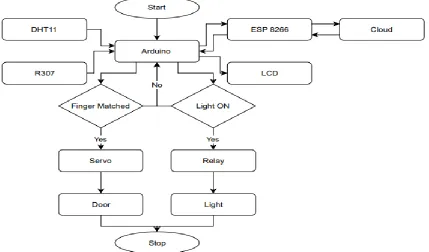
It read finger form R307 and opens door if it is valid. It sends data to cloud and show on LCD.
DHT11 Provides Temperature and Humidity value to Arduino to update on cloud and display on LCD.
Servo motor operated the door mechanism and controlled by Arduino.
ESP8266 connects with WiFi and provide link between hardware and cloud.
Figure 3: Experimental setup of HAS
V. RESULTS
ISSN(Online): 2319-8753 ISSN (Print): 2347-6710
I
nternational
J
ournal of
I
nnovative
R
esearch in
S
cience,
E
ngineering and
T
echnology
(A High Impact Factor, Monthly, Peer Reviewed Journal) Visit: www.ijirset.com
Vol. 8, Issue 9, September 2019
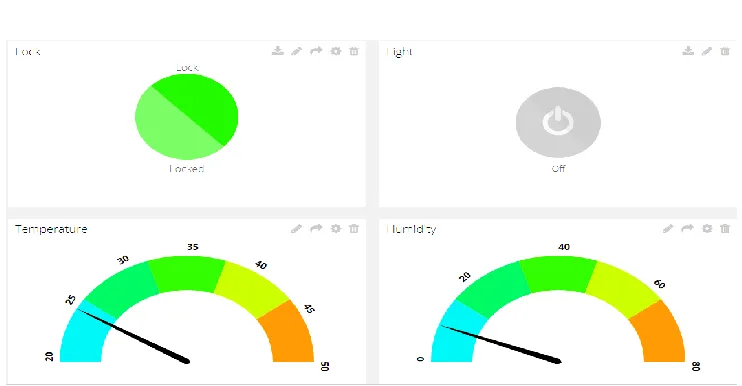
After the fruitful association with the server, the information of sensor are sent to the web server for observing of the framework. The figure 5.1 demonstrates the web server page which will enable us to screen and control the framework. By entering the relegated IP address in the internet browser this web server page will show up. The web server gives the data about the temperature in better places of the house and movement state in the house. It likewise gives the status of the different electrical machines like light ,Temp., Humidity and so on which we can control remotely.
Figure 5.2: Graph showing the different temperature value along with the threshold
All the required information is put away in the cloud. The put away information can be investigated at whenever and anyplace. The figure 5.2 demonstrates the temperature and humidity in degree Celsius put away at various time interims. And furthermore it demonstrates the condition of the movement indicator alongside the time. It additionally gives data about time of movement recognized and how frequently also. This data is put away in the cloud which can be checked by the client whenever away from home.
The diagram appeared in the figure 5.2 gives the investigation of the temperature and humidity at various time and edge level of the temperature. By observing the diagram we can come to know the adjustment in the temperature. Also, at what time the temperature was low/high. We can also realize that if temperature was over the edge level or not. whenever was above then at what time.
VI. CONCLUSION AND FUTURE WORK
6.1 Conclusion:
ISSN(Online): 2319-8753 ISSN (Print): 2347-6710
I
nternational
J
ournal of
I
nnovative
R
esearch in
S
cience,
E
ngineering and
T
echnology
(A High Impact Factor, Monthly, Peer Reviewed Journal) Visit: www.ijirset.com
Vol. 8, Issue 9, September 2019
ACKNOWLEDGEMENT
We acknowledge the efforts and hard work by the experts who have contributed towards development of the different home automation systems. We also acknowledge the efforts of Associated Professor Ajay Kushwaha Coordinator for their constant support, suggestions and modifications to improve the quality of the paper and to help prepare the paper.
REFERENCES
1. Sirsath N. S, Dhole P. S, Mohire N. P, Naik S. C & Ratnaparkhi N.S Department of Computer Engineering, 44, Vidyanagari, Parvati,
Pune-411009, India University of Pune, “Home Automation using Cloud Network and Mobile Devices”.
2. Deepali Javale, Mohd. Mohsin, Shreerang Nandanwar “Home Automation and Security System Using Android ADK” in International Journal of
Electronics Communication and Computer Technology (IJECCT) Volume 3 Issue 2 (March 2013).
3. Charith Perera, Student Member, IEEE, Arkady Zaslavsky, Member, IEEE, Peter Christen,and Dimitrios Georgakopoulos, Member, IEEE
“Context Aware Computing for The Internet of Things: A Survey”. IEEE COMMUNICATIONS SURVEYS & TUTORIAL.
4. Charith Perera_y, Arkady Zaslavskyy, Peter Christen_ and Dimitrios Georgakopoulosy Research School of Computer Science, The
Australian National University, Canberra, ACT 0200, Australia yCSIRO ICT Center, Canberra, ACT 2601, Australia ” CA4IOT: Context Awareness for Internet of Things”.
5. Bill N. Schilit, Norman Adams, and Roy Want, “Context-Aware Computing Applications”.
6. Jayavardhana Gubbi, ,Rajkumar Buyya, Slaven Marusic,a Marimuthu Palaniswamia, “Internet of Things (IoT): A Vision, Architectural
Elements, and Future Directions”.
7. S.P. Pande, Prof. Pravin Sen, “Review On: Home Automation System For Disabled People Using BCI” in IOSR Journal of Computer
Science (IOSR-JCE) e- ISSN: 2278-0661, p-ISSN: 2278-8727 PP 76-80.
8. Basil Hamed, “Design & Implementation of Smart House Control Using LabVIEW” at International Journal of Soft Computing and
Engineering (IJSCE) ISSN: 2231-2307, Volume-1, Issue-6, January 2012.
9. Basma M. Mohammad El-Basioni1, Sherine M. Abd El- kader2 and Mahmoud Abdelmonim Fakhreldin3, “Smart Home Design using
Wireless Sensor Network and Biometric Technologies” at Volume 2, Issue 3, March 2013.
10. Inderpreet Kaur, “Microcontroller Based Home Automation System With Security” at IJACSA) International Journal of Advanced Computer
Science and Applications, Vol. 1, No. 6, December 2010.
11. Rosslin John Robles and Tai-hoon Kim, “Review: Context Aware Tools for Smart Home Development”, International Journal of Smart
Home, Vol.4, No.1, January, 2010.
12. Hitendra Rawat, Ashish Kushwah, Khyati Asthana, Akanksha Shivhare, “LPG Gas Leakage Detection & Control System”, National
Conference on Synergetic Trends in engineering and Technology (STET-2014) International Journal of Engineering and Technical Research ISSN: 2321- 0869, Special Issue.
13. Nicholas D., Darrell B., Somsak S., “Home Automation using Cloud Network and Mobile Devices”, IEEE Southeastcon 2012, Proceedings
of IEEE.
14. Chan, M., Campo, E., Esteve, D., Fourniols, J.Y., “Smart homes-current features and future perspectives,” Maturitas, vol. 64, issue 2, pp.
90-97, 2009.
15. Das, S.R., Chita, S., Peterson, N., Shirazi, B.A., Bhadkamkar, M., “Home automation and security for mobile devices,” IEEE PERCOM
Workshops, pp. 141- 146, 2011.
16. S.D.T. Kelly, N.K. Suryadevara, S.C. Mukhopadhyay, “Towards the Implementation of IoT for Environmental Condition Monitoring in
Homes”, IEEE, Vol. 13, pp. 3846- 3853, 2013.
17. Rajeev Piyare “Internet of Things: Ubiquitous Home Control and Monitoring System using Android based Smart Phone” International
Journal of Internet of Things 2013, 2(1): 5-11DOI: 10.5923/j.ijit.20130201.02.
18. G. Kortuem, F. Kawsar, D. Fitton, and V. Sundramoorthy, "Smart objects as building blocks for the internet of things," Internet Computing, IEEE, vol. 14, pp. 44-51, 2010.
19. S. Hilton. (2012, 14 January). Progression from M2M to the Internet of Things: an introductory blog. Available:
http://blog.bosch-si.com/progression- from-m2m-to- internet-of-things-an-introductory- blog/.