ISSN(Online): 2319-8753 ISSN (Print): 2347-6710
I
nternational
J
ournal of
I
nnovative
R
esearch in
S
cience,
E
ngineering and
T
echnology
(A High Impact Factor, Monthly, Peer Reviewed Journal)
Visit: www.ijirset.com
Vol. 8, Issue 10, October 2019
A Study of Glass Transition Kinetics of
Te
15
(Se
100-x
Sb
x
)
85
Amorphous Alloys using
Differential Thermal Analysis
Kameshwar Kumar
Maharaja Lakshman Sen Memorial College, Sundernagar, H.P, India
ABSTRACT: A study of glass transition kinetics of Te15(Se100-xSbx)85amorphous semiconductors ( x= 0, 1, 2, 3 and 4
at. %) has been reported in this communication. The samples were prepared by quenching the melt process. Differential thermal analysis (DTA) has been used to carry out the study. DTA has been performed at different heating rates of 10, 15, 20 and 25 K/min. DTA thermo grams have been analysed for glass transition temperature (Tg). The Glass transition
temperature increases with increase in heating rate (β) and with increase in Sb content (x). Tghas also been found using
covalent bond approach (CBA) theoretically. The experimental and theoretical values of Tg both increases with Sb
addition. The activation energy of glass transition (Eg) has been calculated using the Kissinger and Moynihan
approaches. The activation energy of glass transition has been found to increase with Sb content. Egvalues calculated
using different methods are in good agreement with each other.
KEYWORDS: differential thermal analysis, phase transition, activation energy of glass transition, coordination
number.
I. INTRODUCTION
Amorphous alloys have great importance because of their technological applications like electrical switching [1]. Pure amorphous Se shows property of reversible phase transition [2-3]. Pure Se has short lifetime, low photo sensitivity and low thermal stability. Se has long polymeric chains and eight member rings [4]. These chains and rings are broken by adding Te making Se-Te alloys important because of advantages like higher photo sensitivity, lesser aging effects, higher crystallization temperature and greater hardness [5]. Se-Te has limited reversibility, low glass transition and crystallization temperatures [6].These problems can be overcome by adding third element to Se-Te host. Further the properties of Se-Te binary alloys can be varied by adding a third element like Bi, Sb, Cd and In etc. so that the new materials are tailor made for specific purposes. The glass transition temperature and the glass forming ability of Se-Te matrix can be increased by adding the third element [7-8]. It also produces compositional and configurational disorder in the system.
We have chosen Sb as the third element because it produces remarkable changes in the thermal and optical properties of the Se-Te amorphous glasses [9-10]. Sb addition causes a p to n transition in conductivity [11-12]. The Sb addition also increases the glass transition temperature indicating the hardening of Se-Te host. The study of kinetics of glass transition of ternary amorphous semiconductors can be carried out using isothermal and non-isothermal methods [13-14]. Non isothermal DTA study has been used for the glass transition kinetics of the samples because it is rapid and precise in manner [15].
In the present work the effect of Sb addition on the glass transition kinetics of Te15(Se100-xSbx)85(x = 0,1,2,3,4 at.%)
ISSN(Online): 2319-8753 ISSN (Print): 2347-6710
I
nternational
J
ournal of
I
nnovative
R
esearch in
S
cience,
E
ngineering and
T
echnology
(A High Impact Factor, Monthly, Peer Reviewed Journal)
Visit: www.ijirset.com
Vol. 8, Issue 10, October 2019
heating rate (β) and Sb content (x) from the DTA thermo grams. The activation energy of glass transition has been calculated using different approaches.
II.EXPERIMENTAL DETAILS
Amorphous bulk alloys of Te15(Se100-xSbx)85 (x = 0, 1, 2, 3 and 4 at%) were prepared by the melt quenching technique.
The constituent elements Se, Te and Sb of high purity (99.999%) were weighed according to their atomic percentages and were sealed in quartz ampoules evacuated at 10 -6 mPa. The sealed ampoules were kept inside a vertical furnace where the temperature was raised up to 1073 K at the heating rate of 3-4 K/min. The ampoules were heated at the highest temperature for 12 h. During this heating the ampoules were frequently rocked to make the melt homogenous. The quenching was done in ice cold water. The quenched samples were obtained by breaking the ampoules. The amorphous nature of the glasses was confirmed as there was no prominent peak in their X-ray diffraction spectra. The prepared glasses were grounded to make fine powder for DTA studies. The thermal behaviour of the samples was recorded using Shimadzu DTG-60 system. In each study approximately 20-25 mg bulk material was used. Four heating rates of 10, 15, 20 and 25 K/min were chosen for the present study to get glass transition temperature Tg.
III. RESULTS
A. Glass transition temperature and activation energy of glass transition:
Fig.1 shows X-ray diffract grams for Te15(Se100-xSbx)85 (x=2 at%) system. The amorphous nature is confirmed as there
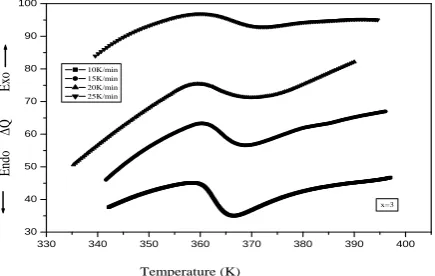
is no sharp peak in the X-ray diffraction spectra (XRD). The other samples also do not show any sharp peak in their XRD spectra.The DTA graphs of Te15(Se100-xSbx)85 for x = 3 at.% at different heating rates of 10, 15, 20 and 25 K/min
are shown in fig. 2. It is clear from the figure that glass transition temperature (Tg) increases with increase in heating
rate. The Tg is also found to increase with Sb content. The increase in the value of glass transition temperature (Tg) with
increase in Sb content can be explained to some extent with the help of chemically ordered network model (CONM), according to which the formation of hetro polar bonds is favoured over the homo polar bonds. When Sb is added, it is expected to form bonds with Se because the bond energy of Se (183.84 kJ/mol) is greater than bond energy of Sb-Te (159.55 kJ/mol) resulting in decrease of Se-Se bonds (184 kJ/mol) [16]. This explains the increase in Tgwith
increase in Sb content due to formation of large number of hetropolar Sb-Se bonds and decrease in homopolar Se-Se and Te-Te bonds. The increase in Tg can also be explained partly on the basis of the average coordination number <r>
given by [17]
c
b
a
CN
c
CN
b
CN
a
r
Te se Bi
(
)
(
)
(
)
(1)Where a, b and c are the at. % of Te, Se and Sb respectively and CNT e= 2, CNSe = 2 and CNSb = 3 are their respective
ISSN(Online): 2319-8753 ISSN (Print): 2347-6710
I
nternational
J
ournal of
I
nnovative
R
esearch in
S
cience,
E
ngineering and
T
echnology
(A High Impact Factor, Monthly, Peer Reviewed Journal)
Visit: www.ijirset.com
Vol. 8, Issue 10, October 2019
Fig. 1 X-ray diffraction spectra of Te15(Se100-xSbx)85 ( x =2 at.%) amorphous alloys.
Fig. 2 DTA thermo grams for Te15(Se100-xSbx)85 amorphous alloys for (x = 3 at%) at heating rates of 10, 15, 20, 25 K/min.
The glass transition temperature Tg was recorded from the DTA data and is listed in table1 for different heating rates. It
has been observed that Tg increases with heating rate and obeys the empirical relation [19]
ln
B
A
T
g
(2)where Aand B are constants. The increase in Tg with the heating rate is explained on the fact that when the heating
rate increases the system does not get sufficient time for nucleation and crystallization. The increase in Tgalso results in
increase in activation energy of glass transition and is in good agreement with Cofmenero et. al [18].
20 30 40 50 60 70 80 600
800 1000 1200 1400
1600 x=2
Intensit
y
(Ar
bit
ra
ry
Units
)
(degree)
330 340 350 360 370 380 390 400
30 40 50 60 70 80 90 100
Temperature (K)
Endo
Q
Ex
o
x=3 10K/min
ISSN(Online): 2319-8753 ISSN (Print): 2347-6710
I
nternational
J
ournal of
I
nnovative
R
esearch in
S
cience,
E
ngineering and
T
echnology
(A High Impact Factor, Monthly, Peer Reviewed Journal)
Visit: www.ijirset.com
Vol. 8, Issue 10, October 2019
Fig. 3 Plots of Tg vs ln(β) for Te15(Se100-xSbx)85 ( x = 0, 1, 2, 3 and 4 at.%) amorphous alloys.
Fig. 3 shows the variation of Tg with ln(β) for the glassy alloys. Tg is further found to increase with increase in Sb
content. Glass transition and structural relaxation theory developed by Moynihan and others [20-22] was used to analyse the kinetics of glass transition from the heating rate dependence of glass transition temperature. The activation energy of glass transition (Eg) has been calculated using Moynihan theory. The dependence of Tg on heating rate is
given by [21-22]
R
E
T
d
d
gg
)
1
(
)
(ln
(3)
2.2 2.4 2.6 2.8 3.0 3.2
358 360 362 364 366 368 370 372 374
x=0 x=1 x=2 x=3 x=4
Tg
(K
)
ln()
2.6 2.8 3.0 3.2
x=0 x=1 x=2 x=3 x=4
ln(
ISSN(Online): 2319-8753 ISSN (Print): 2347-6710
I
nternational
J
ournal of
I
nnovative
R
esearch in
S
cience,
E
ngineering and
T
echnology
(A High Impact Factor, Monthly, Peer Reviewed Journal)
Visit: www.ijirset.com
Vol. 8, Issue 10, October 2019
where R is gas constant.
Fig. 5 Plots of ln( Tg 2/β
) vs 1000/Tg for Te15(Se100-xSbx)85 ( x = 0, 1, 2, 3 and 4 at.%) amorphous alloys.
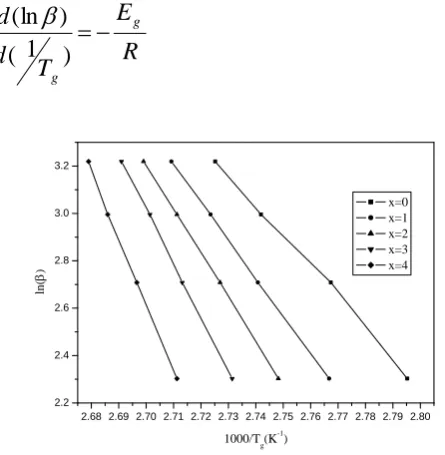
The plots of ln(β) vs 1000/Tg for all the samples are a straight line and are shown in Fig. 4. The activation energy of
glass transition is calculated from the slope of these plots. The activation energy is found to increase with Sb content. The activation energy of glass transition is also calculated from the Kissinger’s equation [23]
g g g
RT
E
constt
T
.
)
ln(
2
(4)The activation energy of glass transition was calculated from slope of ln(Tg2/β) vs 1000/Tg plots. The calculated values
of Eg are reported in table 1. The activation energy of glass transition is found to increase with Sb content (x) in both
approaches. The activation energy calculated from both the approaches is comparable which means that either of the two approaches can be used to calculate the activation energy of glass transition.
TABLE 1 Values of <r>, Eg (kJ/mol) (Moynihan), Eg (kJ/mol) (Kissinger) , theoretical (Tg ) and Tg from DTA for Te15(Se100-xSbx)85 ( x = 0, 1, 2,
3 and 4 at.%) glassy alloys at the heating rate of 10, 15, 20 and 25 K/min.
2.66 2.68 2.70 2.72 2.74 2.76 2.78 2.80
8.4 8.6 8.8 9.0 9.2 9.4 9.6
x=0 x=1 x=2 x=3 x=4
ln(T
g
2 /
)
1000/Tg(K-1)
x <r> Tg (K)
10K/min
Tg (K) 15K/min
Tg (K) 20K/min
Tg (K) 25K/min
Eg (kJ/mol)
(Moynihan)
Eg (kJ/mol)
(Kissinger)
Tg (K) (Theoretical)
0 2.000 357.75 361.35 364.71 366.95 107.25 101.26 298.6
1 2.008 361.43 364.86 367.17 369.11 132.77 126.71 300.1
2 2.017 363.87 366.71 368.84 370.5 154.81 148.65 301.4
ISSN(Online): 2319-8753 ISSN (Print): 2347-6710
I
nternational
J
ournal of
I
nnovative
R
esearch in
S
cience,
E
ngineering and
T
echnology
(A High Impact Factor, Monthly, Peer Reviewed Journal)
Visit: www.ijirset.com
Vol. 8, Issue 10, October 2019
B.Theoretical glass transition temperature and mean bond energy:
The glass transition temperature (Tg) is that characteristic temperature below which the glassy system frozes into a
structure which cannot change into another structure and is related to the magnitude of the cohesive forces in the system. Thus Tg is assumed to be proportional to system parameter which strongly depends on cohesive forces in the
system. One such parameter is mean bond energy <E>. Tichy and Ticha [24] illustrated an impressive relation of Tg
with <E> in the form
]
9
.
0
[
311
E
T
g (5)<E> is sum of mean bond energy per atom due to strong hetropolar bonds (Ec) and average bond energy per atom of
remaining matrix, the weak homopolar bonds (Erm). The bond energies of heteropolar bonds calculated from Pauling
relation are quite different from bond energies of weak homopolar bonds so chemically ordered networks are expected. Based on chemical bond ordering model the mean bond energy is given by
rm c
E
E
E
(6) For Se rich glass system, the values of Ec and Erm are given in [25]Sb Se Te
Se
c
aE
cE
E
2
3
(7)Se Se
rm
E
r
c
a
b
E
2
2
3
(8)where a, b and c are at. % of Te, Se and Sb respectively. The theoretically calculated glass transition temperature is reported in table 1.
IV. CONCLUSION
The glass transition temperature has been found to increase with heating rate and with Sb addition to Se-Te host. The activation energy of glass transition has been found to increase with Sb addition in both Kissinger and Moynihan approaches. The theoretically calculated glass transition temperature is also found to increase with Sb addition. The activation energy calculated from both the approaches is comparable with each other.
REFERENCES
1. S.R. Ovshinsky, “ Reversible electrical switching in disordered structures”, Phys. Rev. Lett., vol.21, p.1450, 1968.
2. J. Vazquez, D. Garcia-G. Barreda, P.L. Lopez-Alemany, P. Villares and R.Jimenez-Garay, “Crystallization of Ge0.08Sb0.15Se0.77 glass studied by
DSC”, J. Non-cryst. Solid., vol. 345, pp. 142-147, 2004.
3. G. Singh, J. Sharma, A. Thakur, N. Goyal, G.S.S Saini and S.K. Tripathi, “Preparation and characterization of Sn-Se nanocrystalline thin
films”, J. Optoelectron .Adv. Mater., vol. 7, pp. 2085-2090, 2005.
4. M.K. El-Mously and M.M. El-Mously, “Thermal and electrical conductivity during the devitrification of Te-Se amorphous alloys ”,vol. 21, pp.
265-271, 1968.
5. P. Sharma and S.C. Katyal, “Effect of tellurium addition on the physical properties of germanium selenide glassy semiconductors”, Physica B,
vol. 403, pp. 3667-3671, 2008.
6. A.W. Smith, “Injection laser writing on chalcogenide thin films”, Appl.Optics,vol. 13, pp.779-795, 1974.
ISSN(Online): 2319-8753 ISSN (Print): 2347-6710
I
nternational
J
ournal of
I
nnovative
R
esearch in
S
cience,
E
ngineering and
T
echnology
(A High Impact Factor, Monthly, Peer Reviewed Journal)
Visit: www.ijirset.com
Vol. 8, Issue 10, October 2019
15. E. Baiocch, M. Bettinelli, A. Montener. D. Sipio and A. Sotgiu, “Rigorous determination of kinetic parameters from DTA measurements”,
Journal of Materials Science, vol. 18, pp. 411–415, 1983
16. M. Saxena and P.K. Bhatnagar, “Crystallization study of Te-Bi-Se glasses”, Bull. Mater. Sci., vol. 26, pp.547-551, 2006.
17. J.Tauc, “Optical properties of solids”, Abeles (Ed.), North Holland, Amsterdam, (1972) p.227.
18. J. Cofmenero and J.M. Barandiaran, “Crystallization of Al23Te77 Glasses”, J. Non-cryst. Solid. vol. 30 pp. 263-271, 1979.
19. S. Mahadevan, A. Giridharand A.K. Singh, “Calorimetric measurements on As-Sb-Se glasses” J. Non-cryst. Solid., vol. 88, pp.11-34, 1986.
20. K. Kumar, N. Thakur, S.S. Bhatt and P. Sharma, Phil. Mag., vol. 90, pp. 3907-3917, 2010.
21. J.P. Larmagnac, J. Grenet and P. Michon, “Glass transition temperature dependence on heating rate and on ageing for amorphous selenium
films”, J. Non-cryst. Solid., vol. 45 pp.157-168, 1981.
22. C.T. Moynihan, A.J. Easteal, J. Wilder and J. Tucker, “Dependence of the glass transition temperature on heating and cooling rate”, J. Phys.
Chem. vol. 78, pp. 2673-2677, 1974.
23. H.E. Kissinger, “Variation of peak temperature with heating rate in Differential Thermal Analysis”, J. Res. Mat. Bur. Stand., vol. 57, pp.
217-221, 1956.
24. L.Tichy and H.Ticha, “Covalent bond approach to the glass-transition temperature of chalcogenide glasses”, J. Non-Cryst.Solid., vol. 189,
pp.141-146, 1995.
25. A. Sharmaand P.B. Barman, “Effect of Bi incorporation on the glass transition kinetics of Se85Te15 glassy alloy” Journal of Thermal Analysis