Differential Production Cross Section of
Z
Bosons as a Function of Transverse Momentum
at
p
p
p
s
5
1
.
8
TeV
B. Abbott,45 M. Abolins,42 V. Abramov,18 B. S. Acharya,11 I. Adam,44 D. L. Adams,54 M. Adams,28 S. Ahn,27 V. Akimov,16G. A. Alves,2N. Amos,41 E. W. Anderson,34M. M. Baarmand,47 V. V. Babintsev,18 L. Babukhadia,20 A. Baden,38B. Baldin,27S. Banerjee,11J. Bantly,51E. Barberis,21P. Baringer,35J. F. Bartlett,27A. Belyaev,17S. B. Beri,9 I. Bertram,19V. A. Bezzubov,18 P. C. Bhat,27V. Bhatnagar,9M. Bhattacharjee,47G. Blazey,29S. Blessing,25 P. Bloom,22
A. Boehnlein,27N. I. Bojko,18 F. Borcherding,27 C. Boswell,24A. Brandt,27 R. Breedon,22 G. Briskin,51 R. Brock,42 A. Bross,27D. Buchholz,30V. S. Burtovoi,18J. M. Butler,39W. Carvalho,3D. Casey,42Z. Casilum,47H. Castilla-Valdez,14
D. Chakraborty,47K. M. Chan,46S. V. Chekulaev,18 W. Chen,47D. K. Cho,46S. Choi,13S. Chopra,25 B. C. Choudhary,24 J. H. Christenson,27 M. Chung,28D. Claes,43 A. R. Clark,21W. G. Cobau,38 J. Cochran,24 L. Coney,32W. E. Cooper,27 D. Coppage,35C. Cretsinger,46 D. Cullen-Vidal,51 M. A. C. Cummings,29 D. Cutts,51O. I. Dahl,21 K. Davis,20 K. De,52
K. Del Signore,41 M. Demarteau,27 D. Denisov,27 S. P. Denisov,18 H. T. Diehl,27 M. Diesburg,27 G. Di Loreto,42 P. Draper,52Y. Ducros,8L. V. Dudko,17 S. R. Dugad,11 A. Dyshkant,18 D. Edmunds,42 J. Ellison,24 V. D. Elvira,47
R. Engelmann,47S. Eno,38 G. Eppley,54 P. Ermolov,17 O. V. Eroshin,18 J. Estrada,46 H. Evans,44V. N. Evdokimov,18 T. Fahland,23M. K. Fatyga,46S. Feher,27D. Fein,20T. Ferbel,46 H. E. Fisk,27Y. Fisyak,48E. Flattum,27 G. E. Forden,20
M. Fortner,29 K. C. Frame,42 S. Fuess,27 E. Gallas,27 A. N. Galyaev,18 P. Gartung,24 V. Gavrilov,16 T. L. Geld,42 R. J. Genik II,42 K. Genser,27C. E. Gerber,27 Y. Gershtein,51 B. Gibbard,48 G. Ginther,46 B. Gobbi,30 B. Gómez,5 G. Gómez,38P. I. Goncharov,18J. L. González Solís,14H. Gordon,48L. T. Goss,53K. Gounder,24A. Goussiou,47N. Graf,48
P. D. Grannis,47 D. R. Green,27 J. A. Green,34 H. Greenlee,27 S. Grinstein,1 P. Grudberg,21 S. Grünendahl,27 G. Guglielmo,50J. A. Guida,20J. M. Guida,51A. Gupta,11S. N. Gurzhiev,18G. Gutierrez,27P. Gutierrez,50N. J. Hadley,38
H. Haggerty,27S. Hagopian,25V. Hagopian,25 K. S. Hahn,46 R. E. Hall,23P. Hanlet,40S. Hansen,27J. M. Hauptman,34 C. Hays,44 C. Hebert,35 D. Hedin,29A. P. Heinson,24U. Heintz,39R. Hernández-Montoya,14T. Heuring,25 R. Hirosky,28
J. D. Hobbs,47 B. Hoeneisen,6 J. S. Hoftun,51 F. Hsieh,41 Tong Hu,31 A. S. Ito,27 S. A. Jerger,42 R. Jesik,31 T. Joffe-Minor,30 K. Johns,20 M. Johnson,27 A. Jonckheere,27 M. Jones,26 H. Jöstlein,27 S. Y. Jun,30 S. Kahn,48 D. Karmanov,17D. Karmgard,25 R. Kehoe,32S. K. Kim,13B. Klima,27 C. Klopfenstein,22 B. Knuteson,21 W. Ko,22
J. M. Kohli,9D. Koltick,33 A. V. Kostritskiy,18 J. Kotcher,48 A. V. Kotwal,44 A. V. Kozelov,18E. A. Kozlovsky,18 J. Krane,34 M. R. Krishnaswamy,11 S. Krzywdzinski,27 M. Kubantsev,36 S. Kuleshov,16 Y. Kulik,47 S. Kunori,38
F. Landry,42G. Landsberg,51 A. Leflat,17J. Li,52Q. Z. Li,27 J. G. R. Lima,3D. Lincoln,27S. L. Linn,25 J. Linnemann,42 R. Lipton,27 J. G. Lu,4 A. Lucotte,47 L. Lueking,27 A. K. A. Maciel,29 R. J. Madaras,21 R. Madden,25
L. Magaña-Mendoza,14 V. Manankov,17 S. Mani,22 H. S. Mao,4R. Markeloff,29 T. Marshall,31 M. I. Martin,27 R. D. Martin,28 K. M. Mauritz,34 B. May,30 A. A. Mayorov,18 R. McCarthy,47 J. McDonald,25 T. McKibben,28 J. McKinley,42T. McMahon,49H. L. Melanson,27 M. Merkin,17K. W. Merritt,27C. Miao,51H. Miettinen,54A. Mincer,45 C. S. Mishra,27N. Mokhov,27N. K. Mondal,11H. E. Montgomery,27M. Mostafa,1H. da Motta,2F. Nang,20M. Narain,39 V. S. Narasimham,11 A. Narayanan,20H. A. Neal,41J. P. Negret,5P. Nemethy,45 D. Norman,53 L. Oesch,41 V. Oguri,3
N. Oshima,27D. Owen,42P. Padley,54 A. Para,27 N. Parashar,40 Y. M. Park,12R. Partridge,51N. Parua,7M. Paterno,46 B. Pawlik,15 J. Perkins,52 M. Peters,26 R. Piegaia,1 H. Piekarz,25 Y. Pischalnikov,33B. G. Pope,42 H. B. Prosper,25
S. Protopopescu,48 J. Qian,41 P. Z. Quintas,27 R. Raja,27S. Rajagopalan,48 O. Ramirez,28 N. W. Reay,36S. Reucroft,40 M. Rijssenbeek,47 T. Rockwell,42 M. Roco,27 P. Rubinov,30R. Ruchti,32 J. Rutherfoord,20 A. Sánchez-Hernández,14 A. Santoro,2L. Sawyer,37R. D. Schamberger,47H. Schellman,30J. Sculli,45E. Shabalina,17C. Shaffer,25H. C. Shankar,11
R. K. Shivpuri,10 D. Shpakov,47 M. Shupe,20 R. A. Sidwell,36 H. Singh,24 J. B. Singh,9 V. Sirotenko,29P. Slattery,46 E. Smith,50 R. P. Smith,27R. Snihur,30 G. R. Snow,43 J. Snow,49S. Snyder,48 J. Solomon,28 X. F. Song,4M. Sosebee,52
N. Sotnikova,17 M. Souza,2N. R. Stanton,36 G. Steinbrück,50R. W. Stephens,52 M. L. Stevenson,21F. Stichelbaut,48 D. Stoker,23V. Stolin,16 D. A. Stoyanova,18 M. Strauss,50K. Streets,45 M. Strovink,21 A. Sznajder,3P. Tamburello,38
J. Tarazi,23 M. Tartaglia,27T. L. T. Thomas,30 J. Thompson,38 D. Toback,38T. G. Trippe,21P. M. Tuts,44 V. Vaniev,18 N. Varelas,28 E. W. Varnes,21 A. A. Volkov,18 A. P. Vorobiev,18 H. D. Wahl,25 J. Warchol,32 G. Watts,51 M. Wayne,32
H. Weerts,42 A. White,52 J. T. White,53 J. A. Wightman,34 S. Willis,29 S. J. Wimpenny,24 J. V. D. Wirjawan,53 J. Womersley,27 D. R. Wood,40 R. Yamada,27 P. Yamin,48 T. Yasuda,27 P. Yepes,54 K. Yip,27 C. Yoshikawa,26 S. Youssef,25J. Yu,27 Y. Yu,13 M. Zanabria,5Z. Zhou,34 Z. H. Zhu,46 M. Zielinski,46 D. Zieminska,31A. Zieminski,31
V. Zutshi,46 E. G. Zverev,17 and A. Zylberstejn8 (D0 Collaboration)
1Universidad de Buenos Aires, Buenos Aires, Argentina 2LAFEX, Centro Brasileiro de Pesquisas Físicas, Rio de Janeiro, Brazil
3Universidade do Estado do Rio de Janeiro, Rio de Janeiro, Brazil 4Institute of High Energy Physics, Beijing, People’s Republic of China
5Universidad de los Andes, Bogotá, Colombia 6Universidad San Francisco de Quito, Quito, Ecuador
7Institut des Sciences Nucléaires, IN2P3-CNRS, Universite de Grenoble 1, Grenoble, France 8DAPNIA/Service de Physique des Particules, CEA, Saclay, France
9Panjab University, Chandigarh, India 10Delhi University, Delhi, India
11Tata Institute of Fundamental Research, Mumbai, India 12Kyungsung University, Pusan, Korea
13Seoul National University, Seoul, Korea 14CINVESTAV, Mexico City, Mexico 15Institute of Nuclear Physics, Kraków, Poland
16Institute for Theoretical and Experimental Physics, Moscow, Russia 17Moscow State University, Moscow, Russia
18Institute for High Energy Physics, Protvino, Russia 19Lancaster University, Lancaster, United Kingdom
20University of Arizona, Tucson, Arizona 85721
21Lawrence Berkeley National Laboratory and University of California, Berkeley, California 94720 22University of California, Davis, California 95616
23University of California, Irvine, California 92697 24University of California, Riverside, California 92521 25Florida State University, Tallahassee, Florida 32306
26University of Hawaii, Honolulu, Hawaii 96822 27Fermi National Accelerator Laboratory, Batavia, Illinois 60510
28University of Illinois at Chicago, Chicago, Illinois 60607 29Northern Illinois University, DeKalb, Illinois 60115
30Northwestern University, Evanston, Illinois 60208 31Indiana University, Bloomington, Indiana 47405 32University of Notre Dame, Notre Dame, Indiana 46556
33Purdue University, West Lafayette, Indiana 47907 34Iowa State University, Ames, Iowa 50011 35University of Kansas, Lawrence, Kansas 66045 36Kansas State University, Manhattan, Kansas 66506 37Louisiana Tech University, Ruston, Louisiana 71272 38University of Maryland, College Park, Maryland 20742
39Boston University, Boston, Massachusetts 02215 40Northeastern University, Boston, Massachusetts 02115
41University of Michigan, Ann Arbor, Michigan 48109 42Michigan State University, East Lansing, Michigan 48824
43University of Nebraska, Lincoln, Nebraska 68588 44Columbia University, New York, New York 10027 45New York University, New York, New York 10003 46University of Rochester, Rochester, New York 14627 47State University of New York, Stony Brook, New York 11794
48Brookhaven National Laboratory, Upton, New York 11973 49Langston University, Langston, Oklahoma 73050 50University of Oklahoma, Norman, Oklahoma 73019
51Brown University, Providence, Rhode Island 02912 52University of Texas, Arlington, Texas 76019 53Texas A&M University, College Station, Texas 77843
54Rice University, Houston, Texas 77005
(Received 11 October 1999)
We present a measurement of the transverse momentum distribution of Z bosons produced in pp
PACS numbers: 14.70.Hp, 13.38.Dg, 13.85.Qk
We report a new measurement [1,2] of the inclusive differential cross section of the Z boson in the dielectron channel as a function of transverse momentum (ds兾dpT) with statistics and precision greatly improved over pre-vious measurements [3,4]. The measurement provides a sensitive test of quantum chromodynamics (QCD) at large scales, or high Q2. At small transverse
momen-tum (pT), where the cross section is largest, uncertain-ties in the phenomenology of vector boson production have contributed significantly to the uncertainty in the extraction of the mass of the W boson. Because of its similar production characteristics, and the fact that the decay electrons can be well measured, the Z provides a unique precision tool for evaluating the veracity of the phenomenology of vector boson production.
In the parton model, Z bosons are produced in col-lisions of qq constituents of the proton and antiproton. The fact that observed Z bosons have finite pT can be attributed to gluon radiation from the colliding partons prior to their annihilation. In standard perturbative QCD ( pQCD), the cross section forZ boson production is cal-culated by expanding a series in powers of the strong coupling constant as. This procedure works well when pT2 ⬃Q2 withQ 苷 MZ. However, when pT ø Q, cor-rection terms that are proportional to asln共Q2兾pT2兲 be-come significant, and the cross section therefore diverges at small pT. This difficulty is surmounted by reorder-ing the perturbative series through a technique called
re-summation [5 – 13]. Although this technique extends the
applicability of pQCD to lower values of pT, a more fundamental barrier is encountered when pT approaches LQCD, the scale characterizing QCD processes. In this
region,as becomes large and the perturbative calculation is no longer valid. Accounting for the nonperturbative contribution requires the introduction of a phenomeno-logical form factor, which contains several parameters that must be tuned to data [8,10,11]. The universality of the resummation approach is an important idea that requires experimental testing. Its implications are far reaching, ranging from impact on the precision determi-nation of MW, to the production of Higgs bosons and diphotons [14,15].
The resummation can be carried out in impact-parameter (b) space via a Fourier transform, or in trans-verse momentum space. Both approaches require a nonperturbative function in order to describe the low-pT region beyond some cutoff value bmax orpTlim, and they
merge to fixed-order perturbation theory at pT ⬃Q. The current state-of-the-art for the b-space formalism resums terms to next-to – next-to-next leading log and includes fixed-order terms to O共a2
s兲 [11]. Similarly, the pT-space formalism resums terms to next-to-next leading log and includes fixed-order terms to O共as兲 [13].
In the b-space formalism, the resummed cross section is modified at largeb(abovebmax) by exp关2SNP共b,Q2兲兴.
The form factor SNP共b,Q2兲 has a general
renormaliza-tion group invariant form, but requires a specific choice of parametrization when making predictions. A possible choice, suggested by Ladinsky and Yuan [11], is
SNP共b,Q2兲 苷g1b2 1g2b2ln µ
Q2
Q2
o
∂
1g1g3bln共100xixj兲, (1) wherexi andxj are the fractions of incident hadron mo-menta carried by the colliding partons andgiare the non-perturbative parameters. An earlier parametrization by Davies, Webber, and Stirling [8] corresponds to the above withg3 ⬅0. For measurements at the Fermilab Tevatron
atQ2 苷MZ2, the calculation is most sensitive to the value ofg2and quite insensitive to the value ofg3.
In thepT-space formalism, the resummed cross section is modified at low pT (below pTlim) by multiplying the
cross section byFNP共pT兲. In this case, the form of the nonperturbative function is not constrained by renormal-ization group invariance. The choice suggested by Ellis and Veseli [13] is
˜
FNP共pT兲苷12 e2ap˜ 2
T, (2) wherea˜ is a nonperturbative parameter.
Previously published measurements of the differential cross section for Z boson production have been limited primarily by statistics (candidate samples of a few hun-dred events). This measurement is based on a sample of 6407 Z !e1e2 events, corresponding to an integrated luminosity of艐111pb21, collected with the DØ detector [16] in 1994 – 1996. A recent measurement by the CDF Collaboration has a similar number of events [17].
Electrons are detected in the uranium/liquid-argon calorimeter with a fractional energy resolution of
艐15%兾pE共GeV兲. The calorimeter has a transverse granularity at the electron shower maximum of Dh 3 Df苷0.05 30.05, where h is the pseudorapidity and f is the azimuthal angle. The two electron candidates in the event with the highest transverse energy (ET), both having ET .25GeV, are used to reconstruct the Z boson candidate. One electron is required to be in the central region, jhdetj,1.1, and the second electron
may be either in the central or in the forward region, 1.5,jhdetj,2.5, where hdet refers to the value of h
obtained by assuming that the shower originates from the center of the detector. Offline, both electrons are required to be isolated and to satisfy cluster-shape requirements. Additionally, at least one of the electrons is required to have a matching track in the drift chamber system that points to the reconstructed calorimeter cluster.
four-momentum of the Z boson is obtained by generat-ing the mass of the Z according to an energy-dependent Breit-Wigner line shape. The pT and rapidity of the Z boson are chosen randomly from two-dimensional grids created using the computer program LEGACY[12], which calculates theZboson cross section for a givenpT, rapid-ity, and mass of theZboson. The positions and energies of the electrons are smeared according to the measured reso-lutions, and corrected for offsets in energy scale caused by the underlying event and recoil particles that overlap the calorimeter towers. Underlying events are modeled us-ing data from random inelasticpp collisions of the same luminosity profile as the Z boson sample. The electron energy and angular resolutions are tuned to reproduce the observed width of the mass distribution at the Z-boson resonance and the difference between the reconstructed vertex positions of the electrons.
We determine the shape of the efficiency of the event selection criteria as a function of pT using Z !e1e2 events generated withHERWIG[19], smeared with the DØ detector resolutions, and overlaid on randomly selected zero biasppcollisions. This simulation models the effects of the underlying event and jet activity on the selection of the electrons. The absolute efficiency is obtained from Z !e1e2data [20]. The values of the efficiency times acceptance range from (26 – 37)% forpT below 200 GeV and is 53% forpT above 200 GeV.
The primary background arises from multiple-jet pro-duction from QCD processes in which two jets pass the electron selection criteria. We use several DØ data sets for estimating this background — direct-gevents, dijet events, and dielectron events in which both electrons fail quality criteria — all of which have very similar kinematic char-acteristics [1]. The level of the multijet background is determined by fitting the ee invariant mass in the range 60,Mee ,120GeV to a linear combination of Monte Carlo Z !e1e2 signal events (using PYTHIA [21]) and background (from direct-g events). We assign a system-atic uncertainty to this measurement by varying the choice of mass window used in the fit, and by changing the back-ground sample among those mentioned above. We es-timate the total multijet background level to be (4.46 0.9)%. The direct-g sample is used to parametrize the shape of the background distribution as a function ofpT . Backgrounds from other sources, such asZ !t1t2,tt,
and diboson production, are negligible.
We use the data corrected for background, acceptance, and efficiency, to determine the best value of the nonper-turbative parameter g2, given the shape of our data. In
the fit, we fix g1 and g3 to the values obtained in [11]
and vary the value of g2. We use the CTEQ4M
prob-ability distribution function. The prediction is smeared with the known detector resolutions, and the result fitted to our data. The resulting x2 distribution as a function of g2 is well behaved and parabolic, yielding a value of
g2苷 0.596 0.06GeV2, considerably more precise than
previous determinations. For completeness, we also fit the individual values ofg1andg3, with the other two
param-eters fixed to their published values [11]. We obtaing1苷
0.096 0.03GeV2 and g
3 苷21.160.6GeV21. Both
results are consistent with the values of Ref. [11]. To determine the trueds兾dpT, we correct the measured cross section for effects of detector smearing, using the ratio of generated to resolution-smeared ansatzpT distri-butions. We use the calculation fromLEGACYas our ansatz function, with theg2determined from our fit. The largest
smearing correction occurs at low pT, where smearing causes the largest fractional change inpT and where the kinematic boundary at pT 苷 0 produces non-Gaussian smearing. The correction is 18.5% in the first bin, decreasing to about 2% at 5 GeV. For allpT values above 5 GeV, the correction is &5%. Systematic uncertainties arising from the choice of ansatz function are evaluated by varyingg2within61standard deviation of the best-fit
values. Additional uncertainties are evaluated by varying
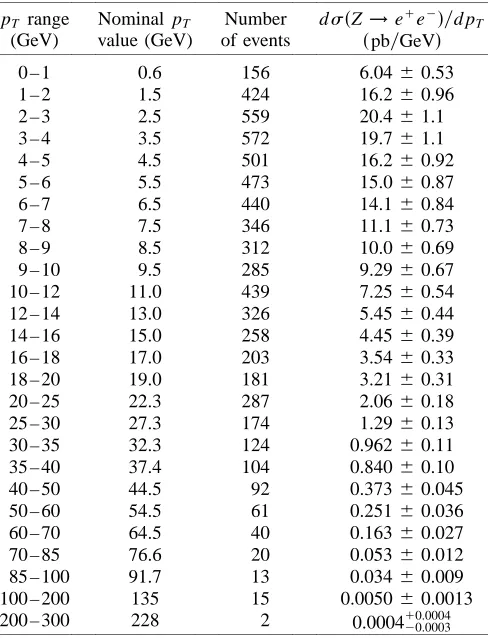
TABLE I. Summary of the results of the measurement of the
pTdistribution of theZboson. The range ofpTcorresponds to
the intervals used for binning the data. The nominalpT
corre-sponds to the value ofpTused to plot the data and was obtained
from theory. The quantityds共Z!e1e2兲兾dp
Tcorresponds to
the differential cross section in each bin ofpT forZ !e1e2
production. The uncertainty on the differential cross section in-cludes both systematic and statistical uncertainties, but does not include overall normalization uncertainty due to the luminosity of64.4%.
pT range NominalpT Number ds共Z!e1e2兲兾dpT
(GeV) value (GeV) of events 共pb兾GeV兲
0 – 1 0.6 156 6.0460.53
1 – 2 1.5 424 16.260.96
2 – 3 2.5 559 20.461.1
3 – 4 3.5 572 19.761.1
4 – 5 4.5 501 16.260.92
5 – 6 5.5 473 15.060.87
6 – 7 6.5 440 14.160.84
7 – 8 7.5 346 11.160.73
8 – 9 8.5 312 10.060.69
9 – 10 9.5 285 9.2960.67
10 – 12 11.0 439 7.2560.54
12 – 14 13.0 326 5.4560.44
14 – 16 15.0 258 4.4560.39
16 – 18 17.0 203 3.5460.33
18 – 20 19.0 181 3.2160.31
20 – 25 22.3 287 2.0660.18
25 – 30 27.3 174 1.2960.13
30 – 35 32.3 124 0.96260.11
35 – 40 37.4 104 0.84060.10
40 – 50 44.5 92 0.37360.045
50 – 60 54.5 61 0.25160.036
60 – 70 64.5 40 0.16360.027
70 – 85 76.6 20 0.05360.012
85 – 100 91.7 13 0.03460.009
100 – 200 135 15 0.005060.0013
the detector resolutions by61standard deviation from the nominal values. The effect of these variations is negligi-blerelative to the other uncertainties in the measurement.
Table I shows the values ofds共Z !e1e2兲兾dpT. The uncertainties on the data points include statistical and systematic contributions. An additional normalization uncertainty of 64.4%arises from the uncertainty on the integrated luminosity [20] that is not included in any of the plots nor in the table, but must be taken into account in any fits involving an absolute normalization.
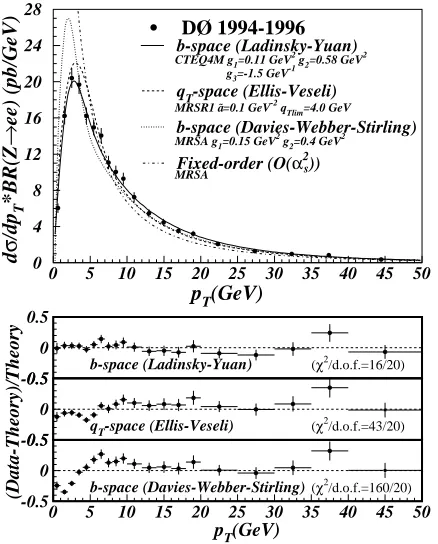
Figure 1 shows the differential cross section corrected for the detector resolutions, compared to the fixed-order calculation and the resummation calculation with three different parametrizations of the nonperturbative region, based on published values of the nonperturbative parame-ters. Also shown are the fractional differences between data and the resummed predictions. The data are normal-ized to the measured Z !e1e2 cross section (221 pb [20]), and the predictions are normalized to the absolute theoretical calculation. We observe best agreement with the Ladinsky-Yuan parameters for theb-space formalism; however, we expect that fits to high-statistics newer data using the Davies-Weber-Stirling (b-space) or Ellis-Veseli (pT-space) parametrizations of the nonperturbative func-tions could describe our results similarly well. We
fur-0 4 8 12 16 20 24 28
0 5 10 15 20 25 30 35 40 45 50 qT-space (Ellis-Veseli)
MRSR1 a˜=0.1 GeV-2 qTlim=4.0 GeV b-space (Ladinsky-Yuan) CTEQ4M g1=0.11 GeV2 g2=0.58 GeV2
g3=-1.5 GeV-1
b-space (Davies-Webber-Stirling) MRSA g1=0.15 GeV2 g2=0.4 GeV2
Fixed-order (O(α2s)) MRSA
DØ 1994-1996
pT(GeV)
d σ /dp T *BR(Z → ee) (pb/GeV) -0.5 0 0.5
b-space (Ladinsky-Yuan) (χ2/d.o.f.=16/20)
-0.5 0 0.5
qT-space (Ellis-Veseli) (χ2/d.o.f.=43/20)
-0.5 0 0.5
0 5 10 15 20 25 30 35 40 45 50
b-space (Davies-Webber-Stirling)(χ2/d.o.f.=160/20)
pT(GeV)
(Data-Theory)/Theory
FIG. 1. The differential cross section of theZboson as a func-tion ofpT compared with resummation calculations using three
published parametrizations of the nonperturbative region as well as a fixed-order calculation. Also shown are the fractional dif-ferences in absolute cross section between data and each of the resummed predictions. As noted in the text, the large disagree-ment with the Davies-Weber-Stirling parametrization should not be considered as ruling out the two-parameter description.
ther note that the published values for the Ladinsky-Yuan parametrization are due largely to low energy Drell-Yan data. That they do so well in confrontation with high sta-tistics and high-Q2 data is intriguing. This is especially
significant since these are not just shape comparisons, but involve absolute cross sections.
Figure 2 shows the measured differential cross section compared to the fixed-order absolute cross section calcula-tion and the resummacalcula-tion calculacalcula-tion using the Ladinsky-Yuan parametrization. We observe strong disagreement between the data and the fixed-order prediction in the shape for all but the highest values of pT. We attribute this to the divergence of the next-to-leading-order calcula-tion atpT 苷0, and a significant enhancement of the cross section relative to the prediction at moderate values ofpT. This disagreement confirms the presence of contributions from soft gluon emission, which are accounted for in the resummation formalisms.
In summary, we have measured the inclusive differential cross section of theZboson as a function of its transverse momentum. With the enhanced precision of this measure-ment over previous results, we can probe nonperturbative, resummation, and fixed-order QCD effects for all values of pT. We observe good agreement between data and theb-space resummation calculation of the absolute cross section using the published values of the nonperturbative parameters of Ladinsky-Yuan. Using their form for the
10-5 10-4 10-3 10-2 10-1 1 10
0 50 100 150 200 250 300
b-space (Ladinsky-Yuan) CTEQ4M g1=0.11 GeV2
g2=0.58 GeV2 g3=-1.5 GeV-1 Fixed-order (O(αs2)) MRSA
DØ 1994-1996
pT(GeV)
d σ /dp T *BR(Z → ee) (pb/GeV) -1 0 1 2
1 10 102
b-space (Ladinsky-Yuan)
(χ2/d.o.f.=23/26)
Fixed-Order (O(α2s))
pT(GeV)
(Data-Theory)/Theory
FIG. 2. A comparison of data to the resummed and fixed-order [O共a2
s兲] calculations. Also shown are the fractional differences
parametrization of the nonperturbative region, we obtain g2苷 0.596 0.06GeV2.
We thank the Fermilab and collaborating institution staffs for contributions to this work and acknowledge support from the Department of Energy and National Science Foundation (U.S.A.), Commissariat à L’Energie Atomique (France), Ministry for Science and Technology and Ministry for Atomic Energy (Russia), CAPES and CNPq (Brazil), Departments of Atomic Energy and Science and Education (India), Colciencias (Colombia), CONACyT (Mexico), Ministry of Education and KOSEF (Korea), and CONICET and UBACyT (Argentina).
[1] DØ Collaboration, B. Abbott et al., Phys. Rev. D 61,
032004 (2000).
[2] D. Casey, Ph.D. thesis, University of Rochester, 1997 (unpublished) [http://www-d0.fnal.gov/publications_talks/ thesis/casey/thesis.ps].
[3] UA2 Collaboration, P. Bagnaia et al., Z. Phys. C 47, 523 (1990).
[4] CDF Collaboration, F. Abe et al., Phys. Rev. Lett. 67,2937 (1991).
[5] J. C. Collins and D. E. Soper, Nucl. Phys. B193, 381 (1981); B213,545E (1983); J. C. Collins, D. E. Soper, and G. Sterman, ibid. B250,199 (1985).
[6] C. T. H. Davies and W. J. Stirling, Nucl. Phys. B244, 337 (1984).
[7] G. Altarelli, R. K. Ellis, M. Greco, and G. Martinelli, Nucl. Phys. B246, 12 (1984).
[8] C. T. H Davies, B. R. Weber, and W. J. Stirling, Nucl. Phys.
B256,413 (1985).
[9] P. B. Arnold and M. H. Reno, Nucl. Phys. B319,37 (1989);
B330,284E (1990).
[10] P. B. Arnold and R. P. Kaufman, Nucl. Phys. B349, 381 (1991).
[11] G. A. Ladinsky and C.-P. Yuan, Phys. Rev. D 50, 4239 (1994).
[12] C. Balazs and C.-P. Yuan, Phys. Rev. D 56, 5558
(1997).
[13] R. K. Ellis and S. Veseli, Nucl. Phys. B511,649 (1998). [14] C. Balazs and C.-P. Yuan, Phys. Rev. D 59, 114007
(1999).
[15] C. Balazs, E. L. Berger, S. Mrenna, and C.-P. Yuan, Phys. Rev. D 57, 6934 (1999).
[16] DØ Collaboration, S. Abachi et al., Nucl. Instrum. Methods Phys. Res., Sect. A 338,185 (1994).
[17] CDF Collaboration, T. Affolder et al., FERMILAB PUB-99/220-E (to be published).
[18] DØ Collaboration, B. Abbott et al., Phys. Rev. D 58,
092003 (1998).
[19] G. Marchesini et al., Comput. Phys. Commun. 67, 465 (1992).
[20] DØ Collaboration, B. Abbott et al., FERMILAB PUB-99/ 171-E, hep-ex/9906025 (to be published).
[21] H. U. Bengtsson and T. Sjostrand, Comput. Phys. Commun.