Clinical Interventions in Aging 2018:13 1079–1089
Clinical Interventions in Aging
Dove
press
submit your manuscript | www.dovepress.com 1079
O r I g I n A l r e s e A r C h
open access to scientific and medical research
Open Access Full Text Article
Usual gait speed is associated with frailty status,
institutionalization, and mortality in
community-dwelling rural older adults: a longitudinal analysis
of the Aging study of Pyeongchang rural Area
hee-Won Jung1,2,*
Il-Young Jang3,4,*
Chang Ki lee5
sang soo Yu4
Jae Kyoon hwang4
Chawoong Jeon4
Young soo lee3
eunju lee3
1graduate school of Medical science and engineering, Korea Advanced Institute of science and Technology, Daejeon, republic of Korea; 2geriatric Center, seoul national University Bundang hospital, seongnam-si, gyeonggi-do, republic of Korea; 3Department of Internal Medicine, Asan Medical Center, University of Ulsan College of Medicine, seoul, republic of Korea; 4PyeongChang health Center & County hospital, PyeongChang-gun, gangwon-Do, republic of Korea; 5goldman Urology Clinic, seoul, republic of Korea
*These authors contributed equally to this work
Purpose: We aimed to describe the age- and sex-specific distributions of gait speed and to evaluate associations with longitudinal outcomes in Korean rural community-dwelling older adults.
Patients and methods: A total of 1,348 people (mean age: 76 years, 55% women) in the population-based, prospective cohort of Aging Study of Pyeongchang Rural Area (ASPRA) between October 2014 and June 2017. All participants underwent a comprehensive geriatric assessment, including 4-m usual gait speed, and were followed annually.
Results: Among the 1,348 participants, women had a slower gait speed than men (mean 0.709 m/s vs 0.850 m/s, P , 0.001). Gait speed was inversely associated with age, frailty index; slow gait speed as classified by sex-specific quartile was associated with the prevalence of common geriatric syndromes. During the mean follow-up period of 21.5 months (SD 7.88), future survival without mortality or institutionalization was affected by sex-specific gait-speed quartile (log rank test P, 0.001): the 1st quartile of sex-specific gait speed was associated with increased risk of death or institutionalization.
Conclusion: Gait speed was related to age, sex, frailty status, and geriatric health outcomes in Korean rural community-dwelling older adults. Since this gait-speed distribution in an older Korean population differs from previous data on other populations, we should consider a gait-speed cutoff value based on sex-specific quartiles to prevent misclassification in sarcopenia and frailty diagnosis.
Keywords: cohort studies, frailty, gait speed, geriatric assessment, physical function
Introduction
Gait speed in older adults has been accepted as a reliable and sensitive measure for assessment of physiologic performance and prediction of clinical outcomes, and indeed has been regarded as the “sixth vital sign.”1,2 A ground-breaking study3 on nine Western cohorts showed that gait speed can predict survival in older people as precisely as age, sex, and use of mobility aids. Given its clinical, epidemiological importance, gait speed has been included in most clinical studies dealing with older adults.
Frailty is defined as a state of decreased physiological reserve coupled with increased vulnerability to possible stressors in older adults.4 Cumulative research results have demonstrated its outstanding performance in predicting clinical geriatric outcomes under various settings. In defining physical frailty, objective gait speed5 or subjective walking capability6 usually has been included in operational frailty criteria. Correspondence: eunju lee
Department of Internal Medicine, Asan Medical Center, University of Ulsan College of Medicine, 88, Olympic-ro 43-gil, songpa-gu, seoul, 05505, republic of Korea
Tel +82 2 3010 3308 Fax +82 2 476 0824 email [email protected]
Journal name: Clinical Interventions in Aging Article Designation: Original Research Year: 2018
Volume: 13
Running head verso: Jung et al
Running head recto: Gait speed in Korean older adults DOI: 166863
Clinical Interventions in Aging downloaded from https://www.dovepress.com/ by 118.70.13.36 on 20-Aug-2020
For personal use only.
Dovepress
Jung et al
Moreover, studies have measured gait speed as the sole marker of physiological reserve and have shown that it can predict adverse procedural outcomes.7,8
Gait speed, accordingly, has been included as the com-ponent of diagnostic criteria for sarcopenia.9,10 A recent definition of sarcopenia uses physical performance, muscle strength, and muscle mass as indicators. A report of the European Working Group on Sarcopenia, having summarized several studies from Western countries, suggested a 0.8 m/s gait-speed cutoff value for detection of sarcopenia.5,11,12 The Asian Working Group for Sarcopenia (AGWS), not-withstanding the possible gender differences and large heterogeneities between studies from various countries, also suggested the 0.8 m/s cutoff value of gait speed to detect sarcopenia.10
South Korea is one of the fastest aging societies in the world, and the estimated life expectancy of Korean people will be the longest by 2,030 among developed countries.13 Because of this compelling need for research on frailty and sarcopenia, studies thus far have revealed the prevalence and clinical implications of frailty14 and sarcopenia15,16 in Korean populations. However, to date, no study has deter-mined the gait-speed distribution or analyzed its clinical implications in older Korean adults. Consequently, most studies on frailty and sarcopenia in Korea have had to adopt a gait-speed cutoff value for a Western population, restricting scientific and clinical validity of their results in the Korean population.
In this context, we aimed to determine the age- and sex-specific distributions of usual gait speed and to analyze the longitudinal associations of usual gait speed with outcomes of mortality and institutionalization in a rural community-based prospective cohort study designed to reflect the general Korean rural population.
Patients and methods
study design and population
The current study population was selected from the Aging Study of PyeongChang Rural Area (ASPRA), a population-based, prospective cohort study on frailty and geriatric syndromes among older Koreans living in rural areas. ASPRA’s design and the method by which it was carried out are described elsewhere.15 Briefly, participants residing in Pyeongchang County, Gangwon Province, Korea, located 180 km east of Seoul, were enrolled. The inclusion criteria for participation were 1) aged $65 years; 2) registered in the National Healthcare Service; 3) ambulatory with or without an assistive device; 4) living at home; and 5) able to provide informed consent. We excluded those who were
1) living in a nursing home; 2) hospitalized; or 3) bed-ridden and receiving nursing home-level care at home at the time of enrollment.
In the present study, we used data from ASPRA’s 1,350-participant cohort recruited and baseline assessed between October 2014 and June 2017. This included over 90% of eligible older adults living in the study area. A previous report showed that, based on a nationally representative sample of the Korea National Health and Nutrition Examination Survey (KNHANES), the characteristics of the ASPRA participants were very similar to the general Korean rural population, except for a higher proportion of agricultural laborers and a low formal-education level.15 All of the participants under-went a comprehensive geriatric assessment every 12 months. Participants who died or were institutionalized for .3 months were recorded as health-related outcomes. The protocol of this study was approved by the Institutional Review Board of Asan Medical Center. Written informed consent was obtained from all participants and/or their legal guardians. All methods from this study were performed in accordance with the relevant guidelines and regulations.
Measurements
Usual gait speed
In the evaluation of usual gait speed, participants were instructed to walk, from a standing point, a total of 7 m on a level indoor surface, with no turns, at the pace most comfort-able and usual for them. Using a standard digital stopwatch, a trained tester measured the 4-m transit time between the first footstep at the starting line to the first footstep at the 4-m line. Accelerating and decelerating sections of 1.5 m each were excluded from the measurement. The result was defined as the gait speed.16
geriatric conditions
Trained nurses administered a comprehensive geriatric assessment to evaluate common geriatric conditions. Multi-morbidity was defined as having $5 of the 11 physician-diagnosed illnesses including angina, arthritis, asthma, cancer, chronic lung disease, congestive heart failure, diabetes, heart attack, hypertension, kidney disease, and stroke. A short physical performance battery (SPPB) score was calculated from three components: the ability to stand for up to 10 s with feet positioned in three ways (together side-by-side, semi-tandem, and tandem); the time to complete a 4-m walk, and the time to rise from a chair five times.17,18 The resultant SPPB scores ranged from 0 to 12, a higher score indicating a better level of function. Disability was defined as requiring assistance in performing any of the seven
Clinical Interventions in Aging downloaded from https://www.dovepress.com/ by 118.70.13.36 on 20-Aug-2020
Dovepress gait speed in Korean older adults
activities of daily living (ADLs) including bathing, conti-nence, dressing, eating, toileting, transferring, and washing face and hands, or 10 instrumental activities of daily living (IADLs) including food preparation, household chores, going out a short distance, grooming, handling finances, laundry, managing own medications, shopping, transportation, and using a telephone.19 Depression was determined if the score on the Korean version of the Center for Epidemiological Studies Depression (CES-D) scale was .20.20 Cognitive dysfunction was determined if the score on the Korean version of the Mini-Mental State Examination was ,24.21 Polypharmacy was defined as taking five or more prescrip-tion medicaprescrip-tions.15
Frailty assessment
We used a frailty index, the Cardiovascular Health Study (CHS) frailty phenotype, and the Korean version of the Fatigue, Resistance, Ambulation, Illnesses, and Loss of weight (K-FRAIL) questionnaire in this study to evaluate the associa-tions between the usual gait speed and the frailty status.
Frailty index
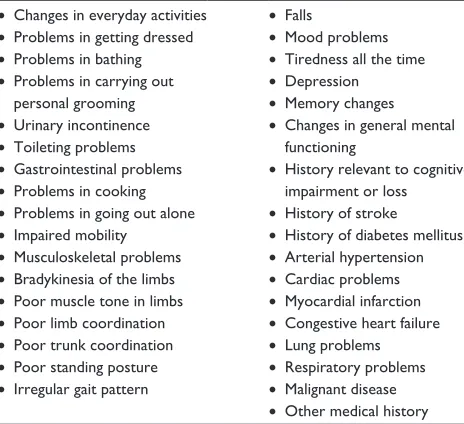
For quantitative evaluation of frailty burden, we built the frailty index based on the widely accepted procedure sug-gested by Rockwood and colleagues.22 The frailty index is a sensitive, quantitative predictor of adverse health out-comes, because it includes underlying diseases, physical and cognitive impairments, psychosocial risk factors, geriatric syndromes (eg, falls, delirium, and urinary incontinence), and disability.22 Of 70 previously suggested frailty index components, 34 were selected and utilized to build the pres-ent version. The specific componpres-ents of our frailty index are listed in Table S1. The frailty index was calculated as the cumulative deficit of the 34 items and ranged from 0 to 1, a higher score indicating a greater frailty burden.
Chs frailty phenotype
We evaluated the frailty phenotype according to the widely accepted CHS frailty criteria.5 These criteria, developed by Fried and coworkers, assigns 1 point to each of the five fol-lowing components: 1) exhaustion (“moderate or most of the time during the past week” for either of the following statements: “I felt that everything I did was an effort” or “I could not get going”); 2) low activity (lowest quintile in physical activity level measured using the International Physical Activity Questionnaires Short Form 16); 3) slow-ness (usual gait speed ,0.8 m/s in the 4-m walk test); 4) weakness (dominant hand grip strength ,26 kg for men and ,17 kg for women); 5) weight loss (unintentional weight
loss .3 kg during the previous 6 months). Participants were classified as robust (0 points), prefrail (1–2 points), or frail (3–5 points).
K-FrAIl questionnaire
In this study, the K-FRAIL questionnaire was used as a screening measure for frailty status.23 This simple screening tool of five self-reported items has been validated in many populations,24–26 including Koreans, and it can be assessed within 2 or 3 minutes with no requirement of special equip-ment or training.6 It assigns 1 point to each of the following five components: 1) fatigue (response of “all of the time” or “most of the time” to the following question: “How much of the time during the past 4 weeks did you feel tired?”); 2) resistance (positive response to the question, “By yourself and not using aids, do you have any difficulty walking up 10 steps without resting?”); 3) ambulation (positive response to the question, “By yourself and not using aids, do you have any difficulty walking 300 m?”); 4) illnesses (five or more self-reported physician diagnoses of hypertension, diabetes, cancer excluding a minor skin cancer, chronic lung disease, heart attack, congestive heart failure, angina, asthma, arthri-tis, stroke, or kidney disease); and 5) loss of weight (.5% in the past year). Participants were classified as robust (0 points), prefrail (1–2 points), or frail (3–5 points).
Data analysis
The independent t-test for continuous variables and the
χ2 test for categorical variables were used to evaluate the participants’ characteristics. Sex-specific gait-speed quartiles were calculated and used to group participants into gait-specific categories. We used linear regression analysis and Pearson correlation analysis to assess the associations between gait speed and age, frailty. The Kaplan–Meier plot, log-rank test and Cox proportional hazard model were used to determine the associations between gait-speed categories and outcomes. Additionally, receiver operating characteristic (ROC) analyses with comparisons of the area under the curve were performed to assess the predictive ability for gait speed and frailty outcomes. The statistical analyses were performed using STATA 15.0 (StataCorp, College Station, TX, USA).
Results
Baseline characteristics and distributions
of gait speed according to age and sex
Among the 1,350 people (602 men and 748 women) exam-ined between October 2014 and June 2017, two women were excluded for missing gait-speed data and frailty status.
Clinical Interventions in Aging downloaded from https://www.dovepress.com/ by 118.70.13.36 on 20-Aug-2020
Dovepress
Jung et al
Consequently, 1,348 (602 men and 746 women) were included in the analysis for this study. As shown in Figure 1, gait speed was slower in women (mean 0.709 m/s, standard deviation [SD] 0.283 m/s) than in men (mean 0.850 m/s, SD 0.321 m/s), with statistical significance (P , 0.001). Although the women in the study population were older than the men (mean 76.29, SD 6.67 vs mean 74.97, SD 6.04, P, 0.001), the sex-dependent gait-speed difference (0.141 m/s) could not be explained by the difference of age, by linear regression analysis showing a coefficient of -0.017 m/s of gait speed per 1 year increment of age. Therefore, we classified the study population into fast and slow walkers (by sex-specific median gait speed) for descriptive characteristics and used the sex-specific gait-speed quartiles for the other analyses.
When the gait speeds of participants were divided into three categories according to the known cutoff val-ues of 0.6 and 1.0 m/s, 108 (17.94%), 310 (51.50%), and 184 (30.56%) men had a gait speed of ,0.6, 0.6–1.0, and $1.0 m/s, respectively.9,10 On the other hand, 254 (34.05%), 382 (51.21%), and 110 (14.75%) women had a gait speed of ,0.6, 0.6–1.0, and $1.0 m/s, respectively. With respect to the sex-specific quartiles for gait speed, 161 (26.74%), 155 (25.75%), 149 (24.75%), and 137 (22.76%) men along with 194 (26.01%), 189 (25.34%), 192 (25.74%),
and 171 (22.92%) women were classified into the 1st to 4th quartiles, respectively.
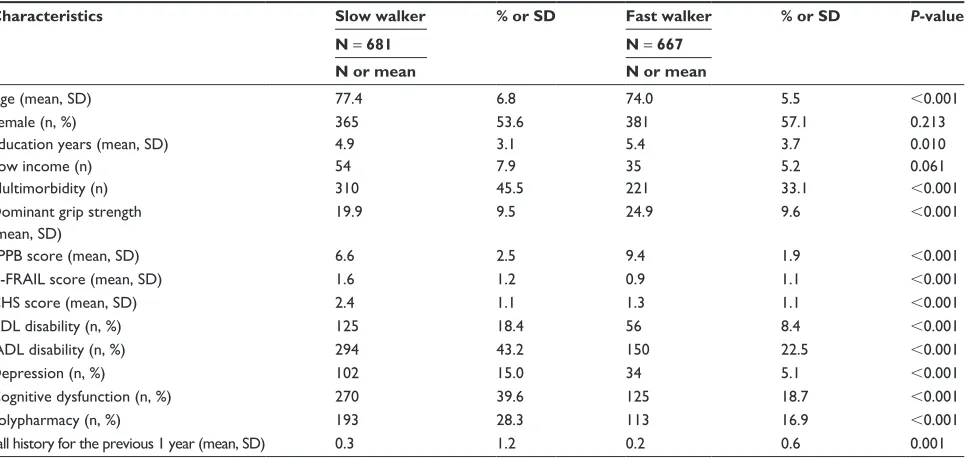
As displayed in Table 1, slow walkers were older, with more multimorbidity, lower grip strength, worse SPPB score, more frailty, more depression, more cognitive dysfunction, and a fall-down history for the previous 1 year.
gait speed is associated with frailty status
As shown in Figure 2, gait speed was associated with age and frailty index in both men and women. By linear regression analysis, age (standardized beta [β] =-0.342, P , 0.001) was associated with gait speed after adjusting for sex. Frailty index was associated with gait speed either without adjustment (β=-0.589, P , 0.001) or with adjustment with age and sex (β=-0.534, P , 0.001).
When gait speed was classified into the four categories by sex-specific quartile, the slower gait-speed categories were associated with the worse frailty status by both the K-FRAIL questionnaire (Pearson correlation coefficient [ρ] =-0.334, P , 0.001) and the CHS frailty phenotype (ρ = -0.480, P, 0.001). As shown in Figure 3, no participant in the 1st quartile was robust according to the CHS frailty phenotype, and 172 (55.8%) in the 4th quartile were robust according to the K-FRAIL questionnaire.
'HQVLW\
*DLWVSHHGPV
0HQ :RPHQ
3HUFHQWLOH
0HQ :RPHQ *DLWVSHHG
PV
$
%
Figure 1 Distribution of gait speed from the Aging study of Pyeongchang rural Area.
Note: Distribution of gait speed by (A) sex and (B) sex-specific percentiles of gait speed.
Clinical Interventions in Aging downloaded from https://www.dovepress.com/ by 118.70.13.36 on 20-Aug-2020
Dovepress gait speed in Korean older adults
To evaluate the associations between the subcompo-nents of the frailty measures and gait speed, multivariable linear regression analyses with adjustment for age and sex were performed. In the K-FRAIL questionnaire, resistance (β = -0.137, P , 0.001) and ambulation (β = -0.171, P , 0.001) were associated with gait speed. In the CHS frailty phenotype, exhaustion (β=-0.085, P= 0.001) and grip strength (β=-0.310, P, 0.001) were associated with gait speed when the slow gait-speed item was not included in the regression analysis.
gait speed can predict adverse outcomes
as effectively as frailty status in older
adults
During the mean follow-up period of 21.5 months (SD 7.88), 23 participants (1.71%) died and 93 (6.90%) were institution-alized due to functional impairment. We considered these as the major adverse health outcomes in this study. When com-pared with participants without adverse outcomes, partici-pants with outcomes were older (80.78±7.80 vs 75.23±6.07 years old, P, 0.001 by t-test) and had a higher baseline frailty index (0.31±0.14 vs 0.21±0.11, P, 0.001 by t-test).
As shown in Figure 4, future survival without mortality or institutionalization by functional decline was affected by the sex-specific gait-speed quartile (log rank test P, 0.001). Classification into the 1st quartile of sex-specific gait speed was associated with the increased risk of death or institu-tionalization by functional decline, either as unadjusted or
as adjusted by age, sex education years, household income, multimorbidity, polypharmacy, and cognitive status in the Cox proportional hazard model (Table 2). Sensitivity analy-ses excluding participants with observation periods of ,1 year were formed, showing similar trends of association between slower gait speed and risk of death or institutional-ization by functional decline (Table S2). Secondary analysis for outcome relevance of lowest sex-specific gait-speed quartile was performed, separately for mortality and institu-tionalization. For mortality, gait speed of lowest sex-specific quartile was associated with increased mortality (hazard ratio [HR] 3.37, 95% confidence interval [CI] 1.25–9.08) in the Cox proportional hazard model. However, this association was attenuated when adjusted for age, sex (HR 2.54, 95% CI 0.88–7.28). When Cox regression analysis was performed with the outcome variable of institutionalization, gait speed of lowest sex-specific quartile was associated with institu-tionalization (HR 2.26, 95% CI 1.45–3.53). The association became attenuated when adjusted with age and sex (HR 1.59, 95% CI 0.98–2.58).
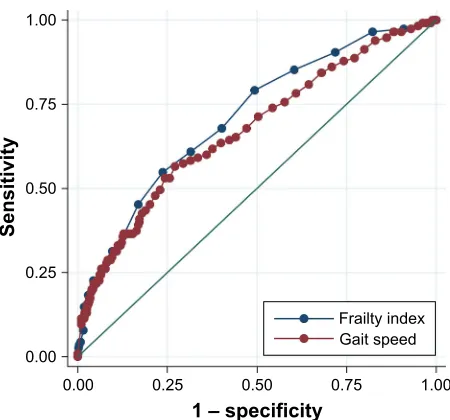
Since the frailty index has been known for its predict-ability of mortality and institutionalization by functional decline in older populations, we compared it in this respect with gait speed. By ROC analysis (Figure 5), the area under the curve was 0.712 (95% CI 0.662–0.762) for the frailty index and 0.673 (95% CI 0.619–0.728) for gait speed, thus indicating no statistically significant difference in outcome prediction (P= 0.059).
Table 1 Baseline characteristics compared between slow walkers (gait speed slower than sex-specific median) and fast walkers
Characteristics Slow walker % or SD Fast walker % or SD P-value
N = 681 N = 667
N or mean N or mean
Age (mean, sD) 77.4 6.8 74.0 5.5 ,0.001
Female (n, %) 365 53.6 381 57.1 0.213
education years (mean, sD) 4.9 3.1 5.4 3.7 0.010
low income (n) 54 7.9 35 5.2 0.061
Multimorbidity (n) 310 45.5 221 33.1 ,0.001
Dominant grip strength (mean, sD)
19.9 9.5 24.9 9.6 ,0.001
sPPB score (mean, sD) 6.6 2.5 9.4 1.9 ,0.001
K-FrAIl score (mean, sD) 1.6 1.2 0.9 1.1 ,0.001
Chs score (mean, sD) 2.4 1.1 1.3 1.1 ,0.001
ADl disability (n, %) 125 18.4 56 8.4 ,0.001
IADl disability (n, %) 294 43.2 150 22.5 ,0.001
Depression (n, %) 102 15.0 34 5.1 ,0.001
Cognitive dysfunction (n, %) 270 39.6 125 18.7 ,0.001
Polypharmacy (n, %) 193 28.3 113 16.9 ,0.001
Fall history for the previous 1 year (mean, sD) 0.3 1.2 0.2 0.6 0.001
Abbreviations: ADl, activity of daily living; Chs, Cardiovascular health study; IADl, instrumental activity of daily living; K-FrAIl, the Korean version of the Fatigue,
resistance, Ambulation, Illnesses, and loss of weight questionnaire; sD, standard deviation; sPPB, short physical performance battery.
Clinical Interventions in Aging downloaded from https://www.dovepress.com/ by 118.70.13.36 on 20-Aug-2020
Dovepress
Jung et al
Discussion
In this study, we evaluated the distributions of gait speed according to sex, age, and frailty index among older rural community-dwelling Korean people and found that gait speed is associated with frailty status and the geriatric clinical outcome of combined mortality and institutionalization. To the best of our knowledge, this is the first study in Korea
to comprehensively assess the gait speed in a longitudinal prospective cohort that can represent the general Korean rural population15 in a descriptive and analytic manner.
Although the clinical value of gait speed to assessment of physical performance, frailty status, and even neurological performance in older people has been established with cumu-lative evidence, especially for Western populations,3,9,10,27–30
*DLWVSHHGPV
0HQ
$
%
:RPHQ
*DLWVSHHGPV
0HQ
)UDLOW\LQGH[ $JH
:RPHQ
&, 3UHGLFWHGOLQH *DLWVSHHG
Figure 2 scatterplots showing distributions of gait speed in men and women.
Notes: (A) by age and (B) by frailty index. The line and shading denote the predicted gait speed by fractional polynomial regression and the 95% confidence interval,
respectively.
Clinical Interventions in Aging downloaded from https://www.dovepress.com/ by 118.70.13.36 on 20-Aug-2020
Dovepress gait speed in Korean older adults
there has been insufficient data on the distributions and clini-cally meaningful cutoff values for gait speed among older Asian populations.
Notably, previous studies from Asian countries have suggested a higher cutoff value for slow gait speed relative to the values for Western populations. For example, a study by Tanimoto and colleagues31 suggested a cutoff value from the lowest quartile of gait speed: ,1.27 m/s for men and ,1.29 m/s for women. In this study, participants were recruited through local newspapers and by the local welfare commissioner, thereby leaving possibilities of bias in the study population. On the other hand, a Taiwanese group
in the I-Lan Longitudinal Aging Study (ILAS) suggested a gait-speed cutoff value of 1 m/s for slow gait speed10 after assessing ILAS data showing gait-speed distributions of 1.5±0.5 m/s for men and 1.3±0.4 m/s for women.32 For that cohort, participants were randomly sampled in the Yuanshan Township of I-Lan County in order to limit the possible bias which may oversample healthier people.
In our study, we analyzed the data of the ASPRA study, which involved a longitudinal prospective cohort in a moun-tainous region of PyeongChang County, Korea. Because this region is distant from major cities, the population remains relatively stable, with ,5% of older adults immigrating or
6H[VSHFLILFJDLWVSHHGTXDUWLOH .)5$,/TXHVWLRQDLUH
$
6H[VSHFLILFJDLWVSHHGTXDUWLOH &+6IUDLOW\SKHQRW\SH%
)UDLO 3UHIUDLO 5REXVW
Figure 3 Frailty status is associated with gait-speed classification by sex-specific gait-speed quartile.
Note: The numbers in the graphs represent the absolute number of participants classified in each group for (A) the K-FrAIl questionnaire and (B) the Chs frailty
phenotye.
Abbreviations: Chs, Cardiovascular health study; K-FrAIl, the Korean version of the Fatigue, resistance, Ambulation, Illnesses, and loss of weight questionnaire.
1XPEHUDWULVN VWTXDUWLOH QGTXDUWLOH UGTXDUWLOH WKTXDUWLOH )ROORZXSGXUDWLRQPRQWKV 3UREDELOLW\ VWTXDUWLOH UGTXDUWLOH QGTXDUWLOH WKTXDUWLOH
Figure 4 Kaplan–Meier curve for survival of participants without mortality or
institutionalization by functional decline, with “number at risk” table.
Notes: Mean times to cutoff were 28.08, 30.47, 30.74, and 31.20 months for
1st, 2nd, 3rd, and 4th quartiles, respectively. Total observed person-month were 9,406.64, 11,090.26, 8,484.02, and 10,263.04 person-month for 1st, 2nd, 3rd, and 4th quartiles, respectively.
Table 2 Cox proportional hazard analysis showing the effect of gait speed on combined mortality and institutionalization during follow-up period
Model HR 95% CI P-value Model 1
1st quartile 4.76 2.56–8.88 ,0.001
2nd quartile 1.93 0.96–3.90 0.066
3rd quartile 1.7 0.84–3.44 0.139
4th quartile (reference) Model 2
1st quartile 2.43 1.24–4.76 0.009
2nd quartile 1.43 0.68–2.90 0.362
3rd quartile 1.35 0.66–2.75 0.407
4th quartile (reference) Model 3
1st quartile 2.31 1.20–4.49 0.013
2nd quartile 1.26 0.63–2.53 0.510
3rd quartile 1.15 0.54–2.43 0.720
4th quartile (reference)
Notes: Model 1, unadjusted model; Model 2, age-, sex-adjusted model; Model 3,
age, sex, education years, household income, multimorbidity, polypharmacy, and cognitive impairment-adjusted model.
Abbreviations: CI, confidence interval; HR, hazard ratio.
Clinical Interventions in Aging downloaded from https://www.dovepress.com/ by 118.70.13.36 on 20-Aug-2020
Dovepress
Jung et al
±VSHFLILFLW\
6HQVLWLYLW\
)UDLOW\LQGH[ *DLWVSHHG
Figure 5 receiver operating characteristic curves for the frailty index and gait speed for
prediction of combined mortality and institutionalization during the follow-up period.
emigrating from the area with the exception of morbidity or mortality. Also, residents receive medical and preventive care almost exclusively from the regional Community Health Posts operated by the National Health Service.15 A comparative analysis with the sixth Korea National Health and Nutrition Examination Survey, furthermore, showed that the ASPRA population can represent the general Korean rural community-dwelling older population.15 Therefore, the gait-speed dis-tributions and associations with age, sex, and frailty status in our study might be considered to represent those of the general older Korean rural community-dwelling population.
The gait speeds in our study are slower than those found in previous Japanese31 and Taiwanese32 studies. This may be partially explained by the higher age in ASPRA com-pared with ILAS as well as the inclusion in ASPRA of even the frailest participants, who might not be included in the Japanese study.
Traditionally, gait speeds in older adults have been clas-sified into three categories (,0.6, 0.6–1, and $1 m/s) or two categories (,0.8 and $0.8 m/s).9,10 Although the AGWS adopted this cutoff value (0.8 m/s) as its criterion for Asian sarcopenia diagnosis, it would classify nearly half of men (272, 45.18%) and too many women (483, 64.75%) as slow walkers in our study population. Even when the 0.6 m/s cut-off was used, 254 (34.05%) women were classified as slow walkers, because the sex-dependent difference in gait speed was substantial in the ASPRA population.
Alternatively, defining low gait speed according to the sex-specific lowest quartile might be beneficial, specifically
to prevent misclassification and also to meet the original goal of setting a cutoff value of impairment for a designated population.33 Also, the sex-specific lowest quartile of gait speed was associated in this study with future adverse out-comes including death and institutionalization by functional impairment. Therefore, we suggest that the cutoff value for slow gait speed in the Korean population be 0.663 m/s for men and 0.545 m/s for women, which are the sex-specific 25th percentile values of gait speed.
Considering the as-yet unmet need of physical parameter reference values for longitudinal outcome measures that can be incorporated into future Asian sarcopenia guidelines for older people, the results obtained in this study might prove helpful. However, there are several limitations to the present study. First of all, the data reflect only a rural population of older Korean people, who are more frail and of lower socio-economic status than urban-dwelling populations.34 Also, the ASPRA focused on items included in a comprehensive geriatric assessment and diagnosis of sarcopenia and frailty; it lacks biomarker assessments and detailed physical assess-ments, such as gait analysis, that typically are performed in rehabilitation laboratories. In the present study, the follow-up duration for outcome assessment was short, and only a small set of participants died during the observation period. This prevented a detailed analysis of outcome relevance of sex-specific gait speed quartile on separate outcome of mortality and institutionalization. Therefore, further studies including urban populations with specific biological and physical markers, with longer observation periods, are warranted.
Conclusion
Gait speed was associated with age and frailty status and was slower in women than in men among Korean rural community-dwelling older adults. Since the sex-specific difference in gait speed was substantial, we recommend that the cutoff value for slow gait speed in older Korean adults be based on sex-specific quartiles to minimize misclassifica-tion in operamisclassifica-tionalizamisclassifica-tion of sarcopenia and determinamisclassifica-tion of frailty status.
Acknowledgments
We are indebted to the public health professionals and nurses of PyeongChang County Hospital, Public Health Center, and Community Health Posts for their administrative support and help in enrollment, retention, and measurements. The Aging Study of PyeongChang Rural Area was supported by PyeongChang County Hospital, PyeongChang County,
Clinical Interventions in Aging downloaded from https://www.dovepress.com/ by 118.70.13.36 on 20-Aug-2020
Dovepress gait speed in Korean older adults
10. Chen LK, Liu LK, Woo J, et al. Sarcopenia in Asia: consensus report of the Asian Working Group for Sarcopenia. J Am Med Dir Assoc.2014; 15(2):95–101.
11. Cesari M, Kritchevsky SB, Newman AB, et al. Added value of physical performance measures in predicting adverse health-related events: results from the Health, Aging and Body Composition Study. J Am Geriatr Soc. 2009;57(2):251–259.
12. Lauretani F, Russo CR, Bandinelli S, et al. Age-associated changes in skeletal muscles and their effect on mobility: an operational diagnosis of sarcopenia. J Appl Physiol (1985). 2003;95(5):1851–1860. 13. Kontis V, Bennett JE, Mathers CD, Li G, Foreman K, Ezzati M.
Future life expectancy in 35 industrialised countries: projections with a Bayesian model ensemble. Lancet. 2017;389(10076):1323–1335. 14. Jung HW, Kim SW, Ahn S, et al. Prevalence and outcomes of frailty in
Korean elderly population: comparisons of a multidimensional frailty index with two phenotype models. PLoS One. 2014;9(2):e87958. 15. Jung HW, Jang IY, Lee YS, et al. Prevalence of frailty and aging-related
health conditions in older Koreans in rural communities: a cross-sectional analysis of the Aging Study of Pyeongchang Rural Area.
J Korean Med Sci. 2016;31(3):345–352.
16. Jang IY, Lee CK, Jung HW, et al. Urologic symptoms and burden of frailty and geriatric conditions in older men: the Aging Study of PyeongChang Rural Area. Clin Interv Aging. 2018;13:297–304. 17. Guralnik JM, Simonsick EM, Ferrucci L, et al. A short physical
per-formance battery assessing lower extremity function: association with self-reported disability and prediction of mortality and nursing home admission. J Gerontol. 1994;49(2):M85–M94.
18. Pavasini R, Guralnik J, Brown JC, et al. Short Physical Performance Battery and all-cause mortality: systematic review and meta-analysis.
BMC Med. 2016;14(1):215.
19. Won CW, Yang KY, Rho YG, et al. The Development of Korean Activities of Daily Living (K-ADL) and Korean Instrumental Activi-ties of Daily Living (K-IADL) Scale. J Korean Geriatr Soc. 2002;6(2): 107–120.
20. Radloff LS. The CES-D scale a self-report depression scale for research in the general population. Appl Psychol Meas. 1977;1(3):385–401. 21. Kang Y, Na DL, Hahn S. A validity study on the Korean Mini-Mental
State Examination (K-MMSE) in dementia patients. J Korean Neurol Assoc. 1997;15(2):300–308.
22. Rockwood K, Andrew M, Mitnitski A. A comparison of two approaches to measuring frailty in elderly people. J Gerontol A Biol Sci Med Sci. 2007;62(7):738–743.
23. Morley JE, Malmstrom TK, Miller DK. A simple frailty question-naire (FRAIL) predicts outcomes in middle aged African Americans.
J Nutr Health Aging. 2012;16(7):601–608.
24. Woo J, Yu R, Wong M, Yeung F, Wong M, Lum C. Frailty screen-ing in the community usscreen-ing the FRAIL scale. J Am Med Dir Assoc. 2015;16(5):412–419.
25. Gleason LJ, Benton EA, Alvarez-Nebreda ML, Weaver MJ, Harris MB, Javedan H. FRAIL questionnaire screening tool and short-term out-comes in geriatric fracture patients. J Am Med Dir Assoc. 2017;18(12): 1082–1086.
26. Malmstrom TK, Miller DK, Morley JE. A comparison of four frailty models. J Am Geriatr Soc. 2014;62(4):721–726.
27. Studenski S, Perera S, Wallace D, et al. Physical performance measures in the clinical setting. J Am Geriatr Soc. 2003;51(3):314–322. 28. Rosano C, Brach J, Studenski S, Longstreth WT Jr, Newman AB.
Gait variability is associated with subclinical brain vascular abnor-malities in high-functioning older adults. Neuroepidemiology. 2007; 29(3–4):193–200.
29. Rosano C, Studenski SA, Aizenstein HJ, Boudreau RM, Longstreth WT Jr, Newman AB. Slower gait, slower information processing and smaller prefrontal area in older adults. Age Ageing.2012;41(1):58–64. 30. Beavers KM, Beavers DP, Houston DK, et al. Associations between body composition and gait-speed decline: results from the health, aging, and body composition study. Am J Clin Nutr. 2013;97(3):552–560.
Gangwon Province, Korea. The present study was supported, in part, by Paul Park and Maeil Dairies Co., Ltd. from the Asan Institute for Life Sciences and Corporate Relations of the Asan Medical Center, Seoul, Korea. The public health professionals and nurses of PyeongChang County Hospital were involved in data collection, but they did not have any role in the study design, analysis, or interpretation of data, in the writing of the report or in the decision to submit it for publication. Paul Park and Maeil Dairies Co., Ltd. did not have any role in the study design, in the collection, analysis, or interpretation of data; in the writing of the report; or in the decision to submit it for publication.
Author contributions
All authors participated in designing the study conception; performing the statistical analysis, data analysis, and inter-pretation; and drafting the manuscript. The agreement is to be accountable for all aspects of the work in ensuring that the accuracy or integrity of any part of the work is appropriately investigated and resolved. All authors read and revised this manuscript. This manuscript is the final approval of version from all authors. All authors have reviewed and agreed to be responsible for the process, accuracy, and integrity of all parts of this manuscript.
Disclosure
The authors report no conflicts of interest in this work.
References
1. Fritz S, Lusardi M. White paper: “walking speed: the sixth vital sign”.
J Geriatr Phys Ther. 2009;32(2):46–49.
2. Middleton A, Fritz SL, Lusardi M. Walking speed: the functional vital sign. J Aging Phys Act. 2015;23(2):314–322.
3. Studenski S, Perera S, Patel K, et al. Gait speed and survival in older adults. JAMA.2011;305(1):50–58.
4. Clegg A, Young J, Iliffe S, Rikkert MO, Rockwood K. Frailty in elderly people. Lancet. 2013;381(9868):752–762.
5. Fried LP, Tangen CM, Walston J, et al. Frailty in older adults: evidence for a phenotype. J Gerontol A Biol Sci Med Sci.2001;56(3):M146–M156. 6. Jung HW, Yoo HJ, Park SY, et al. The Korean version of the FRAIL
scale: clinical feasibility and validity of assessing the frailty status of Korean elderly. Korean J Intern Med.2016;31(3):594–600.
7. Alfredsson J, Stebbins A, Brennan JM, et al. Gait speed predicts 30-day mortality after transcatheter aortic valve replacement: results from the Society of Thoracic Surgeons/American College of Cardiol-ogy transcatheter valve therapy registry. Circulation. 2016;133(14): 1351–1359.
8. Afilalo J, Eisenberg MJ, Morin JF, et al. Gait speed as an incremental predictor of mortality and major morbidity in elderly patients undergoing cardiac surgery. J Am Coll Cardiol. 2010;56(20):1668–1676. 9. Cruz-Jentoft AJ, Baeyens JP, Bauer JM, et al. Sarcopenia: European
consensus on definition and diagnosis: report of the European Work-ing Group on Sarcopenia in Older People. Age Ageing. 2010;39(4): 412–423.
Clinical Interventions in Aging downloaded from https://www.dovepress.com/ by 118.70.13.36 on 20-Aug-2020
Dovepress
Jung et al
31. Tanimoto Y, Watanabe M, Sun W, et al. Association between sarcopenia and higher-level functional capacity in daily living in community-dwelling elderly subjects in Japan. Arch Gerontol Geriatr. 2012; 55(2):e9–e13.
32. Liu LK, Lee WJ, Liu CL, et al. Age-related skeletal muscle mass loss and physical performance in Taiwan: implications to diagnostic strategy of sarcopenia in Asia. Geriatr Gerontol Int.2013;13(4):964–971.
33. Searle SD, Mitnitski A, Gahbauer EA, Gill TM, Rockwood K. A stan-dard procedure for creating a frailty index. BMC Geriatr.2008;8:24. 34. Jang IY, Jung HW, Lee CK, et al. Rural and urban disparities in frailty
and aging-related health conditions in Korea. J Am Geriatr Soc. 2016; 64(4):908–911.
Clinical Interventions in Aging downloaded from https://www.dovepress.com/ by 118.70.13.36 on 20-Aug-2020
Clinical Interventions in Aging
Publish your work in this journal
Submit your manuscript here: http://www.dovepress.com/clinical-interventions-in-aging-journal Clinical Interventions in Aging is an international, peer-reviewed journal focusing on evidence-based reports on the value or lack thereof of treatments intended to prevent or delay the onset of maladaptive correlates of aging in human beings. This journal is indexed on PubMed Central, MedLine,
CAS, Scopus and the Elsevier Bibliographic databases. The manuscript management system is completely online and includes a very quick and fair peer-review system, which is all easy to use. Visit http://www.dovepress. com/testimonials.php to read real quotes from published authors. Dovepress
Dove
press
gait speed in Korean older adults
Table S1 The 34 components of the frailty index
• Changes in everyday activities • Problems in getting dressed • Problems in bathing • Problems in carrying out
personal grooming • Urinary incontinence • Toileting problems • gastrointestinal problems • Problems in cooking • Problems in going out alone • Impaired mobility
• Musculoskeletal problems • Bradykinesia of the limbs • Poor muscle tone in limbs • Poor limb coordination • Poor trunk coordination • Poor standing posture • Irregular gait pattern
• Falls
• Mood problems • Tiredness all the time • Depression • Memory changes • Changes in general mental
functioning
• history relevant to cognitive impairment or loss
• history of stroke • history of diabetes mellitus • Arterial hypertension • Cardiac problems • Myocardial infarction • Congestive heart failure • lung problems • respiratory problems • Malignant disease • Other medical history
Table S2 Cox proportional hazard analysis showing the effect of gait speed on combined mortality and institutionalization during the follow-up period, excluding participants with observation periods of ,1 year
Model HR 95% CI P-value Model 1
1st quartile 4.87 2.25–10.53 ,0.001
2nd quartile 1.89 0.80–4.47 0.147
3rd quartile 1.51 0.60–3.83 0.384
4th quartile (reference) Model 2
1st quartile 2.69 1.18–6.11 0.018
2nd quartile 1.38 0.58–3.30 0.466
3rd quartile 1.26 0.50–3.21 0.623
4th quartile (reference) Model 3
1st quartile 2.51 1.08–5.84 0.032
2nd quartile 1.34 0.55–3.24 0.517
3rd quartile 1.25 0.49–3.18 0.646
4th quartile (reference)
Notes: Model 1, unadjusted model; Model 2, age-, sex-adjusted model; Model 3,
age, sex, education years, household income, multimorbidity, polypharmacy, and cognitive impairment-adjusted model.
Abbreviations: CI, confidence interval; HR, hazard ratio.
Supplementary materials
Clinical Interventions in Aging downloaded from https://www.dovepress.com/ by 118.70.13.36 on 20-Aug-2020