Cryptanalysis of Reduced-Round
Whirlwind
(Full Version)
?Bingke Ma1,2,3, Bao Li1,2, Ronglin Hao1,2,4, and Xiaoqian Li1,2,3
1State Key Laboratory of Information Security, Institute of Information Engineering,
Chinese Academy of Sciences, Beijing, 100093, China 2Data Assurance and Communication Security Research Center,
Chinese Academy of Sciences, Beijing, 100093, China
{bkma,lb,xqli}@is.ac.cn 3
University of Chinese Academy of Sciences, Beijing, China 4
Department of Electronic Engineering and Information Science, University of Science and Technology of China, Hefei, 230027, China
Abstract. The Whirlwindhash function, which outputs a 512-bit digest, was designed by Barreto et al.and published byDesign, Codes and Cryptography in 2010. In this paper, we provide a thorough cryptanalysis on Whirlwind. Firstly, we focus on security properties at the hash function level by presenting (second) preimage, collision and distinguishing attacks on reduced-round Whirlwind. In order to launch the preimage attack, we have to slightly tweak the original Meet-in-the-Middle preimage attack framework onAES-like compression functions by partially fixing the values of the state. Based on this slightly tweaked framework, we are able to construct several new and interesting preimage attacks on reduced-roundWhirlpoolandAEShashing modes as well. Secondly, we investigate security properties of the reduced-round components ofWhirlwind, including semi-free-start and free-start (near) collision attacks on the compression function, and a limited-birthday distinguisher on the inner permutation. As far as we know, our results are currently the best cryptanalysis onWhirlwind.
Keywords: cryptanalysis, hash function,Whirlwind,Whirlpool,AES, PGV
1
Introduction
Cryptographic hash functions are widely acknowledged as the Swiss Army Knife of modern cryptography thanks to its versatility and numerous applications. A secure hash function should at least preserve three basic security properties, namely, collision resistance, preimage resistance and second preimage resistance. Several other security properties are also concerned, such as the limited-birthday distinguisher on hash functions [14].
In order to hash an input message, many state-of-the-art hash functions divide the message into many blocks and process each block iteratively with the inner components. The Merkle-Damg˚ard construction [27,10] is one of the most classical constructions following this principle, and the underlying component which processes the message block in the Merkle-Damg˚ard construction is called the compression function. Security properties of the compression function often have great impacts on the hash function, thus cryptanalysis of the compression function is important and meaningful. For the compression function, there are security notions such as semi-free-start (near) collision, free-start (near) collision1 and (pseudo) preimage. Most of the compression functions used in practice are constructed with cryptographic permutations adopting proper modes of operation such as the PGV modes [31]. Security evaluations of the underlying permutation are quite necessary and helpful in order to know the potential weaknesses, the security margins which are crucial especially in the design of new primitives and the validity of the security proofs. A noted example is the limited-birthday distinguisher on permutations [12] which has been applied to many symmetric primitives, including [12,15,16], to name but a few.
?
This article is the full version of the paper published at ACISP 2015. 1 A semi-free-start collision attack aims to find two distinct messages (M, M0
) and an identical chaining valueh0 satisfying CF(h0, M) = CF(h0, M0). A free-start collision attack searches for two messages (M, M0) and two chaining values (h0, h00) satisfyingCF(h0, M) =CF(h
0 0, M
0
), andh0=h00 andM0=M 0
The Whirlwind hash function [6] was designed by Barreto et al. and published by Design, Codes and Cryptography in 2010. It takes messages up to 2256 bits as inputs and outputs a 512-bit digest. At the high level construction, Whirlwindadopts a Merkle-Damg˚ard construction with a final output transformation. At the compression function level, it employs an AES-like [28,9] design embedded in a Davies-Meyer-like mode. The state of the compression function can be seen as an 8×8 array of 16-bit elements, while the left (resp. right) half of the input state array is the 512-bit chaining value (resp. message block). Besides the high level structure of Whirlwind, it has some unique underlying components, i.e., the interesting 16-bit SBox and the linear layer which are friendly to both software and hardware implementations. Actually some of its novelty design philosophies have influences on several recent works,e.g., its linear layer design based on the strategy of subfield construction has been further investigated in [1] and [19]. Although Whirlwind
contributes many heuristic and inspiring ideas to the design of symmetric cryptographic primitives, its concrete security properties are less evaluated in literature. Besides the analyses provided by the designers at the compression function level in [6], Rihamet al.recently presented second preimage attacks on 5 and 6 rounds of Whirlwind[2].
Our Contributions. We present a thorough cryptanalysis on Whirlwind. Firstly, we focus on security properties at the hash function level by presenting several attacks on reduced-round versions of the 12-round
Whirlwind hash function, including improved second preimage attack reduced to 6 rounds, the preimage attack reduced to 4 rounds, the collision attack reduced to 5 rounds, and the limited-birthday distinguisher reduced to 6 rounds. Secondly, security properties of the reduced-round inner components ofWhirlwindare evaluated. More precisely, we launch semi-free-start collision and free-start near collision attacks on 6-round and 7-round Whirlwindcompression function, and build a multiple limited-birthday distinguisher [17] on the inner permutation reduced to 9 rounds. Our attacks show that Whirlwind offers a quite comfortable security margin with respect to existing attacks. The results are summarized in Table 1.
In order to launch the preimage attacks on 4-round Whirlwind, we need to slightly tweak the original Meet-in-the-Middle preimage attack framework on AES-like compression functions by partially fixing the values of the state. Although this small tweak is rather simple, it has several further applications. For instance, we present two new preimage attacks on 5 and 6 rounds of Whirlpool [7,13], which significantly reduce the preimage lengths compared with previous attacks [35] (though our attacks require higher time complexities). We also show the first preimage attacks on several PGV hashing modes instantiated with 6-roundAESat the hash function level.
Structure. The remainder of this paper is organized as follows: Section 2 provides a brief description of theWhirlwindhash function, and the techniques utilized in this paper. We present the (second) preimage attacks and the collision attacks on reduced-roundWhirlwindin Section 3 and Section 4 respectively, along with the illustrations of the part-fixed Meet-in-the-Middle preimage attack and the part-fixed SuperSBox technique. The limited-birthday distinguisher on 6-roundWhirlwindis elaborated in Section 5. We analyze the reduced-round components of Whirlwindin Section 6. Section 7 concludes and summarizes the paper. More details and applications of the part-fixed Meet-in-the-Middle preimage attack are provided in Appendix A.
2
Preliminaries
2.1 The WhirlwindHash Function
The Whirlwind hash function takes any message up to 2256 bits as input, and outputs a 512-bit digest. It adopts the Merkle-Damg˚ard construction with an output transformation, and the padding algorithm of
Whirlwindis MD-strengthening with a 256-bit length padding L.
Table 1.Summary of results onWhirlwind†
Target Attack Type Rounds Time Memory Ideal Reference
Hash Function (12 rounds)
Preimage 4 2
496
2255
2512 Section 3 2497 2208
Second Preimage
5 2449 2128 2512 [2]
6 2505 2112 2512 [2]
6 2497 2128 2512 Section 3
Collision 5 2
240 2128
2256 Section 4
4 2128 2128
LBD Distinguisher♦ 6 2353 2160 2449 Section 5
Compression Function (12 rounds)
SFS. Near Collision♥ 5.5 2176 232 2224 [6]
SFS. Collision♥ 4.5 2
64 232 2256 [6]
6 2128 2128 2256 Section 6
FS. Near Collision♣ 7 2224 2128 2448 Section 6
Inner Permutation
(12 rounds) MLBD Distinguisher♠ 9 2
730
2128 2763 Section 6
†: We do not consider the attacks starting from a middle round.
♦: Limited-birthday distinguisher on the hash function.
♥: Semi-free-start (near) collision on the compression function.
♣: Free-start near collision (896 colliding bits out of 1024 bits) on the compression function with no truncation.
♠: Multiple limited-birthday distinguisher on the permutation.
– SubBytes(γ):process each cell of the state with the 16-bit SBox.
– MixRows(θ):multiply each row of the state array by a matrix.
– Transposition(τ):transpose the k-th column to be thek-th row fork= 0,1,2, ...,7,i.e., transposition of the state array.
– AddRoundConstant(σr):XOR the 1024-bit constant of the r-th round to the state array.
The designers also provide an alternative understanding for the concatenation ofθandτ, namely,τ◦θas:
– θR: multiply each row of the state array by a matrix in even rounds.
– θC: multiply each column of the state array by a matrix in odd rounds.
CF
12 roundsMt
ht ht+1
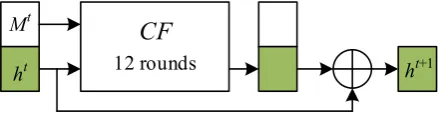
Fig. 1.The compression function of Whirlwind
For the remainder of this paper, we will adopt this alternative understanding of the round function. Now we give detailed algorithm of the compression functionCF.
1. Initialize the state arrayS0 with the input chaining valuehtand the input message blockMt:
S0 i,j=hti,j
S0i+4,j =Mi,jt , for 0≤i <4, 0≤j <8.
2. Apply 12 iterations of the round function to the initial stateS0, and derive the final stateS12:
Sk+1=
(σk◦θR◦γ)(Sk), kis even,
3. Truncate the final stateS12and perform the feed-forward to derive the output chaining value ht+1:
ht+1i,j =hti,j⊕Si,j12, for 0≤i <4, 0≤j <8.
After all message blocks have been processed with the compression function iteratively, the output trans-formation is performed to avoid trivial length extension attacks. Suppose the output chaining value of the last message block ishLAST, then the final 512-bit digesthX is computed as:
hX=CF(hLAST,0),
with the message block equal to the 8×4 null matrix.
2.2 The Meet-in-the-Middle Preimage Attack
The Meet-in-the-Middle (MitM) preimage attack was first introduced by Aoki and Sasaki in their preimage attacks againstMD4and 63-stepMD5[5]. The basic idea of this technique, which is known assplice-and-cut, aims to divide the target cipher into two sub-ciphers which can be computed independently. Due to the feed-forward operations in hash functions, the MitM attack can then be applied. Several advanced techniques to further improve the basic attack are developed, such as partial matching [5], partial fixing [5], initial structure [34], indirect partial matching [3], bicliques [20] and differential MitM attack [21].
In [33], Sasaki proposed the first MitM preimage attack on AES-like compression functions. Two main techniques were presented, namely, initial structure in anAES-like compression function and indirect partial matching through an MixColumn layer. This work was later improved by Wuet al.in [36]. Thanks to the delicate descriptions of the MitM preimage attack framework on AES-like compression functions presented in [36], the chunk separations can be easily represented by introducing several essential integer parameters, and the best attack parameters can be easily derived through an exhaustive search. In [35], Sasaki et al. introduced the guess-and-determine approach to extend the basic attack by one more round.
2.3 The Rebound Attack and the SuperSBox Technique
The rebound attack was first introduced by Mendelet al.in their attacks against reduced-roundWhirlpool
andGrøstl[24]. It aims to find a pair of inputs satisfying some unique properties for some specific (truncated) differential characteristics faster than the ideal case. There are two main procedures of the rebound attack, namely, the inbound phase and the outbound phase. LetCandDdenote the certain non-full-active differential forms (normally with very few active cells) in the inbound phase, and F denote the full-active differential form, then the differentials in the inbound phase of the basic rebound attack can be denoted asC → F ← D. The available freedom degrees are used to connect these middle rounds with relatively small amount of computations using the match-in-the-middle technique. In the outbound phase, solutions from the inbound phase are propagated both forwards and backwards to connect the differentials in both directions.
The SuperSBox technique for the rebound attack was independently introduced in [12,22]. This technique exploits the fact that the non-linear layers between two rounds,i.e.,SB, SR, MC, AC, SBcan be computed for each column independently. Therefore, by constructing the look-up tables for each individual column, the SuperSBox technique is able to cover one more full-active state in the inbound phase, namely,C → F ↔ F ← D. The look-up tables built are hence called the SuperSBoxes. In [15,16], a further extension of the rebound attack and the SuperSBox technique, which can cover three full-active states C → F ↔ F ↔ F ← D in the inbound phase, was presented. The core of this technique is the advanced techniques utilized to merge solutions generated from the forward and backward SuperSBoxes in more efficient manners.
3
(Second) Preimage Attacks on Reduced-Round
Whirlwind
3.1 Second Preimage Attack on 6-Round Whirlwind
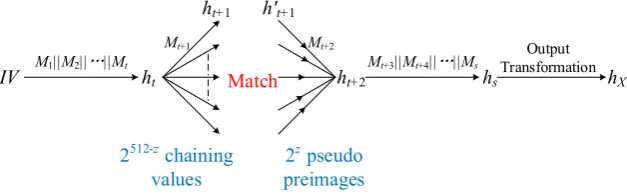
Before describing all attacks, we stress that a single compression function computation (resp. the state bit size of the compression function) is used as the basic unit of time (resp. memory) throughout this paper. The second preimage attack on 6-round Whirlwindis less complex and more traditional. As depicted in Fig. 2, suppose we expect to find a second preimage ofM1||M2||...||Ms, the attack procedures can be divided into two phases. In the first phase, we find sufficient pseudo preimages and derive a set ofh0t+1s for a chaining value in the middle ht+2. In the second phase, we launch the traditional MitM method [26, Fact 9.99] to convert the pseudo preimages into a second preimage. More precisely, we choose random values of Mt to compute a set of ht+1s fromht, and search for a match of ht+1 in the set of h0t+1s. A second preimage is successfully constructed if a match is derived.
IV Match
2z pseudo
preimages 2512-z chaining
values
ht+2
ht+1 h't+1
M1||M2||…||Mt
ht
Mt+3||Mt+4||…||Ms
hs
Mt+1 Mt+2 Output
Transformation h
X
Fig. 2.Second preimage attack on 6-roundWhirlwind
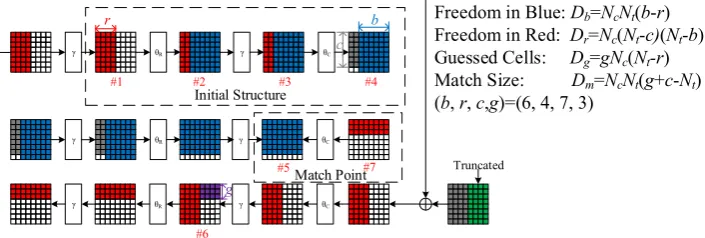
The main task lies in the first phase where sufficient pseudo preimages have to be generated. This can be done by utilizing the MitM preimage attack framework onAES-like compression functions which have been extensively investigated in [33,36,35]. Without loss of generality, we introduce the plain attack framework with the MitM preimage attack on 6-round Whirlwindcompression function, and Fig. 3 depicts the basic chunk separation of this attack. Before more details are illustrated, we define several notations which are used throughout this paper.
n Bit size of the digest. Nc Bit size of the cell.
Nt Number of columns (or rows) in the state.
b Number of blue columns (or rows) in the initial structure, and r Number of red columns (or rows) in the initial structure.
c Number of constant cells in each column (or row) corresponding to the red column (or row) in the initial structure.
g Number of guessed rows (or columns, in purple) in the backward (or forward) computation.
Db Freedom degrees of the blue chunk in bits. Dr Freedom degrees of the red chunk in bits. Dg Bit size of the guessed cells.
Dm Bit size of the match point. T Time complexity of the attack. M Memory requirement of the attack.
The attack procedures of the first phase can be further divided into five steps which are elaborated as follows, and the interested readers are referred to [33,36,35] for more detailed descriptions.
Step 2. Forward Computation. For all the blue and grey cells at state #4, the forward chunk can be computed forwards independently until state #5.
Step 3. Backward Computation. For all the red cells at #1, the backward chunk can be computed backwards independently until state #7. In order to proceed the backward computation by one more round, the guess-and-determine strategy is applied at state #6 by guessing the value of grows.
Step 4. Indirect-Partial-Matching through the MixRow Layer. We have partial information of the red and blue cells from both directions, and linear relations of theθC operation can be further exploited at the match point to perform the indirect-partial-matching between states #5↔#7.
Step 5. Recheck. Check whether the guessed cells of the partial match derived in step 4 are guessed correctly. If so, check whether the partial match is also a full match. Repeat the above steps 1-5 until a preimage is found.
θR
γ γ θC
b
Initial Structure
Match Point
Freedom in Blue: Db=NcNt(b-r)
Freedom in Red: Dr=Nc(Nt-c)(Nt-b)
Guessed Cells: Dg=gNc(Nt-r)
Match Size: Dm=NcNt(g+c-Nt)
(b, r, c,g)=(6, 4, 7, 3)
#4 #1
r
θR
θR γ θC
θC γ
γ
γ
#6
Truncated g
c
#2 #3
#5 #7
Fig. 3.Chunk separation for the 6-round pseudo preimage attack
Deriving the Attack Parameters.As studied in [36,35], the attack parameters, e.g., (Db, Dr, Dg, Dm) can be easily represented with several predefined integer parameters (b, r, c, g) as shown in Fig. 3. The attack complexities can be denoted as follows:
T = 2n(2−Dr+ 2Dg−Db+ 2Dg−Dm),
M =min{2Dr+Dg,2Db}. (1)
We can derive the optimal attack parameters by enumerating all possible values of (b, r, c, g).
Complexity Analysis. Fig. 3 gives the optimal chunk separation for the pseudo preimage attack on the compression function, and it requires 2480time and 2128memory. In order to balance the overall complexities, we generate 216pseudo preimages in the first phase. In the second phase of the attack, we compute 2496h
t+1s, and find a match with the pseudo preimages generated in the first phase with a high probability. Finally, it would require 2497 time and 2128 memory to launch a second preimage attack on 6-roundWhirlwind.
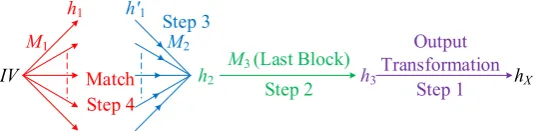
3.2 Overview of the 4-Round Preimage Attack
Due to the strong impacts introduced by the truncation operation and the partially fixed state ofWhirlwind
(especially by the output transformation), our preimage attack can only work up to 4 rounds. The gap between the attacked rounds of preimage and second preimage attacks demonstrates that the adoptions of the truncation operation and the partially fixed state do strengthen Whirlwind in terms of preimage resistance.
Match h2 Step 1 h1 h'1
IV M3 (Last Block) h3
M1 M2 Output
Transformation h
X Step 2
Step 3
Step 4
Fig. 4.Overview of the preimage attack on 4-roundWhirlwind
3.3 The Slightly Tweaked MitM Preimage Attack on AES-like Compression Functions
The main bottlenecks of the preimage attack lie in step 1 and step 2 where partial values of the initial states are already fixed before launching the attack. More precisely, in step 1 the rightmost 4 columns of the state are fixed to 0 in the output transformation. As in step 2, since the preimage we try to build consists of 3 blocks, and the last block contains 255 message bits and 257 padding bits according to the MD-strengthening padding algorithm, the rightmost 2 columns of the state are fixed to the value 512 + 512 + 255 = 1279. The plain MitM preimage attack framework on AES-like compression functions described in Section 3.1 seems inapplicable in this scenario. Luckily, we can apply a small and simple tweak which partially fixes the values of the state, and thus make the original attack framework feasible.
The Tweaked Attack Framework with Truncation. There are two main differences in the tweaked
attack framework compared to the plain framework, namely, the partially fixed input state before the first round and the truncation operation carried after the last round. Also notice that the first and the last rounds are connected by the feed-forward operation, thus the initial structure in the tweaked framework needs to be located carefully between the first and the last rounds. Without loss of generality, we use the attack on 4-roundWhirlwindcompression function as an instance to elaborate the tweaked framework, and Fig. 5 depicts the basic chunk separation of this attack. Following the definitions in Section 3.1, several additional notations need to be specified before providing more details. Since the half truncation is performed inWhirlwind, we will describe the slightly tweaked attack framework under the setting that the output chaining value is truncated in the following part.
tr Number of columns (or rows) truncated in the output chaining value. f i Number of columns (or rows) fixed in the initial state before the attack. b1 Number of blue columns (or rows) with partial freedom degrees in the
initial structure.
b2 Number of blue columns (or rows) with full freedom degrees in the initial structure, we haveb=b1+b2.
Db1 Freedom degrees of the blue chunk with partial freedom degrees in bits.
Db2 Freedom degrees of the blue chunk with full freedom degrees in bits,
we haveDb=Db1+Db2.
Freedom in Blue 1: Db = Ncb1(Nt - g) Freedom in Blue 2: Db = Ncb2Nt
Freedom in Blue: Db = Nc[b1(Nt - g) + b2Nt] Freedom in Red: Dr = rNc(Nt - c)
Guessed Cells: Dg = gNc(b2 + fi) Match Size: Dm = NcNt(g + c - Nt)
Constraints: b1 + b2 + r + fi = Nt b1+ b2= b b1 + r ≤ Nt - tr
(tr, fi) = (4, 2), (b1, b2, b, r, c, g) = (2, 3, 5, 1, 7, 3)
γ
θR
γ
θC
γ
θR
γ
θC
Initial Structure Match Point
r
g c
hX tr b1b2 fi
b
#4
#3 #5 #6 #1 #2
Fig. 5.The tweaked MitM preimage attack framework with truncation
Step 1. Initialization. Set thef iyellow columns in the initial state to the prefixed values, and denote the target digest ashX.
Step 2. Initial Structure. Randomly choose values for the constants which are denoted in grey in the initial structure. According to the prefixed values in step 1 and the chosen constants in step 2, compute all values for the blue and red cells in the initial structure. After this step, the compression function is divided into two independent chunks.
Step 3. Backward Computation. In order to perform the backward computation, we have to apply the guess-and-determine strategy by guessingg rows which are denoted in purple at state #1. For all values of the red and guessed purple cells, compute backwards to the matching point at state #6 and store all partial matching values in a sorted tableT L(e.g.hash table).
Step 4. Forward Computation. The blue cells in the forward computation can be further classified into two categories. For the b1 columns, their values are constrained by the constant values in the initial structure, and there are overall 2Db1 values for these blue cells. Due to the truncation, we have to ensure
r+b1≤Nt−tr. For theb2columns, they can take all 2Db2 possible values of these blue cells. Combining
these two categories, the freedom degrees in the blue cells are 2Db = 2Db1+Db2. For all values of the blue
cells, compute forwards to the matching point at state #5.
Step 5. Indirect-Partial-Matching. Check whether the partial matching values derived in step 4 is also in the tableT Lbuilt in step 3.
Step 6. Recheck. Check whether the guessed cells of the partial match derived in step 5 are guessed correctly. If so, check whether the partial match is also a full match. Repeat the above steps 2-6 until a preimage is found.
Complexity Analysis. Note that we can also swap the orders of step 3 and step 4, and the selection depends on which step requires less memory. Similar to the plain framework described in Section 3.1, the complexities of the tweaked attack are as follows:
T = 2n(2−Dr+ 2Dg−Db+ 2Dg−Dm),
M =min{2Dr+Dg,2Db}.
We do not provide detailed deductions, but it is convenient to check that the quartet (Db, Dr, Dg, Dm) can be represented with the integer variables defined as given in Fig. 5. The optimal attack parameters can be easily achieved by an exhaustive search for all valid values of (b1, b2, r, c, g) with a prefixed (f i, tr).
The Tweaked Attack Framework without Truncation and Its Applications. Another interesting
problem is to study the tweaked attack framework without truncation. We present detailed descriptions of this framework in Appendix A. As shown in the analyses, the attacked rounds can be further extended to 5 and even 6 rounds.
A natural scenario to adapt this tweaked framework without truncation is to generate short preimages for certain hash primitives by fixing partial values of the padding. The idea of generating short preimages by fixing the padding values is simple and widely applied to hash functions with the generalized Feistel structure and permutation-based message schedules such asMD5[34] andSHA-0/1[4], because the message blocks are commonly added into the round functions leaving enough freedom degrees to fix the padding message blocks. However, for most of theAES-like hash primitives, the input message block is immediately mixed into the input state, and thus restrain the ability to choose and fix proper values of the padding message block (normally the last one). In practice, many previous preimage attacks on AES-like hash functions do not impose any restraints on the padding values, and they largely rely on the expandable messages [18] which often result in preimages with very large and impractical lengths. After the investigations of this tweaked framework, we find out that for some practicalAES-like hash constructions, there are freedom degrees to prefix partial values of the padding message block, and thus it is possilbe to derive preimages with relatively short (even practical) lengths for these constructions (though normally with higher time complexities). As direct applications, we launch two new preimage attacks against 5 and 6 rounds of Whirlpool, which reduce the preimage length from 2256bits [35] to two blocks and 2128bits respectively. Furthermore, under a very reasonable adoption of the padding algorithm, namely, MD-strengthening with the 64-bit length padding which is also used byMD5
while no preimage attacks exist in literature for these constructions instantiated with (reduced-round)AES
at the hash function level. The details of these proposed attacks are also provided in Appendix A, and the results are summarized in Table 4.
3.4 Details of the 4-Round Preimage Attack
Step 1.In this step, we need to invert the output transformation and derive the chaining valueh3. Since the right half of the input state #1 is fixed to 0, and the right half of the output state #2 is truncated, we have to utilize the tweaked MitM preimage attack framework with truncation under the parameters (f i, tr) = (4,4). As shown in Fig. 6, we derive the optimal chunk separation with parameters (b1, b2, r, c, g) = (3,0,1,7,3) after an exhaustive search. Finally, it requires 2496time and 2208memory to invert the output transformation of 4-round Whirlwind. Note that since we need to match a 512-bit target digest, but there are only 2512 freedom degrees in the input chaining valueh3, step 1 will succeed with probability 1−e−1.
Freedom in Blue: Db=Nc(b1(Nt - g) + b2Nt)
Freedom in Red: Dr=rNc(Nt - c) Guessed Cells: Dg = gNc(b2 + fi)
Match Size: Dm=NcNt(g + c - N) (tr, fi)=(4, 4), (b1, b2, r, c, g)=(3, 0, 1, 7, 3) γ θR γ θC γ θR γ θC Initial Structure Match Point
r b1
g c
hX tr fi
Initial Structure #1 #2
Fig. 6.Step 1. Invert the output transformation
Step 2.In this step, given the value of h3, we have to invert the compression function in order to derive the input chaining value h2 and the last message block M3 which contains the padding part. Since we aim to build a three-block preimage, according to the MD-strengthening padding algorithm, the last 257 bits of M3 are fixed to the padding value. Consequently, the 2 rightmost columns of the initial state are prefixed as denoted with yellow in Fig. 7. Note that since the 256-th bit ofM3 has to be ’1’ due to the padding, we lose one bit freedom degree of the blue chunks. We utilize the tweaked MitM preimage attack framework with truncation under the parameters (f i, tr) = (2,4), and exhaustively search for all valid values of (b1, b2, r, c, g). The chunk separation with (b1, b2, r, c, g) = (0,2,4,7,3) as shown in Fig. 7 is the best result achieved. As a result, step 2 requires 2449 time and 2255 memory. Since step 2 requires much less computations than step 1, one can also carry out step 2 with parameters (b1, b2, r, c, g) = (3,2,1,7,3) to minimize the memory requirement. The corresponding complexities are (T, M) = (2496,2208).
Freedom in Blue: Db=Nc(b1(Nt - g) + b2Nt)
Freedom in Red: Dr=rNc(Nt - c)
Guessed Cells: Dg = gNc(b2 + fi)
Match Size: Dm=NcNt(g + c - N) (tr, fi)=(4, 2), (b1, b2, r, c, g)=(0, 2, 4, 7, 3)
12333 γ θR γ θC γ θR γ θC Initial Structure Match Point r b2 g c h3 Initial Structure 1 tr fi #3 #4
Fig. 7.Step 2. Derive the last message block
Step 3.In this step, given the value of h2, we have to invert the compression function in order to derive the value of the second message block M2 and the input chaining value h1. The only constraint of this step is the final truncation, thus the traditional MitM preimage attack can be launched. We omit these details. As depicted in Fig. 8, with parameters (b, r, c) = (5,3,4), the attack is optimized with complexities (T, M) = (2320,2192). Since we will perform the traditional MitM procedure [26, Fact 9.99] to convert the pseudo preimages into a preimage in step 4, we have to generate and store multiple say 2xpairs of (h1, M2), which require 2320+x time and 2xmemory.
Freedom in Blue: Db=bNc(Nt - r)
Freedom in Red: Dr=Nc(Nt - b)(Nt - c)
Match Size: Dm=crNc
(b,r,c)=(5,3,4)
γ θR γ θC γ θR γ θC Match Point Initial Structure r b h2 1 c
Step 4.In this step, we launch the traditional MitM method to connect the values ofh01 generated in step 3. More precisely, we choose random values of M1 and compute the corresponding output chaining values h1, then match it with the values ofh01 generated in step 3. After choosing 2512−xdistinct values ofM1, we expect to find a match and finally derive a preimage of 4-round Whirlwind. Since each h1 can be checked on the fly, the memory requirement for step 4 is negligible. We choosex= 96 to minimize the overall time complexity for step 3 and step 4 which is 2512−96+ 2320+96= 2417.
Complexity Analysis. Now to sum up, the time complexity is dominated by step 1, and the memory requirement is dominated by step 2. Finally, the complexities for the 4-round preimage attack are (T, M) = (2496,2255). One can also minimize the memory requirement by adopting the alternative attack parameters provided in step 2, which results in complexities of (T, M) = (2497,2208).
4
Collision Attacks on Reduced-Round
Whirlwind
This section presents the collision attack on 4- and 5-round Whirlwindhash function. Due to the Davies-Meyer-like mode of Whirlwind, it is feasible to launch semi-free-start or free-start collision attacks on the reduced-round compression function with the rebound attack, but deriving a collision attack at the hash function level seems difficult. Fortunately, with the aid of the multi-block strategy, we are able to launch collision attacks on 4 and 5 rounds of theWhirlwindhash function.
4.1 Overview of the 5-Round Collision Attack
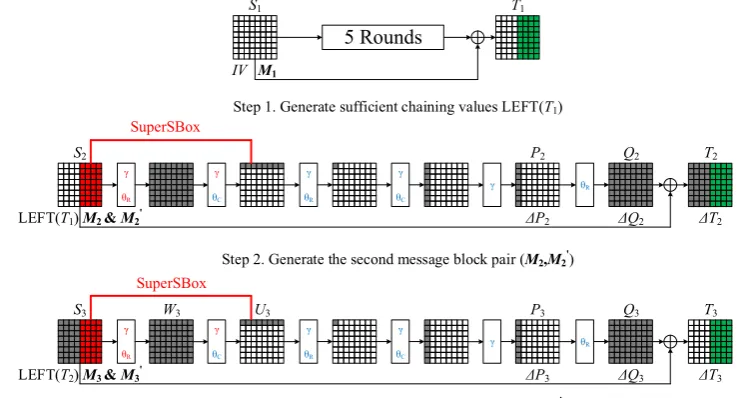
The previous collision attacks onGrindahl[30] andGrøstl [25] generate colliding messages which contain several consecutive message blocks. The general strategy in these attacks is after introducing the differences into the chaining values, the differences are gradually cancelled with the posterior message blocks, and eventually lead to collisions by eliminating the differences in the output chaining values. Our attack is based on a similar multi-step process which gradually introduces, restricts and finally cancels the differences. As shown in Fig. 9, the overall attack consists of three steps and outputs a 3-block colliding pair, and each step targets on a certain message block.
T1
IV M1
S1
5 Rounds
Step 1. Generate sufficient chaining values LEFT(T1)
Step 2. Generate the second message block pair (M2,M2')
γ
θC γ
θR
γ θR
Q2 T2
P2
LEFT(T1)M2 & M2' ΔP2 ΔQ2 ΔT2
γ
θR
γ
θC
S2
γ
θC γ
θR
γ θR
Q3 T3
P3
LEFT(T2) M3 & M3' ΔP3 ΔQ3 ΔT3
Step 3. Generate the third message block pair (M3,M3')
γ
θR
γ
θC
S3 W3 U3
SuperSBox
SuperSBox
Fig. 9.Collision attack on 5-roundWhirlwind
the green cells in the output chaining value of the compression function are truncated. The overall collision attack consists of three steps, and the collision pair has three blocks,i.e., (M1||M2||M3, M1||M20||M30).
Step 1. Provide the freedom degrees. The purpose of the first step is to provide sufficient freedom degrees for the subsequent two steps. We randomly choose the values of the first message blockM1and compute the output chaining valuesLEFT(T1).
Step 2. Introduce the input differences and restrict the output differences. We introduce the in-put differences by choosing different values for the second message block,i.e., (M2, M20), such that the difference of the output chaining values for the second compression function call, namely, LEFT(∆T2), satisfies thatLEFT(∆T2) =LEFT(∆Q2), where∆Q2=θR(∆P2) and the difference ofP2only lies in the first column.
Step 3. Cancel the output differences. We need to generate the message block pair (M3, M30), such that the output difference of the permutation for the third compression function call, namely, LEFT(∆Q3), satisfies that ∆Q3 = θR(∆P3), where the difference of P3 only lies in the first column. It is clear that the values of ∆Q2 and ∆Q3 are in the same subspace thanks to their unique differential forms, and moreover, if ∆P2 = ∆P3 is satisfied, we can directly deduct that ∆Q2 = ∆Q3 due to the linear properties of θR. Consequently, the output difference of the third compression function call, namely,
LEFT(∆T3) will be 0, since we haveLEFT(∆T3) =LEFT(∆T2)⊕LEFT(∆Q3) =LEFT(∆Q2)⊕LEFT(∆Q3) due to the feed-forward operation. Finally, appending any identical message blocks which satisfy padding to (M1||M2||M3, M1||M20||M30) will lead to a collision on the hash function.
4.2 Impacts of the Partially Fixed States
As shown in Fig. 9, partial values of the input states are fixed in the last two steps of the attack. More precisely, the left half of S2 is fixed to LEFT(T1) in the second step of the attack, and the left half of the paired values S3 are fixed to LEFT(T2) and LEFT(T20) in the last step of the attack. Since the SuperSBox technique is utilized at the input states of the last two steps, it is essential to discuss the impacts brought by the partially fixed states.
γ θR
γ θC
S3 U3
SSB0
SSB1
SSBN -1
W3
Nf
Nt t
Fig. 10.Illustrations of the tweaked SuperSBox technique with partially fixed states
Without loss of generality, we use the inbound phase of step 3 which connectsS3andU3as an instance to discuss a similar and generalized problem as depicted in Fig. 10. Suppose that both the differences and the values of theNf grey columns inS3are fixed, and the differences and the values of theNt−Nf remaining red columns inS3can be freely chosen. According to the SuperSBox technique, the three layersγ→θR→γ can be seen asNtparallel row-wise SuperSBoxes, namely,SSB0, SSB1, ..., SSBNt−1. Regarding some of the
definitions in Section 3.1, the exact attack steps of the tweaked SuperSBox technique with partially fixed states are as follows:
1. From the forward direction, for every difference of the red cells inSSB0, we enumerate all 2Nc(Nt−Nf) possible values conforming to this difference, and compute the corresponding values and differences in γ(W3). We save them in a sorted table. Since we can enumerate all 2Nc(Nt−Nf) differences in SSB0, so the lookup table ofSSB0 has at most 22Nc(Nt−Nf) entries. For the remainingNt−1 SuperSBoxes, the
procedures are similar.
2. From the backward direction, we select a random difference of U3, and compute it backwards to get the value ofθC−1(∆U3). We match this difference with theNt SuperSBox tables built in step 1. Since a NcNt-bit difference needs to be matched for each SuperSBox, two different cases need to be considered:
Case 1. The number of entries in each table is insufficient to derive aNcNt-bit match, namely, 2Nc(Nt− Nf) < NcNt (equivalent to 2Nf > Nt). In this case, we have to compute 2NcNt−2Nc(Nt−Nf) =
2Nc(2Nf−Nt)differences ofθ−1
to derive a match for allNtSuperSBoxes simultaneously, we have to choose 2NcNt(2Nf−Nt)different
values ofθ−C1(∆U3). Since there are overall 2NcNtpossible differences ofU3, ifNcNt< NcNt(2Nf−Nt)
which is equivalent to 2Nf > Nt+ 1, we are not able to derive a match for all the SuperSBoxes at the same time.
Case 2. The number of entries in each table is sufficient to derive a match, namely, 2Nc(Nt−Nf)≥NcNt (equivalent to 2Nf ≤Nt). In this case, instead enumerating all differences and values of the red cells in each row ofS3, we only need to select suffiecient say 2X differences of the red cells, and exhaust all 2X+Nc(Nt−Nf) corresponding values for each SuperSBox. We chooseX +Nc(Nt−Nf) =NcNt
(equivalent toX=NcNf), because we only need to match aNcNt-bit difference for each SuperSBox. It requires 2NcNt time and memory to generate and store theNtSuperSBoxes tables. Given a specific
differenceθC−1(∆U3), we expect to get a match for each of theNtSuperSBoxes simultaneously, thus derive a solution for the inbound phase. After exhausting all 2NcNt differences of U
3, we expect to get 2NcNt solutions for the inbound phase with 2NcNt time and memory. Since there are overall
22NcNt(Nt−Nf)differences and corresponding values of the red cellsS
3, andNtactive cells inU3, we can generate at most 22NcNt(Nt−Nf)−NcNt(Nt−1)= 2NcNt(Nt−2Nf+1)solutions for the inbound phase.
To summarize the above analysis, if 2Nf ≤Nt, we can generate 2NcNt solutions for the inbound phase
with 2NcNt time and memory, and at most 2NcNt(Nt−2Nf+1) solutions can be generated for the inbound
phase. Otherwise if 2Nf > Nt, the attack would be infeasible due to the lack of freedom degrees.
4.3 Details of the Collision Attack
For Whirlwind, Nc = 16, Nt = 8, Nf = 4 which satisfies the condition discussed in Section 4.2, and the SuperSBox technique can be adapted. We illustrate the detailed procedures of the 5-round collision attack as shown in Fig. 9.
Step 1. From the specifiedIV, we choose a random value for the first message blockM1, and compute its output chaining value which isLEFT(T1) due to the truncation.
Step 2. FromLEFT(T1), we utilize the SuperSBox technique by exploiting the freedom degrees in both the values and the differences ofM2in the inbound phase (in red). We get 2128solutions for the inbound phase with 2128 time and 2128 memory. Based on the analysis in Section 4.2, the overall number of solutions for the inbound phase is 2128. The probability of the outbound phase (in blue) is 2−16×7 = 2−112, thus we expect to get 216 pairs of (M2, M0
2).
Step 3. From a specific pair ofLEFT(T2) andLEFT(T20) which is generated in step 2, we utilize the SuperSBox technique by exploiting the freedom degrees in both the values and the differences ofM3in the inbound phase (in red). We get 2128 solutions for the inbound phase with 2128 time and 2128 memory. The probability of the outbound phase (in blue) is 2−16×7 = 2−112, and we need to guarantee∆P3 =∆P2 which happens with probability 2−16×8 = 2−128 in order to eliminate the difference. So we need 2240 solutions from the inbound phase of step 3, and the freedom degrees seem insufficient. By choosing 296 different values ofM1in step 1, and combining the 216solutions (LEFT(T2),LEFT(T20)) generated in step 2 for each value of M1, the overall number of solutions reaches 296+16+128 = 2240, and we expect to derive a collision.
Complexity Analysis.As illustrated above, it requires 2240compression function computations to generate a collision for 5-roundWhirlwind. The memory requirement is 2128 due to the SuperSBox technique.
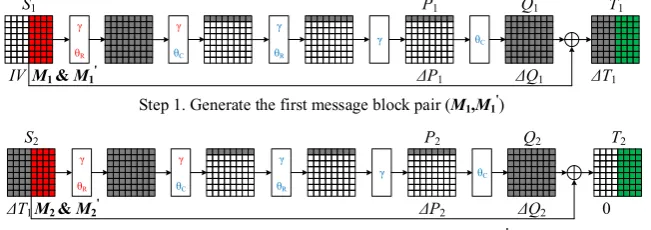
4.4 The Four Round Collision Attack
Step 1. Generate the first message block pair (M1,M1')
Step 2. Generate the second message block pair (M2,M2')
γ
θR
γ
γ
θC
γ
θR
θC
S1 P1 Q1 T1
IV M1 & M1' ΔP1 ΔQ1 ΔT1
γ
θR
γ
γ
θC
γ
θR
θC
S2 P2 Q2 T2
ΔT1 M2 & M2' ΔP2 ΔQ2 0
Fig. 11.Collision attack on 4-roundWhirlwind
5
Limited-Birthday Distinguisher on Reduced-Round
Whirlwind
The limited-birthday distinguisher on hash functions [14], which was proposed at ASIACRYPT 2013, converts semi-free-start collisions on the compression function into a distinguisher on the hash function. This section presents the limited-birthday distinguisher on 6-roundWhirlwind. There are two main procedures to build a limited-birthday distinguisher,i.e., generating sufficient semi-free-start collisions on the compression function and connecting the chaining values with the traditional MitM method. In order to achieve better balance between these two procedures, we follow the ideas presented in [23].
Step 1. Truncated differential trails for the 6-round semi-free-start collision attack with x=3, y=4
γ
θR
γ
θC
γ
θC
γ
θR
γ
θR
γ
θC
S0 S5 S6
0Truncated
x y
S2
S1 S3 S4
IV Match
2z semi-free-start collisions 2512-z chaining
values
Step 2. the MitM procedure to connect chaining values
Fig. 12.Limited-birthday distinguisher on 6-roundWhirlwind
Step 1. Build the Semi-free-start Collisions. The truncated differential trail for the 6-round semi-free-start collision attack is shown in Fig. 12, and it follows the following pattern:
4x r0
−→8x r1
−→64 r2
−→64 r3
−→8y r4
−→4y r5
−→32y,
where x, y = 1,2, ...,8 denote the number of active rows in S1 and S4 respectively. The rebound attack and the SuperSBox technique are utilized to find the collisions, and the specific details are omitted. In the inbound phase, given a random difference of γ(S1), we calculate the corresponding SuperSBoxes with 2128 time and 2128 memory. Then we choose 2128 differences from all possible differences ofS4, and match with the SuperSBoxes. According to the SuperSBox technique, we expect to generate 2128solutions for the inbound phase at the cost of 2128time and 2128memory. In other words, the average complexity to generate a solution for the inbound phase is only 1. If the solutions are insufficient, we can choose other difference values ofγ(S1) andS4and repeat the above procedures.
The outbound phase has a probability of 2−64(x+y), thus the average complexities to generate one semi-free-start collision is 264(x+y)time and 2128memory. Note that there are 2128xdifferences inγ(S
Step 2. Build the Limited-Birthday Distinguisher. As depicted in Fig. 12, suppose 2z semi-free-start collisions are generated in step 1, we compute 2512−zoutput chaining values and hope to find a match using the traditional MitM method with a high probability.
Complexity Analysis. Combining both steps, the time complexity to launch the attack is
T = 2z+64(x+y)+ 2512−z.
Note that the difference of the input messages lies in a subspace of size 216×4x= 264x, and the difference of the output lies in a subspace of size 1 due to the collision property. Hence, for an ideal one-way function, it would requiremax{2256,2513−64x}computations to find a message pair corresponding to the limited-birthday problem.
Now we show how to minimizeT and also make the distinguisher valid. Two different occasions need to be considered. In the first occasion, the amount of the semi-free-start collisions is sufficient to achieve balance for step 2, thus we letz+ 64(x+y) = 512−z in order to balance the complexities of the two steps, and we need to guaranteez≤64(x+y). The above conditions are equivalent tox+y≥3 andz= 256−32(x+y), and the time complexity can be rewritten as
T = 2257+32(x+y).
In the second occasion, the amount of the semi-free-start collisions is insufficient to achieve balance for step 2, thus we need to maximizezto minimize the time complexity. These restraints are equivalent tox+y≤2 andz= 64(x+y), and the time complexity can be rewritten as
T = 2512−64(x+y).
Finally, we consider both occasions and find out that when x = 1, y = 2 the overall time complexity is minimized to 2353 computations, where the generic attack would require 2449 computations. As a result, a valid limited-birthday distinguisher is constructed for 6-roundWhirlwindwith 2353 time and 2160 memory (the semi-free-start collisions need to be stored).
6
Analyses of the Reduced-Round Components of
Whirlwind
This section presents analyses of the reduced-round compression function and inner permutation ofWhirlwind.
6.1 Semi-free-start Collision Attack on 6-RoundWhirlwind Compression Function
The truncated differential trail is depicted in Fig. 13. The three middle rounds are covered with the inbound phase by utilizing the SuperSBox technique, and in the outbound phase two rounds and one round are propagated in the forward and the backward directions respectively. The inbound phase generates 2128 solutions with 2128 time and 2128memory. There are two 8→4 transitions in the outbound phase, thus the probability of the outbound phase is 2−16×8= 2−128. Consequently, it requires 2128 time and 2128 memory to find a semi-free-start collision.
γ
θR
γ
θC
γ
θC
γ
θR
γ
θR
γ
θC
0Truncated
Fig. 13.Semi-free-start collision attack on 6-roundWhirlwindcompression function
6.2 Free-start Near Collision Attack on 7-Round WhirlwindCompression Function
propagated in both the forward and the backward directions. The inbound phase generates 2128 solutions with 2128time and 2128 memory, and can generate at most 2256solutions. There are two 8→1 transitions in the outbound phase, thus the probability of the outbound phase is 2−16×14 = 2−224. Consequently, it requires 2224 time and 2128 memory to find a free-start near collision on 896 bits out of 1024 bits, while for an ideal compression function it would require 2448computations. Note that in order to find a free-start collision, we have to cancel the four leftmost cells of the active row, thus it would require 2224+64 = 2288 solutions from the inbound phase. Consequently, it is almost impossible to derive a free-start collision with this truncated differential trail due to the lack of freedom degrees.
γ
θR
γ
θC
γ
θC
γ
θR
γ
θR
γ
θC
γ
θR
0
Fig. 14.Free-start near collision attack on 7-roundWhirlwindcompression function
6.3 Limited-Birthday Distinguisher on 9-RoundWhirlwind Inner Permutation
The truncated differential trail to build the limited-birthday distinguisher on the permutation [12] is depicted in Fig. 15. The distinguisher is actually a straightforward application of the generic distinguisher onAES-like permutations which has been comprehensively studied [15,16], thus we omit more descriptions. In a word, we can find two messages satisfying the limited-birthday problem with 2736time and 2128memory, while for an ideal permutation it would require 2769computations. Finally, combining the multiple-birthday distinguisher [17] which takes all possible outbound patterns into account, the time complexity can be further reduced to 2730, while the best known generic algorithm would require no less than 2763computations.
γ θR
γ θC
γ θR
γ θC
γ θR
γ θC
γ θR
γ θC
γ θR
Fig. 15.Limited-birthday distinguisher on 9-roundWhirlwindinner permutation
7
Conclusion
We provide a thorough security analysis of Whirlwind. Firstly, we focus on security properties at the hash function level, and present 6-round second preimage, 4-round preimage, 5-round collision and 6-round distin-guishing attacks out of the 12-round hash function. Then we investigate security properties of theWhirlwind
components with several reduced-round attacks on the compression function and the underlying permutation. Moreover, we show how to generate preimages with significantly reduced lengths for reduced-round ver-sions of Whirlpool, and also present the first preimage attacks at the hash function level for several PGV modes instantiated with 6-roundAES.
Acknowledgements. We would like to thank the anonymous reviewers of ACISP 2015 for their valuable comments and suggestions.
References
1. Albrecht, M., Driessen, B., Kavun, E., Leander, G., Paar, C., Yal¸cın, T.: Block Ciphers - Focus on the Linear Layer (feat. PRIDE). In: Garay, J., Gennaro, R. (eds.) CRYPTO 2014, LNCS, vol. 8616, pp. 57–76. Springer, Heidelberg (2014)
2. AlTawy, R., Youssef, A.: Second Preimage Analysis of Whirlwind. In: Lin, D., Yung, M., Zhou, J. (eds.) Inscrypt 2014. LNCS, vol. 8957, pp. 311–328. Springer International Publishing (2015)
3. Aoki, K., Guo, J., Matusiewicz, K., Sasaki, Y., Wang, L.: Preimages for Step-Reduced SHA-2. In: Matsui, M. (ed.) ASIACRYPT 2009. LNCS, vol. 5912, pp. 578–597. Springer, Heidelberg (2009)
5. Aoki, K., Sasaki, Y.: Preimage Attacks on One-Block MD4, 63-Step MD5 and More. In: Avanzi, R., Keliher, L., Sica, F. (eds.) SAC 2008. LNCS, vol. 5381, pp. 103–119. Springer, Heidelberg (2009)
6. Barreto, P., Nikov, V., Nikova, S., Rijmen, V., Tischhauser, E.: Whirlwind: A New Cryptographic Hash Function. In: Designs, Codes and Cryptography. vol. 56, pp. 141–162. Springer, US (2010)
7. Barreto, P., Rijmen, V.: The Whirlpool Hashing Function. Submitted to NESSIE (2000),http://www.larc.usp. br/~pbarreto/WhirlpoolPage.html
8. Bogdanov, A., Khovratovich, D., Rechberger, C.: Biclique Cryptanalysis of the Full AES. In: Lee, D., Wang, X. (eds.) ASIACRYPT 2011. LNCS, vol. 7073, pp. 344–371. Springer, Heidelberg (2011)
9. Daemen, J., Rijmen, V.: The Design of Rijndael: AES - the Advanced Encryption Standard. Springer, Heidelberg (2002)
10. Damg˚ard, I.B.: A Design Principle for Hash Functions. In: Brassard, G. (ed.) CRYPTO 1989. LNCS, vol. 435, pp. 416–427. Springer, New York (1990)
11. Floyd, R.W.: Nondeterministic Algorithms. J. ACM 14(4), 636–644 (1967)
12. Gilbert, H., Peyrin, T.: Super-Sbox Cryptanalysis: Improved Attacks for AES-like Permutations. In: Hong, S., Iwata, T. (eds.) FSE 2010. LNCS, vol. 6147, pp. 365–383. Springer, Heidelberg (2010)
13. International Organization for Standardization: ISO/IEC 10118-1:2004: Information technology - Security tech-niques - Hash-functions - Part 3: Dedicated hash-functions (2004)
14. Iwamoto, M., Peyrin, T., Sasaki, Y.: Limited-Birthday Distinguishers for Hash Functions. In: Sako, K., Sarkar, P. (eds.) ASIACRYPT 2013. LNCS, vol. 8270, pp. 504–523. Springer, Heidelberg (2013)
15. Jean, J., Naya-Plasencia, M., Peyrin, T.: Improved Rebound Attack on the Finalist Grøstl. In: Canteaut, A. (ed.) FSE 2012, LNCS, vol. 7549, pp. 110–126. Springer, Heidelberg (2012)
16. Jean, J., Naya-Plasencia, M., Peyrin, T.: Improved Cryptanalysis of AES-like Permutations. In: J. Cryptology. pp. 1–27. Springer, US (2013), published online
17. Jean, J., Naya-Plasencia, M., Peyrin, T.: Multiple Limited-Birthday Distinguishers and Applications. In: Lange, T., Lauter, K., Lisonˇek, P. (eds.) SAC 2013, pp. 533–550. LNCS, Springer, Heidelberg (2014)
18. Kelsey, J., Schneier, B.: Second Preimages onn-bit Hash Functions for Much Less than 2n Work. In: Cramer, R. (ed.) EUROCRYPT 2005. LNCS, vol. 3494, pp. 474–490. Springer, Heidelberg (2005)
19. Khoo, K., Peyrin, T., Poschmann, A., Yap, H.: FOAM: Searching for Hardware-Optimal SPN Structures and Components with a Fair Comparison. In: Batina, L., Robshaw, M. (eds.) CHES 2014. LNCS, vol. 8731, pp. 433–450. Springer, Heidelberg (2014), also available athttp://eprint.iacr.org/2014/530
20. Khovratovich, D., Rechberger, C., Savelieva, A.: Bicliques for Preimages: Attacks on Skein-512 and the SHA-2 Family. In: Canteaut, A. (ed.) FSE 2012. LNCS, vol. 7549, pp. 244–263. Springer, Heidelberg (2012)
21. Knellwolf, S., Khovratovich, D.: New Preimage Attacks against Reduced SHA-1. In: Safavi-Naini, R., Canetti, R. (eds.) CRYPTO 2012, LNCS, vol. 7417, pp. 367–383. Springer, Heidelberg (2012)
22. Lamberger, M., Mendel, F., Rechberger, C., Rijmen, V., Schl¨affer, M.: Rebound Distinguishers: Results on the Full Whirlpool Compression Function. In: Matsui, M. (ed.) ASIACRYPT 2009. LNCS, vol. 5912, pp. 126–143. Springer, Heidelberg (2009)
23. Ma, B., Li, B., Hao, R., Li, X.: Improved Cryptanalysis on Reduced-Round GOST and Whirlpool Hash Func-tion. In: Boureanu, I., Owesarski, P., Vaudenay, S. (eds.) ACNS 2014. LNCS, vol. 8479, pp. 289–307. Springer International Publishing (2014), full version available athttp://eprint.iacr.org/2014/375
24. Mendel, F., Rechberger, C., Schl¨affer, M., Thomsen, S.S.: The Rebound Attack: Cryptanalysis of Reduced Whirlpool and Grøstl. In: Dunkelman, O. (ed.) FSE 2009. LNCS, vol. 5665, pp. 260–276. Springer, Heidelberg (2009)
25. Mendel, F., Rijmen, V., Schl¨affer, M.: Collision Attack on 5 Rounds of Grøstl. In: Cid, C., Rechberger, C. (eds.) FSE 2014. LNCS, vol. 8540, pp. 509–521. Springer, Heidelberg (2015)
26. Menezes, A.J., Van Oorschot, P.C., Vanstone, S.A.: Handbook of Applied Cryptography. CRC press (2010) 27. Merkle, R.C.: One Way Hash Functions and DES. In: Brassard, G. (ed.) CRYPTO 1989. LNCS, vol. 435, pp.
428–446. Springer, New York (1990)
28. National Institute of Standards and Technology (NIST): FIPS-197: Advanced Encryption Standard. Federal Information Processing Standards Publication 197, U.S. Department of Commerce (November 2001), http: //csrc.nist.gov/publications/fips/fips197/fips-197.pdf
29. National Institute of Standards and Technology (NIST): FIPS PUB 180-3: Secure Hash Standard. Federal Information Processing Standards Publication 180-3, U.S. Department of Commerce (October 2008), http: //csrc.nist.gov/publications/fips/fips180-3/fips180-3_final.pdf
30. Peyrin, T.: Cryptanalysis of Grindahl. In: Kurosawa, K. (ed.) ASIACRYPT 2007. LNCS, vol. 4833, pp. 551–567. Springer, Heidelberg (2007)
31. Preneel, B., Govaerts, R., Vandewalle, J.: Hash Functions Based on Block Ciphers: A Synthetic Approach. In: Rueppel, R. (ed.) CRYPTO 1993. LNCS, vol. 658, pp. 368–378. Springer, Heidelberg (1993)
33. Sasaki, Y.: Meet-in-the-Middle Preimage Attacks on AES Hashing Modes and an Application to Whirlpool. In: Joux, A. (ed.) FSE 2011. LNCS, vol. 6733, pp. 378–396. Springer, Heidelberg (2011)
34. Sasaki, Y., Aoki, K.: Finding Preimages in Full MD5 Faster Than Exhaustive Search. In: Joux, A. (ed.) EURO-CRYPT 2009. LNCS, vol. 5479, pp. 134–152. Springer, Heidelberg (2009)
35. Sasaki, Y., Wang, L., Wu, S., Wu, W.: Investigating Fundamental Security Requirements on Whirlpool: Improved Preimage and Collision Attacks. In: Wang, X., Sako, K. (eds.) ASIACRYPT 2012. LNCS, vol. 7658, pp. 562–579. Springer, Heidelberg (2012)
36. Wu, S., Feng, D., Wu, W., Guo, J., Dong, L., Zou, J.: (Pseudo) Preimage Attack on Round-reduced Grøstl Hash Function and Others. In: Canteaut, A. (ed.) FSE 2012. LNCS, vol. 7549, pp. 127–145. Springer, Heidelberg (2012)
A
The Tweaked MitM Preimage Attack Framework without Truncation and
Its Applications
A.1 The Tweaked MitM Preimage Attack Framework without Truncation
Fig. 16 shows the basic chunk separation for the tweaked MitM preimage attack framework on 6-roundAES -like compression function without truncation. The symbols follow the same definitions in Section 3, and we fix n= 512, Nc=Nt= 8 for this case. The initial structure has to be built in the last round (or the first round) due to the influences from both the partially fixed values in the input state before the first round and the feed-forward computation performed after the last round. After the construction of the initial structure, the blue and the red chunks can be computed independently. By utilizing the guess-and-determine technique, the backward computation of the red chunk can be extended by one more round. We omit detailed descriptions of the attack procedures. Also note that we have to remove the guessed round under some circumstances because of the lack of freedom degrees in the state, and the attack can only reach 5 rounds. The memoryless attacks can also be achieved with proper attack parameters. The complexities for the 5- and 6-round attacks can be denoted as follows:
T6R= 2n(2−Dr+ 2Dg−Db+ 2Dg−Dm), M6R=min{2Dr+Dg,2Db},
T6R,M L= 2n(2−Dr+ 2Dg−Db+ 2Dg−Dm/2),
T5R= 2n(2−Dr+ 2−Db+ 2−Dm), M5R=min{2Dr,2Db}, T5R,M L= 2n(2−Dr+ 2−Db+ 2−Dm/2).
where M Lrefers to the memoryless attacks. The attack parameters can be easily enumerated, and we list the results in Table 2.
Table 2.Summary of the results for the tweaked MitM preimage attacks without truncation
Rounds f i Parameters I Parameters II Time Memory
#(b, r, c, g) #(Db, Dr, Dg, Dm)
6 1 (6,5,7,2) (64,8,48,64) 2
504 256
2 (5,3,7,3) (128,8,120,128) 2504 2128
5
1 (5,4,5,-) (64,48,-,64) 2
464
248
(5,3,6,-)† (128,32,-,64) 2480 O(1)
2 (4,3,6,-) (64,32,-,64) 2
480 232
(4,3,6,-)† (64,32,-,64) 2480 O(1)
3 (4,3,6,-) (64,16,-,64) 2
496
216
(4,3,6,-)† (64,16,-,64) 2496 O(1)
4 (3,2,7,-) (64,8,-,64) 2
504 28
(3,2,7,-)† (64,8,-,64) 2504 O(1)
Match Point
Initial Structure
MC AK
SB SR
MC AK
SB SR MC
AK SB SR
#1
hX
MC AK
SB SR
MC AK
SB SR
MC AK
SB SR
b : blue rows at #1 r : red rows at #3
c : constant cells in each row at #2 g : purple rows at #4
fi : fixed padding rows at #5 (b, r, c, g, fi) = (6, 5, 7, 2, 1) 6-Round Attack:
Freedom in Blue: Db=NcNt(b-r) Freedom in Red: Dr=Nc(Nt-c)(Nt-b-fi)
Guess Cells: Dg=gNc(Nt-r) Match Size: Dm=NcNt(g+c-Nt)
5-Round Attack:
Freedom in Blue: Db=NcNt(b-r) Freedom in Red: Dr=Nc(Nt-c)(Nt-b-fi)
Match Size: Dm=NcNt(r+c-Nt)
#3
#4
#2 #5
b
fi
r
c
g
Fig. 16.The tweaked MitM preimage attack framework onAES-like compression function without truncation
A.2 Two-Block Preimage Attack on 5-Round Whirlpool and More
Whirlpoolis an ISO standardized hash function [13] which operates on 512-bit input message blocks and produces a 512-bit digest. It adopts the classical MD-strengthening padding, which adds a single bit ‘1’ followed with multiple ‘0’s, and appends a 256-bit length padding L. Its compression function adopts the Miyaguchi-Preneel mode. We refer to [7] for the detailed specifications of Whirlpool. There are several preimage attacks on reduced-round Whirlpool[36,35], but these attacks rely on the expandable messages and construct preimages with very long and impractical lengths. We present two preimage attacks on reduced-round Whirlpool, namely, the two-block preimage attack on 5-round Whirlpooland the preimage attack on 6-roundWhirlpool which significantly reduce the length of the preimage from a maximum size of 2256 bits to a maximum size of 2128 bits.
Two-Block Preimage Attack on 5-RoundWhirlpool. As shown in Fig. 17 (a), the two-block preimage attack consists of two steps. In the first step, we choose random values of the first message block M1, and compute its output chaining valueh1 from the initial value of Whirlpool. In the second step, givenh1and the target digesthX, we launch the tweaked MitM preimage attack on the 5-round compression function to derive the second message blockM2. Since we have to match a 512-bit digest, and partial values ofM2are prefixed due to padding, it seems the freedom degrees are insufficient. However, since we can freely choose the values ofM1 and repeat the second step, thus we have 512 bits freedom degrees inh1 which guarantee the feasibility of the attack.
the MD-strengthening padding, we also lose 1-bit freedom degree in the blue chunk. The expressions of the attack parameters are provided in Fig. 17 (b). After an exhaustive search for the best attack parameters, the two-block preimage attack on 5-roundWhirlpoolcan be launched with 2504 time and 28 memory. The attack can also be memoryless with the same time complexity.
Match Point
Initial Structure
MR AK
SB SC
MR AK
SB SC
MR AK
SB SC
MR AK
SB SC MR
AK SB SC
#4
Fixed
Padding
1
hX
h1
b : blue rows at #1 r : red rows at #3
c : constant cells in each row at #2 fi : fixed padding rows at #4 (b, r, c, fi) = (3, 2, 7, 4)
Freedom in Blue: Db=NcNt(b-r)-1 Freedom in Red: Dr=Nc(Nt-c)(Nt-b-fi)
Match Size: Dm=NcNt(r+c-Nt)
#3 #1 #2
IV
h
1M
1h
XM
2Step 1
Step 2
(a) sketch of the 5-round preimage attack
(b) chunk separation for step 2
Fig. 17.Two-block preimage attack on 5-roundWhirlpool
Extend the Attack to 6-RoundWhirlpool. The current best preimage attack onWhirlpool[35] reaches 6 rounds with 2481time and 2256 memory. However, this attack adds no restraints on the padding part, and the length of the preimage generated can reach a maximum size of 2256 bits. Now we show how to launch the preimage attack on 6-roundWhirlpoolwhich significantly reduces the maximum size of the preimage from 2256bits to 2128 bits.
As depicted in Fig. 18 (a), this attack consists of three steps. In the first step, we build a (119,119 + 2119−1)-expandable messages with 2119+ 119×2256+1≈2264 time and negligible memory2. We denote the output chaining value of the expandable messages asht−1. In the second step, fromht−1, we choose random values for the message blockMt−1and compute the output chaining valueht. In the third step, givenhtand the target digesthX, we launch the tweaked MitM preimage attack on the 6-round compression function to derive the last message blockMt. We need to repeat the last two steps to exploit the freedom degrees in ht which guarantee the validity of the attack. After we derive the value ofMt, we choose message blocks from the expandable messages corresponding to the padding part ofMt. There is a negligible probability that the message length does not correspond to the expandable messages. However, we can repeat the last two steps to derive another value ofMt and make adaptive selection from the expandable messages. If all three steps succeed, we manage to construct a preimage for 6-roundWhirlpool.
2
Based on the results in Appendix A.1, the 6-round attack can work with at most two prefixed columns (or rows, depending on whether the MixColumn or the MixRow is performed). Consequently, two yellow rows are fixed to 0 in the initial state #5 as depicted in Fig. 18 (b), and the maximum size of the message reduces to 2128 bits (equivalent to 2119 512-bit message blocks, thus explain the structure of the expandable messages built in the first step). We also have to fix the 256-th bit to ‘1’ due to the MD-strengthening padding, and thus lose 1 bit freedom degree of the blue chunk. The last 9 bits have to be fixed to0xffsince the last blockMtcontains 255 message bits, but these bits lie in the constants in the initial structure which can be freely chosen by the attacker, thus we do not lose any freedom degrees of the red chunk. Finally, we derive the optimal attack parameters through an exhaustive search, and this step requires 2505 time and 2127 memory. Combining all three steps of the 6-round attack, we need 2505 time and 2127 memory to find a preimage for 6-roundWhirlpoolwhose length is at most 2128bits.
Match Point
Initial Structure
MR AK
SB SC
MR AK
SB SC MR
AK SB SC
#1
Fixed
Padding 1
hX
ht
ff
MR AK
SB SC
MR AK
SB SC
MR AK
SB SC
b : blue rows at #1 r : red rows at #3
c : constant cells in each row at #2 g : purple rows at #4
fi : fixed padding rows at #5 (b, r, c, g, fi) = (5, 3, 7, 3, 2)
Freedom in Blue: Db=NcNt(b-r)-1 Freedom in Red: Dr=Nc(Nt-c)(Nt-b-fi)
Guess Cells: Dg=gNc(Nt-r) Match Size: Dm=NcNt(g+c-Nt)
#3
#4
#2 #5
h
t-1IV
expandable messages
h
tM
t-1h
XM
tStep 1
Step 2
Step 3
(a) sketch of the 6-round preimage attack
(b) chunk separation for step 3
Fig. 18.Preimage attack on 6-roundWhirlpoolwith relatively short length
A.3 Preimage Attacks on 6-Round AESHashing Modes with Practical Lengths
It is also interesting to apply the tweaked MitM preimage attack to the PGV modes instantiated with (reduced-round)AES. Table 3 lists the 12 secure PGV modes. In [33], Sasaki evaluated the (second) preimage resistance of the PGV modes instantiated with 7-roundAES. More precisely, preimage attacks were launched for No.1 to No.4. However, only second preimage attacks were launched for No.5 to No.12 (including Matyas-Meyer-Oseas and Miyaguchi-Preneel) because the padding cannot be satisfied. The preimage resistance of