Semantic Classification with Distributional Kernels
Diarmuid ´O S´eaghdhaComputer Laboratory University of Cambridge
15 JJ Thomson Avenue Cambridge CB3 0FD
United Kingdom [email protected]
Ann Copestake
Computer Laboratory University of Cambridge
15 JJ Thomson Avenue Cambridge CB3 0FD
United Kingdom [email protected]
Abstract
Distributional measures of lexical similar-ity and kernel methods for classification are well-known tools in Natural Language Processing. We bring these two meth-ods together by introducingdistributional kernelsthat compare co-occurrence prob-ability distributions. We demonstrate the effectiveness of these kernels by present-ing state-of-the-art results on datasets for three semantic classification: compound noun interpretation, identification of mantic relations between nominals and se-mantic classification of verbs. Finally, we consider explanations for the impressive performance of distributional kernels and sketch some promising generalisations. 1 Introduction
This paper draws a connection between two well-known topics in statistical Natural Language Pro-cessing: distributional measures of lexical simi-larity and kernel methods for classification. Dis-tributional similarity measures quantify the sim-ilarity between pairs of words through their ob-served co-occurrences with other words in corpus data. The kernel functions used in support vec-tor machine classifiers also allow an interpretation as similarity measures; however, not all similar-ity measures can be used as kernels. In particu-lar, kernel functions must satisfy the mathemati-cal property ofpositive semi-definiteness. In Sec-tion 2 we consider kernel funcSec-tions suitable for comparing co-occurrence probability distributions and show that these kernels are closely related to measures known from the distributional similarity literature. We apply these distributional kernels © 2008. Licensed under the Creative Commons Attribution-Noncommercial-Share Alike 3.0 Unported li-cense (http://creativecommons.org/licenses/ by-nc-sa/3.0/). Some rights reserved.
to three semantic classification tasks: compound noun interpretation, identification of semantic re-lations between nominals and semantic classifica-tion of verbs. In all cases, the distribuclassifica-tional ker-nels outperform the linear and Gaussian kerker-nels standardly used for SVM classification and fur-thermore achieve state-of-the-art results. In Sec-tion 4 we provide a concrete explanaSec-tion for the superior performance of distributional kernels, and in Section 5 we outline some promising directions for future research.
2 Theory
2.1 Distributional Similarity Measures
Distributional approaches to lexical similarity as-sume that words appearing in similar contexts are likely to have similar or related meanings. To measure distributional similarity, we use a repre-sentation of words based on observation of their relations with other words. Specifically, a target word w is represented in terms of a set C of ad-missible co-occurrence types c = (r, w0), where the word w0 belongs to a co-occurrence vocab-ulary Vc and r is a relation that holds between w and w0. Co-occurrence relations may be syn-tactic (e.g., verb-argument, conjunct-conjunct) or may simply be one of proximity in text. Counts
f(w, c) of a target word w’s co-occurrences can be estimated from language corpora, and these counts can be weighted in a variety of ways to re-flect prior knowledge or to reduce statistical noise. A simple weighting method is to represent each wordwas a vector of co-occurrence probabilities (P(c1|w), . . . , P(c|C||w)). This vector defines the parameters of a categorical or multinomial proba-bility distribution, giving a useful probabilistic in-terpretation of the distributional model. As the vector for each target word must sum to 1, the marginal distributions of target words have little effect on the resulting similarity estimates. Many
similarity measures and weighting functions have been proposed for distributional vectors; compara-tive studies include Lee (1999), Curran (2003) and Weeds and Weir (2005).
2.2 Kernel Methods for Computing Similarity and Distance
In this section we describe two classes of func-tions, positive definite and negative semi-definite kernels, and state some relationships be-tween these classes. The mathematical treatment follows Berg et al. (1984). A good general intro-duction to kernels and support vector machines is the book by Cristianini and Shawe-Taylor (2000).
LetX be a set of items and letk : X × X →
Rbe a symmetric real-valued function on pairs of items inX. Thenkis apositive semi-definite (psd) kernelif for all finiten-element setsX ⊆ X, the
n×nGram matrixKdefined byKij =k(xi, xj)
satisfies the property
v0Kv≥0, ∀v∈Rn (1) This is equivalent to requiring thatkdefine an in-ner product in a Hilbert spaceFwhich may be the same as X or may differ in dimensionality or in type (F is by definition a vector space, butX need not be). An intuitive interpretation of psd kernels is that they provide a similarity measure on members ofX based on an embeddingφfrom input spaceX
into feature spaceF. It can be shown that a func-tion is psd if and only if all Gram matricesKhave no negative eigenvalues.
Kernel functions have received significant atten-tion in recent years through their applicaatten-tions in machine learning, most notably support vector ma-chines (SVMs, Cortes and Vapnik (1995)). SVM classifiers learn a decision boundary between two data classes that maximises the minimum distance ormarginfrom the training points in each class to the boundary. The notion of distance used and the feature space in which the boundary is set are de-termined by the choice of kernel function. So long as the kernel satisfies (1), the SVM optimisation algorithm is guaranteed to converge to a global op-timum that affords the geometric interpretation of margin maximisation. Besides these desirable op-timisation properties, kernel methods have the ad-vantage that the choice of kernel can be based on prior knowledge about the problem and on the na-ture of the data.
A negative semi-definite (nsd) kernelis a sym-metric function˜k :X × X → Rsuch that for all
finiten-element sets X ⊆ X and for all vectors
v= (v1, . . . , vn)∈RnwithPivi = 0
v0Kv˜ ≤0 (2)
Whereas positive semi-definite kernels correspond to inner products in a Hilbert space F, negative semi-definite kernels correspond to squared dis-tances. In particular, if k˜(x, y) = 0 only when
x = y then p˜k is a metric. If a function k is psd, then−kis always nsd, but the converse does not hold.1 However, Berg et al. (1984) describe two simple methods for inducing a positive semi-definite functionkfrom negative semi-definite˜k:
k(x, y) = ˜k(x, x0) + ˜k(y, x0)−k˜(x, y)
−k˜(x0, x0), ∀x0 ∈ X (3a)
k(x, y) = exp(−αk˜(x, y)), ∀α >0 (3b)
The point x0 in (3a) can be viewed as providing an origin inF that is the image of some point in the input spaceX; the choice ofx0 does not have an effect on SVM classification. A familiar exam-ple of these transformations arises if we take˜kto be the squared EuclideanL2 distancekx−yk2 =
P
i(xi −yi)2. Applying (3a) and setting x0 to be the zero vector, we obtain a quantity that is twice the linear kernelk(x, y) =Pixiyi.
Apply-ing (3b) we derive the Gaussian kernelk(x, y) = exp(−αkx−yk2). In the next section we consider kernels obtained by plugging alternative squared metrics into equations (3a) and (3b).
2.3 Distributional Kernels
Given the effectiveness of distributional similarity measures for numerous tasks in NLP and the in-terpretation of kernels as similarity functions, it seems natural to consider the use of kernels tai-lored for co-occurrence distributions when per-forming semantic classification. As shown in Sec-tion 2.2 the standardly used linear and Gaussian kernels derive from theL2distance, yet Lee (1999) has shown that this distance measure is relatively poor at comparing co-occurrence distributions. In-formation theory provides a number of alterna-tive distance functions on probability measures, of which theL1 distance (also calledvariational
dis-tance), Kullback-Leibler divergence and Jensen-Shannon divergence are well-known in NLP and
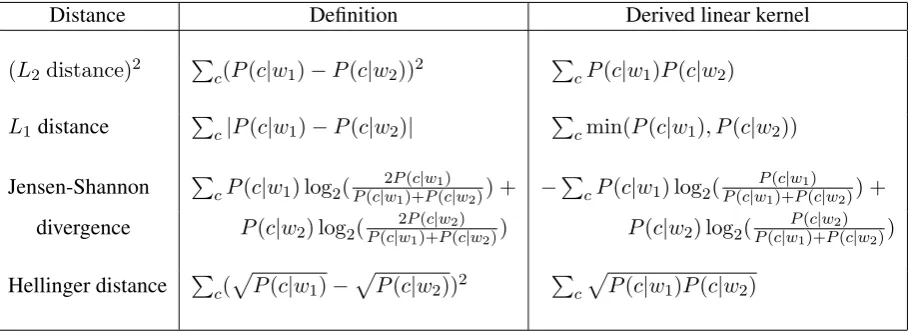
Distance Definition Derived linear kernel
(L2 distance)2 Pc(P(c|w1)−P(c|w2))2 PcP(c|w1)P(c|w2)
L1distance Pc|P(c|w1)−P(c|w2)| Pcmin(P(c|w1), P(c|w2))
Jensen-Shannon PcP(c|w1) log2(P(c|2wP1)+(c|wP(1c)|w2)) + −
P
cP(c|w1) log2(P(c|wP1()+c|wP1()c|w2)) +
divergence P(c|w2) log2(P(c|w2P1)+(c|wP2(c)|w2)) P(c|w2) log2(
P(c|w2)
P(c|w1)+P(c|w2))
Hellinger distance Pc(pP(c|w1)−pP(c|w2))2 Pc p
P(c|w1)P(c|w2)
Table 1: Squared metric distances on co-occurrence distributions and corresponding linear kernels
were shown by Lee to give better similarity esti-mates than theL2distance.
In Section 2.2 we have seen how to derive psd kernels (similarities) from nsd kernels (distances). It seems likely that distance measures that are known to work well for comparing co-occurrence distributions will also give us suitable psd similar-ity measures. Negative semi-definite kernels are by definition symmetric, which rules the Kullback-Leibler divergence and Lee’s (1999)α-skew diver-gence out of consideration. The nsd condition (2) is met if the distance function is a squared metric in a Hilbert space. In this paper we use a parametric family of squared Hilbertian metrics on probability distributions that has been discussed by Hein and Bousquet (2005). This family contains many fa-miliar distances including theL1distance, Jensen-Shannon divergence (JSD) and the Hellinger dis-tance used in statistics, though not the squaredL2 distance. Positive semi-definitedistributional ker-nels can be derived from these distances through equations (3a) and (3b). We interpret the distribu-tional kernels produced by (3a) and (3b) as ana-logues of the linear and Gaussian kernels respec-tively, given by a different norm or concept of dis-tance in the feature spaceF. Hence thelinear dis-tributional kernels produced by (3a) correspond to inner products in the input space X, and therbf
distributional kernels produced by (3b) are radial basis functions corresponding to inner products in a high-dimensional Hilbert space of Gaussian-like functions. In this paper we use the unmodi-fied term “linear kernel” in the standard sense of the linear kernel derived from theL2 distance and make explicit the related distance when referring to other linear kernels, e.g., the “JSD linear kernel”. Likewise, we use the standard term “Gaussian” to
refer to theL2rbf kernel, and denote other rbf ker-nels as, for example, the “JSD rbf kernel”.
Table 1 lists relevant squared metric distances and their derived linear kernels. The linear ker-nel derived from theL1distance is the same as the
difference-weighted token-based similarity mea-sure of Weeds and Weir (2005). The JSD linear kernel can be rewritten as (2 -JSD), whereJSD
is the value of the Jensen-Shannon divergence. This formulation is used as a similarity measure by Lin (1999). Dagan et al. (1999) use a similar-ity measure 10−αJSD, though they acknowledge
that this transformation is heuristically motivated. The rbf kernel exp(−αJSD) provides a theoret-ically sound alternative when the psd property is required. It follows from the above discussion that these previously known distributional similar-ity measures are valid kernel functions and can be used directly for SVM classification.
3 Practice
3.1 General Methodology
All experiments were performed using the LIB-SVM Support Vector Machine library (Chang and Lin, 2001), modified to implement one-against-all classification. The members of the distribu-tional kernel family all performed similarly but the Jensen-Shannon divergence kernels gave the most consistently impressive results, and we restrict dis-cussion to these kernels due to considerations of space and clarity. In each experiment we com-pare the standard linear and Gaussian kernels with the linear and JSD rbf kernels. As a preprocess-ing step for the L2 kernels, each feature vector was normalised to have unit L2 norm. For the Jensen-Shannon kernels, the feature vectors were normalised to have unit L1 norm, i.e., to define a probability distribution. For all datasets and all training-test splits the SVM cost parameterCwas optimised in the range(2−6,2−4, . . . ,212)through cross-validation on the training set. In addition, the width parameterαwas optimised in the same way for the rbf kernels. The number of optimisation folds differed according to the size of the dataset and the number of training-test splits to be eval-uated: we used 10 folds for the compound task, leave-one-out cross-validation for SemEval Task 4 and 25 folds for the verb classification task.
3.2 Compound Noun Interpretation
The task of interpreting the semantics of noun compounds is one which has recently received considerable attention (Lauer, 1995; Girju et al., 2005; Turney, 2006). For a given noun-noun com-pound, the problem is to identify the semantic re-lation between the compound’s constituents – that a kitchen knife is a knife used in a kitchen but a
steel knifeis aknife made of steel.2 The difficulty of the task is due to the fact that the knowledge re-quired to interpret compounds is not made explicit in the contexts where they appear, and hence stan-dard context-based methods for classifying seman-tic relations in text cannot be applied. Most previ-ous work making use of lexical similarity has been based on WordNet measures (Kim and Baldwin, 2005; Girju et al., 2005). ´O S´eaghdha and Copes-take (2007) were to our knowledge the first to ap-ply a distributional model. Here we build on their
2In the classification scheme considered here, kitchen knifewould have the labelIN andsteel knife would be la-belledBE.
methodology by introducing a probabilistic feature weighting scheme and applying the new distribu-tional kernels.
For our experiments we used the dataset of ´O S´eaghdha and Copestake (2007), which con-sists of 1443 noun compounds annotated with six semantic relations: BE, HAVE, IN, AGENT,
INSTRUMENT and ABOUT.3 The classification baseline associated with always choosing the most frequent relation (IN) is 21.3%. For each compound (N1, N2) in the dataset, we associate the co-occurrence probability vector (P(c1|N1), . . . , P(c|C||N1))withN1and the vec-tor (P(c1|N2), . . . , P(c|C||N2)) with N2. The probability vector for the compound is created by appending the two constituent vectors, each scaled by 0.5 to weight both constituents equally and ensure that the new vector sums to 1. These probability vectors are used to compute the Jensen-Shannon kernel values. The pre-processing step for the L2 kernels is analogous, except that the co-occurrence frequency vector (f(c1, Ni), . . . , f(c|C|, Ni)) for each constituent Ni is normalised to have unit L2 norm (instead of unitL1 norm); the combined feature vector for each data item is alsoL2-normalised.4
The co-occurrence relation we counted to esti-mate the probability vectors was the conjunction relation. This relation gives sparse but high-quality information, and was shown to be effective by ´O S´eaghdha and Copestake. We extracted two fea-ture sets from two very different corpora. The first is the 90 million word written component of the British National Corpus (Burnard, 1995). This corpus was parsed with the RASP parser (Briscoe et al., 2006) and all instances of theconj gram-matical relation were counted. The co-occurrence vocabulary Vc was set to the 10,000 words most
frequently entering into a conj relation across the corpus. The second corpus we used was the Web 1T 5-Gram Corpus (Brants and Franz, 2006), which contains frequency counts for n-grams up to length 5 extracted from Google’s index of ap-proximately 1 trillion words of Web text. As the nature of this corpus precludes parsing, we used a simple pattern-based technique to extract tions. An n-gram was judged to contain a conjunc-tion co-occurrence between Ni and Nj if it con-3This dataset is available fromhttp://www.cl.cam. ac.uk/∼do242/resources.html.
BNC 5-Gram
Kernel Acc F Acc F
Linear 57.9 55.8 55.0 52.5
Gaussian 58.0 56.2 53.5 50.8
JSD (linear) 59.9 57.8 60.2 58.1
JSD (rbf) 59.8 57.9 61.0 58.8
Table 2: Results for compound interpretation
tained the patternNiand (¬N)*Nj(¬N)*. A noun
dictionary automatically constructed from Word-Net and an electronic version of Webster’s 1913 Unabridged Dictionary determined the sets of ad-missible nouns{N} and non-nouns {¬N}.5 The vocabulary Vc was again set to the 10,000 most
frequent conjuncts, and the probability estimates
P(c|w)were based on the n-gram frequencies for each n-gram matching the extraction pattern. A third feature set extracted from the 5-Gram Corpus by using a larger set of joining terms was also stud-ied but the results were not significantly different from the sparser conjunction feature sets and are not presented here.
Performance was measured by splitting the data into five folds and performing cross-validation. Results for the two feature sets and four kernels are presented in Table 2. The kernels derived from the Jensen-Shannon divergence clearly outperform theL2distance-based linear and Gaussian kernels in both accuracy and macro-averaged F-score. The best performing kernel-feature combination is the Jensen-Shannon rbf kernel with the 5-Gram fea-tures, which attains 61.0% accuracy and 58.8% F-score. This surpasses the best previous result of 57.1% accuracy, 55.3% F-score that was re-ported by ´O S´eaghdha and Copestake (2007) for this dataset. That result was obtained by combin-ing a distributional model with a relational simi-larity model based on string kernels; incorporating relational similarity into the system described here improves performance even further ( ´O S´eaghdha, 2008).
3.3 SemEval Task 4
Task 4 at the 2007 SemEval competition (Girju et al., 2007) focused on the identification of seman-tic relations among nominals in text. Identifica-tion of each of seven relaIdentifica-tions was designed as a binary classification task with 140 training
sen-5The electronic version of Webster’s is available from http://msowww.anu.edu.au/∼ralph/OPTED/.
BNC 5-Gram
Kernel Acc F Acc F
Linear 67.6 57.1 65.4 63.3
Gaussian 66.8 60.7 65.6 62.9
JSD (linear) 71.4 68.8 69.6 65.8
JSD (rbf) 69.9 66.7 70.7 67.5
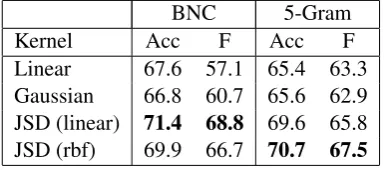
Table 3: Results for SemEval Task 4
tences and around 70 test sentences.6 To ensure that the task be a challenging one, the negative test examples were all “near misses” in that they were plausible candidates for the relation to hold but failed to meet one of the criteria for that rela-tion. This was achieved by selecting both positive and negative examples from the results of the same targeted Google queries. The majority-class base-line for this task gives Accuracy = 57.0%, F-score = 30.8%, while the all-true baseline (label every test sentence positive) gives Accuracy = 48.5%, F-score = 64.8%.
We used the same feature sets and kernels as in Section 3.2. The results are presented in Table 3. Again, the JSD kernels outperform the standard
L2 kernels by a considerable margin. The best performing feature-kernel combination achieves 71.4% Accuracy and 68.8% F-score, higher than the best performance attained in the SemEval com-petition without using WordNet similarity mea-sures (Accuracy = 67.0%, F-score = 65.1%; Nakov and Hearst (2007)). This is also higher than the performance of all but three of the 14 SemEval en-tries which did use WordNet. Davidov and Rap-poport (2008) have recently described a WordNet-free method that attains slightly lower accuracy (70.1%) and slightly higher F-score (70.6%) than our method. Taken together, Davidov and Rap-poport’s results and ours define the current state of the art on this task.
3.4 Verb Classification
To investigate the effectiveness of distributional kernels on a different kind of semantic classifi-cation task, we tested our methods on the verb class data of Sun et al. (2008). This dataset con-sists of 204 verbs assigned to 17 of Levin’s (1993) verb classes. Each verb is represented by a set of features corresponding to the distribution of its instances across subcategorisation frames (SCFs).
FS3 FS5
Kernel Acc F Acc F
Linear 67.1 65.5 67.6 65.9
Gaussian 60.8 58.6 62.7 60.2
JSD (linear) 70.6 67.3 69.6 66.4
JSD (rbf) 68.6 65.1 70.1 67.2
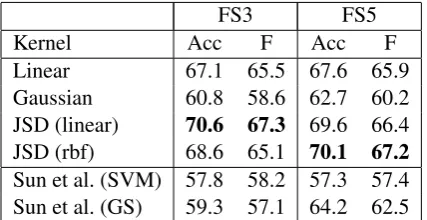
Sun et al. (SVM) 57.8 58.2 57.3 57.4 Sun et al. (GS) 59.3 57.1 64.2 62.5
Table 4: Results for leave-one-out verb classifica-tion and comparison with Sun et al.’s (2008) SVM and Gaussian fitting methods
These frames include information about syntac-tic constituents (NP, NP NP, NP SCOMP, . . . ) and some lexical information about subcategorised prepositions (NP with,out, . . . ). The feature val-ues are counts of SCFs extracted from a large cor-pus. As the feature vector for each verb natu-rally defines a probability distribution over SCFs, it seems intuitive to apply distributional kernels to the problem of predicting Levin classes for verbs.
Sun et al. use multiple feature sets of varying sparsity and noisiness. We report results on the two feature sets for which they reported best per-formance; for continuity we keep the namesFS3
and FS5 for these feature sets. These were de-rived from the least filtered and hence least sparse subcategorisation lexicon (which they call VALEX 1) and differ in the granularity of prepositional SCFs. The SCF representation in FS5 is richer and hence potentially more discriminative, but it is also sparser. Using an SVM with a Gaussian ker-nel, Sun et al. achieved their best results on FS3. Perhaps surprisingly, their best results overall were attained with FS5 by a simple method based on fitting multivariate Gaussian distributions to each class in the training data and assigning the maxi-mum likelihood class to test points.
Following Sun et al., we use a leave-one-out measure of verb classification performance. As the examples are distributed equally across the 17 classes, the random baseline accuracy is 5.9%. Ta-ble 4 presents our results withL2and JSD kernels, as well as those of Sun et al. The best overall performance is attained by the JSD linear kernel, which scores higher than the L2-derived kernels on both feature sets. TheL2linear kernel also per-forms quite well and with consistency. The JSD rbf kernel was less consistent over cross-validation runs, seemingly due to uncertainty in selecting the
optimalαparameter value; it clearly outperforms the L2 linear kernel on one feature set (FS5) but on the other (FS3) it attains a slightly lower F-score while maintaining a higher accuracy. The Gaussian kernel seems particularly ill-suited to this dataset, performing significantly worse than the other kernels. The difference between Sun et al.’s results with the Gaussian kernel and ours with the same kernel may be due to the use of one-against-all classification here instead of one-against-one, or it may be due to differences in preprocessing or parameter optimisation.
4 The effect of marginal distributions It is natural to ask why distributional kernels per-form better than the standard linear and Gaussian kernels. One answer might be that just as infor-mation theory provides the “correct” notion of in-formation for many purposes, it also provides the “correct” notion of distance between probability distributions. Hein and Bousquet (2005) show that their family of distributional kernels are invariant to bijective transformations of the event spaceC
and suggest that this property is a valuable one for image histogram classification where data may be represented in a range of equivalent colour spaces. However, it is not clear that this confers an advan-tage when comparing lexical co-occurrence distri-butions; when transformations are performed on the space of co-occurrence types, they are gener-ally not information-conserving, for example lem-matisation or stemming.
A more practical explanation is that the distri-butional kernels and distances are less sensitive than the (squared)L2distance and its derived ker-nels to the marginal frequencies of co-occurrence types. When a typechas high frequency we expect that it will have higher variance, i.e., the differ-ences|P(c|w1)−P(c|w2)|will tend to be greater even ifcis not a more important signifier of simi-larity.7 These differences contribute quadratically to the L2 distance and hence also to the associ-ated rbf kernel, i.e., the Gaussian kernel. It is also easy to see that types c for which P(c|wi) tends
to be large will dominate the value of the linear kernel. This explanation is also plausibly a fac-tor in the relatively poor performance ofL2 dis-tance as a lexical dissimilarity measure, as
strated by Lee (1999). In contrast, the differences
|P(c|w1)−P(c|w2)|are not squared in theL1 dis-tance formula, and the minimum function in theL1 linear kernel dampens the effect of high-variance co-occurrence types. The Jensen-Shannon formula is more difficult to interpret, as the difference terms do not directly appear. While co-occurrence types with large P(c|w1) and P(c|w2) do contribute more to the distance and kernel values, it is the proportional size of the difference that appears in the log term rather than its magnitude. Finally, the Hellinger distance and kernels squash the variance associated withcthrough the square root function.
5 Discussion and Future Directions Kernels on probability measures have been dis-cussed in the machine learning literature (Kondor and Jebara, 2003; Cuturi et al., 2005; Hein and Bousquet, 2005), but they have previously been applied only to standard image and text classifi-cation benchmark tasks. We seem to be the first to use distributional kernels for semantic classifica-tion and to note their connecclassifica-tion with familiar lex-ical similarity measures. Indeed, the only research we are aware of on kernels tailored for lexical sim-ilarity is the small body of work on WordNet ker-nels, e.g., Basili et al. (2006). In contrast, Sup-port Vector Machines have been widely adopted for computational semantic tasks, from word sense disambiguation (Gliozzo et al., 2005) to semantic role labelling (Pradhan et al., 2004). The standard feature sets for semantic role labelling and many other tasks are collections of heterogeneous fea-tures that do not correspond to probability distri-butions. So long as the features are restricted to positive values, distributional kernels can be ap-plied; it will be interesting (and informative) to see whether they retain their superiority in this setting. One advantage of kernel methods is that kernels can be defined for non-vectorial data structures such as strings, trees, graphs and sets. A promis-ing topic of future research is the design of distri-butional kernels for comparing structured objects, based on the feature space embedding associated with convolution kernels (Haussler, 1999). These kernels map structures inX into a space whose di-mensions correspond to substructures of the ele-ments of X. Thus strings are mapped onto vec-tors of substring counts, and trees are mapped onto vectors of subtree counts. We adopt the perspec-tive that this mapping represents structuresxi ∈ X
as measures over substructures x¯1, . . . ,x¯d.
Prop-erly normalised, this gives a distributional proba-bility vector(P(¯x1), . . . , P(¯xd))similar to those
used for computing lexical similarity. This per-spective motivates the use of distributional inner products instead of the dot products implicitly used in standard convolution kernels. Several authors have suggested applying distributional similarity measures to sentences and phrases for tasks such as question answering (Lin and Pantel, 2001; Weeds et al., 2005). Distributional kernels on strings and trees should provide a flexible implementation of these suggestions that is compatible with SVM classification and does not require manual feature engineering. Furthermore, there is a ready gener-alisation to kernels on sets of structures; if a set is represented as the normalised sum of its mem-ber embeddings in feature spaceF, distributional methods can be applied directly.
6 Conclusion
In this paper we have introduced distributional ker-nels for classification with co-occurrence proba-bility distributions. The suitaproba-bility of distribu-tional kernels for semantic classification is intu-itive, given their relation to proven distributional methods for computing semantic similarity, and in practice they work very well. As these kernels give state-of-the-art results on the three datasets we have tested, we expect that they will prove useful for a wide range of semantic classification prob-lems in future.
Acknowledgements
We are grateful to Andreas Vlachos and three anonymous reviewers for their useful comments, and to Anna Korhonen for providing the verb clas-sification dataset. This work was supported in part by EPSRC Grant EP/C010035/1.
References
Basili, Roberto, Marco Cammisa, and Alessandro Mos-chitti. 2006. A semantic kernel to classify texts with very few training examples.Informatica, 30(2):163– 172.
Berg, Christian, Jens P. R. Christensen, and Paul Ressel.
1984.Harmonic Analysis on Semigroups: Theory of
Positive Definite and Related Functions. Springer, Berlin.
Brants, Thorsten and Alex Franz, 2006.Web 1T 5-gram
Briscoe, Ted, John Carroll, and Rebecca Watson. 2006.
The second release of the RASP system. In
Proceed-ings of the ACL Interactive Presentation Sessions.
Burnard, Lou, 1995. Users’ Guide for the British
Na-tional Corpus. British National Corpus Consortium, Oxford University Computing Service.
Chang, Chih-Chung and Chih-Jen Lin, 2001.LIBSVM:
a library for support vector machines. Software
available athttp://www.csie.ntu.edu.tw/
∼cjlin/libsvm.
Chapelle, Olivier, Patrick Haffner, and Vladimir N.
Vapnik. 1999. Support vector machines for
histogram-based image classification. IEEE
Trans-actions on Neural Networks, 10(5):1055–1064. Cortes, Corinna and Vladimir Vapnik. 1995. Support
vector networks. Machine Learning, 20(3):273–297.
Cristianini, Nello and John Shawe-Taylor. 2000. An In-troduction to Support Vector Machines. Cambridge University Press, Cambridge.
Curran, James. 2003. From Distributional to Semantic
Similarity. Ph.D. thesis, University of Edinburgh. Cuturi, Marco, Kenji Fukumizu, and Jean-Philippe
Vert. 2005. Semigroup kernels on measures.
Jour-nal of Machine Learning Research, 6:1169–1198. Dagan, Ido, Lillian Lee, and Fernando Pereira. 1999.
Similarity-based models of word cooccurrence prob-abilities. Machine Learning, 34(1–4):43–69. Davidov, Dmitry and Ari Rappoport. 2008.
Classifica-tion of semantic relaClassifica-tionships between nominals us-ing pattern clusters. InProceedings of the 46th An-nual Meeting of the Association for Computational Linguistics.
Girju, Roxana, Dan Moldovan, Marta Tatu, and
Daniel Antohe. 2005. On the semantics of
noun compounds. Computer Speech and Language,
19(4):479–496.
Girju, Roxana, Preslav Nakov, Vivi Nastase, Stan Sz-pakowicz, Peter Turney, and Deniz Yuret. 2007. SemEval-2007 Task 04: Classification of
seman-tic relations between nominals. In Proceedings of
the 4th International Workshop on Semantic Evalua-tions.
Gliozzo, Alfio, Claudio Giuliano, and Carlo Strappar-ava. 2005. Domain kernels for word sense
disam-biguation. InProceedings of the 43rd Annual
Meet-ing of the Association for Computational LMeet-inguistics. Haussler, David. 1999. Convolution kernels on dis-crete structures. Technical Report UCSC-CRL-99-10, Computer Science Department, University of California at Santa Cruz.
Hein, Matthias and Olivier Bousquet. 2005. Hilbertian metrics and positive definite kernels on probability
measures. InProceedings of the 10th International
Workshop on Artificial Intelligence and Statistics. Kim, Su Nam and Timothy Baldwin. 2005. Automatic
interpretation of noun compounds using WordNet
similarity. In Proceedings of the 2nd International Joint Conference on Natural Language Processing. Kondor, Risi and Tony Jebara. 2003. A kernel between
sets of vectors. InProceedings of the 20th Interna-tional Conference on Machine Learning.
Lauer, Mark. 1995. Designing Statistical Language
Learners: Experiments on Compound Nouns. Ph.D. thesis, Macquarie University.
Lee, Lillian. 1999. Measures of distributional
similar-ity. InProceedings of the 37th Annual Meeting of
the Association for Computational Linguistics. Leopold, Edda and J¨org Kindermann. 2002. Text
cat-egorization with support vector machines. how to
represent texts in input space? Machine Learning,
46(1–3):423–444.
Levin, Beth. 1993. English Verb Classes and
Alter-nations: A Preliminary Investigation. University of Chicago Press, Chicago.
Lin, Dekang and Patrick Pantel. 2001. Discovery of
in-ference rules for question answering. Natural
Lan-guage Engineering, 7(4):343–360.
Lin, Dekang. 1998. An information-theoretic defini-tion of similarity. InProceedings of the 15th Inter-national Conference on Machine Learning.
Nakov, Preslav I. and Marti A. Hearst. 2007. UCB:
System description for SemEval Task #4. In
Pro-ceedings of the 4th International Workshop on Se-mantic Evaluations.
´O S´eaghdha, Diarmuid and Ann Copestake. 2007. Co-occurrence contexts for noun compound
interpreta-tion. In Proceedings of the ACL Workshop on a
Broader Perspective on Multiword Expressions.
´O S´eaghdha, Diarmuid. 2008. Learning Compound
Noun Semantics. Ph.D. thesis, Computer Labora-tory, University of Cambridge. In preparation. Pradhan, Sameer, Kadri Hacioglu, Valerie Krugler,
Wayne Ward, James H. Martin, and Daniel Juraf-sky. 2004. Support vector learning for semantic ar-gument classification. Machine Learning, 60(1):11– 39.
Sun, Lin, Anna Korhonen, and Yuval Krymolowski. 2008. Verb class discovery from rich syntactic data. In Proceedings of the 9th International Conference on Intelligent Text Processing and Computational Linguistics.
Turney, Peter D. 2006. Similarity of semantic rela-tions.Computational Linguistics, 32(3):379–416. Weeds, Julie and David Weir. 2005. Co-occurrence
retrieval: A flexible framework for lexical dis-tributional similarity. Computational Linguistics, 31(4):439–476.