A Rule-based Question Answering System for Reading
Comprehension Tests
E l l e n R i l o f f a n d M i c h a e l T h e l e n D e p a r t m e n t of C o m p u t e r Science
U n i v e r s i t y of U t a h Salt Lake City, U t a h 84112 {riloff, t h e l e n m } @ c s . u t a h . e d u
A b s t r a c t
We have developed a rule-based system, Quarc, that can r e a d a short story and find the sentence in the story that best answers a given question. Quarc uses heuristic rules that look for lexical and semantic clues in the question and the story. We have tested Quarc on reading comprehen- sion tests typically given to children in grades 3-6. Overall, Quarc found the correct sentence 40% of the time, which is encouraging given the simplicity of its rules.
1 I n t r o d u c t i o n
In the United States, we evaluate the reading ability of children by giving t h e m reading com- prehension tests. These test typically consist of a short story followed by questions. Presum- ably, the tests are designed so that the reader must understand i m p o r t a n t aspects of the story to answer the questions correctly. For this reason, we believe that reading comprehension tests can be a valuable tool to assess the state of the art in natural language understanding.
These tests are especially challenging because they can discuss virtually any topic. Conse- quently, broad-coverage natural language pro- cessing (NLP) techniques must be used. But the reading comprehension tests also require seman- tic understanding, which is difficult to achieve with broad-coverage techniques.
We have developed a system called Quarc that "takes" reading comprehension tests. Given a story and a question, Quarc finds the sentence in the story t h a t best answers the question. Quarc does not use deep language understanding or sophisticated techniques, yet it achieved 40% accuracy in our experiments. Quarc uses hand-crafted heuristic rules that look for lexical and semantic clues in the ques- tion and the story. In t h e next section, we de-
scribe the reading comprehension tests. In the following sections, we describe the rules used by Quarc and present experimental results.
2 R e a d i n g C o m p r e h e n s i o n T e s t s
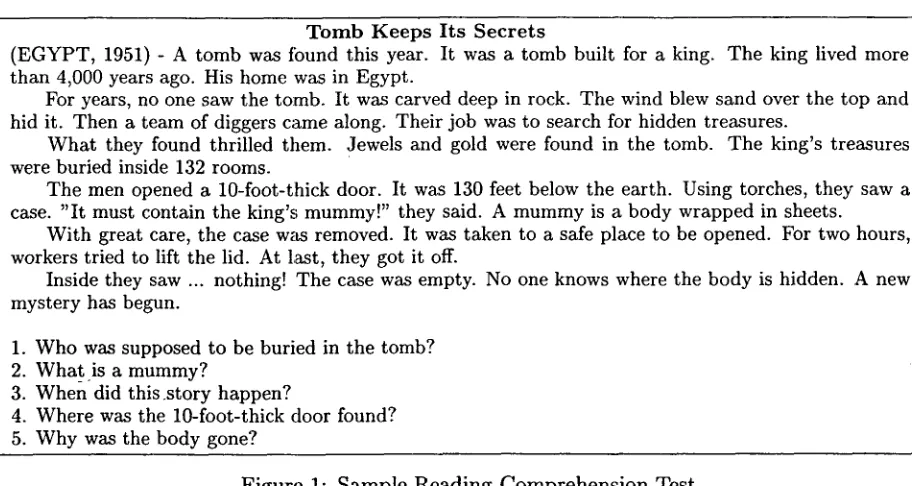
Figure 1 shows an example of a reading compre- hension test from Remedia Publications. Each test is followed by five "WH" questions: WHO,
WHAT, WHEN, WHERE, and WHY. 1 T h e answers
to the questions typically refer to a string in the text, such as a name or description, which can range in length from a single n o u n phrase to an entire clause or sentence. T h e answers to WHEN and WHERE questions are also sometimes inferred from the dateline of the story. For ex- ample, ( E G Y P T , 1951) contains the answer to the WHEN question in Figure 1.
Ideally, a natural language processing system would produce the exact answer to a question. Identifying the precise boundaries of the answer can be tricky, however. We will focus on the somewhat easier task of identifying the sentence t h a t contains t h e answer to a question.
3 A R u l e - b a s e d S y s t e m f o r Q u e s t i o n A n s w e r i n g
Quarc (QUestion Answering for Reading Com- prehension) is a rule-based system that uses lex- ical and semantic heuristics to look for evidence that a sentence contains the answer to a ques- tion. Each type of WH question looks for differ- ent types of answers, so Quarc uses a separate set of rules for each question type (WHO, WHAT,
WHEN, WHERE, WHY).
Given a question and a story, Quarc parses the question and all of the sentences in the story using our partial parser Sundance. Much of
T o m b K e e p s I t s S e c r e t s
( E G Y P T , 1951) - A t o m b was tound this year. It was a t o m b built for a king. T h e king lived more t h a n 4,000 years ago. His home was in Egypt.
For years, no one saw the tomb. It was carved deep in rock. T h e wind blew sand over the t o p and hid it. Then a team of diggers came along. Their job was to search for hidden treasures.
W h a t they found thrilled them. Jewels and gold were found in the tomb. T h e king's treasures were buried inside 132 rooms.
T h e men opened a 10-foot-thick door. It was 130 feet below the earth. Using torches, t h e y saw a case. " I t must contain the king's m u m m y ! " they said. A m u m m y is a b o d y wrapped in sheets.
W i t h great care, the case was removed. It was taken to a safe place to be opened. For two hours, workers tried to lift the lid. At last, they got it off.
Inside they saw ... nothing! T h e case was empty. No one knows where the b o d y is hidden. A new mystery has begun.
1. Who was supposed to be buried in the tomb? 2. Wha_t_is a mummy?
3. When did this .story happen?
4. Where was the 10-foot-thick door found? 5. Why was the body gone?
Figure 1: Sample Reading C o m p r e h e n s i o n Test
t h e syntactic analysis is not used, b u t Quarc does use the morphological analysis, part-of- speech tagging, semantic class tagging, and en- tity recognition. T h e rules are applied to each sentence in the story, as well as t h e title of the story, with the exception t h a t t h e title is not considered for WHY questions. T h e dateline is also a possible answer for WHEN a n d WHERE questions and is evaluated using a special set of dateline rules.
Each rule awards a certain n u m b e r of points to a sentence. After all of the rules have been applied, t h e sentence (or dateline) t h a t obtains the highest score is r e t u r n e d as the answer.
All of t h e question types share a c o m m o n W o r d M a t c h function, which counts the n u m b e r of words t h a t appear in b o t h the question and the sentence being considered. T h e WordMatch function first strips a sentence of stopwords 2, and t h e n matches t h e r e m a i n i n g words against t h e words in the question. Two words m a t c h if t h e y share the same morphological root. Verbs seem to be especially i m p o r t a n t for recogniz- ing t h a t a question a n d sentence are related, so verb m a t c h e s are weighted more heavily t h a n non-verb matches. M a t c h i n g verbs are awarded 6 points each and o t h e r m a t c h i n g words are awarded 3 points each.
T h e other rules used by Q u a r c look for a vari-
~We used a stopword list containing 41 words, mostly prepositions, pronouns, and auxiliary verbs.
ety of clues. Lexical clues look for specific words or phrases. Unless a rule indicates otherwise, words are c o m p a r e d using their morphological roots. Some rules can be satisfied by a n y of sev- eral lexical items; these rules are w r i t t e n using set n o t a t i o n (e.g., {
yesterday, today, tomorrow}).
Some rules also look for semantic classes, which we will write in u p p e r case (e.g., H U M A N ) . O u r parser uses a dictionary a n d a semantic hierar- chy, so t h a t words can be defined with semantic classes. T h e semantic classes used by Q u a r c are shown below, along with a description of t h e words assigned to each class.H U M A N : 2608 words, 3 including c o m m o n first names, last names, titles such as "Dr." a n d "Mrs.", a n d a b o u t 600 occupa- tion words acquired from WordNet (Miller, 1990).
L O C A T I O N : 344 words, including 204 coun- t r y n a m e s and the 50 United States.
M O N T H : t h e 12 m o n t h s of t h e year.
T I M E : 667 words, 600 of which are e n u m e r - ated years from 1400-1999. T h e others are general t i m e expressions, including t h e 12 m o n t h s of t h e year.
[image:2.596.104.560.85.328.2]Our parser also recognizes two types of se- mantic entities: proper nouns and names. A PROPER__NOUN is defined as a n o u n phrase in which all words are capitalized. A N A M E is defined as a P R O P E R _ N O U N t h a t contains at least one H U M A N word.
Each rule awards a specific n u m b e r of points to a sentence, depending on how strongly the rule believes that it found t h e answer. A rule can assign four possible point values: c l u e (+3),
good_clue
(+4), c o n f i d e n t (+6), and s l a m _ d u n k (+20). These point values were based on our intuitions a n d worked well empir- ically, but t h e y are not well justified. T h e m a i n purpose of these values is to assess the relative i m p o r t a n c e of each clue.Figure 2 shows the WHO rules, which use three fairly general heuristics as well as t h e Word- Match function (rule # 1 ) . If t h e question (Q) does not contain any names, t h e n rules # 2 and # 3 assume t h a t the question is looking for a name. Rule # 2 rewards sentences t h a t contain a recognized NAME, and rule # 3 rewards sen- tences t h a t contain the word "name". Rule # 4 awards points to all sentences t h a t contain ei- ther a n a m e or a reference to a h u m a n (often an occupation, such as "writer"). Note t h a t more t h a n one rule can apply to a sentence, in which case the sentence is awarded points by all of the rules t h a t applied.
1. Score(S) + = WordMatch(Q,S) 2. If-~ contains(Q,NAME) and
contains(S,NAME)
Then Score(S) + = c o n f i d e n t 3. If ~ contains(Q,NAME) and
contains(S,name)
Then Score(S) + = good_clue 4. If contains(S,{NAME,HUMAN})
Then Score(S) + = good_clue
Figure 2: W H O Rules
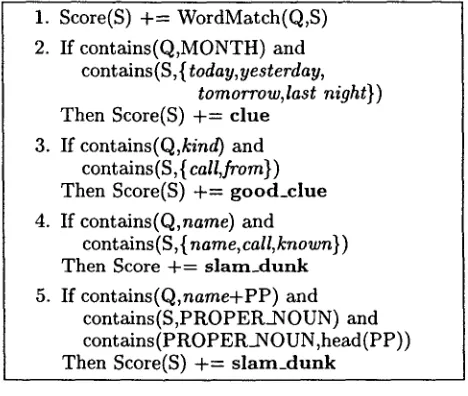
T h e W H A T questions were t h e most difficult to handle because t h e y sought an amazing va- riety of answers. But Figure 3 shows a few spe- cific rules t h a t worked reasonably well. Rule # 1 is the generic word m a t c h i n g function shared by all question types. Rule # 2 rewards sen- tences t h a t contain a d a t e expression if t h e ques- tion contains a m o n t h of t h e year. This rule handles q u e s t i o n s t h a t ask w h a t occurred on
a specific date. We also noticed several "what kind?" questions, which looked for a description of an object. Rule # 3 addresses these questions by rewarding sentences t h a t contain the word "call" or "from" (e.g., "It is called..." or "It is m a d e from ..."). Rule # 4 looks for words asso- ciated with names in b o t h t h e question and sen- tence. Rule # 5 is very specific and recognizes questions t h a t contain phrases such as "name of < x > " or " n a m e for < x > " . Any sentence t h a t contains a proper n o u n whose head n o u n matches < x > will be highly rewarded. For ex- ample, the question " W h a t is t h e n a m e of t h e creek?" is answered by a sentence t h a t contains t h e noun phrase "Pigeon Creek".
1. Score(S) + = WordMatch(Q,S) 2. If contains(Q,MONTH) and
contains(S,{
today, yesterday,
tomorrow, last night})
Then Score(S) + = clue3. If
contains(Q,kind)
and contains (S, {call,from})
Then Score(S) + = g o o d _ d u e 4. Ifcontains(Q,narne)
andeontains( S, { name, call, known} )
Then Score + = s l a m _ d u n k 5. Ifcontains(Q,name+PP)
andcontains(S,PROPER_NOUN) and contains(PROPER_NOUN,head(PP)) Then Score(S) + = s l a m _ d u n k
Figure 3: W H A T Rules
T h e rule set for W H E N questions, shown in Figure 4, is the only rule set t h a t does not ap- ply t h e W o r d M a t c h function to every sentence in the story. WHEN questions almost always re- quire a T I M E expression, so sentences t h a t do not contain a T I M E expression are only con- sidered in special cases. Rule # 1 rewards all sentences t h a t contain a T I M E expression with g o o d _ c l u e points as well as W o r d M a t c h points. T h e remaining rules look-for specific words t h a t suggest a d u r a t i o n of time. Rule # 3 is inter- esting because it recognizes t h a t certain verbs ("begin", "start") can be indicative of time even when no specific t i m e is mentioned.
[image:3.596.302.536.296.494.2]:'."
1. If contains(S,TIME)
Then Score(S) + = good_clue Score(S) + = WordMatch(Q,S) 2. If
contains(Q,the last)
andcontains(S,{first, last, since, ago}) Then Score(S) + = s l a m _ d u n k • 3. If
contains( Q, { start, begin})
andcontains(S,{
start, begin,since,year})
Then Score(S) + = s l a m _ d u n kFigure 4: W H E N Rules
1. Score(S) + = WordMatch(Q,S) 2. If contains(S,LocationPrep)
Then Score(S) + = good_clue 3. If contains(S, LOCATION)
Then Score(S) + = c o n f i d e n t
Figure 5: W H E R E Rules
tences w i t h a location preposition. Q u a r c rec- ognizes 21 prepositions as being associated with locations, such as "in", "at", "near", and "in- side". R u l e # 3 looks for sentences t h a t contain a word belonging to the L O C A T I O N semantic class.
WHY questions are handled differently t h a n other questions. T h e WHY rules are b a s e d on the observation t h a t the answer to a WHY ques- tion often appears i m m e d i a t e l y before or im- mediately after the sentence t h a t most closely matches the question. We believe t h a t this is due to the causal n a t u r e of WHY questions.
First, all sentences are assigned a score using the W o r d M a t c h function. T h e n the sentences with the t o p score are isolated. We will refer to these sentences as B E S T . Every sentence score is then reinitialized to zero and the WHY rules, shown in Figure 6, are applied to every sentence in the story.
Rule # 1 rewards all sentences t h a t p r o d u c e d the best W o r d M a t c h score b e c a u s e t h e y are plausible candidates. Rule # 2 rewards sen- tences t h a t i m m e d i a t e l y precede a b e s t Word- Match sentence, and Rule # 3 rewards sentences that i m m e d i a t e l y follow a best W o r d M a t c h sen- tence. R u l e # 3 gives a higher score t h a n Rules # 1 and # 2 because we observed t h a t WHY an- swers are s o m e w h a t more likely to follow the best W o r d M a t c h sentence. Finally, Rule # 4 re- wards sentences t h a t contain the word "want"
1. I f S e B E S T
Then Score(S) +-- clue
2. If S immed, precedes member of BEST Then Score(S) + = clue
3. If S immed, follows member of BEST Then Score(S) + = g o o d _ c l u e
4. If
contains(S,want)
Then Score(S) + = g o o d _ c l u e 5. If
contains(S, { so, because} )
Then Score(S) + = g o o d _ c l u e
Figure 6: W H Y Rules
a n d Rule # 5 rewards sentences t h a t contain the word "so" or "because". T h e s e words are in- dicative of intentions, explanations, and justifi- cations.
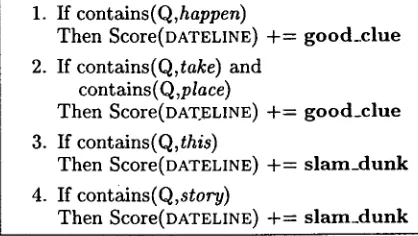
T h e answers to WHEN and WHERE questions are frequently found in the dateline r a t h e r t h a n the story itself, so Q u a r c also considers the date- line as a possible answer. Figure 7 shows the dateline rules, which are used for b o t h WHEN
and WHERE questions. T h e words "happen"
and "take place" suggest t h a t the dateline may b e the best answer (rules # 1 and # 2 ) . We also found t h a t t h a t t h e words "this" and "story" were strong indicators t h a t the dateline is the best answer (rules # 3 and # 4 ) . We found sev- eral sentences of the form " W h e n did this hap- pen?" or " W h e n did this take place?". T h e verbs alone are not sufficient to be slam d u n k s because t h e y often have a specific s u b j e c t (e.g., " W h e n did t h e surprise h a p p e n ? " ) t h a t refers back to a sentence in t h e story. B u t when the words "story" or "this" appear, the question seems to b e referring to the story in its entirety and the dateline is the best answer.
1. If
contains(Q,happen)
Then Score(DATELINE) -b= g o o d _ c l u e
2. If
contains(Q,take)
and contains(Q,place)Then Score(DATELINE) +---- good_clue 3. If
contains(Q,this)
Then Score(DATELINE) --b: s l a m _ d u n k 4. If
contains(Q,story)
Then Score(DATELINE) +---- s l a m _ d u n k
Figure 7: Dateline Rules
[image:4.596.353.562.576.694.2]sentence in the story, the sentence (or dateline) with the highest score is returned as the best answer. In the event of a tie, a W H Y question chooses the sentence that appears latest in the story, and all other question types choose the sentence that appears earliest in the story. If no sentence receives a positive score, then WHEN and W H E R E questions return the dateline as a default, W H Y questions return the last sentence in the story, and all other questions return the first sentence in the story.
4 E x p e r i m e n t a l R e s u l t s
We evaluates Quarc on the same data set that was used to evaluate the DeepRead reading comprehension system (Hirschman et al., 1999). This data set contains 115 reading comprehen- sion tests, 55 of which were used for develop- ment and 60 of which were reserved for testing purposes. We also used the answer keys created by the DeepRead developers (Hirschman et al., 1999). The H u m S e n t answers are sentences that a human judged to be the best answer for each question. The A u t S e n t answers are gen- erated automatically by determining which sen- tence contains the highest percentage of words in the published answer key, excluding stop- words. We focused on obtaining the best pos- sible H u m S e n t score because we believed that humans were more reliable than the automatic word-counting routine.
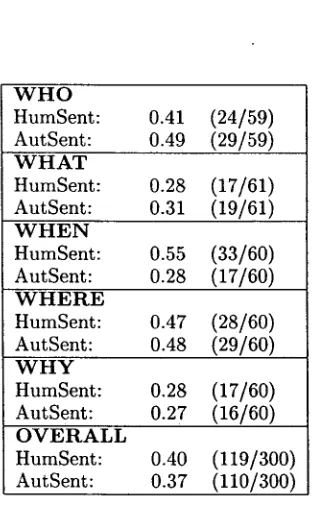
Table 1 shows Quarc's results for each type of question as well as its overall results. Quarc achieved 40% H u m S e n t accuracy overall, but the accuracy varied substantially across ques- tion types. Quarc performed the best on W H E N questions, achieving 55% accuracy, and per- formed the worst on WHAT and WHY questions, reaching only 28% accuracy.
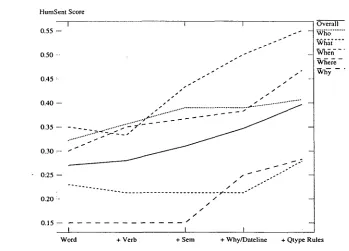
Quarc's rules use a variety of knowledge sources, so we ran a set of experiments to evalu- ate the contribution of each type of knowledge. Figure 8 shows the results of these experiments, based on the H u m S e n t answer keys. First, we evaluated the performance of Quarc's Word- Match function all by itself, giving equal weight to verbs and non-verbs. The WordMatch func- tion alone, shown as Word on the graph, pro- duced 27% accuracy. When we gave verbs twice as much weight as non-verbs (÷
Verb),
overall accuracy improved to 28%. Interestingly, giv-W H O
HumSent: 0.41 (24/59) AutSent: 0.49 (29/59) W H A T
HumSent: 0.28 (17/61) AutSent: 0.31 (19/61) W H E N
HumSent: 0.55 (33/60) AutSent: 0.28 (17/60) W H E R E
HumSent: 0.47 (28/60) AutSent: 0.48 (29/60) W H Y
HumSent: 0.28 (17/60) AutSent: 0.27 (16/60) O V E R A L L
HumSent: 0.40 (119/300) AutSent: 0.37 (110/300)
Table 1: Overall Results
ing extra weight to verbs improved the W H O and WHAT questions, but hurt the WHEN and WHERE questions. These results suggest that verbs should be weighted more heavily only for certain question types, even though we
Next, we wanted to see how much effect the semantic classes had on performance, so we added the rules that use semantic classes. Only the WHO, WHEN, and WHAT question types had such rules, and performance improved on those question types
(+Sem).
We then added the dateline rules for the WHEN and WHERE ques- tions, and added the W H Y rules that reward the sentences immediately preceding and following the best WordMatch sentence (rules #1-3 in Figure 6). Figure 8 shows that these additions(+Why/Dateline)
also improved results for all three question types.Finally, we added the remaining rules that look for specific words and phrases. The final version of Quarc achieved 40% H u m S e n t ac- curacy, which compares favorably with Deep- Read's results (36% H u m S e n t accuracy). Fur- thermore, DeepRead's best results used hand- tagged named entity recognition and hand- tagged coreference resolution. Quarc did not rely on any hand-tagging and did not perform any coreference reslution.
[image:5.596.339.495.63.316.2]H u m S e n t S c o r e
0 . 5 5 - -
0 . 5 0 ---
0 . 4 5 ~ ~ ~ ~ ~ ~ . . ~
r
p s ~ . .
0 . 4 0 - - - " . . . 2
0 3 5 . . . : > -
0 . 3 0 ,-- "~
I I O v e r a l l
s ~ ~ - - W h o
~ ~ - W h a t
" W h e r e
s
t" ~ - "
0 : 2 5 - - / ~ .
0 . 2 0 :- /
/ / /
0 . 1 5 : /
I I t
W o r d + V e r b + S e m + W h y / D a t e l i n e + Q t y p e R u l e s
Figure 8: Experimental Results
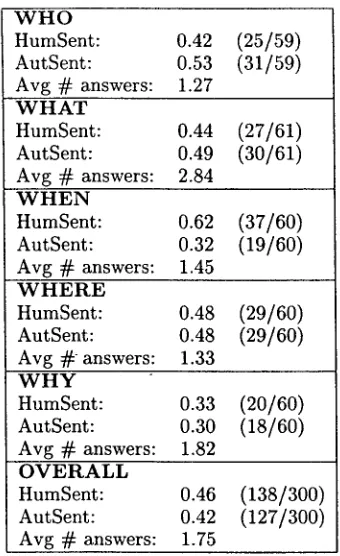
more than one sentence is tied with the best score, Quarc selects the sentence that appears earliest in the story, except for WHY questions when Quarc chooses the sentence appearing lat- est in the story. Table 2 shows the results of removing this tie-breaking procedure, so t h a t Quarc is allowed to o u t p u t all sentences t h a t received the top score. These results represent an upper b o u n d on performance if Quarc had a perfect tie-breaking mechanism.
Table 2 shows that Quarc's performance on
WHAT, WHEN, and WHY questions improved by
several percentage points, b u t performance on WHO and WHERE questions was basically t h e same. Overall, Quarc was able to identify 46% of the correct sentences by generating 1.75 hy- potheses per question on average. These re- sults suggest t h a t a better tie-breaking proce- dure could substantially improve Quarc's per- formance by choosing between the top two or three candidates more intelligently.
5 L e s s o n s L e a r n e d
Quarc's rules were devised by hand after ex- perimenting with the 55 reading comprehension tests in the development set. These simple rules are probably not adequate to handle other types
of question-answering tasks, b u t this exercise gave us some insights into the problem.
First, semantic classes were extremely useful
f o r W H O , W H E N , and W H E R E questions because
they look for descriptions of people, dates, and locations. Second, WHY questions are concerned with causal information, and we discovered sev- eral keywords that were useful for identifying intentions, explanations, and justifications. A better u n d e r s t a n d i n g of causal relationships and discourse structure would u n d o u b t e d l y be very helpful. Finally, WHAT questions were the most difficult because they sought a staggering vari- ety of answers. T h e only general p a t t e r n that we discovered was t h a t WHAT questions often look for a description of an event or an object.
[image:6.596.154.503.111.362.2]W H O
HumSent: 0.42 (25/59)
AutSent: 0.53 (31/59)
Avg # answers: 1.27 W H A T
HumSent: 0.44 (27/61)
AutSent: 0.49 (30/61)
Avg # answers: 2.84
W H E N
HumSent: 0.62 (37/60)
AutSent: 0.32 (19/60)
Avg # answers: 1.45
W H E R E
HumSent: 0.48 (29/60)
AutSent: 0.48 (29/60)
Avg #-answers: 1.33 W H Y
HumSent: 0.33 (20/60)
AutSent: 0.30 (18/60)
Avg # answers: 1.82 O V E R A L L
HumSent: 0.46 (138/300)
AutSent: 0.42 (127/300)
Avg # answers: 1.75
Table 2: Generating multiple answers
6 A c k n o w l e d g m e n t s
This research is s u p p o r t e d in part by the Na- tional Science Foundation under grant IRI- 9704240.
R e f e r e n c e s
L. Hirschman, M. Light, E. Breck, and J. Burger. 1999. Deep Read: A Reading Comprehension System. In Proceedings of the 37th Annual Meeting of the Association for Computational Linguistics.
G. Miller. 1990. Wordnet: An On-line Lexical Database. International Journal of Lexicog-
raphy, 3(4).
E. Riloff and J. Shepherd. 1997. A Corpus- Based Approach for Building Semantic Lex- icons. In Proceedings of the Second Confer- ence on Empirical Methods in Natural Lan-
guage Processing, pages 117-124.
B. Roark and E. Charniak. 1998. Noun-phrase Co-occurrence Statistics for Semi-automatic Semantic Lexicon Construction. In Proceed- ings off the 36th Annual Meeting of the Asso-
ciation for Computational Linguistics, pages
[image:7.596.87.257.99.377.2]