A Two-level Approach to Coding Dialogue for Discourse
Structure: Activities of the 1998 DRI Working Group on
Higher-level Structures*
D a v i d R . T r a u m U n i v e r s i t y o f M a r y l a n d
t r a u m @ c s . u m d . e d u
C h r i s t i n e H . N a k a t a n i
Bell L a b o r a t o r i e s , L u c e n t T e c h n o l o g i e s c h n @ r e s e a r c h . b e l l - l a b s . c o m
A b s t r a c t
This paper presents a novel two-level scheme for coding discourse structure in dialogue, which was created by the au- thors for the discourse structure subgroup of the 1998 D R / m e e t i n g on dialogue tag- ging. We discuss the theoretical motiva- tions and framework for the coding pro- posal, and then review the results of coding exercises performed by the 1998 DR/ dis- course structure subgroup using the new manual. Finally, we provide suggestions for improving the scheme arising from the working group activities at the third DRI meeting.
1 I n t r o d u c t i o n
A two-level scheme for coding discourse structure in dialogue has been proposed and undergone ini- tial testing within the DR/effort. In particular, the higher-level structures working group of the third DR/ was charged with the task of creating a cod- ing scheme concerned exclusively with the discourse structure of dialogue. Finding a good starting point The discourse structure working group was chaired by Christine Nakatani (Bell Laboratories, Lucent Tech- nologies) and co-chaired by David Traum (U Maryland). Pre-meeting group participants also included Jean Car- letta (U Edinburgh), Jennifer Chu-Carroll (Bell Lab- oratories, Lucent Technologies), Peter I-Iceman (Ore- gon Graduate Institute), Juha Hirschberg (AT&T Labs), Masato Ishizaki (JAIST), Diane Litman (AT&T Labs), Owen Rainbow (Cogentex), Jennifer Venditti (Ohio State U), Marilyn Walker (At&T Labs), Gregory Ward (Northwestern U). Participants at the meeting also included Ellen Bard (U Edinburgh), Yasuo Horiuchi (Chiba U), Koichi Hoshida (ATR), Yasuhiro Katagisi (NTT), Kikuo Maekawa (NLRI), Michael Strube (U Pennsylvania), Masafumi Tamato (NTT), Yuki Tateishi (Tokyo U), and Takahiro Wakao (TAO).
for a consensus coding scheme for discourse struc- ture in dialogue was a non-trivial task. Most dis- course structure schemes in fact were geared toward monologue, and most dialogue coding schemes omit- ted the higher-level structures that were essential to the monologue schemes, or provided only genre or domain-specific higher-level structures.
Given the limited amount of work in this area, it was impossible to attempt a comprehensive cod- ing scheme for all aspects of discourse structure ill dialogue. Instead, we were guided by an analysis of what choices needed to be made in creating a coding scheme. (Traum, 1998) identifies three dimensions along which discourse structure schemes can be clas- sifted: granularity, content, s t r u c t u r i n g m e c h a n i s m s .
• Granularity: how much material (time, text, turns, etc.) is covered by the units (minimum, maximum, and average)? Granularity ranges were divided roughly into three categories: M i c r o - roughly within a single turn
M e s o - roughly an exchange, IR-unit, "game", or short "sub-dialogue",
M a c r o - coherent larger spans, related to over- all dialogue purposes.
• C o n t e n t : what is this a structure of(e.g., inten- tions, accessibility, effects, etc.)?
• • S t r u c t u r i n g m e c h a n i s m s : What kinds of units and structuring principles are used (e.g., fiat, set inclusion, hierarchical/CFG structuring, re- lational)? How many primitive types of units are allowed (one basic unit type, two or three types of units, or several types)?
This multi-dimensional space was then used to clas- sify different extant coding schemes as to which as- pects they are concerned with.
pair of coupled schemes at the meso- and macro- levels in order to create a dialogue-oriented scheme for discourse structure analysis. We felt the micro- level of analysis was addressed by the dialogue acts coding effort of DRI, and it seemed most productive to build meso- and macro-levels on top of that, in an independent manner, to see what synergy might arise. It did not seem most fruitful to code the same content at three different levels, or to code three types of content at the macro-level without making any attempt to relate that coding to other schemes in development within the DRI initiative.
Thus, for our starting point we proposed two orig- inal coding schemes within this multi-dimensional space. One scheme which has as content Ground- ing (Clark and Schaefer, 1989; Traum, 1994), op- erated at a meso level of granularity, and used non-hierarchical (and possibly discontinuous ) utter- ance sets as its structuring principle. The second scheme concerned intentional/informational struc- ture (Grosz and Sidner, 1986; Nakatani et al., 1995) as content, operated at a macro level of granularity, and was structured as hierarchical trees (with anno- tations for capturing discontinuities). In addition, these two schemes were linked by using the result- ing structures from meso-level analysis as basic input for macro-level analysis.
There were several factors motivating the decision to use these particular facets of discourse structure for initial analysis. First, considering intentions, it is clear that aspects of dialogue at all levels of gran- ularity relate to the intentions of the participants. However, not all of these intentional aspects are at- tuned to well-behaved plan-like structures. One is- sue is whose intention is under consideration: the speaker, the hearer, or the collaborative "team" of the speaker and hearer together. It is only at the level of grounded content that some sort of joint or shared intentional structure is really applicable. Be- low this level, one may only properly talk of indi- vidual intentions, even though those intentions may be subservient to joint goals (or goals of achieving sharedness). Thus taking grounded units (achieved at the meso-range) as a starting point for the cod- ing of intentional structure is a natural basis for the study of joint intentional structure. Individual in- tentions at a lower level, especially those relating to communication management rather than task are expected to be captured within the dialogue act level of the DRI coding scheme (Discourse Resource Ini- tiative, 1997; Allen and Core, Draft 1997). Likewise, the phenomena of grounding can occur on multiple levels. However, since macro-level phenomena (such as task summarization) differ from more local feed-
back phenomena (including acknowledgments and repairs), restricting the grounding-relating coding to the meso-level allows for a more tractable effort.
While examining intentional structure at the macro range and grounding structure at a meso range thus had independent motivations, the coding scheme used for this subgroup was designed to test a further novel and previously untested hypothesis that the units of achieving common ground would serve as an appropriate type of basic unit for inten- tional analysis. Since the phenomena of grounding and intentional task-related structure are somewhat independent, there is reason to believe the structures might not align properly. However, given the utility of having an appropriate meso-level starting point for intentional structure, and lacking any compelling counter-examples, we decided to put the hypothesis to the test in the coding exercises.
2 T h e c o d i n g s c h e m e
The" coding scheme used for pre-meeting cod- ing exercises is defined in (Nakatani and Traum, 1999), which was distributed to the group mem- bers prior to coding assignments. As mentioned above, this included two levels of coding, common ground units ( C G U s ) at the meso-level, and inten- tional/informational units ( I U s ) at the macro-level. Here we provide a brief summary of these cod- ing schemes. Interested parties are referred to the manual (Nakatani and Traum, 1999) for detailed in- structions and examples. There are three stages of coding, which must be performed in sequence. First, a preparatory tokenization phase, in which the dia- logue is segmented into speaker turns and utterance tokens within the turns, each token being given a la- bel. This was used as input for the coding of CGUs, in which utterance tokens were gathered together in units of tokens which together served to add some material to the common ground. Finally, the results of CGU coding was used as input for IU Coding, in which hierarchical intentional structure was built from either CGUs or smaller IUs. Each of these pro- cesses is briefly described in the subsections below. 2.1 C o m m o n G r o u n d Units ( C G U s )
A C o m m o n Ground Unit (CGU) contains all and only the utterance tokens needed to ground (that is, make part of the common ground) some bit of con- tent. This content will include the initial token of the unit, plus whatever additional content is added by subsequent tokens in the unit and added to the common ground at the same time as the initiating token. The main coherence principle for CGUs is
thus not directly related to the coherence of the con- tent itself (this kind of coherence is handled at the micro and macro levels), but whether the content is added to the common ground in the same manner (e.g., with the same acknowledgment utterance).
CGUs will require at least some initiating mate- rial by one conversational participant (the initiator), presenting the new content, as well as generally some feedback (Allwood et al., 1992), or acknowledgment, by the other participant.
The following principles in (1) summarize the de- cision procedures for how to code an utterance token with respect to existing or new CGUs:
(1) 1.
.
I f the token contains new content, and there is no accessible ungrounded CGU, the contents of which could be acknowledged together with the current token
t h e n create a new CGU, and add this to- ken to it.
i f there is an accessible CGU for which the current token:
(a) acknowledges the content (b) repairs the content
(c) cancels the CGU (in this case, also put a * before the CGU marker, to indicate that it is canceled).
(d) continues the content, in such a fashion that all content could be grounded to- gether (with the same acknowledgment) t h e n add this token to the CGU
o t h e r w i s e , do not add this token to the CGU
Note that these rules are not mutually exclusive: more than one may apply, so that a token can be added to more than one CGU.
CGUs are similar in many respects to other meso- level coding schemes, such as initiative-response in the LINDA coding scheme (Ahrenberg et al., 1990; Dahlb~ck and JSnsson, 1998), or conversa- tional games (Carletta et al., 1997). However, there are some important differences. In terms of con- tent, CGUs cover only grounding, while the LINDA scheme covers initiative more generally, and the I-ICRC game structure codes achievement of dia- logue purposes. Several authors (e.g., (Allwood et al., 1992; Clark, 1994; Dillenbourg et al., 1996), consider multiple levels of coordination in dialogue, including roughly those of contact, perception, un- derstanding, and attitudinal reaction. Grounding (which is what CGUs capture) is mainly concerned with the understanding level (and also the percep- tion of messages), while there is a large part of the
notion of response that is concerned with attitudinal reaction and not strictly mutual understanding.
There are also differences in the structuring mech- anisms used. In the LINDA coding scheme, IR units consist of trees, which may contain embedded IR units as constituents. The HCRC scheme does not require a strict tree structure, but also allows em- bedded games, when one game is seen as subordi- nate to the main purpose of another. In contrast, CGUs are "fiat" structures, consisting only of a set of utterances which work together to add some ma- terial to common ground. Moreover, a single ut- terance can be part of multiple (non-nested) CGUs. For example, except for very short reactions which are expressed in the same locution with the feed- back signal of understanding, the grounding of the reaction itself will also constitute a separate CGU. More concretely, consider a suggestion followed by a refinement by another speaker. The refinement indi- cates understanding of the original, and is thus part of the prior CGU, which presents the original, but it also'introduces new material (the refinement itself), and thus also initiates a new CGU, which requires further signals of understanding to he added to the
common ground.
Both of these differences in content and structur- ing mechanisms can lead to differences in the kinds of units that would be coded for a given dialogue frag- ment. For example, a question/answer/followup se- quence might be one IR-unit or game but two CGUs (one to ground the question, and one to ground the answer). Likewise, a unit including a repair might be coded as two (embedded) IR-units or games, but only a single CGU.
It remains an open question as to whether CGUs or one of these other meso-level units might be the most appropriate building block for macro-level in- tentional structure. One reason to think that CGUs might be more appropriate, though, is the use of non-hierarchical units, which avoids the question of which level of unit to use as starting point.
m
m
logic discourse, and is not directly applicable to di- alogue. In particular, there is the general problem in dialogue, of associating the individual intentions of the participants with the overall structure. We use CGUs as a starting point helps establish the rel- evant intentions as a kind of joint intentional struc- ture. While CGU analysis concentrates on estab- lishing what is being said at the level of informa- tion exchange, macro-level analysis goes beyond this to establish relationships at a higher-level, namely relationships amongst CGUs (instead of utterance- tokens) and relationships amongst groups of CGUs. These relationships may be both informational and intentional. Thus, we refer to groupings of CGUs at the lowest level of macro-structure as I-UNITS (IUs), where 'T' stands for either informational or inten- tional.
IU trees are created by identifying certain kinds of discourse relations. Following (Grosz and Sid- ner, 1986), macro-level analysis captures two funda- mental intentional relations between I-units, those of domination (or parent-child) and satisfaction- precedence (or sibling) relations. The correspond- ing informational relations are generates and en- ables (Pollack, 1986; Goldman, 1970). More con- cretely, the domination relation can be elaborated in a planning-based framework as holding between a subsidiary plan and its parent, in which the com- pletion of one plan contributes to the completion of its parent plan; the satisfaction-precedence relation can be elaborated as the temporal dependency be- tween two plans (Lochbaum, 1994). As is often the case, when a temporal dependency cannot be strictly established, two IUs will be placed in a sibling rela- tionship by virtue of their each being in a subsidiary relationship with the same dominating IU.
I-unit analysis consists of identifying the higher- level intentional/informational structure of the di- alogue, where each I-unit (IU) in the macro struc- ture achieves a joint (sub)goal or conveys informa- tion necessary to achieve a joint (sub)goal. T h e fol- lowing schema captures the decision process for IU coding:
• Establish problem to be collaboratively solved, or joint goal.
• Negotiate how to achieve joint goal. This may involve:
1. Deciding which (of possibly several) recipe(s) for action to use,
2. Deciding how to implement a recipe in the participants' domain by instantiating or
identifying constraints and parameters of the recipe (e.g. deciding which of two en- gines to move to the orange warehouse),
3. Breaking the plan down into subplans, whose own achievements can be similarly negotiated at the subtask level.
• Confirm achievement of (or failure to achieve) joint goal.
This schema explicitly accommodates the inferential interface between the intentional and informational levels of analysis. For example, intentional and in- formational relations blend as siblings at the level of choosing and implementing a recipe and breaking down a plan into subplans. This reflects the simple fact that achieving a goal via action requires knowl- edge of the world (e.g. identification of objects), knowledge of how to act in the world (i.e. knowledge of recipes), and knowledge of how to reason about complex relations among actions (i.e. the ability to plan and re-plan). In sum, the blending of inten- tional and informational relations in IU coding is an original theoretical aspect of this coding scheme. 3 C o d i n g e x e r c i s e s
In order to familiarize the group members with the coding schemes and provide some initial data for discussion, several coding exercises were performed, divided into two sets of two dialogues each - first T O O T and TRAINS, second Verbmobil (IU on com- mon provided CGUs) and Maptask (only a fragment, no IU coding). These dialogues are all roughly char- acterizable as "task-oriented", although the tasks are quite varied.
The TRAINS dialogue was taken from the TRAINS-93 Corpus by the University of Rochester (Heeman and Allen, 1994; Heeman and Allen, 1995). TRAINS dialogs deal with tasks involving manufac- turing and shipping goods in a railroad freight sys- tem. TRAINS dialogs consist of two human speak- ers, the system and the user. The user is given a problem to solve and a map of the world. The system is given a more detailed map and acts as a planning assistant to the user. Additional online information about the dialogues can be found at
h t t p ://WWl~. cs. ro chest or. edu/res
eazch/speech/
9 3 d i a l o g s / a n d about the trains project as a whole athl:~;p://www, c s . r o c h e s t e r , e d u / r e s e a x c h / t r a i n s / Toot dialogues are Human-Computer spoken dia- logues, in which the computer system (S) finds Am-
m
m
m
m
m
m
m
m
m
m
m
trek rail schedules via internet, according to specifi- cations provided by the human user (U). The Toot system is described in (Litman et el., 1998). The dialogue we used for coding, was provided by Diane Litman of A T & T Research.
T h e Verbmobil project is a long term effort to de- velop a mobile translation system for spontaneous speech in face-to-face situations. T h e current do- main of focus is scheduling business meetings. T o support this goal, some English h u m a n - h u m a n di- alogs were collected in this domain. More informa- tion about the Verbmobil project can be found on- line at http://~ww, dfki. uni-sb, d o / v e r b m o b £ 1 / . In the dialogue we coded, the two speakers try to establish a time and place for a meeting.
The DCIEM Map Task dialogs from w h i c h the one we coded (d204), was drawn were collected in Canada and consist of pairs of Canadian army re- servists collaborating to solve a problem. Both re- servists have a map but the maps are not identical in terms of the landmarks present. One participant is designated the direction giver, G and has a path marked on his map. The goal is for the other partic- ipant, the direction follower, F to trace this route on his map even though he can only communicate with G via speech; i.e., these are not face to face conversa- tions. Only the opening portion of the dialogue was coded, due to the length. More information about the DCIEM Map Task corpus can be found online at http ://www. here. ed. ac. uk/Si~ o/MAPTASKD, html.
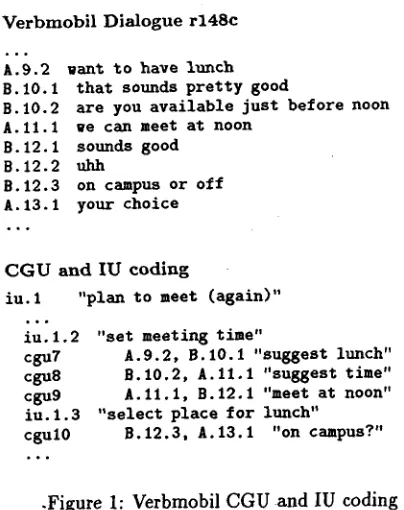
A fragment taken from the Verbmobil Dialogue, along with CGU and IU coding for this fragment is shown in Figure 1. Note that some utterances (e.g., A.11.1) appear in multiple cgus (serving an acknowl- • edgment function for one and a proposal function for the other), and some utterances (e.g., B.12.2) do not appear in any.
3.1 C G U C o d i n g A n a l y s i s
The inter-coder reliability of CGU coding was quite variable between the different dialogues and for dif- ferent stretches within some of the dialogues. Re- suits ranged from segments in which all coders coded identically to a few segments (for Maptask and Toot) in which all coders coded some aspect differently. This section outlines some of the qualitative and quantitative analysis done on the CGU coding for the four dialogues presented in the previous section. 3.1.1 I n t e r - c o d e r R e l i a b i l i t y
It was a bit challenging to devise a meaningful measure of inter-coder reliability for the CGU cod- ing task. While it is simple to count how many coders chose to include a particular unit, there is no
Verbmobil Dialogue r148c . . .
It.9.2 want to have lunch B.10.1 that sounds pretty good
B. 10.2 are you available just before noon A.II.I we can meet at noon
B.12.1 sounds good B.12.2 uhh
B.12.3 on campus or off A.13.1 your choice
° * .
C G U a n d I U coding
iu. 1 "plan to meet (again)"
cgu7 cgu8 cgu9
iu. 1.3
cgul0
"set meeting time"
A.9.2, B. 10. I "suggest lunch" B.10.2, A.II.I "suggest time" A.11.1, B.12.1 "meet at noon" "select place for lunch"
B.12.3, A.13.1 "on campus?"
.Figure 1: Verbmobil CGU a n d IU coding
easy way to devise an expected agreement for such a unit. Table 2 shows the average ratio of coders per CGU coded by any of the coders. It is not clear how to interpret this number, however, since if a partic- ular unit was included only by a small amount of coders, that means that there was fairly high agree- ment among the other coders not to include it.
D i a l o g u e a v g %
TRAINS 0.41
T O O T 0.36 Verbmobil 0.30 MAPTASK 0.26
Table 2: Average coders per proposed CGU Simply marking down boundary points of units would also not work well, since CGUs are allowed to be both overlapping and discontinuous. Instead, a pseudo-grounding acts scheme was induced, consid- ering whether an utterance token begins, continues or completes a CGU. This is fueled by the obser- vation that, while a token could appear in multiple CGUs, it doesn't generally perform the same func- tion in each of them. This is not explicitly ruled out but does seem to be the case, perhaps with one or two exceptions. So, each token is scored as to whether or not it appeared (1) as the first token in a CGU (2) as the last token in a CGU a n d / o r (3) in a CGU in neither the first or last position.
This system seems sufficient to count as the same
[image:5.612.301.503.74.329.2]PA PE
T R A I N S
B M E
T O O T
B M E
V e r b m o b i l
B M E
0.83 0.87 0.85 0.79 0.81 0.78 0.79 0.78 0.89
0.50 0.65 0.51 0.50 0.52 0.50 0.57 0.51 0.58
0.66 0.62 0.69 0.58 0.60 0.56 0.52 0.56 0.74
M a p t a s k
B M E
0.69 0.74 0.79
0.54 0.52 0.56
0.34 0.45 0.52
Table 1: CGU Inter-coder Reliability
all identified CGUs that are the same, and to assess penalties for all codings that differ, though it is not clear that the weighting of penalties is necessarily
optimal (e.g., leaving out a middle counts only one
point of disagreement, but leaving out an end counts
as two, since the next to last, gets counted as an end
rather than a middle).
From this, it was possible to compute agreement and expected agreement (by examining the relative frequencies of these tags), and thus Kappa (Siegel and Castellan, 1988). The numbers for the group as a whole are shown in table 1 Systematic individual pairwise agreement or cluster analysis was not per- formed, however some of the pairwise numbers are above 0.8 for some dialogues.
From this table it is clear that the ending points of CGUs in verbmobil has fairly high agreement, as does the TRAINS dialogue overall, whereas Map- task has fairly low agreement, especially for CGU beginnings.
3.2 I U C o d i n g A n a l y s i s
IU analysis was carried out on the Toot, Trains and Verbmobil dialogues. However, as noted, only the IU analysis on Verbmobil was conducted starting with uniform IUs for all the coders. Thus, the reliability for IU coding could be quantitatively measured for the Verbmobil dialogue only. Nine coders provided IU trees starting from identical CGUs.
Following the methodology in (ttirschberg and Nakatani, 1996), we measured the reliability of cod- ing for a linearized version of the IU tree, by calcu- lating the reliability of coding of IU beginnings using the kappa metric. We calculated the observed pair- wise agreement of CGUs marked as the beginnings of IUs, and factored out the expected agreement es- timated from the actual data, giving the pairwise kappa score.
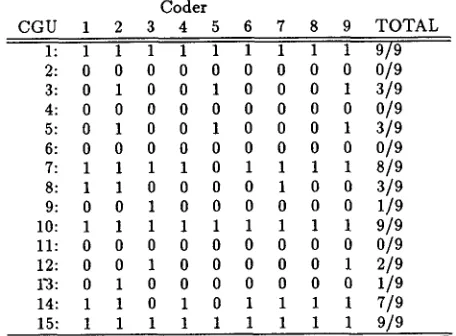
Table 3 gives the raw data on coders marking of IU beginnings. For each CGU, a "1" indicates that it was marked as an IU-initial CGU by a given coder. A "0" indicates that it was not marked as IU-initial. Table 4 shows the figures on observed pairwise agreement, or the percentage of the time both coders agreed on the assignment of CGUs to IU-initial po-
Coder
CGU 1 2 3 4 5 6 7 8 9 TOTAL
1: 1 1 1 1 1 1 1 1 1 9/9
2: 0 0 0 0 0 0 0 0 0 0/9
3: 0 1 0 0 1 0 0 0 1 3/9
4: 0 0 0 0 0 0 0 0 0 0/9
5: 0 1 0 0 1 0 0 0 1 3/9
6: 0 0 0 0 0 0 0 0 0 0 / 9
7: 1 1 1 1 0 1 1 1 1 8 / 9
8: 1 1 0 0 0 0 1 0 0 3 / 9
9: 0 0 1 0 0 0 0 0 0 1/9
10: 1 1 1 1 1 1 1 1 1 9/9
11: 0 0 0 0 0 0 0 0 0 0/9
12: 0 0 1 0 0 0 0 0 1 2/9
1"3: 0 1 0 0 0 0 0 0 0 1/9
14: 1 1 0 1 0 1 1 1 1 7/9
15: 1 1 1 1 1 1 1 1 1 9/9
Table 3: Summary of IU coding for all coders ( I = I U - initial, 0=non-IU-initial)
ID 1 2 3 4 5 6 7 8 9
1 1 .8 .73 .93 .6 .93 .93 .93 .73
2 1 .53 .73 .67 .73 .73 .73 .8
3 1 .8 .6 .8 .67 .8 .73
4 1 .67 1 .87 1 .8
5 1 .67 .67 .67 .73
6 1 .87 1 .8
7 1 .87 .67
8 1 .8
9 1
Table 4: Observed agreement for IU-initial CGUs
sition.
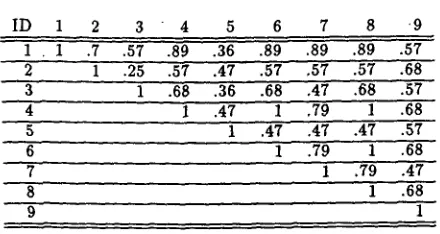
We calculated the expected probability of agree- ment for IU-initial CGUs to be P(E)=.375, based on the actual Verbmobil codings. Given P(E), kappa scores can be computed. Table 5 shows the kappa scores measuring the reliability of the codings for each pair of labelers.
As the kappa scores show, there is some individ- ual variation in IU coding reliability. On average, however, the kappa score for pairwise coding on IU- initial CGUs is .64, which is moderately reliable but shows room for improvement.
By examining Table 3, it can be Seen that there was in fact always a decisive majority label for each
[image:6.612.111.510.83.156.2] [image:6.612.312.540.188.356.2] [image:6.612.315.537.400.508.2]ID 1 2 3 " 4 5 6 7 8 '9 1 . 1 .7 .57 .89 .36 .89 .89 .89 .57 2 1 .25 .57 .47 .57 .57 .57 .68 3" ' 1 .68 .38 .68 .47 .68 .57
4 ] .47 1 .79 1 .68
5 1 .47 .47 .47 .57
6 1 .79 1 .68
7 " 1 .79 .47
8 1 .68
9 1
Table 5: Palrwise kappa scores
CGU, i.e. there are no CGUs on which the coders were split into two groups of four and five in their coding decision for IU-initial CGUs. A weaker relia- bility metric on the pooled data from nine coders, therefore, would provide a reliable majority cod- ing on this dialogue (see (Passonneau and Litman, 1997) for discussion of how reliability is computed for pooled coding data). In fact, for the group of six coders who showed the most inter-coder agree- ment, the average palrwise kappa score is .80, which is highly reliable.
4 S u m m a r y a n d F u t u r e W o r k
In addition to the quantitative analysis of eodings, the subgroup at the 1998 DRI meeting reiterated some goals for the scheme in general and made progress on several open theoretical issues3 First and foremost, it was agreed upon that CGU analy- sis at the meso-level allowed coders to abstract the "messy" bits of dialogue (e.g., local repair, turn- taking, grounding) into common ground units, mak- ing the structures at both the meso- and macro- levels cleaner. The consensus was that many NLP applications would benefit from this abstraction, which can help separate to a large degree the pro- cessing of dialogic phenomena from the processing of intentions and informational units at the dialogue planning level.
As for theoretical issues, the subgroup laid out initial proposals for exploring the interface between Damsl tagging at the dialogue act micro-level, and CGU analysis at the meso-level. One important open issue was whether to modify the coding scheme to identify different types of acknowledgments sepa- rately, especially when the acknowledgment function was parasitic on a more direct relation, such as an answer to a question. It was found that alternative proposals for placing CGU boundaries patterned a Full details of the subgroup proceedings can be found in the DRI report of the 1998 meeting, also available from the first author.
with differences in backward- and forward-looking properties of the ambiguous tokens. The general principle that was agreed upon was that we should investigate further the situations in which dialogue act coding can serve as the basis for CGU coding de- cisions, just as CGU codings serve as the primitive units for constraining IU analysis in a substantial way. A more general principle was to identify when independent decisions at one level could influence the coding decisions at a second level, e.g. when an IU boundary resolved a difficult CGU boundary decision. Defining non-circular coding guidelines ap- pears feasible, if difficult.
While the reliability results presented here are al- ready close to acceptable, directions for future work are clear. In particular, extensions to include addi- tional dimensions of dialogue content would be desir- able; the current scheme considers only grounding at the meso-range, and information/intention content at the macro-range. Secondly, we expect refinement and revision of the initial coding manual, (Nakatani and'Traum, 1999), will facilitate both greater relia- bility and utility of the two levels we do cover. We hope other researchers will explore whether a more productive synergy can be found between the two levels, both in theory and in practice. The relation we hypothesize between the two levels, and our sup- position that important relations may be found be- tween micro-level schemes and the two-level scheme posited here, lay the groundwork for more focused investigations of coding schemes for discourse struc- ture in dialogue than have previously existed w i t h i n the DR/initiative.
References
Lars Ahrenberg, Nils Dahlb~ick, and Arne J6nsson. 1990. Discourse representation and discourse management for a natural language dialogue sys- tem. In Proceedings of the Second Nordic Con- ference on Text Comprehension in Man and Ma- chine.
James Allen and Mark Core. Draft, 1997. Draft of darnsl: Dialog act markup in sev- eral layers, available through the W W W at: http:/ /www.cs.rochester.edu/research]trains/ annotation.
Jens Allwood, Joakim Nivre, and Elisabeth Ahlsen. 1992. On the semantics and pragmatics of linguis- tic feedback. Journal of Semantics, 9.
[image:7.612.65.285.76.193.2]Anne H. Anderson. 1997. The reliability of a di- alogue structure coding scheme. Computational
Linguistics, 23(1):13-31.
Herbert H. Clark and Edward F. Schaefer. 1989. Contributing to discourse. Cognitive Science,
13:259-294. Also appears as Chapter 5 in (Clark, 1992).
Herbert H. Clark. 1992. Arenas of Language Use.
University of Chicago Press.
Herbert H. Clark. 1994. Managing problems in speaking. Speech Communication, 15:243- 250.
Nils DahlbKck and Arne JSnsson. 1998. A coding manual for the linkSping dialogue model, unpub- lished manuscript.
Pierre Dillenbourg, David Traum, and Daniel Schneider. 1996. Grounding in multi-modal task- oriented collaboration. In Proceedings of the Eu-
ropean Conference on AI in Education.
Discourse Resource Initiative. 1997. Standards for dialogue coding in natural language processing. Report no. 167, Dagstuhl-Seminar.
A. I. Goldman. 1970. A Theory of Human Action.
Princeton University Press, Princeton, NJ.
Barbara J. Grosz and Candace L. Sidner. 1986. At- tention, intention, and the structure of discourse.
Computational Linguistics, 12(3):175-204.
Peter A. Heeman and James Allen. 1994. The TRAINS 93 dialogues. TRAINS Technical Note 94-2, Department of Computer Science, Univer- sity of Rochester.
Peter A. Heeman and James F. Allen. 1995. The Trains spoken dialog corpus. CD-ROM, Linguis- tics Data Consortium, April.
Julia Hirschberg and Christine Nakatani. 1996. A prosodic analysis of discourse segments in direction-giving monologues. In Proceedings of the 34th Annual Meeting of the A CL, Santa Cruz. As- sociation for Computational Linguistics.
Diane J. Litman, Shimei Pan, and Marilyn A. Walker. 1998. Evaluating response strategies in a web-based spoken dialogue agent. In Proceedings
COLING-ACL-98.
Karen Lochbaum. 1994. Using Collaborative Plans to Model the Intentional Structure of Discourse.
Ph.D. thesis, Harvard University. Available as Technical Report 25-94.
Christine H. Nakatani and David R. Traum. 1999. Coding discourse structure in dialogue (version 1.0). Technical Report UMIACS-TR-99-03, Uni- versity of Maryland.
Christine H. Nakatani, Barbara Grosz, David Ahn, and Julia Hirschberg. 1995. Instructions for anno- tating discourse. Technical Report 21-95, Center for Research in Computing Technology, Harvard University, Cambridge, MA, September.
Rebecca Passonneau and Diane Litman. 1997. Dis- course segmentation by human and automated means. Computational Linguistics, 23(1):103-
140.
Martha E. Pollack. 1986. Inferring Domain Plans in Question-Answering. Ph.D. thesis, University of Pennsylvania.
S. Siegel and N. J. Castellan. 1988. Nonparametric statistics for the Behavioral Sciences. McGraw- Hill, 2nd edition.
David R. Traum. 1994. A Computational Theory of Grounding in Natural Language Conversation.
Ph.D. thesis, Department of Computer Science, University of Rochester. Also available as T R 545, Department of Computer Science, University of Rochester.
David R. Traum. 1998. Notes on dialogue structure. Unpublished manuscript.