International Journal of Research in Advent Technology (IJRAT) Special Issue “
ICADMMES 2018
”
E-ISSN: 2321-9637
Available online at www.ijrat.org
110
Structural Performance Assessment of Hybrid Fibre
Reinforced Self compacting Concrete Deep Beam With Size
Effect
Dr.Rajesh Kumar.K1, Dr.Suman Kumar B2 1
Professor & Head, Department of Civil Engineering, Navodaya Institute of Technology, Raichur -584103, Karnataka,INDIA
2
Professor & Head, Department of Sciences, Navodaya Institute of Technology, Raichur 584103, Karnataka, INDIA
Email: [email protected]
Abstract – The objective of the present investigation is to study the structural behaviour of deep beams with size effect
made with hybrid fibre reinforced self-compacting concrete (HYSCC). In this article two different types of fibers namely Glass Chopped Fibre Strands (CS) and Polypropylene fibers (PP) were used in combination. The Self compacting concrete(SCC) mixes were prepared with Class F fly ash partially replacing of cement by 40% and 0.06% of CS (CSSCC) in combination with polypropylene fibre varying from 0.1,0.2,0.3%(CSPSCC)of Volume of Concrete. SCC mix design was performed by Nan-Su method and the proportion was fine tuned by EFNARC guidelines. The effects of fibers addition on the workability of SCC, CSSCC, and CSPSCCs were studied, at the same time the hardened concrete behavior was evaluated by compression, Splitting tension and flexure strength tests. Studies on size effects in two different deep beams of depth 300 mm and 500 mm. Twelve Deep beams made with HYSCC were tested under two point load test (SCC,CSSCC with CSPSCC)to understand the size effect. The behavior of deep beams including load– deflection curves, web strains, Energy Absorption, Toughness and crack width has been investigated. From the study it was observed that addition of hybrid fibers to SCC gives economical and Technical benefits.
Index Terms – SCC, HYSCC, CSSCC, CSPSCC, Deep
Beam
1. INTRODUCTION
In the present decade, Civil Engineers and researchers are interested in inventing new materials which are durable and strong enough to resist the applied loads as well as serve the exact need of any structure. Many structures are designed with congested reinforcement which leads the placement of concrete is tough task, hence there arises the need for self compacting concrete(SCC) which was developed in Japan [1] in the late 1980’s to be mainly used for highly congested reinforced structures. Recently, this Concrete has gained wide use in many countries for different applications and structural configuration.
In modern construction industry, the use of deep beam has gained popularity and it has become necessary due to the space required between columns, tall buildings, bridges, transfer girders and foundations. The structural behaviour of deep beam is considerably different from shallow beams due to arch action after diagonal cracking occurred. Deep beams are classified as non flexural members in which plane section do not remain plane in bending, because of geometry and load transfer mechanism. They behave as two dimensional elements rather than one dimensional [2, 3]. According to the CIRIA guide 2 and IS 456-2000, when the ratio of effective span to overall depth ratio is less than 2 for simply supported members and 2.5 for continuous members. The ACI (318 -99) code explicit that clear span / effective depth ratio lesser than 5 is considered as a deep beam[4,5,6] where as CEB-FIP 1993 code treats
simply supported and continuous beam having span / depth ratios less than 2 and 2.5respectively[7].But the British code BS8110 strongly states that reference should be made to special literature for the design of deep beams [8].
The connection with the above for meeting the industrial requirement, the deep beam should be made with higher strength Self Compacting Concrete (HSSCC)[9]. For making HSSCC, the self-compacting fibre reinforced concrete(SCFRC) is an innovative concrete which flows under its own weight in fresh state and improved performance in hardened state. The addition of fibre gives more benefits is in hardened state of the concrete[11]. Bountiful research works were done in the past and they have revealed the usefulness of fibres to improve the structural properties of concrete like ductility, post crack resistance, energy absorption capacity etc.[12-14]. However, the single type of fiber may improve the properties of Fiber reinforced concrete to a limited level, the concept of hybridization, adding two or more types of fiber in to concrete, can offer more attractive engineering properties like better crack resistance, ductility and toughness as well as greater tensile strength [15-17 ].
International Journal of Research in Advent Technology (IJRAT) Special Issue “
ICADMMES 2018
”
E-ISSN: 2321-9637
Available online at www.ijrat.org
111 Nan Su et al (2001) [23] proposed alternative mix
design method for making SCC, and hence it is referred to as Chinese method. In that method, packing all aggregates together. Latter the aggregates voids are filled by paste. In that investigation, he analyzed the advantages and the drawback of Okamura Mix Design Method [1] and proposed a novel mix design method which is simpler, and requiring a smaller amount of binders and lesser cost.
Mustafa sahmaran et al, (2007) [11] observed that, by using high volumes of a coarse and substandard Flyash it is possible to increase the workability characteristics of SCC Mixtures. The compressive strength reduction due to Flyash was partially offset by the use of small sized steel fiber. The highly flowable, yet cohesive, FR-SCC is capable of speeding into place without blockage and can greatly facilitate constructability of FRC. Such concrete with 0.37W/C and 0.42W/C, high slump flow of 650 mm can develope compressive strength and flexural toughness similar to those of conventional FRC that is vibrated in to place[16]. Rafat Siddique (2011) [21] investigated that it is possible to design an SCC mixes incorporating flyash content up to 35%. SCC mixes made with 20 % flyash reduced the rapid chloride ion penetrability to the very low range at the age of 90 days and 365 days. The replacement levels of minerals admixture have resulted in decrease in strength. So 40 % replacement levels could be of optimum consideration for flow ability as well mechanical properties [13].
Mohammed et al (2011) [2] conclude that the stress and strain distribution in deep beam is linear. The flexural crack in mid –span region was always verti cal and within the range of 25-42%of failure load. Shear and diagonal cracks appear between 46% and 92% of failure load. In all cases of tested beams the load corresponding to inclined cracks is in close proximity. Appearance of these cracks is independent of tensile bar or web bar percentages. It depends on concrete compressive strength. Kim et al (2011) [3] state that when the shear span –to-depth ratio decreases with increased axial load, the deep beam fails due to concrete crushing before shear failure is occurred. It is indicated that early failure of the beam occurred due to concrete crushing when the deep beam is under axial load with relatively small shear –to-depth ratio. It is obser ved from testing that there is a decrease of diagonal strength ranging from 20% to 25% for the beam depth increased from 600mm to 1200mm while it ranges between 35% and 55% when the depth increased from 300 mm to 1200mm [22].
2. RESEARCH SIGNIFICANCE
The main purpose of this study is to determine the causes of size effect in deep beam failure related to
hybrid fibers (glass chopped strands and Polypropylene) with percentage variation in self compacting concrete. This SCC contains High Modulus Glass strands and low modulus polypropylene fibers in combination with conventional reinforcement of Deep beam. This work also evolves the different S.C.C parameters like flow properties, Compressive, Splitting tensile and flexural properties by using varying the addition of Hybrid fibers. The mix design composed as per Nan Su method by replacing the cement partially by fly ash (40 %) will reduce the cost of SCC .It has been observed from the investigation that the making of SCC more affordable for the construction market.
3. MATERIALS AND METHODS
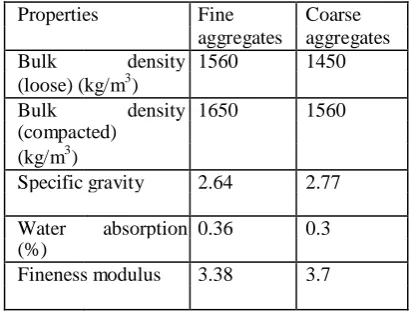
Ordinary Portland cement (53 grades- similar to ASTM Type I) was used. Its physical properties are given in Table 1.Fly ash from Tuticorin Thermal Power Station, Tamil Nadu, India is used as partial cement replacement (40%) material. The properties of fly ash is confirming to IS 1727 – 1967 and ASTM C 618.The specific gravity is 2.05.The percentage of finess of fly ash is 0.5.Crushed angular granite metal of 8 to 12.5 mm size from a local source is used as coarse aggregate. River sand of 2.36 mm size sieve passed is used as fine aggregate in this investigation. Physical properties are given in Table 2.
The High range water reducer (HRWR), the Modified Polycarboxylated Ether based Super Plasticizer complying with IS 9103:1999 and ASTM C494-type F is used in this experimental work. It is light brown in Color and is a free flowing liquid. A Viscosity modified admixture (VMA) also used for complying with EFNARC VMA guidelines 2006.Table 3 gives properties of Chemical admixture.
International Journal of Research in Advent Technology (IJRAT) Special Issue “
ICADMMES 2018
”
E-ISSN: 2321-9637
Available online at www.ijrat.org
112 Table 1: Physical and chemical properties of Cement
and flyash
Physical Properties
Cemen Class F - IS Code t Fly ash Specification
Specific gravity 3.152 2.05
IS 4031(11)
– 1988
Percentage of
IS 12269-
0.2 0.5 1987 (Max finess (%)
10) IS 4031(2) – Specific Surface
270
1999 m2/kg 365 IS 4031(11)
- 1988
Initial setting 35Min
IS 12269-
- 1987 (30 time utes
Minutes)
Final Testing
480 IS 12269-
Minut - 1987 (600 Time
es Minutes)
Chemical Composition
Silica (Sio2) 19.03 55.42 Alumina(Al203) 4.85 19.44
Ferric
6.68 8.19 Oxide(Fe2O3)
Calcium
61.71 2.96
oxide(CaO) Cement
Magnesium
0.86 0.81
(IS 4032 –
oxide (MgO) 1985)
Sodium Oxide
0.39 0.06
Class F -Fly
(Na2O) ash
Potassium
0.40 0.09
(IS 1727-
oxide(K2O) 1967)
Sulphuric
3.20 0.37 anhydride (SO3)
Loss on ignition 2.60 8.62
Total Chlorides
0.10 0.05 Cl-
Table2: Physical properties of Fine and Coarse Aggregate (as per IS 383 -1970 &IS 2386 part III)
Properties Fine Coarse aggregates aggregates Bulk density 1560 1450 (loose) (kg/m3)
Bulk density 1650 1560 (compacted)
(kg/m3)
Specific gravity 2.64 2.77
Water absorption 0.36 0.3 (%)
[image:3.595.332.538.165.321.2]Fineness modulus 3.38 3.7
Table 3:Properties of chemical admixture
Chemical Specific
pH
Dosage Chloride
admixture gravity used Content
[image:3.595.307.540.457.670.2]SP 1.08 5.7 1.2% < 0.2% VMA 1.01 5.8 0.1% < 0.2%
Table 4:Properties of fibers
Glass Poly-
Properties chopped Propelynefibe
strands r
Length (mm) 6 12
Density(Kg/m3) 617 175 Aspect ratio 200 316 Modulus of
72 3.5
elasticity(GPa) Tensile
1700 400
strength(MPa) Elongation at
3.6 >100 break (%)
4. MIX COMPOSITION
International Journal of Research in Advent Technology (IJRAT) Special Issue “
ICADMMES 2018
”
E-ISSN: 2321-9637
Available online at www.ijrat.org
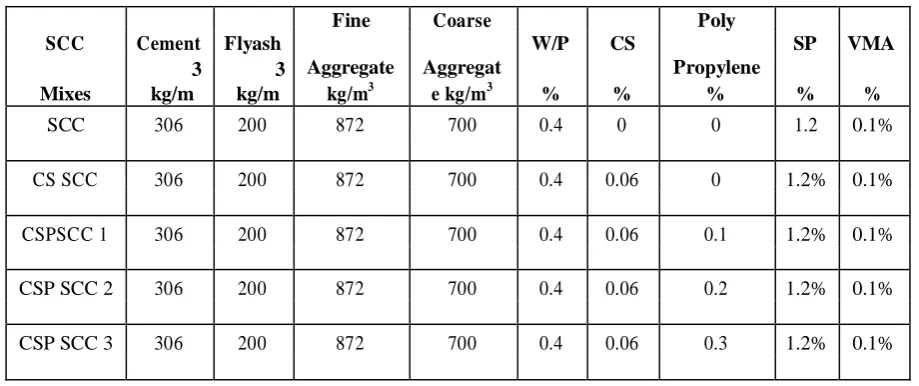
113 assumed to be 2%. (Nan Su, 2001).The various SCC
mixes including fly ash with Chopped fibre strands as 0.06% with Polypropylene0.1%,0.2%,0.3% by Volume of concrete are developed, and their mix propositions are shown in Table 5. The dosage of super plasticiser is fixedat1.4% of weight of powder and dosage of VMA is fixed at 0.2% of weight of powder. The Packing factor of all mix is 1.1 which meets the rank R1 requirements specified by the Japanese mix design [24].
REQUIREMENTS OF SCC
The concrete mix can only be classified as Self Compacting Concrete if the following three characteristics are fulfilled as per EFNARC-2002[30]. filling ability , passing ability, resistance to segregation. These characteristics are determined by Slump flow, T50 Slump, V-Funnel, V funnel at T5, L-box and U-box test. Table 6 shows the test results against EFNARC Standards.
CHARACTERISTICS OF SCC, CSSCC AND CSPSCC MIXES IN FRESH STATE
International Journal of Research in Advent Technology (IJRAT) Special Issue “
ICADMMES 2018
”
E-ISSN: 2321-9637
Available online at www.ijrat.org
[image:5.595.69.529.104.297.2]114 Table 5: Mix Proposition of SCC,CSSCC and CSPSCCs
SCC Cement Flyash
Fine Coarse
W/P CS
Poly
SP VMA
Aggregate Aggregat Propylene
3 3
Mixes kg/m kg/m kg/m3 e kg/m3 % % % % %
SCC 306 200 872 700 0.4 0 0 1.2 0.1%
CS SCC 306 200 872 700 0.4 0.06 0 1.2% 0.1%
CSPSCC 1 306 200 872 700 0.4 0.06 0.1 1.2% 0.1%
CSP SCC 2 306 200 872 700 0.4 0.06 0.2 1.2% 0.1%
CSP SCC 3 306 200 872 700 0.4 0.06 0.3 1.2% 0.1%
Table 6: Fresh Properties of Self Compacting Mixes
SCC Slump T50cm V- funnel V- funnel U – box L-box J-ring
Mixes flow (mm) Slump (sec) at T5min (mm) (mm) (mm)
Flow (sec) (sec)
SCC 700 3 8 11 13 0.95 4
CSSCC 680 3 9 9 12 0.91 4
CSPSCC 1 670 4 9 8 8 0.92 5
CSPSCC 2 665 4 10 11 14 0.90 5
CSPSCC 3 660 4 10 12 16 0.88 8
Table7: Tests on Hardened Concrete
Compressive strength Splitting Tensile Strength Flexural Strength
Specimens (N/mm²) (N/ mm²) (N/ mm²)
28 days 56 days 90days 28days 56 days 90days 28 days 56 days 90days
SCC 31.53 34.44 35.88 2.15 2.22 2.78 4.75 5.6 6.13
CS SCC 37.20 38.37 39.93 2.57 2.57 2.80 5.6 6.9 8.55
CSPSCC 1 38.37 40.11 41.42 2.64 2.64 3.10 6.55 7.05 8.63
CSP SCC 2 33.57 34.44 35.00 2.36 2.78 2.92 7.9 8.2 8.45
International Journal of Research in Advent Technology (IJRAT) Special Issue “
ICADMMES 2018
”
E-ISSN: 2321-9637
Available online at www.ijrat.org
115 Table 8: Energy Absorption, Ductility Factor, Stiffness
Beam Energy Absorption Toughness Index I Stiffness Ductility
Designations (kN mm) 5 ASTM C1018 (kN/ mm) Factor
SCC-300 51.213 18.53 161.32 3.06
CSSCC -300 157.2 - 248.40 2.5
CSP SCC2- 300 192.4 6.29 490.30 6.4
SCC -500 239.3 6.52 333 2.99
CSSCC -500 852.65 5.56 500 4.93
CSPSCC 2-500 1265.1 4.77 575 6.12
PREPARATION AND CASTING OF TEST SPECIMENS
After testing the SCC, CSSCC and the CSPSCC in fresh state,the concrete is poured in moulds of cubes (150mm x150mm x150mm),cylinders(150mmX 300mm), prisms (100mm x 100mm x 500mm). After 24 hours of casting, the specimens are de-moulded and placed in water for curing. After 28, 56 and 90 days of curing the specimens are taken out from water and are allowed for surface drying. For each SCC, CSSCC and the CPSSCC mixes, cubes, cylinders, prisms are casted.
CHARACTERISTICS OF SCC MIXES IN
HARDENED STATE
Compressive and Splitting tensile strength tests are carried out, as per IS 5816:1959 by using a compression testing machine of 2000 KN capacity. Flexural strength tests are carried out on prisms as per IS 516:1959on flexure testing machine of capacity 100 kN. Table 7 gives the test results on hardened concrete.
COMPRESSIVE STRENGTH
The compressive strength values are obtained by testing standard cubes which are made with SCC ,CSSCC and different CSPSCC mixes. All the mixes have strength above 30MPa, which is the required strength. The mix, without fibres and CSPSCC3 has shown lower compressive strength when compared to other mixes. The mix with CS SCC and CSPSCC 1 has shown an improvement in compressive strength by 11% and 16% respectively.
TENSILE STRENGTH AND FLEXURAL
STRENGTH
5. DESIGN OF DEEP BEAMS
Concerning the above mechanical properties of all the mixes, the mix CSSCC and CSPSCC 2 show the better improvement when compared to SCC and hence concluded that the mix CSSCC and CSPSCC2 are optimum dosage level of fiber.
Twelve deep beams are casted in two different depth in wooden moulds. Six small deep beam size 100 X 300X 700mm (SCC 300,CSSCC 300,CSPSCC 300) and six Medium Deep beam size 100X500X1000 mm(SCC 500,CSSCC 500,CSPSCC 500) are casted with Three levels of optimum dosage level of fibers. The mix of SCC Control, CSSCC and CSPSCC 2 are casted for both 300 mm and 500 mm depth of deep beams. The design of deep beams is done as per IS 456:2000. The shear span is 267 mm and 167 mm for 500 mm and 300mm depth of the beam respectively. Figs 1,2,3,4 are showing the test set up and reinforcement details of deep beams.
6. TEST SET UP AND INSTRUMENTS
The test set up arrangements is given in figure 1 and 3. The deep beams are tested byusing 100 Tonne capacity UTM under two point loads to get the
International Journal of Research in Advent Technology (IJRAT) Special Issue “
ICADMMES 2018
”
E-ISSN: 2321-9637
Available online at www.ijrat.org
116 BEHAVIOUR OF DEEP BEAM
The Tensile strength of mixes is obtained (i) by conducting split tensile test on standard cylindrical specimens as per IS 5816 and also by (ii) by conducting two point bend test on standard prisms. The results indicated that the incorporation of Hybrid Fibre into the SCC mixes increased the split tensile strength and flexural strengths by 28% and 27% respectively with the mixes of CSPSCC 1 and CSPSCC 2. The increase is significant and it may be due to high tensile strength of Hybrid Fibers.
[image:7.595.323.525.143.255.2]An experimental investigation is taken to study the effect of Chopped fibrestrands and Polypropylene fiber on the deflection, ultimate load, strain in both concrete and steel
[image:7.595.60.270.295.421.2]Figure 1. Details of tested 500 mm deep beam and testing arrangement
Figure 2. RC Detailing of 500mm Deep Beam
Figure 3. Details of tested 300mm deep beam and testing arrangement
[image:7.595.318.535.392.625.2]LOAD - DEFLECTION RELATIONSHIP
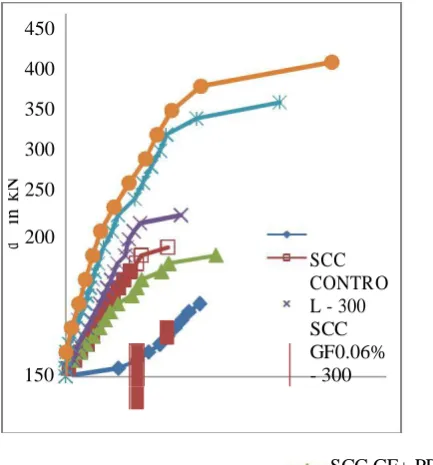
Figure 5 Shows the typical load –deflection plots o f SCC, CSSCC and CSPSCC2 specimens tested under two point load. For comparison and better
representation all the specimens plotted in a single graph is shown in figure. Arresting the micro cracks as well as macro cracks are due to the ability of hybrid fibers. The polypropylene fibers arrest the micro cracks and control the formation of macro cracks
SCC GF+ PP 0.2% -
300 SCC CONTROL - 500
SCC GF 0.06% - 500
Figure 5. Envelope of Load – Deflection curve 450
400
350
300
kN250 in
Lo
a
d 200
SCC CONTRO L - 300
150
SCC GF0.06% - 300
[image:7.595.48.256.460.609.2]International Journal of Research in Advent Technology (IJRAT) Special Issue “
ICADMMES 2018
”
E-ISSN: 2321-9637
Available online at www.ijrat.org
117 The Glass strands restrict the widening of macro
cracks and increase the energy absorption capacity of the beam [Ganesan et al 2006].
The ultimate load and corresponding deformation of specimen were increased as the hybrid fibre content increases. In 500 mm deep beam the CSSCC, CSPSCC 2gives increased ultimate load by 1.7 times and 1.95 times than SCC control specimen respectively. In 300 mm depth of deep beam the CSSCC, CSPSCC 2gives increased ultimate load by 1.8times and 1.7 times than SCC control specimen respectively .The increase is significant and it may be due to high tensile strength of Glass fiber and polypropylene fibers.
STRAIN MEASUREMENTS
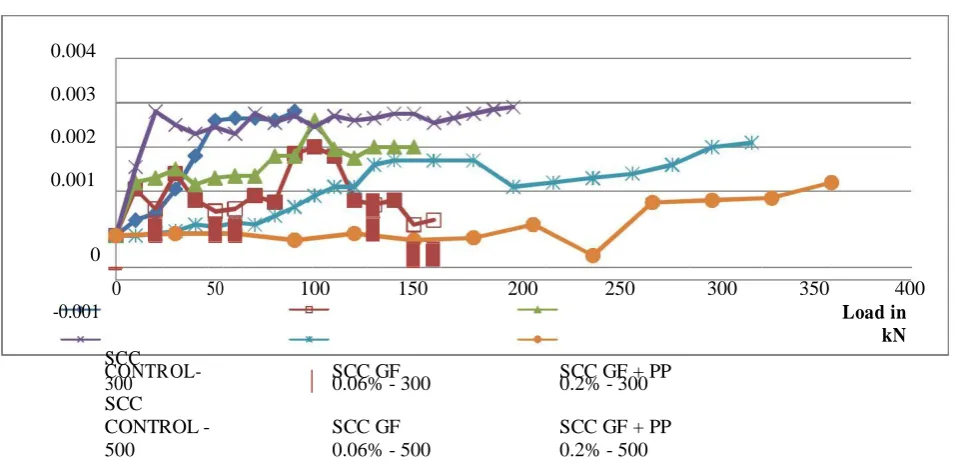
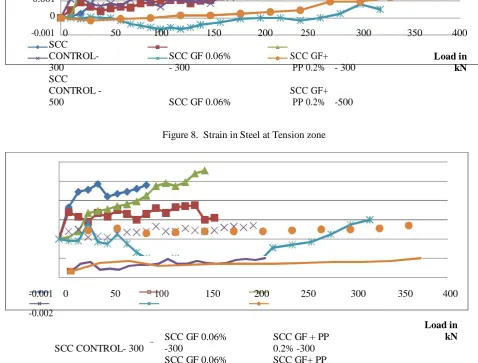
The Strains are measured in Compression zone and web zone of concrete surface and Strains are measured in steel at tension zone of deep beam specimens for 300 mm and 500mm are plotted in groups for better clarification and are shown in figure7,8 and 9. In deep beams the stress and strain distribution is non-linear. As per IS 456:2000, the Maximum strain in concrete at outermost compression zone is taken as 0.0035 and the maximum strain in the tension reinforcement in the section at failure shall not be less than 0.002 +
(Characteristics strength of steel / 1.15Modulus of Elasticity).
[image:8.595.322.532.180.330.2]All 6 deep beams show very low strain value that is less than 0.0035 in steel at tension and concrete at compression, web zones due to inclusion of Hybrid fibre except CSP SCC 2 – 300. The strain also has t he decrement when depth increases from 300 mm to 500 mm deep
Figure 6 crack patterns for 0.06% CS SCC deep beam
0.004
0.003
0.002
0.001
0
-0.001
0 50 100 150 200 250 300 350 400
Load in
kN
SCC CONTROL- 300
SCC GF
0.06% - 300 SCC GF + PP 0.2% - 300
SCC
CONTROL -
500
SCC GF 0.06% - 500
SCC GF + PP 0.2% - 500
[image:8.595.60.538.449.681.2]International Journal of Research in Advent Technology (IJRAT) Special Issue “
ICADMMES 2018
”
E-ISSN: 2321-9637
Available online at www.ijrat.org
118
S
tr
ai
n
0.005
0.004
0.003
0.002
0.001
0
-0.001 0 50 100 150 200 250 300 350 400
SCC CONTROL- 300
SCC GF 0.06% - 300
SCC GF+ PP 0.2% - 300
Load in kN SCC
CONTROL -
500 SCC GF 0.06%
[image:9.595.59.543.120.319.2]SCC GF+ PP 0.2% -500
[image:9.595.53.532.211.574.2]Figure 8. Strain in Steel at Tension zone
Figure 9. Strain in concrete at web zone
-0.001 0 50 100 150 200 250 300 350 400
-0.002
SCC CONTROL- 300
SCC GF 0.06% -300
SCC GF + PP 0.2% -300
Load in kN
SCC CONTROL - 500
SCC GF 0.06% -500
International Journal of Research in Advent Technology (IJRAT) Special Issue “
ICADMMES 2018
”
E-ISSN: 2321-9637
Available online at www.ijrat.org
119 7. STRUCTURAL PARAMETERS
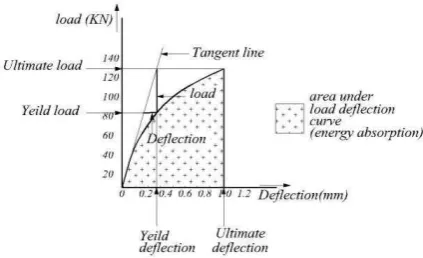
[image:10.595.56.268.190.319.2]The Table 8 for Structural response parameters like Energy Absorption, Ductility Factor, and Stiffness were determined by plotted tangent line in the load versus deflection curve. The Figure 10 shows a schematic diagram of Yield and Ultimate load and Deflection.
Figure 10. Load –Deflection for determining structu ral Parameters
Energy Absorption, Ductility Factor, Stiffness
The area under load -deflection curve indicates the energy absorption. The energy absorption capacity of 300mm deep beam shows an increment of 3 times in CSSCC 300 and 1.2 times in CSPSCC2- 300 than control SCC 300.The energy absorption capacity of 500 mm deep beam shows an increment of 3.5 times in CSSCC 500 and 1.4 times in CSPSCC2- 500 than control SCC 500.
Deflection Ductility of structures is , the ability of the structure which undergo deflection beyond the initial yield deflection without losing its strength. The ductility of a structure is defined as the ratio of ultimate deflection to yield deflection. The ductility factor is calculated and presented in Table 8. The Energy Absorption, Ductility factor are increased in both size of the beam especially in CSSCC and CSPSCC due to addition of strands & Polypropylene fibre matrix. But the level of increment in ductility is also based on the depth of the beam. Ductility factor increases about 3.5 to 2.8 times when depth increases from 300 mm to 500 mmdeep. Toughness is also defined (ASTM C 1018) as the energy absorption capacity. Toughness indices are found to increase with the increasing fibre content, and the behaviour indicates the ability of fibers in arresting cracks at both micro –macro –levels. In CSPSCC 2 -5 00 shows reduction in toughness due to balling effect of polypropylene fibers. The stiffness also has the decrement about 5 to 6 times when depth increases from 300 mm to 500 mm deep.
8. CONCLUSIONS
1. All the SCC, CSSCC and the CSPSCCs mixes are developed and satisfy the requirements of self compacting concrete which are specified by EFNARC 2002.
2. The results indicates that the use of hybrid fibers(glass strands and polypropelyne) which improves the mechanical properties of concrete. 3. It is found out that the results obtained in
mechanical properties of(GF 0.06% + PF 0.1 % ) is 16% and 11 % more in compressive strength and split tensile strength respectively at 90 days when compared to the results obtained for other mixes. CSPSCC 2 (GF 0.06% + PF 0.2 %) is slightly more for flexural strength when compared to the results obtained for other mixes.
4. The inclusion of fibre in SCC mixes, improves the ultimate load by 1.7 to 1.95 times in CSSCC, CSPSCC 2 respectively when compared with SCC and no major effect found in 300mm and 500mm deep beam.
5. Ductility factor increases about 3.5 to 2.8 times when depth increases from 300 mm to 500 mm deep.
6. The energy absorption capacity of 300mm and 500 mm deep beam shows an increment of 3-3.5 times in CSSCC and1.2-1.4 times in CSPSCC2than control SCC. The stiffness also has the decrement of about 5 to 6 times when depth increases from 300 mm to 500 mm deep. The above results indicate that the possibilities are available to reduce the congestion of steel reinforcement in deep beams by using this high ductile hybrid material and also reduce the construction difficulties.
7. Therefore concluded that CS 0.06% + PP
0.2% is optimum dosage level in SCC for improved performance. The above effects point out that the possibilities are accessible to decrease the congestion of steel reinforcement in deep beams by employing this high ductile hybrid material and as well decrease the construction difficulties.
REFERENCES
[1]Okamura H, Ozawa K. Self compactable HPC in Japan, SP 169: ACI, Detroit, pp. 31- 44, 1994. [2]Mohammad Mohammad hassani, Mohd Zamin Jumaat, Ashraf Ashour, Mohammed Jameel, “Failure modes and serviceability of high strength selfcompacting Concrete deep beams” Engineering Failure Analysis 18 (2011) pp. 2272-2281. [3]H. S. Kim, M. S. Lee, Y. S. Shin, “Structural
Behaviors of deep RC beams under combined axial and Bending Force” procedia Engineering 14 (2011) pp 2212-2218.
International Journal of Research in Advent Technology (IJRAT) Special Issue “
ICADMMES 2018
”
E-ISSN: 2321-9637
Available online at www.ijrat.org
120 [5]Indian standard Plain and Reinforced concrete -
code of practice. IS 456:2000 ,Bureau of Indian Standards, New Dehli.
[6]ACI 318, Building Code requirements for structural concrete (ACI 318-99) and Commentary (ACI 318R-99). Detroit: American Concrete
Institute;1999.
[7]CEB-FIP 1993.Model code 1990 for concrete structures. London,Comit_e Euro-International du B_eton, Laussane: Thomas tel ford services,Ltd., PP437.
[8]British Standards Institution (BSI)1997. Structural use of concrete. Milton Keynes : BSI : BS 8110 : Part 1.
[9]S. Goel, S. P. Singh, P. singh, “Flexural Fatigue strength and failure probability of self compacting fibre reinforced concrete beams”, Engineering structures 40 (2012) pp 131-140.
[10]Mohammad Mohammad hassani, Mohd Zamin Jummaat, Mohammed Jameel, Hamid Badiee, Arul M. S. Arumugam, “Ductility and Performance assessment of high strength self compacting (HSSCC) Deep beams: An Experimental Investigation”, Nuclear Engineering and Design 250 (2012) pp116-124.
[11]Mustafa Sahmaran, I. ozguryaman, “ hybrid fiber reinforced self compacting concrete with a high volume coarse flyash,” construction and building materials 21 (2007) pp150-156.
[12]Okamura H. Self Compacting High Performance Concrete, Concrete International, No. 7, 19(1997)50-4.
[13]P.Ramanathan,I.Baskar,P.Muthupriya,R.Venkatasu bramani,“Performance of self –compacting concrete containing Different mineral admixtures”, KSCE Journal of civil Engineering (2013)
17(2):465-472.
[14]Yasser sharifi. Structural performance of self-compacting concrete used in reinforced concrete beams, KSCE Journal of civil Engineering(2012) 16(4):618-626.
[15]Abdulkadircuneyt Aydin, “ Selfcompactability of high volume hybrid fiber reinforced concrete” construction and building Materials 21(2007) pp. 1149-1154.
[16]K.H. Khayat ,Y.Roussel, “Testing and performance offiberreinforced,selfconsolidating
concrete”,Matreials and structures, Vol 33,July2000,pp 391-397
[17]Bentur A, Mindess S. Fiber reinforced
cementitious composites. London: Elsevier;1990. [18]Kurita M,NomuraT, “Highly –flowable steel
fiber-reinforced concrete containing flyash”. In:Malhotra
VM, editor. Am ConcrInst SP178,June 1998.PP159-175.
[19]Kim JK,HanSH,ParkYD,Noh JH, Park CL, Kwon YH et al. “Experimental research on the materials properties of super flowing concrete.In:
BartosPJM, MarrsDL,Clel and DJ, Editors. Production methods and worklability of concrete,E&FN Spon;1996.pp271-284.
[20]Bouzoubaa N, Lachemi M, “self Compacting concrete incorporating high volumes of class F fly ash, Preliminary results” Cement concrete research 2001;31 (3) pp413-420.
[21]RafatSiddique, “Properties of self compacting Concrete containing class F flyash”,Materials and Design 32 (2011) pp 1501-1507.
[22]G. Appa Rao, B. S. R. K. Prasad and K. Ramamohan Rao. Influence of beam size and distribution of horizontal reinforcement on shear strength of RC deep beams, Journal of Structural Engineering, vol.39, No.3, Auguest - September 2012 pp.347-354
[23]Nan Su, Kung-Chung Hsu, His –Wen Chai, “A simple mix design method for self-Compacting Concrete”, Cement and Concrete Research 31 (2001) pp1799-1807
[24]Japanese Society of Civil Engineering,Guide to construction of high flowing concrete, Gihoudou Pub., Tokyo, 1998 (in Japanese)
[25]Y. W. Choi, H. K. Lee, S. B. Chu, S. H. Cheong and W. Y. Jung. Shear behavior and performance of deep beams made with self-compacting concrete, International journal of concrete structures and materials, vol.6, No.2, pp.65-78, june 2012
[26]Ganesan.N, Indira P.V, Sabeena M.V, “Behaviour of hybrid fibre reinforced concrete beam –column joints under reverse cyclic loads” materials and design 54 (2014) pp 686 – 693
[27]Sivakumar A. Manusanthanam. “Mechanical properties of high strength concrete reinforced with metallic and non metallic fibers. Cement concr Compos 2007;29:603-60
[28]Dinakar . P, Babu K. G, Manu Santhanam, “Durability properties of high volume flyash selfcompacting concrete” Cement and concrete composites 30 (2008) pp 880-886
[29]Mehta PK, “Concrete technology for sustainable development –an overview of essential principles ”In: Mehta PK ,editor, Concrete technology for sustainable development in the twenty –first century, New Delhi: Cement manufactures Association 1999 pp 1-22
[30]EFNARC. Specification & guidelines for self- compacting concrete.Englishedition:European Federation for specialist construction chemicals and concrete systems.Norfolk, UK;February 2002 [31]Indian standard code of practice for 53 grade
ordinary Portland cement ,IS 12269:1987 ,Bureau of Indian Standards, New Dehli
[32]Indian standard code of practice for Specification for coarse and fine aggregate from natural sourses for concrete, IS 383:1970 ,Bureau of Indian Standards, New Dehli
International Journal of Research in Advent Technology (IJRAT) Special Issue “
ICADMMES 2018
”
E-ISSN: 2321-9637
Available online at www.ijrat.org
121 [34]Indian standard code ofMethods of test for strength
of concrete, IS 516:1959,Bureau of Indian Standards, New Dehli