Reference Hashed
F r a n k Schilder Department for lnformaticsUniversity of Hamburg Vogt-K611n-Str. 30 22527 Hamburg, Germany
s c h i I d e r @ i n f o r m a t i k , u n i - h a m b u r g , d e
Abstract
This paper argues for a novel data structure for the representation of discourse referents. A so-called hashing list is employed to store discourse referents according to their grammatical features. The ac- count proposed combines insights from several the- odes of discourse comprehension. Segmented Dis- course Representation Theory (Asher, 1993) is en- riched by the ranking system developed in center- ing theory (Grosz et al., 1995). In addition, a tree logic is used to represent underspecification within the discourse structure (Schilder, 1998).
1 Introduction
Discourse referents are represented quite differently by current diso~urse theories. Discourse Represen- tation Theory (DRT), for example, employs a rather unstructured data structure for the domain of dis- course referents: a set (Kamp and Reyle, 1993). A DRT-implementation by Asherand Wada (1988), however, employs a more complex data type: a tree representation. In further work by Asher (i 993) ref- erents are grouped together into segments depend- ing on Ihe discourse structure. His Segmented DRT (SDRT) uses a tree-like representation for the dis- course s U u c t u i ~ I
Centering Theory (CD proposes a//st
structure for the entities one preferably refers to in subse- quent sentences. In order to cover coreference over discourse segments the centering model was ex- tended by a stack mechanism (Grosz and Sidner, 1986). Recently, these data structures have been criticized by Walker (1998), because they seem to be too restrictive. She proposes a cache storage for the referenis in the focus of attention.! propose instead a novel data structure for the representation of discourse referents. A/rushing list tSimilarly, Rhetorical Structure Theory (RST) makes use of a tree representation (Mann et aL,1988).
100
is used to distinguish between the different types of referents according to their grammatical features wrt. number or gender. This list structure is further- more combined with a hierarchical tree structure.
The remaining pan of the paper is organised as follows. Section 2 introduces the main claims made by past theories. Focusing on SDRT and CT, I will highlight the (dis.-...) advantages of these two ap- proaches. Section 3 provides the reader with an introduction to hashing lists and how they can be used for linguistic dam. Section 4 discusses how the different advantages of former approaches can be combined. First, DRT will be amended by us- ing a hashing list for the discourse referents instead of a simple set. Second, the centering model will be applied to the representation gained. Finally, the shortcomings of a flat representation are presented and the introduction of discourse segments is dis- cussed. Subsequently, section 5 describes a detailed formalisation of one example sequences by the rep- resentation proposed, before section 6 concludes. 2 B a c k g r o u n d
0
t
0
0
0
0
0
0
0
Q
0
0
0
0
0
0
0
0
0
0
0
0
0
0
2.1 Hierarchical discourse grammars
SDRT (and RST) assume that so-called discourse (or rhetorical) relations are the links between dis- course segments. A discourse relation has to be de- rived in order to achieve a coherent discourse. More importantly, the choice of this relation has a crucial influence on possible antecedents for anaphoric ex- pressions, z Asher (i 993) defines in SDRT the terms
subordination
andopenness
that specify where open attachment sites are in a discourse structure. A tree- like representation illustrates the hierarchical struc- ture of the discourse. Basically, the nodes on the so-called "right frontier" of the discourse structure are assumed to be available for further attachment (Webber. 199 i ).Generally speaking, all nodes which dominate the current node of the newly processed sentence are open (i.e.D.Subordination). However, a restriction is introduced by the term
D.Freedom
which applies to all nodes that are directly dominated by a topic (i.e. ~ ~/3), unless it is the current node (see fig- ure 1). An informal definition for possible attach- ment sites looks like the following:I. The last clause represented as a Discourse Rep- resentation Structure (DRS) K.
2. Any DRSs that are embedded in K.
3. Any DRSs that dominate the DRSs in I. and 2. through
Explanation, Elaboration
or ~[K 0 : a ~ d-free
Kt s :~ Kto :&
K l O l : ~
K I 0 l l : ~ K I 0 1 0 : ~
Rgure i:
Openness and D-Freedom
SDgr exploits discourse relations to establish a hierachical ordering of discourse segments. A so- called constituent graph indicates the dependencies
Zl will concentrate on how SORT deals xvith this i.,~ue in the folltm, ing. A study that .shows how RST can be u.~d to make predictions regarding anaphora resolution in a text can be found in Fox (1987).
between ~cgments,e.,~pecially highlighting the ()pen attachment pt>h]ls.
SDRT has been sucessful whet) phenomena are considered thai are explainable because of the hier- archical structure of the discourse. This approach is too restrictive when an anaphoric reference is drawn over .~egment. boundaries:
(I) (a) Mary once organised a party..(b) Tqm bought the beer. (c) Pete~" was in charge of the food. (d) Years later Mary still com- plained that it was too spicy.
The sentence (Id) continues at the top level of the discourse, but the antecedent of it (i.e.
food)
is still available even though it is deeply embedded in anElaboruzirm
segmenr(i.e. (! a-c)).Other shortcomings concern formal, features. First," SDRT is not capable Of expressing under- specification for ambiguous sequences. Second, the derivation of the di~'~turse structure is not mono- tonic. Once derived, SDRSs are overwritten by an
uLulate.
2.2
CenteringCT proposed by Grosz et al. (1995) offers a text comprehension model that describes the relation be- tween the focus of attention and the choices of re- ferring expressions within a discourse segment. The main idea of this theory is that a sentence possesses
a center arid that normally one Continues to write (or talk) about this center. Each utterance 0~ gets a list
of forward-looking centers
C/(U~) assigned to it. Basically, all the entities mentioned by the sen- tence are ranked according to their degree of being in the center o f the utterance. Each sentence also has a uniquebackward.looking
center C'b(Ui). A main claim by the theory is that the most likely C6(Ui+t) is the most highly ranked Cl([/i)~ Hence, the cri- teria for ranking the entities on the forward-looking center list are crucial for the predicative power of this theory. No tm~ly, the grammatical relationssubject, object etc.
determine the preferredCp(Ui)
(i.e.
the first entity on theCl(Ui )
list).forward- and backward looking centers is popped off the stack. The new top clement of the stack contains the centering information from the old seg- ment that the subsequent discourse continues with.
This simple stack mechanism has been criticised. In particular Walker (1998) points out that (i) a long intervening discourse segment Can make it difficult to return back to earlier mentioned discourse refer- ents and (ii) discourse referents introduced in a sub- ordinated segment can easily be carded over to a higher segment (e.g. (I)). Note that a stack model would discard the information of a closed-off dis- course segment. Walker proposes a c a c h e storage that keeps often-used discourse referents within a storage. If reference is made to an antecedent men- tioned earlier in the discourse the information is re- stored from long term memory.
Unfortunately, it is not quite clear how this re- trieval operation can be fonnalised. In addition, it should be acknowledged that there are structured constraints of the discourse structure that do not al- low the choosing o f a recently mentioned referent. Data discussed within DRT, such as the sentence be- low, have been presented as evidence for a notion of (in-)accesibility. 3 Negation is a standard example that does not allow a reference to a discourse entity in the prevous sentence:
(2) No man walks in the park. #He whistles.
In the given example sequences the pronoun he cannot refer back to the discourse refett~ts intro- duced i n t h e previous sentence. Another example can be found in (3) that involves a conditional:
(3) If a farmer owns a donkey, he beats it. # H e hates it.
Again, neither a pronominal reference by he nor by it is possible. It may be concluded from these data that a cache approach is not restrictive enough. The discussion so far has shown that the data structures used for discourse processing are either too restrictive or not restrictive enough. The next Section presents a novel way o f representing dis:
course referents introduced by a text. The data structure pre.sented is called a hashing list and al- lows for an efficient way to access stored informa- tion.
"Gordon et al. (1998), for example, blend DRT with CT.
102
3 H a s h i n g lists
The following section describes how a hashing list works before the subsequent section shows how this data structure can be used for discourse processing.
3.1 Data hashed
One of the main problems for the de~,;ign of com- puter systems is the question of how data is stored and efficiently accessed. Hashing lists are often used for this purpose since this data structure is specifically designed for easy retrieval of stored data.
I will first describe the data structure in more de- tail and then I will give an example of how data can be retrieved from a hashing list.
Hashing lists. The basic data structure for a hash- ing list is an array A[min..max] (i.e. an indexed • list A that has a preset length of n elements). An array with the name y e a r could be defined as fol- lows:
TYPE hash = ARRAY[0..99] of
integer;
The random access structure of this data type al- lows the programmer to assig n a single cell of the array directly (e.g. h a s h [ 9 9 ] : = 9 ; ). This is an advantage over other data structures such as trees.
Hashing functions. A function has to be designed that tells us how to store data on the hashing list. This function takes the item to be stored and gives back an appropriate key k. The item can now be stored at the fight place on the list.
Suppose we want the program to store the inte- ger 2 0 0 0 on the hashing list y e a r defined earlier. A hashing function H ( i ) has to be be chosen such that this function gives back an index k. With this information the assignment h a s h [k] : = 2 0 0 0 ; can take place. A hashing function for integers may be the Modulo function. For the given example the key k would be 2 0 (i.e. 2 0 0 0 rood 99 = 20).
0
Q
0
0
0
0
0
0
0
0
0
0
0
0
0
0
0
0
0
0
0
0
0
0
0
0
0
0
0
0
0
0
0
0
0
[19]
l'J
[ 2 0 ]
2o'oo
119 °
[ l
[ 2 1 ]
6
Figure 2: h a s h [ 1 9 . . 21] with collision resolu- tion for two items
3 . 2 Discourse hashed
I now show how a hashing list can be employed as a data structure for linguistic data. This may not be obvious after using only integers for storing on a hashing list.
Domains of referents. Natural language process- ing requires a richer data structure than storing in- tegers. However, in the end a hashing function for linguistic data will also consist of an array.
Considering the different types of discourse refer- ents, we can assume at least the following list of mr. erents to be relevant: singular male, singular female, singular neuter, plural and event referents. 4 We n o w take these conceivable referents and reserve each of them a slot in the d o m a i n array:
d o m a i n [ s g M , sgF, sON, pl, ev]
Note that this way of writing the hashing list is actually only syntactic sugar for a normal definition
such as d o m a i n [ 1 . . 5 ].
Referent function. A function is needed that can assign a cell on the array d o m i n to a newly introduced discourse referent. The semantic and syntactic information that comes with the a dis- course referent gives us the key for this. Take for example a proper name such as Peter. The information that comes with it could be encoded as a feature value matrix such as proposed by Dale (1992) (see figure 3). The hashing function
INDEX:
;CI['AT
pn
SYN.
[NUM.
sing"
AGR:LGEND:
maleSEM: NAMED: peler]
Figure 3: The representation for Peter
The function rezums sgM (or 1) as key for the array d o m a i n in the example given.
Summing up, a hashing list was proposed to store discourse referents while processirlg natural lan- guage discourse. This kind of list contains several "slots" that await discourse referents described by a discourse. The grammatical features of gender and number distinguish the different referents.
The following section discusses how this data structure is embedded into a discourse grammar.
4 R e f e r e n t s in d i s c o u r s e
The linguistic data presented earlier demonstrates the need for hierarchical constraints on anaphora resolution. But the data also show that previous approaches such as SDRT overemphasise this re- striction. A refusal of any discourse structure con- suaints, on the other hand, also does not seem to be appropriate. A cache storage that stores the fre- quently used discourse referents does not account for the data that were explainableby (S)DRT.
This section describes how a hashing list can be used for the storage of discourse referents. The list is integrated into an SDRT framework. The infor- mation about the discourse segments is kept in order to cover data that is explainable by thehierarchicai discourse structure. In addition, the insight that a takes the information under the agreement feature sentence has a center as proposed by CT is also re- AGR and checks for the values regarding n u m b e r ' : flected by the theow proposed. The discourse refer-
and gender, ents are ordered according to centering preference.
NUM: ,nng ]
~F.JqO: nude]
*This is only a first list of very fundamental referents. But .
the
list
can easily he extended .by more differentiated plural types,speech
acts or types of referents.The following sections describe in more detail how the different concepts are integrated in the sys- tem proposed by this paper. First, the way discourse referents are stored via a hashing list is explained. Second, the ordering regarding the centering prefer- ence is imposed on the slots of the hashing list. And finally, a tree structure is presented that binds all the components together.
[image:4.612.53.562.33.760.2]4.1 Referents hashed
In the system proposed, a hashing list stores the rel'ercnts introduced by the discourse. The hashing list contains at least the following slots: s c j l , s g F , s g N , p l , ev. Since the basic formalism is DRT, we need to incorporate the hashing list into the formalism. In DRT, a DRS consists of the domain of discourse referents and the set of conditions, imposed on the referents. A sentence such as Peter sighs is represented by the box notation as follows:
4.2 Referents re-centered
Alter blending a I)RT representation with a hash- ing list lor a structured representation of discourse referents. 1 will introduce the centering I'~ature into the formalism. The different slots already contain the ordering of the referents regarding the centering preference. An apparent advantage over the center- ing approach should become clear: the referents are already separated from each other.
A discourse such as (4) without any competing antecedents for the pronoun she is formalised by a HDRS as follows:
Xl el
p~ter( x D
ez : sigh(xz)
A hashing list substitutes, for the set of discourse referents offering ~ffezcnt slots for the discourse referents to be stored in:
Peter(x z ) el : sigh(xl)
The representation of a more complex sentence such as Peter gave John a book containing several discourse referents is in the following DRS:
• ::1 I: '11 "'
p~.er(xl)
john(z2)
book(zs)
ez : give(:l, : : , :a)
This Hashed DRS (HDRS) contains a complex domain sub-box. '['he slot for male and singular discourse referents is filled with the two items xt and zz. The two referents are on a collision list as described earlier. Additionally, the list reflects the ordering for the centering list. The subject NP Pe- ter was processed before the object NP John "and • is therefore the first entry on the preferred center- ing list. Note that only referents that share the same grammatical features are listed in the same slot.
104
(4) (a) Peter gave Mary a book. (b) It was about sailboats. (c) She was thrilled.
xz x2 Fz el
S2 S3
peter(xl)
mary(x2) book(y] ) et:give(xz,x2,!/I) s2:about(yz; s_boats) ss:thrilled(x2)
C T would predict for (4.b) that the book is the preferred forward looking center Cp. The back- ward looking center of (4c) is Mary. This is called
a rough slu'ft in CT. A continuation of the center
(Cp(Ui) = Cs(Ui+t)) is the preferred and most co-
herent constellation according to this theory. How- ever, contrary to what CT would predict, it is no problem to read(4).
The HDRS format seems to work fine with pronominal references to persons or objects. But we run into problems when the slot regarding the descihed events and states is considez~l. The fol- lowing example (5) illustrates that a simple flat list representation as indicated above by et, a2, ss is not sufficient for more complex anaphori¢ expressions such as event anaphora (Allen 1995):
(5)
(a) When Jack entered the room, everyone threw balloons at him. (b) In retaliation, he picked up the ladle and started throwing punch at everyone. (c) Just then; the chair-. man walked into the room. (d) Jack hithim. with a ladleful, right in the face. (e) Every- one talked about it for years afterwards.0
0
0
0
0
0
0
0
0
0
0
0
0
0
0
0
0
0
0
0
0
0
0
0
0
0
0
0
0
0
0
0
Q
m
I
I
I
I
O
O
O
O
O
O
O
O
O
O
O
O
O
@
O
O
O
O
O
@
@
@
O
O
O
O
O
@
O
O
O
O
O
O
O
O
O
KI
I
K m : ehzh(Ktt~t. K;~t;
S2
Figure 4: The discourse structure for Eluboruthm
The pronoun h in (5e) may refer to the entire sit- uation described by (5a) through (5d). BUt this is not the only conceivable antecedent for it. The sit- uation described by (5d) may be referred to by it as well, if we consider an alternation of (5e) as in the following:
(Se') It was a foolish thing to do.
Note that the situation in (5d) is the only situation available from the sequence (5a-d). The list struc- ture for the e v e n e slot does not reflect the structure of the discourse. A segmented discourse structure is needed here.
4.3 Discourse segments
The derivation of discourse structure used in this account is that.proposed by SDRT. This discourse grammar, as well as others, claims that discourse • segments originate from the derivation of so-called discourse relations (e.g. Narration, Elaboration etc.) due to our background or world knowledge.
The account proposed by this paper assumes that HDRSs are grouped together wrt their discourse segment. Consider now the following sequence (6) with the possible continuation (6e) with a male and female pronoun (depending on whether a male or female protagonist was introduced by the first sen- tence).
(6) (a) Mary/Mark once organised a party. (b) Tom wrote the invitation cards. ( c ) P e t e r bought the booze.
(re) She/He was glad that everything worked out so nicely.
The first continuation does not cause any prob- lems. although the antecedent for she was intro-
thlced by the iirst sentence of the sequence. Since no odler COml~.'ting discourse refcrellls have been menlioned, the resolulion process works without problem. However; .substituting a male protagonist called Mark for the female protagonist in the first sentence does cause problems for the understanding of 16). In this case, it is unclear w h o was meant by he. Note furthermore thai only two antecedents are available, even though three male antecedents have been introduced. Only the one in the last sen- tence (i.e. Peter), or the one introduced by the first sentence (i.e. Mark) are conceivable antecedents. A different continuation does not show this ambiguity:
(6e') He decided just to buy beer.
The continuation in (6¢') is an elaboration of the last sentence. Hence Peter, who was responsible for the booze, is the only possible antecedent.
The following sentence is the last piece of evi- dence that the discourse segment allows only an- tecedents that are available on the so..ealled right frontier. The following sentence shows that it is not possible to refer to Tom, who wrote the cards, with the last sentence:
(6¢") #He decided to use thick blue paper.
5 F o r m a l i s a t i o n
This section is an introduction to the formalism used. The formalism consists oftbe following parts:
DRT The standard DRT theory is used to obtain a semantic representation for the meaning of a clau~ (Kamp and Reyle, "i993). However, the set of discourse referents is more structured than in the standard approach. It also goes be- yond the approach by Asher and Wada (1988) (see below for further details).
Hashing lists The data structure of hashing lists is used to divide the set o f discourse referents up into different slots. Each slot contains only ref- erents of the same type, as there are singular male, female, or neuter referents, plural enti- ties and events.
SDRT A hierarchical discourse structure is needed to explain anaphoric expressions that refer back over segments boundaries. In addition, a theory is needed that takes into account world knowledge for the derivation of discourse rela- tions (Asher. 1993).
Ixl ly, ! ]el
mary(zz)
p a r t y ( I / t )et
:organise(zz, Z/z)
KT"
I ~, l y, ] z, l el
mary(a:z) party(z/z)
ez : organise(zz, gz)
el _3/¢;~l-e
Zl
= zl ~ ~2 • X ~ l . ZI
KRI : elab(K~l.
K~I)
82 :
i
i
tom(z2)
[image:7.612.50.575.40.739.2]invitation_cards(Z2) e2 "wri~z2, ~ )
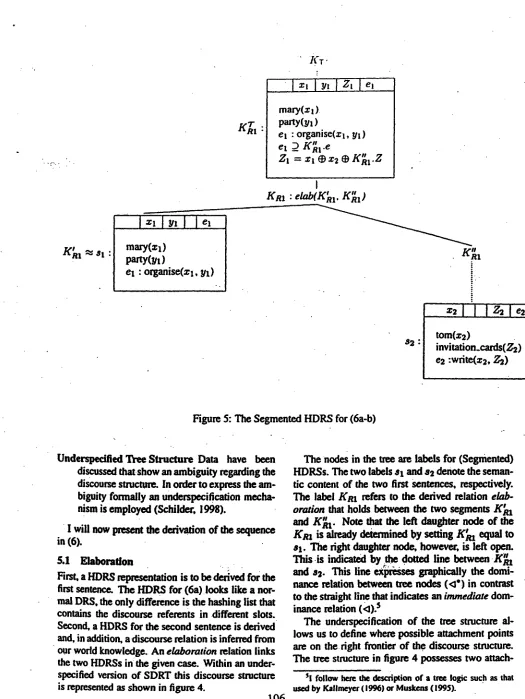
Figure 5: The Segmented HDRS for (6a-b)
Underspecified Tree Structure Data have been discussed thatshow an ambiguity regarding the dis¢oune structm~ In order to express the am- biguity formally an underspecification mecha- nism is employed (Schilder, 1998).
• I will now present the derivation of the sequence in (6).
$.1 Elaberation
First, a HDRS representation is to be de~ved for the first sentence. The HDRS for (6a)looks like a nor- real DRS, the only difference is the hashing list that contains the discourse referents in different slots. Second, a HDRS for the second sentence is derived ~ and, in addition, adiscourse relation is inferred from our world knowledge. An elaboration relation links the two HDRSs inthe given case. Within an under- specified version of SDRT this discourse structure is represented as shown in figure 4.
106
The nodes in the tree are labels for (Segmented) HDRSs. The two labels st and a~ denote the seman- tic content of the two first sentences, respectively. The label KRt refers to the derived relation dab- oration that holds between the two segments K~x and K~t. Note that the left daughter node of the K ~ is already deiermined by setting K ~ t equal to at. The right daughter node, however, is left open. This i s indicated by ~the dotted line between K,~ l and s2. This fine expr~ses graphically the domi- nance relation between tree nodes (<Z') in contrast to the straight line that indicates an immediate dom- inance relation (<l). s
The underspecification of the tree structure al- lows us to define where possible attachment points are on the right frontier of the discourse structure. The tree structure in figure 4 possesses two attach-
Sl follow here the description of a tree logic such as that used by Kallmeyer ( 1996} or Muskens (1995).
e
] ' ( T . . "K : " K T
I "r I
le,
e
e
/
• . K ' :
0
l'.i z21 I IZ21e2
/
" ~
e
/
\
tom(z2)
invitadon_cards(~2) e2 :write(z~, Z2)
82 :
..." f'J
...-°°~
xsl
i y31 103
peter(z2) s3 : booze(z/s)
[image:8.612.46.562.60.750.2]es : buy(z2, Y3)
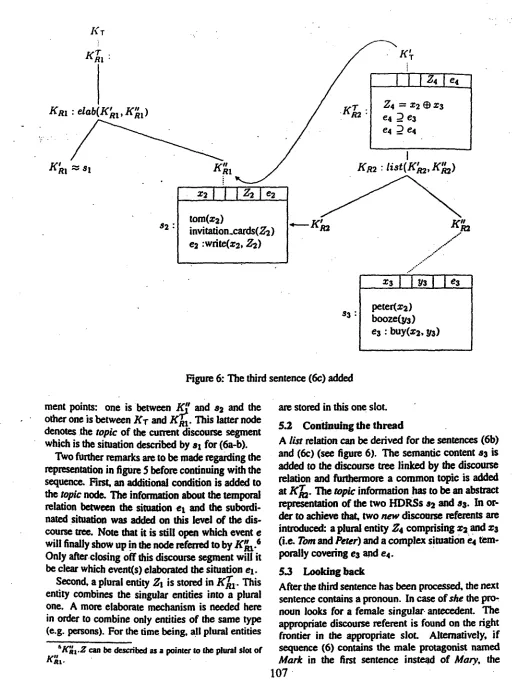
Figure 6: The third sentence (6c) added
ment points: one is between K~ ~ and s:~ and the other one is between/CT and K ~ x. This latter node denotes .the
topic
of the current discourse segment which is the situation described by sz for (6a-b).Two further remarks are to be made regarding the representation in figure 5 before continuing with the sequence. First, an additional condition is added to
the
topic
node. The information about the temporal relation between the situation-et and the subordi- nated situation was added on this level of the dis- course tree. Note that it is still open which event e will finally show up !n the node referred to by K~x. ~ Only afterclosing off this discourse segment will it be clear which event(s) elaborated the situation ez.Second, a plural entity Zl is stored in K~z.. This entity combines the singular entities into a plural one. A more elaborate mechanism is needed here in order to combine only entities of the same type (e.g. persons). For the time being, all plural entities s/C'~z.g can be described as a pointer to the plural slot of K,~t.
are stored in this one slot.
5.2 Continuing the thread
A//st relation can be derived for the sentences (6b) and (6c) (see figure 6). The semantic content sa is added to the discourse tree linked by the discourse relation and furthermore a common topic is added at KTR2. The
topic
information has to be an abstract representation of the two HDRSs a2 and as. In or- der to achieve that, two new discourse referents am introduced: a plural entity Z4 comprising za.and zs (i.e.Tom and Peter)
and a complex situation e4 tem- porally covering ea and e4.5.3 Looking back
After the third sentence has been processed, the next sentence contains a pronoun. In case of she the pro- noun looks for a female singular-antecedent. The appropriate discourse referent is found on the right frontier in the appropriate slot. Alternatively, if sequence (6) contains the male protagonist named
Mark
in the first sentence instead ofMa~., the
Ixzrsonal Pronoun he could I£1v¢ two Posnll~lc ;m- l¢cCdc:nts: I~'ler or MCar/,'. How can Ihal be L'x-
plaincd by the formalism?
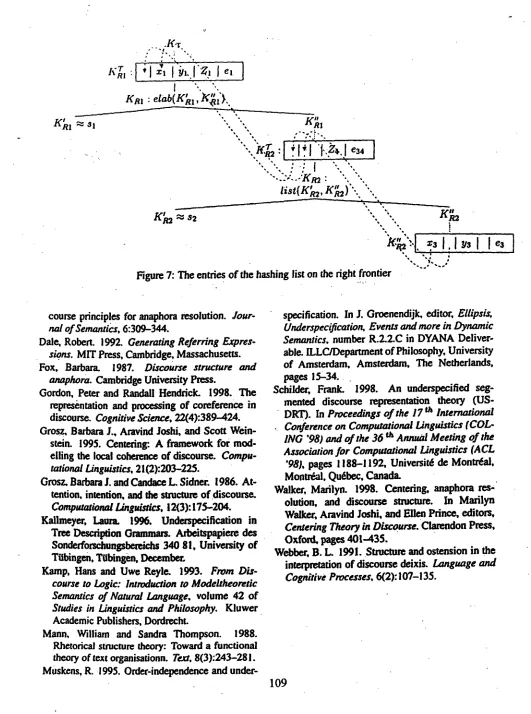
Figure 7 depicts the formalisation of the dis- coupe (6a-c) cmly showing the hashing lists on the right frontier. The dotted arrows indicate the hash- ing list as it is distributed over the right frontier of the discourse structure. There is only one entry for a female singular antecedent over the levels of nodes on the right frontier. However, if there were a male protagonist, the hashing list for the referents in node /x'~o would contain a discourse referent in the first slot. The list of possible antecedents for he would be xa and x t.
The separation of different reference types also allows us to explain sequences such as ( I ). The dis- course continues on the highest level, but it is possi- ble to refer to discourse referents that got introduced on a lower level of the discourse structure. The link between two situations can be made via a rhetorical rela6on, and at the same time the slots for the other referents at the right frontier are still accessible.
The hashing list also models a hashed right fron- tier. Past approaches always collapsed discourse at- tachment with the restriction regarding possible an- tecedents for anaphora (cf. the stack mechanism in CT or the tree representation for (S)DRT).
The formalisation can also provide an explana- tion of why competing antecedents can cause an ambiguity for the pronoun resolution. The acces- sibility of hashifig lists on different levels of the dis- course structure explains why, in this example, a fe- male antecedent can be used as an antecedent even over several intervening sentences. It is important to highlight the difference of the account presented here to past approaches: The discourse referents are grouped together according to their agreement fea- tures. The DRT account by Asher and Wada, for instance, stores the discourse referents in a tree ac- cording to the accessibility conditions imposed by DRT and singles out the appropriate antecedents ac- cording to number and gender information as well as other criteria. There the agreement information is used to "weed out" possible antecedents, whereas within a HDRS the discourse referents are already accordingly stored.
It should also be clear that an embedded dis- course cannot be extended infinitively, as shown by the cache approach. A restriction has to be imposed on the number of levels where an antecedent can be looked ['or. Future research, however, has to clarify 108
this is.~uc Iurlhcr.
Nt)t¢ thai Ihis I'ormali.~atio. c:q~itahzcs on the in- sight gained From the cache al)proacli. An elabo- ration cannot be continued for too long. since the working memory of the reader might lose track of the protagonist(s)introduced on the highest level. On the other hand, this fonnalisation also cov- ers mor~ data than the cache approach. A text
comprehension theory
that employs a cache stor-age cannot account for a discou~e such as (6) with a non-competing female protagonist. The dis- course referent for Mary would have been stored in long term memory, because no differentiation is made betwee n the grammatical types of possible an- tecedents according to the cache approach.
6 C o n c l u s i o n
I have proposed a new data structure for the process- ing of coreference in a discourse. A hashbzg list was employed to store referents according to their grammatical features such as number or gender. Be- cause of this, better accessibility to non-competing antecedents can be modelled by the approach pre- sented.
The discourse grammar used combined insights from different approaches to discourse processing:
(S)DRT and CT. In addition, a tree logic was used
to allow underspecification in the representation of
ambiguous. ~quences.
Future research has to focus on the evaluation of . . ' - . . . • the proposed theory to anaphora resolution. Co- pora investigation and psychological experiments will provide more evidence. In addition, an imple- mentation of hashed DRT is being programmed.
A c k n o w l e d g m e n t s
I would like to thank the two annomynous reviewers to their comments and feedback. Special thanks to Christie Manning for providing me with all her help.
R e f e r e n c e s : ,
Allen. James. 1995. Natural I.zmguage Under- standing. The Benjamin/Cummings Publishing Company, Redwood City. California.
Asher, Nicholas. 1993. Reference #J abstract Ob- je¢'ls in Discour.ve, volume 50 of 5uulie.v in Lin- gui,'tic.v mul Philosophy. Kluwer Academic Pub- lishers. Dordrecht.
Asber, Nichola~ and Hajime Wada. 1988. A c o m - putational account o f syntactic, semantic and dis-
D
O
O
O
O
O
O
O
e
O
O
O
e
O
e
O
O
O
O
O
O
e
O
e
O
e
O
e
O
O
e
O
O
O
®
K~R1 "~ a l
,.l(~r
" o .,: "-,
Kl~l : elab(K~l, Net'},.
i , I
lis *r r'l K " ~zl'R2, R 2 1 ~'" "., "" • t t
K ~ ~ s2 "., ""
[image:10.612.45.576.48.762.2]• . !
Figure 7: The entries of the hashing list on the right frontier
course principles for anaphora resolution. Jour- nal of Semantics, 6:309-344.
Dale., Robert. 1992. Generating Referring Expres- sions. MIT Press, Cambridge, Massachusetts. Fox, Barbara. 1987. Discourse structure and
anaphora. Cambridge University Press.
Gordon, Peter and Randall Hendrick. 1998. The representation and processing of comferenC¢ in discourse. Cognitive Science, 22(4):389-424. Grosz, Barbara L, Aravind Joshi, and Scott Wein-
stein. 1995. Contusing: A framework for mod- elling the local cohe~nc¢ of discourse. Compu- tational Linguistics, 21(2):203-225.
Grosz, Barbara J. and Candac¢ L. Sidnex. 1986. At.. tentien, intention, and the structure of discourse. Compataaonal Linguistics, 12(3): 175-.-204. Kallmcycr, Laura. 1996. Undenp~ification in
Tree Descri#on Grammars. Arbeitspapiem des Souderfonchungsbereichs 340 81, University of Ttibingen, T(lbingen, December.
Kamp, Hans and Uwe Reyl¢. 1993. From Dis- course to Logic: lmroduction to Modeltheoretic Semantics of Natural Language, volume 42 of Studies in Linguistics and Philosophy. Kluwer Academic Publishers, Dordmcht.
Mann, William and Sandm Thompson. 1988. Rhetorical structure theory: Toward a functional theory of text organisationn. Text. 80):243-28 I. Muskens, R. 1995. Order-independence and under-
specification. In J. Groenendijk, editor, Ellipsis, Underspecification, Events and more in Dynamic Semantics, number R.2.2.C in DYANA Deliver- able. ILLC/Department of Philosophy, University of Amsmrdam, Amsterdam, The Netherlands, pages 15--34.
Schilder, Frank. 1998. An underspacified seg- meated discourse representation theory (US- DR'I'). In Proceedings of th e 17 ~ International . Conference on Computational Linguistics (COL- ING "98) and of the 36 th Annual Meeting of the Association for Computational Linguistics (ACL "98), pages ! 188-1192, Universit6 de Moutr6al, Montr~,al, Qu6bec, Canada.
Walker, Marilyn. 1998. Centering, anaphora res, olution, and discourse structure. In Marilyn Walker, Aravind Joshi, and Ellen Prince, editors, Centering Theory in Discourse. Clarendon Press, Oxford, pages 401-435.
Wcbber, B. L. 1991. Structure and ostension in the interpmtatiou of discourse deixis. Language and Cognitive Processes, 6(2): 107-135.
![Figure 2: hash [ 19.. 21] with collision resolu- tion for two items](https://thumb-us.123doks.com/thumbv2/123dok_us/756413.1087329/4.612.53.562.33.760/figure-hash-collision-resolu-tion-items.webp)