Can Discourse Relations be Identified Incrementally?
Frances Yung
Language Science and Technology, Saarland University,
Saarland Informatic Campus, 66123 Saarbr¨ucken, Germany [email protected]
Hiroshi Noji Yuji Matsumoto Information Science,
Nara Institute of Science and Technology 8916-5 Takayama, Ikoma
Nara, 630-0101, Japan {noji,matsu}@is.naist.jp
Abstract
Humans process language word by word and construct partial linguistic structures on the fly before the end of the sentence is perceived. Inspired by this cognitive ability, incremental algorithms for natural language processing tasks have been pro-posed and demonstrated promising perfor-mance. For discourse relation (DR) pars-ing, however, it is not yet clear to what extent humans can recognize DRs incre-mentally, because the latent ‘nodes’ of discourse structure can span clauses and sentences. To answer this question, this work investigates incrementality in dis-course processing based on a corpus an-notated with DR signals. We find that DRs are dominantly signaled at the bound-ary between the two constituent discourse units. The findings complement existing psycholinguistic theories on expectation in discourse processing and provide direction for incremental discourse parsing.
1 Introduction
Incremental processing is an essential character-istic of human language comprehension, because linguistic data naturally occurs in streams. For example, during sentence comprehension, humans do not start parsing only after the whole sentence is perceived. Instead the human processor incre-mentally constructs a partial syntactic tree that matches the sentence prefix read so far (Tanenhaus et al.,1995). Though intuitively for parsing every word is relevant to the syntactical structure, it may not be the case for more global linguistic struc-tures such as DRs, which may only be triggered by some informative cue words, and it is yet un-clear at which point the human processor
recog-nizes a DR as the sentence is read or listened word by word.
DRs are relations between units of texts, such as clauses or sentences. For example,
1. In the first year, the bank eliminated 800 jobs. Now it says it will trim more in the next year.
the first and second sentences are connected by a
temporalrelation, as the events occur in a tempo-ral sequence. An incremental discourse processor should predict and recognize the relation at some point before the end of the second sentence. It is useful for speech recognition and dialogue sys-tems where real-time analysis is desirable.
Towards an incremental approach to automatic discourse parsing, this work investigates word-level incrementality in human discourse process-ing based on manual identification of DR cues. The point at which humans recognize a DR can provide a reference on how long an incremen-tal discourse parser should ‘wait’, before there is enough input for timely yet accurate prediction of the discourse structure.
2 Related Work
This work is related to incremental approaches of natural language processing (NLP) and psycholin-guistic studies on human discourse processing.
In NLP, incremental approaches are used in tasks such as syntactic parsing (Stolcke, 1995;
Collins and Roark, 2004; K¨ohn and Menzel,
2014), semantic role labeling (Konstas et al.,
2014) and other joint tasks (Hatori et al.,2012;Li and Ji,2014;Zhou et al.,2016). These incremental systems are advantageous since they are capable of synchronous analysis by accepting sentence pre-fixes as inputs. On top of generating more natural and timely response in dialogue systems and im-proving language modeling in speech recognition,
these models can also be used to reflect difficul-ties in human language processing (Keller,2010;
Demberg et al.,2013).
However, we are not aware of any prior work that implements a discourse processor with such a strong assumption to incrementality. Although expectation for upcoming DRs is demonstrated in various lexico-syntactic constructions in the first clause/sentence (Cristea and Webber, 1997), existing methods of discourse parsing rely on a pipeline, in which the raw text is first segmented into discourse units, mostly clauses or sentences, and the relation is predicted based on two com-plete discourse units. In this respect, even shift-reduce discourse parsers (Marcu, 1999; Reitter,
2003; Sagae, 2009; Ji and Eisenstein, 2014) are incremental only at discourse unit level.
In psycholinguistics, expectation in language processing is a well studied topic (e.g. Altmann
(1998)). Experimental studies suggest that hu-mans use available pragmatic cues to generate ex-pectations and anticipate the upcoming discourse structure (Rohde, 2008), but there are diverging findings about the time-course for humans to rec-ognize and integrate DRs. For example,Millis and Just(1994) state that integration of acausal rela-tion takes place at the end of the second clause. In contrast, other experiments report that the integra-tion already occurs in the beginning of the second clause, at least for some relation types (Traxler et al.,1997;Cozijn,2000;Mak and Sanders,2010,
2013;K¨ohne and Demberg, 2013). These exper-iments are, however, limited to comparison of a few relation types and mostly depend on discourse markers (e.g. however,because). We still lack an integrated picture on where humans generally rec-ognize a DR.
3 Methodology
This study presents an off-line corpus analysis to determine when or where humans recognize a DR as they process words incrementally. To this end, we want a human subject to identify the cues within the component clauses/sentences that trig-ger the recognition of a given DR, such as the un-derlined tokens in Example (1).
Although the exact annotated resource is not yet available, we obtained such annotation by converting the annotation in the RST Signaling Corpus (Das et al.,2015).
Data The RST Signaling Corpus consists of an-notation of discourse signals over the RST Dis-course Treebank (Carlson et al., 2002), which is a discourse annotated resource following the Rhetorical Structure Theory (RTS) (Mann and Thompson, 1988). In the RST Discourse Tree-bank, a DR is annotated between two consecu-tive discourse units. In turn, in the RST Signal-ing Corpus, each DR is further labeled with one or more types of signaling strategy. These sig-nals not only include explicit discourse markers but also other features typically used in automatic implicit relation identification and psycholinguis-tic research, such as reference, lexical, semanpsycholinguis-tic, syntactic, graphical and genre features (Das and Taboada,2017). For example, thetemporal rela-tion in Example (A) is annotated with three signal labels in the RST Signaling Corpus:1
(1) discourse marker (now)
(2) tense (past — present, future)
(3) lexical chain (first year — next year)
Only 7% of the relations are annotated as ‘im-plicit’. Therefore, most conventionally ‘implicit’ relations are also annotated with explicit signals and included in the present analysis.
Locating signal positions Based on these la-bels, we use heuristic rules (see appendix) and gold syntactic annotation2 to identify the actual
cue words in the text. For example, based on the above 3 signal labels, we identify the underlined tokens in Example (1). Manual check on 200 ran-dom samples shows that all signal tokens are per-fectly tagged in 95%of the samples, and the re-maining5%samples are partially correct.
We focus on relations that are signaled by sur-face tokens in order to examine word-level incre-mentality in discourse processing. Thus, we do not consider signals that are not associated with partic-ular words, e.g. genre, and relations with annota-tions that are not specific enough. 4,146relations are screened3and15,977relations are included in
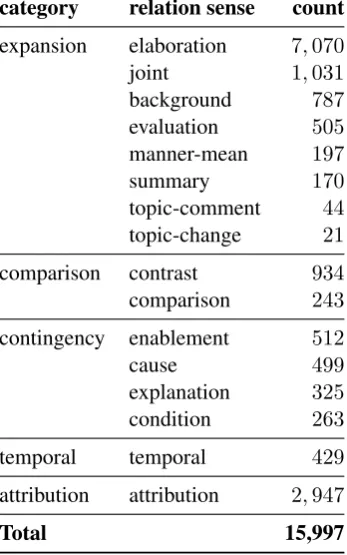
the analysis. The distribution of the DRs under analysis is shown in Table1.
1The list of DR signals and the relation between the RST
Treebank and the RST Signaling Corpus can be found in the appendix. Details can be found in the related literature.
2provided by the Penn Treebank, which annotates on the
same text as the RST Treebank (Marcus et al.,1993)
category relation sense count
expansion elaboration 7,070
joint 1,031
background 787
evaluation 505
manner-mean 197
summary 170
topic-comment 44
topic-change 21
comparison contrast 934
comparison 243
contingency enablement 512
cause 499
explanation 325
condition 263
temporal temporal 429
attribution attribution 2,947
Total 15,997
Table 1: Sense distribution of discourse samples used in the analysis. The original RST senses are mapped to18conventional senses (2screened)
Relating signal positions to incremental pro-cessing We analyze the positions of the cue tokens in relation to the DRs they signal. Each cue position is represented by its distance from the boundary of the relation’s discourse units. The boundary is defined as the first word of the second clause/sentence in the relation, as each relation is annotated between two consecutive clauses/sentences in the RST formalism.4 For
example, the cue words eliminated and now
in Example (1) have distances of −4 and 0, respectively.
Although positions of the discourse cues can be identified from the recovered annotation, it is still unclear how informative the discourse cues are. It is possible that unambiguous cues only occur at the end even though numerous cues occur in the beginning. For example, in Example 1, can people correctly anticipate the temporal relation after reading the word now? Or is now
too ambiguous that it is necessary to consider all signals after reading the last word? To answer these questions, we quantify and compare the 4Some relations, e.g.list, have more than two consecutive
units. In this case, thedistance of the cue is thedistance compared with the closestboundary.
discourse informativenessof prefixes in different sizes.
The informativeness of each prefix is calculated from the cues covered by the prefix. For each DR spanning two consecutive clauses/sentences, the prefix size ranges from the first word of the first clause/sentence to the complete first and sec-ond clauses/sentences. Consecutive cue tokens are merged as one signal and a signal is counted as being covered by a prefix only if the last token of the signal string5 is covered by the prefix. We
use majority as a baseline approach to associate the discourse signals with the relation sense. The inferred relation sense rpn based on the majority cues in discourse prefixpnis defined as:
rpn = arg max
r∈R
X
s∈Spn
count(s, r) (1)
where R is the set of all relation senses; Spn is the set of signal strings covered in discourse pre-fixpn;nis thedistanceof the last word ofpn; and
count(s, r)is the count of stringsbeing identified as a signal for a DR of senserin the corpus. The most frequent relation,elaboration, is assigned if no signals are found in the prefix.
The relation senses inferred from prefixes of various sizes are compared with the actual relation sense. Although the majority approach does not model inter-relation and ambiguity of the signals, we assume that more signals, and thus longer pre-fixes, give better or the same prediction6.
There-fore, we can compare the informativeness of the prefixes with that of the whole discourse span as upper bound.
4 Results
Distribution of signal locations This analysis seeks to find out how far humans read before they recognize a DR. If DR cues are evenly distributed throughout the discourse components, partial dis-course structures can plausibly be constructed on the fly. On the other hand, if the relation cues gen-erally occur towards the end of the last clause, in-tegration of the DR is better to be restrained until 5or the last token of the last span if the signal has multiple
spans of strings, such asfirst year – next year
6Empirically, this assumption was true: in over99%of
all clauses are perceived, implying limited incre-mentality in discourse processing.
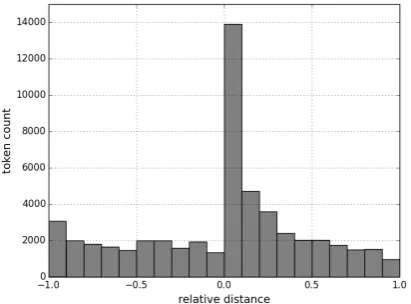
Result of the analysis reveals that it is neither of the cases. Figure1shows the relativedistanceof the signals with respect to the length of the dis-course units. It can be observed that most sig-nals occur at the boundary, and the further away from the boundary, the less signals are found. In fact 24% of the tagged tokens belong to the first 2 words of the second discourse unit. Note that these do not limit to explicit discourse connectives but also other lexical and semantic features.
Figure 1: Distribution of the relative distances of the signal tokens.
Overall, more signal tokens locate after the boundary. Counting by relation, 52% of the re-lations have signals only in the second discourse unit (49% of which at the boundary), 20% have signals only in the first discourse unit, and 28%
have signals in both. In other words, in 69% of the cases, all signals for the DR are covered after reading the relation boundary.
Informativeness of discourse prefixes Simi-larly, the informativeness of the discourse prefixes shows a leap across theboundary. Figure2 illus-trates the accuracy of the DR predicted by prefixes of all the relation samples collectively. Accuracy
refers to the proportion thatrpn equals the actual relation sense of the discourse sample. The upper half of Figure2shows that the predictionaccuracy
rises sharply after the boundary is read. Accord-ing to Figure 1, more signals are detected in the first clause near the boundary, but the informative-ness of the prefixes actually drops slightly, possi-bly due to the ambiguity of the signals. Yet the drop is reverted at the boundary and the accuracy
remains stable. This implies that the signals oc-curring later in the second clause do not contradict to those found at the boundary.
Figure 2:‘Accuracy’of sense prediction based on oracle signals covered by discourse prefixes8.
The lower half of Figure 2 compares the five sense categories defined in Table 1, zooming at prefixes ending near theboundary. It is observed that, in general, signals forcontingencyand tem-poralrelations are mostly identified just after the boundary, while expansion, attribution and con-trastrelations are identified just before the bound-ary. The informativeness of the discourse pre-fixes of expansion relation does not rise sharply like other relations because it is the default rela-tion when no signals are identified. Nonetheless, it still hold for all relations that predictions just af-ter the boundary is similar to predictions at the end of the second discourse unit.
5 Conclusion
This work investigates whether DRs can be identi-fied incrementally based on human performance. Our analysis concludes that it is possible be-cause DR signals occur throughout the discourse. Nonetheless, the signals are not evenly distributed but concentrated on the boundary of the two dis-course units. An incremental disdis-course parser that jointly segments discourse units and predicts DR senses can potentially output the predicted DR im-mediately after aboundary is detected, and then 8This‘accuracy’is not comparable to the performance of
focus on detectingexpectative signals in the sec-ond clause/sentence for the next relation.
Results of the analysis agree with the psycholin-guistics literature that DRs are integrated at the be-ginning of second clause/sentence of the relation, because otherwise the annotator should mostly recognize signals towards the end of the discourse. Our analysis evaluates and extends existing lab-oratory findings on DR processing by comparing a wide range of relations that are signaled not only by discourse markers. Expectation-focused discourse processing can also be explained by the ‘good-enough’ predictive approach in human language processing, which argues that humans should integrate a probabilistically ‘good-enough’ DR prediction at the boundary, and allocate more processing resource to predict the forth-coming DR (Ferreira and Lowder,2016).
Nonetheless, this corpus study alone is not enough to prove the incrementality hypothesis in DR processing. As future work, we would also like to explore global signals, which are possi-bly recognized unconsciously and less likely to be identified. In addition, we plan to verify the cog-nitive reality of the signal positions by behavioral experiments with multiple subjects. Another goal is to design a word-level incremental discourse parser based on the findings of this work, taking into account global discourse flow.
Acknowledgments
This research was funded by the German Research Foundation (DFG) as part of SFB 1102 Infor-mation Density and Linguistic Encoding and the Cluster of Excellence (MMCI).
References
Gerry TM Altmann. 1998. Ambiguity in sentence pro-cessing. Trends in cognitive sciences, 2(4):146–152.
Lynn Carlson, Mary Ellen Okurowski, and Daniel Marcu. 2002. Ldc2002t07: Rst discourse treebank.
Michael Collins and Brian Roark. 2004. Incremen-tal parsing with the perceptron algorithm. In Pro-ceedings of the Annual Meeting of the Association for Computational Linguistics, page 111. Associa-tion for ComputaAssocia-tional Linguistics.
Reinier Cozijn. 2000. Integration and inference in un-derstanding causal sentences. Unpublished doctoral dissertation, Tilburg University, Tilburg, Nether-lands.
Dan Cristea and Bonnie Webber. 1997. Expectations in incremental discourse processing. InProceedings of the Annual Meeting of the Association for Com-putational Linguistics and Conference of the Euro-pean Chapter of the Association for Computational Linguistics, pages 88–95. Association for Computa-tional Linguistics.
Debopam Das and Maite Taboada. 2017. Rst signalling corpus: a corpus of signals of coherence relations.
Language Resources and Evaluation.
Debopam Das, Maite Taboada, and Paul McFetridge. 2015. Ldc2015t10 rst signalling corpus.
Vera Demberg, Frank Keller, and Alexander Koller. 2013. Incremental, predictive parsing with psy-cholinguistically motivated tree-adjoining grammar.
Computational Linguistics, 39(4):1025–1066.
F Ferreira and MW Lowder. 2016. Prediction, infor-mation structure, and good-enough language pro-cessing.Psychology of Learning and Motivation.
Jun Hatori, Takuya Matsuzaki, Yusuke Miyao, and Jun’ichi Tsujii. 2012. Incremental joint approach to word segmentation, pos tagging, and dependency parsing in chinese. In Proceedings of the Annual Meeting of the Association for Computational Lin-guistics, pages 1045–1053. Association for Compu-tational Linguistics.
Yangfeng Ji and Jacob Eisenstein. 2014. Represen-tation learning for text-level discourse parsing. In
ACL (1), pages 13–24.
Frank Keller. 2010. Cognitively plausible models of human language processing. In Proceedings of the Annual Meeting of the Association for Compu-tational Linguistics, pages 60–67. Association for Computational Linguistics.
Arne K¨ohn and Wolfgang Menzel. 2014. Incremental predictive parsing with turboparser. Proceedings of Annual Meeting of the Association of Computational Linguistics.
Judith K¨ohne and Vera Demberg. 2013. The time-course of processing distime-course connectives. In Pro-ceedings of the 35th Annual Meeting of the Cogni-tive Science Society.
Ioannis Konstas, Frank Keller, Vera Demberg, and Mirella Lapata. 2014. Incremental semantic role la-beling with tree adjoining grammar. InProceedings of the Conference on Empirical Methods in Natural Language Processing, volume 301.
W Mak and T Sanders. 2010. Incremental discourse processing: How coherence relations influence the resolution of pronouns. The linguistics enterprise: From knowledge of language to knowledge in lin-guistics, pages 167–182.
Willem M Mak and Ted JM Sanders. 2013. The role of causality in discourse processing: Effects of expec-tation and coherence relations. Language and Cog-nitive Processes, 28(9):1414–1437.
William C Mann and Sandra A Thompson. 1988. Rhetorical structure theory: Toward a functional the-ory of text organization. Text-Interdisciplinary Jour-nal for the Study of Discourse, 8(3):243–281.
Daniel Marcu. 1999. A decision-based approach to rhetorical parsing. InProceedings of the 37th an-nual meeting of the Association for Computational Linguistics on Computational Linguistics, pages 365–372. Association for Computational Linguis-tics.
Mitchell P Marcus, Mary Ann Marcinkiewicz, and Beatrice Santorini. 1993. Building a large annotated corpus of english: The penn treebank. Computa-tional linguistics, 19(2):313–330.
Keith K Millis and Marcel Adam Just. 1994. The in-fluence of connectives on sentence comprehension.
Journal of Memory and Language, 33(1):128.
David Reitter. 2003. Rhetorical analysis with rich-feature support vector models. Unpublished Mas-ter’s thesis, University of Potsdam, Potsdam, Ger-many.
Hannah Rohde. 2008. Coherence-Driven Effects in Sentence and Discourse Processing. Ph.D. thesis, University of California, San Diego.
Kenji Sagae. 2009. Analysis of discourse structure with syntactic dependencies and data-driven shift-reduce parsing. In Proceedings of the 11th Inter-national Conference on Parsing Technologies, pages 81–84. Association for Computational Linguistics.
Andreas Stolcke. 1995. An efficient probabilis-tic context-free parsing algorithm that computes prefix probabilities. Computational linguistics, 21(2):165–201.
Michael K Tanenhaus, Michael J Spivey-Knowlton, Kathleen M Eberhard, and Julie C Sedivy. 1995. Integration of visual and linguistic information in spoken language comprehension. Science, 268(5217):1632.
Matthew J Traxler, Anthony J Sanford, Joy P Aked, and Linda M Moxey. 1997. Processing causal and diag-nostic statements in discourse. Journal of Experi-mental Psychology: Learning, Memory, and Cogni-tion, 23(1):88.