Identification of Implicit Topics in Twitter Data Not Containing Explicit
Search Queries
Suzi Park Hyopil Shin
Department of Linguistics, Seoul National University 1 Gwanak-ro, Gwanak-gu, Seoul, 151-745, Republic of Korea
{mam3b,hpshin}@snu.ac.kr
Abstract
This study aims at retrieving tweets with an implicit topic, which cannot be identified by the current query-matching system employed by Twitter. Such tweets are relevant to a given query but do not explicitly contain the term. When these tweets are combined with a relevant tweet containing the overt keyword, the “serialized” tweets can be integrated into the same discourse context. To this end, features like reply relation, authorship, temporal proximity, continuation markers, and discourse markers were used to build models for detecting serialization. According to our experiments, each one of the suggested serializing methods achieves higher means of average precision rates than baselines such as the query matching model and the tf-idf weighting model, which indicates that considering an individual tweet within a discourse context is helpful in judging its relevance to a given topic.
1 Introduction
1.1 Limits of the Twitter Query-Matching Search
Twitter search was not a very crucial thing in the past (Stone, 2009a), at least for users in its early stages who read and wrote tweets only within their curated timelines real-time (Dorsey, 2007; Stone, 2009b; Stone, 2009c). Users’ personal interests became one of the motivations to explore a large body of tweets only after commercial, political and academic demands, but it triggered the current extension of the Twitter search service. The domain of Twitter search was widened, for example, from tweets in the recent week to older ones (Burstein, 2013), and from accounts that have a specific term in their name or username to those that are relevant to that particular subject (Stone, 2007; Stone, 2008; Twitter, 2011; Kozak, Novermber 19, 2013). However, the standard Twitter search mechanism is based only on the presence of query terms.
Even though the Twitter Search API provides many operators, the current query matching search does not guarantee retrieving a complete list of all relevant tweets.12The 140-character limit sometimes forces
a tweet not to contain a term, not because of its lack of relevance to the topic represented by the term, but due to one of the following:
Reduction the query term is written in an abbreviated form or in form of Internet slang,
Expansion the query term is in external text that can be expanded through other services such as Twit-Longer (http://twitlonger.com) and twtkr (http://twtkr.olleh.com), while the part exceeding 140 characters is shown only as a link ontwitter.com, or
Serialization the query term is contained as an antecedent in some previous tweet.
This work is licenced under a Creative Commons Attribution 4.0 International License. Page numbers and proceedings footer are added by the organizers. License details:http://creativecommons.org/licenses/by/4.0/
1“[T]he Search API is focused on relevance and not completeness.” 2 October 2013. Using the Twitter Search API. https://dev.twitter.com/docs/using-search
2“[T]he Search API is not meant to be an exhaustive source of Tweets.” 7 March 2013. GET search/tweetshttps: //dev.twitter.com/docs/api/1.1/get/search/tweets
If these cases are frequent enough, the current query matching search in Twitter will get a low recall rate. Considering that tweets are usually used to obtain as various views on a topic as possible, in addition to accurate and reliable information about it, this setback would block attempts to collect diverse opinions in Twitter.
These three different cases require different approaches. First,reduction, one of the most significant characteristics of Twitter data in natural language processing, can be solved by building a dictionary of Internet slang terms or learning them. Second, in case ofexpansiontweets are always accompanied with short URLs (http://tl.gdfor TwitLonger and http://dw.amfor twtkr) and the full text is reachable through them. In these two cases, tweets correspond one-on-one with documents, whether reduced internally or expanded externally. This study will focus on the third case,serialization, where several tweets may be interpreted as a single document.
1.2 Serialization of Tweets: An Overlooked Aspect of Twitter
Though little reported before, serialization of tweets is frequently observed in Korean data.3 Influential
users like famous journalists, columnists and critics as well as ordinary users often publish multiple tweets over a short period of time instead of using other media such as blogs or web magazines. Types of tweets published in this way by Korean users include reports, reviews, and analysis on political or social affairs, news articles, books, films and dramas. The content users intend to express is longer than a tweet but shorter than a typical blog post. Examples from our dataset will be introduced in Section 3.
This study aims at retrieving tweets on a topic, which cannot be found by the current query-matching system. Such tweets are relevant to a given query but do not contain the necessary words. Under the hypothesis that a considerable number of these tweets not containing the query term are serialized with one containing it overtly, and that serialized segments are integrated into the same discourse context, we built a model that allows us, when given a tweet that includes a query or a mentioned topic, to find the other tweets serialized with it and count them as relevant to the topic. We primarily focused on Korean Twitter data, but we believe that the methods developed here are also applicable to other languages with similar phenomena.
2 Previous Studies
Our study is based on the observation that a tweet in a “serialization” does not necessarily correspond to a full document. In fact, it has already been reported (Hong and Davison, 2010; Weng et al., 2010; Mehrotra et al., 2013) that a single tweet is too short to be treated as an individual document, especially considering that word co-occurrence in a tweet is hardly found. Studies proved that performance of Latent Dirichlet Allocation (LDA) models for Twitter topic discovery can be improved by aggregating tweets into a document. In these studies, a “document ” consists either of all tweets under the same authorship (Hong and Davison, 2010; Weng et al., 2010), all tweets published in a particular period, or all tweets sharing a hashtag (Mehrotra et al., 2013). These criteria are useful for finding topics, into which tweets can be classified, but our purpose requires a different degree of “documentness.” Our study deals with a fixed topic and is interested in whether or not only tweets relevant to the topic can be pooled. All tweets merged into the same document as constructed in the previous studies are not necessarily coherent or related to the same topic because it is not usually expected that ordinary users devote their Twitter accounts to a single topic. In this study, we will develop more detailed criteria for the aggregation of tweets by combining authorship with time intervals and adopting features such as sentiment consistency and discourse markers.
A method of using discourse markers for microblog data was proposed by Mukherjee and Bhat-tacharyya (2012). They noted that a dependency parser, on which opinion analyses using discourse information (Somasundaran, 2010) are usually based, is inadequate for small microblog data, and in-stead used a “lightweight” discourse analysis, considering the existence of a discourse marker on each tweet. The list of discourse markers used in their study was based on the list of conjunctions repre-senting discourse relations presented by Wolf et al. (2004). This method was successful for sentiment
analysis on Twitter data assuming that the relevance of each tweet to a certain topic was already known. We will take a similar approach of using discourse markers, but with a different assumption and for a different purpose. In our study, we treat unknown topic relevance of tweets with missing query terms by aggregating them with a topic-marked tweet using discourse markers.
3 Features
3.1 Properties of Tweet Serialization
Multiple tweets are likely to be consistent with a topic if they form a discourse as in the following situations, with examples of tweets in Korean translated into English. In each tweet, topic words are in boldface.
Conversation This is the most typical case.
U1: Wow the neighborhood theater is packed; willSnowpiercerhit ten million?
U2: @U1 My parents and my boss are all gonna watch, and they watch only one film a year. This is the measure for ten million.
Comment after retweet Users retweet and comment.
U3 RT @U4: Today’s quote. “It is stupid to concentrate on symbolic meaning in Wang Kar Wai’s
Happy Together. That would be like trying to find political messages and signs in Snow-piercer.” — Jung Sung-Il
U3 Master Jung’s sarcasm...☆
On-the-spot addition Because a published tweet cannot be edited, users can elaborate or correct it only by writing a new tweet or deleting the existing tweet.
U5 Is Curtis the epitome ofDirector Bong’s4sinserity U5 Sincerity, shit
True (intentional) serialization Some users begin to write tweets with a text of more than 140 charac-ters in mind. They arrive at the length limit and continue to write in a new tweet.
U6 (1) WatchedSnowpiercer. It was more interesting than I thought. It felt more like black comedy than SF. On another note, I was surprised by several oddities, making the film feel more like a Korean film with foreign actors in it rather than Director Bong’s Hollywood debut.
U6 (2) In many ways the film was “nineties”... like watching The City of Lost Childrenall over again... and the trip from the tail-car to the first car, though I expected some kind of level-up for each car,
U6 (3) the world connected car to car was not an organic world (a sideways pyramid?) but worlds too separate car by car, and the front-car people were so lifeless that I was surprised. The scale of the “charge” after 17 years felt shrunken.
If this is a characteristic feature of Korean Twitter data, this may be due to reasons such as personal writing style, the writing system of the Korean language, and Korean Web platforms. First, it may be simply because these users prefer formal language and are reluctant to use short informal expressions even in Web writing. Second, it is possibly because CJK writing systems including Hangul, the Korean alphabet, have more information per character than the Roman alphabet (Neubig and Duh, 2013). Since a 140-character text in Hangul has generally more information than that in the Roman alphabet, a Korean (or Japanese) user can more readily tweet about content which an English (or other European) language user would consider too long to write about on Twitter. Third, for many Korean users Twitter is the most available medium for publishing their opinions online, as a number of standard blogs have been replaced
by microblogs. Some users divide a long public text into multiple length-limited tweets simply because they do not have a blog to write in.
While Internet slang and abbreviations are common in tweets, “Serializers” tend to use 1) fully-spelled forms (unlike “reducers”), 2) usually without hashtags and emoticons, 3) which are all visible on
twitter.comitself (unlike “expanders”), so it is not guaranteed that all serialized tweets will contain the topic word, as in the examples above. This implies that some tweet segments in a single discourse may not be retrieved even if the discourse is relevant to a given query. Search results may include a partial document for which it is difficult the full version of which is difficult to find.
3.2 Extralinguistic Criteria
Two tweets are more likely to be a part of a larger document consisting of a series of tweets if
Reply-relation one of them is a reply to the other,
Temporal proximity they are published immediately one after the other, or
[image:4.595.76.535.326.401.2]Continuation markers they share such markers as numbers, arrows>>and continuation marker ‘(con-tinued).’
Figure 1 shows examples of each case.
Figure 1: Serialized tweets with numbers, an arrow, or a continuation marker ‘(continued)’
3.3 Linguistic Clues
Semantic similarity to the query In order to determine the relatedness of two documents, the similarity between their term distributions is mainly considered. Based on this idea, one of our baseline methods will represent each tweet as a bag-of-words vector and retrieve a tweet containing no query term if its tf-idf weighted vector has a high cosine similarity with at least one vector from a tweet containing a query term.
Discourse markers Users may add a discourse marker when writing a new sentence in a new tweet. If a tweet begins with a marker that indicates continuation of a discourse, it is likely to be a part of a larger document. A sentiment analysis in Twitter by Mukherjee and Bhattacharyya (2012) adopted discourse relations from Wolf et al. (2004). In this paper, we use linguistic characteristics described by Kang (1999) in order to classify Korean texts, listing their English translations in Table 1. The
discourse markerfeature refers to whether or not any marker on the list occurs in the firstN words (setN = 5) of the tweet.
4 Experiments 4.1 Data
We collected 173,271 tweets posted or retweeted by 105 Korean users, including film critics, film stu-dents, and amateur cinephiles from 27 July to 26 September 2013. Out of the 105 users, 17 users who had mentioned the filmSnowpiercer5most often were singled out. In addition, the highest overall
oc-currence of the keyword was found to be between 1 to 15 August, probably due the film’s release on 31
Demonstratives this, that, it, here, there
Proverbs be so, do so
Discourse well, now
Conj-Reasoning because, so, therfore, thus, hence
Conj-Conditional then, as long as, in the case, under
Conj-Coordinate and, nor
Conj-Adversative but, yet, however, still, by contrast
[image:5.595.175.422.61.147.2]Conj-Discourse meanwhile, anyway, by the way
Table 1: List of selected Korean discourse markers used for classifying text types in Kang (1999), trans-lated into English
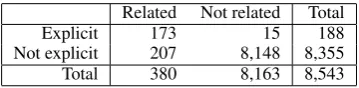
July in South Korea. Then we kept all 8,543 tweets posted by those 17 users from the period between 1 to 15 August 2013, in order to construct a labeled data set. This set includes 189 tweets that explicitly contain the wordSnowpiercer. Each tweet in the filtered set was labeled asrelatedornot relatedto the movie by three annotators who were Twitter users already following most of the above 17 users and thus aware of the context of most tweets, and a tweet was considered relevant if two or more of the annota-tors agreed. Inter-annotator agreement was evaluated by using Fleiss’s kappa statistic flei:71, which was
κ= 0.749 (p≈0). Table 2 shows the annotation results.
Related Not related Total
Explicit 173 15 188
Not explicit 207 8,148 8,355
[image:5.595.209.389.312.356.2]Total 380 8,163 8,543
Table 2: The number of annotated tweets classified by explicitness and relatedness
Table 2 shows that 8163/8543 = 95.55% of the tweets in the dataset are not relevant to the movie
Snowpiercer. Additional topics are induced from 7–9 manually collected seed words among the 200 most frequently occurring nouns in the dataset, in which each tweet text was POS-tagged by the Korean morphological and POS tagger Hannanum6. Induced topics and their seed words are listed in Table 3.
Topic Seed words
Movie Movie, Snowpiercer, director, The Terror Live, actor, stage, audience, film, theater Literature Story, book, writing, author, novel, character, work
Gender/relationship Men, women, female, marriage, male, wife, lover
Politics Politics, state, Park Geun-hye, government, president, party, Ahn Cheol-soo
Table 3: Four topics from manually collected seed words
As described in 3.1, it should be noted again that hashtags are not always useful for finding information in Korean tweets, particularly in this dataset. Among the seed words above, onlySnowpiercerwas ever used as a hashtag, and happened only three times (twice in English and once in Korean). Only nine types of hashtags occurred more than twice in the full dataset (they are presented in Table 4 with their respective frequencies). This predicts that hashtag-based tweet aggregation would not be very useful to find tweets relevant toSnowpierceror one of the four induced topics.
Table 5 shows the number of tweets containing seed words for each topic, where a tweet is allowed to belong to more than one topic. Since only 1853/8543 = 21.69% of the tweets explicitly contain a topic or seed word, it is not plausible that each of the remaining 80% tweets belongs to one of the four topics. Many of the tweets may be related to a topic which was of a too small portion to be induced, or to no topic at all. So, instead of classifying all of the tweets into the given topics, the experiment seeks to retrieve any tweet that is relevant to a certain topic, which allows each tweet to belong to more than one topic at once. In every experiment we regarded tweets that contain a topic or seed word as relevant to the topic, and restricted the test set to those tweets which did not contain them.
#make people cry with a story of two words 13
#lgtwins 10
#quote 7
#changing zero0 to fatty makes things totally depressing 6
#EBSbookcafe 4
#today i feel 4
#blow the whistle on chun doo-hwan 3
#chosundotcom 3
#the name of your bias followed by the name of the food you just ate feels nice 3
Table 4: Korean hashtags occurring more than twice in the dataset, translated into English
Movie Literature Gender Politics Total
[image:6.595.127.468.61.154.2]716 452 379 306 1853
Table 5: Number of tweets including at least one of the seed words for each induced topic
4.2 Measures
For all models, the authors judged the relevance of each of the retrieved tweets for induced topics until ten relevant tweets were retrieved. In theSnowpiercer case, precision scores were calculated for all recall scores. We built a ranking retrieval system for each model and evaluated its performance by average precision. For models including a randomizing process, we used the mean of average precisions over 1,000 replicated samples. Precision was computed at every percentile of recall levels forSnowpiercer
case and after each retrieved relevant tweet (up to top 10) for induced topics. In sum, the performance of a modelmwas defined in two ways as
meanAP@percent(m) := 10001 1000X
i=1
AP@percent(mi)
and
meanAP@10(m) := 10001 1000X
i=1
AP@10(mi)
, wheremhas 1,000 replicatesm1,· · ·m1000whose measures are
AP@percent(mi) := 1001 100
X
j=1
prec@j%(mi)
and
AP@10(mi) := 101 10
X
k=1
prec@k%(mi).
Whenmis a tf-idf model, which has a unique ranking without replication, average precision was used.
4.3 Baselines
Query matching method The most obvious baseline method for this study is the current Twitter search system that treats topic words and seed words as queries and finds documents, or tweets, that are relevant to the topic. Since only tweets not containing the query terms remained in the test set, there are no tweets matching them. As the set of retrieved tweets is empty, relevance rank is randomly assigned to each tweet of the test set.
4.4 Tweet Serialization
Examples of Tweet Serialization in Section 3 indicate clues between related tweets other than distribu-tional similarity. When 1) a tweet is a reply to another one, 2) two tweets are written one after another by the same user, 3) one tweet following another includes some discourse marker, or 4) two tweets share a marker, such as numbers, they can be considered to be serialized into a single document rather than being two separate ones. Tweets serialized together are treated as a single document, and if this docu-ment contains a a tweet with a query term, then all tweets lacking it but belonging to the same the same document are retrieved. All retrieved tweets are first ranked in random order, followed by the others also in random order.
We suggest four criteria for Tweet Serialization:
Reply Two tweets are serialized if one is a reply to the other.
Continuation markers Two tweets are serialized if they are written successively by the same user and share a marker, such as a number or a phrase “(cont.)”
Discourse markers Two tweets are serialized if they are written successively by the same user, the latter contains one of the discourse markers listed in Table 1 in its first 5 words, and neither of them is a reply to another user.
Time Two tweets are serialized if they are written successively by the same user within a given interval and neither of them is a reply to another user. The upper boundary for intervals is set in one of the following ways:
Constant 30 or 60 seconds
User-specific Users may show different densities in their tweets, depending on their tweeting en-vironment. Distribution of time intervals between successive tweets over users is presented in Table 6. The smallest 5% and 15% quantiles were selected, corresponding to 30 and 60 seconds respectively.
Quantile U1 U2 U3 U4 U5 U6 U7 U8 U9 U10 U11 U12 U13 U14 U15 U16 U17
0% 3 19 2 1 1 5 10 3 2 3 9 3 2 3 3 2 16
5% 20 42 18 16 13 30 21 18 13 8 43 23 18 15 13 12 110
10% 33 45 25 35 20 43 38 38 28 13 71 35 28 35 21 21 130
15% 47 52 33 57 30 56 67 57 40 23 89 51 37 61 27 40 161
20% 62 67 41 79 41 73 92 74 53 31 111 65 50 84 33 58 197
25% 81 86 55 100 55 92 145 95 69 43 138 84 68 105 38 77 275
[image:7.595.83.517.451.521.2]50% 237 298 164 322 151 242 1060 297 167 159 297 317 178 258 90 266 725
Table 6: Time intervals (in seconds) by cumulative percentile between consecutive pairs of tweets for each user
For all criteria, Tweet Serialization is transitive, that is, if ti andtj are serialized andtj andtk are serialized, then ti and tk are serialized. Table 7 shows the distribution of serialization sizes (number of serialized tweets) over criteria. Time value of 60 seconds serializes most tweets, as many as (8543-6464)/8543=24.33%, while continuation markers serialize only (8543-8511)/8543 = .37%. Assuming all serializations are correct, the relevance of retrieved documents is judged.
4.5 Results
Size Repl. Disc. Cohe. T:30s T:60s T:5% T:15%
1 8137 8169 8511 7314 6464 7845 6849
2 88 166 6 465 664 298 610
3 34 14 2 76 149 31 109
4 9 0 0 6 40 1 19
5 3 0 1 5 12 1 8
6 5 0 0 1 6 0 2
7 3 0 0 0 3 0 0
8 1 0 0 2 2 0 1
9 2 0 1 0 0 0 0
10 0 0 0 0 0 0 0
11 0 0 0 0 1 0 1
Table 7: Distribution of serialization size (number of serialized tweets) under each criterion
Recall level (%)
Me
an
o
f AP
ove
r
1,
00
0
re
pl
ica
tio
ns
0.0
0.2
0.4 0.6 0.8
0 20 40 60 80 100
[image:8.595.171.428.61.185.2]tf-idf match reply disc. cont. 30sec 60sec 5% 15%
Figure 2: Means of average precision rates of all methods for the topicSnowpiercer
Recall Baselines: Repl. Disc. Cont. Time difference threshold level≤ Match tf-idf rela. mark. mark. 30sec 60sec 5% 15%
5% .0342 .0518 .3019 .1266 .2313 .5158 .4178 .6804 .4720 10% .0309 .0588 .1798 .0801 .1324 .3916 .3459 .4050 .3976 25% .0284 .0695 .0920 .0494 .0702 .1824 .1665 .1847 .1894
50% .0273 .0685 .0602 .0382 .0486 .1062 .0986 .1070 .1103
100% .0268 .0556 .0434 .0322 .0375 .0666 .0628 .0669 .0687
Table 8: Means of average precision rates (at recall level up to 5%, 50%, and 100%) on various se-rialization criteria for the topicSnowpiercer (Results in boldface represent the best results among the methods.)
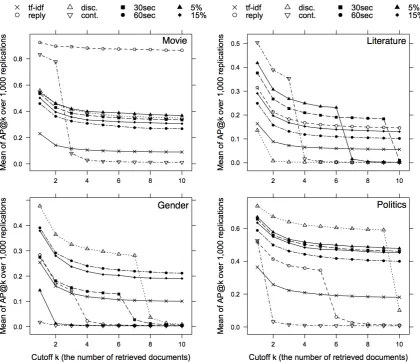
Serialization methods also perform better than the tf-idf baseline for induced topics, as shown in Figure 3 and Table 9. In particular,ReplyandDiscourse markers, which were far from the best forSnowpiercer, serve well for other topics such asMoviein general,Politics, andGender/Relationships.
The precision ofReplyfor the topicMovieis exceptionally high, partly because the data were initially collected from users who were interested in films.Reply relationis dependent on the choice of the data, in that it is determined by interaction between users, not by a single user’s tweets. If data are collected from users friendly with each other,Replywill serialize many tweets. On the contrary, if data contains some users while leaving out their friends, replies to these friends are not serialized byReplycriteria.
[image:8.595.78.517.223.442.2]Figure 3: Means of average precision rates of all methods for the induced topics
[image:9.595.86.507.67.429.2]Baselines: Repl. Disc. Cont. Time difference threshold Match tf-idf rela. mark. mark. 30sec 60sec 5% 15% Mov. .0134 .1139 .8855 .3925 .1791 .3787 .3123 .4161 .3435 Lit. .0026 .0759 .1804 .0171 .1293 .2005 .1287 .1719 .1601 Gen. .0048 .1287 .0653 .2424 .0050 .1092 .2476 .0187 .2297 Pol. .0090 .2176 .2135 .5762 .0625 .5072 .4453 .5234 .4948
Table 9: Means of Average Precision rates at cutoff k = 10of baselines and different serialization criteria for induced topics (Results in boldface represent the most accurate results of the topic among the methods.)
In the topicsLiteratureandGender/Relationships, average precision scores are at most 25%, which possibly results from the fact that the seed words for these topics consist of general terms only, while those of the other two topics include proper nouns such as movie titles or politicians’ names. This is less a problem of the topic itself but rather one of data selection, which focused on users tweeting about films, and so the set of seed words will vary according to differences in data collection.
5 Conclusion
original purpose was to find as various opinions on a given topic as possible, but we expect the methods used here will be helpful for other tasks, including topic discovery and sentiment analysis, by setting more exact document boundaries in microblog data. The method we proposed is for Korean Twitter data, where tweet serialization is observed frequently, particularly among influential users, but it is also applicable to other languages with similar phenomena.
In future work, we will investigate methods for the evaluation of the results of Tweet Serialization and combine tf-idf methods with Tweet Serialization criteria. Furthermore, we aim at verifying the applicability of the results of this study with regard to more various users and more topics.
References
Paul Burstein. February 7, 2013. Older Tweets in search results. The Official Twitter Blog. https://blog. twitter.com/2013/now-showing-older-tweets-in-search-results.
Jack Dorsey. September 25, 2007. Tracking Twitter. The Official Twitter Blog. https://blog.twitter. com/2007/tracking-twitter.
Joseph L. Fleiss. 1971. Measuring nominal scale agreement among many raters. Psychological Bulletin. 76(5): 378–382.
Liangjie Hong and Brian D. Davison. 2010. Empirical study of topic modeling in Twitter. SOMA 2010: The Proceedings of the First Workshop on Social Media Analytics. 80–88.
Beom-mo Kang. 1999.Hankukeui theksuthu cangluwa ene thukseng[Text genres and linguistic characteristics in Korean]. Korea University Press, Seoul, Korea.
Esteban Kozak. November 19, 2013. New ways to search on Twitter. The Official Twitter Blog. https: //blog.twitter.com/2013/new-ways-to-search-on-twitter.
Subhabrata Mukherjee and Pushpak Bhattacharyya. 2012. Sentiment analysis in Twitter with lightweight dis-course analysis. COLING 2012: The 24th International Conference on Computational Linguistics, Proceedings of the Conference: Technical Papers. 1847–1864.
Rishabh Mehrotra, Scoot Sanner, Wray Buntine and Lexing Xie. 2013. Improving LDA topic models for mi-croblogs via tweet pooling and automatic labeling. SIGIR ’13; The 36th International ACM SIGIR Conference on Research and Development in Information Retrieval.889–892.
Graham Neubig and Kevin Duh. 2013. How much is said in a Tweet? A multilingual, information-theoretic perspective. AAAI Spring Symposium: Analyzing Microtext, Volume SS-13-01 of AAAI Technical Report. Gerard Salton and Christopher Buckley. 1988. Term-weighting approaches in automatic text retrieval. Information
Processing & Management. 24(5): 513–523.
Swapna Somasundaran. 2010. Discourse-level Relations for Opinion Analysis. Ph.D Thesis, University of Pitts-burgh.
Biz Stone. August 22, 2007. Searching Twitter. The Official Twitter Blog. https://blog.twitter.com/ 2007/searching-twitter.
Biz Stone. December 23, 2008. Finding Nemo — Or, name search is back! The Official Twitter Blog. https: //blog.twitter.com/2008/finding-nemo%E2%80%94or-name-search-back.
Biz Stone. February 18, 2009. Testing a more integrated search experience. The Official Twitter Blog. https: //blog.twitter.com/2009/testing-more-integrated-search-experience.
Biz Stone. April 03, 2009. The discovery engine is coming. The Official Twitter Blog. https://blog. twitter.com/2009/discovery-engine-coming.
Biz Stone. April 30, 2009. Twitter search for everyone! The Official Twitter Blog.https://blog.twitter. com/2009/twitter-search-everyone.
Jianshu Weng, Ee-Peng Lim, Jing Jiang, and Qi He. 2010. TwitterRank: Finding topic-sensitive influential twitterers. WSDM ’10: Proceedings of the Third ACM International Conference on Web Search and Data Mining. 261–270.