Does
Similarity
Matter? The Case of Answer Extraction from
Technical Discussion Forums
Rose Catherine
1Amit Singh
1Rashmi Gangadharaiah
1Dinesh Raghu
1Kar thik V isweswariah
1(1) IBM Research - India, Bangalore
{rosecatherinek, amitkumarsingh, rashgang, dinraghu, v-karthik}@in.ibm.com
A
BSTRACTExtracting question–answer pairs from social media discussions has garnered much attention in recent times. Several methods have been proposed in the past that pose this task as a post or sentence classification problem, which label each entry as an answer or not. This paper makes the first attempt at the following two–fold objectives: (a) In all classification based approaches towards this direction, one of the foremost signals used to identify answers is theirsimilarity to the question. We study the contribution of content similarity specifically in the context of technical problem–solving domain. (b) We introduce hitherto unexplored features that aid in high–precision extraction of answers, and present a thorough study of the contribution of all features to this task. Our results show that, it is possible to extract answers using these features with high accuracy, when their similarity to the question is unreliable.
1 Introduction
Online discussion forums are internet sites that provide a channel for users to discuss and share their views on various topics ranging from troubleshooting products to choosing holiday resorts. Over a period of time, they have accumulated huge amounts of data, thus making them excellent sources of information for future reference. Mining question–answer knowledge from these online forums, and social media discussions in general, has garnered much research and commercial interest of late. Such mined data can be used to provide enhanced access to the forum content, augment chatbot knowledge (Huang et al., 2007), supplement the data in Community Question Answering (CQA) sites (Cong et al., 2008) etc.
All answer extraction methods suggested in the past use a multitude of features that include similarity based and lexical features, structural features constructed from the organization of the discussion etc. Of these, similarity of the answer candidate to the question post has been a de facto standard feature, whose contribution to the accuracy of extraction have so far only been assumed, but never really measured.
The goals and contributions of this paper are as below:
• Study the characteristics of technical discussion forums and their points of difference from other domains, thus motivating the rest of the contributions of this paper. • Analyze the effectiveness of similarity of candidates to the question, as a feature towards
the task of identifying answers, specifically in the case of technical discussion forums. Unlike other domains, here, the answers have minimal lexical overlap with the question. • Propose new features and study the contribution of all features to the overall goal of an-swer extraction. Particularly, we aim to test if similarity–independent features can act as an understudy to question similarity for this task, when the latter is unavailable/unreliable. To the best of the authors’ knowledge, this is the first paper which attempts the above objectives.
2 Related Work
Classification–based approaches
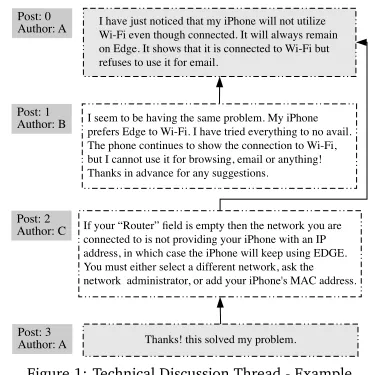
I have just noticed that my iPhone will not utilize Wi-Fi even though connected. It will always remain on Edge. It shows that it is connected to Wi-Fi but refuses to use it for email.
I seem to be having the same problem. My iPhone prefers Edge to Wi-Fi. I have tried everything to no avail. The phone continues to show the connection to Wi-Fi, but I cannot use it for browsing, email or anything! Thanks in advance for any suggestions.
If your “Router” ield is empty then the network you are connected to is not providing your iPhone with an IP address, in which case the iPhone will keep using EDGE. You must either select a different network, ask the network administrator, or add your iPhone's MAC address.
Thanks! this solved my problem. Post: 0
Figure 1: Technical Discussion Thread - Example proposed in the past for detecting
answers in online discussion forums like (Ding et al., 2008), (Hong and Davison, 2009), (Yang et al., 2009), (Kim et al., 2010), and in email discussions like (Shrestha and McKeown, 2004) use similarity of the sentence or post to the question as one of the main features for identifying an-swers. Other approaches like graph based methods (Cong et al., 2008) and (Otterbacher et al., 2005) rely on similarity to construct the graph. However, none of these approaches test systematically, the inadequacy or indispensability, which ever is the case, of similarity to the task. The low similarity between
incidentally observed (Cong et al., 2008), (Ding et al., 2008), (Hong and Davison, 2009), and used external data like Yahoo! Answers1to either expand the content or learn a translation
model. For learning such models, it should be noted that, such data may not always be available and is required in good amounts to train a decent model. Also, (Hong and Davison, 2009), while experimenting on technical discussions, reported that a combination of two non–similarity based features gave better accuracy than a language model. In Section 4.1, we show that, in addition to these features, with the aid of other non–similarity based features, the accuracy of the task can be greatly improved.
3 Does Question Similarity Matter for Answer Extraction?
Discussion forums provide an online medium for users to collaboratively solve a problem or answer a query. Figure 1 shows a typical discussion in an online forum – it starts with the first post, which we refer to as thequestionpost. The directed edges show thereply–to
relation, where the start node of the edge – child post, was posted in reply to the end node of the edge – parent post. In this paper, we use the term ‘thread’ interchangeably with ‘discussion’ to refer to a single multi–user conversation of the above form.
Discussions frequently have digressions, where new questions are posted and discussed within the same thread. We do not attempt to find these questions; question detection is a well researched area (Cong et al., 2008), and is outside the scope of this paper. We treat the first post as the main question and find answers to only this question. Answers to other questions within the same thread are not considered.
3.1 Characteristics of Technical Discussion Forums
Technical discussion forums differ from other forums like travel and shopping in that, they are characterized by low lexical overlap between the problem statement and the answer.
3.1.1 Lexical Overlap
To verify the above hypothesis about the
0 0.1 0.2 0.3 0.4 0.5
0 0.2 0.4 0.6 0.8 1
Normalized Post Count
Cosine Similarity to Question Solution Non-Solution
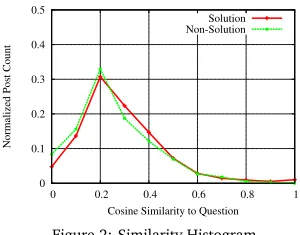
Figure 2: Similarity Histogram
lap between answer posts and question posts, we studied about 450 threads which together have about 2000 reply posts, from Apple Dis-cussions2(details about the dataset is in
Sec-tion 4). Figure 2 plots a histogram (counts normalized) of cosine similarity (bucketized) of answers and non–answers to their respec-tive question posts. The cosine similarity was computed on thetf-idfrepresentation of the posts, after removing common English stop-words and stemming the stop-words using a Porter Stemmer (Porter, 1980). It is clear from the figure that, a large fraction of answers have very minimal overlap with the question, and the fraction of answers with high overlap is very minimal. It is interesting to note that, the same trend is exhibited by non-answers too, thereby making it difficult to separate out the two using question similarity alone. In-depth inspection showed that, a large fraction of posts whose overlap with the question post is high, are in fact, other users complaining about facing the same or a similar problem, while the actual answer
1http://answers.yahoo.com 2https:
Forum Avg. Spam % Avg. Digression %
Apple Discussions(discussions.apple.com) 0 10.9
Ubuntu(ubuntuforums.org) 0 5.9
Photography(photography-on-the.net) 0 8.9
Avg. for Technical 0 8.5
Trip Advisor(www.tripadvisor.com) 4.1 25.2 Lonely Planet(www.lonelyplanet.com) 0 33.5
Vogue(forums.vogue.com.au) 0 21.3
Avg. for Non Technical 1.3 26.6
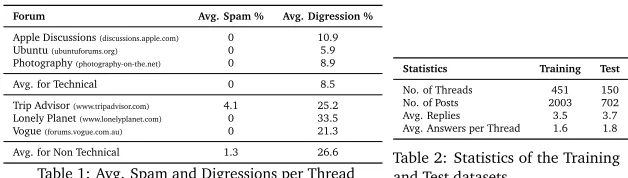
Table 1: Avg. Spam and Digressions per Thread
Statistics Training Test
No. of Threads 451 150
No. of Posts 2003 702
Avg. Replies 3.5 3.7
Avg. Answers per Thread 1.6 1.8
Table 2: Statistics of the Training and Test datasets
uses a different set of words, thus resulting in a low lexical overlap. This is also noticeable in the sample discussion of Figure 1. Here, similarity with the question post is actually misleading. 3.1.2 Spam and Digressions
When the similarity of answers to questions is low or unreliable, are there other properties of the post, the thread or its structure that we can rely on for accurate extraction? To explore such options, we conducted a small study to compare the amount of spam and digressions in technical forums versus other forums.
A spam is a completely off–topic post, while a digression is a post that is related to, but not discussing the same exact problem stated in the first post. Spam posts are usually advertisements generated automatically by spambots3and can be safely ignored without affecting the rest of
the discussion. A digression, however, is still related to the overall discussion; at times, the result of this seemingly different problem might be useful in solving the main problem, and hence cannot be ignored completely. Nevertheless, for the purposes of this paper, we do not attempt to collate any of the sub–problems or their answers discussed within the thread. Table 1 summarizes our findings on three technical and non-technical forums each. The numbers give the fraction (percentage) of the number of replies per thread, averaged over 15 randomly chosen threads from each of the forums. In the table, we note that the former has fewer spam and digressions, which suggests that it might be possible to find answers to the main question without regard to the question post or similarity to it, in a technical domain.
3.2 Features for Answer Extraction
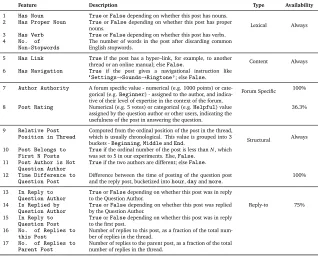
The features that we study in this paper for the answer extraction task are detailed in Table 3. All Part-Of-Speech tags were generated using the Open NLP POS Tagger4. The column Typegroups the features andAvailabilitygives the fraction of forums in which each feature is publicly available, from 12 technical forums that we inspected. For example, theReply–to
structure of the thread may not always be displayed (Seo et al., 2009), and is usually flattened to their chronological order. Where the entry isAlways, the data is always available, usually
because it is computed from the text of the post.
Out of these, Has_Link, Has_Navigation, Post_Belongs_to_First_N_Posts, In_Reply_to_Question_Author and Is_Replied_by_Question_Author have not
been proposed before, to the best of our knowledge.
4 Experiments
We crawled about 147,000 threads from Apple Discussions5of which we discarded those that
had only 2 or fewer number of reply posts (88, 565 threads) and those that had more than 30 3http://en.wikipedia.org/wiki/Forum_spam
4http://opennlp.apache.org 5https:
Feature Description Type Availability
1 Has Noun TrueorFalsedepending on whether this post has nouns.
Lexical Always
2 Has Proper Noun TrueorFalsedepending on whether this post has proper nouns.
3 Has Verb TrueorFalsedepending on whether this post has verbs.
4 No. of
Non-Stopwords
The number of words in the post after discarding common English stopwords.
5 Has Link Trueif the post has a hyper–link, for example, to another
thread or an online manual; elseFalse. Content Always
6 Has Navigation True if the post gives a navigational instruction like
‘Settings→Sounds→Ringtone’; elseFalse. 7 Author Authority A forum specific value - numerical (e.g. 1000 points) or
cate-gorical (e.g.Beginner) - assigned to the author, and indica-tive of their level of expertise in the context of the forum.
Forum Specific 100%
8 Post Rating Numerical (e.g. 5 votes) or categorical (e.g.Helpful) value assigned by the question author or other users, indicating the usefulness of the post in answering the question.
36.3%
9 Relative Post Position in Thread
Computed from the ordinal position of the post in the thread, which is usually chronological. This value is grouped into 3
buckets -Beginning,MiddleandEnd. Structural Always
10 Post Belongs to First N Posts
Trueif the ordinal number of the post is less thanN, which was set to 5 in our experiments. Else,False.
11 Post Author is Not Question Author
Trueif the two authors are different; elseFalse. 12 Time Difference to
Question Post
Difference between the time of posting of the question post
and the reply post, bucketized intohour,dayandmore. 100% 13 In Reply to
Question Author
TrueorFalsedepending on whether this post was in reply to the Question Author.
Reply-to 75%
14 Is Replied by Question Author
TrueorFalsedepending on whether this post was replied by the Question Author.
15 In Reply to Question Post
TrueorFalsedepending on whether this post was in reply to the first post.
16 No. of Replies to this Post
Number of replies to this post, as a fraction of the total num-ber of replies in the thread.
17 No. of Replies to Parent Post
Number of replies to the parent post, as a fraction of the total number of replies in the thread.
Table 3: Features generated for a post, their types and availability
reply posts (845 threads), which gave us 58, 356 threads. From this, about 600 threads were randomly chosen for manual tagging. Posts in these threads were tagged as ‘Answer’ if they proposed an answer to the question post, and as ‘Other’, otherwise. If there were more than one answer post, ALL were marked as ‘Answer’s. Answers to other questions within the thread (digressions) were marked as ‘Other’. Table 2 gives statistics of the training and test datasets.
4.1 Classification Experiments
We trained LibSVM classifiers6(Chang and Lin, 2011) on different sets of features as listed
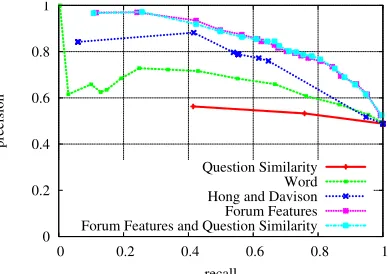
below, to obtain classifiers that mark each post as an answer or not, the precision–recall plot7
of which is given in Figure 3:
•Question Similarity: uses the cosine similarity of the answer candidate and its
respective question post, after discarding English stopwords and Porter stemming. As expected, it fails to give good accuracy for the task.
•Word: the features of this classifier are the words of the post after stopword removal and
stemming. This is to test if answer posts use similar terminology which can be leveraged,
6With default settings (svm-type: C-SVC, kernel-type: RBF) and no tuning of hyperparameters
but gives an unimpressive performance.
• Hong and Davison(Hong and Davison, 2009): this classifier usesRelative Post Position in ThreadandAuthor Authorityalone, as reported in their paper. As
can be seen from the figure, it gives better performance than the above two classifiers. • Forum Features: this is the classifier that uses all features listed in Table 3 and is able
to show a significant improvement overHong and Davison.
• Forum Features and Question Similarity: it uses question similarity in
addi-tion toForum Features, but overlaps almost completely with it indicating that
similar-ity does not give any value addition.
4.2 Feature Selection Experiments
To study the relative importance of features for the answer extraction task, we performed two sets of feature selection experiments – a permutation test (Section 4.2.1) and a feature ablation study (Section 4.2.2), discussed in the below sections. The latter technique gauges the importance based on the performance of a classifier, while the former uses a statistical measure and does not depend on an external classifier.
4.2.1 Permutation Test Permutation test (Good, 2000)
0 0.2 0.4 0.6 0.8 1
0 0.2 0.4 0.6 0.8 1
precision
recall
Question Similarity Word Hong and Davison Forum Features Forum Features and Question Similarity
Figure 3: Precision Recall plots for answer classification is a popular non-parametric
technique for statistical anal-ysis of data and provides an empirical estimate for the dis-tribution of the statistic under the null hypothesis (H0). Let
l,mbe the number of class 0, 1 samples respectively. For each feature, a test statisticθ(like
information gain, mutual infor-mation) indicating similarity between the two class condi-tional densities, is calculated. Next, the data for the feature is randomly permuted and par-titioned into sets of sizeland
m, on which the test statisticθpis calculated. This procedure is repeated over all possible such
partitions of the feature into sets of sizelandm. p-value is then estimated as the fraction of timesθp> θand is an indicator of feature importance. Table 4 shows the Mutual Information
scores for all features along with p-value. As a standard practice, any feature with p-value<
0.05 (marked with *) is deemed important and the ones with p-value≫0.05 (marked with **) are suggestively weak. From Table 4, it can be seen thatQuestion_Similarityranks very
low on mutual Information. More detailed analysis is in Section 4.2.3. 4.2.2 Feature Ablation Study
Feature Mutual
Post Author is Not Question
Author 0.0977
∗
Has Link 0.0336∗∗
Post Belongs to First N Posts 0.0299∗∗
Time Difference to Question
Post 0.0265
∗∗
Author Authority 0.0250∗∗
Is Replied by Question
Au-thor 0.0223
No. of Replies to Parent Post 0.0201∗∗
Has Proper Noun 0.0080∗
Has Verb 0.0046∗
No. of Non-Stopwords 0.0041∗
Post Rating 0.0033
Has Noun 0.0027
Has Navigation 0.0019
In Reply to Question Post 0.0013 Question Similarity 0.0013 No. of Replies to Parent Post 0.0010∗
Table 4: Permutation test results
Feature Precision Recall F measure
Post Author is Not Question
Author 0.82 0.69 0.75
Author Authority 0.81 0.65 0.72
Has Link 0.79 0.64 0.71
In Reply to Question Post 0.77 0.64 0.70 In Reply to Question Author 0.83 0.59 0.69 Relative Post Position in
Thread 0.84 0.51 0.63
Is Replied by Question
Au-thor 0.70 0.46 0.55
Post Belongs to First N Posts 0.69 0.43 0.53
No. of Non-Stopwords 0.71 0.39 0.50
Has Verb 0.69 0.36 0.48
Has Navigation 0.70 0.35 0.46
Has Proper Noun 0.71 0.35 0.47
Post Rating 0.67 0.37 0.47
Has Noun 0.63 0.34 0.44
No. of Replies to this Post 0.63 0.34 0.44 Time Difference to Question
Post 0.63 0.34 0.44
Question Similarity 0.63 0.34 0.44
No. of Replies to Parent Post 0.58 0.34 0.43
Table 5: Feature Ablation Study
progressively removed until all features are exhausted, to give them in their decreasing order of importance. For the experiment, we used a LibSVM classifier (Chang and Lin, 2011), and the results are in Table 5. The table lists the most helpful to the least helpful of features; the Precision, Recall and F–measure values (Chakrabarti, 2002) shown against each feature gives the accuracy numbers obtained when that feature and all those below it in the table were used to train the classifier. Detailed analysis is in Section 4.2.3.
4.2.3 Feature Selection Results Discussion
The results of permutation test in Table 4 and that of feature ablation study in Table 5 differ slightly because the latter is dependent on the performance of a classification algorithm while the former uses a statistical measure. However, it can be noted that, the following features show up as the best in both the tests:
• Post Author is Not Question Author • Author Authority
• Has Link*
• Relative Post Position in Thread • Is Replied by Question Author* • Post Belongs to First N Posts*
Note that, out of the best 6 features, 3 were newly proposed in this paper (marked with *). Also note that,Question_Similarityranks among the lowest in both the tests, thus showing its
insignificance to this task. Another rather surprising observation is thatPost_Rating, which
gives the usefulness of the post, also does not contribute highly, which could be because, the number of posts that can be marked asHelpfulis limited in the Apple discussions forum, thus
missing out on useful suggestions that exceed the limit.
4.3 Feature Correlation Study
Correlation8refers to any of the broad class of statistical relationships between two random
variables. In this paper, we use Pearson Product–Moment Correlation Coefficient9(Pearson’sr),
a widely used measure of correlation, defined ascov(X,Y)
σXσY for two variablesXandY, wherecov
andσare the covariance and the standard deviation respectively.
8http://en.wikipedia.org/wiki/Correlation_and_dependence 9http:
Feature Correlation to Answer
Time Difference to Question
Post 58.92
Author Authority 57.41
Is Replied by Question
Au-thor 40.92
Has Link 39.81
Post Rating 32.17
Relative Post Position in
Thread 30.89
In Reply to Question Post 19.08 No. of Non-Stopwords 18.16 In Reply to Question Author 12.22 Post Belongs to First N Posts 12.06
Has Navigation 10.47
Has Proper Noun 8.73
No. of Replies to Parent Post 8.21 Post Author is Not Question
Author 5.47
Has Noun 4.18
Has Verb 3.80
No. of Replies to this Post 1.44
Table 6: Feature – Answer Correlation
Feature A Feature B Correlation
In Reply to Question Post In Reply to Question Author 86.72 Post Belongs to First N Posts Relative Post Position in
Thread 63.68
In Reply to Question Author Post Author is Not Question
Author 58.14
Time Difference to Question
Post Author Authority 55.41
In Reply to Question Post Post Author is Not Question
Author 51.94
Time Difference to Question
Post In Reply to Question Post 43.91
No. of Replies to Parent Post In Reply to Question Post 41.68 Post Belongs to First N Posts In Reply to Question Author 40.75 Is Replied by Question
Au-thor Author Authority 38.89
Time Difference to Question
Post In Reply to Question Author 37.61
In Reply to Question Author No. of Replies to Parent Post 37.29 Time Difference to Question
Post Is Replied by Question Au-thor 35.40
Table 7: Feature – Feature Correlation
Table 6 gives the correlation of all the features to the answer label of the post. Higher the score, higher is the influence of the feature on the label. However, a higher score alone does not imply that the feature is important. If the feature is also highly correlated to many other features, it introduces redundancy, thus reducing its significance. The top 12 inter–feature correlation are listed in Table 7. ThoughTime_Difference_to_Question_Postshows the highest
correlation to the answer label (Table 6), Table 7 shows that it is also highly correlated to many other features. Another contradicting result is that, in Section 4.2.3,Post_Ratingwas not
ranked high. But Tables 6 and 7 show that it is highly correlated to the answer label and at the same time, not correlated to other features, suggesting that it might still prove to be useful. Some of the features chosen in Section 4.2.3 from the feature selection experiments show correlation amongst themselves, as shown in Table 7. However,Has_Linkproves to be a high
ranking feature according to both (a) Feature Selection, as well as, (b) Feature Correlation, since it highly correlates to the answer, but does not overlap with other features.
5 Conclusion
In this paper, we studied the contribution and importance of similarity to question in extracting answers from technical discussions, and showed that this feature does not contribute signifi-cantly towards the task of answer extraction, contrary to its perceived significance. We also presented the characteristics of technical discussion forums that distinguish them from other domains thus suggesting that it is possible to extract answers with high accuracy using other non-similarity based features when question similarity is unreliable, which was then demon-strated through experiments. We also presented a careful study of all features to determine which ones contributed highly to this task. The results of one set of experiments – Feature Selection – showed that out of the 6 best features, 3 were the ones newly proposed in this paper. Further analysis using Feature Correlation tests showed that all but one of the 6 best features from the former experiments were in fact highly correlated amongst themselves. The one feature that proved to be highly important in all the tests isHas_Link, proposed for the
first time in this paper.
References
Arguello, J., Callan, J., and Diaz, F. (2009). Classification-based resource selection. In Proceedings of the 18th ACM conference on Information and knowledge management, CIKM ’09, pages 1277–1286, New York, NY, USA. ACM.
Chakrabarti, S. (2002).Mining the Web: Discovering Knowledge from Hypertext Data. Morgan-Kauffman.
Chang, C. and Lin, C. (2011). LIBSVM: A library for support vector machines.ACM Transactions on Intelligent Systems and Technology, 2:27:1–27:27. http://www.csie.ntu.edu.tw/cjlin/libsvm. Cong, G., Wang, L., Lin, C.-Y., Song, Y.-I., and Sun, Y. (2008). Finding question-answer pairs from online forums. InProceedings of the 31st annual international ACM SIGIR conference on Research and development in information retrieval, SIGIR ’08, pages 467–474, New York, NY, USA. ACM.
Ding, S., Cong, G., Lin, C.-Y., and Zhu, X. (2008). Using conditional random fields to extract contexts and answers of questions from online forums. InACL, pages 710–718.
Good, P. (2000). Permutation Tests: A Practical Guide to Resampling Methods for Testing Hypotheses. Springer, 2nd edition.
Hong, L. and Davison, B. D. (2009). A classification-based approach to question answering in discussion boards. InProceedings of the 32nd international ACM SIGIR conference on Research and development in information retrieval, SIGIR ’09, pages 171–178, New York, NY, USA. ACM. Huang, J., Zhou, M., and Yang, D. (2007). Extracting chatbot knowledge from online discussion forums. InProceedings of the 20th international joint conference on Artifical intelligence, IJCAI’07, pages 423–428, San Francisco, CA, USA. Morgan Kaufmann Publishers Inc.
Kim, S. N., Wang, L., and Baldwin, T. (2010). Tagging and linking web forum posts. In Proceedings of the Fourteenth Conference on Computational Natural Language Learning, CoNLL ’10, pages 192–202, Stroudsburg, PA, USA. Association for Computational Linguistics. Otterbacher, J., Erkan, G., and Radev, D. R. (2005). Using random walks for question-focused sentence retrieval. InProceedings of the conference on Human Language Technology and Empirical Methods in Natural Language Processing, HLT ’05, pages 915–922, Stroudsburg, PA, USA. Association for Computational Linguistics.
Porter, M. (1980). An algorithm for suffix stripping. InProgram.
Seo, J., Croft, W. B., and Smith, D. A. (2009). Online community search using thread structure. InProceedings of the 18th ACM conference on Information and knowledge management, CIKM ’09, pages 1907–1910, New York, NY, USA. ACM.
Shrestha, L. and McKeown, K. (2004). Detection of question-answer pairs in email conversa-tions. InProceedings of the 20th international conference on Computational Linguistics, COLING ’04, Stroudsburg, PA, USA. Association for Computational Linguistics.