Entity Disambiguation for Knowledge Base Population
†Mark Dredze and †Paul McNamee and †Delip Rao and †Adam Gerber and ?Tim Finin †Human Language Technology Center of Excellence, Center for Language and Speech Processing
Johns Hopkins University
?University of Maryland – Baltimore County
mdredze,mcnamee,delip,[email protected], [email protected]
Abstract
The integration of facts derived from information extraction systems into existing knowledge bases requires a system to disambiguate entity mentions in the text. This is challeng-ing due to issues such as non-uniform variations in entity names, mention ambiguity, and entities absent from a knowl-edge base. We present a state of the art system for entity dis-ambiguation that not only addresses these challenges but also scales to knowledge bases with several million entries using very little resources. Further, our approach achieves perfor-mance of up to 95% on entities mentioned from newswire and 80% on a public test set that was designed to include challenging queries.
1 Introduction
The ability to identify entities like people, orga-nizations and geographic locations (Tjong Kim Sang and De Meulder, 2003), extract their at-tributes (Pasca, 2008), and identify entity rela-tions (Banko and Etzioni, 2008) is useful for sev-eral applications in natural language processing and knowledge acquisition tasks like populating structured knowledge bases (KB).
However, inserting extracted knowledge into a KB is fraught with challenges arising from nat-ural language ambiguity, textual inconsistencies, and lack of world knowledge. To the discern-ing human eye, the “Bush” in “Mr. Bush left for the Zurich environment summit in Air Force One.” is clearly the US president. Further con-text may reveal it to be the 43rd president, George W. Bush, and not the 41st president, George H. W. Bush. The ability to disambiguate a polyse-mous entity mention or infer that two orthograph-ically different mentions are the same entity is crucial in updating an entity’s KB record. This task has been variously called entity disambigua-tion, record linkage, or entity linking. When per-formed without a KB, entity disambiguation is called coreference resolution: entity mentions ei-ther within the same document or across multi-ple documents are clustered together, where each
cluster corresponds to a single real world entity. The emergence of large scale publicly avail-able KBs like Wikipedia and DBPedia has spurred an interest in linking textual entity references to their entries in these public KBs. Bunescu and Pasca (2006) and Cucerzan (2007) presented im-portant pioneering work in this area, but suffer from several limitations including Wikipedia spe-cific dependencies, scale, and the assumption of a KB entry for each entity. In this work we in-troduce an entity disambiguation system for link-ing entities to correspondlink-ing Wikipedia pages de-signed for open domains, where a large percent-age of entities will not be linkable. Further, our method and some of our features readily general-ize to other curated KB. We adopt a supervised approach, where each of the possible entities con-tained within Wikipedia are scored for a match to the query entity. We also describe techniques to deal with large knowledge bases, like Wikipedia, which contain millions of entries. Furthermore, our system learns when to withhold a link when an entity has no matching KB entry, a task that has largely been neglected in prior research in cross-document entity coreference. Our system produces high quality predictions compared with recent work on this task.
2 Related Work
Motivated by ambiguity in personal name search, Mann and Yarowsky (2003) disambiguate person names using biographic facts, like birth year, occupation and affiliation. When present in text, biographic facts extracted using regular expressions help disambiguation. More recently, the Web People Search Task (Artiles et al., 2008) clustered web pages for entity disambiguation.
The related task of cross document corefer-ence resolution has been addressed by several researchers starting from Bagga and Baldwin (1998). Poesio et al. (2008) built a cross document coreference system using features from encyclo-pedic sources like Wikipedia. However, success-ful coreference resolution is insufficient for cor-rect entity linking, as the coreference chain must still be correctly mapped to the proper KB entry.
Previous work by Bunescu and Pasca (2006) and Cucerzan (2007) aims to link entity men-tions to their corresponding topic pages in Wikipedia but the authors differ in their ap-proaches. Cucerzan uses heuristic rules and Wikipedia disambiguation markup to derive map-pings from surface forms of entities to their Wikipedia entries. For each entity in Wikipedia, a context vector is derived as a prototype for the entity and these vectors are compared (via dot-product) with the context vectors of unknown en-tity mentions. His work assumes that all entities have a corresponding Wikipedia entry, but this as-sumption fails for a significant number of entities in news articles and even more for other genres, like blogs. Bunescu and Pasca on the other hand suggest a simple method to handle entities not in Wikipedia by learning a threshold to decide if the entity is not in Wikipedia. Both works mentioned rely on Wikipedia-specific annotations, such as category hierarchies and disambiguation links.
We just recently became aware of a system fielded by Li et al. at the TAC-KBP 2009 eval-uation (2009). Their approach bears a number of similarities to ours; both systems create candi-date sets and then rank possibilities using differing learning methods, but the principal difference is in our approach to NIL prediction. Where we simply consider absence (i.e.,the NIL candidate) as an-other entry to rank, and select the tranked op-tion, they use a separate binary classifier to decide
whether their top prediction is correct, or whether NIL should be output. We believe relying on fea-tures that are designed to inform whether absence is correct is the better alternative.
3 Entity Linking
We defineentity linkingas matching a textual tity mention, possibly identified by a named en-tity recognizer, to a KB entry, such as a Wikipedia page that is a canonical entry for that entity. An entity linkingquery is a request to link a textual entity mention in a given document to an entry in a KB. The system can either return a matching en-try orNILto indicate there is no matching entry. In this work we focus on linking organizations, geo-political entities and persons to a Wikipedia derived KB.
3.1 Key Issues
There are 3 challenges to entity linking:
Name Variations. An entity often has multiple mention forms, including abbreviations (Boston Symphony Orchestra vs. BSO), shortened forms (Osama Bin Laden vs. Bin Laden), alternate spellings (Osama vs. Ussamah vs. Oussama), and aliases (Osama Bin Laden vs. Sheikh Al-Mujahid). Entity linking must find an entry de-spite changes in the mention string.
Entity Ambiguity. A single mention, like Springfield, can match multiple KB entries, as many entity names, like people and organizations, tend to be polysemous.
Absence. Processing large text collections vir-tually guarantees that many entities will not ap-pear in the KB (NIL), even for large KBs.
matches, should it returnNILor the variant “Bill Clinton”? If variants are acceptable, then perhaps “Clinton, Iowa” or “DeWitt Clinton” should be acceptable answers?
3.2 Contributions
We address these entity linking challenges. Robust Candidate Selection. Our system is flexible enough to find name variants but suffi-ciently restrictive to produce a manageable can-didate list despite a large-scale KB.
Features for Entity Disambiguation. We de-veloped a rich and extensible set of features based on the entity mention, the source document, and the KB entry. We use a machine learning ranker to score each candidate.
Learning NILs. We modify the ranker to learn NILpredictions, which obviates hand tuning and importantly, admits use of additional features that are indicative ofNIL.
Our contributions differ from previous efforts (Bunescu and Pasca, 2006; Cucerzan, 2007) in several important ways. First, previous efforts de-pend on Wikipedia markup for significant perfor-mance gains. We make no such assumptions, al-though we show that optional Wikipedia features lead to a slight improvement. Second, Cucerzan does not handle NILs while Bunescu and Pasca address them by learning a threshold. Our ap-proach learns to predict NIL in a more general and direct way. Third, we develop a rich fea-ture set for entity linking that can work with any KB. Finally, we apply a novel finite state machine method forlearningname variations.1
The remaining sections describe the candidate selection system, features and ranking, and our novel approach learning NILs, followed by an empirical evaluation.
4 Candidate Selection for Name Variants The first system component addresses the chal-lenge of name variants. As the KB contains a large number of entries (818,000 entities, of which 35% are PER, ORG or GPE), we require an efficient se-lection of the relevant candidates for a query.
Previous approaches used Wikipedia markup for filtering – only using the top-k page categories
1http://www.clsp.jhu.edu/ markus/fstrain
(Bunescu and Pasca, 2006) – which is limited to Wikipedia and does not work for general KBs. We consider a KB independent approach to selec-tion that also allows for tuning candidate set size. This involves a linear pass over KB entry names (Wikipedia page titles): a naive implementation took two minutes per query. The following sec-tion reduces this to under twosecondsper query.
For a given query, the system selects KB entries using the following approach:
• Titles that are exact matches for the mention. • Titles that are wholly contained in or contain
the mention (e.g.,NationwideandNationwide In-surance).
• The first letters of the entity mention match the KB entry title (e.g.,OAandOlympic Airlines). • The title matches a known alias for the entity
(aliases described in Section 5.2).
• The title has a strong string similarity score with the entity mention. We include several mea-sures of string similarity, including: character Dice score>0.9, skip bigram Dice score>0.6, and Hamming distance<= 2.
We did not optimize the thresholds for string similarity, but these could obviously be tuned to minimize the candidate sets and maximize recall.
All of the above features are general for any KB. However, since our evaluation used a KB derived from Wikipedia, we included a few Wikipedia specific features. We added an entry if its Wikipedia page appeared in the top 20 Google results for a query.
4.1 Scaling Candidate Selection
Our previously described candidate selection re-lied on a linear pass over the KB, but we seek more efficient methods. We observed that the above non-string similarity filters can be pre-computed and stored in an index, and that the skip bigram Dice score can be computed by indexing the skip bigrams for each KB title. We omitted the other string similarity scores, and collectively these changes enable us to avoid a linear pass over the KB. Finally we obtained speedups by serving the KB concurrently2. Recall was nearly identical
to the full system described above: only two more queries failed. Additionally, more than 95% of the processing time was consumed by Dice score computation, which was only required to cor-rectly retrieve less than 4% of the training queries. Omitting the Dice computation yielded results in a few milliseconds. A related approach is that of canopies for scaling clustering for large amounts of bibliographic citations (McCallum et al., 2000). In contrast, our setting focuses on alignment vs. clustering mentions, for which overlapping parti-tioning approaches like canopies are applicable.
5 Entity Linking as Ranking
We select a single correct candidate for a query using a supervised machine learning ranker. We represent each query by aD dimensional vector x, where x ∈ RD, and we aim to select a
sin-gle KB entry y, where y ∈ Y, a set of possible KB entries for this query produced by the selec-tion system above, which ensures thatY is small. Theith query is given by the pair{xi, yi}, where
we assume at most one correct KB entry.
To evaluate each candidate KB entry in Y we create feature functions of the form f(x, y),
de-pendent on both the examplex(document and en-tity mention) and the KB entry y. The features address name variants and entity disambiguation.
We take a maximum margin approach to learn-ing: the correct KB entry y should receive a higher score than all other possible KB entries
ˆ
y ∈ Y,yˆ 6=yplus some marginγ. This learning
2Our Python implementation with indexing features and
four threads achieved up to 80×speedup compared to naive implementation.
constraint is equivalent to the ranking SVM algo-rithm of Joachims (2002), where we define an or-dered pair constraint for each of the incorrect KB entriesyˆand the correct entryy. Training sets pa-rameters such that score(y) ≥ score(ˆy) +γ. We used the library SVMrank to solve this optimiza-tion problem.3 We used a linear kernel, set the
slack parameter C as 0.01 times the number of
training examples, and take the loss function as the total number of swapped pairs summed over all training examples. While previous work used a custom kernel, we found a linear kernel just as effective with our features. This has the advan-tage of efficiency in both training and prediction4
– important considerations in a system meant to scale to millions of KB entries.
5.1 Features for Entity Disambiguation 200 atomic features represent x based on each candidate query/KB pair. Since we used a lin-ear kernel, we explicitly combined certain fea-tures (e.g., acroynym-match AND known-alias) to model correlations. This included combining each feature with the predicted type of the entity, al-lowing the algorithm to learn prediction functions specific to each entity type. With feature combina-tions, the total number of features grew to 26,569. The next sections provide an overview; for a de-tailed list see McNamee et al. (2009).
5.2 Features for Name Variants
Variation in entity name has long been recog-nized as a bane for information extraction sys-tems. Poor handling of entity name variants re-sults in low recall. We describe several features ranging from simple string match to finite state transducer matching.
String Equality. If the query name and KB en-try name are identical, this is a strong indication of a match, and in our KB entry names are distinct. However, similar or identical entry names that refer to distinct entities are often qualified with parenthetical expressions or short clauses. As an example, “London, Kentucky” is distinguished
3www.cs.cornell.edu/people/tj/svm_light/svm_rank.html 4Bunescu and Pasca (2006) report learning tens of
from “London, Ontario”, “London, Arkansas”, “London (novel)”, and “London”. Therefore, other string equality features were used, such as whether names are equivalent after some transfor-mation. For example, “Baltimore” and “Baltimore City” are exact matches after removing a common GPE word like city; “University of Vermont” and “University of VT” match if VT is expanded. Approximate String Matching. Many entity mentions will not match full names exactly. We added features for character Dice, skip bigram Dice, and left and right Hamming distance scores. Features were set based on quantized scores. These were useful for detecting minor spelling variations or mistakes. Features were also added if the query was wholly contained in the entry name, or vice-versa, which was useful for handling ellip-sis (e.g., “United States Department of Agricul-ture” vs. “Department of AgriculAgricul-ture”). We also included the ratio of the recursive longest com-mon subsequence (Christen, 2006) to the shorter of the mention or entry name, which is effective at handling some deletions or word reorderings (e.g., “Li Gong” and “Gong Li”). Finally, we checked whether all of the letters of the query are found in the same order in the entry name (e.g., “Univ Wis-consin” would match “University of WisWis-consin”). Acronyms. Features for acronyms, using dic-tionaries and partial character matches, enable matches between “MIT” and “Madras Institute of Technology” or “Ministry of Industry and Trade.” Aliases. Many aliases or nicknames are non-trivial to guess. For example JAVA is the stock symbol for Sun Microsystems, and “Gin-ger Spice” is a stage name of Geri Halliwell. A reasonable way to do this is to employ a dictio-nary and alias lists that are commonly available for many domains5.
FST Name Matching. Another measure of sur-face similarity between a query and a candidate was computed by training finite-state transducers similar to those described in Dreyer et al. (2008). These transducers assign a score to any string pair by summing over all alignments and scoring all
5We used multiple lists, including class-specific lists (i.e.,
for PER, ORG, and GPE) lists extracted from Freebase (Bol-lacker et al., 2008) and Wikipedia redirects. PER, ORG, and GPE are the commonly used terms for entity types for peo-ple, organizations and geo-political regions respectively.
contained charactern-grams; we usedn-grams of length 3 and less. The scores are combined using a global log-linear model. Since different spellings of a name may vary considerably in length (e.g.,
J Miller vs. Jennifer Miller) we eliminated the
limit on consecutive insertions used in previous applications.6
5.3 Wikipedia Features
Most of our features do not depend on Wikipedia markup, but it is reasonable to include features from KB properties. Our feature ablation study shows that dropping these features causes a small but statistically significant performance drop. WikiGraph statistics. We added features de-rived from the Wikipedia graph structure for an entry, like indegree of a node, outdegree of a node, and Wikipedia page length in bytes. These statis-tics favor common entity mentions over rare ones. Wikitology. KB entries can be indexed with hu-man or machine generated metadata consisting of keywords or categories in a domain-appropriate taxonomy. Using a system called Wikitology, Syed et al. (2008) investigated use of ontology terms obtained from the explicit category system in Wikipedia as well as relationships induced from the hyperlink graph between related Wikipedia pages. Following this approach we computed top-ranked categories for the query documents and used this information as features. If none of the candidate KB entries had corresponding highly-ranked Wikitology pages, we used this as aNIL feature (Section 6.1).
5.4 Popularity
Although it may be an unsafe bias to give prefer-ence to common entities, we find it helpful to pro-vide estimates of entity popularity to our ranker as others have done (Fader et al., 2009). Apart from the graph-theoretic features derived from the Wikipedia graph, we used Google’s PageRank to by adding features indicating the rank of the KB entry’s corresponding Wikipedia page in a Google query for the target entity mention.
6Without such a limit, the objective function may diverge
5.5 Document Features
The mention document and text associated with a KB entry contain context for resolving ambiguity. Entity Mentions. Some features were based on presence of names in the text: whether the query appeared in the KB text and the entry name in the document. Additionally, we used a named-entity tagger and relation finder, SERIF (Boschee et al., 2005), identified name and nominal mentions that were deemed co-referent with the entity mention in the document, and tested whether these nouns were present in the KB text. Without the NE anal-ysis, accuracy on non-NIL entities dropped 4.5%. KB Facts. KB nodes contain infobox attributes (or facts); we tested whether the fact text was present in the query document, both locally to a mention, or anywhere in the text. Although these facts were derived from Wikipedia infoboxes, they could be obtained from other sources as well. Document Similarity We measured similarity between the query document and the KB text in two ways: cosine similarity with TF/IDF weight-ing (Salton and McGill, 1983); and usweight-ing the Dice coefficient over bags of words. IDF values were approximated using counts from the Google 5-gram dataset as by Klein and Nelson (2008). Entity Types. Since the KB contained types for entries, we used these as features as well as the predicted NE type for the entity mention in the document text. Additionally, since only a small number of KB entries had PER, ORG, or GPE types, we also inferred types from Infobox class information to attain 87% coverage in the KB. This was helpful for discouraging selection of eponymous entries named after famous enti-ties (e.g., the former U.S. president vs. “John F. Kennedy International Airport”).
5.6 Feature Combinations
To take into account feature dependencies we cre-ated combination features by taking the cross-product of a small set of diverse features. The attributes used as combination features included entity type; a popularity based on Google’s rank-ings; document comparison using TF/IDF; cov-erage of co-referential nouns in the KB node text; and name similarity. The combinations were
cascaded to allow arbitrary feature conjunctions. Thus it is possible to end up with a feature kbtype-is-ORG AND high-TFIDF-score AND
low-name-similarity. The combined features increased the
number of features from roughly 200 to 26,000.
6 Predicting NIL Mentions
So far we have assumed that each example has a correct KB entry; however, when run over a large corpus, such as news articles, we expect a signifi-cant number of entities will not appear in the KB. Hence it will be useful to predictNILs.
Welearnwhen to predictNILusing the SVM
ranker by augmentingY to include NIL, which then has a single feature unique toNILanswers. It can be shown that (modulo slack variables) this is equivalent to learning a single thresholdτ for NIL predictions as in Bunescu and Pasca (2006). Incorporating NIL into the ranker has several advantages. First, the ranker can set the thresh-old optimally without hand tuning. Second, since the SVM scores are relative within a single exam-ple and cannot be compared across examexam-ples, set-ting a single threshold is difficult. Third, a thresh-old sets a uniform standard across all examples, whereas in practice we may have reasons to favor aNILprediction in a given example. We design features for NIL prediction that cannot be cap-tured in a single parameter.
6.1 NIL Features
Micro-Averaged Macro-Averaged
Best Median All Features Best Features Best Median All Features Best Features
All 0.8217 0.7108 0.7984 0.7941 0.7704 0.6861 0.7695 0.7704
non-NIL 0.7725 0.6352 0.7063 0.6639 0.6696 0.5335 0.6097 0.5593
NIL 0.8919 0.7891 0.8677 0.8919 0.8789 0.7446 0.8464 0.8721
Table 1: Micro and macro-averaged accuracy for TAC-KBP data compared to best and median reported performance. Results are shown for all features as well as removing a small number of features using feature selection on development data.
7 Evaluation
We evaluated our system on two datasets: the Text Analysis Conference (TAC) track on Knowl-edge Base Population (TAC-KBP) (McNamee and Dang, 2009) and the newswire data used by Cucerzan (2007) (Microsoft News Data).
Since our approach relies on supervised learn-ing, we begin by constructing our own training corpus.7 We highlighted 1496 named entity
men-tions in news documents (from the TAC-KBP doc-ument collection) and linked these to entries in a KB derived from Wikipedia infoboxes. 8 We
added to this collection 119 sample queries from the TAC-KBP data. The total of 1615 training ex-amples included 539 (33.4%) PER, 618 (38.3%) ORG, and 458 (28.4%) GPE entity mentions. Of the training examples, 80.5% were found in the KB, matching 300 unique entities. This set has a higher number of NIL entities than did Bunescu and Pasca (2006) (10%) but lower than the TAC-KBP test set (43%).
All system development was done using a train (908 examples) and development (707 examples) split. The TAC-KBP and Microsoft News data sets were held out for final tests. A model trained on all 1615 examples was used for experiments.
7.1 TAC-KBP 2009 Experiments
The KB is derived from English Wikipedia pages that contained an infobox. Entries contain basic descriptions (article text) and attributes. The TAC-KBP query set contains 3904 entity mentions for 560 distinct entities; entity type was only provided for evaluation. The majority of queries were for organizations (69%). Most queries were missing from the KB (57%). 77% of the distinct GPEs in the queries were present in the KB, but for
7Data available from www.dredze.com 8http://en.wikipedia.org/wiki/Help:Infobox
PERs and ORGs these percentages were signifi-cantly lower, 19% and 30% respectively.
Table 1 shows results on TAC-KBP data us-ing all of our features as well a subset of features based on feature selection experiments on devel-opment data. We include scores for both micro-averaged accuracy – micro-averaged over all queries – and macro-averaged accuracy – averaged over each unique entity – as well as the best and me-dian reported results for these data (McNamee and Dang, 2009). We obtained the best reported results for macro-averaged accuracy, as well as the best results for NIL detection with micro-averaged accuracy, which shows the advantage of our approach to learning NIL. See McNamee et al. (2009) for additional experiments.
The candidate selection phase obtained a re-call of 98.6%, similar to that of development data. Missed candidates included Iron Lady, which refers metaphorically to Yulia Tymoshenko,PCC, the Spanish-origin acronym for the Cuban Com-munist Party, andQueen City, a former nickname for the city of Seattle, Washington. The system re-turned a mean of 76 candidates per query, but the median was 15 and the maximum 2772 (Texas). In about 10% of cases there were four or fewer can-didates and in 10% of cases there were more than 100 candidate KB nodes. We observed that ORGs were more difficult, due to the greater variation and complexity in their naming, and that they can be named after persons or locations.
7.2 Feature Effectiveness
Class All non-NIL NIL
Baseline 0.7264 0.4621 0.9251
Acronyms 0.7316 0.4860 0.9161
NE Analysis 0.7661 0.7181 0.8022
Google 0.7597 0.7421 0.7730
Doc/KB Text Similarity 0.7313 0.6699 0.7775 Wikitology 0.7318 0.4549 0.9399
All 0.7984 0.7063 0.8677
Table 2:Additive analysis: micro-averaged accuracy.
Table 2 shows the most significant features in the feature addition experiments. The baseline includes only features based on string similarity or aliases and is not effective at finding correct entries and strongly favors NIL predictions. In-clusion of features based on analysis of named-entities, popularity measures (e.g., Google rank-ings), and text comparisons provided the largest gains. The overall changes are fairly small, roughly±1%; however changes in non-NIL pre-cision are larger.
The ablation study showed considerable redun-dancy across feature groupings. In several cases, performance could have been slightly improved by removing features. Removing all feature com-binations would have improved overall perfor-mance to 81.05% by gaining on non-NIL for a small decline onNILdetection.
7.3 Experiments on Microsoft News Data We downloaded the evaluation data used in Cucerzan (2007)9: 20 news stories from MSNBC
with 642 entity mentions manually linked to Wikipedia and another 113 mentions not having any corresponding link to Wikipedia.10 A
sig-nificant percentage of queries were not of type PER, ORG, or GPE (e.g., “Christmas”). SERIF assigned entity types and we removed 297 queries not recognized as entities (counts in Table 3).
We learned a new model on the training data above using a reduced feature set to increase speed.11 Using our fast candidate selection
sys-tem, we resolved each query in 1.98 seconds (me-dian). Query processing time was proportional to
9http://research.microsoft.com/en-us/um/people/silviu/WebAssistant/TestData/ 10One of the MSNBC news articles is no longer available
so we used 759 total entities.
11We removed Google, FST and conjunction features
which reduced system accuracy but increased performance.
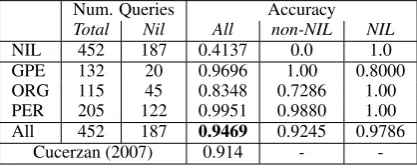
Num. Queries Accuracy Total Nil All non-NIL NIL
NIL 452 187 0.4137 0.0 1.0
GPE 132 20 0.9696 1.00 0.8000
ORG 115 45 0.8348 0.7286 1.00 PER 205 122 0.9951 0.9880 1.00 All 452 187 0.9469 0.9245 0.9786
Cucerzan (2007) 0.914 -
-Table 3:Micro-average results for Microsoft data.
the number of candidates considered. We selected a median of 13 candidates for PER, 12 for ORG and 102 for GPE. Accuracy results are in Table 3. The high results reported for this dataset over TAC-KBP is primarily because we perform very well in predicting popular and rare entries – both of which are common in newswire text.
One issue with our KB was that it was derived from infoboxes in Wikipedia’s Oct 2008 version which has both new entities,12and is missing
en-tities.13 Therefore, we manually confirmedNIL
answers and new answers for queries marked as NILin the data. While an exact comparison is not possible (as described above), our results (94.7%) appear to be at least on par with Cucerzan’s sys-tem (91.4% overall accuracy).With the strong re-sults on TAC-KBP, we believe that this is strong confirmation of the effectiveness of our approach.
8 Conclusion
We presented a state of the art system to disam-biguate entity mentions in text and link them to a knowledge base. Unlike previous approaches, our approach readily ports to KBs other than Wikipedia. We described several important chal-lenges in the entity linking task including han-dling variations in entity names, ambiguity in en-tity mentions, and missing entities in the KB, and we showed how to each of these can be addressed. We described a comprehensive feature set to ac-complish this task in a supervised setting. Impor-tantly, our method discriminately learns when not to link with high accuracy. To spur further re-search in these areas we are releasing our entity linking system.
122008 vs. 2006 version used in Cucerzan (2007) We
could not get the 2006 version from the author or the Internet.
13Since our KB was derived from infoboxes, entities not
References
Javier Artiles, Satoshi Sekine, and Julio Gonzalo. 2008. Web people search: results of the first evalu-ation and the plan for the second. InWWW. Amit Bagga and Breck Baldwin. 1998.
Entity-based cross-document coreferencing using the vec-tor space model. InConference on Computational Linguistics (COLING).
Michele Banko and Oren Etzioni. 2008. The tradeoffs between open and traditional relation extraction. In
Association for Computational Linguistics.
K. Bollacker, C. Evans, P. Paritosh, T. Sturge, and J. Taylor. 2008. Freebase: a collaboratively cre-ated graph database for structuring human knowl-edge. InSIGMOD Management of Data.
E. Boschee, R. Weischedel, and A. Zamanian. 2005. Automatic information extraction. In Conference on Intelligence Analysis.
Razvan C. Bunescu and Marius Pasca. 2006. Using encyclopedic knowledge for named entity disam-biguation. InEuropean Chapter of the Assocation for Computational Linguistics (EACL).
Peter Christen. 2006. A comparison of personal name matching: Techniques and practical issues. Techni-cal Report TR-CS-06-02, Australian National Uni-versity.
Silviu Cucerzan. 2007. Large-scale named entity disambiguation based on wikipedia data. In Em-pirical Methods in Natural Language Processing (EMNLP).
Markus Dreyer, Jason Smith, and Jason Eisner. 2008. Latent-variable modeling of string transductions with finite-state methods. InEmpirical Methods in Natural Language Processing (EMNLP).
Anthony Fader, Stephen Soderland, and Oren Etzioni. 2009. Scaling Wikipedia-based named entity dis-ambiguation to arbitrary web text. In WikiAI09 Workshop at IJCAI 2009.
Thorsten Joachims. 2002. Optimizing search engines using clickthrough data. InKnowledge Discovery and Data Mining (KDD).
Martin Klein and Michael L. Nelson. 2008. A com-parison of techniques for estimating IDF values to generate lexical signatures for the web. In Work-shop on Web Information and Data Management (WIDM).
Fangtao Li, Zhicheng Zhang, Fan Bu, Yang Tang, Xiaoyan Zhu, and Minlie Huang. 2009. THU QUANTA at TAC 2009 KBP and RTE track. InText Analysis Conference (TAC).
Gideon S. Mann and David Yarowsky. 2003. Unsuper-vised personal name disambiguation. InConference on Natural Language Learning (CONLL).
Andrew McCallum, Kamal Nigam, and Lyle Ungar. 2000. Efficient clustering of high-dimensional data sets with application to reference matching. In
Knowledge Discovery and Data Mining (KDD).
Paul McNamee and Hoa Trang Dang. 2009. Overview of the TAC 2009 knowledge base population track. InText Analysis Conference (TAC).
Paul McNamee, Mark Dredze, Adam Gerber, Nikesh Garera, Tim Finin, James Mayfield, Christine Pi-atko, Delip Rao, David Yarowsky, and Markus Dreyer. 2009. HLTCOE approaches to knowledge base population at TAC 2009. InText Analysis Con-ference (TAC).
Marius Pasca. 2008. Turning web text and search queries into factual knowledge: hierarchical class attribute extraction. InNational Conference on Ar-tificial Intelligence (AAAI).
Massimo Poesio, David Day, Ron Artstein, Jason Dun-can, Vladimir Eidelman, Claudio Giuliano, Rob Hall, Janet Hitzeman, Alan Jern, Mijail Kabadjov, Stanley Yong, Wai Keong, Gideon Mann, Alessan-dro Moschitti, Simone Ponzetto, Jason Smith, Josef Steinberger, Michael Strube, Jian Su, Yannick Ver-sley, Xiaofeng Yang, and Michael Wick. 2008. Ex-ploiting lexical and encyclopedic resources for en-tity disambiguation: Final report. Technical report, JHU CLSP 2007 Summer Workshop.
Gerard Salton and Michael McGill. 1983. Introduc-tion to Modern InformaIntroduc-tion Retrieval. McGraw-Hill Book Company.
Erik Tjong Kim Sang and Fien De Meulder. 2003. In-troduction to the conll-2003 shared task: Language-independent named entity recognition. In Confer-ence on Natural Language Learning (CONLL).