Simple and Effective Parameter Tuning for Domain
Adaptation of Statistical Machine Translation
Pavel Pecina
1, Antonio Toral
2, Josef van Genabith
2(1) Faculty of Mathematics and Physics, Charles University in Prague, Czech Republic (2) Centre for Next Generation Localisation, School of Computing, Dublin City University, Ireland
♣❡❝✐♥❛❅✉❢❛❧✳♠❢❢✳❝✉♥✐✳❝③,❛t♦r❛❧❅❝♦♠♣✉t✐♥❣✳❞❝✉✳✐❡,❥♦s❡❢❅❝♦♠♣✉t✐♥❣✳❞❝✉✳✐❡
A
BSTRACTCurrent state-of-the-art Statistical Machine Translation systems are based on log-linear models that combine a set of feature functions to score translation hypotheses during decoding. The models are parametrized by a vector of weights usually optimized on a set of sentences and their reference translations, called development data. In this paper, we explore a (common and industry relevant) scenario where a system trained and tuned on general domain data needs to be adapted to a specific domain for which no or only very limited in-domain bilingual data is available. It turns out that such systems can be adapted successfully by re-tuning model parameters using surprisingly small amounts of parallel in-domain data, by cross-tuning or no tuning at all. We show in detail how and why this is effective, compare the approaches and effort involved. We also study the effect of system hyperparameters (such as maximum phrase length and development data size) and their optimal values in this scenario.
T
ITLE ANDA
BSTRACT INC
ZECHJednoduchá a efektivní optimalizace parametr˚u
pro doménovou adaptaci statistického strojového pˇrekladu
Souˇcasné systémy statistického strojového pˇrekladu jsou založeny na logaritmicko-lineárních modelech, které pro hodnocení pˇrekladových hypotéz ve fázi dekódování kombinují sadu pˇríznakových funkcí. Tyto modely jsou parametrizovány vektorem vah, které se optimalizují na tzv. vývojových datech, tj. množinˇe vˇet a jejich referenˇcních pˇreklad˚u. V tomto ˇclánku se zabýváme (ˇcastou a pro pr˚umyslové nasazení relevantní) situací, kdy je tˇreba pˇrekladový systém natrénovaný na datech z obecné domény adaptovat na nˇejakou specifickou doménu, pro kterou jsou k dispozici paralelní data jen ve velice omezeném (ˇci žádném) množství. Ukazujeme, že takové systémy mohou být vhodnˇe adaptovány pomocí optimalizace parametr˚u za použití jen pˇrekvapivˇe malého množství paralelních doménovˇe-specifických dat nebo tzv. kˇrížovou optimalizací. Možností je také nepoužití optimalizace v˚ubec. Jednotlivé pˇrístupy analyzujeme a porovnáváme jejich cekovou nároˇcnost. Dále se zabýváme analýzou systémových hyperparametr˚u (napˇr. maximální délkou frází a velikostí vývojových dat) a jejich optimalizací.
1 Introduction
Statistical Machine Translation (SMT) is an instance of a machine learning application and, in general, will work best if the data for training and testing are drawn from the same distribution (i.e. domain, genre, and style). In practice, however, it is often difficult to obtain sufficient amounts of in-domain data (in particular parallel data required for translation and distortion models) to train a well performing system for a specific domain.
Recently, Pecina et al. (2011) showed that just using in-domain development data for parameter tuning improves output quality of a Phrase-Based SMT (PB-SMT) system trained on general--domain data but applied to a specific domain. Although further additional improvements can be realized by using in-domain parallel and/or monolingual training data, parameter tuning on in-domain data requires only a relatively small set of parallel sentences, which is often easier to obtain. They report on a series of experiments carried out on the domains of Natural Environment (env) and Labour Legislation (lab) and two language pairs: English–French and English–Greek (both directions) and observe a substantial average relative improvement of 25% in terms of BLEU (Papineni et al., 2002) when switching from general-domain to in-domain tuning.
In this paper, we corroborate the results reported by Pecina et al. (2011), carrying out similar experiments on the domain of medical texts (med). In contrast to earlier work, we explain the improvements brought about by specific domain tuning by analysing the results in detail. In a nutshell: domain tuning for matching-domain training, tuning and test data results in feature vectors that trust (often long) translation table entries, while tuning with and for specific domains (while using generic training data) allows the MT system to stitch together translations from smaller bits and pieces with significantly more reordering, effectively undoing or "de--tuning" any previous optimizations. In a sense, this is natural: substantial divergence between test and training data means that in particular long and potentially high quality phrase pairs obtained in training may no longer be applicable to the test data and that this divergence can only be bridged by smaller translation units and more flexible recombination. Furthermore, our findings show that in the general-domain training and specific-domain test scenario, approaches that do not perform any parameter tuning (at all) or that tune on other specific development sets may in fact fare better than tuning on general-domain data. In addition, there is a question of how much specific-domain tuning data is in fact required to "de-tune" a general domain system to a specific domain. Finally, given the fact that a general-domain system can only use limited length translation units when translating specific-domain data, we explore limited length training and decoding.
After a brief overview of the log-linear model including its parameter optimization and an overview of the state-of-the-art in domain adaptation for SMT, we describe our experiments, present the results, the analysis, explore the resulting research questions with additional experiments, and conclude.
2 Phrase-Based Statistical Machine Translation
Formally, the model is based on the noisy channel model. The translationeof an input sentence fis searched for by maximizing the translation probabilityp(e|f)formulated as a log-linear combination of a set of feature functionshiand their weightsλi:
p(e|f) =Qnihi(e,f)λi
Typically, the components include features of the following models:phrase translation model, which ensures that the source and target phrases are good translations of each other (e.g. direct and inverse phrase translation probability, direct and indirect lexical weighting, and phrase penalty),language model, which ensures that the translations are fluent,reordering(distortion)
model, which allows to reorder phrases in the input sentences (e.g. distance-based and lexical-ized reordering) andword penalty, which prevents the translations from being too long or too short. These models are trained on either parallel or monolingual training data.
The weights of the log-linear combination influence overall translation quality; however, the optimal setting depends on the translation direction and data. A common solution to optimise weights is to use Minimum Error Rate Training (MERT), proposed by Och (2003), which automatically searches for the values that minimize a given error measure (or maximize a given translation quality measure) on a development set of parallel sentences. Theoretically, any automatic measure can be used for this purpose; however, the most commonly used is BLEU (Papineni et al., 2002). The search algorithm is a type of coordinate ascent: considering
n-best translation hypotheses for each input sentence, it updates the feature weight most likely promising to improve the objective and iterates until convergence. The error surface is highly non-convex and as the algorithm cannot explore the whole parameter space, it may converge to a local maximum; in practise, it often produces good results (Bertoldi et al., 2009).
3 Domain adaptation in Statistical Machine Translation
Domain-adaptation is a very active research topic within the area of SMT. Three main topics can be identified: (i) combination of in-domain and out-of-domain resources for training, (ii) training data selection, and (iii) acquisition of specific-domain data. Below we briefly review a selection of relevant work that falls into these topics.
The first attempt to perform domain adaptation was carried out by Langlais (2002), who integrated in-domain lexicons in the translation model. Koehn and Schroeder (2007) integrate in-domain and out-of-domain language models as log-linear features in Moses. Nakov (2008) combines in-domain translation and reordering models with out-of-domain models. Finch and Sumita (2008) use a probabilistic mixture model combining two models for questions and declarative sentences with a general model.
Training data selection is another approach to domain-adaptation. The assumption is that a general-domain corpus, if sufficiently broad, includes sentences that resemble the target domain. Eck et al. (2004) present a technique for adapting the language model by selecting similar sentences from available training data. Hildebrand et al. (2005) extended this approach to the translation model. Foster et al. (2010) weigh phrase pairs from out-of-domain corpora according to their relevance to the target domain.
languages (L1-L2) dom set sentences L1 tokens / voc L2 tokens / voc English–French gen train 1,725,096 47,956,886 73,645 53,262,628 103,436
dev 2,000 58,655 5,734 67,295 6,913
test 2,000 57,951 5,649 66,200 6,876
env dev 1,392 41,382 4,660 49,657 5,542
test 2,000 58,865 5,483 70,740 6,617
lab dev 1,411 52,156 4,478 61,191 5,535
test 2,000 71,688 5,277 84,397 6,630
med dev 1,064 16,807 3,484 18,932 4,865
test 2,000 31,725 5,268 34,884 7,331
English–Greek gen train 964,242 27,446,726 61,497 27,537,853 173,435
dev 2,000 58,655 5,734 63,349 9,191
test 2,000 57,951 5,649 62,332 9,037
env dev 1,000 27,865 3,586 30,510 5,467
test 2,000 58,073 4,893 63,551 8,229
lab dev 506 15,129 2,227 16,089 3,333
test 2,000 62,953 4,022 66,770 7,056
med dev 1,064 16,807 3,484 20,625 3,893
test 2,000 31,725 5,268 38,614 5,754
Table 1: Statistics of the training, development and test data sets from the domains used in the experiments including the number of sentence pairs, tokens, and vocabulary size (voc).
Pecina et al. (2011) exploit automatically web-crawled in-domain resources for parameter optimization and improving language models. Pecina et al. (2012) extend the work by using the web-crawled resources to also improve translation models.
4 Experimental setup
Our experimental setup follows and extends the one used in Pecina et al. (2011). In addition to the two evaluation domains (env,lab) used in that work, and in order to corroborate their earlier findings, we also carry out experiments on medical domain data (med).
4.1 Data
Our general-domain system is trained on the Europarl parallel corpus (Koehn, 2005, v5) extracted from the proceedings of the European Parliament and for the purposes of this work considered to contain general-domain texts (it covers a very broad range of topics and it is to a considerable extent spoken language). The general-domain development and test data used for parameter optimization and testing, respectively, are adopted from the WPT 20051 machine translation shared task. These sets were extracted from the same source as Europarl and contain 2,000 sentence pairs each.
The specific-domain development and test data for theenvandlabdomains were acquired by domain-focused web-crawling within the PANACEA project2and are available from the ELRA catalogue3under reference numbers ELRA-W0057 and ELRA-W0058. The entire acquisition procedure is described in detail in Pecina et al. (2011). The test sets consist of 2,000 sentence pairs each and the amount of sentence pairs in the development sets varies from 506 to 2,000.
1http://www.statmt.org/wpt05/ 2http://www.panacea-lr.eu/ 3http:
dev test English–French French–English English–Greek Greek–English
gen gen 49.12 0.00 57.00 0.00 42.24 0.00 44.15 0.00
env 28.03 −42.94 31.79 −44.23 20.20 −52.18 29.23 −33.79 lab 22.26 −54.68 27.00 −52.63 22.92 −45.74 31.71 −28.18 med 12.32 −74.92 15.33 −73.11 8.96 −78.79 14.79 −66.50
[image:5.420.79.357.69.126.2]average −57.51 −56.65 −58.90 −42.82
Table 2: Results (in BLEU) of the systems tuned on general-domain and tested on the specific domains (env,lab,med) compared with the results on the general domain (gen); the figures in italics indicate the relative change (in percentage).
Themeddevelopment and test data were extracted from the EMEA parallel corpus of texts from the European Medicines Agency, distributed as a part of the OPUS corpus (Tiedemann, 2009). A set of 3,500 parallel sentences in English, French, and Greek was randomly sampled from the sentence-aligned corpus data and manually checked for translation quality. Correct sentences were left untouched, sentences with minor errors were corrected, and those which required major corrections or were misaligned were discarded completely. We aimed at acquiring at least 3,000 correct sentence pairs: 2,000 for the test sets and the rest for the development sets. Finally, the test and development sets contained 2,000 and 1,064 sentence pairs respectively. All data sets used in our experiments contain one reference translation. Statistics are given in Table 1.
4.2 System description
Our MT system is based on the Moses PB-SMT system (Koehn et al., 2007). For training, all data sets are tokenized and lowercased using the Europarl tools. The original (non-lowercased) target side of the parallel data is kept for training the Moses recaser. The lowercased versions of the target side are used for training an interpolated 5-gram language model with Kneser-Ney discounting using the SRILM toolkit (Stolcke, 2002). Translation models are trained on the Europarl corpus, lowercased, and filtered on sentence level; we kept all sentence pairs having less than 100 words on each side and with length ratio within the interval〈0.11,9.0〉. The maximum length for aligned phrases is set to seven and the reordering models are generated using the following parameters: distance, orientation-bidirectional-fe. The resulting system combines 14 feature functions, listed below.
1. distance reordering score 2-7. lexicalised reordering scores
8. language model score
9. inverse phrase translation probability 10. inverse lexical weighting
11. direct phrase translation probability 12. direct lexical weighting
13. phrase penalty 14. word penalty
gen env lab med EN−EL
EL−EN EN−FR FR−EN
0 200 400 600 800 (PPL)
20 50 100 200 500 1000
0 10 20 30 40 50 60
(PPL) (BLEU)
[image:6.420.50.361.70.175.2]EN−EL EL−EN EN−FR FR−EN
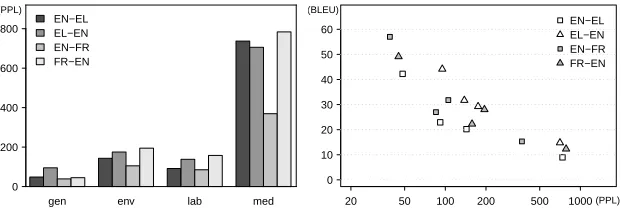
Figure 1: Perplexity (PPL) of the source side of the test sets given the language models trained on the source side of the training sets (left). Perplexity of the source side of the test data versus BLEU scores of the corresponding systems tuned on general-domain development data (right).
5 Experiments
Translation quality in our experiments is automatically evaluated using BLEU (Papineni et al., 2002) and all BLEU scores are reported as percentages.
5.1 Baseline system performance
Performance of the baseline system trained and tuned on the general-domain data and tested on the same domain varies from 42.24 to 57.00 (row 1 in Table 2). Applying the baseline general--domain system on the specificgeneral--domain data leads to significant degradation of translation quality (Banerjee et al., 2010; Wu et al., 2008). Pecina et al. (2011) reported an average decrease of 44.3% when the general-domain system was applied to theenvandlabdomains (see rows 2–3 in Table 2). Our experiments on themeddomain show even more pronounced decrease: e.g. in case of the English–French translation, BLEU drops from 49.12 to 12.32; for English–Greek the change is from 42.24 to 8.96; other translation directions produce similar results. The average decrease for all directions on themeddomain is 73.33% relative – the domain divergence between the training and test data from this domain is even more pronounced than in the case of the other two domains. The average decrease taken over all translation directions and all the domains is 53.97% relative.
5.2 Measuring domain divergence
From the results presented above, it is evident that the translation quality of a particular test set depends on the extent to which its domain differs from the domain of the training data. Quality is maximal when the domains match and decreases when the test data diverges from the training data. To quantify this observation, we measure cross perplexity of the test data given the training data. For each domain and translation direction, a language model of the same order as the maximum phrase length (7) used in the SMT systems is trained on the source side of the training data and applied to the source side of the test data. The results are presented in Figure 1 (left).
test dev English–French French–English English–Greek Greek–English
env gen 28.03 0.00 31.79 0.00 20.20 0.00 29.23 0.00
env 35.81 +27.76 39.04 +22.81 26.18 +29.60 34.16 +16.87
lab gen 22.26 0.00 27.00 0.00 22.92 0.00 31.71 0.00
lab 30.84 +38.54 33.52 +24.15 28.79 +25.61 37.55 +18.42
med gen 12.32 0.00 15.33 0.00 8.96 0.00 14.79 0.00
med 18.47 +49.92 24.42 +59.30 14.57 +62.61 18.10 +22.38
average +38.74 +35.42 +39.28 +19.22
Table 3: The effect (measured by BLEU) of general-domain (gen) and in-domain (env,lab,med) tuning. The figures in italics indicate relative improvement (in percentage) obtained from using in-domain development data for optimization (with respect to tuning on general-domain data).
the perplexity scores obtained on themeddomain are substantially higher; for most language directions they exceed 700. The only exception is the French–English test set, for which the score is as low as 370. This higher drop is consistent across the other domains (compare the yellow bars with other language pairs in Figure 1, left) and in line with the higher decrease of translation quality for this domain in terms of BLEU (see Section 5.1).
To complete the picture, we directly compare the perplexity scores with the translation quality measured by BLEU and provide a plot in Figure 1 (right). It is quite obvious that the perplexity scores on the logarithmic X axis (PPL) are highly correlated (inversely) with the BLEU scores on the Y axis. Higher perplexity indicates lower translation quality. This finding is in line with previous research on translation confidence estimation (Specia et al., 2011; He et al., 2010).
5.3 Parameter tuning on specific-domain development data
The baseline systems trained and tuned on general-domain data perform much worse on specific domains. Pecina et al. (2011) reported that a surprisingly significant amount of loss can be recovered by tuning on in-domain development data. The average relative improvement measured on theenvandlabdomains reported in this work was 25.5%. Our results, including those on themeddomain, confirm the previous findings (see Table 3). The average relative improvement of BLEU e.g. in English–French translation is 38.74%. Similar improvements are obtained on French–English and English–Greek. Slightly lower improvements were achieved on Greek–English, 19.22% on average. The overall average increase of BLEU is 33.16% relative. Given that the development sets contain only several hundred sentence pairs each, such improvement is remarkable.
5.4 Analysis of model parameters
1 2 3 4 5 6 7 8 910 11 12 13 14 −0.4 −0.2 0.0 0.2 0.4 English−French
1 2 3 4 5 6 7 8 9 1011121314
−0.4 −0.2 0.0 0.2 0.4 English−Greek
1 2 3 4 5 6 7 8 9 1011121314
−0.4 −0.2 0.0 0.2 0.4 French−English
1 2 3 4 5 6 7 8 9 1011121314 gen env lab med
−0.4 −0.2 0.0 0.2 0.4 Greek−English
EN–FR gen env lab med
gen – 0.25 0.12 0.15
env 0.25 – 0.82 0.89
lab 0.12 0.82 – 0.89
med 0.15 0.89 0.89 –
FR–EN gen env lab med
gen – 0.10 0.15−0.12
env 0.10 – 0.92 0.86
lab 0.15 0.92 – 0.92
med −0.12 0.86 0.92 –
EN–EL gen env lab med
gen – 0.17 0.28 0.18
env 0.17 – 0.81 0.73
lab 0.28 0.81 – 0.76
med 0.18 0.73 0.76 –
EL–EN gen env lab med
gen – −0.29 0.19−0.20 env −0.29 – 0.72 0.71
lab 0.19 0.72 – 0.81
[image:8.420.49.359.67.290.2]med −0.20 0.71 0.81 –
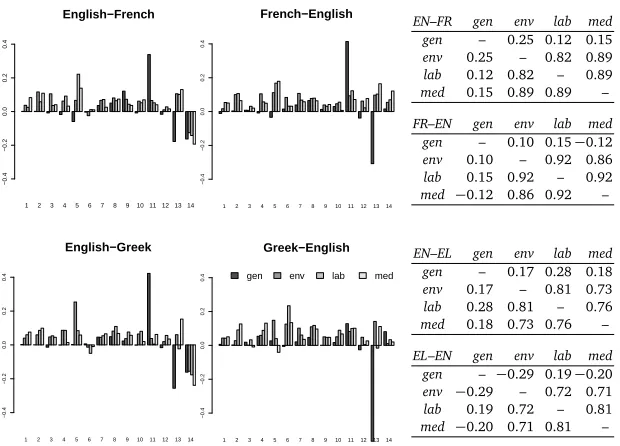
Figure 2: Visualization of model weights of the four systems in the twelve evaluation scenarios; the black bars refer to model weights of the systems tuned on general-domain (gen) development sets while the grey bars refer to the model weights of the systems tuned on specific-domain development sets (env,lab,med) (left). Cosine similarity of the system feature vectors (right).
First, we analyse parameters of the systems tuned on the general-domain data (black bars): 1. The high weights assigned toh11(direct phrase translation probability) indicate that the
phrase pairs in the systems’ translation tables apply well to the development data which are from the same domain as the training data; a high reward is given to translation hypotheses consisting of phrases with high translation probability (i.e. good general--domain translations).
2. The low negative weights assigned toh13(phrase penalty) imply that the systems prefer hypotheses consisting of fewer but longer phrases.
3. Reordering in the hypotheses is not rewarded (weights of the reordering modelsh1–h7are assigned values around zero). In some cases (e.g. for English–French and French–English), reordering is even slightly penalized (some weights ofh1–h7are negative).
test dev EN–FR FR–EN EN–EL EL–EN Average
gen gen 4.37 3.46 3.76 2.35 3.49
env gen 3.00 2.49 2.69 2.18 2.59
def 2.33 2.12 2.12 2.03 2.15
env 2.16 1.77 2.17 1.54 1.91
lab gen 2.82 2.45 2.97 2.43 2.67
def 2.24 2.09 2.30 2.21 2.21
lab 2.05 1.83 2.46 2.30 2.16
med gen 2.00 1.71 1.74 1.43 1.72
def 1.62 1.52 1.47 1.41 1.51
[image:9.420.122.313.69.170.2]med 1.54 1.20 1.38 1.21 1.33
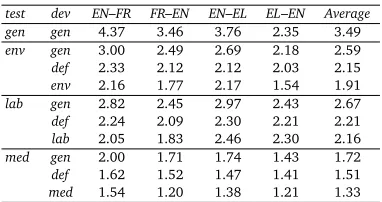
Table 4: Average phrase lengths in translations of all test sets (in all directions) by systems tuned on general (gen) and specific domains (env,lab,med) and with the default weights (def).
Now, we compare these findings with the systems tuned on the specific domains (grey bars). 1. The weights ofh11(direct phrase translation probability) decrease rapidly, in some
scenar-ios this weight is very close to zero. The translation tables do not provide enough good quality translations for the specific domains and the best translations of the development sentences consist of phrases with varying translation probabilities.
2. Hypotheses consisting of few (and long) phrases are not rewarded anymore (weights of
h13are higher); in most cases they are penalized and hypotheses consisting of more (and short) phrases are allowed or even preferred.
3. In almost all cases the reordering feature weights (featuresh1–h7) increased substantially and for specific-domain data the model significantly prefers hypotheses with altered word order (which is consistent with the two preceding observations).
4. Language model weights (h8) do not change substantially, its importance remains similar on general-domain and specific-domain data.
These findings are highly consistent across domains and language pairs. The weight vectors of the systems tuned on specific-domain data are quite similar but differ substantially from the parameters obtained by tuning on general-domain. This observation can be quantified by measuring cosine similarity (see Figure 2, right) as proposed by Hopkins and May (2011). Lower scores, as in the first rows/columns of each table, indicate low similarity of the vectors – specific-domain tuned weights differ a lot from the general-domain tuned ones; and vice versa – specific-domain tuned parameters are quite similar when compared to each other.
5.5 Analysis of phrase-length distribution
gen/gen gen/env env/env gen/lab lab/lab gen/med med/med
1 2 3 4 5 6 7
[image:10.420.75.329.68.175.2]0 10 20 30 40 50 60 (BLEU)
Figure 3: Phrase-length distribution in English–French translations by systems tuned and tested (dev/test) on various combinations of general (gen) and specific (env,lab,med) domains.
To support this hypothesis we analyse the phrase length distribution actually seen in the translation of the test sets. The average phrase lengths estimated for various combinations of tuning and test domains and all language pairs are shown in Table 4. The highest values are observed for translations of general-domain test sets by systems tuned on the same domain: 3.49 on average across all language pairs. The scores for systems trained on general and tuned and tested on specific-domain data are significantly lower and range from 1.21 to 3.00, depending on the domain and language pair. Figure 3 presents complete phrase-length distribution in English–French translations by systems tuned and tested on various combinations of general and specific domains. Generally, a higher divergence of the test domain from the training domain leads to shorter phrases being used in translation. However, when the systems tuned on general-domain are applied to specific domains, the average phrase lengths are consistently longer than for specific-domain tuning. The systems are tuned to prefer long phrases (Table 4) but the translation quality is lower (Table 3). This situation can be interpreted as overtraining, the model overfits the training (and tuning) data and on different data fails to form the best possible translations (given the translation, reordering, and language models).
5.6 Overfitting reduction
The optimal solution in case of such overfitting is to employ a sufficient amount of specific--domain development data, effectively tuning the system to using shorter phrases (see Figure 3). However, if such tuning data is not available (which is quite a realistic scenario in many applications) we explore the following alternatives: simply side-step parameter tuning (no tuning at all), or tune on a different domain, or use smaller amounts of development data, or reduce the maximum phrase length in decoding. All these methods work surprisingly well and are discussed in the following subsections.
5.6.1 No parameter tuning
test dev English–French French–English English–Greek Greek–English
env gen 28.03 0.00 31.79 0.00 20.20 0.00 29.23 0.00
env 35.81 +27.76 39.04 +22.81 26.18 +29.60 34.16 +16.87 lab 36.16 +29.00 38.78 +21.99 26.13 +29.36 33.85 +15.81 med 32.40 +15.59 36.89 +16.04 24.89 +23.22 34.01 +16.35 def 34.94 +24.65 34.05 +7.11 26.09 +29.16 31.33 +7.18 flat 32.22 +14.95 37.66 +18.46 21.91 +8.47 32.84 +12.35
lab gen 22.26 0.00 27.00 0.00 22.92 0.00 31.71 0.00
env 30.13 +35.35 33.21 +23.00 28.36 +23.73 37.57 +18.48 lab 30.84 +38.54 33.52 +24.15 28.79 +25.61 37.55 +18.42 med 27.04 +21.47 30.77 +13.96 26.85 +17.15 37.52 +18.32 def 29.26 +31.45 29.73 +10.11 28.48 +24.26 34.95 +10.22 flat 27.16 +22.01 32.24 +19.41 25.13 +9.64 35.79 +12.87
med gen 12.32 0.00 15.33 0.00 8.96 0.00 14.79 0.00
env 18.74 +52.11 23.75 +54.92 13.89 +55.02 17.88 +20.89 lab 18.91 +53.49 23.73 +54.79 13.69 +52.79 17.62 +19.13 med 18.47 +49.92 24.42 +59.30 14.57 +62.61 18.10 +22.38
def 18.20 +47.73 21.15 +37.96 13.82 +54.24 16.70 +12.91 flat 17.06 +38.47 23.02 +50.16 11.99 +33.82 17.71 +19.74
Table 5: Translation quality (in BLEU) of the general-domain systems tuned and tested on various domains. The figures in italics indicate relative improvement (in percentage) over the system tuned on general domain. The figures in bold denote the best performing combination for each test domain and translation direction and those which are not significantly different (Koehn, 2004,p=0.05).
to those of systems tuned on specific-domain data. The overall average relative improvement of the systems with default parameters over the systems tuned on general domain is 24.75% (compare with 33.16% obtained from specific-domain tuning). The average phrase length in translations produced by such systems falls between the scores of general-domain-tuned and specific-domain-tuned systems (see rows withdefin the development data column in Table 4). The systems with the flat weight vectors achieve an average relative improvement of 21.70%. However, they outperform the systems with the default parameters always when the translation direction is to English; the systems with the default parameters are better when translating from English.
5.6.2 Cross-domain tuning
It seems that the problem of the overfitted general-domain models and their poor performance on specific domains can be reduced by “diverting” the systems away from the general domain they are tuned to translate – but not necessarily towards a particular specific domain. To analyse this hypothesis we perform “cross-domain” tuning, i.e. tuning on specific domains different from the test domains. The results are shown in Table 5 (see the rows where the test and development domain do not match). In all scenarios the cross-domain tuned system performs better than the un-tuned ones. In a few cases the systems tuned on a cross domain perform even better than the in-domain ones: e.g. the EN–FR system tuned on thelabdomain and tested on theenvandmeddomains or the EL–EN system tuned on theenvdomain and tested on the
0 500 1000 1500 2000 10
20 30 40 50 60
●
●●● ● ● ● ● ● ● ●
● gen/env env/env
gen/lab lab/lab
gen/med med/med
gen/gen
[image:12.420.100.304.71.176.2](size) (BLEU)
Figure 4: Translation quality (BLEU) of French–English systems tuned on data of varying size.
Similar results were observed also on mixtures of two domains (e.g. tuned onlab+envand tested onmed). In general, we can conclude that cross-domain tuning is a reasonable solution when no in-domain development data is available (and the domains differ in a similar way).
5.6.3 Tuning on small development data
In the previous two scenarios we did not use any specific-domain development data for tuning, but were able to get very close to the performance of the systems tuned on a specific domain. Specific-domain parallel data is scarce, for many domains not available at all and must be prepared by manual translation of monolingual in-domain sentences. We investigate how much development data is needed. The only technical requirement is that MERT, the parameter optimization method, must converge in a reasonable number of iterations. For this reason, typical development sets contain about 1,000 – 2,000 sentence pairs (compare e.g. the size of development sets provided for the WMT4translation shared tasks). We vary the amount of sentences in our development sets, tune the systems, test their performance on the test sets and plot learning curves to capture the dependency of translation quality (in terms of BLEU) against gradually increasing the size of development data.
The general shapes of the curves are consistent across all translations (and domains) and thus we provide the curves for the English–French translation direction only (see Figure 4). Increasing the size of development sets is beneficial only in case the domains of development and test data are the same. The curve of the system tuned and tested on the general domain reaches a plateau for about 500 sentence pairs. In case of in-domain tuning for specific domains, the plateau is reached much earlier. Usually, as few as 100–200 sentence pairs are enough to get optimal results. This is encouraging, as tuning on specific-domains yields best results and fortunately requires only very limited amounts of bilingual data (and expense). Development sets of more than 400–600 sentences pairs do not improve translation quality at all and make the tuning process take longer. The systems tuned on the general domain and tested on specific domain do not benefit from the development data at all. The relatively high BLEU scores achieved with no tuning (zero development data size) decrease with increasing size of the development sets.
4http:
1 2 3 4 5 6 7 10
20 30 40 50 60
●
● ● ● ● ●
● ● gen/env
env/env
gen/lab lab/lab
gen/med med/med
gen/gen
[image:13.420.115.320.70.177.2](length) (BLEU)
Figure 5: Translation quality (BLEU) of French–English systems with varying max phrase length.
5.6.4 Limiting phrase length
In the last experiment presented in this paper we limit the maximum phrase length allowed during training and decoding and study how system performance changes. The systems tuned on general-domain prefer longer phrases which, however, do not occur frequently in the specific--domain test sets. Our baseline systems, trained and tuned on general domain with maximum phrase length set to seven, translate general-domain test sets with an average phrase length of 3.49 (see Table 4). However, for the systems tuned and tested on in-domain data, this score is as low as 1.80. Figure 5 illustrates how the translation quality changes when the maximum phrase length varies from one to seven. The only case when longer phrases improve translation quality is for the systems trained, tuned and tested on the same (general) domain. In all other cases, the results for phrases up to three words long are as good as for longer phrases. If the domain of the test data does not match the domain of training and tuning data, the maximum phrase length set to three is enough in all scenarios. Longer phrases lead to degradation of translation quality and increase time for training and decoding, as well as memory requirements for building and storing the translation models. A similar result was reported already by Koehn et al. (2003). They observed that limiting the maximum length of a phrase to only three words achieved top performance. However, current state-of-the-art SMT systems usually benefit from longer phrases than three (see e.g. the top curve in Figure 5 which refers to a general-domain system applied to a general-domain test set), and our result applies only to scenarios where the training and test domains do not match; in that case setting the maximum phrase length to three is sufficient.
6 Conclusions
phrases in the output translations and therefore underperforms on specific domains where such phrases do not occur frequently. By contrast, the same systems tuned on specific-domain data form output translations from shorter phrases, allow more reordering and perform significantly and consistently better on specific domain data.
We investigated possible solutions for (common) scenarios when no or very little in-domain data is available for parameter tuning. Skipping tuning, i.e. using the default model parameters, performs surprisingly well and always outperforms systems tuned on general domain. Based on this observation, this should be preferred over general domain tuning if the test domain differs substantially. Cross-domain tuning on a different set also offers a good solution when no in-domain development data is available, especially when the domains differ in a similar way (e.g. measured by perplexity). This step has the effect of disassembling the original general-domain system towards shorter phrases and it does not matter much which different development set to use.
The analysis of learning curves of the tuning process showed that in-domain tuning of the general-domain systems requires about 100–200 sentence pairs to achieve decent translation quality (in terms of BLEU, the gain obtained from tuning on more data was negligible). We also experimented with limiting the maximum phrase length of decoding. The results showed that setting this parameter to three is sufficient for translating data from specific domains; longer phrases in this case do not improve translation quality and increase computational requirements of the translation systems. The last two results (limiting phrase length and using sufficient amounts of development data) have efficiency implications of paramount importance in industrial application scenarios.
Acknowledgments
This research was supported by the the Czech Science Foundation (grant no. P103/12/G084), by EU FP7 projects PANACEA (contract no. 248064) and Khresmoi (contract no. 257528), and by Science Foundation Ireland (grant no. 07/CE/I1142) as part of the Centre for Next Generation Localisation (http://www.cngl.ie/) at Dublin City University.
References
Banerjee, P., Du, J., Li, B., Naskar, S., Way, A., and van Genabith, J. (2010). Combining Multi-Domain Statistical Machine Translation Models using Automatic Classifiers. In9th Conference of the Association for MT in Americas, pages 141–150, Denver, Colorado, USA.
Bertoldi, N., Haddow, B., and Fouet, J.-B. (2009). Improved minimum error rate training in moses.Prague Bulletin of Mathematical Linguistics, No. 91:7–16.
Callison-Burch, C., Osborne, M., and Koehn, P. (2006). Re-evaluating the role of bleu in machine translation research. In11th Conference of the European Chapter of the Association for Computational Linguistics, pages 249–256, Trento, Italy.
Eck, M., Vogel, S., and Waibel, A. (2004). Language Model Adaptation for Statistical Machine Translation based on Information Retrieval. InProceedings of the International Conference on Language Resources and Evaluation, Lisbon, Portugal.
Finch, A. and Sumita, E. (2008). Dynamic model interpolation for statistical machine transla-tion. InProceedings of the Third Workshop on Statistical Machine Translation, pages 208–215, Columbus, Ohio, USA.
Foster, G., Goutte, C., and Kuhn, R. (2010). Discriminative instance weighting for domain adaptation in statistical machine translation. InProceedings of the 2010 Conference on Empirical Methods in Natural Language Processing, pages 451–459, Cambridge, MA.
He, Y., Ma, Y., Roturier, J., Way, A., and van Genabith, J. (2010). Improving the Post-Editing Experience Using Translation Recommendation: A User Study. InProceedings of the Ninth Conference of the Association for Machine Translation in the Americas, pages 247–256, Denver, Colorado, USA.
Hildebrand, A. S., Eck, M., Vogel, S., and Waibel, A. (2005). Adaptation of the Translation Model for Statistical Machine Translation based on Information Retrieval. InProceedings of the 10th Annual Conference of the European Association for Machine Translation, pages 133–142, Budapest, Hungary.
Hopkins, M. and May, J. (2011). Tuning as ranking. InProceedings of the Conference on Empirical Methods in Natural Language Processing, pages 1352–1362, Edinburgh, United Kingdom.
Koehn, P. (2004). Statistical significance tests for machine translation evaluation. In Lin, D. and Wu, D., editors,Proceedings of EMNLP 2004, pages 388–395, Barcelona, Spain. Koehn, P. (2005). Europarl: A Parallel Corpus for Statistical Machine Translation. InConference Proceedings of the Tenth Machine Translation Summit, pages 79–86, Phuket, Thailand.
Koehn, P., Hoang, H., Birch, A., Callison-Burch, C., Federico, M., Bertoldi, N., Cowan, B., Shen, W., Moran, C., Zens, R., Dyer, C., Bojar, O., Constantin, A., and Herbst, E. (2007). Moses: open source toolkit for statistical machine translation. InProceedings of the 45th Annual Meeting of the ACL on Interactive Poster and Demonstration Sessions, pages 177–180, Prague, Czech Republic.
Koehn, P., Och, F. J., and Marcu, D. (2003). Statistical phrase-based translation. InProceedings of the 2003 Conference of the North American Chapter of the Association for Computational Linguistics on Human Language Technology - Volume 1, pages 48–54, Edmonton, Canada.
Koehn, P. and Schroeder, J. (2007). Experiments in domain adaptation for statistical machine translation. InProceedings of the Second Workshop on Statistical Machine Translation, pages 224–227, Prague, Czech Republic.
Langlais, P. (2002). Improving a general-purpose Statistical Translation Engine by termino-logical lexicons. InCOLING-02 on COMPUTERM 2002: second international workshop on computational terminology - Volume 14, pages 1–7, Taipei, Taiwan.
Nakov, P. (2008). Improving English-Spanish statistical machine translation: experiments in domain adaptation, sentence paraphrasing, tokenization, and recasing. InProceedings of the Third Workshop on Statistical Machine Translation, pages 147–150, Columbus, Ohio, USA.
Och, F. J. (2003). Minimum error rate training in statistical machine translation. InProceedings of the 41st Annual Meeting on Association for Computational Linguistics, pages 160–167, Sapporo, Japan.
Papineni, K., Roukos, S., Ward, T., and Zhu, W.-J. (2002). BLEU: a method for automatic evaluation of machine translation. InProceedings of the 40th Annual Meeting of the Association for Computational Linguistics, pages 311–318, Philadelphia, USA.
Pecina, P., Toral, A., Papavassiliou, V., Prokopidis, P., and van Genabith, J. (2012). Domain adaptation of statistical machine translation using web-crawled resources: a case study. In Cettolo, M., Federico, M., Specia, L., and Way, A., editors,EAMT 2012: Proceedings of the 16th Annual Conference of the European Association for Machine Translation, pages 145–152, Trento, Italy.
Pecina, P., Toral, A., Way, A., Papavassiliou, V., Prokopidis, P., and Giagkou, M. (2011). Towards Using Web-Crawled Data for Domain Adaptation in Statistical Machine Translation. In
Proceedings of the 15th Annual Conference of the European Associtation for Machine Translation, pages 297–304, Leuven, Belgium.
Specia, L., Hajlaoui, N., Hallett, C., and Aziz, W. (2011). Predicting machine translation adequacy. InProceedings of the Machine Translation Summit XIII, Xiamen, China.
Stolcke, A. (2002). SRILM-an extensible language modeling toolkit. InProceedings of In-ternational Conference on Spoken Language Processing, pages 257–286, Denver, Colorado, USA.
Tiedemann, J. (2009). News from OPUS – A Collection of Multilingual Parallel Corpora with Tools and Interfaces. In Nicolov, N., Angelova, G., and Mitkov, R., editors,Recent Advances in Natural Language Processing V, volume 309 ofCurrent Issues in Linguistic Theory, pages 227–248. John Benjamins, Amsterdam & Philadelphia.