Text Linkage in the Wiki Medium – A Comparative Study
Alexander Mehler
Department of Computational Linguistics & Text Technology
Bielefeld University
Bielefeld, Germany
[email protected]
Abstract
We analyze four different types of docu-ment networks with respect to their small world characteristics. These characteris-tics allow distinguishing wiki-based sys-tems from citation and more traditional text-based networks augmented by hyper-links. The study provides evidence that a more appropriate network model is needed which better reflects the specifics of wiki systems. It puts emphasize on their topo-logical differences as a result of wiki-related linking compared to other text-based networks.
1 Introduction
With the advent of web-based communication, more and more corpora are accessible which man-ifest complex networks based on intertextual rela-tions. This includes the area ofscientific commu-nication (e.g. digital libraries as CiteSeer),press communication(e.g. the New York Times which links topically related articles),technical commu-nication (e.g. the Apache Software Foundation’s documentations of open source projects) and elec-tronic encyclopedia (e.g. Wikipedia and its re-leases in a multitude of languages). These are sources oflargecorpora of web documents which are connected bycitation links(digital libraries),
content-based add-ons(online press communica-tion) orhyperlinksto related lexicon articles (elec-tronic encyclopedias).
Obviously, a corpus of such documents is more than a set of textual units. There is structure for-mation above the level of single documents which can be described by means of graph theory and network analysis (Newman, 2003). But what is
new about this kind of structure formation? Or do we just have to face the kind of structuring which is already known from other linguistic networks?
This paper focuses on the specifics of network-ing in wiki-based systems. It tackles the follownetwork-ing questions: What structure do wiki-based text net-works have? Can we expect a wiki-specific topol-ogy compared to more traditional (e.g. citation) networks? Or can we expect comparable results when applying network analysis to these emerging networks? In the following sections, these ques-tions are approached by example of a language specific release of the Wikipedia as well as by wikis for technical documentation. That is, we contribute to answering the question why wiki can be seen as something new compared to other text typesfrom the point of view of networking.
In order to support this argumentation, section (2) introduces those network coefficients which are analyzed within the present comparative study. As a preprocessing step, section (3) outlines a webgenre model which in sections (4.1) and (4.2) is used to represent and extract instances of four types of document networks. This allows apply-ing the coefficients of section (2) to these instances (section 4.3) and narrowing down wiki-based net-works (section 5). The final section concludes and prospects future work.
2 Network Analysis
characterize small worlds by two properties: First, other than in regular graphs, any randomly chosen pair of nodes in a small world has, on average, a considerably shortergeodesic distance.1 Second,
compared to random graphs, small worlds show a considerably higher level ofcluster formation.
In this framework, cluster formation is mea-sured by means of the average fraction of the num-berO(vi)of triangles connected to vertexviand
the numberY(vi)of triples centered onvi(Watts
and Strogatz, 1998):2
C2=
1
n
X
i O(vi) Y(vi)
(1)
Alternatively, the cluster coefficient C1 com-putes the fraction of the number of triangles in the whole network and the number of its connected vertex triples. Further, themean geodesic distance
lof a network is the arithmetic mean of all shortest paths of all pairs of vertices in the network. Watts and Strogatz observe high cluster values and short average geodesic distances in small worlds which apparently combine cluster formation with short-cuts as prerequisites of efficient information flow. In the area of information networks, this property has been demonstrated for the WWW (Adamic, 1999), but also for co-occurrence networks (Ferrer i Cancho and Sol´e, 2001) and semantic networks (Steyvers and Tenenbaum, 2005).
In addition to the SW model of Watts & Stro-gatz, link distributions were also examined in or-der to characterize complex networks: Barab´asi & Albert (1999) argue that the vertex connectivity of social networks is distributed according to a scale-free power-law. They recur to the observation – confirmed by many social-semiotic networks, but not by instances of the random graph model of Erd˝os & R´enyi (Bollob´as, 1985) – that the num-ber of links per vertex can be reliably predicted by a power-law. Thus, the probabilityP(k)that a randomly chosen vertex interacts withkother ver-tices of the same network is approximately
P(k)∼k−γ (2)
Successfully fitting a power law to the distrib-ution of out degrees of vertices in complex net-works indicates “that most nodes will be relatively
1The geodesic distance of two vertices in a graph is the length of the shortest path in-between.
2A triangle is a subgraph of three nodes linked to each other. Note that all coefficients presented in the following sections relate by default to undirected graphs.
poorly connected, while a select minority ofhubs
will be very highly connected.” (Watts, 2003, p.107). Thus, for a fixed number of links, the smaller theγvalue, the shallower the slope of the curve in a log-log plot, the higher the number of edges to which the most connected hub is incident. A limit of this model is that it views the prob-ability of linking a source node to a target node to depend solely on the connectivity of the lat-ter. In contrast to this, Newman (2003) proposes a model in which this probability also depends on the connectivity of the former. This is done in or-der to account for social networks in which ver-tices tend to be linked if they share certain proper-ties (Newman and Park, 2003), a tendency which is calledassortative mixing. According to New-man & Park (2003) it allows distinguishing social networks from non-social (e.g. artificial and bio-logical) ones even if they are uniformly attributed as small worlds according to the model of Watts & Strogatz (1998). Newman & Park (2003) ana-lyze assortative mixing of vertex degrees, that is, the correlation of the degrees of linked vertices. They confirm that this correlation ispositivein the case of social, butnegativein the case of techni-cal networks (e.g. the Internet) which thus prove disassortative mixing (of degrees).
Although these SW models were applied to cita-tion networks, WWW graphs, semantic networks and co-occurrence graphs, and thus to a variety of linguistic networks, a comparative study which focuses on wiki-based structure formation in com-parison to other networksof textual unitsis miss-ing so far. In this paper, we present such a study. That is, we examine SW coefficients which allow distinguishing wiki-based systems from more “tra-ditional” networks. In order to do that, a general-ized web document model is needed to uniformly represent the document networks to be compared. In the following section, a webgenre model is out-lined for this purpose.
3 A Webgenre Structure Model
Linguistic structures vary with the functions of the discourses in which they are manifested (Biber,
1995; Karlgren and Cutting, 1994). In
pat-terns. In this sense, we expect web documents to be distinguishable by the functional structures they manifest. More specifically, we agree with
the notion of webgenre (Yoshioka and Herman,
2000) according to which the functional structure of web documents is determined by their member-ship ingenres(e.g. of conference websites, per-sonal home pagesorelectronic encyclopedias).
Our hypothesis is that what is common to in-stances of different webgenres is the existence of an implicitlogical document structure(LDS) – in analogy to textual units whose LDS is described in terms of section, paragraph and sentence cate-gories (Power et al., 2003). In the case of web doc-uments we hypothesize that their LDS comprises four levels:
• Document networks consist of documents which serve possibly heterogenous functions if necessary independently of each other. A web document network is given, for example, by the system of websites of a university.
• Web documents manifest – typically in the form of websites – pragmatically closed acts
of web-based communication (e.g.
confer-ence organization or online presentation). Each web document is seen to organize a sys-tem of dependent subfunctions which in turn are manifested by modules.
• Document modules are, ideally, functionally homogeneous subunits of web documents which manifest single, but dependent sub-functions in the sense that their realization is bound to the realization of other subfunctions manifested by the same encompassing docu-ment. Examples of such subfunctions arecall for papers,program presentationor confer-ence venue organization as subfunctions of the function of web-based conference orga-nization.
• Finally, elementarybuilding blocks(e.g.lists,
tables, sections) only occur as dependent parts of document modules.
This enumeration does not imply a one-to-one mapping between functionally demarcated mani-fested units (e.g. modules) and manifesting (lay-out) units (e.g. web pages). Obviously, the same functional variety (e.g. of a personal academic home page) which is mapped by a website of
dozens of interlinked pages may also be mani-fested by a single page. The many-to-many re-lation induced by this and related examples is de-scribed in more detail in Mehler & Gleim (2005).
The central hypothesis of this paper is that genre specific structure formation also concerns docu-ment networks. That is, we expect them to vary with respect to structural characteristics according to the varying functions they meet. Thus, we do
not expect that different types of document net-works (e.g. systems of genre specific websites vs. wiki-based networks vs. online citation networks) manifest homogeneous characteristics, but signif-icant variations thereof. As we concentrate on co-efficients which were originally introduced in the context of small world analyses, we expect, more concretely, that different network types vary ac-cording to their fitting to or deviation from the small world model. As we analyze only a couple of networks, this observation is bound to the cor-pus of networks considered in this study. It never-theless hints at how to rethink network analysis in the context of newly emerging network types as, for example, Wikipedia.
In order to support this argumentation, the fol-lowing section presents a model for representing and extracting document networks. After that, the SW characteristics of these networks are com-puted and discussed.
4 Network Modeling and Analysis
4.1 Graph Modeling
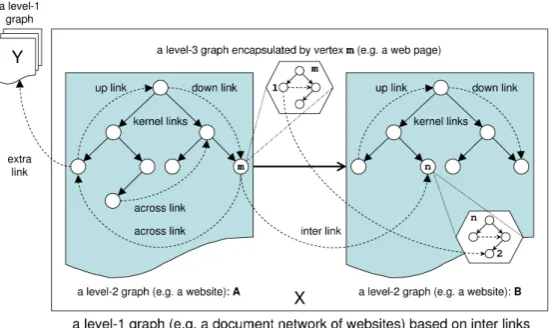
In order to analyse the characteristics of docu-ment networks, a format for uniformly represent-ing their structure is needed. In this section, we presentgeneralized treesfor this task. Generalized trees are graphs with a kernel tree-like structure – henceforth calledkernel hierarchy– superimposed by graph-forming edges as models of hyperlinks. Figure (1) illustrates this graph model. It distin-guishes three levels of structure formation:
1. According to the webgenre model of section (3),L1-graphsmap document networks and thus corpora of interlinked (web) documents.
Figure 1: The stratified model of network representation with kernel hierarchies of L2-graphs.
2. L2-graphs model the structure of web doc-uments as constituents of a given network. This structure is seen to be based on ker-nel hierarchies superimposed, amongst oth-ers, byup,downandacrosslinks (see fig. 1).
In the case of webgenre corpora, L2-graphs mo-del websites. In the case of citation networks, they map documents which consist of a scientific arti-cle and add-ons in the form of citation links. Like-wise, in the case of online newspapers, L2-graphs model articles together with content-based hyper-links. Finally, in the case of wikis, L2-graphs rep-resentwiki documentseach of which consists of a wiki article together with a corresponding discus-sion and editing page. According to the webgenre model of section (3), L2-graphs model web docu-ments which consist of nodes whose structuring is finally described by L3-graphs:
3. L3-graphs model the structure of document modules.
In the case of webgenre corpora, L3-graphs
map the DOM3-based structure of theweb pages
of the websites involved. In the case of all other networks distinguished above they represent the logical structure of single text units (e.g. the sec-tion and paragraph structuring of a lexicon, news-paper or scientific article). Note that the tree-like structure of a document module may be superim-posed by hyperlinks, too, as illustrated in figure (1) by the verticesmandn.
3I.e. DocumentObjectModel.
The kernel hierarchy of an L2-graph is consti-tuted bykernel linkswhich are distinguished from
across, up, down and outside links (Amitay et al., 2003; Eiron and McCurley, 2003; Mehler and Gleim, 2005). These types can be distinguished as follows:
• Kernel links associate dominating nodes with their immediately dominated successor nodes in terms of the kernel hierarchy.
• Down linksassociate nodes with one of their (mediately) dominated successor nodes in terms of the kernel hierarchy.
• Up links analogously associate nodes of the kernel hierarchy with one of their (mediately dominating) predecessor nodes.
• Across links associate nodes of the kernel hi-erarchy none of which is an (im-)mediate pre-decessor of the other in terms of the kernel hierarchy.
• Extra (or outside)linksassociate nodes of the kernel hierarchy with nodes of other docu-ments.
the probability to be navigated by a reader starting from the root page and following kernel links only. The kernel hierarchy of a wiki document is spanned by an article page in conjunction with the correspondingdiscussion(ortalk),historyand
edit this or view source pages which altogether form a flatly structured tree. Likewise in the case of citation networks as the CiteSeer system (Lawrence et al., 1999), a document consists of the various (e.g. PDF or PS) versions of the focal article as well as of one or more web pages mani-festing its citations by means of hyperlinks.
From the point of view of document network analysis, L2-graphs and inter links (see fig. 1) are most relevant as they span the corresponding net-work mediated by documents (e.g. websites) and modules (e.g. web pages). This allows specifying which links of which type in which network are examined in the present study:
• In the case of citation networks, citation links are modeled as interlinks as they relate (sci-entific) articles encapsulated by documents of this network type. Citation networks are ex-plored by example of the CiteSeer system: We analyze a sample of more than 550,000 articles (see table 1) – the basic population covers up to 800,000 documents.
• In the case of newspaper article networks, content-based links are explored as resources of networking. This is done by example of the 1997 volume of the German newspaper S¨uddeutsche Zeitung (see table 1). That is, firstly, nodes are given by articles where two nodes are interlinked if the corresponding ar-ticles contain see also links to each other. In the online and ePaper issue of this news-paper these links are manifested as hyper-links. Secondly, articles are linked if they appear on the same page of the same is-sue so that they belong to the same thematic field. By means of these criteria, a bipar-tite network (Watts, 2003) is built in which the top-mode is spanned by topic and page units, whereas the bottom-mode consists of text units. In such a network, two texts are in-terlinked whenever they relate to at least one common topic or appear on the same page of the same issue.
• In the case of webgenres we explore a cor-pus of 1,096 conference websites (see table
variable value
[image:5.595.346.465.97.186.2]number of web sites 1,096 number of web pages 50,943 number of hyperlinks 303,278 maximum depth 23 maximum width 1,035 average size 46 average width 38 average height 2
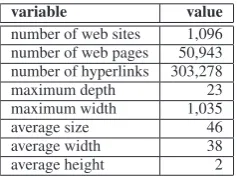
Table 2: A corpus of conference and workshop websites (counting unit: web pages).
1 and 2) henceforth called indogram
cor-pus.4 We analyze the out degrees of all web
pages of these websites and thus explore ker-nel, up, down, across, inter and outside links on the level of L2-graphs. This is done in order to get abase linefor our comparative study, since WWW-based networks are well known for their small world behavior. More specifically, this relates to estimations of the exponentγof power laws fitted to their de-gree distributions (Newman, 2003).
• These three networks are explored in
or-der to comparatively study networking in Wikipedia which is analyzed by example of
its German release de.wikipedia.org
(see table 1). Because of the rich system of its node and link types (see section 4.2) we ex-plore three variants thereof. Further, in order to get a more reliable picture of wiki-based structure formation, we also analyze wikis in the area of technical documentation. This is done by example of three wikis on open source projects of the Apache Software
Foun-dation (cf.wiki.apache.org).
In the following section, the extraction of Wiki-pedia-based networks is explained in more detail.
4.2 Graph Extraction – the Case of Wiki-based Document Networks
In the following section we analyze the network spanned by document modules of the German Wikipedia and their inter links.5 This cannot
sim-ply be done by extracting all its article pages. The reason is that Wikipedia documents consist
4See http://ariadne.coli.uni-bielefeld. de/indogram/resources.htmlfor the list of URLs of the documents involved.
network network genre node |V| |E|
de.wikipedia.org electronic encyclopedia wiki unit
variant I (e.g. article or talk) 303,999 5,895,615
variant II 406,074 6,449,906
variant III 796,454 9,161,706
[image:6.595.102.498.97.210.2]wiki.apache.org/jakarta online technical documentation wiki unit 916 21,835 wiki.apache.org/struts online technical documentation wiki unit 1,358 40,650 wiki.apache.org/ws online technical documentation wiki unit 1,042 23,871 citeseer.ist.psu.edu digital library open archive record 575,326 5,366,832 indogram conference websites genre web page 50,943 303,278 S¨uddeutsche Zeitung 1997 press communication newspaper article 87,944 2,179,544
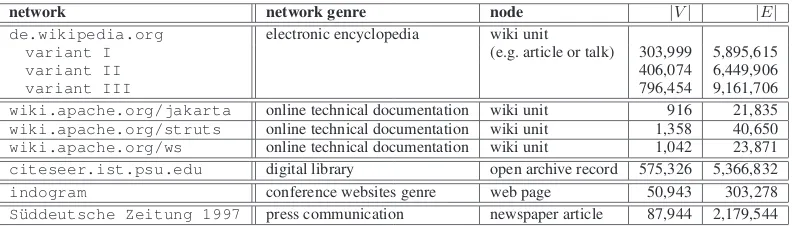
Table 1: The document networks analyzed and the sizes|V|and|E|of their vertex and edge sets.
of modules (manifested by pages) of various types which are likewise connected by links of differ-ent types. Consequdiffer-ently, the choice of instances of these types has to be carefully considered.
Table (3) lists the node types (and their fre-quencies) as found in the wiki or additionally in-troduced into the study in order to organize the type system into a hierarchy. One heuristic for extracting instances of node types relates to the URL of the corresponding page. Category, por-tal and media wiki pages, for example, contain the
prefixKategorie,PortalandMediaWiki,
respectively, separated by a colon from its page
name suffix (as in http://de.wikipedia.
org/wiki/Kategorie:Musik).
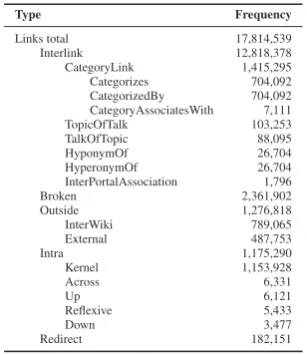
Analogously, table (4) lists the edge types ei-ther found within the wiki or additionally intro-duced into the study. Of special interest are redi-rectnodes and links which manifest transitive and, thus, mediate links of content-based units. An arti-cle nodevmay be linked, for example, with a redi-rect noderwhich in turn redirects to an articlew. In this case, the document network contains two edges(v, r),(r, w)which have to be resolved to a single edge(v, w)if redirects are to be excluded in accordance with what the MediaWiki system does when processing them.
Based on these considerations, we compute net-work characteristics of three extractions of the German Wikipedia (see table 1): Variant I con-sists of a graph whose vertex set contains all Ar-ticle nodes and whose edge set is based on In-terlinks and appropriately resolvedRedirectlinks.
Variant II enlarges variant I by including other content-related wiki units, i.e.ArticleTalk,Portal,
PortalTalk, and Disambiguation pages (multiply typed nodes were excluded). Variant IIIconsists of a graph whose vertex set covers all vertices and edges found in the extraction.
Type Frequency
Documents total 796,454 Article 303,999 RedirectNode 190,193 Talk 115,314 ArticleTalk 78,224 UserTalk 30,924 ImageTalk 2,379 WikipediaTalk 1,380 CategoryTalk 1,272 TemplateTalk 705 PortalTalk 339 MediaWikiTalk 64 HelpTalk 27 Image 97,402 User 32,150 Disambiguation 22,768 Category 21,999 Template 6,794 Wikipedia 3,435 MediaWiki 1,575 Portal 791
[image:6.595.348.464.245.424.2]Help 34
Table 3: The system of node types and their fre-quencies within the German Wikipedia.
4.3 Network Analysis
Based on the input networks described in the pre-vious section we compute the SW coefficients de-scribed in section (2). Average geodesic distan-ces are computed by means of the Dijkstra algo-rithm based on samples of 1,000 vertices of the input networks (or the whole vertex set if it is of minor cardinality). Power law fittings were com-puted based on the modelP(x) =ax−γ+b. Note
Type Frequency
Links total 17,814,539 Interlink 12,818,378 CategoryLink 1,415,295 Categorizes 704,092 CategorizedBy 704,092 CategoryAssociatesWith 7,111 TopicOfTalk 103,253 TalkOfTopic 88,095 HyponymOf 26,704 HyperonymOf 26,704 InterPortalAssociation 1,796 Broken 2,361,902 Outside 1,276,818 InterWiki 789,065 External 487,753 Intra 1,175,290 Kernel 1,153,928 Across 6,331
Up 6,121
Reflexive 5,433
Down 3,477
[image:7.595.116.270.97.275.2]Redirect 182,151
Table 4: The system of link types and their fre-quencies within the German Wikipedia.
andcited bylinks. Finally, in the case of the news-paper article network, this is due to the fact that it is based on a bipartite graph (see above). Note that the indogramcorpus consists of predomi-nantly unrelated websites and thus does not allow computing cluster and distance coefficients.
5 Discussion
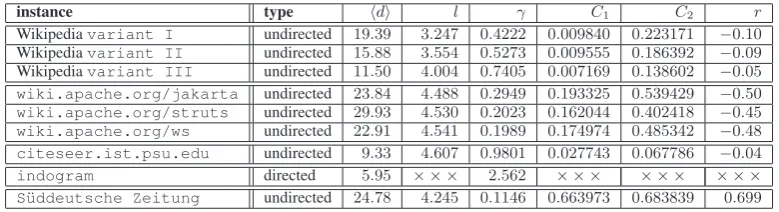
The numerical results in table (5) are remarkable as they allow identifying three types of networks:
• On the one hand, we observe the extreme
case of theS¨uddeutsche Zeitung, that
is, of the newspaper article network. It is the only network which, at the same time, has very high cluster values, short geodesic dis-tancesanda high degree of assortative mix-ing. Thus, its values support the assertion that it behaves as a small world in the sense of the model of Watts & Strogatz. The only excep-tion is the remarkably low γ value, where, according to the model of Barab´asi & Al-bert (1999), a higher value was expected.
• On the other hand, the CiteSeer sample is the reverse case: It has very low values ofC1and
C2, tends to show neither assortative, nor dis-assortative mixing, and at the same time has a lowγvalue. The small cluster values can be explained by the low probability with which two authors cited by a focal article are related by a citation relation on their own.6
6Although articles can be expected which cite, for
exam-• The third group is given by the wiki-based networks: They tend to have higherC1and
C2values than the citation network does, but
also tend to show stochastic mixing and short geodesic distances. The cluster values are confirmed by the wikis of technical docu-mentation (also w.r.t their numerical order). Thus, these wikis tend to be small worlds ac-cording to the model of Watts & Strogatz, but also prove disassortative mixing – compa-rable to technical networksbut in departure from social networks. Consequently, they are ranked in-between the citation and the news-paper article network.
All these networks show rather short geodesic distances. Thus,lseems to be inappropriate with respect to distinguishing them in terms of SW characteristics. Further, all these examples show remarkably low values of theγcoefficient. In con-trast to this, power laws as fitted in the analyses reported by Newman (2003) tend to have much higher exponents – Newman reports on values which range between 1.4 and 3.0. This result is only realized by theindogramcorpus of confer-ence websites, thus, by a sample of WWW docu-ments whose out degree distribution is fitted by a power law with exponentγ= 2.562.
These findings support the view that compared to WWW-based networks wiki systems behave more like “traditional” networks of textual units,
but are new in the sense that their topology nei-ther approximates the one of citation networks nor of content-based networks of newspaper articles. In other words: As intertextual relations are genre sensitive (e.g. citations in scientific communica-tion vs. content-based relacommunica-tions in press commu-nication vs. hyperlinks in online encyclopedias), networks based on such relations seem to inherit this genre sensitivity. That is, for varying genres (e.g. of scientific, technical or press communica-tion) differences in topological characteristics of their instance networks are expected. The study presents results in support of this view of the genre sensitivity of text-based networks.
6 Conclusion
We presented a comparative study of document networks based on small world characteristics.
instance type hdi l γ C1 C2 r Wikipediavariant I undirected 19.39 3.247 0.4222 0.009840 0.223171 −0.10
Wikipediavariant II undirected 15.88 3.554 0.5273 0.009555 0.186392 −0.09
Wikipediavariant III undirected 11.50 4.004 0.7405 0.007169 0.138602 −0.05
wiki.apache.org/jakarta undirected 23.84 4.488 0.2949 0.193325 0.539429 −0.50
wiki.apache.org/struts undirected 29.93 4.530 0.2023 0.162044 0.402418 −0.45
wiki.apache.org/ws undirected 22.91 4.541 0.1989 0.174974 0.485342 −0.48
citeseer.ist.psu.edu undirected 9.33 4.607 0.9801 0.027743 0.067786 −0.04
indogram directed 5.95 × × × 2.562 × × × × × × × × ×
[image:8.595.104.494.97.203.2]S¨uddeutsche Zeitung undirected 24.78 4.245 0.1146 0.663973 0.683839 0.699
Table 5: Numerical values of SW-related coefficients of structure formation in complex networks: the average numberhdiof edges per node, the mean geodesic distancel, the exponentγof successfully fitted power laws, the cluster valuesC1, C2and the coefficientrof assortative mixing.
According to our findings, three classes of net-works were distinguished. This classification sep-arates wiki-based systems from more traditional text networks but also from WWW-based web-genres. Thus, the study provides evidence that there exist genre specific characteristics of text-based networks. This raises the question for mod-els of network growth which better account for these findings. Future work aims at elaborating such a model.
References
Lada A. Adamic. 1999. The small world of web. In Serge Abiteboul and Anne-Marie Vercoustre, edi-tors,Research and Advanced Technology for Digital Libraries, pages 443–452. Springer, Berlin.
Einat Amitay, David Carmel, Adam Darlow, Ronny Lempel, and Aya Soffer. 2003. The connectivity sonar: detecting site functionality by structural pat-terns. InProc. of the 14th ACM conference on Hy-pertext and Hypermedia, pages 38–47.
Albert-L´aszl´o Barab´asi and R´eka Albert. 1999. Emer-gence of scaling in random networks. Science, 286:509–512.
Douglas Biber. 1995. Dimensions of Register Varia-tion: A Cross-Linguistic Comparison. Cambridge University Press, Cambridge.
B´ela Bollob´as. 1985. Random Graphs. Academic Press, London.
Nadav Eiron and Kevin S. McCurley. 2003. Untan-gling compound documents on the web. In Proceed-ings of the 14th ACM conference on Hypertext and Hypermedia, Nottingham, UK, pages 85–94.
Ramon Ferrer i Cancho and Ricard V. Sol´e. 2001. The small-world of human language.Proceedings of the Royal Society of London. Series B, Biological Sci-ences, 268(1482):2261–2265, November.
Jussi Karlgren and Douglass Cutting. 1994. Recogniz-ing text genres with simple metrics usRecogniz-ing discrimi-nant analysis. InProc. of COLING ’94, volume II, pages 1071–1075, Kyoto, Japan.
Steve Lawrence, C. Lee Giles, and Kurt Bollacker. 1999. Digital libraries and Autonomous Citation In-dexing.IEEE Computer, 32(6):67–71.
Alexander Mehler and R¨udiger Gleim. 2005. The net for the graphs — towards webgenre representation for corpus linguistic studies. In Marco Baroni and Silvia Bernardini, editors,WaCky! Working papers on the Web as corpus. Gedit, Bologna, Italy.
Stanley Milgram. 1967. The small-world problem. Psychology Today, 2:60–67.
George A. Miller and Walter G. Charles. 1991. Con-textual correlates of semantic similarity. Language and Cognitive Processes, 6(1):1–28.
Mark E. J. Newman and Juyong Park. 2003. Why so-cial networks are different from other types of net-works.Physical Review E, 68:036122.
Mark E. J. Newman. 2003. The structure and function of complex networks.SIAM Review, 45:167–256.
Richard Power, Donia Scott, and Nadjet Bouayad-Agha. 2003. Document structure. Computational Linguistics, 29(2):211–260.
Mark Steyvers and Josh Tenenbaum. 2005. The large-scale structure of semantic networks: Statisti-cal analyses and a model of semantic growth. Cog-nitive Science, 29(1):41–78.
Duncan J. Watts and Steven H. Strogatz. 1998. Collec-tive dynamics of ‘small-world’ networks. Nature, 393:440–442.
Duncan J. Watts. 2003. Six Degrees. The Science of a Connected Age. Norton & Company, New York.