Separating Surface Order and Syntactic R e l a t i o n s
in a D e p e n d e n c y G r a m m a r
N o r b e r t B r S k e r
Universit/it S t u t t g a r t A z e n b e r g s t r . 12 D-70174 S t u t t g a r t
NOBI (@ IMS. UNI-STUTTGART. DE
A b s t r a c t
This paper proposes decoupling the dependency tree fl'om word order, such that surface ordering is not determined by traversing the dependency tree. We develop the notion of a word order do- main structure, which is linked but structurally dissimilar to the syntactic dependency tree. The proposal results in a lexicalized, declarative, and formally precise description of word order; fea- tures which lack previous proposals for depen- dency grammars. Contrary to other lexicalized approaches to word order, our proposal does not require lexical ambiguities for ordering alterna- tives.
1 I n t r o d u c t i o n
Recently, the concept of valency has gained con-
siderable attention. Not only do all linguis-
tic theories refer to some reformulation of the traditional notion of valency (in the form of 0- grid, subcategorization list, argument list, or ex- tended domain of locality); there is a growing number of parsers based on binary relations be- tween words (Eisner, 1997; Maruyama, 1990).
Given this interest in the valency concept, and the fact that word order is one of the main difference between phrase-structure based approaches (henceforth PSG) and dependency grammar (DG), it is valid to ask whether DG can capture word order phenomena without re- course to phrasal nodes, traces, slashed cate- gories, etc. A very early result on the weak generative equivalence of context-free grammars and DGs suggested that DGs are incapable of describing surface word order (Gaifman, 1965). This result has recently been critizised to apply only to impoverished DGs which do not properly represent formally the expressivity of contempo- rary DG variants (Neuhaus &; BrSker, 1997).
Our position will be that dependency re- lations are motivated semantically (Tesni~re, 1959), and need not be projective (i.e., may cross if projected onto the surface ordering). We argue for so-called word order domains, consist- ing of partially ordered sets of words and associ- ated with nodes in the dependency tree. These order domains constitute a tree defined by set in- clusion, and surface word order is determined by traversing this tree. A syntactic analysis there- for consists of two linked, but dissimilar trees.
Sec. 2 will briefly review approaches to word order in DG. In Sec. 3, word order domains will be defined, and Sec. 4 introduces a modal logic to describe dependency structures. Sec. 5 ap- plies our approach to the German clause and Sec. 6 relates it to some PSG approaches.
2 W o r d O r d e r in D G
A very brief characterization of DO is that it recognizes only lexical, not phrasal nodes, which are linked by directed, typed, binary rela- tions to form a dependency tree (TesniOre, 1959; Hudson, 1993). The following overview of DG flavors shows that various mechanisms (global rules, general graphs, procedural means) are generally employed to lift the limitation of pro- jectivity and discusses some shortcomings of these proposals.
F u n c t i o n a l G e n e r a t i v e D e s c r i p t i o n (Sgall et al., 1986) assumes a language-independent
we argue for a repro.sentational account of word order (based on valid structures representing word order), eschewing the non-determinism in- troduced by unary operators; the second differ- ence is the avoidance of an underlying structure, which stratifies the theory and makes incremen- tal processing difficult.
M e a n i n g - T e x t T h e o r y (Melc'hk, 1988) as- sumes seven .strata of representation. The rules mapping from the unordered dependency trees of surface-syntactic i'el)resentations onto the all- n o t a t e d lexeme sequen(:es of deet)-nmrl)hoh@eal
representations include global ordering rules
which allow disesmtinuities. These rules have
not yet, been formally specitied (Melc'hk & Pertsov, 19871). 187f).
W o r d G r a m m a r (WG, ttudson ( 1 9 9 0 ) ) i s based on geueral graphs instead of trees. Tile ordering of two linked words is specified together with their dependency relation, its ill the t)rot)o - sition " o b j e c t of verb follows it". Extra(:- lion of, e.g,, objects is analyzed 1)3' establish-
lug an additional del)en(lency (:ailed visitor
l)etween the wu'b and tim extractee, which re- (luires the reverse or(ler, as ill " v i s i t o r of
v e r b p r e c e d e s it". This results in inconsis-
tencies, since an exti'acted object must follow
tile verb (being its o b j e c t ) and at the same tinle precede it (being its v i s i t o r ) . The al)proach (:onlproufises tile semantic nlotiw~tion of depen-
dencies by adding p,arely order-induced depen-
dencies. W G is similar to our proposal in that it also distinguishes a t)ropositional nw, ta language de.scribing the graph-based analysis structures.
D e p e n d e n c y U n i f i c a t i o n G r a m m a r
(DUG, Hellwig (1986)) defines a tree-like
d a t a structure for the representation of syntac-
tic analyses. Using mortfllosyntactic ligatures
with special interpretations, a word defines
abstract positions into whicll modifiers are
mapped. Partial orderings and even discon-
tinuities (:all thus be described by allowing a nlodifier to occupy a position defined by some transitive head. The approach requires that the parser interpretes several features specially, and it cannot restrict the s(:ope of discontinuities.
S l o t G r a m m a r (McCord, 1990) e m p l o y s a
number of rule types, sOille of which are ex- clusively con(:erned with precedence. So-called h e a d / s l o t and slot/slot ordering rules des(:rilm
the Inecedence in projective trees, referring to arbitrm'y predicates over head and modifiers. Extractions (i.e., discontinuities) are merely handled by a mechanism built into the parser.
3 W o r d O r d e r D o m a i n s
Summarizing the previous discussion, we require the following of a word order description for D O :
,, not to colnpromise the semantic motivation of dependencies,
• to be able to restrict discontinuities to cer- tain constructions and delimit their scope,
• to be lexicalized without requiring lexical ambiguities for the representation of order- ing alternatives,
• to be declarative (i.e., independent of an analysis procedure), and
• to be formally l)recise and consistent.
The subsequent definition of an order domain structure and its linking to the delmndeney tree satisif:y these requirements.
3 . 1 T h e O r d e r D o m a i n S t r u c t u r e
A word order domain is a set of words, general- izing the notion of positions in DUG. The cardi- nality of an order domain may be restricted to at most one elenlent, at least one element, or
1)y (:onjun(:tion to exactly one element. Each
word is associated with a se(tuence of order do- mains, one of wlfieh must contain the word itself, and each of these donmins may require that its elements have certain features. Order domains can be partially ordered based on set inclusion: If an order domain d contains word w (which is not associated with d), ew'.ry word w' con- t a i n e d in a d o m a i n d' associated with w is also contained in d; therefor, d' C d for each d' asso- ciated with w. This partial ordering induces a
tree on order (tomains, which we call the order domain structure.
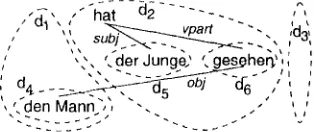
. - , , - & - t - - . . . 7
,' dl ',{ ~ vpart " ' ' . ' '
, ,, s u b j ' ~ . ~ _ ~ . ' , [d3;
,' , ' . '. d e r J u n g e . ' '. g e s o h e n ) ,, , , d ¢ . - ~ _ . _ ~ u 6 , ' '
, '. d e n M a n n , - . - ~ '
Figure 1: Dependency Tree and Order Domains
for
"Den Mann hat der Junge gesehen"
dl d2
d,4 hat d 5 46 ,
Mann Junge gesehen
d3
Figure 2: Order Domain Structure for
"Den
Mann hat der Junge geschen"
and
"Junge"
and the participle"gesehcn"
eachdefine one order domain
(d4,ds,d6,
resp.). Setinclusion gives rise to the domain structure in Fig.2, where the individual words are attached by clashed lines to their including domains (dl and d4 collapse, being identical). 1
3.2 S u r f a c e O r d e r i n g
How is the sm'face order derived fl'om an or- der domain structure? First of all, the ordering of domains is inherited by their respective ele- ments, i.e.,
"Mann"
precedes (any element of)d2, "hat"
follows (any element of) dl, etc.Ordering within a domain, e.g., of
"hat"
and d6, or d5 and d6, is based on precedence pred- icates (adapting the precedence predicates of WG). There are two different types, one order- ing a word w.r.t, any other element of the do- main it is associated with (e.g.,"hat"
w.r.t, d6), and another ordering two modifiers, referring to the d e p e n d e n c y relations they occupy (ds and d6, referring to subj and v p a r t ) . A verb like"hat"
introduces two precedence predicates, re-quiring other words to follow itself and the par- ticiple to follow subject and object, resp.: 2
" h a t " ~
( < . A ( v p a r t ) > { s u b j , o b j } )1Note that in this case, we have not a single rooted tree, but rather an ordered sequence of trees (by virtue of ordering dl, d2, and d3) ms domain structure. In gen- eral, we assume the sentence period to govern the finite verb and to introduce a single domain for the complete sentence.
2For details of the notation, please refer to Sec. 4.
Informally, the first conjunct is satisfied by any domain in which no word precedes
"hat",
and the second conjunct is satisfied by any do- main in which no subject or object follows a participle. The domain structure in Fig.2 satis- fies these restrictions since nothing follows the participle, and because "denMann"
is not an el- ement old2, which contains"hat".
This is an im- p o r t a n t interaction of order domains and prece- dence predicates: Order domains define scopes for precedence predicates. In this way, we take into account that dependency trees are flatter than PS-based ones a and avoid the formal in- consistencies noted above for WC.3.3 Linking D o m a i n S t r u c t u r e a n d
D e p e n d e n c y T r e e
Order domains easily extend to discontinuous dependencies. Consider the non-projective tree
in Fig.1. Assuming that the finite verb gov-
erns the t)articiple, no projective d e p e n d e n c y between the object "den
Mann"
and the partici-ple
"gesehen"
can be established. We allow non-projectivity by loosening the linking between de- p e n d e n c y tree and domain structure: A modi- tier (e.g., "Mann") m a y not only be inserted into a domain associated with its direct head
("gese-
hen"),
but also into a domain of a transitive head("hat"),
which we will call thepositional head.
The possibility of inserting a word into a do- main of some transitive head raises the ques~ tions of how to require contiguity (as needed in most cases), and how to limit the distance between the governor and the modifier in the case of discontinuity. From a descriptive view- point, the
syntactic construction
is often cited to determine the possibility and scope of disconti- nuities (Bhatt, 1990; Matthcws, 1981). In PS- based accounts, the construction is represented by phrasal categories, and extraction is lira- ited by bounding nodes (e:g., Haegeman (1994), Becker et al. (1991)). In dependency-based ac- counts, the construction is represented by the dependency relation, which is t y p e d or labelled to indicate constructional distinctions which are configurationally defined in PSG. Given this cor- respondence, it is natural to employ dependen- cies in the description of discontiImities as fol- [image:3.612.107.264.45.111.2]lows: For each modifi(:r of a certain head, a set (>f dependency types is defined wfiieh may link tim direct head and the positional head of the modifier ("gesehen" and "hat", resp.). If this set is; empty, b o t h he.ads are identical and a con- tiguous a t t a c h m e n t restflts. The inll)Ossil)ility of extra(:tion from, e.g., a finite verb phrase may follow fi'Olll the fact that the dcI)endency embed- ding finite verbs, propo, may not appear on any path between a direct and a positional head. 4
4 T h e D e s c r i p t i o n L a n g u a g e
This section sketches a logical language describ- ing the det)enden(:y structure. It is based (m modal logic and owes much to work of Blacklmrn (1994). As he argues, standard Kripke models can 1o(,. regarded as directed graphs with node annotations. We will use this interpr('tation to represent detmndeney strllctm'es. Dep(uMen(:ies and the mat)i)ing from (tel)endency trec to order domain structure are described by nlodal opera- tots, while simple properties such as word (:lass, features, and cardinality of order domains are des(:ril)ed })y modal In'Oi)t>sitions.
4.1 M o d e l S t r u c t u r e s
In the following, we assume a set of words, W, ordered 1)y a precede.nee relation, -<, a set of dependency tyl)eS, 20, a set (>f atomic feature
values A, and a set of word classes, C. We
define a family of dependen(:y re.lalions R.d C
]42 x 142, d eft "D and for (:()nveni(ulee al)l>reviate the union Ud~> Rd as 1~9.
D e f : A det)endency tree is a tv, plc
(W, Wr,/~.~o, VA, Vc>, where .l~n f o r m s a tree over ]42 rooted in "wr, VA : 142 ~ 2 .4 m a p s words to • ~ets offeat'urc.s, and Vc : I/V ~ C m a p s words to w o r ' d cla,~aes.
D e f t An order domain (over W) rn is a ~set of
words f r o m W ,where V~IJI,'W2,'W 3 C W : (W 1 -< 'w2 -< wa A 'Wl ~ m A 'wa ~ ?n.) =)> w2 C m.
De:f: An order domain structure (over W) 3.4
is a .set oJ" order d o m a i n s where V m , m ' ~ . A d :
m r ~ m ' = (~ V m c m ' V m ' c m .
4 O i l , r e v i e w ])ointed o u t t h a t some. v e r b s m a y allow
extractions, i.e., t h a t t h i s r e s t r i c t i o n is lexical, n o t uni- versal. T h i s fact c a n easily 1)e a c c o m o d a t e d b e c a u s e tit(, possil)ility of d i s c o n t i m l i t y ( a n d t h e d e p e n d e n c y tyl)es across whi(:h t h e m o d i f i e r m a y b e e x t r a c t e d ) is d e s c r i b e d in t h e lexical e n t r y of t h e verb. In fact, a u n i v e r s a l re- strictiol~ c o u l d n o t (!Veil l)(} st,~tted })QC~tltS(} t h e t r e a t m e n t is c o m p l e t e l y lexicalized.
D e f t A dependency structure T is a
tv, ple ( g , w , , R > , VA~ Ve , 3.4, VM > where
042, w,., R.D, VA, Vc> is a d e p e n d e n c y tree, M
is a , order d o m a i n ,str,tct'ure over W , and
Vz4 : I/V ~÷ 3.4 '~ m a p s words to order" d o m a i n sequences.
Additionally, we require for a dependency str~mture four more conditions: (1) Each word w is contained in exactly one of the domains fi'om VM(w), (2) all domains ill V ~ (w) are pairwise disjoint, (3) each word (except w,.)is contained in at least two domains, one of which is associ- ated with a (transitive) head, and (4) the (par- tial) orde.ring of domains (as described by I/'M) is (:onsistent with the precedence of the words contained in the donlains (see (BrSker, 1997) for more details).
4.2 T h e L a n g u a g e /2-1)
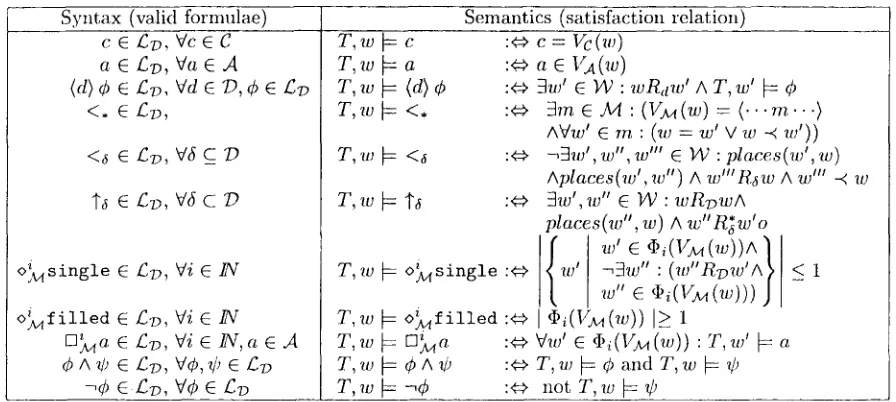
Fig.3
defines the logical language L;r~ used to describe dependency structures. Although they haw~ been presented difl'erently, they can eas- ily be rewritten as (multimodal) Kripke models: q'h(: dell,lid,hey relal;ion H,d is l'epresenl;e(t as modality (d) and tile Inapping fl'oln a word to its ith order domain as modality 0~4.5 All other formulae denote properties of nodes, and tail beformulated as unary predicates nlost evident
for word (:lass and feature assigmnent. For the I)recedence predicates < , and <a, there are ii> verses > , and >a. For presentation, the relation
places C W x 142 has be.en inlroduced, which
holds between two words iff the first argument is the positional h(:ad of the second argument.
A more elaborate definition of d e p e n d e n c y structures and L;~ defines two more dimensions, a feature graph m a p p e d off' the d e p e n d e n c y tree much like the proposal of Blackburn (1994), and a conceptual representation based on termino~ logical logic, linking content words with refer- (;nee objects and dependencies with conceptual roles.
5 T h e G e r m a n C l a u s e
"IYaditionally, the G e r m a n main clause is de- scribed using three topological fields; the ini- tim and middle fields are separated by the fi- nite (auxiliary) verb, and the middle and the
Syntax (valid formulae)
c 6 £ v , VcEC T,
a E £ ~ ) , V a 6 A T,
(d)¢ E £ v , Vd e ~9,¢ E z:;v T,
<. E £ v , T,
<~ E £ v , V5 C iD T,
?a E £~, V6 C /9 T,
o~4single E £ v , Vi E ~V
o ~ f i l l e d E £z~, Vi E ~V E]~a E £ v , V i E W , a e A ¢ A ~ E £7), Vq~,t/) E £/9
~0 E £ v , V¢ E £ v
Semantics (satisfaction relation)
w ~ c
w ~ a
w ~ (d> ¢w I= ta
:~, c = Vc(w) :** a c V.4(w)
:~=~ 3w' C W : wRdw' A T,w' ~ ¢ :** 3m c M : ( V ~ ( w ) = ( . . . m . . . >
A W ' C , , , : (,,, = ~ ' v w ~ w')) :¢~ -,3w', w", w"' 6 W : places(w', w)
Aplaces(w',
w") Aw'"H,~w
A w'" -< w :¢:~ 3w',w" E I/V : w R z ~ w Aplaces(w", w) A w"Rjw' o
w ' E
~}i (V34 (w))A ~
w' -~w" : (w"Rvw'A~ < 1
~," e ~ ( ~ % ( w ) ) ) J • / ( v ~ ( , , ) ) I> 1
: ~ Vw' e ~I,~(V,~ (w)) : r , w' p a
: ~ T , w D O a n d T , w ~ b
:¢* not T , w ~ ¢ T, w ~ o~4single :<0
T, w ~ @~4filled :¢~
T,w ~ ~ b a
T,w D O Av) T, w p -~¢
Figure 3: Syntax and Semantics of £ v Formulae
Vfin ~ o~(single A filled) A ~ i n i t i a l [I]
A O L (middle A norel) [2]
A o~single
A~
(final
Anorel)
[3]
A V2 ~=~ (middleA <. A D L n o r e l ) [4]
A VEnd ¢$ (middleA >,) [5]
AVI <=~ (initial A norel) [6]
Figure 4: Domain Description of finite verbs
"hat" A Vfin
[7]
A <subj}
("Junge" A~0)
[8]
A(vpart> ("gesehen" A 1"0 [9] A - ~ f i n a l A >{subj,obj} [10] A (obj} ("Mann" A ?{vpart})) [11]
Figure 5: Hierachicat Structure
final fields by infinite verb parts such as sepa- rable prefixes or participles. We will generalize this field structure to verb-initial and verb-final clauses as well, without going into the linguistic motivation due to space limits.
The formula in Fig.4 states that all finite verbs (word class V f i n C C) define three order domains, of which the first requires exactly one element with the feature i n i t i a l [1], the second allows an unspecified nmnber of elements with features m i d d l e and n o r e l 12], and the third al- lows at most one element with featm'es f i n a l and n o r e l I3]. The features i n i t i a l , m i d d l e , and f i n a l E A serve to restrict placement of certain phrases in specific fields; e.g., no reflex- ive pronouns can appear in the final field. The n o r e l 6 .4 featm'e controls placement of a rela- tive NP or PP, which may appear in the initial field only in verb-final clauses. The order types are defined as follows: In a verb-second clause (feature V2), the verb is placed at the beginning ( < . ) of the middle field (middle), and the el- ement of the initial field cannot be a relative phrase (@~4norel in [41). In a verb-final clause
(VEnd), the verb is placed at the end ( > , ) of" the middle field, with no restrictions for the initial field (relative clauses and non-relative verb-final clauses are subordinated to the noun and con- junction, resp.) [5]. in a verb-initial clause (Vl),
the verb occupies the initial field [6].
The fornmla in Fig.5 encodes the hierarchical structure from Fig. 1 and contains lexical restric- tions on placement and extraction (the surface is used to identify the word). Given this, the order type of"h, at" is determined as follows: The par.- ticiple may not be extraposed ( - f f i n a l in
[101;
a restriction from the lexical entry of "hat"), itS
must follow "hat" in d2. 2 h u , , the verb can- not be of order type VEnd, which would require it to be the last element in its domain ( > , in [51). "Mann" is not adjacent to "gesehen", but m a y be extracted across the dependency v p a r t (?{vpart} in 111]), allowing its insertion into a domain defined by "hat". It cannot precede
[image:5.612.81.529.45.246.2]6 C o m p a r i s o n t o P S G A p p r o a c h e s
One feature of word order domains is that they factor ordering alternatives fl'om the syntactic tree, much like feature annotations do for mor- phological alt(,rnatives. Other lexicalized gram- mars collapse syntactic and ordering informa- tion an(t are fbI'ced to represent ordering alterna- tives by lexical ambiguity, most notable L-TAG (Schabes et al., 1988) and some versions of CG
(Hepple, 1994). This is not necessary in our
approach, which drastically reduces the search space for parsing.
This p r o p e r t y is shared by the proposal of R e a p e (19931) to associate I t P S G signs with se- (luelices of const;itueilts, also called word or-
d(;r dolnains. Surface ordering is determined
by the s('quen(:c of constituents associated with the root node. The order domain of a mother node is the sequence :nlion of the. order domains of the. daughter nodes, which means that the relative ord(~r of elements in an order domain is retained, b u t material flom several domains may be iilterleaved, resulting in discontinuities. W h e t h e r an order domain allows interleaving with other d o m a i n s is a parameter of the con- ,~;tituent. This approach is v(::'y similar to ours in that order (hmiains separate word order fi'om the syntactic tree, but; there is one important diff(:ren(:e: Word order domains in H P S C (lo not completely free the hierarchical structure fl'oin ordering considerations, because discontin, fity is specified per phrase,, not per modifier. For ex- anlple, two projections are required for an NP, the lower one for the continuous material (de-- terminer, adjective, noun, genitival and prepo- sitional attributes) and the higher one for the possibly discontinuous relative elaus(,,. This de,- pem]ence of hierm'chic~fi structure on ordering is absent fl'om our prot)osal.
We may also compare our al)proach with the
l)rojection architecture of LFG (Kaplan & Bres- nan, 1982; Kaplan, 1995). Th(;re is a close sim- ilarit, y of the LFG projections (c-structure and f-structure) to the dimensions used here (order domain structure and dependency tree, respec- tively). C-structure and order doinains repre- se:rl; surface ordering, whereas f s t r u c t u r e and delmndency tree show the subcategorization or yah;nee requirements. W h a t is more, these pro-
jections or dimensions are linked in both ae-
~:ounts l)y an eh~unent-wise mapt)ing. The (lit-
ferenee between tile two architectures lies ill tile linkage of the projections or dimensions: LFG
maps f-structure off c-structure. In contrast, the dependency relation is taken to be prilni- tive here, and ordering restrictions are taken to be indicators or consequences of dependency re- lations (see also Br6ker (1998b, 1998a)).
7 C o n c l u s i o n
We have presented an approach to word or- der %r DG which combines traditional notions (semantically motivated dependencies, topolog- ical fields) with c o n t e m p o r a r y techniques (log- ical description language, model-theoretic se- mantics). Word order domains are sets of par- tially ordered words associated with words. A word is contained in an order domain of its head, or may float into an order domain of a transi- tive head, resulting in a discontinuous depen- dency tree while retaining a projective order domain structure. Restrictions on the floating are expressed in a lexicalized fashion in terms of dependency relations. An i m p o r t a n t benefit is that the proposal is lexicalized without reverting to lexical ambiguity to represent order variation, thus 1)rofiting even more from the efficiency con- siderations discussed by Schabes et 31. (1988).
It is not yet (:lear what the generatiw; capac- ity of such lexicalized discontilmous ])Gs is, b u t at least some index languages (such as a'~b~c '~) can be characterized. Neuhaus & Br6ker (1997) have shown that recognition and parsing of such grammars is ArT'-complete. A parser operating ()n the model structures is described in (Hahn et al., 1997).
R e f e r e n c e s
Beck(r, T., A. Joshi & O. Rainbow (1991). Long- l)istance s(:ralnbling and tree-adjoining gram- mar. in Prec. 5th Co@ of the European (]hap- tcr of the ACL, pp. 21 -26.
Bhatt, C. (1990). Dic syntaktische Struktur dcr Nominalphrase im De~ttschcn. Studien zur deutschen Grammatik 38. Tiibingen: Nan'.
Blackburn, P. (1994). Structures, Languages and
Translations: The Structural Approach to Fea- ture Logic. In C. Rupp, M. Rosner ~ R. John- son (Eds.), Constraints, Language and Compu- tation, Pt). 1 27. I,ondon: Academic Press.
Br6ker, N. (1997). Eine Dcpendenzgrammatik
Br5ker, N. (1998a). How to define a context-free backbone for DGs: An experiment in gram-
mar conversion. In Proe. of the COLING-
A CL '98 workshop "Processing of Dependency- based Grammars". Montreal/CAN, Aug 15, 1998.
BrSker, N. (1998b). A Projection Architecture for Dependency Grammar and How it Compares to LFG. In Proc. 1998 Int'l Lcxical-Functional Grammar Conference. (accepted as alternate paper) Brisbane/AUS: Jun 30-Jul 2, 1998. Eisner, J. (1997). Bilexical Grammars and a Cubic-
Time Probabilistic Parser. In Proc. of Int'l Workshop on Parsing Technologies, pp. 54-65. Boston/MA: MIT.
Gaifman, H. (1965). Dependency Systems and
Phrase Structure Systems. Information and
Control, 8:304-337.
Haegeman, L. (1994). Intwduction to Government
and Binding. Oxford/UK: Basil Blackwell. Hahn, U., P. Neuhaus ~5 N. BrSker (1997). Message-
Passing Protocols for Real-World Parsing - An Object-Oriented Model and its Preliminary Evaluation. In Proc. Int'l Workshop on Parsing Technology, pp. 101--112. Boston/MA: MIT, Sep 17-21, 1997.
Hellwig, P. (1986). Dependency Unification Gram- mar. In Proc. 11th Int'l Co~¢ on Computa- tional Linguistics, pp. 195-198.
Hepple, M. (1994). Discontinuity and the Lambek Calculus. In Proc. 15th Int'l Conf. on Compu- tational Linguistics, pp. 1235-1239. Kyoto/JP.
Hudson, R. (1990). English Word Grammar. Ox-
ford/UK: Basil Blackwell.
Hudson, R. (1993). Recent developments in depen- dency theory. In J. Jacobs, A. v. Stechow, W. Sternefeld &: T. Vennemann (Eds.), Syn- tax. Ein internationales Handbuch zeitgenSssis- citer Forschung, pp. 329-338. Berlin: Walter de Gruyter.
Kaplan, R. (1995). The formal architecture of
Lexical-Functional Grammar. In M. Dalrym- ple, R. Kaplan, J. I. Maxwell ~ A. Zae- nen (Eds.), Formal Issues in Lexical-Funetional
Grammar, pp. 7-27. Stanford University. Kaplan, R. ~ J. Bresnan (1982). Lexical-Functional
Grammar: A Formal System for Grammatical Representation. In J. Bresnan 8z R. Kaplan
(Eds.), The Mental Representation of Gram-
matical Relations, pp. 173 281. Cambridge, MA: MIT Press.
Kruijff, G.-J. v. (1997). A Basic Dependency-Based Logical Grammar. Draft Manuscript. Prague: Charles University.
Maruyama, H. (1990). Structural Disambiguation
with Constraint Propagation. In Proc. 28th
Annual Meeting of the ACL, pp. 31 38. Pitts-
burgh/PA.
Matthews, P. (1981). Syntax. Cambridge Text-
books in Linguistics, Cambridge/UK: Cam- bridge Univ. Press.
McCord, M. (1990). Slot Grammar: A System for Simpler Construction of Practical Natural Lan- guage Grammars. In R. Studer (Ed.), Natural Language and Logic, pp. 118-145. Berlin, Hei- delberg: Springer.
Melc'hk, I. (1988). Dependency Syntax: Theory and Practice. Albany/NY: State Univ. Press of New York.
Melc'hk, I. ~z N. Pertsov (1987). Surface Syntax of English: A Formal Model within the M T T Framework. Philadelphia/PA: John Benjamins. Neuhaus, P. ~ N. Br6ker (1997). The Complexity of
Recognition of Linguistically Adequate Depen-
dency Grammars. In Proe. 35th Annual Meet-
ing of the A CL and 8th Conf. of the EA CL, pp. 337-343. Madrid, July 7-12, 1997.
Reape, M. (1993). A Formal Theory of Word Order: A Case Study in West Germanic. Doctoral Dis- sertation. Univ. of Edinburg.
Schabes, Y., A. Abeille ~ A. Joshi (1988). Parsing Strategies with 'Lexicalized' Grammars: Appli- cation to TAGs. In Proc. 12th Int'l Co~¢ on
Computational Linguistics, pp. 578-583. Sgall, P., E. Hajicova 8z J. Panevova (1986). The
Meaning of the Sentence in its Semantic and Pragmatic Aspects. Dordrecht/NL: D.Reidel. TesniOre, L. (1959). Elemdnts de syntaxe strueturale.