Abstract
To support context-based multimodal interpre-tation in conversational systems, we have
devel-oped a semantics-based representation to
capture salient information from user inputs and the overall conversation. In particular, we
present three unique characteristics:
fine-grained semantic models, flexible composition of feature structures, and consistent representa-tion at multiple levels. This representarepresenta-tion allows our system to use rich contexts to resolve ambiguities, infer unspecified information, and improve multimodal alignment. As a result, our system is able to enhance understanding of mul-timodal inputs including those abbreviated, imprecise, or complex ones.
1 Introduction
Inspired by earlier works on multimodal interfaces (e.g., Bolt, 1980; Cohen el al., 1996; Wahlster, 1991; Zancanaro et al., 1997), we are currently building an intelligent infrastructure, called Responsive Informa-tion Architect (RIA) to aid users in their informa-tion-seeking process. Specifically, RIA engages users in a full-fledged multimodal conversation, where users can interact with RIA through multiple modalities (speech, text, and gesture), and RIA can act/react through automated multimedia generation (speech and graphics) (Zhou and Pan 2001). Cur-rently, RIA is embodied in a testbed, called Real
HunterTM, a real-estate application to help users find
residential properties.
As a part of this effort, we are building a
seman-tics-based multimodal interpretation framework
MIND (Multimodal Interpretation for Natural Dia-log) to identify meanings of user multimodal inputs.
Traditional multimodal interpretation has been
focused on integrating multimodal inputs together with limited consideration on the interaction context. In a conversation setting, user inputs could be abbre-viated or imprecise. Only by combining multiple inputs together often cannot reach a full understand-ing. Therefore, MIND applies rich contexts (e.g.,
conversation context and domain context) to
enhance multimodal interpretation. In support of this context-based approach, we have designed a seman-tics-based representation to capture salient informa-tion from user inputs and the overall conversainforma-tion.
In this paper, we will first give a brief overview on multimodal interpretation in MIND. Then we will
present our semantics-based representation and dis-cuss its characteristics. Finally, we will describe the use of this representation in context-based multimo-dal interpretation and demonstrate that, with this rep-resentation, MIND is able to process a variety of user inputs including those ambiguous, abbreviated and complex ones.
2 Multimodal Interpretation
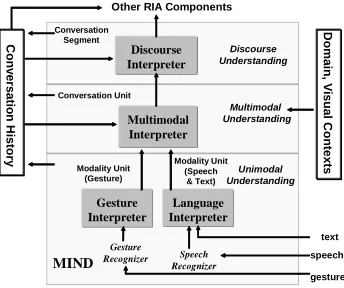
To interpret user multimodal inputs, MIND takes three major processes as in Figure 1: unimodal understanding, multimodal understanding, and dis-course understanding. During unimodal understand-ing, MIND applies modality specific recognition and understanding components (e.g., a speech recognizer and a language interpreter) to identify meanings from each unimodal input, and captures those mean-ings in a representation called modality unit. During multimodal understanding, MIND combines seman-tic meanings of unimodal inputs (i.e., modality units), and uses contexts (e.g., conversation context and domain context) to form an overall understand-ing of user multimodal inputs. Such an overall understanding is then captured in a representation called conversation unit. Furthermore, MIND also identifies how an input relates to the overall conver-sation discourse through discourse understanding. In particular, MIND uses a representation called versation segment to group together inputs that con-tribute to a same goal or sub-goal (Grosz and Sidner, 1986). The result of discourse understanding is an evolving conversation history that reflects the over-all progress of a conversation.
Figure 2 shows a conversation fragment between a
user and MIND. In the first user inputU1, the deictic
Figure 1. MIND components
gesture speech text Multimodal
Interpreter Multimodal Interpreter Discourse Interpreter
Discourse Interpreter
Language Interpreter
Language Interpreter Gesture
Interpreter Gesture Interpreter
Speech Recognizer Gesture
Recognizer
Modality Unit (Speech & Text) Modality Unit
(Gesture) Conversation Unit
Unimodal Understanding
Discourse Understanding
Multimodal Understanding
Other RIA Components
C
onv
er
sat
io
n
H
ist
o
ry
Conversation Segment
MIND
D
o
main,
V
isual
C
ontexts
Semantics-based Representation for Multimodal Interpretation in
Conversational Systems
Joyce Chai
IBM T. J. Watson Research Center 19 Skyline Drive
Hawthorne, NY 10532, USA
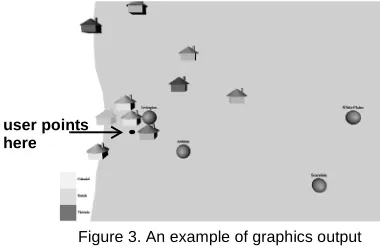
gesture (shown in Figure 3) is ambiguous. It is not clear which object the user is pointing at: two houses
nearby or the town of Irvington1. The third user input
U3 by itself is incomplete since the purpose of the
input is not specified. Furthermore, in U4, a single
deictic gesture overlaps (in terms of time) with both “this style” and “here” from the speech input, it is hard to determine which one of those two references should be aligned and fused with the gesture. Finally,
U5is also complex since multiple objects (“these two
houses”) specified in the speech input need to be uni-fied with a single deictic gesture.
This example shows that user multimodal inputs exhibit a wide range of varieties. They could be abbreviated, ambiguous or complex. Fusing inputs together often cannot reach a full understanding. To process these inputs, contexts are important.
3 Semantics-based Representation
To support context-based multimodal interpretation, both representation of user inputs and representation of contexts are crucial. Currently, MIND uses three types of contexts: domain context, conversation con-text, and visual context. The domain context provides domain knowledge. The conversation context reflects
the progress of the overall conversation. The visual context gives the detailed semantic and syntactic structures of visual objects and their relations. In this paper, we focus on representing user inputs and the conversation context. In particular, we discuss two aspects of representation: semantic models that cap-ture salient information and struccap-tures that represent those semantic models.
3.1 Semantic Models
When two people participate in a conversation, their understanding of each other’s purposes forms strong constraints on how the conversation is going to pro-ceed. Especially, in a conversation centered around information seeking, understanding each other’s information needs is crucial. Information needs can be characterized by two main aspects: motivation for seeking the information of interest and the informa-tion sought itself. Thus, MIND uses an inteninforma-tion model to capture the first aspect and an attention model to capture the second. Furthermore, since users can use different ways to specify their information of interest, MIND also uses a constraint model to cap-ture different types of constraints that are important for information seeking.
3.1.1 Intention and Attention
Intention describes the purpose of a message. In an information seeking environment, intention indicates the motivation or task related to the information of interest. An intention is modeled by three dimensions:
Motivator indicating one of the three high level
pur-poses: DataPresentation, DataAnalysis (e.g.,
compari-son), and ExceptionHandling (e.g., clarification), Act
specifying whether the input is a request or a reply,
and Method indicating a specific task, e.g., Search
(activating the relevant objects based on some
crite-ria) or Lookup (evaluating/retrieving attributes of
objects).
Attention relates to objects, relations that are salient at each point of a conversation. In an informa-tion seeking environment, it relates to the informainforma-tion sought. An attention model is characterized by six
dimensions. Base indicates the semantic type of the
information of interest (e.g., House, School, or City
which are defined in our domain ontology). Topic
specifies the granularity of the information of interest
(e.g.,InstanceorCollection).Focusidentifies the scope
of the topic as to whether it is about a particular
fea-ture (i.e., SpecficAspect) or about all main features
(i.e., MainAspect). Aspectprovides specific features of
the topic. Constraint describes constraints to be
satis-fied (described later).Contentpoints to the actual data.
The intention and attention models were derived based on preliminary studies of user information needs in seeking for residential properties. The details are described in (Chai et al., 2002).
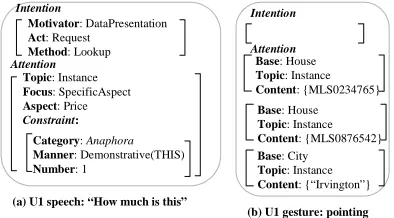
For example, Figure 4(a-b) shows theIntentionand
Attention identified from U1 speech and gesture input
respectively.Intentionin Figure 4(a) indicates the user
is requesting RIA (Act: Request) to present her some data (Motivator: DataPresentation) about attributes of
1 The generated display has multiple layers, where the house icons are on top of the Irvington town map. Thus this deictic gesture could either refer to the town of Irvington or houses.
Figure 2. A conversation fragment Speech: Here is the comparison chart.
Graphics: Show a chart
R5:
Speech: Compare these two houses with the previous house. Graphics: Point to the corner of the screen where two house icons are
displayed U5:
Speech: This is a Victorian style house. I find seven Victorian houses
in White Plains.
Graphics: Show seven houses in White Plains
R4:
Speech: Show me houses with this style around here Gesture: Point to a position east of Irvington on the map
U4:
Speech: This house costs 320,000 dollars.
Graphics: Highlight the house icon and show a picture
R3:
Speech: What about this one?
Gesture: Point to a house icon on the screen
U3:
Speech: The green house costs 250,000 dollars.
R2:
Speech: The green one.
U2:
Speech: Which house are you interested in? Graphics: Highlight two house icons
R1:
Speech: How much is this?
Gesture: Point to the screen (not directly on any object)
U1:
A collection of houses are shown on the map of Irvington
Speech: Here is the comparison chart. Graphics: Show a chart
R5:
Speech: Compare these two houses with the previous house. Graphics: Point to the corner of the screen where two house icons are
displayed U5:
Speech: This is a Victorian style house. I find seven Victorian houses
in White Plains.
Graphics: Show seven houses in White Plains
R4:
Speech: Show me houses with this style around here Gesture: Point to a position east of Irvington on the map
U4:
Speech: This house costs 320,000 dollars.
Graphics: Highlight the house icon and show a picture
R3:
Speech: What about this one?
Gesture: Point to a house icon on the screen
U3:
Speech: The green house costs 250,000 dollars.
R2:
Speech: The green one.
U2:
Speech: Which house are you interested in? Graphics: Highlight two house icons
R1:
Speech: How much is this?
Gesture: Point to the screen (not directly on any object)
U1:
A collection of houses are shown on the map of Irvington
Figure 3. An example of graphics output
certain object(s) (Method: Lookup). The Attention indi-cates that the information of interest is about the price (Aspect: Price) of a certain object (Focus: Instance). The exact object is not known but is referred by a
demon-strative “this” (inConstraint). Intention in Figure 4(b)
does not have any information since the high level purpose and the specific task cannot be identified from the gesture input. Furthermore, because of the
ambiguity of the deictic gesture, three Attentions are
identified. The first two Attentions are about house
instancesMLS0234765andMLS0876542(ID from
Mul-tiple Listing Service) and the third is about the town of Irvington.
3.1.2 Constraints
In an information seeking environment, based on the conversation context and the graphic display, users can refer to objects using different types of refer-ences, for example, through temporal or spatial rela-tions, visual cues, or simply a deictic gesture. Furthermore, users can also search for objects using different constraints on data properties. Therefore, MIND models two major types of constraints: refer-ence constraints and data constraints. Referrefer-ence con-straints characterize different types of references. Data constraints specify relations of data properties. A summary of our constraint model is shown in Figure 5. Both reference constraints and data
con-straints are characterized by six dimensions.Category
sub-categorizes constraints (described later). Manner
indicates the specific way such a constraint is
expressed. Aspect indicates a feature (features) this
constraint is concerned about. Relation specifies the
relation to be satisfied between the object of interest
and other objects or values.Anchorprovides a
particu-lar value, object or a reference point this constraint
relates to.Numberspecifies cardinal numbers that are
associated with the constraint. Reference Constraints
Reference constraints are further categorized into
four categories:Anaphora,Temporal,Visual, andSpatial.
An anaphora reference can be expressed through pro-nouns such as “it” or “them” (Pronoun), demonstra-tives such as “this” or “these” (Demonstrative), here or there (Here/There), or proper names such as “Lyn-hurst” (ProperNoun). An example is shown in Figure 4(a), where a demonstrative “this” (Manner: Demonstrative-This) is used in the utterance “this house” to refer to a single house object (Number: 1). Note that
Manner also keeps track of the specific type of the
term. The subtle difference between terms can pro-vide additional cues for resolving references. For example, the different use of “this” and “that” may indicate the recency of the referent in the user mental model of the discourse, or the closeness of the refer-ent to the user’s visual focus.
Temporal references use temporal relations to refer to entities that occurred in the prior conversation.
Manneris characterized byRelativeandAbsolute.
Rela-tiveindicates a temporal relation with respect to a
cer-tain point in a conversation, andAbsolute specifies a
temporal relation regarding to the whole interaction.
Relationindicates the temporal relations (e.g., Precede
or Succeed) or ordinal relations (e.g., first). Anchor
indicates a reference point. For example, as in
Figure 6(a), a Relative temporal constraint is used
since “the previous house” refers to the house that
pre-cedes the current focus (Anchor: Current)in the
conver-sation history. On the other hand, in the input: “the
first house you showed me,”an Absolute temporal
con-straint is used since the user is interested in the first house shown to her at the beginning of the entire con-versation.
Spatial references describe entities on the graphic
display in terms of their spatial relations. Manner is
again characterized byAbsoluteandRelative.Absolute
indicates that entities are specified through
orienta-tions (e.g., left or right, captured by Relation) with
respect to the whole display screen (Anchor:
Display-Frame). In contrast,Relativespecifies that entities are
described through orientations with respect to a par-ticular sub-frame (Anchor: FocusFrame, e.g., an area
Figure 4. Intention and Attention for U1 unimodal inputs
Motivator: DataPresentation Act: Request
Method: Lookup
(b) U1 gesture: pointing Base: House (a) U1 speech: “How much is this”
Base: House Topic: Instance Content: {MLS0876542}
Figure 5. Constraint model
Manner
Category Aspect Relation Anchor Number
Anaphora Demonstrative,
Figure 6. Temporal and visual reference constraints
Base: House
(a) “ the previous house”
with highlighted objects) or another object.
Visual references describe entities on the graphic output using visual properties (such as displaying col-ors or shapes) or visual techniques (such as
high-light).MannerofComparativeindicates a visual entity
is compared with another value (captured byAnchor).
Aspectindicates the visual entity used (such as Color
and Shape, which are defined in our domain
ontol-ogy). Relation specifies the relation to be satisfied
between the visual entity and some value. For exam-ple, constraint used in the input “the green house” is shown in Figure 6(b). It is worth mentioning that
dur-ing reference resolution, the colorGreen will be
fur-ther mapped to the internal color encoding used by graphics generation.
Data Constraints
Data constraints describe objects in terms of their
actual data attributes (Category: Attributive). The
Man-nerof Comparative indicates the constraint is about a
comparative relation between (aspects of) the desired
entities with other entities or values.Superlative
indi-cates the constraint is about minimum or maximum
requirement(s) for particular attribute(s).Fuzzy
indi-cates a fuzzy description on the attributes (e.g., “cheap house”). For example, for the input “houses
under 300,000 dollars” in Figure 7(a),Manneris
Compar-ativesince the constraint is about a “less than”
rela-tionship (Relation: Less-Than) between the price (Aspect: Price) of the desired object(s) and a particular value (Anchor: “300000 dollars”). For the input “3 largest
houses” in Figure 7(b),MannerisSuperlativesince it is
about the maximum (Relation: Max) requirement on the size of the houses (Aspect: Size).
The refined characterization of different constraints provides rich cues for MIND to identify objects of interest. In an information seeking environment, the objects sought can come from different sources. They could be entities that have been described earlier in the conversation, entities that are visible on the dis-play, or entities that have never been mentioned or seen but exist in a database. Thus, fine-grained con-straints allow MIND to determine where and how to find the information of interest. For example, tempo-ral constraints help MIND navigate the conversation history by providing guidance on where to start, which direction to follow in the conversation history, and how many to look for.
Our fine-grained semantic models of intention, attention and constraints characterize user informa-tion needs and therefore enable the system to come
up with an intelligent response. Furthermore, these models are domain independent and can be applied to any information seeking applications (for structured information).
3.1.3 Representing User Inputs
Given the semantic models of intention, attention and constraints, MIND represents those models using a combination of feature structures (Carpenter, 1992). This representation is inspired by the earlier works (Johnston et al., 1997; Johnston, 1998) and offers a flexibility to accommodate complex inputs. Specifi-cally, MIND represents intention, attention and con-straints identified from user inputs as a result of both unimodal understanding and multimodal understand-ing.
During unimodal understanding, MIND applies a decision tree based semantic parser on natural lan-guage inputs (Jelinek et al., 1994) to identify salient information. For the gesture input, MIND applies a simple geometry-based recognizer. As a result, infor-mation from each unimodal input is represented in a modality unit. We have seen several modality units (in Figure 4, Figure 6, and Figure 7), where intention, attention and constraints are represented in feature structures. Note that only features that can be instan-tiated by information from the user input are included in the feature structure. For example, since the exact
object cannot be identified fromU1speech input, the
Contentfeature is not included in itsAttentionstructure
(Figure 4a). In addition to intention, attention and constraints, a modality unit also keeps a time stamp that indicates when a particular input takes place. This time information is used for multimodal align-ment which we do not discuss here.
Depending on the complexity of user inputs, the representation can be composed by a flexible
combi-Figure 7. Attributive data constraints
Base: House Topic: Collection
Constraint: Attention
Cateogry: Attributive Manner: Comparative Aspect: Price Relation: Equals Anchor: “300000 dollars”
(a) “houses under 300,000 dollars”
Base: House Topic: Collection
Constraint: Attention
Cateogry: Attributive Manner: Superlative Aspect: Size Relation: Max Number: 3
(a) “3 largest houses”
Figure 8. Attention structures for U4
Base: House Topic: Collection
Constraint: Attention (A1)
Category: Attributeive Manner: Comparative Aspect: Style Relation: Equals Anchor: *
Topic: Instance
Constraint:
Category: Anaphora Manner: Demonstrative
(THIS) Number: 1
Attention (A2)
Category: Attributive Manner: Comparative Aspect: Location Relation: Equals Anchor: *
Base: GeoLocation Topic: Instance
Constraint:
Category: Anaphora Manner: HERE
Attention (A3) Constraint:
(a) Attention structure in the modality unit for U4 speech input
Base: House Topic: Collection
Constraint: Attention (A1)
Category: Attributeive Manner: Comparative Aspect: Style Relation: Equals Anchor: “Victorian”
Category: Attributive Manner: Comparative Aspect: Location Relation: Equals Anchor: “White Plains”
Constraint:
nation of different feature structures. Specifically, an attention structure may have a constraint structure as its feature, and on the other hand, a constraint struc-ture may also include another attention strucstruc-ture.
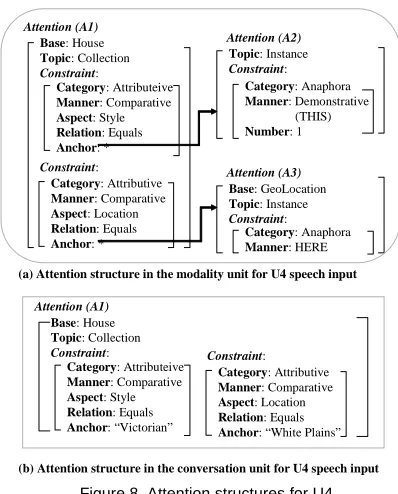
For example, U4 in Figure 2 is a complex input,
where the speech input “what about houses with this style around here” consists of multiple objects with
dif-ferent relations. The modality unit created for U4
speech input is shown in Figure 8(a). The Attention
feature structure (A1) contains two attributive con-straints indicating that the objects of interest are a collection of houses that satisfy two attributive con-straints. The first constraint is about the style (Aspect: Style), and the second is about the location. Both of these constraints are related to other objects (Manner:
Comparative), which are represented byAttention
struc-turesA2 andA3 throughAnchorrespectively.A2
indi-cates an unknown object that is referred by a
Demonstrative reference constraint (this style), and A3
indicates a geographic location object referred by HERE. Since these two references are overlapped with a single deictic gesture, it is hard to decide which one should be unified with the gesture input. We will show in Section 4.3 that the fine-grained representa-tion in Figure 8(a) allows MIND to use contexts to resolve these two references and improve alignment.
During multimodal understanding, MIND com-bines information from modality units together and generates a conversation unit that represents the over-all meaning of user multimodal inputs. A conversa-tion unit also has the same type of intenconversa-tion and attention feature structures, as well as the feature structure for data constraints. Since references are resolved during the multimodal understanding pro-cess, the reference constraints are no longer present in conversation units. For example, once two references in Figure 8(a) are resolved during multimodal under-standing (details are described in Section 4.3), and MIND identifies “this style” is “Victorian” and “here” is “White Plains”, it creates a conversation unit represent-ing the overall meanrepresent-ings of this input in Figure 8(b).
3.2 Representing Conversation Context
MIND uses a conversation history to represent the conversation context based on the goals or sub-goals of user inputs and RIA outputs. For example, in the conversation fragment mentioned earlier (Figure 2), the first user input (U1) initiates a goal of looking up the price of a particular house. Due to the ambiguous gesture input, in the next turn, RIA (R2) initiates a sub-goal of disambiguating the house of interest. This
sub-goal contributes to the goal initiated byU1. Once
the user replies with the house of interest (U2), the sub-goal is fulfilled. Then RIA gives the price
infor-mation (R2), and the goal initiated byU1is
accompol-ished. To reflect this progress, our conversation history is a hierarchical structure which consists of conversation segments and conversation units (in Figure 9). As mentioned earlier, a conversation unit
records user (rectangleU1, U2) or RIA (rectangleR1,
R2) overall meanings at a single turn in the conversa-tion. These units can be grouped together to form a
conversation segment (ovalDS1, DS2) based on their
goals and sub-goals. Furthermore, a conversation seg-ment contains not only intention and attention, but also other information such as the conversation initi-ating participant (Initiator). In addition to conversation segments and conversation units, a conversation his-tory also maintains different relations between seg-ments and between units. Details can be found in (Chai et al., 2002).
Another main characteristic of our representation is the consistent representation of intention and atten-tion across different levels. Just like modality units and conversation units, conversation segments also consist of the same type of intention and attention feature structures (as shown in Figure 9). This consis-tent representation not only supports unification based multimodal fusion, but also enables context-based inference to enhance interpretation (described later).
We have described our semantics-based representa-tion and presented three characteristics: fine-grained semantic models, flexible composition, and consis-tent representation. Next we will show that how this representation is used effectively in the multimodal interpretation process.
4 The Use of Representation in Multimodal
Interpretation
As mentioned earlier, multimodal interpretation in MIND consists of three processes: unimodal under-standing, multimodal understanding and discourse understanding. Here we focus on multimodal under-standing. The key difference between MIND and ear-lier works is the use of rich contexts to improve understanding. Specifically, multimodal understand-ing consists of two sub-processes: multimodal fusion and context-based inference. Multimodal fusion fuses intention and attention structures (from modality units) for unimodal inputs and forms a combined rep-resentation. Context-based inference uses rich
con-Figure 9. A fragment of a conversation history Motivator: DataPresentation
Act: Request Method: Lookup Intention
Base: House Topic: Instance Focus: SpecificAspect Aspect: Price Content: {MLS0234765|
MLS0876542} Attention
U1
Motivator: DataPresentation Method: Lookup Intention
Base: House Topic: Instance Focus: SpecificAspect Aspect: Price Content: {MLS0234765} Attention
DS1
R2 Initiator: User
Motivator: ExceptionHandling Method: Disambiguate Intention
Base: House Topic: Instance Content: {MLS0234765 |
MLS0876542} Attention DS1
Initiator: RIA
R1 U2
texts to improve interpretation by resolving ambiguities, deriving unspecified information, and improving alignment.
4.1 Resolving Ambiguities
User inputs could be ambiguous. For example, inU1,
the deictic gesture is not directly on a particular object. Fusing intention and attention structures from each individual inputs presents some ambiguities. For
example, in Figure 4(b), there are three Attention
structures forU1gesture input. Each of them can be
unified with the Attention structure from U1 speech
input (in Figure 4a). The result of fusion is shown in Figure 10(a). Since the reference constraint in the
speech input (Number: 1 in Figure 4a) indicates that
only one attention structure is allowed, MIND uses contexts to eliminate inconsistent structures. In this
case,A3 in Figure 10(a) indicates the information of
interest is about the price of the city Irvington. Based on the domain knowledge that the city object cannot
have the price feature,A3 is filtered out. As a result,
bothA1andA2are potential interpretation. Therefore,
the Contentin those structures are combined using a
disjunctive relation as in Figure 10(b). Based on this revised conversation unit, RIA is able to arrange the follow-up question to further disambiguate the house
of interest (R2in Figure 2). This example shows that,
modeling semantic information by fine-grained dimensions supports the use of domain knowledge in context-based inference, and can therefore resolve some ambiguities.
4.2 Deriving Unspecified Information
In a conversation setting, user inputs are often abbre-viated. Users tend to only provide new information when it is their turn to interact. Sometimes, fusing individual modalities together still cannot provide overall meanings of those inputs. For example, after
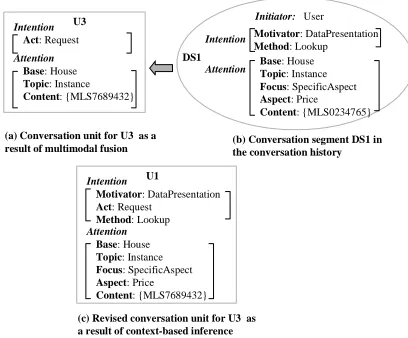
multimodal fusion, the conversation unit for U3
(“What about this one”) does not give enough informa-tion on what the user exactly wants. The motivainforma-tion and task of this input is not known as in Figure 11(a). Only based on the conversation context, is MIND able to identify the overall meaning of this input. In
this case, based on the most recent conversation seg-ment (DS1) in Figure 9 (also as in Figure 11b), MIND
is able to derive Motivator and Method features from
DS1 to update the conversation unit for U3
(Figure 11c). As a result, this revised conversation unit provides the overall meaning that the user is interested in finding out the price information about
another houseMLS7689432. Note that it is important
to maintain a hierarchical conversation history based on goals and subgoals. Without such a hierarchical structure, MIND would not be able to infer the
moti-vation ofU3. Furthermore, because of the consistent
representation of intention and attention at both the discourse level (in conversation segments) and the input level (in conversation units), MIND is able to directly use conversation context to infer unspecified information and enhance interpretation.
4.3 Improving Alignment
In a multimodal environment, users could use differ-ent ways to coordinate their speech and gesture inputs. In some cases, one reference/object men-tioned in the speech input coordinates with one
deic-tic gesture (U1,U3). In other cases, several references/
objects in the speech input are coordinated with one
deictic gesture (U4,U5). In the latter cases, only using
time stamps often cannot accurately align and fuse the respective attention structures from each modal-ity. Therefore, MIND uses contexts to improve align-ment based on our semantics-based representation.
For example, from the speech input inU4 (“show me
houses with this style around here”), threeAttention struc-tures are generated as shown in Figure 8(a). From the
gesture input, only oneAttentionstructure is generated
which corresponds to the city of White Plains. Since the gesture input overlaps with both “this style”
(corre-sponding to A2) and “here” (corresponding to A3),
there is no obvious temporal relation indicating which of these two references should be unified with
the deictic gesture. In fact, bothA2andA3are
poten-tial candidates. Based on the domain context that a
city cannot have a feature Style, MIND determines
that the deictic gesture is actually resolving the
refer-Figure 10. Resolving ambiguity for U1
Motivator: DataPresentation Act: Request
Method: Lookup
Intention
Base: House Topic: Instance Focus: SpecificAspect Aspect: Price Content:{MLS0234765}
Attention
Base: House Topic: Instance Focus: SpecificAspect Aspect: Price Content:{MLS0876542}
Base: City Topic: Instance Focus: SpecificAspect Aspect: Price Content:{“Irvington”}
Motivator: DataPresentation Act: Request
Method: Lookup
Intention
Base: House Topic: Instance Focus: SpecificAspect Aspect: Price Content:{MLS0234765 |
MLS0876542}
Attention
A1
A2
A3
(a) Conversation unit for U1 as a result of multimodal fusion
(b) Revised conversation unit for U1 as a result of context-based inference
Figure 11. Deriving unspecified information for U3
Act: Request
Intention
Base: House Topic: Instance Content: {MLS7689432}
Attention
U3
Motivator: DataPresentation Method: Lookup
Intention
Base: House Topic: Instance Focus: SpecificAspect Aspect: Price Content: {MLS0234765}
Attention
DS1
Initiator: User
(a) Conversation unit for U3 as a
result of multimodal fusion (b) Conversation segment DS1 inthe conversation history
Motivator: DataPresentation Act: Request
Method: Lookup
Intention
Base: House Topic: Instance Focus: SpecificAspect Aspect: Price Content: {MLS7689432}
Attention
U1
ence of “here”. To resolve the reference of “this style”, MIND uses the visual context which indicates a house is highlighted on the screen. A recent study (Kehler, 2000) shows that objects in the visual focus are often referred by pronouns, rather than by full noun phrases or deictic gestures. Based on this study, MIND is able to infer that most likely “this style”
refers to the style of the highlighted house
(MLS7689432). Suppose the style is “Victorian”, then MIND is able to figure out that the overall meaning
ofU4is looking for houses with a Victorian style and
located in White Plains (as shown in Figure 8b).
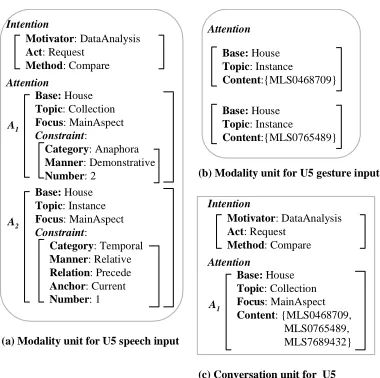
Furthermore, for U5 (“Comparing these two houses
with the previous house”), there are two Attention
struc-tures (A1 and A2) created for the speech input as in
Figure 12(a). A1 corresponds to “these two houses”,
where theNumberfeature in the reference constraint is
set 2. Although there is only one deictic gesture which points to two potential houses (Figure 12b), MIND is able to figure out that this deictic gesture is actually referring to a group of two houses rather than an ambiguous single house. Although the gesture
input inU5is the same kind as that inU1, because of
the fine-grained information captured from the
speech input (i.e.,Number feature), MIND processes
them differently. For the second reference of “previous
house” (A2 in Figure 12a), based on the information
captured in the temporal constraint, MIND searches the conversation history and finds the most recent house explored (MLS7689432). Therefore, MIND is
able to reach an overall understanding ofU5 that the
user is interested in comparing three houses (as in Figure 12c).
5 Conclusion
To facilitate multimodal interpretation in conversa-tional systems, we have developed a semantics-based representation to capture salient information from user inputs and the overall conversation. In this paper, we have presented three unique characteristics of our representation. First, our representation is based on
fine grained semantic models of intention, attention and constraints that are important in information seeking conversation. Second, our representation is composed by a flexible combination of feature struc-tures and thus supports complex user inputs. Third, our representation of intention and attention is consis-tent at different levels and therefore facilitates
con-text-based interpretation. This semantics-based
representation allows MIND to use contexts to resolve ambiguities, derive unspecified information and improve alignment. As a result, MIND is able to process a large variety of user inputs including those incomplete, ambiguous or complex ones.
6 Acknowledgement
The author would like to thank Shimei Pan and Michelle Zhou for their contributions on semantic models.
References
Bolt, R. (1980) Voice and gesture at the graphics inter-face. Computer Graphics, pages 262-270.
Carpenter, R. (1992) The logic of typed feature struc-tures. Cambridge University Press.
Chai, J.; Pan, S.; and Zhou, M. X. (2002) MIND: A Se-mantics-based multimodal interpretation framework for conversational systems. To appear in Proceedings of International CLASS Workshop on Natural, Intelli-gent and Effective Interaction in Multimodal Dialog Systems.
Cohen, P.; Johnston, M.; McGee, D.; S. Oviatt, S.; Pitt-man, J.; Smith, I.; Chen, L; and Clow, J. (1996) Quick-set: Multimodal interaction for distributed applications. Proc. ACM MM'96, pages 31-40. Grosz, B. J. and Sidner, C. (1986) Attention, intentions,
and the structure of discourse. Computational Linguis-tics, 12(3):175-204.
Jelinek, F.; Lafferty, J.; Magerman, D. M.; Mercer, R. and Roukos, S. (1994) Decision tree parsing using a hidden derivation model. Proc. Darpa Speech and Nat-ural Language Workshop.
Johnston, M.; Cohen, P. R.; McGee, D.; Oviatt, S. L.; Pittman, J. A.; and Smith, I. (1997) Unification based multimodal integration. Proc. 35th ACL, pages 281-288.
Johnston, M. (1998) Unification-based multimodal pars-ing. Proc. COLING-ACL'98.
Kehler, A. (2000) Cognitive status and form of reference in multimodal human-computer interaction. Proc. AAAI’01, pages 685–689.
Wahlster, W. (1998) User and discourse models for mul-timodal communication. In M. Maybury and W. Wahl-ster, editors, Intelligent User Interfaces, pages 359-370.
Zancanaro, M.; Stock, O.; and Strapparava, C. (1997) Multimodal interaction for information access: Ex-ploiting cohesion. Computational Intelligence, 13(4):439-464.
Zhou, M. X. and Pan, S. (2001) Automated authoring of coherent multimedia discourse for conversation sys-tems. Proc. ACM MM’01, pages 555–559.
Figure 12. Improving alignment for U5
Motivator: DataAnalysis Act: Request Method: Compare
Intention
Base: House Topic: Collection Focus: MainAspect
Constraint: Attention
Base: House Topic: Instance Content:{MLS0765489}
Attention
A1
(a) Modality unit for U5 speech input
(b) Modality unit for U5 gesture input Category: Anaphora
Manner: Demonstrative Number: 2 Base: House Topic: Instance Focus: MainAspect
Constraint: A2
Category: Temporal Manner: Relative Relation: Precede Anchor: Current Number: 1
Base: House Topic: Instance Content:{MLS0468709}
Motivator: DataAnalysis Act: Request Method: Compare
Intention
Base: House Topic: Collection Focus: MainAspect Content: {MLS0468709,
MLS0765489, MLS7689432}
Attention
A1