Coreference Annotation Scheme and Relation Types for Hindi
Vandan Mujadia, Palash Gupta, Dipti Misra Sharma
FC Kohli Center on Intelligent Systems (KCIS), IIIT-H, India [email protected], [email protected], [email protected]Abstract
This paper describes a coreference annotation scheme, coreference annotation specific issues and their solutions through our proposed annotation scheme for Hindi. We introduce different co-reference relation types between continuous mentions of the same coreference chain such as ‘Part-of’, ‘Function-value pair’ etc. We used Jaccard similarity based Krippendorff‘s’ alpha to demonstrate consistency in annotation scheme, annotation and corpora. To ease the coreference annotation process, we built a semi-automatic Coreference Annotation Tool (CAT). We also provide statistics of coreference annotation on Hindi Dependency Treebank (HDTB).
Keywords:Hindi, Coreference, Annotation Scheme
1. Introduction
There has been considerable research for coreference annotation on various languages (English(Hovy et al., 2006), French(Mitkov et al., 2000), Spanish(Recasens et al., 2007), Czech(Nedoluzhko et al., 2013), etc), on diverse domains like newspaper texts, bio-medical journals, etc. Coreference annotation is a time consuming, challenging and an expensive task. To overcome these challenges, various coreference an-notation tools have been developed like CorefDraw (Harabagiu et al., 2001), GATE (Cunningham et al., 2002), PALinkA (Orasan and Sb, 2000), MMAX2 (Müller and Strube, 2001) and BART (Versley et al., 2008). All these provide text based visualization for annotation. Also there has been considerable work on coreference type relations, like, (Recasens et al., 2010) presented a typology of Near-Identity Relations and motivated the need for a middle ground category be-tween identity and non-identity in the coreference task.
For Indian languages, co-referentially annotated corpora are few in numbers and mostly for Hindi. As stated in (Dakwale et al., 2012), most schemes which are meant to be for English are not applicable for Indian languages due to their free word order. (Dak-wale et al., 2012) presents an anaphora annotation scheme and applied it on Hindi Dependency Treebank for limited set of pronominal categories, particularly for concrete anaphors. (Dakwale et al., 2012) used key-value pair attributes on anaphor chunk-head to represent its referent(s). Compared to English coref-erence annotation (and its representation), very little work has been done on Indian languages. This paper tries to fill that gap by describing our coreference annotation scheme for Indian Languages with Hindi examples. We also discuss issues related to coreference annotation specific to Hindi such as distribution of markable span, level of annotation, concept of chain, type relation between mentions(referential entities), full and partial membership of mentions in a chain, multi-chain membership of mentions in chains and their representation in SSF(Bharati et al., 2007).
We point out several issues in the earlier annotation schemes and describe a consistent solution to those issues. Co-referentially annotated corpora were, traditionally, not annotated to capture the degree of relations between the referential entities. Our scheme also includes the degree of relation between continuous referential entities of the same chain into different relation types. This includes rela-tions such as ‘Part-of’, ‘Instance-of’, ‘Function-value pair’etc. These relation types would help various ap-plications like question-answering, summarization,etc.
The structure of the paper is as follows. Section 2 describes possible co-referential expressions in Hindi. Section 3 describes annotation scheme and design is-sues and their solutions. While in sections 4, 5, 6 we discuss relation types between mentions, inter an-notator agreement study and coreference annotation tool(CAT) respectively. Section 7 describe the statis-tics of coreference annotated corpora (Hindi depen-dency treebank). We conclude the paper in section 8.
2.
Coreference in Hindi
Lexical cref creHead acrefmod acrefmodHead crefmod crefType ChainHead
मोहालीMohali - - m1%1 मोहालीMohali:m1 - -
-का‘s′ - - -
-मोहनMohan i1%1:t1 मोहनMohan:i1 - - m1 i1:t1
एकone i2%0:t1 - - -
-अच्छाnice i2%0:t1 - - -
-लड़काboy i2%1:t1 लड़काboy:i2 - - noun-noun:i1
है ।is.
वहHe i3%1:t1 वहHe:i3 - - - anaphora-C:i2
मुंबई मेंin_Mumbai
रहता है ।live+PRES
मोहनMohan i4%1:t1 मोहनMohan:i4 - - - noun-noun:i1
आजtoday
हैदराबादHyderabad
आया है ।came_.
Table 1: Coreference annotation for Example (1)
(1) मोहाली का
Mohali’s मोहनMohan एकone अच्छाnice लड़काboy हैis ।. वहHe मुंबई में
in_mumbai
रहता है live+PRES
। .
मोहन Mohan
आज today हैदराबाद
Hyderabad आया हैcame ।.
’Mohali‘s Mohan is nice boy. He lives in Mumbai. Mohan came to Hyderabad today.’
(sentential discourse) rather than only verb as referen-tial element.
3. Annotation Scheme
This section describes our annotation scheme and compares it with (Dakwale et al., 2012) and MUC1 schemes.
Our coreference annotation scheme includes all-together 7 fields. They are cref : This field represents the unique index for a mention, the unique index for a chain to which a mention belongs and the textual span of a mention [template- MentionId%(0/1):chainId],
crefHead : This field represents the linguistic head of a mention, acrefmod : This field specifies the unique index for a modifier and its textual span, crefmod : This field is used to link a mention and its modi-fier with the unique modimodi-fier index, crefmodHead : This field represents the linguistic head of a modi-fier, crefType : This field specifies the type relation between mentions of the same chain, and crefChain-Head : This field is used to mark the head mention of the chain.
Table (1) demonstrates a use-case of above mention
1htt p: //www.nl pir.nist.gov/related_pro jects/muc/
proceedings/co_task.html
fields using example (1). We can see in table (1) that mention indices i1, i2, i3, i4 in ‘cref’ tag are assigned to mentions मोहनMohan, एक अच्छा लड़का one−nice−boy,
वहhe and मोहनMohan respectively. Unique chain index
‘t1’ is assigned to each mention(reference of the same concept). Mentions’ textual span is specified within ‘cref’ tag by either %0 and %1(indicate end of men-tion) value. ‘crefHead’ indicates the linguistic head for a mention. Here at लड़काboy, crefType=‘noun-noun’
indicates that the mention एक अच्छा लड़काone−nice−boy
has a ‘noun-noun’ relation with a mention मोहनmohan
(coreference type relations have been discussed in next section). ‘acrefmod’ and ‘crefmod’ are used to in-dicate the link between the mention and its modi-fier, the unique index in this case is ‘m1’. crefChain-Head=‘i1:t1’ is assigned onमोहनmohan, which indicates
that i1 is the head mention of the ‘t1’ chain. Dis-continuous parts of the same referential entity (single unit) captured by marking %0 and %1 with the unique mention index in ‘cref’ field.
We point out the gist of coreference annotation schemes ((Dakwale et al., 2012), MUC2[1]) and theirs weaknesses, observed by us. We overcome those limi-tations in our scheme.
1. Our annotation scheme accommodates coreference while (Dakwale et al., 2012)‘s scheme is only able to represent anaphors and their referents.
2. Our scheme operates on lexicals to include refer-ential mentions which are may be smaller or larger than chunk/phrase while (Dakwale et al., 2012)‘s’ scheme operates on chunks.
4. Our scheme uses indeies to represent chains while in (Dakwale et al., 2012) and MUC4[1] schemes, We can only partially derive coreference chains with some difficulties.
5. A mention cannot be a multi-chain member in both schemes ((Dakwale et al., 2012) and MUC5[1].
6. In both schemes ((Dakwale et al., 2012) and MUC6[1] there is no provision to represent par-tial or full membership of a mention in chains.
From the example (1) (table -3), We can see that the issues mentioned above and the ones pointed out in (Dakwale et al., 2012) can resolved by our sug-gested scheme. ‘Markable span identification’ (point 2.) and ‘Distributed mention(Dakwale et al., 2012)’ issues can be solved by annotating coreference on each lexical of markable (see example (1), एक अच्छा लड़काone−nice−boy). Issue ‘Multiple Non-continuous
ref-erents’ listed in (Dakwale et al., 2012) also can be solve by the flag value (0/1) used after % symbol in ‘cref’ tag, which indicates end of the lexical textual span of a mention. We can see from example (1) ( table (3)) that we are capturing chain notion (points 4.-5.) by unique index (t) in cref field. We used ‘crefType’ field to capture the type relations between mentions (points 3.-6.).
4.
Coreference relations
To capture the degree of relations between referen-tial entities, we mark relations between the continuous mentions of the same chain. We divided relations into following broader classes. They are anaphoric rela-tions, strong identity relarela-tions, near identity relations and weak identity relations. All-together we catego-rize these relations into 21 sub-categories. Anaphoric relations include concrete, abstract, temporal rela-tions whilestrong identity relationsinclude the ex-act lexical match between mentions. Near identity relations include syntactic behavior between men-tions like, noun-complement, apposition, abbreviation, etc. In weak identity relations we include rela-tions like part-of where one mention partially refers to other mention. For example, मुंबई पु लसmumbai−police
and पु लसpolice, it is clear thatमुंबई पु लसmumbai−policeis
not referring to wholeपु लसpolicebut refers to sub-part
of it. This deep taxonomy of relation is quite useful for question-answering and summarization alike tasks. Inferred and function-value relations are also part of weak identity relations. Following subsections explain all coreference relation types one-by-one in detail.
(2) [ भाजपा नेता]i BJP_leader
[ अपने]i
his.POSS fieryउगर् तेवरtemper मेंin कुछ
anything
नहीं कहना चाहते थे । not_want_to_say+Past
BJP leader did not want to say anything in his fiery temper.
4.1. Anaphora relations :
4.1.1. Anaphora-C :
When pronominal mention has an individual or a con-crete entity referent, for that we decided to mark ”Anaphora-C” relation (C stands for Concrete) be-tween those two mentions. If pronominal mention has another pronominal mention as a referent, then also we mark ’Anaphora-C’ as a relation between those two pronominal mentions.
In above example (2), a pronominal mentionअपनेhis is
referring to concrete entityभाजपा नेताBJP_leader.
There-fore, pronoun अपनेhishas a ’Anaphora-C’ relation with
भाजपा नेताBJP_leader.
4.1.2. Anaphora-RC :
This relation is similar to ‘Anaphora-C’ relation with only directional difference between a pronoun and its referent. i.e., first expression (here pronominal men-tion), that later co-refers with a more specific, second expression (referent mention) in the discourse. It is also known as a cataphora relation where the pronoun precedes its reference. Here ‘RC’ in ‘Anaphora-RC’ stands for Reverse Concrete.
4.1.3. Anaphora-E :
When pronominal mention has an abstract/event en-tity as a referent, then we decided to mark it as ”Anaphora-E” relation (E stands for Event) between two mentions. If a pronominal mention has another pronoun as referent then, also we mark ’Anaphora-E’ as relation between those two pronominal mentions.
(3) [ ओरलैंडो इंटरनेशनल एयरपोटर्
Orlando_International_Airport देश - िवदेश क
national_and_international.GEN करीब साठ एयरलाइंस से
around_sixty_airlines
जुड़ा हआ है ।]i being+link+pre. [ इसके]i
other-then_this other-thanअलावा शहर मेंcity_in बस , टैक्सी और टर्ेन के
bus_texi_and_train‘s
अच्छे जंक्शन good_station
है । be+pre
(Orlando International Airport is being link with around 60 national-international airlines)i.
Other-then this, city has good junctions for bus, taxi and train.
In above example (3), a pronoun इसकेotherthen_this
which is referring to abstract entity in previous sen-tence. Therefore, pronominal mention इसकेotherthen_this
has an ’Anaphora-E’ relation with last sentential event.
4.1.4. Anaphora-RE :
4.1.5. Anaphora-T :
When a pronoun refers to time or time refer-ring/representing an event or a clause in given dis-course, for that we decided to mark ”Anaphora-T” relation (T stands for Temporal) between those two mentions. Also, if pronominal mention has an an-other pronoun as a referent, then also, we decided to mark ’Anaphora-T’ as a relation between those two pronouns.
(4) [ मुझसे i.Ablative
पूछा िक ask+that
आप you.SP
िकसका whose
नाम name लेना चाहेंगी ,]i
like_to_take,
[ तब]i
then i.NOMमैंने अपनाi.POS नामname लया ।
take+past.
(When i was asked that whose name you would like to take)i, theni I took my name
In above example (4), pronoun तबthen is referring to
time referring verb of previous sentence therefore a pronoun तबthenhas an ’Anaphora-T’ relation with its
previous sentence.
4.1.6. Anaphora-others :
Apart from above discussed pronominal reference types, in text there can be pronouns for which either no reference is specified or they do not have any ref-erence. Like indefinite pronoun refers to something that is not definite or specific or exact. Indefinite pro-nouns include quantifiers (some, any, enough, several, many, much); universals (all, both, every, each); and partitives (any, anyone, anybody, either, neither, no, nobody, some, someone). Many of the indefinite pro-nouns can function as determiners. In Hindiकोईsomeone,
इतनाthis_much and कुछsome are indefinite pronouns. In
Hindi कुछsome is used to indicate a portion or
quan-tity of some enquan-tity. It is also use to indicate unspeci-fied quantity of countable entities and unspeciunspeci-fied por-tion of uncountable entities. The indefinite pronoun कोईsomeone used to indicate the absence of a portion or
quantity of some entity. This indefinite pronouns are marked with ’Anaphora-others’ relation.
4.2. Strong Identity relation :
In this strong identity relation, we decided to mark only exact match (same lexicals/strings) and partial match (matched with entity head) mentions under ‘strong identity relation’ as they refer to same real world entity with same lexical patterns.
4.2.1. Coreference-Identity :
This only relation comes under strong Identity re-lation where two mentions have same lexical pat-tern and same mention head which are identi-cal to each other. For example, सिचन रमेश तेंदुलकरSachin_Ramesh_Tendulker and सिचनSachin ,सिचन रमेश
तेंदुलकरSachin_Ramesh_Tendulker and तेंदुलकरTendulker ,राजग
सरकारRa jag_govermentandसरकारGovermentare pairs of
men-tions which are identical to each other on referential as
well as lexical bases but राजग सरकारRa jag_goverment and
यूपीए सरकारU PA_goverment, राजग सरकारRa jag_goverment and
राजगRa jag are certainly not.
4.3. Near Identity relations :
In these type of relations, two referents are represent-ing same discourse entity although they may have dif-ferent lexical pattern and also they can be in syntac-tic constructions. We divided this type into mainly 6 sub-types, base on their significance. Those types are discussed in following subsections.
4.3.1. Coreference-Apposition :
Apposition is a grammatical construction in which two mentions (a noun or noun phrase) are occurred sub-sequently, where one is serving to identify the other. Coreference-Apposition relation occurs when there is a proper noun and followed by its description, which also has an independent capability to replace previous proper noun for further reference in discourse. The mention pair having this property are said to be in ap-position relation and we decided to mark this relation type between them. i.e. ,सिचन तेंदुलकर, एक महान ख-लाड़ी है.(Sachin Tendulker is one of the greatest player.) In this example सिचन तेंदुलकरSachin_Tendulker is also
ex-plained asएक महान खलाड़ीone_o f_the_gretast_player, hence
एक महान खलाड़ीone_o f_the_gretast_player is in apposition
relation withसिचन तेंदुलकरSachin_Tendulker.
(5) [ जयेंदर् सरस्वती]i Jayandra_Saraswati
, , कांची कामकोिट पीठ के
Kanchi_Kamakoti_unioun_of [शंकराचायर् ने]i
Shankaracharya.ACC वातार् के ज रयेthrough_talk अयोध्या मसला
Ayadhya_issue
सुलझाने क resolve
िदशा में towards
एक बार िफर once_again मदद क
help पेशकश क है ।offer
Jayendra Saraswati, Shankaracharya of Kanchi Kamakoti union once again offers help to resolve the Ayodhya issue through talks.
In above example (5), mention जयेंदर् सरस्वती
Jayandra_Saraswati is a proper noun and is followed
by कांची कामकोिट पीठ के शंकराचायर् (Shankaracharya of Kanchi Kamakoti union). So according to our definition, जयेंदर् सरस्वती Jayandra_Saraswati has
’Coreference-Apposition’ relation with कांची कामकोिट पीठ के शंकराचायर् (Shankaracharya of Kanchi Kamakoti union).
4.3.2. Coreference-NounComplement :
apposition relation. A designation followed by a proper noun phrase make the Coreference-NounComplement relation. This relation is most commonly observed re-lation in Hindi dependency treebank .
(6) [ पूवर् सलामी ब ेबाज
former_opening_batsman ]i
[ रमीज का]i
Rameez board_inबोडर् में सीईओCEO रहते हए
being
टीवी TV
कमेंटरी करने
doing+commentary क काफ़ आलोचना हो रही थी ।
criticize+past+cont.
Former opener, Rameez was heavily criticized for doing TV commentary while being a CEO in the board.
In above example (6), two mentions, पूवर् सलामी ब ेबाजf ormer_opener and रमीजRameez are placed side by
side and first noun sequence is showing designation for the second one. Therefore, mentionरमीजRameez has
a ’Coreference-NounComplement’ relation withपूवर् स-लामी ब ेबाजf ormer_opener.
4.3.3. Coreference-Abbreviation :
Like previous relation types, this relation type does not have linguistic significant but sentential construction for this type is very frequent in text. This relation type is used to show the relation between shortened form of a noun sequence and a noun sequence. Usually, shortened form consists of a letter or group of letters taken from the initial of individual words of a noun sequence. Specially for Hindi, where there can be two types of abbreviation, 1) noun sequence is in romanize Devanagari and it is abbreviated from their initials. 2) noun sequence is in Devanagari and its initials are taken in abbreviated form.
(7) रलायंस ने Reliance
अपनी गैस own_gas
[ नेशनल थमर्ल पॉवर प्लांट]i national_thermal_plant
( ( [ एनटीपीसी]i
NTPC ) )
को बेची । sell+past
Reliance sold its gas to (National Thermal Power Plant)i( NTPCi ) .
In above example (7), नेशनल थमर्ल पॉवर प्लांटnational_thermal_plant is in romanized
Devana-gari and there individual word‘s initials are taken for abbreviation. So एनटीपीसीNT PC has a relation
’Coreference-Abbreviation’ with नेशनल थमर्ल पॉवर प्लांटnational_thermal_plant noun sequences.
4.3.4. Coreference-RAbbreviation :
Like Coreference-RAbbreviation relation-type, this relation-type has same significant with only directional difference between mention and its referent. As ’R’ in-dicates the reverse direction.
4.3.5. Coreference-Noun-Noun :
This relation is applicable when none of the syntactic (above mentioned), semantic (mentioned in next sub-section) relations between two mentions are applicable, and still they are referring to a same discourse entity. So this relation has a significance when there are no other relation are applicable between two mentions.
(8) घटना क सूचना
Incident‘s_information’
[ पर्बंधक]i manager
[
सुबोदीप चकर्वतीर् को]i
Subodeep_Chakraborty.DAT give+pastदी । [ पर्बंधक ने]i
Manager
पु लस को police.DAT
इस घटना से this_incident अवगत कराया ।
inform+past
Information about incident was given to Manageri (Subodeep Chakraborty)i. Manageri
informed police about the incident.
In above example (8), three mentions (with i in-dex) are in referring to same entity, where last men-tionपर्बंधकmanager is referring to second mentionसुबोदीप
चकर्वतीर्Subodeep_Chakraborty. There is no syntactic
link-age between mentionपर्बंधकmanager and mentionसुबोदीप
चकर्वतीर्Subodeep_Chakrabortythus, mentionपर्बंधकmanagerhas
’Coreference-Noun-Noun’ relation with mention सुबो-दीप चकर्वतीर्Subodeep_Chakraborty.
4.3.6. Coreference-Noun-Verb :
This relation ‘Coreference-Noun-Verb’ is applicable when from two mentions, one mention is of a noun sequence and it is referring to an event (noun-verb se-quence) in discourse. In this situation, we decided to mark ‘Coreference-Noun-Verb’ between these two men-tions.
4.4. Weak Identity relations :
In this sub type of relation, we capture those relations in which, mentions are related to each other by var-ious semantic notions. Conceptually, we can relate them through various word-net relations, though lexi-cally they are not identical to each other but concep-tually they are related to each other. These relations are mainly useful in question-answering kind of appli-cations.
4.4.1. Coreference-PartOf :
(9) [ राजस्थान में]i Rajasthan+loc
आंधी से storm
[ उत्री िहस्से में]i northern_part+loc पेड़
trees उखड़ गएuproot+past ।.
Tree uprooted by the storm in the northern part of Rajasthan.
In above example (9), mentionउत्री िहस्सेnorthern_part is
part ofराजस्थानRa jasthan. It is not referring to whole
en-tity but only some part. In this case the noun sequence उत्री िहस्सेnorthern_part has a ‘Coreference-PartOf’
rela-tion type with राजस्थानRa jasthan.
4.4.2. Coreference-RPartOf :
RpartOf relation is similar to Coreference-PartOf with only directional difference. Like Coreference-PartOf, this is also a relation between two mentions, where in mention sequence, the first men-tion is subset of second menmen-tion or we can say that first mention is physically or conceptually part of sec-ond mention.
(10) [ भारत]i India औरand
[ पािकस्तान के]j Pakistan बीच बढ़ते संबंध का असर
impact_of_the_growing_ties
कश्मीर के Kashmir.GEN िकचन में भी
kitchen_in देखा जा रहा है ।see+PP. लोगPeople इसेthis [ दोन देश के]i,j
two_countries
बीच बढ़ते रश्ते के growing_relationship प रणाम के
result asप में देख रहे हैं ।see+pres+cont.
The impact of the growing ties between India and Pakistan, is seen in the kitchen of Kashmir. People are seeing it as a result of growing rela-tionship between two countries .
In example (10), दोन देशtwo_countriesis bigger set while
भारतIndia andपािकस्तानPakistan are part/smaller set of it,
thus दोन देशtwo_countries has a ’Coreference-RPartOf’
relation with bothभारतIndia andपािकस्तानPakistan.
(11) [ आम]i
Mango खाने के बादeat+cont._after उसनेhe+NOM [
गुठली को]i kernel+DAT
फेंक िदया । throw+past
After eating mangoi, he threw kerneli.
4.4.3. Coreference-Inferred :
This Inferred relation thoroughly based on different lexical and semantic relation between mentions. This lexical and semantic relation (Coreference-Inferred) includes synonymous, Hyponymy and Hypernymy, Meronymy and Holonymy (Part-whole relation), En-tailment, Troponymy, Antonymy. This relation occurs when an mention can be inferred or derived from its
predecessor mentions. For example, वाहनvehicle, गाड़ीcar
both can be inferred from each other, because they share the same synset.
In example (11), गुठलीkernel has wordnet relation with
आमmango. Thus they link each other with
‘Coreference-Inferred’ relation.
4.4.4. Coreference-Function-Value :
In a sentence, function or variable is a notation that specifies places, where the substitution of certain quan-tifiable value, may take place. This notion is related to a placeholder (a symbol that will later has some value), or a character that stands for an specified function. It is also somewhere related to copula, but here we are accounting only those functions which are capable to holding only quantifiable values. Here for example, it can be anything likeसंख्याnumber,तापमानtemperature,कर्मांक rank andगुणmark, etc.
(12) [ िवमान संख्या]i Flight_number
[ आईसी - ८०३ के]i IC-803‘s
कैप्टन ने
caption.ACC िबना समय गंवाएwithout_time_weasting िवमान को
aircraft.DAT वापसback िद ी क तरफto_Delhi.LOC मोड़ िदया ।turn+past
(Flight Number)i (IC - 503)i‘s’ caption turned
the aircraft back to Delhi without losing time .
In above example (12), mention आईसी - ८०३IC−803 is not at all a reference ofिवमान संख्याFlight_numberbut they
shared some attributes. That is, one is the function and other describes the value that the function can take. Soआईसी - ८०३IC−803 has relation ’Coreference-Function-Value’ with िवमान संख्याFlight_number.
5. Inter-Annotator Study
Coreference annotation is defined as a process of lan-guage corpora annotation, to indicate which textual expression have been used to co-specify the same en-tity in the discourse. When such an annotated corpora are collected from different coders, the reliability of the annotated data has to be quantified. Many times due to annotator‘s preferences, they do prejudice annotation, to standardize annotation process these types of errors have to be quantified. For coreference annotation, we used various reliability metrics to quantify the annotation scheme and annotation. As mention in (Passonneau, 2004), Krippendorff’s alpha (Krippendorff, 2012) is a better metric for calculating agreement for co-reference annotation as compared to other metrics. Because it considers degree of disagreement and can be apply for more than two annotators. Similar to (Dakwale et al., 2012) as explained in (Passonneau, 2004), we also consider coreference chain as discrete categories.
Equation (Figure 1) demonstrate the Kripandorff‘s al-pha, Where PDo is probability of observed
disagree-Figure 1: Kripandoff alpha
ments. For r coding units and m coders, the equa-tion calculates the agreement among the annotators by summing disagreement coefficient within and across the annotators. For every pair of values b and c (for sets),δbc is the distance between the values. nbiis the
number of times the value b occurred in ith unit. In nominal scales δ = 0 when b = c (equivalent sets); otherwiseδ = 1 (different sets). Theδ value in above equation is depends upon comparison of two sets. As described in (Passonneau, 2004) the relation be-tween two sets can be describe in four different ways i.e, identity, subscription, intersection and disjunc-tions and their δ values are, 0 for identity, 0.33 for subsumption, .67 for intersection and 1 for disjunc-tions. As discussed in (Artstein and Poesio, 2008), the assignment of δvalue mislead the agreement, because it is not able to capture the length of sets (cardinality of sets). i.e. for the same sets discussed in (Passon-neau, 2004), {C, H, J, K} and {C, H} has subsumption relation and {C, H, J, K} and {C} also has subsump-tion relasubsump-tion so according to (Passonneau, 2004), one needs to give 0.33δvalue. These two sets {C, H} and {C} have 2 and 1 elements respectively, and this differ-ence in sets cannot be captured here. Therefore we use
Jaccard index also known as the Jaccard similarity coefficient , for comparing the similarity anddiversity of sample sets, to capture this difference as mention in (Artstein and Poesio, 2008). The Jaccard coefficient measures similarity between finite sample sets, and is defined as the size of the intersection divided by the size of the union of the sample sets (Jaccard equation - Figure 2). We use new δdefine as follow:
δ=
0, foridentity
0.33∗J, forsubsumption
0.67∗J, forintersection
1∗J, fordis junctions
(1)
With the mentioned annotation scheme, we measured the inter annotator agreement score on 6̃0 coreference annotated documents with 3 annotators on Krippen-dorff‘s alpha with Jaccard similarity index. We cal-culated agreement score on two different set of docu-ments (60 each) with same annotators and got aver-age agreement score around 8̃7 % on 1400 co-refereeing mentions.
As the Hindi dependency treebank has several layers of annotation from part-of-speech to Karaka based de-pendency(Begum et al., 2008) and on the top of that annotators annotated coreference relations, links and span of mentions. Annotators can refer these layered information throw annotation tool (CAT). All these detail information tuned corpora tends to lead us on relatively higher agreement score.
Figure 2: Jaccard Index
6. Coreference Annotation Tool
(CAT)
We built coreference annotation tool (CAT) to help and automate the complex process of coreference an-notation. This web based tool has functionality to identify annotation errors and provide an assistance to annotators. Other annotation functionality like semi-automatic annotation, textual representation are implemented after concerning with the annotators. CAT mainly deals with 3 aspects of Coreference an-notation 1)Mention identification 2)Initial feed
sets/chains generator 3) Automatic mention
and chain head identification.
6.1. Mention identification :
We use automatic mention identifier tool7and config-ure it in this coreference annotation tool (CAT). From where annotators can guide them self in mention se-lection or directly add those mentions in further anno-tation process.
6.2. Initial feed chain generation :
On extracted mentions, CAT also provide an option to generate initial coreference chains/sets base on several string match, named dictionary and dependency rela-tions (optional) base rules. This is up to annotators to use this facility or not because sometimes some of the rules generate noisy chains. In this kind of tedious annotation, annotators sometimes make mistakes. i.e wrong coreference chain selection for a given mention. We try to tackle these kind of issues by using derived dictionary (from dbpedia) and dependency based rules in CAT. These rules give alert to annotators on doubt-able annotations. These warning messages can be ig-nored. Although annotators can edit tool generated automatic annotation for smooth working.
6.3. Head Selection :
As Hindi is a head final language (Benmamoun et al., 2009), linguistic head of a noun sequence/mention is mostly the last word and, main verb for the event (verb-noun sequence) mention. We built automatic mention head identifier based on that observation. We also observed that for a coreference chain, its head/governing element lies in its first mention thus we also added an automatic chain head marking facil-ity to CAT. Annotators can always edit/update/delete automated annotation to correct the annotation pro-cess.
7. Annotated Data
Around 9000 sentences of Hindi dependency tree-bank(Begum et al., 2008) have been annotated with coreference and their relations with our described an-notation scheme. During these process CAT was used by annotators for assistance.
Hindi Dep. TreeBank Size
# Documents 600
# Sentences 9000
# Tokens 90000
Table 2: Corpus detail
Mention Type occurrences
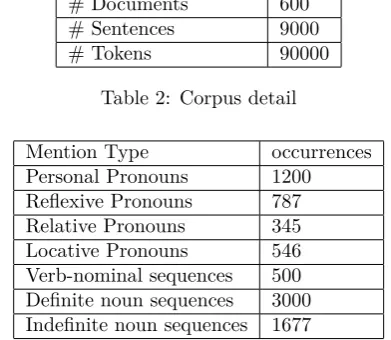
Personal Pronouns 1200 Reflexive Pronouns 787 Relative Pronouns 345 Locative Pronouns 546 Verb-nominal sequences 500 Definite noun sequences 3000 Indefinite noun sequences 1677
Table 3: Distribution of co-referential entities
The annotation task was carried out on 600 news text documents of treebank. Table (2) shows the corpus statistics while table (3) shows the distribution of co-referential entities across the corpus.
8. Conclusion and future work
In this paper, we described a scheme for coreference annotation and applied to the Hindi Dependency Tree-bank. In future this scheme can be validated for other languages especially Indian languages. The main con-tribution of this work is to define and discuss different types of co-referential relations between the referen-tial entities to account the need of applications like question-answering, summarization, sentiment analy-sis, etc. The inter annotator agreement shows that proposed scheme performs consistently well.9. Bibliographical References
Artstein, R. and Poesio, M. (2008). Inter-coderagree-ment for computational linguistics. Computational Linguistics, 34(4):555–596.
Begum, R., Husain, S., Dhwaj, A., Sharma, D. M., Bai, L., and Sangal, R. (2008). Dependency annotation scheme for indian languages. InIJCNLP, pages 721– 726. Citeseer.
Benmamoun, E., Bhatia, A., and Polinsky, M. (2009). Closest conjunct agreement in head final languages. Linguistic variation yearbook, 9(1):67–88.
Bharati, A., Sangal, R., and Sharma, D. M. (2007). Ssf: Shakti standard format guide. Language Tech-nologies Research Centre, International Institute of Information Technology, Hyderabad, India, pages 1– 25.
Cunningham, H., Maynard, D., Bontcheva, K., and Tablan, V. (2002). A framework and graphical de-velopment environment for robust nlp tools and ap-plications. InACL, pages 168–175.
Dakwale, P., Sharma, H., and Sharma, D. M. (2012). Anaphora annotation in hindi dependency treebank. In Proceedings of the 26th Pacific Asia Conference on Language, Information, and Computation, pages 391–400.
Harabagiu, S. M., Bunescu, R. C., and Maiorano, S. J. (2001). Text and knowledge mining for coreference resolution. In Proceedings of the second meeting of the North American Chapter of the Association for Computational Linguistics on Language technolo-gies, pages 1–8. Association for Computational Lin-guistics.
Hovy, E., Marcus, M., Palmer, M., Ramshaw, L., and Weischedel, R. (2006). Ontonotes: the 90% solu-tion. InProceedings of the human language technol-ogy conference of the NAACL, Companion Volume: Short Papers, pages 57–60. Association for Compu-tational Linguistics.
Krippendorff, K. (2012). Content analysis: An intro-duction to its methodology. Sage.
Mitkov, R., Evans, R., Orasan, C., Barbu, C., Jones, L., and Sotirova, V. (2000). Coreference and anaphora: developing annotating tools, annotated resources and annotation strategies. In Proceedings of the Discourse, Anaphora and Reference Resolu-tion Conference (DAARC2000), pages 49–58. Cite-seer.
Müller, C. and Strube, M. (2001). Annotating anaphoric and bridging relations with mmax. In Proceedings of the Second SIGdial Workshop on Dis-course and Dialogue-Volume 16, pages 1–6. Associ-ation for ComputAssoci-ational Linguistics.
Nedoluzhko, A., Mírovskỳ, J., and Novák, M. (2013). A coreferentially annotated corpus and anaphora resolution for czech. In Computational Linguistics and Intellectual Technologies. Papers from the An-nual International Conference” Dialogue.
Orasan, C. and Sb, W. W. (2000). Clinka a corefer-ential links annotator.
Passonneau, R. (2004). Computing reliability for coreference annotation.
Recasens, M., Marti, M. A., and Taulé, M. (2007). Where anaphora and coreference meet. annotation in the spanish cess-ece corpus. In Proceedings of RANLP. Citeseer.
Recasens, M., Hovy, E. H., and Martí, M. A. (2010). A typology of near-identity relations for coreference (nident). InLREC.